How to Build a Quick Commerce App? Benefits, Process & Cost Guide

By Shravan Rajpurohit
December 5, 2025
Summary:
This blog explains how quick commerce works and why it’s becoming the preferred way to deliver essentials within minutes. It covers dark stores, business models, benefits, AI’s role, and a complete step-by-step guide to building a Q-commerce app. You’ll also find cost insights, key challenges, and future trends to help you plan, launch, or scale a quick commerce business in 2026 and beyond.
Quick commerce has shifted from a “nice-to-have” option to something people now expect. The promise is simple: groceries, essentials, and small daily items delivered to your doorstep in minutes. And surprisingly, people have gotten used to it almost like they got used to online payments or same-day delivery a few years ago.
If you’re planning to enter this space or upgrade your existing delivery business, building a well-designed quick commerce (Q-commerce) app is one of the smartest moves in 2026. Below is a detailed guide that explains the industry, benefits, business models, process, and complete development cost.
The Rise of Quick Commerce: Market Overview
Quick commerce exploded mainly because people want convenience without waiting. The rise of remote work, urban living, and busy schedules changed shopping habits. Customers now prefer ordering a few items instantly instead of doing one big weekly shopping run.
A few major reasons why the market is booming:
- Smaller delivery radius (often 1-3 km)
- More Dark stores made fulfillment faster
- Partnerships between retailers and tech startups
- Competition lowered delivery costs
- The use of AI for routing, demand forecasting, and customer behavior analysis
Major brands like Blinkit, Getir, GoPuff, and DoorDash Express have shown that the model works when operations are tight and speed is consistent. The market is expected to keep growing because users want convenience, and businesses want more recurring orders instead of occasional ones.
What Is Quick Commerce?

Quick commerce or Q-commerce is a system where customers order essential items and receive them within a short window, usually 10-30 minutes. These items are usually essentials: groceries, snacks, personal care, medicines, pet supplies, and more. The goal is to fulfill last-minute or immediate needs.
It relies on:
- High-density micro-fulfillment centers
- Fast vehicles (bikes, scooters, bicycles)
- Smart routing technology
- Real-time inventory
- A well-designed mobile app
Unlike regular e-commerce, which might take a day or two, Q-commerce focuses only on urgent or frequent purchases like snacks, vegetables, medicines, baby items, cleaning supplies, or anything you might run out of at the wrong time.
What Are Dark Stores?
Dark stores are mini warehouses placed inside busy neighborhoods. They look nothing like retail stores, no walking lanes, no customers, no fancy signboards. They simply act as fast fulfillment hubs.
Dark stores help:
- Keep inventory close to delivery zones
- Reduce delivery time
- Improve order accuracy
- Increase the number of deliveries per hour
Most quick commerce companies operate multiple dark stores to cover different clusters inside a city.
How To Start A Quick Commerce Business?
If you’re thinking about building a Q-commerce venture, here’s the basic flow:
- Pick your business model – inventory-led, aggregator, niche, etc.
- Choose your service zones – define clusters or neighborhoods.
- Set up dark stores or supplier partnerships.
- Build your Q-commerce mobile app – for users, delivery partners, and admins.
- Integrate AI-powered tools – routing, recommendations, and demand predictions.
- Onboard suppliers and delivery fleets.
- Plan marketing and promotions for the first 60 days.
- Start with a small area and scale gradually.
This blueprint helps control costs while making operations smoother.
Benefits of Quick Commerce for Businesses
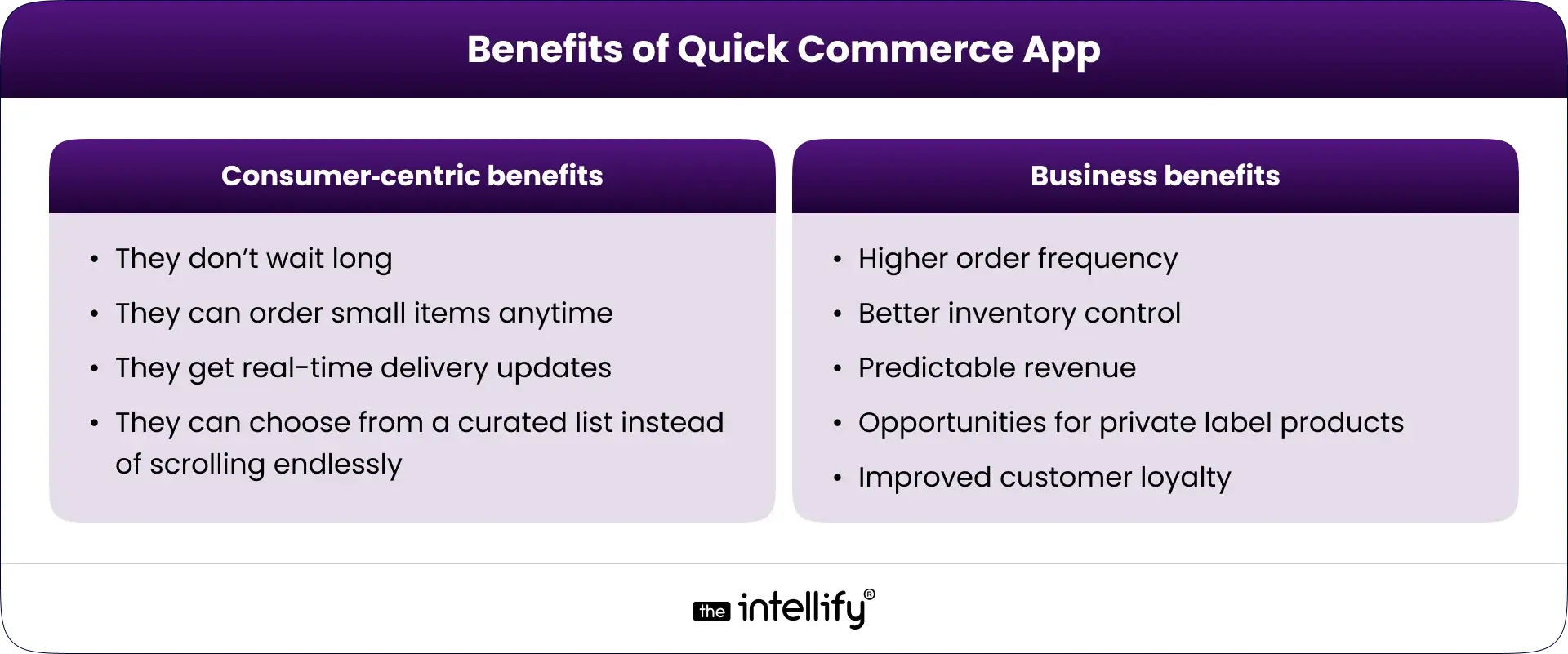
Quick commerce gives companies the chance to offer faster delivery and increase customer loyalty. Some practical advantages include:
- Higher order frequency: Customers order multiple times per week
- Better inventory control: Dark stores reduce stock mismatches
- Predictable revenue: Steady flow of orders due to essential items.
- Opportunities for private label products: You can introduce your own brands.
- Improved customer loyalty: Speed creates trust and repeat usage
Benefits of Quick Commerce for Startups
Startups get some extra advantages:
- They can start small with one cluster
- Easy to scale city-by-city
- Faster customer adoption
- Clear data insights for product decisions
Benefits of Quick Commerce for Users
People love Q-commerce because:
- They don’t wait long
- They can order small items anytime
- They get real-time delivery updates
- They can choose from a curated list instead of scrolling endlessly
In short, it makes life easier for busy individuals and families.
Key Difference Between E-Commerce & Quick Commerce
Here’s the simplest way to understand it:
| Feature | E-Commerce | Quick Commerce |
|---|---|---|
| Delivery Time | Hours to days | Minutes |
| Inventory | Large warehouses | Small, local dark stores |
| Order Size | Big baskets | Smaller, urgent items |
| Speed Priority | Medium | Very high |
| Technology Use | Standard | High automation + AI |
| Customer Expectation | Flexible | Instant |
Quick commerce is all about speed and convenience. Traditional eCommerce focuses on availability and variety.
Impact of AI in Quick Commerce Development
AI now sits at the center of every fast delivery system. It helps companies decide what products to stock, how many employees they need, and which route a rider should take.
Here are some ways AI shapes Q-commerce today:
- Demand forecasting: Predicts what products users will need based on trends, seasons, and order patterns.
- Route optimization: Suggests the fastest delivery routes to minimize time and fuel costs.
- Inventory suggestions: Recommends stock levels and reduces wastage.
- Real-time pricing: Helps adjust delivery fees or promotions based on demand or traffic.
- Personalized recommendations: Shows users products they often buy or may need soon.
- Warehouse Automation: Speeds up picking, packing, and stocking.
AI reduces manual work and helps lower the cost per delivery, which is important for profitability.
What Are Some Top Q-Commerce Business Models?
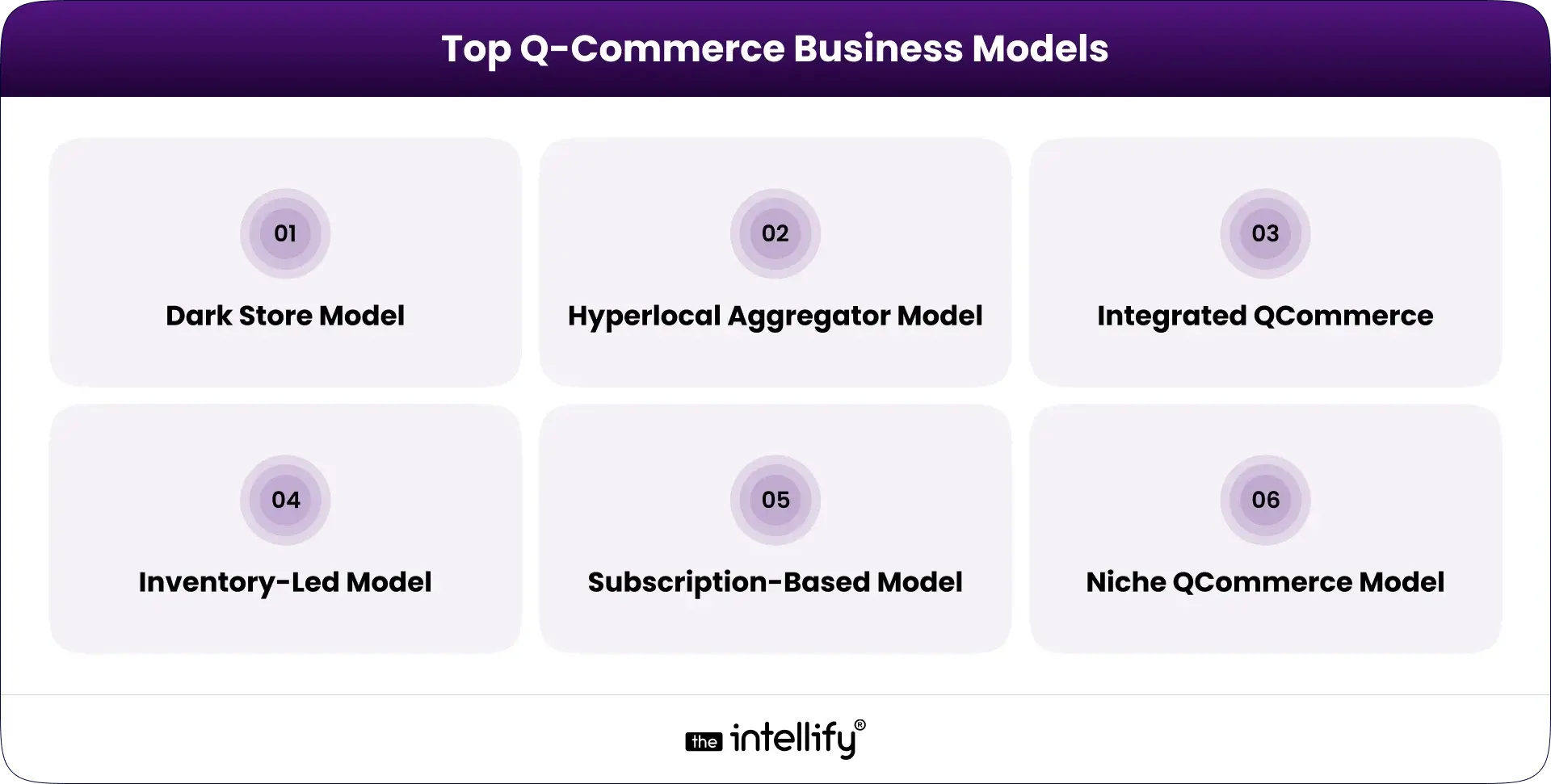
Different companies use different models depending on their budget, scale, and product type.
Dark Store Model
You run your own dark stores with your inventory. This gives the highest control and the fastest service.
Hyperlocal Aggregator Model
You partner with nearby stores and list their inventory inside your app. You don’t hold stock.
Integrated QCommerce
You manage both inventory and delivery, but collaborate with local suppliers.
Inventory-Led Model
You completely own the stock and handle everything from procurement to delivery.
Subscription-Based Model
Users pay monthly and receive recurring deliveries (e.g., milk, fruits, snacks).
Niche QCommerce Model
You focus on one category only, such as organic produce, pet supplies, beauty items, etc.
Step-by-Step Process to Build a Quick Commerce App
Here’s a clean breakdown of the development process:
- Market research and requirement analysis: Understand features, delivery radius, product categories, and operational workflow.
- Business Model and Delivery Radius Finalization: Choose your model and store setup approach.
- User Flow and Architecture Planning: Create wireframes, app navigation, and backend structure
- UI/UX Design: Focusing on speed, easy navigation, and clean visuals.
- Develop app panels: user app, delivery app, store/warehouse app, admin web dashboard
- Core Feature Integration, like order tracking, payments, routing, inventory, and notifications
- AI Integration: Add demand forecasting, routing, and recommendations
- Testing: Check performance, load, bugs, and speed
- Deployment: Launch on the Play Store and App Store.
- Operational Testing: Ensure packing times, fleet readiness, and routing are stable.
- Scaling: Expand to more localities and optimize dark stores.
The goal is to build an app that loads fast, works smoothly under high traffic, and handles real-time operations.

How to Choose Partner for Quick Commerce App Development?
When choosing a development partner, focus on:
- Experience in building on-demand delivery, logistics, or marketplace apps
- Strong backend and database capabilities
- Expertise in real-time tracking, mapping, routing, and inventory systems
- Knowledge of AI integrations
- Ability to customize the app, not provide a generic template
- Clear communication and long-term support
- Strong testing practices
Pick a team that understands operations, not just app design because the backend is what makes Q-commerce work.
How Much Does a Quick Commerce App Development Cost in 2026?
Costs vary depending on the app’s scale, features, and complexity. But here’s a realistic breakdown:
| App Type | Estimated Cost (2026) |
|---|---|
| MVP for one city | $45,000 – $65,000 |
| Full quick commerce app | $80,000 – $150,000 |
| Enterprise-level, multi-city system | $150,000 – $300,000+ |
The biggest cost factors include:
- Real-time tracking
- Inventory integration
- Smart routing
- AI-based modules
- Backend infrastructure
- Multi-app setup (User + Partner + Admin)
A basic version costs less, but the more automated your system, the better your long-term profitability.
Key Challenges in Developing Quick Commerce
Even though the model is attractive, it comes with some practical challenges.
- Inventory Management: Keeping stock accurate is critical. Even a small mismatch can cause order cancellations.
- Quality Control: Fresh produce and perishable goods demand careful handling and fast movement.
- Financial Challenges: Margins in Q-commerce are thin. Efficient cost control is necessary.
- Technology Challenges: Real-time sync, fast mapping, and stable servers are necessary to avoid delays.
- Data Security & Privacy Challenges: Since customers share location and payment details, your app must follow strong security measures.
Future Trends in Quick Commerce Apps Beyond 2026
As the market grows, several new trends are emerging:
- More AI-driven personalization
- Drone-based micro-deliveries in selected cities
- Automated dark stores with robots
- Voice-based ordering within Q-commerce apps
- Expansion into semi-urban areas
- More partnerships with retail chains
- Sustainable packaging and electric delivery fleets
The future of Q-commerce will be shaped by automation and user convenience.

Conclusion
Quick commerce is one of those rare business models that reshaped customer behavior in a short period. People now expect everyday items to be delivered fast, and this trend is going nowhere. If you’re planning to enter the market, building a strong Q-commerce app with real-time features, smooth UX, and AI-driven automation should be your priority.
Whether you’re launching a startup or upgrading an existing retail operation, focus on:
- Fast app performance
- Reliable inventory
- Low operational errors
- Smart AI tools
- Strong backend systems
Start small, pick the right mobile app development partners, and scale step by step. The faster your delivery system works, the more trust and long-term customers you gain.
Frequently Asked Questions (FAQs)
1. What is a quick commerce app, and how does it actually work?
A quick commerce app delivers essentials within minutes using dark stores, real-time inventory, and fast routing. Everything runs through a tight backend that syncs orders, stock, and delivery partners instantly. The Intellify builds these systems end-to-end if you need a reliable setup.
2. How do I start a quick commerce business from scratch?
You choose your model, define service zones, set up dark stores or partners, and build the app that connects it all. The Intellify helps founders with planning, app development, and the tech needed to run operations smoothly from day one.
3. What features should a good quick commerce app have?
Essential features include fast search, simple checkout, real-time tracking, delivery assignment, and accurate inventory. Stability and speed matter most. The Intellify helps businesses choose the right features based on budget and scale.
4. How much does it cost to build a quick commerce app?
Most quick commerce apps cost $45,000 – $150,000+, depending on features, cities, and real-time capabilities. The Intellify provides clear cost estimates based on your requirements.
5. How do dark stores help in quick commerce?
Dark stores cut delivery time by keeping high-demand items close to users. They support quick picking, reduce travel distance, and improve order accuracy. The Intellify assists in setting up the tech workflow for dark store operations.
6. What’s the difference between e-commerce and quick commerce?
eCommerce delivers in hours or days; quick commerce delivers in minutes. Q-commerce relies on dark stores, fast dispatching, and real-time systems. The Intellify builds these fast-moving technology layers for businesses entering this space.
7. How can AI improve a Q-commerce business?
AI predicts demand, optimizes routes, speeds up fulfillment, and reduces stock errors. It helps keep operations efficient and costs low. The Intellify integrates AI tools into Q-commerce apps for smarter decision-making.


Written By, Shravan Rajpurohit
Shravan Rajpurohit is the Co-Founder & CEO of The Intellify, a leading Custom Software Development company that empowers startups, product development teams, and Fortune 500 companies. With over 10 years of experience in marketing, sales, and customer success, Shravan has been driving digital innovation since 2018, leading a team of 50+ creative professionals. His mission is to bridge the gap between business ideas and reality through advanced tech solutions, aiming to make The Intellify a global leader. He focuses on delivering excellence, solving real-world problems, and pushing the limits of digital transformation.

Grocery Delivery App Development: Cost, Features, & Tech Guide
Summary: In this blog, we explore how to build an on-demand grocery delivery app development in 2026, from key features and tech stack to cost estimates, business models, and scaling strategies. Whether you’re a startup or established retailer, you’ll get a clear roadmap to launch and grow a grocery-delivery platform that wins in today’s competitive […]

Apple Vision Pro App Development Guide for Businesses
Summary: This blog breaks down Apple Vision Pro app development in a simple, practical way for businesses exploring AR and VR app solutions. It explains what the device can do, where it fits across industries like healthcare, retail, education, and real estate, and how the full development process works from concept to launch. You’ll also […]

Sports Betting App Development: Features, Process & Cost
Summary: This blog offers a complete guide to sports betting app development, explaining how to create a secure, feature-rich, and user-friendly betting platform. It discusses essential features like live betting, multiple payment options, and responsible gambling tools, along with the full development process, cost factors, and future trends such as AI, AR/VR, and blockchain integration. […]
Grocery Delivery App Development: Cost, Features, & Tech Guide
Summary: In this blog, we explore how to build an on-demand grocery delivery app development in 2026, from key features and tech stack to cost estimates, business models, and scaling strategies. Whether you’re a startup or established retailer, you’ll get a clear roadmap to launch and grow a grocery-delivery platform that wins in today’s competitive […]
How to Build a Digital Twin App: Features, Process & Cost
Summary: A digital twin app creates a real-time virtual model of a physical asset, which helps businesses monitor performance, predict failures, and make smarter decisions. This blog explains what digital twin apps are, how they work, their key features, and the step-by-step development process. It also covers cost, timelines, challenges, and real industry use cases. […]
Apple Vision Pro App Development Guide for Businesses
Summary: This blog breaks down Apple Vision Pro app development in a simple, practical way for businesses exploring AR and VR app solutions. It explains what the device can do, where it fits across industries like healthcare, retail, education, and real estate, and how the full development process works from concept to launch. You’ll also […]
0
+0
+0
+0
+Committed Delivery Leads To Client Satisfaction
Client Testimonials that keep our expert's spirits highly motivated to deliver extraordinary solutions.

Christopher Seny
My experience working with The Intellify, has been a great experience. The team has a wealth of expertise in the tech space. Working with the intellify was a growing experience for me, I learned a lot. The team keeps great communication & responds fast to new ideas & suggestions. The team also provides great suggestions & solutions as well. I couldn’t imagine working with anybody else on this project & it has been a blessing working with, The Intellify.

Izandi Serdyn
The Intellify delivered a platform from scratch, involving the client at every stage. The team was communicative, responsive, and punctual throughout the engagement. Virtual meetings and emails ensured seamless project management. Customers can expect a team that can work fast.

Kya Johnson
The app serves as an effective introduction for users to the product and its characters. Responsive and faithful to initial requirements, The Intellify’s team exceeded initial expectations. Internal stakeholders were particularly pleased with their communication.

Stefan Wyk
Working with The Intellify to develop our website was an outstanding experience. Their team displayed exceptional professionalism, creativity, and technical expertise throughout the entire process. The final product exceeded our expectations, delivering a sleek, user-friendly, and highly functional website. We highly recommend The Intellify to anyone in need of top-tier web development services.

Steve Thorpe
The Intellify’s work has been met with high praise from internal and external stakeholders. The team is efficient, diligent, and reliable in their service. They go above and beyond in terms of communication and project management. The Intellify is a responsive vendor that gets the job done.

Tal Dotan
I’ve been working with The Intellify for the last 3 years. During this period of time we’ve planned and executed projects in both small and large scale. Working with The Intellify was and still is the best decision I’ve made when rising up Divo, I strongly recommend to work with them in any type of project.


 +1-302-803-4983