Transforming Legacy Application Modernization with AI and Automation

By Jalaj Shah
February 22, 2026
Summary:
Legacy Application Modernization helps businesses upgrade outdated systems while maintaining operational stability. Many enterprises face technical debt, scalability challenges, and security risks that limit growth. By combining AI-driven automation with structured modernization strategies, organizations can improve performance, strengthen compliance, and enhance user experience. The blog also covers legacy mobile app modernization, industry use cases, and a practical roadmap to support long-term digital transformation in mobile apps and enterprise systems
Most companies didn’t wake up one day and decide to run on outdated systems. It happened slowly. A quick fix during a tight deadline. A patch before an audit. A workaround that was supposed to be temporary but never really left.
Years later, that “temporary” solution is still there. That’s why Legacy Application Modernization has become a serious conversation in boardrooms. Not because it sounds impressive, but because the pressure is real. Systems feel heavy. Changes feel risky. Teams move carefully instead of confidently.
Modernization today is not about replacing everything in one dramatic move. It’s about improving what slows you down while keeping the business steady. AI-driven automation makes that process more predictable and less chaotic, and honestly, predictability matters.
Why Legacy Application Modernization Is Now a Business Imperative
Many enterprises still rely on legacy applications built a decade or more ago. Payroll engines, claims systems, and inventory dashboards have been doing their job for years. The problem is, the world around them changed.
Customers expect instant responses. Internal teams expect systems to integrate without friction. Leadership expects insights in real time, not at the end of the quarter.
Older systems struggle to scale. Integrations require workarounds. Security updates feel risky. Even adding a small feature can turn into a three-week exercise. Now, Businesses need systems that adapt quickly to market changes. If technology slows decision-making, it slows growth.
Legacy application modernization, supported by AI and automation, allows companies to upgrade without disrupting daily operations. It protects the foundation while strengthening the structure. That balance is what makes it essential now, not optional later.
Understanding the Challenges of a Legacy Application in Today’s Market
Accumulated Technical Debt
Technical debt builds quietly. A small patch today seems harmless. Another quick fix next month. Over time, those fixes overlap and increase complexity. Documentation becomes outdated. The original developers move on. New team members hesitate to touch certain modules because no one fully understands them.
Even minor updates require deep testing. Maintenance slows down. Costs increase. At some point, teams stop improving and start avoiding. That’s usually the signal that something needs to change.
Scalability and Performance Constraints
Growth exposes limitations. More users. More transactions. More data. The architecture that once handled everything smoothly begins to struggle under peak demand.
Performance bottlenecks appear. Dashboards load slowly. Transactions lag. During heavy traffic, systems may even crash. These issues affect customer perception quickly. People rarely complain about slow systems. They simply leave. When growth is restricted by outdated architecture, modernization becomes urgent.
Security and Compliance Risks
Security standards evolve constantly, but legacy platforms often lag behind. Older encryption methods become insufficient. Manual monitoring increases risk. Compliance reporting becomes more complex each year.
Applying security patches can destabilize fragile systems, so updates get delayed. That hesitation increases exposure. It’s not just a technical concern. It affects trust, brand reputation, and regulatory standing.
What Legacy Application Modernization Truly Means
Modernization is not about making a dashboard look modern. It involves rethinking architecture, workflows, and data management. It may include refactoring code, re-platforming infrastructure, or rebuilding specific components that no longer serve the business.
The goal is alignment. Technology should support business strategy, not block it. A well-planned legacy modernization initiative creates systems that are adaptable and easier to maintain. It reduces stress for development teams and improves reliability for users. It sets the business up for long-term flexibility.
The Role of AI in Transforming Legacy Systems
AI adds intelligence to modernization efforts. When used thoughtfully, it improves visibility, decision-making, and system performance.
Intelligent Data Utilization
Legacy systems store years of operational data. Often, that data is underused.
AI analyzes historical and real-time information to identify patterns and trends. Predictive models improve forecasting accuracy. Teams can respond proactively instead of reacting to problems after they occur. Data begins to inform strategy in a meaningful way.
Enhancing User Experience
User expectations are higher now. AI solutions supports personalized experiences by analyzing behavior and preferences. Adaptive interfaces adjust to usage patterns. Intelligent notifications guide users without overwhelming them.
Conversational tools simplify interaction. Instead of navigating complex menus, users can ask direct questions. Smart workflows reduce friction. That alone can improve engagement significantly.
AI-Assisted Code and Architecture Optimization
Large legacy codebases are difficult to evaluate manually. AI tools can scan and analyze these systems efficiently.
They identify redundant logic, performance gaps, and risky dependencies. Automated testing improves accuracy. Migration decisions become data-driven. This reduces uncertainty and shortens planning cycles.
How Automation Strengthens Modernization Efforts
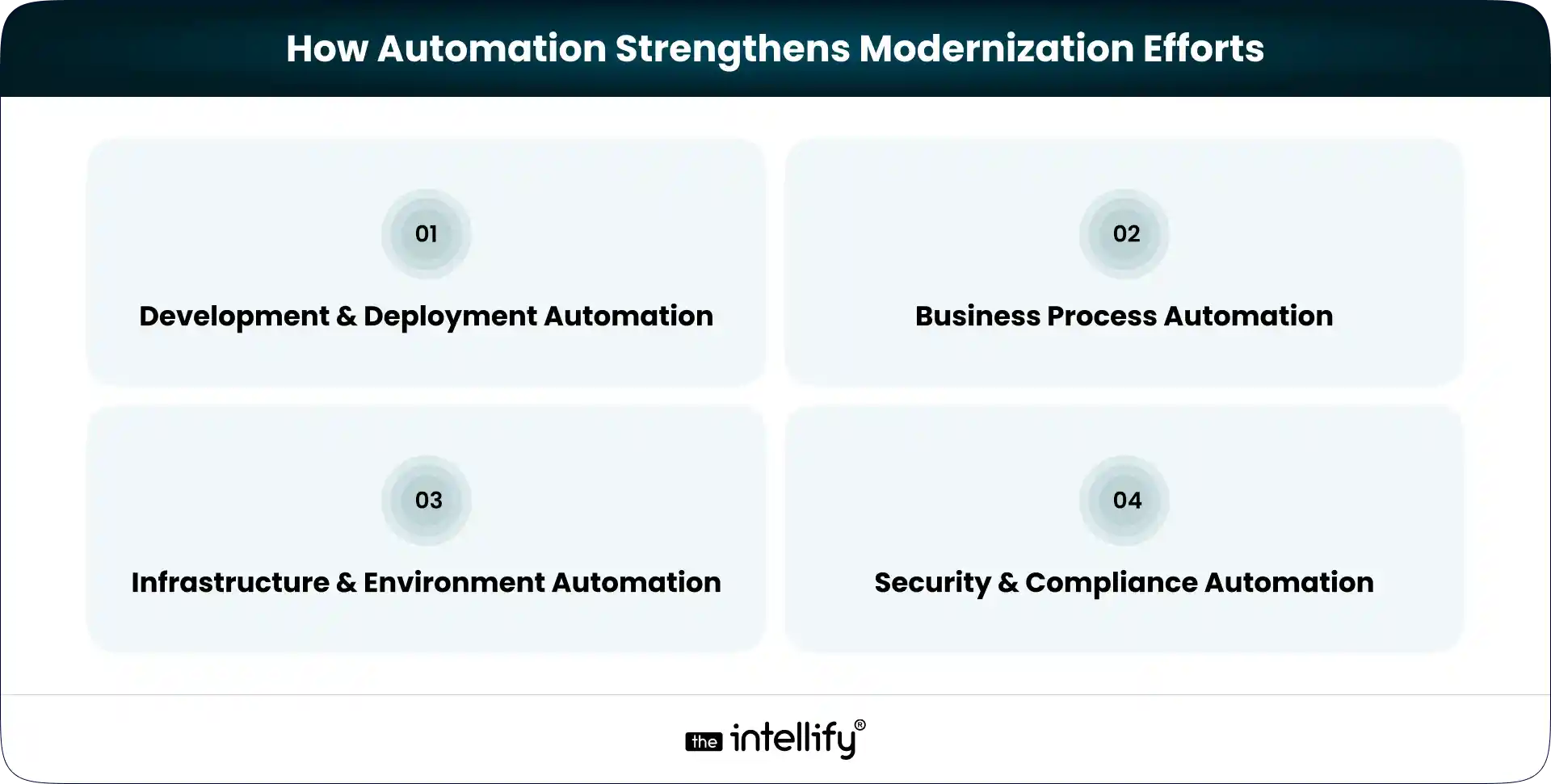
Automation brings structure and consistency. It reduces repetitive tasks and minimizes human error.
Development and Deployment Automation
Continuous integration supports stability. Automated testing catches issues early, which reduces last-minute surprises.
Release cycles become shorter and more predictable. Collaboration improves through structured version control practices. Updates feel controlled instead of stressful.
Business Process Automation
Many enterprise workflows still rely heavily on manual steps. Automation converts repetitive processes into rule-based systems:
- Claims move through structured workflows
- Onboarding becomes standardized
- Approvals follow clear logic
- Data entry errors decrease
- Teams focus on strategic tasks
Over time, productivity improves and operational costs decline.
Infrastructure and Environment Automation
Cloud provisioning becomes repeatable and reliable. Environments can be replicated consistently across teams. Auto-scaling adjusts to traffic changes automatically. Configuration management reduces inconsistencies.
Monitoring systems detect issues early, and recovery processes become more predictable. This stability supports growth without increasing complexity.
Security and Compliance Automation
Automated vulnerability scans strengthen protection. Compliance checks integrate into development pipelines.
Real-time monitoring improves threat detection. Audit readiness becomes easier because reporting is structured. Security shifts from reactive to proactive.

Legacy Mobile App Modernization in a Multi-Device Ecosystem
Many enterprises operate older mobile applications alongside web platforms. The experience often feels disconnected. Legacy mobile app modernization focuses on performance, responsiveness, and integration. Cloud connectivity improves synchronization across devices. AI enables personalization and predictive engagement.
Automation ensures updates are rolled out consistently. Digital transformation in mobile apps matters because users switch between devices constantly. If the experience feels inconsistent, trust erodes quickly.
A Strategic Roadmap for Legacy Modernization Mobile App Initiatives
Modernization works best when it follows a clear structure.
Step 1: Assessment and Discovery
Evaluate architecture, dependencies, and integrations carefully. Identify performance bottlenecks and security gaps. Align findings with business priorities. Not every system requires full rebuilding. Clear visibility reduces unnecessary investment.
Step 2: Selecting the Right Modernization Approach
- Several approaches are available:
- Rehost for quick migration
- Refactor to improve specific components
- Re-platform for gradual upgrades
- Rebuild for complete transformation
Each option involves trade-offs in cost, time, and risk. Evaluate ROI before committing.
Step 3: Architecture Redesign and Cloud Enablement
Shift toward modular or service-based architecture where possible. Strengthen API integrations. Improve data flexibility. Enable scalable cloud-native deployment. Design for adaptability, not just immediate functionality.
Step 4: Integrating AI and Automation Strategically
Identify high-impact areas first. Introduce automation gradually across development and operations. Implement AI capabilities in phases. Measure results and refine continuously. Intentional adoption prevents unnecessary complexity.
Step 5: Continuous Monitoring and Optimization
Track performance metrics consistently. Refine AI models over time. Improve workflows using analytics. Optimize infrastructure usage based on demand. Modernization is ongoing. It evolves with the business.
Industry Use Cases Driving Modernization
1. Healthcare Providers
Healthcare organizations use modernization to improve patient engagement, automate scheduling and billing, apply predictive analytics for operations, strengthen data security, and improve coordination. Efficiency improves, but so does reliability.
2. Insurance Companies
Insurance firms modernize to automate claims management, detect fraud through predictive models, improve risk assessment, process documents intelligently, and reduce response times. Operational friction decreases significantly.
3. Financial Services Institutions
Financial institutions apply AI-enabled onboarding, anomaly detection in transactions, automated compliance reporting, personalized product recommendations, and scalable digital platforms. In this industry, speed and trust must coexist.
Measuring Success After Modernization
Modernization success should be measurable. Improved uptime and faster response times are clear indicators. Reduced maintenance costs reflect operational efficiency. Faster deployment cycles show architectural improvement.
Customer satisfaction and scalability readiness confirm long-term impact. When teams spend less time fixing issues and more time building improvements, progress becomes visible.
Common Implementation Challenges and How to Address Them
Data migration requires careful planning and testing. Avoid rushing transitions. Balance innovation with operational stability through phased rollouts. Invest in team training for AI adoption.
Maintain compliance documentation throughout the transformation. Protect business continuity during upgrades. Structured planning reduces uncertainty and prevents setbacks.
The Future of Intelligent Application Transformation
Generative AI will increasingly assist with code refactoring and architectural decisions. Hyper-automation will connect enterprise systems more tightly. Predictive monitoring will detect issues earlier and enable faster recovery.
Cloud-native architecture will continue expanding. Continuous modernization will replace large, infrequent overhauls. Organizations that treat modernization as an ongoing discipline will remain adaptable.
Final Thought
Legacy Application Modernization is a strategic decision, not a technical trend. AI-driven automation accelerates transformation while maintaining control. A structured roadmap reduces risk and supports steady progress.
Intelligent systems improve performance, strengthen scalability, and enable sustainable growth. Organizations that modernize proactively move forward with confidence instead of hesitation.
Frequently Asked Questions (FAQs)
1. Why should businesses modernize legacy systems now?
Legacy systems often limit growth due to technical debt, slow performance, and rising maintenance costs. Modernization helps organizations improve agility, support AI-driven automation, and align with ongoing digital transformation initiatives.
2. Can modernization be done without replacing the whole system?
Yes. Companies can modernize specific components through approaches like rehosting, refactoring, or re-platforming. This reduces risk and cost while improving performance step by step instead of rebuilding everything at once.
3. What role does AI play in modernization?
AI supports code analysis, predictive insights, automated testing, and performance optimization. It helps teams identify inefficiencies, reduce errors, and make data-driven decisions during modernization projects.
4. What is Legacy Mobile App Modernization?
Legacy mobile app modernization focuses on improving older mobile applications by enhancing performance, cloud integration, security, and user experience across multiple devices.
5. How do organizations measure success after modernization?
Success is measured through improved uptime, faster feature deployment, reduced maintenance costs, and better user satisfaction. Many organizations work with experienced partners like The Intellify to define clear KPIs and ensure measurable modernization outcomes.


Written By, Jalaj Shah
The COO and Co-Founder of The Intellify. Jalaj enjoys experimenting with new strategies. His posts are fantastic for businesses seeking innovative development ideas. Discover practical insights from his engaging content.

Where AI Voice Agents Fit Into a Modern DPC Platform
Summary: AI voice agents can become a practical part of a modern Direct Primary Care (DPC) platform by handling routine phone interactions, appointment scheduling, membership questions, reminders, and call routing. This guide explains where voice AI fits within the DPC technology stack, what tasks it should and shouldn’t handle, HIPAA considerations, integration requirements, and how […]
AI Appointment Scheduling in Healthcare: How It Works, Key Benefits & Costs in 2026
Summary: AI appointment scheduling helps healthcare organizations automate booking, reduce no-shows, optimize provider schedules, and improve patient access to care. This guide explains how AI scheduling works, its key benefits, essential features, implementation costs, EHR integration requirements, and future trends shaping healthcare operations in 2026. A missed appointment doesn’t just create an empty slot in […]
How to Build AI for Real Estate Investment and Market Analysis
Summary: AI for real estate investment is helping investors and property businesses make smarter, faster, and more data-driven decisions. This guide explains how to build an AI-powered real estate investment platform, covering essential features, data sources, AI technologies, market analysis capabilities, development steps, business benefits, and future trends shaping the real estate industry. Real […]
Where AI Voice Agents Fit Into a Modern DPC Platform
Summary: AI voice agents can become a practical part of a modern Direct Primary Care (DPC) platform by handling routine phone interactions, appointment scheduling, membership questions, reminders, and call routing. This guide explains where voice AI fits within the DPC technology stack, what tasks it should and shouldn’t handle, HIPAA considerations, integration requirements, and how […]
AI Appointment Scheduling in Healthcare: How It Works, Key Benefits & Costs in 2026
Summary: AI appointment scheduling helps healthcare organizations automate booking, reduce no-shows, optimize provider schedules, and improve patient access to care. This guide explains how AI scheduling works, its key benefits, essential features, implementation costs, EHR integration requirements, and future trends shaping healthcare operations in 2026. A missed appointment doesn’t just create an empty slot in […]
How to Build AI for Real Estate Investment and Market Analysis
Summary: AI for real estate investment is helping investors and property businesses make smarter, faster, and more data-driven decisions. This guide explains how to build an AI-powered real estate investment platform, covering essential features, data sources, AI technologies, market analysis capabilities, development steps, business benefits, and future trends shaping the real estate industry. Real […]
0
+0
+0
+0
+Committed Delivery Leads To Client Satisfaction
Client Testimonials that keep our expert's spirits highly motivated to deliver extraordinary solutions.

Christopher Seny
My experience working with The Intellify, has been a great experience. The team has a wealth of expertise in the tech space. Working with the intellify was a growing experience for me, I learned a lot. The team keeps great communication & responds fast to new ideas & suggestions. The team also provides great suggestions & solutions as well. I couldn’t imagine working with anybody else on this project & it has been a blessing working with, The Intellify.

Izandi Serdyn
The Intellify delivered a platform from scratch, involving the client at every stage. The team was communicative, responsive, and punctual throughout the engagement. Virtual meetings and emails ensured seamless project management. Customers can expect a team that can work fast.

Kya Johnson
The app serves as an effective introduction for users to the product and its characters. Responsive and faithful to initial requirements, The Intellify’s team exceeded initial expectations. Internal stakeholders were particularly pleased with their communication.

Stefan Wyk
Working with The Intellify to develop our website was an outstanding experience. Their team displayed exceptional professionalism, creativity, and technical expertise throughout the entire process. The final product exceeded our expectations, delivering a sleek, user-friendly, and highly functional website. We highly recommend The Intellify to anyone in need of top-tier web development services.

Steve Thorpe
The Intellify’s work has been met with high praise from internal and external stakeholders. The team is efficient, diligent, and reliable in their service. They go above and beyond in terms of communication and project management. The Intellify is a responsive vendor that gets the job done.

Tal Dotan
I’ve been working with The Intellify for the last 3 years. During this period of time we’ve planned and executed projects in both small and large scale. Working with The Intellify was and still is the best decision I’ve made when rising up Divo, I strongly recommend to work with them in any type of project.


 +1-302-803-4983