AI Workflow Automation Explained: Benefits, Use Cases, and ROI for Businesses

By Darshak Doshi
March 29, 2026
Summary:
AI workflow automation helps businesses achieve faster ROI by optimizing repetitive and time-consuming processes. It improves efficiency, reduces costs, and enhances decision-making by leveraging data and intelligent systems. From customer service to internal operations, organizations can streamline workflows and scale effectively. By starting with high-impact use cases and tracking performance metrics, businesses can unlock immediate value while building a strong foundation for future automation initiatives.
Why Businesses Are Turning to Intelligent Automation Now
In today’s business world, companies are grappling with rising operational costs, talent shortages, and the relentless drive to speed things up without sacrificing quality. As manual and rule-based processes start to show their limits, more organizations are looking to AI workflow automation as a viable solution.
So, what does “seeing ROI first” mean for decision-makers? It’s about capturing quick wins through strategic implementations that boost efficiency while cutting costs. In this blog, we’ll explore what AI workflow automation is all about, its benefits, specific use cases across different industries, and how businesses can effectively measure ROI.
What Is AI Workflow Automation?
AI workflow automation is all about merging artificial intelligence with the automation of routine tasks. Unlike traditional automation tools that just tackle repetitive tasks, AI workflow automation takes it a step further by analyzing data and understanding context and patterns.
Key features :
- Context understanding: AI can sift through both structured and unstructured data, allowing for smarter decision-making.
- Decision-making Capability: When faced with choices, AI evaluates various factors to suggest or execute the best action.
- Real-world examples: Consider automated email sorting, intelligent customer support via chatbots, and streamlined supply chain processes all areas where AI bolsters productivity.
AI workflow automation really shines across departments be it finance, HR, or marketing by smoothing out operations and enhancing overall effectiveness.
Why Traditional Automation Often Falls Short
While traditional automation has brought some benefits, it often falls short in key areas:
- Limited to structured Tasks: These systems only perform well with predictable processes, missing the complexities of real-world situations.
- Requires Constant Updates: They often need manual tweaks to keep up, adding extra workload instead of alleviating it.
- New Bottlenecks: Sometimes, traditional automation introduces new delays rather than solving existing ones, leaving organizations hungry for smarter options.
As the demand for more flexible solutions grows, so does the interest in AI-driven processes.
How AI-Driven Processes Improve Efficiency Across Teams
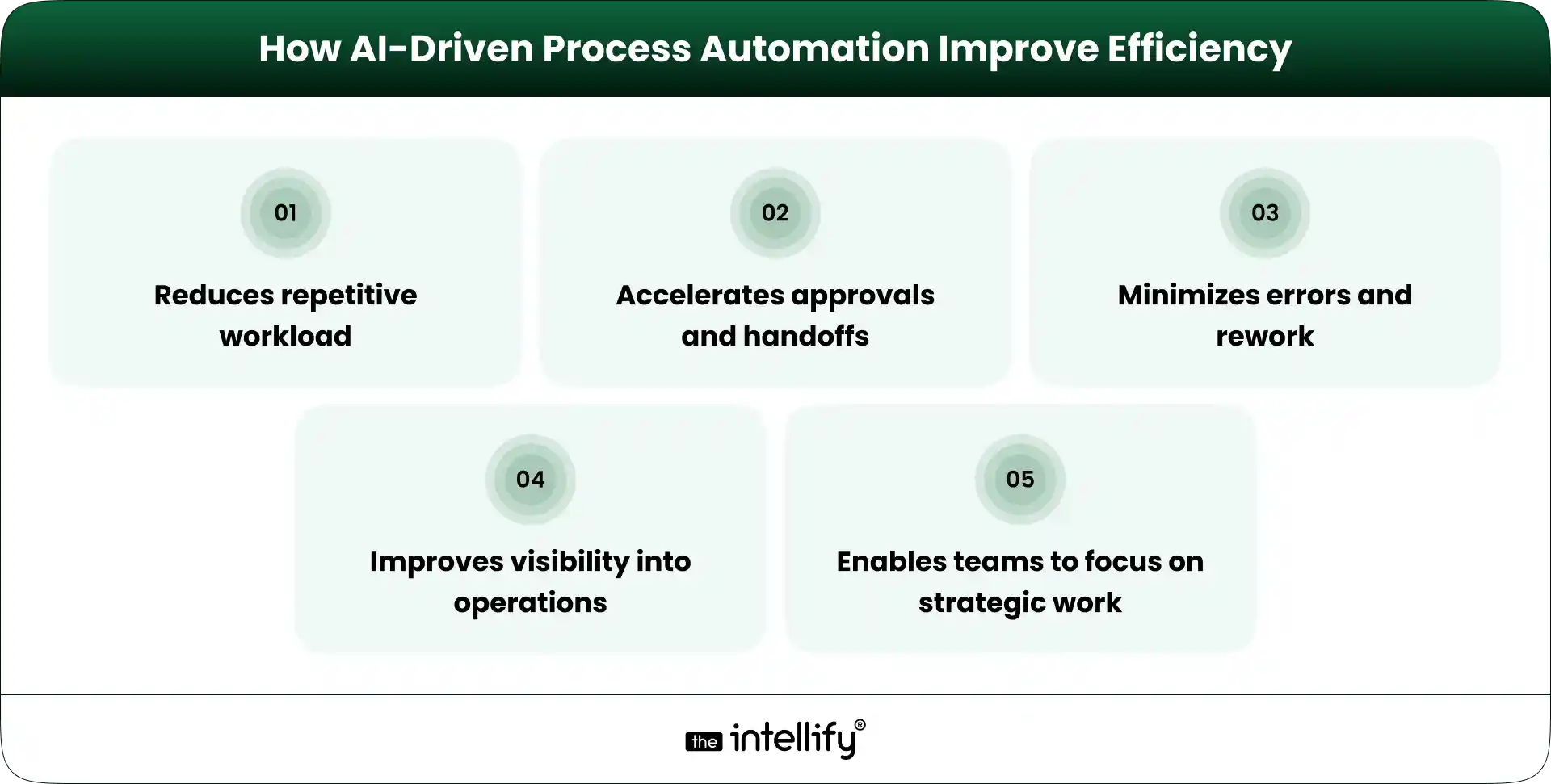
AI workflow automation brings a host of efficiency improvements that resonate across teams:
1. Reduces repetitive workload: By automating tedious tasks, employees can dedicate their time to more strategic projects.
2. Accelerates approvals and handoffs: AI speeds up decision-making, cutting down long waits for task approvals.
3. Minimizes errors and rework: Fewer manual inputs mean fewer chances for mistakes that require rework.
4. Improves visibility into operations: Real-time data and intelligent insights keep teams informed about project statuses and results.
These gains in efficiency enable departments to run more smoothly and adapt quickly to changing demands.
Why Businesses See Faster ROI Compared to Other Digital Investments
Many companies notice a quicker ROI from AI workflow automation compared to broader digital transformation initiatives, and here’s why:
- Lower implementation effort: Getting AI solutions off the ground typically takes less time and fewer resources than larger digital projects.
- Immediate Savings: Reducing manual labor leads to immediate cuts in operating costs.
- Increased Throughout: Businesses can handle more work without hiring additional staff, allowing for efficient scaling.
- Better Resource Utilization: AI optimizes the use of existing resources, making operational improvements sustainable over time.
These advantages stack up, leading to a faster return on investment.
Where AI Workflow Automation Delivers the Most ROI
AI workflow automation can provide significant returns in particular business areas:
1. Customer Service Operations
- Automated handling and routing of requests
- Quicker response times, boosting customer satisfaction
- Reduced support costs without sacrificing quality
2. Finance & Accounting
- Streamlined invoice processing and reconciliation
- Quick expense validation with minimal manual review
- Automatic compliance checks
3. Human Resources
- Effective candidate screening and onboarding
- Timely management of employee requests
- Decreased administrative workloads
4. Sales & Marketing Operations
- Lead qualification and routing
- Automated campaign execution workflows
- Prompt CRM updates and follow-ups
5. IT & Internal Operations
- Efficient incident resolution workflows
- Automated access provisioning
- Routine maintenance processes
These areas offer prime opportunities for businesses looking to establish AI workflow automation that has a direct impact on their bottom line.
Real-World Industry Use Cases Showing Early Returns
Several industries are already reaping the rewards of AI workflow automation. Here are some notable examples:
1. Healthcare: AI streamlines patient intake and automates documentation processes, ultimately leading to better patient care.
2. Manufacturing: AI improves supply chain coordination, ensuring that materials are in the right place at the right time.
3. Retail: Automated order management and returns processing enhance operational efficiency in stores.
4. Banking & Insurance: AI implementations expedite claims and risk processes, reducing turnaround times.
Professional services: Firms with documentation-heavy workflows benefit from automated processing, allowing more focus on client interaction.
These examples demonstrate how AI significantly contributes to operational efficiencies.
How to Identify High-ROI Opportunities in Your Organization
To effectively implement AI workflow automation, organizations should pinpoint processes that show high potential for returns:
- High Volume and Repetition: Tasks that happen frequently and in large quantities are prime for automation.
- Multiple Approvals Needed: Processes requiring numerous approvals can often be streamlined for quicker results.
- Frequent Delays or Errors: Identify areas prone to slowdowns or inefficiencies that could benefit from automation.
- Data Extraction Work : Tasks that involve pulling data from documents provide excellent opportunities for automation.
- Customer- Facing Operations: In scenarios where speed is critical, AI can help ensure timely services.
By identifying these opportunities, organizations can make informed decisions about where to allocate their automation efforts.
How to Implement AI Workflow Automation Successfully
AI workflow automation can be integrated successfully with a few strategic steps:
1. Start Small:- Begin with one high-impact process to kick off your journey.
2. Map Current Workflows:- Pinpoint pain points and areas where efficiency can improve.
3. Choose Compatible Tools:- Look for AI agent solutions that work well with your existing systems.
4. Run Pilot Projects:- Test potential value through small-scale trials.
5. Train Teams:- Ensure your staff is equipped with the skills they need to navigate the new systems effectively.
A gradual scaling approach based on measured results leads to thoughtful and impactful implementation.
Common Challenges and How Businesses Overcome Them
Integrating AI workflow automation isn’t without its challenges. Here are some typical obstacles and strategies for navigating them:
- Legacy System Integration: Ensure new solutions can integrate smoothly with older systems to minimize disruption.
- Data Readiness Issues: Prepare and clean your data before diving into AI systems to dodge inaccuracies.
- Employee Resistance: Communicate openly about changes and how they benefit employees to ease any concerns.
- Security and Compliance: Be vigilant in addressing potential security issues and ensuring regulatory compliance.
- Setting Realistic Expectations: Understand that while ROI is attainable, it requires time and effort.
By proactively tackling these challenges, organizations can improve their chances of successful automation.
Measuring ROI: How to Track the Real Business Impact
To understand the benefits of AI workflow automation, it’s essential to monitor key performance indicators (KPIs):
- Cost savings vs productivity gains: Look at financial savings against gains in efficiency.
- Cycle time reduction: Track how long it takes to complete tasks before and after automation.
- Error rate improvements: Measure the frequency of errors to evaluate process consistency.
- Customer satisfaction impact: Gather customer feedback and analyze service levels.
- Long-term value vs short-term wins: Beyond immediate benefits, assess long-term performance improvements.
Keeping tabs on these metrics helps in understanding the tangible effects of AI workflow automation on business operations.
The Future of AI-Enabled Workflow Transformation
Looking ahead, AI-enabled workflow transformation is set to evolve even further:
1. Move toward autonomous operations:- Future systems might handle more tasks independently, requiring minimal human oversight.
2. Human + AI collaboration models:- Businesses will increasingly see AI as supportive partners in workflow tasks.
3. Predictive and self-optimizing workflows:- AI could evolve to anticipate challenges and continually optimize processes.
4. Competitive advantage for early adopters:- Organizations embracing these innovations sooner are likely to lead in their sectors.
Being prepared for these developments will position businesses favorably as they adapt to a rapidly changing landscape.
Conclusion
Big gains come when businesses focus on the right processes for automation. Quick ROI is achievable through targeted implementation, starting small and scaling thoughtfully. Organizations that act swiftly won’t just keep pace; they’ll lead in efficiency and agility.
Incorporating AI workflow automation can revolutionize operations, creating significant value and gearing businesses up for future growth.

Frequently Asked Questions (FAQs)
1) How quickly can businesses see ROI from AI workflow automation?
Many companies notice improvements within a few months, especially after automating repetitive tasks like customer queries or document handling. Faster processes and reduced manual work quickly translate into cost and time savings.
2) Which departments usually benefit first from AI-driven automation?
Customer support, finance, HR, sales operations, and IT often see the earliest gains. These areas handle large volumes of routine work that can be streamlined easily.
3) Is AI workflow automation suitable for small and mid-sized businesses?
Yes, it helps smaller companies scale without hiring large teams. Modern tools are affordable and easier to implement than traditional enterprise systems.
4) How is AI automation different from traditional workflow automation?
Traditional automation follows fixed rules and struggles with unexpected inputs. AI can handle unstructured data, learn patterns, and adapt to changing situations.
5) What types of tasks are best suited for AI workflow automation?
Repetitive, time-consuming tasks like data entry, document processing, approvals, and request handling are ideal. These processes consume effort but add little strategic value.
6) How should a business decide what to automate first?
Start with processes that are slow, error-prone, or involve heavy manual effort. Choosing one high-impact workflow helps demonstrate value quickly.
7) How can businesses measure the success of automation initiatives?
Key indicators include time saved, lower operating costs, reduced errors, and faster service delivery. Comparing performance before and after implementation shows the real impact.


Written By, Darshak Doshi
With over a decade of experience, Darshak is a technopreneur specializing in cloud-based applications and product development in healthcare, insurance, and manufacturing. He excels in AWS Cloud, backend development, and immersive technologies like AR/VR to drive innovation and efficiency. Darshak has also explored AI/ML in insurance and healthcare, pushing the boundaries of technology to solve complex problems. His user-focused, results-driven approach ensures he builds scalable cloud solutions, cutting-edge AR/VR experiences, and AI-driven insights that meet today’s demands while anticipating future needs.

AI in Healthcare Administration: Streamlining Hospital Operations
Summary The growing complexity of healthcare administration is driving the need for smarter, more efficient solutions. Automation technologies are helping streamline key processes such as scheduling, billing, and data management, reducing manual workload and improving accuracy. This enables faster operations, better coordination, and enhanced patient experiences. As adoption increases, healthcare organizations are moving toward more […]

HIPAA-Compliant AI for Healthcare Platforms: Architecture, Security & Practices
Summary: Healthcare organizations are increasingly using AI to improve diagnostics, operations, and patient engagement. However, handling sensitive medical data requires strict privacy and regulatory safeguards. This guide explains how to design HIPAA compliant AI systems for healthcare platforms. It covers key AI architecture components, security measures, compliance practices, and common challenges organizations face when using […]
Insurance Claims Automation with AI: A Smart Vendor Evaluation Guide
Summary: Insurance claims automation uses AI to streamline the claims lifecycle from FNOL to settlement by reducing manual work, improving accuracy, and speeding up claim decisions. This guide explains how AI enhances claims processing, where human oversight remains important, and what insurers should evaluate when selecting an automation vendor. It also highlights key factors like […]
AI in Healthcare Administration: Streamlining Hospital Operations
Summary The growing complexity of healthcare administration is driving the need for smarter, more efficient solutions. Automation technologies are helping streamline key processes such as scheduling, billing, and data management, reducing manual workload and improving accuracy. This enables faster operations, better coordination, and enhanced patient experiences. As adoption increases, healthcare organizations are moving toward more […]
HIPAA-Compliant AI for Healthcare Platforms: Architecture, Security & Practices
Summary: Healthcare organizations are increasingly using AI to improve diagnostics, operations, and patient engagement. However, handling sensitive medical data requires strict privacy and regulatory safeguards. This guide explains how to design HIPAA compliant AI systems for healthcare platforms. It covers key AI architecture components, security measures, compliance practices, and common challenges organizations face when using […]
Insurance Claims Automation with AI: A Smart Vendor Evaluation Guide
Summary: Insurance claims automation uses AI to streamline the claims lifecycle from FNOL to settlement by reducing manual work, improving accuracy, and speeding up claim decisions. This guide explains how AI enhances claims processing, where human oversight remains important, and what insurers should evaluate when selecting an automation vendor. It also highlights key factors like […]
0
+0
+0
+0
+Committed Delivery Leads To Client Satisfaction
Client Testimonials that keep our expert's spirits highly motivated to deliver extraordinary solutions.

Christopher Seny
My experience working with The Intellify, has been a great experience. The team has a wealth of expertise in the tech space. Working with the intellify was a growing experience for me, I learned a lot. The team keeps great communication & responds fast to new ideas & suggestions. The team also provides great suggestions & solutions as well. I couldn’t imagine working with anybody else on this project & it has been a blessing working with, The Intellify.

Izandi Serdyn
The Intellify delivered a platform from scratch, involving the client at every stage. The team was communicative, responsive, and punctual throughout the engagement. Virtual meetings and emails ensured seamless project management. Customers can expect a team that can work fast.

Kya Johnson
The app serves as an effective introduction for users to the product and its characters. Responsive and faithful to initial requirements, The Intellify’s team exceeded initial expectations. Internal stakeholders were particularly pleased with their communication.

Stefan Wyk
Working with The Intellify to develop our website was an outstanding experience. Their team displayed exceptional professionalism, creativity, and technical expertise throughout the entire process. The final product exceeded our expectations, delivering a sleek, user-friendly, and highly functional website. We highly recommend The Intellify to anyone in need of top-tier web development services.

Steve Thorpe
The Intellify’s work has been met with high praise from internal and external stakeholders. The team is efficient, diligent, and reliable in their service. They go above and beyond in terms of communication and project management. The Intellify is a responsive vendor that gets the job done.

Tal Dotan
I’ve been working with The Intellify for the last 3 years. During this period of time we’ve planned and executed projects in both small and large scale. Working with The Intellify was and still is the best decision I’ve made when rising up Divo, I strongly recommend to work with them in any type of project.


 +1-302-803-4983