Indoor Navigation with AR: The Future of Smart Wayfinding Systems

By Jalaj Shah
March 27, 2026
Summary:
AR-powered indoor navigation is helping businesses deliver smarter and more seamless wayfinding experiences. By guiding users with real-time visual directions, it eliminates confusion in complex environments like hospitals, malls, airports, and campuses. These solutions not only improve visitor satisfaction but also enhance operational efficiency and accessibility. As demand for smarter buildings grows, indoor navigation is becoming a key technology for organizations looking to modernize their spaces.
Lost Inside Big Buildings? You’re Not Alone
Walking into a large hospital, airport, or shopping mall can quickly become confusing, especially when you’re unfamiliar with the layout. Unlike outdoor travel, where GPS guides us almost everywhere, indoor environments block satellite signals. Thick walls, multiple floors, and complex structures make traditional navigation tools unreliable.
Modern facilities are also expanding rapidly. A single building may include dozens of departments, corridors, and entry points. Visitors often waste time wandering, asking for directions, or backtracking after taking a wrong turn. In stressful places like hospitals or transit hubs, this confusion can add unnecessary anxiety. Traditional signs and maps help to some extent, but they can’t adapt to real-time movement which is why smarter digital guidance is becoming increasingly important.
What Are Indoor Navigation Solutions?
Indoor navigation solutions are systems that help people move through buildings efficiently when GPS cannot function properly. Instead of satellites, they rely on local technologies such as Wi-Fi signals, Bluetooth beacons, sensors, and digital building maps to determine a user’s position.
As a person walks, the system continuously updates their location and provides step-by-step directions to the desired destination. Unlike outdoor navigation, indoor guidance must account for elevators, staircases, restricted areas, and multi-floor layouts. These solutions benefit visitors looking for quick directions, staff navigating large facilities daily, and organizations aiming to improve overall efficiency and user experience.
From Maps to AR: A Smarter Way to Find Your Way
Limitations of static maps and directories
Traditional maps show the layout but don’t guide you as you move, so users must remember directions on their own. In large buildings, this often leads to confusion, missed turns, or repeated stops to recheck the map.
Shift toward interactive and real-time guidance
Modern navigation tools provide step-by-step assistance that updates as you walk, similar to GPS outdoors. This makes the experience more dynamic and reduces the need for guesswork.
How AR overlays directions onto the real environment
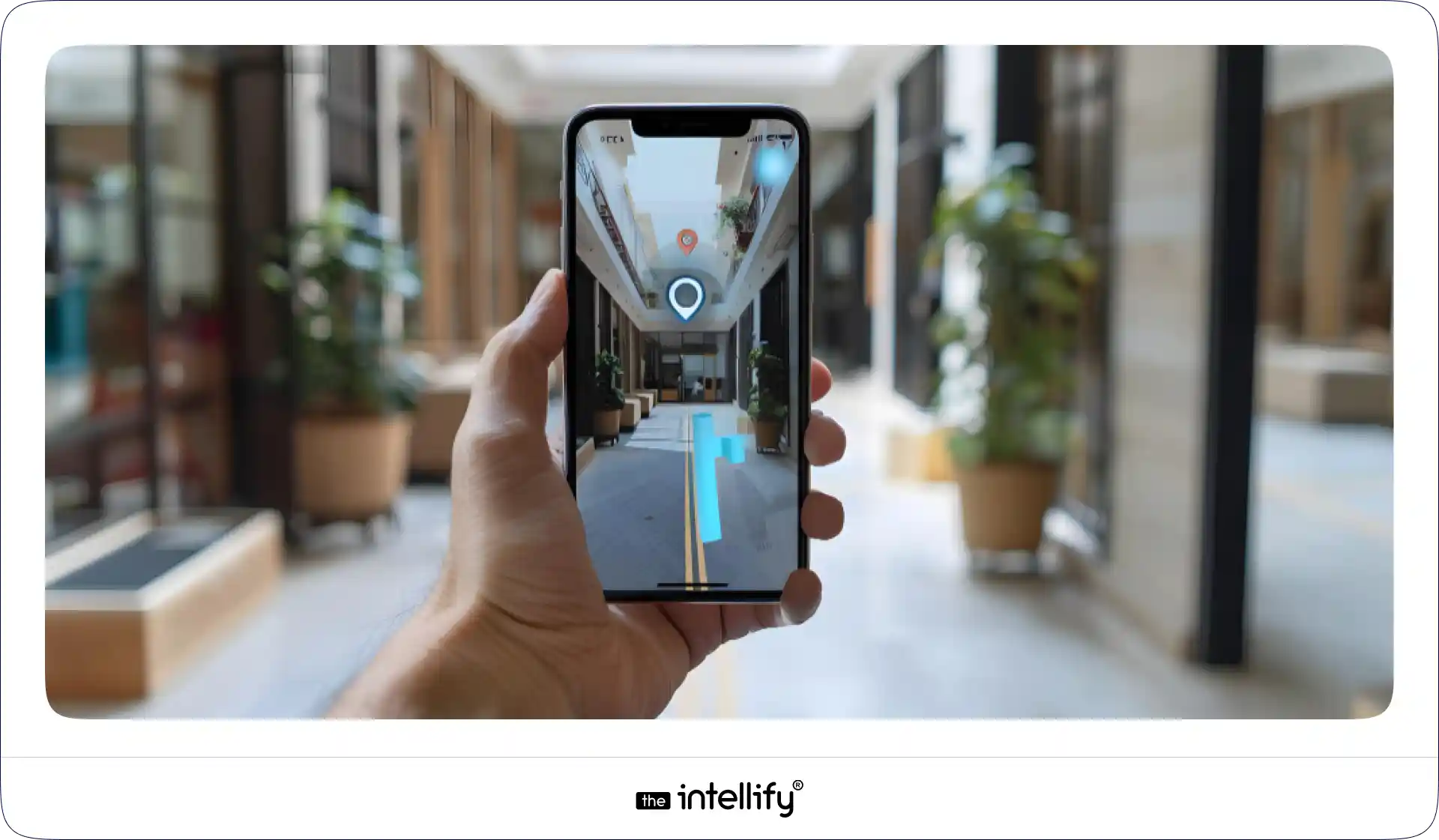
Augmented Reality displays arrows or paths directly on the live camera view of your surroundings. Instead of imagining the route, users can simply follow visual markers placed in their actual environment.
Why visual cues are easier to follow than 2D maps
People naturally understand visual directions faster than abstract diagrams or written instructions. Seeing where to go in real space removes the mental effort of translating a map into movement.
Real-time adjustments as users move
If a user takes a wrong turn or changes direction, the system recalculates instantly and shows a new route. This ensures users stay on track without needing to restart the navigation process.
How an AR Navigation App Guides You Step by Step
How users start navigation on their device
The process begins by selecting a destination within the app, such as a store, department, or room. The system then determines the best route based on the user’s current position.
Environment scanning and position detection
The app scans nearby surroundings using the camera and sensors to understand orientation and location. This helps it align digital directions accurately with the physical space.
Camera-based arrows and turn-by-turn directions
Visual arrows appear on the screen, guiding users step by step through corridors and intersections. This removes uncertainty and makes navigation feel intuitive.
Multi-floor routing and destination search
For multi-level buildings, the app guides users to elevators or staircases and continues directions on the next floor. It can also help locate specific rooms or facilities within large complexes.
Compatibility with smartphones and wearables
Most solutions are designed to work on everyday smartphones and tablets, with some expanding to smart glasses or wearable devices. This makes the technology accessible without requiring special hardware.
Key features that improve usability
Features such as clear visuals, simple interfaces, and automatic rerouting make the app easy to use for people of all ages. Minimal interaction is needed once navigation begins.
Why Smart AR Indoor Navigation Is a Game Changer
For Visitors
Indoor navigation dramatically improves the visitor experience by removing uncertainty. People can reach their destinations faster without relying on staff or signage, which reduces stress in unfamiliar places. It also supports elderly users and individuals with mobility challenges by providing clear, step-by-step guidance.
For Businesses & Facilities
Organizations benefit from smoother operations and improved service perception. Staff spend less time giving directions, allowing them to focus on their primary responsibilities. Additionally, understanding how visitors move through a facility can help optimize layouts, reduce congestion, and enhance overall efficiency.

Where This Technology Makes the Biggest Difference
Airports & Transportation Hubs
Large transit facilities can be overwhelming, especially for travelers under time pressure. Indoor navigation helps passengers quickly locate gates, baggage areas, security checkpoints, and services, reducing missed connections and confusion.
Hospitals & Healthcare Campuses
Hospitals often consist of multiple buildings and departments, making navigation stressful for patients and visitors. Clear guidance ensures people reach the right department on time, improving both experience and operational flow.
Shopping Malls & Retail Spaces
In large malls, customers frequently struggle to locate specific stores or amenities. Navigation tools help shoppers move efficiently, discover more outlets, and spend less time searching and more time engaging.
Universities & Corporate Offices
Expansive campuses can be difficult for new students, visitors, or job candidates to navigate. Guided routes simplify movement between buildings, lecture halls, or offices, especially during events or peak hours.
Museums, Exhibitions & Event Venues
Events and exhibitions often involve temporary layouts that change frequently. Navigation solutions help visitors explore spaces comfortably while preventing overcrowding in popular areas.
Industrial Facilities & Warehouses
Large industrial sites benefit from improved worker mobility and safety. Clear routing helps staff move efficiently across complex environments while reducing time spent searching for locations or equipment.
How Indoor Navigation Solutions Improve Safety Too
Emergency Guidance
During emergencies, clear directions to exits can significantly reduce panic and evacuation time. Real-time guidance ensures people move toward the safest available routes instead of relying on memory or unclear signage.
Support for Vulnerable Users
Navigation systems can highlight accessible paths for individuals with mobility limitations or visual impairments. This promotes independence and ensures safer movement throughout the facility.
Crowd Management
In high-traffic environments, directing people efficiently prevents bottlenecks and unsafe congestion. Balanced crowd flow improves both safety and comfort for everyone present.
Multilingual Assistance
For international locations, language barriers can make navigation difficult. Providing directions in multiple languages helps visitors move confidently without needing personal assistance.
What’s Next for AR Wayfinding?
The future of AR wayfinding lies in smarter, more personalized experiences. Integration with artificial intelligence could allow systems to suggest optimal routes based on crowd levels, user preferences, or accessibility needs. Voice guidance may enable hands-free navigation, making the experience more convenient in busy situations.
As buildings become more connected through smart technologies, navigation systems may integrate with sensors and infrastructure to provide real-time updates about closures, maintenance, or hazards. Over time, indoor guidance is likely to become part of a broader digital ecosystem linking transportation, buildings, and services seamlessly.
The Future of Finding Your Way Indoors
Traditional navigation methods are struggling to keep up with the scale and complexity of modern spaces. Static signs and maps simply cannot provide the adaptability people expect today. Augmented reality bridges the gap between physical environments and digital intelligence, turning navigation into an intuitive experience.
As adoption spreads across industries, indoor navigation is moving from a convenience to a necessity. Organizations that implement these solutions are creating environments that feel easier, safer, and more welcoming. In the near future, getting lost indoors may become uncommon replaced by guidance that feels effortless and reliable.

Conclusion:
Indoor navigation is no longer just a convenience it is becoming an essential part of how people experience large and complex environments. As buildings continue to grow in size and functionality, relying on static signs alone is no longer enough to guide visitors efficiently.
Augmented reality brings a human-friendly approach to navigation by turning directions into a visual, intuitive, and easy-to-follow experience. Organizations that adopt these solutions are not only improving operational efficiency but also creating spaces that feel more welcoming, accessible, and future-ready for everyone who walks through their doors.
Frequently Asked Questions (FAQs)
1. How accurate is AR indoor navigation compared to GPS?
AR indoor navigation can be surprisingly precise because it relies on local signals and visual positioning instead of distant satellites. In well-mapped buildings, it can guide users to specific rooms or facilities with high accuracy. However, performance depends on infrastructure, layout complexity, and device quality.
2. Do users need special devices to use AR wayfinding?
No, most AR navigation solutions work on standard smartphones and tablets. As long as the device supports basic camera and sensor functions, users can access visual guidance without additional hardware. Some advanced setups may also support smart glasses, but they are not required.
3. Can indoor navigation work without internet connectivity?
Many systems need internet access for initial setup and map loading, but some can continue guiding users offline once the data is downloaded. The exact capability depends on how the solution is designed and the building’s infrastructure.
4. How long does it take to implement an indoor navigation system in a large facility?
Implementation timelines vary based on building size and complexity. Mapping, calibration, and testing can take weeks or months for very large spaces. However, once deployed, the system can be updated incrementally as layouts change.
5. How does indoor navigation improve customer experience in large venues?
By removing confusion and saving time, navigation tools make visits smoother and less stressful. Customers can focus on their purpose, shopping, traveling, or attending an event instead of worrying about getting lost. This often leads to higher satisfaction and repeat visits.
6. Is user privacy a concern with location-based indoor navigation?
Responsible solutions prioritize privacy by anonymizing data and avoiding unnecessary personal tracking. Most systems focus on movement patterns rather than individual identities, ensuring useful insights without compromising user trust.
7. Can these systems support accessibility needs?
Yes, many solutions are designed to highlight accessible routes, elevators, ramps, and barrier-free paths. This helps individuals with mobility challenges navigate complex environments independently and safely.


Written By, Jalaj Shah
The COO and Co-Founder of The Intellify. Jalaj enjoys experimenting with new strategies. His posts are fantastic for businesses seeking innovative development ideas. Discover practical insights from his engaging content.


How Augmented Reality in Education is Transforming Learning Apps for Kids
Summary: Augmented Reality in education is transforming how children learn by making lessons more interactive, visual, and engaging. Instead of relying only on text or videos, AR allows kids to explore 3D models, animations, and real-world simulations, improving understanding and retention. This blog covers how AR learning apps work, their key features, real-world applications, benefits, […]
How Augmented Reality Is Redefining the Furniture Industry
Summary Augmented Reality is changing how people explore and buy furniture by allowing them to visualize products in their own spaces before making a purchase. This technology helps reduce uncertainty, improves buying confidence, and creates a more interactive shopping experience. In this blog, we explore how AR is being used across the furniture industry, its […]
How Augmented Reality is Transforming Online Shopping in E-commerce
Summary: Online shopping often means customers cannot often physically experience products, which creates uncertainty for customers. This blog explains how Augmented Reality (AR) helps solve that by allowing shoppers to visualise products in real-world settings before buying. It covers how AR improves product understanding, boosts confidence, and reduces returns, along with real use cases, benefits, […]
How Augmented Reality in Education is Transforming Learning Apps for Kids
Summary: Augmented Reality in education is transforming how children learn by making lessons more interactive, visual, and engaging. Instead of relying only on text or videos, AR allows kids to explore 3D models, animations, and real-world simulations, improving understanding and retention. This blog covers how AR learning apps work, their key features, real-world applications, benefits, […]
How Augmented Reality Is Redefining the Furniture Industry
Summary Augmented Reality is changing how people explore and buy furniture by allowing them to visualize products in their own spaces before making a purchase. This technology helps reduce uncertainty, improves buying confidence, and creates a more interactive shopping experience. In this blog, we explore how AR is being used across the furniture industry, its […]
How Augmented Reality is Transforming Online Shopping in E-commerce
Summary: Online shopping often means customers cannot often physically experience products, which creates uncertainty for customers. This blog explains how Augmented Reality (AR) helps solve that by allowing shoppers to visualise products in real-world settings before buying. It covers how AR improves product understanding, boosts confidence, and reduces returns, along with real use cases, benefits, […]
0
+0
+0
+0
+Committed Delivery Leads To Client Satisfaction
Client Testimonials that keep our expert's spirits highly motivated to deliver extraordinary solutions.

Christopher Seny
My experience working with The Intellify, has been a great experience. The team has a wealth of expertise in the tech space. Working with the intellify was a growing experience for me, I learned a lot. The team keeps great communication & responds fast to new ideas & suggestions. The team also provides great suggestions & solutions as well. I couldn’t imagine working with anybody else on this project & it has been a blessing working with, The Intellify.

Izandi Serdyn
The Intellify delivered a platform from scratch, involving the client at every stage. The team was communicative, responsive, and punctual throughout the engagement. Virtual meetings and emails ensured seamless project management. Customers can expect a team that can work fast.

Kya Johnson
The app serves as an effective introduction for users to the product and its characters. Responsive and faithful to initial requirements, The Intellify’s team exceeded initial expectations. Internal stakeholders were particularly pleased with their communication.

Stefan Wyk
Working with The Intellify to develop our website was an outstanding experience. Their team displayed exceptional professionalism, creativity, and technical expertise throughout the entire process. The final product exceeded our expectations, delivering a sleek, user-friendly, and highly functional website. We highly recommend The Intellify to anyone in need of top-tier web development services.

Steve Thorpe
The Intellify’s work has been met with high praise from internal and external stakeholders. The team is efficient, diligent, and reliable in their service. They go above and beyond in terms of communication and project management. The Intellify is a responsive vendor that gets the job done.

Tal Dotan
I’ve been working with The Intellify for the last 3 years. During this period of time we’ve planned and executed projects in both small and large scale. Working with The Intellify was and still is the best decision I’ve made when rising up Divo, I strongly recommend to work with them in any type of project.


 +1-302-803-4983