AI in Healthcare Administration: Streamlining Hospital Operations

By Jalaj Shah
March 18, 2026
Summary
The growing complexity of healthcare administration is driving the need for smarter, more efficient solutions. Automation technologies are helping streamline key processes such as scheduling, billing, and data management, reducing manual workload and improving accuracy. This enables faster operations, better coordination, and enhanced patient experiences. As adoption increases, healthcare organizations are moving toward more efficient, scalable, and patient-focused administrative systems.
In today’s fast-paced healthcare landscape, administrative tasks often take priority over direct patient care. With more patients seeking services and regulations tightening, tasks like scheduling, billing, and record management have become increasingly complex and time-consuming. That’s where AI in healthcare administration steps in. This blog will explore how AI is reshaping hospital operations, giving staff and patients a much-needed breather.
The Growing Administrative Burden in Healthcare
It’s striking how much time healthcare staff spend buried under paperwork instead of attending to patients. From registering patients to managing billing and navigating compliance requirements, these tasks are essential but can feel overwhelming.
- Patient registration often means gathering and verifying a mountain of information.
- Insurance processing can get tricky, frequently leading to frustrating delays.
- Communication between departments is vital but can feel Herculean, especially as patient numbers swell.
As regulations tighten and patient volumes rise, hospitals find themselves grappling with an expanding list of administrative responsibilities. Manual processes can lead to delays, costly errors, and increased workloads for staff. This impacts both productivity and the bottom line.
To tackle these challenges, more healthcare organizations are embracing AI in healthcare administration to streamline operations and ease the burden on their teams.
Why Traditional Administrative Processes Are No Longer Sustainable
The issues facing healthcare administration often come from sticking to outdated models that can’t keep up with modern demands. Some notable challenges include:
- Mounting patient demand combined with a shortage of administrative staff.
- Frequent errors that crop up from repetitive manual tasks.
- Delays in approvals and documentation that frustrate both staff and patients.
- Staff burnout stemming from an unsustainable workload filled with non-clinical tasks.
In this context, it’s pretty clear that old-school administrative methods just aren’t cutting it anymore. A smarter, more efficient approach is essential.
What AI in Healthcare Administration Means Today
AI is emerging as a game-changer for healthcare administration. It’s not about replacing staff but enhancing their skills. Key features of AI in this area include:
- Rapid processing of large volumes of data while minimizing errors.
- Learning from patterns to help inform decision-making.
- Seamless integration with the existing hospital system to improve workflow.
- Enhancing efficiency, accuracy, and speed at every turn.
Thanks to these capabilities, AI can significantly declutter administrative tasks, letting healthcare professionals shift their focus back to what matters most: patient care.
How Hospitals Are Using AI to Streamline Daily Operations
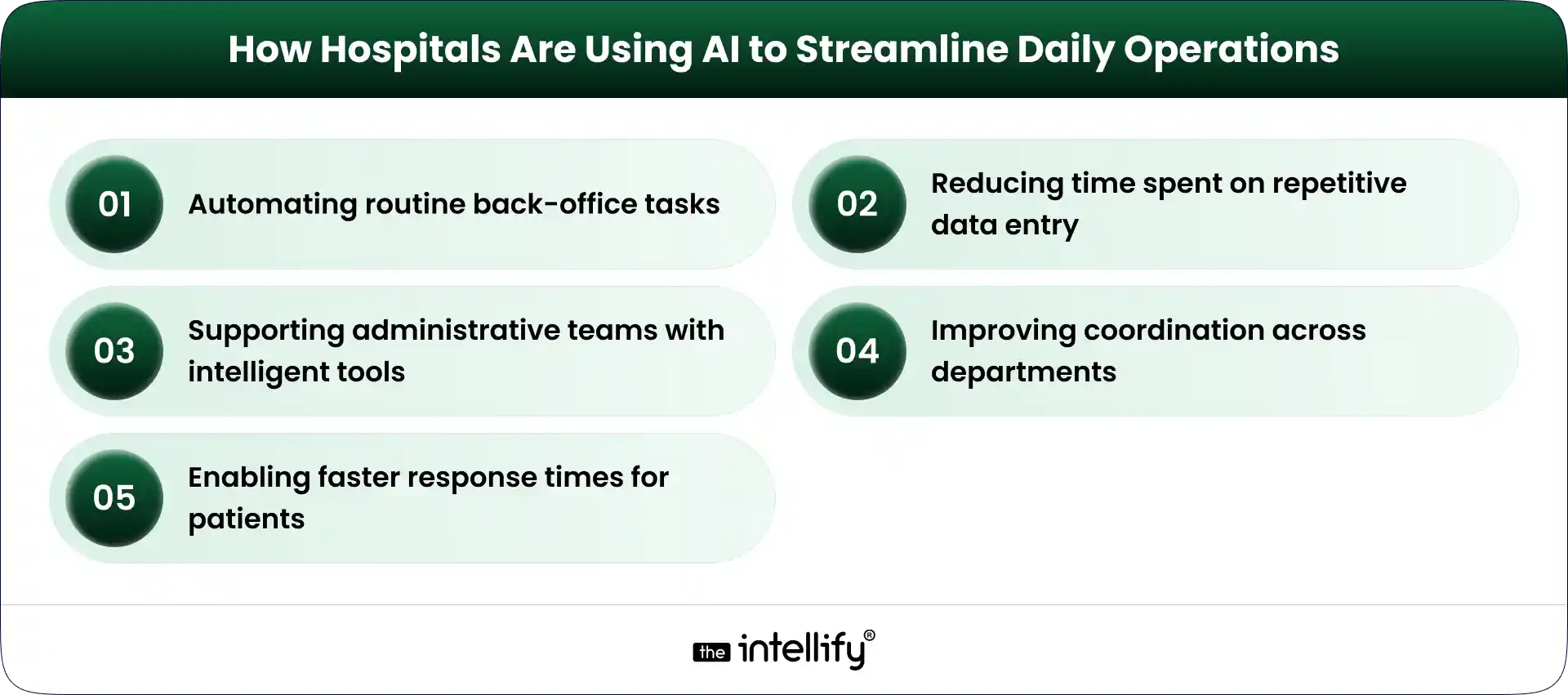
- Automating routine back-office tasks to reduce manual workload and free up staff time for higher-value activities
- Reducing time spent on repetitive data entry by minimizing paperwork and improving data accuracy across systems
- Supporting administrative teams with intelligent tools that simplify workflow management, task prioritization, and decision-making
- Improving coordination across departments by enabling seamless communication and better alignment between teams
Enabling faster response times for patients and staff, from appointment scheduling to handling queries and internal processes
These improvements help hospitals operate more efficiently while creating a smoother, faster, and more patient-focused administrative experience.
Key Use Cases of AI in Healthcare Administration
Several specific applications demonstrate how AI in healthcare can be effectively deployed in healthcare administration:
Patient Scheduling and Appointment Management
- Automated booking and rescheduling:- minimize missed appointments and optimize staff availability.
- AI quickly allocates time slots based on various factors, leading to happier patients.
Billing, Claims, and Insurance Processing
- Faster verification and claims handling speed up the revenue cycle.
- Reduced paperwork errors contribute to better financial performance.
Medical Records Management
- AI assists in organizing and retrieving patient information swiftly.
- It cuts down on duplicate or incomplete records while ensuring secure data handling.
Communication and Support Services
- Chatbots and virtual assistants offer quick answers to common patient inquiries.
- Timely reminders for appointments and follow-ups enhance patient care.
Compliance and Reporting
- AI supports monitoring documentation needs and auditing tasks.
- It helps reduce the risk of non-compliance, ensuring adherence to regulations.
Benefits for Hospitals, Staff, and Patients
Embracing AI in healthcare administration yields a slew of benefits:
- Reduced administrative workload: for healthcare professionals, allowing them to focus less on paperwork and more on meaningful tasks
- Faster processes and shorter waiting times,: leading to quicker service delivery and improved patient satisfaction
- Improved operational efficiency: through streamlined workflows and fewer manual errors across administrative functions
- More time for staff to focus on patient care: especially in areas that require human judgment, empathy, and attention
- Better overall experience for patients: with smoother interactions, timely updates, and more responsive healthcare services.
These benefits collectively help create a more efficient, patient-centric healthcare system while easing the burden on medical and administrative staff.
Challenges and Considerations When Implementing AI
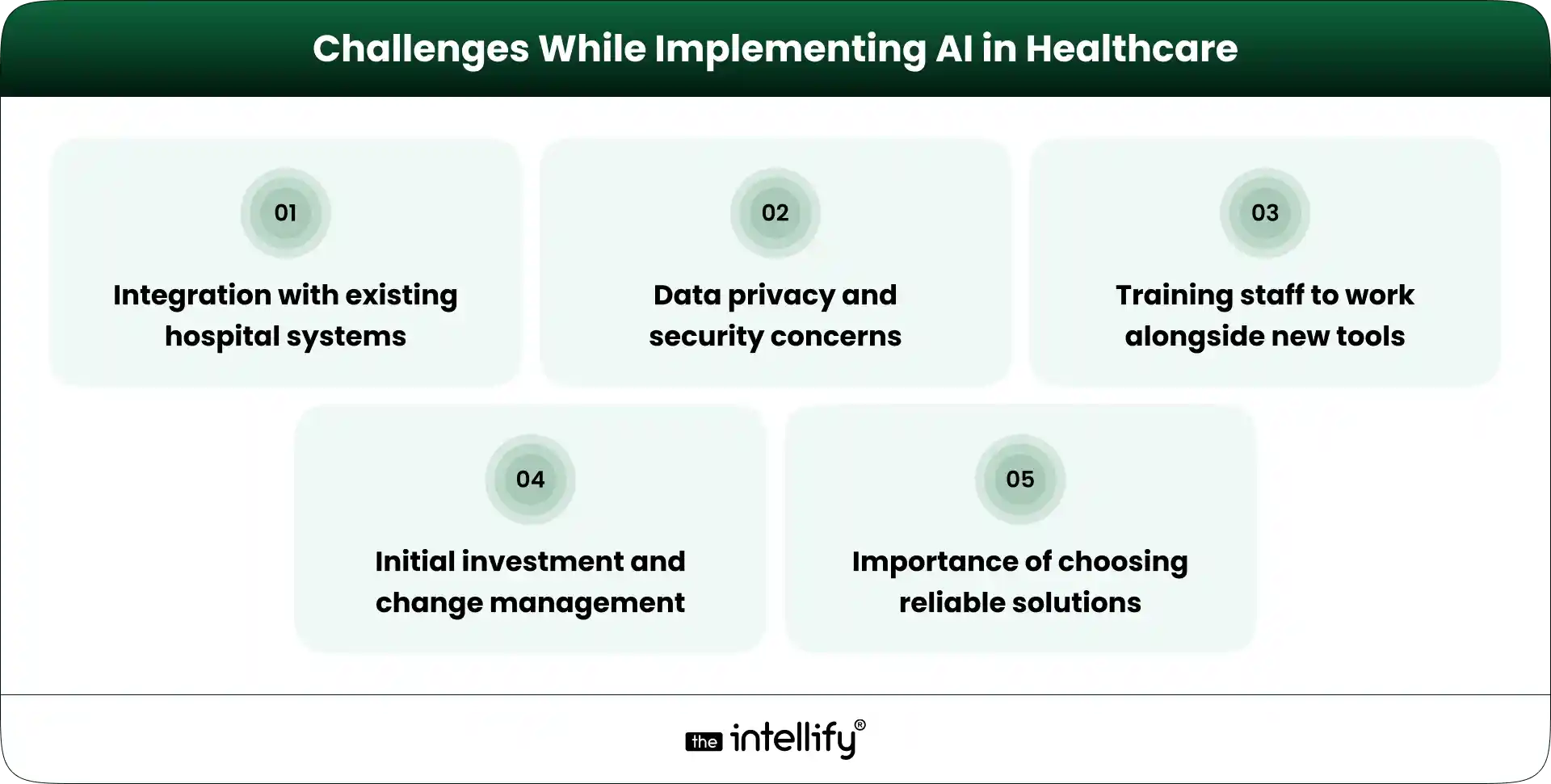
While the perks of AI are numerous, deploying it isn’t without its hurdles:
- Integration with existing hospital systems can be complex, especially when dealing with legacy infrastructure and multiple data sources
- Data privacy and security concerns must be addressed carefully to ensure compliance with healthcare regulations and protect sensitive patient information
- Training staff to work alongside new tools is essential to ensure smooth adoption and maximize the value of AI solutions
- Initial investment and change management require thoughtful planning to minimize disruption and ensure a seamless transition
- Importance of choosing practical, reliable solutions that align with real operational needs rather than overly complex or unnecessary implementations
Addressing these challenges early helps healthcare organizations adopt AI more effectively and achieve long-term success.
How AI Helps Healthcare Staff, Not Replaces Them
The role of AI is to enhance, not replace healthcare staff. Here’s how:
- Administrative work still requires judgment and empathy, which only healthcare professionals can provide
- AI handles routine tasks, while humans manage complex situations, ensuring better decision-making and patient care
- Collaboration between technology and staff enables more efficient workflows and improved outcomes
- Building trust in automated systems is essential for smooth adoption and long-term success
- Importance of oversight and accountability to ensure AI systems are used responsibly and accurately
AI works best as a support system empowering healthcare staff rather than replacing the human touch that patient care depends on.
What the Future of Healthcare Administration Looks Like
As we look ahead, it’s clear that AI will only become more entrenched in healthcare administration. We can expect to see:
- Increasing adoption of intelligent automation to handle repetitive tasks and streamline administrative workflows at scale
- More connected hospital systems enabling seamless data flow, better coordination, and improved operational efficiency
- Predictive insights for planning and resource management, helping hospitals make smarter, data-driven decisions
- Shift toward proactive rather than reactive administration, allowing issues to be identified and addressed before they escalate
- Continued focus on efficiency and patient-centered operations, ensuring smoother experiences for both staff and patients.
The future of healthcare administration will be driven by smarter systems that enhance efficiency while keeping patient care at the center of every decision.
How Organizations Can Start Adopting AI in Administration
For organizations keen to integrate AI, consider these steps:
- Identifying high-impact areas for automation where AI can quickly reduce manual workload, eliminate bottlenecks, and deliver measurable efficiency gains
- Starting with small, practical use cases to test effectiveness, minimize risk, and demonstrate early success before scaling further
- Evaluating technology partners carefully by considering their healthcare expertise, integration capabilities, and long-term scalability
- Ensuring staff involvement and training to encourage adoption, improve usability, and help teams confidently work alongside new tools
- Measuring outcomes and scaling gradually by tracking performance metrics, refining processes, and expanding AI implementation based on real results.
A phased, well-planned approach makes it easier for organizations to adopt AI successfully while ensuring long-term operational and clinical value.
Conclusion:
AI is clearly transforming the realm of healthcare administration. By boosting operational efficiency and enriching the patient experience, we can make significant strides toward sustainable healthcare systems. Thoughtful adoption of AI is crucial; rushing the implementation could stymie progress.
As we move forward, the importance of human oversight in managing AI systems can’t be overstated. Striking the right balance will enable healthcare organizations to flourish in the face of modern challenges. If you’re ready to unlock the potential of AI in healthcare administration, let us at The Intellify show you how to implement effective solutions for your organization.
Frequently Asked Questions (FAQs)
1. How is AI actually used in healthcare administration today?
AI is mainly used to handle routine tasks like appointment scheduling, billing checks, document processing, and patient communication. It helps staff complete work faster and reduces manual effort without changing clinical care.
2. Can AI reduce the paperwork burden in hospitals?
Yes. AI tools can automatically organize records, fill forms, and process documents, which significantly cuts down time spent on paperwork and reduces errors caused by manual entry.
3. Does AI in administration improve patient experience too?
Indirectly, yes. Faster scheduling, shorter waiting times, accurate billing, and quicker responses to queries all make the patient journey smoother, even though AI works behind the scenes.
4. Is AI replacing administrative staff in hospitals?
No. In most cases, AI supports staff by handling repetitive tasks, allowing them to focus on coordination, problem-solving, and patient interaction that require human judgment.
5. What administrative tasks benefit the most from AI automation?
Tasks that follow clear patterns benefit the most, such as appointment management, insurance verification, claims processing, reminders, reporting, and data entry.
6. Is AI in healthcare administration only for large hospitals?
Not anymore. Many modern solutions are scalable, meaning clinics and mid-sized hospitals can also adopt AI tools without major infrastructure changes.
7. How does AI help reduce operational costs in hospitals?
By automating routine work, hospitals need fewer manual hours for repetitive tasks, reduce errors that lead to financial losses, and improve overall efficiency, all of which lower operational expenses over time.


Written By, Jalaj Shah
The COO and Co-Founder of The Intellify. Jalaj enjoys experimenting with new strategies. His posts are fantastic for businesses seeking innovative development ideas. Discover practical insights from his engaging content.

How to Automate Patient Onboarding in a Direct Primary Care Practice
Summary: Patient onboarding automation helps Direct Primary Care (DPC) practices simplify registration, digital intake forms, membership agreements, payment setup, and patient communication. This blog explains how to automate key onboarding workflows, integrate existing healthcare systems, protect patient information, and measure operational improvements. It also covers implementation best practices to help DPC practices reduce administrative work […]
How to Integrate AI Into an Existing DPC Platform Without Rebuilding It
Summary: This blog explains how to integrate AI into an existing Direct Primary Care (DPC) platform without rebuilding the entire system. It covers AI use cases, API integrations, implementation steps, HIPAA compliance, security considerations, common challenges, and costs. DPC practices can use these insights to modernize existing software, streamline administrative workflows, and improve operational efficiency. […]
How to Scale a Direct Primary Care Practice With Technology
Summary: This guide explains how technology can help Direct Primary Care practices scale without increasing administrative workload at the same pace. It covers DPC software, membership management, scheduling, billing, patient communication, automation, AI, and healthcare platform modernization, while outlining practical ways practices can build a more connected and scalable technology infrastructure. Running a Direct […]
How to Automate Patient Onboarding in a Direct Primary Care Practice
Summary: Patient onboarding automation helps Direct Primary Care (DPC) practices simplify registration, digital intake forms, membership agreements, payment setup, and patient communication. This blog explains how to automate key onboarding workflows, integrate existing healthcare systems, protect patient information, and measure operational improvements. It also covers implementation best practices to help DPC practices reduce administrative work […]
How to Integrate AI Into an Existing DPC Platform Without Rebuilding It
Summary: This blog explains how to integrate AI into an existing Direct Primary Care (DPC) platform without rebuilding the entire system. It covers AI use cases, API integrations, implementation steps, HIPAA compliance, security considerations, common challenges, and costs. DPC practices can use these insights to modernize existing software, streamline administrative workflows, and improve operational efficiency. […]
How to Scale a Direct Primary Care Practice With Technology
Summary: This guide explains how technology can help Direct Primary Care practices scale without increasing administrative workload at the same pace. It covers DPC software, membership management, scheduling, billing, patient communication, automation, AI, and healthcare platform modernization, while outlining practical ways practices can build a more connected and scalable technology infrastructure. Running a Direct […]
0
+0
+0
+0
+Committed Delivery Leads To Client Satisfaction
Client Testimonials that keep our expert's spirits highly motivated to deliver extraordinary solutions.

Christopher Seny
My experience working with The Intellify, has been a great experience. The team has a wealth of expertise in the tech space. Working with the intellify was a growing experience for me, I learned a lot. The team keeps great communication & responds fast to new ideas & suggestions. The team also provides great suggestions & solutions as well. I couldn’t imagine working with anybody else on this project & it has been a blessing working with, The Intellify.

Izandi Serdyn
The Intellify delivered a platform from scratch, involving the client at every stage. The team was communicative, responsive, and punctual throughout the engagement. Virtual meetings and emails ensured seamless project management. Customers can expect a team that can work fast.

Kya Johnson
The app serves as an effective introduction for users to the product and its characters. Responsive and faithful to initial requirements, The Intellify’s team exceeded initial expectations. Internal stakeholders were particularly pleased with their communication.

Stefan Wyk
Working with The Intellify to develop our website was an outstanding experience. Their team displayed exceptional professionalism, creativity, and technical expertise throughout the entire process. The final product exceeded our expectations, delivering a sleek, user-friendly, and highly functional website. We highly recommend The Intellify to anyone in need of top-tier web development services.

Steve Thorpe
The Intellify’s work has been met with high praise from internal and external stakeholders. The team is efficient, diligent, and reliable in their service. They go above and beyond in terms of communication and project management. The Intellify is a responsive vendor that gets the job done.

Tal Dotan
I’ve been working with The Intellify for the last 3 years. During this period of time we’ve planned and executed projects in both small and large scale. Working with The Intellify was and still is the best decision I’ve made when rising up Divo, I strongly recommend to work with them in any type of project.


 +1-302-803-4983