AI Appointment Scheduling in Healthcare: How It Works, Key Benefits & Costs in 2026

By Shravan Rajpurohit
June 16, 2026
Summary:
AI appointment scheduling helps healthcare organizations automate booking, reduce no-shows, optimize provider schedules, and improve patient access to care. This guide explains how AI scheduling works, its key benefits, essential features, implementation costs, EHR integration requirements, and future trends shaping healthcare operations in 2026.
A missed appointment doesn’t just create an empty slot in a provider’s calendar. It can delay patient care, increase administrative workload, and reduce revenue. Now multiply that across hundreds or even thousands of appointments each month.
Healthcare organizations today face growing pressure to improve patient access while managing staffing shortages and rising operational costs. At the same time, patients expect the convenience of online booking, instant confirmations, and personalized communication.
This is why AI Appointment Scheduling is gaining traction across healthcare. By combining artificial intelligence, automation, and predictive analytics, healthcare providers can streamline scheduling, reduce no-shows, and improve the overall patient experience.
In 2026, AI-powered scheduling is no longer just a productivity tool. It has become an important part of modern healthcare operations, helping organizations deliver faster, more efficient, and patient-centric care.
Understanding AI Appointment Scheduling in Healthcare
What AI appointment scheduling is
AI appointment scheduling uses artificial intelligence to automate and optimize how healthcare appointments are booked, managed, and followed up.
Unlike traditional scheduling software that simply displays available time slots, AI-driven systems analyze provider availability, patient preferences, appointment types, historical scheduling data, and operational requirements to recommend the most suitable appointments.
How AI scheduling differs from traditional appointment management
Traditional scheduling relies heavily on administrative staff to manage bookings, cancellations, reminders, and rescheduling. AI scheduling platforms automate many of these tasks while continuously optimizing schedules. They can:
- Recommend ideal appointment slots
- Predict likely no-shows
- Fill cancelled appointments automatically
- Send personalized reminders
- Manage waitlists in real time
Technologies powering intelligent scheduling systems
Several technologies make AI scheduling possible:
- Machine Learning: Learns from historical scheduling data.
- Predictive Analytics: Forecasts appointment demand and cancellation risks.
- Conversational AI: Enables scheduling through chatbots and virtual assistants.
- Workflow Automation: Automates reminders, confirmations, and follow-up actions.
How AI appointment scheduling works from booking to follow-up
Patients can book appointments through websites, apps, chatbots, or patient portals. The system analyzes scheduling factors and suggests the best available options.
After booking, automated reminders help reduce no-shows. If cancellations occur, AI can immediately offer those slots to patients on a waitlist. Following the appointment, the system can schedule follow-ups and trigger additional patient communication workflows.
Why Healthcare Organizations Need Smarter Scheduling Systems
Patient expectations have changed dramatically. Most people expect healthcare scheduling to be as simple as booking a flight or reserving a hotel room online. However, many healthcare organizations still struggle with:
- Long call wait times
- Scheduling conflicts
- Double bookings
- Appointment gaps
- Last-minute cancellations
- High no-show rates
These issues affect both patient satisfaction and operational performance.
Manual scheduling processes also place significant pressure on front-desk staff. As healthcare organizations grow, managing appointments across multiple providers and locations becomes increasingly difficult.
AI-powered healthcare software helps address these challenges by automating repetitive tasks, improving schedule utilization, and making it easier for patients to access care.
Key Benefits of AI Appointment Scheduling for Healthcare Providers
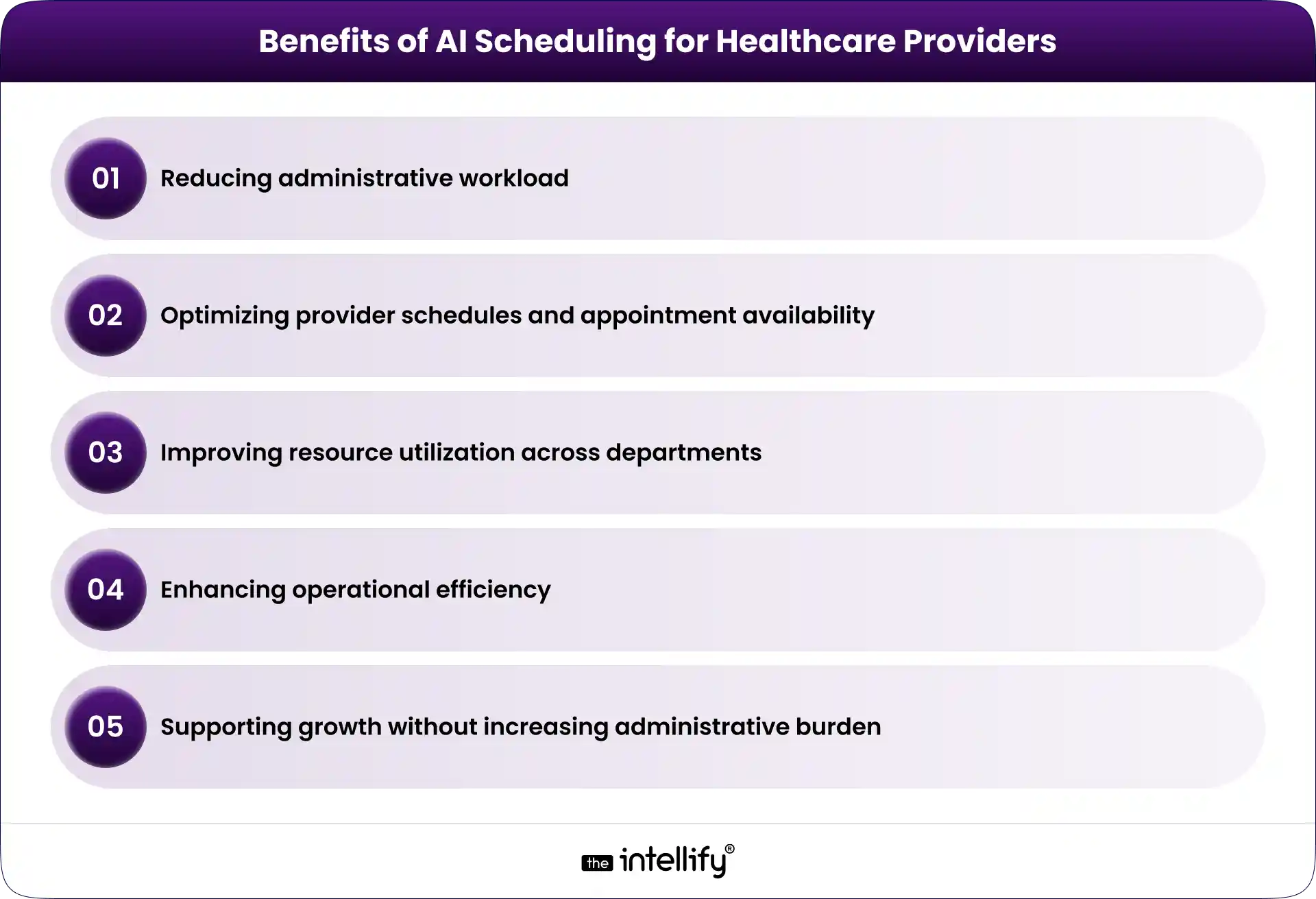
Reducing administrative workload
Administrative teams spend a large portion of their day handling scheduling-related tasks. AI in healthcare automation reduces the need for manual appointment booking, confirmations, reminders, and rescheduling. This allows staff to focus more on patient support and care coordination.
Optimizing provider schedules and appointment availability
AI scheduling systems help ensure providers’ calendars are used efficiently by minimizing gaps and balancing appointment demand. This can increase patient access without requiring additional clinical resources.
Improving resource utilization across departments
Healthcare scheduling often involves more than physicians. Exam rooms, imaging equipment, specialists, and support staff all need coordination. AI helps allocate these resources more effectively, reducing bottlenecks and operational inefficiencies.
Enhancing operational efficiency
Better scheduling leads to:
- Fewer missed appointments
- Reduced administrative costs
- Faster patient access
- Improved provider productivity
Even small improvements in scheduling efficiency can generate measurable operational benefits.
Supporting growth without increasing administrative burden
As healthcare organizations expand, AI scheduling allows them to manage larger patient volumes without proportionally increasing administrative staff. This scalability is one of the key reasons many providers are investing in intelligent scheduling solutions.
Features to Look for in AI Appointment Scheduling Software
When evaluating AI appointment scheduling software, healthcare organizations should prioritize features that improve both efficiency and patient experience.
Self-service patient scheduling
A strong AI appointment scheduling platform should allow patients to book, reschedule, and cancel appointments online at any time.
Intelligent appointment recommendations
AI should recommend appointments based on provider availability, appointment type, patient preferences, and urgency.
Automated reminders and notifications
Personalized reminders delivered through SMS, email, or voice calls help reduce missed appointments.
Smart waitlist management
Cancelled appointments can be automatically offered to patients seeking earlier availability.
Scheduling analytics and reporting
Look for dashboards that track appointment completion rates, cancellations, no-shows, and provider utilization.
Security, privacy, and compliance capabilities
The platform should support HIPAA-compliant workflows, secure data handling, audit trails, and role-based access controls.
Multi-location and multi-provider support
Organizations with multiple facilities should ensure the platform can manage scheduling across locations and providers from a centralized system.
AI Appointment Scheduling Cost in 2026: Pricing Models & ROI
Key factors that influence implementation costs
Several factors affect the cost of AI appointment scheduling:
- Practice size
- Number of providers
- Integration requirements
- Customization needs
- Deployment model
Off-the-shelf vs custom scheduling solutions
| Solution Type | Estimated Cost |
|---|---|
| Small Clinic SaaS | $100-$1,000/month |
| Multi-Location Practice | $1,500-$5,000/month |
| Enterprise Health System | $25,000-$250,000+ implementation |
| Custom AI Scheduling Platform | $50,000-$300,000+ |
Understanding the total cost of ownership
Beyond software licensing, organizations should account for:
- Implementation
- Integration
- Training
- Maintenance
- Ongoing support
Evaluating long-term return on investment
The ROI often comes from:
- Reduced no-shows
- Improved provider utilization
- Lower administrative costs
- Increased patient retention
- Better scheduling efficiency
Hidden costs to watch out for
Organizations should also plan for data migration, workflow redesign, testing, and change management activities.
Reducing No-Shows and Scheduling Gaps
Missed appointments remain one of the biggest operational challenges in healthcare. AI scheduling platforms help reduce no-shows by identifying patients who are more likely to miss appointments and sending personalized reminders based on patient behavior.
Smart waitlists further improve efficiency by automatically filling cancelled slots with patients seeking earlier appointments. These capabilities help healthcare organizations:
- Improve attendance rates
- Reduce revenue loss
- Increase provider utilization
- Improve patient access to care
For many organizations, reducing no-shows alone can significantly improve scheduling performance.
Patient Impact: From Booking to Better Outcomes
The patient experience begins long before the appointment itself. AI-powered scheduling contributes to better outcomes by providing:
- Faster appointment access
- Reduced scheduling delays
- Convenient self-service booking
- Improved follow-up compliance
- Personalized communication
When patients can access care quickly and easily, they are more likely to remain engaged throughout their treatment journey.
Improved engagement often translates into better adherence, stronger provider relationships, and higher satisfaction levels.
Real-World Applications Across Healthcare Settings
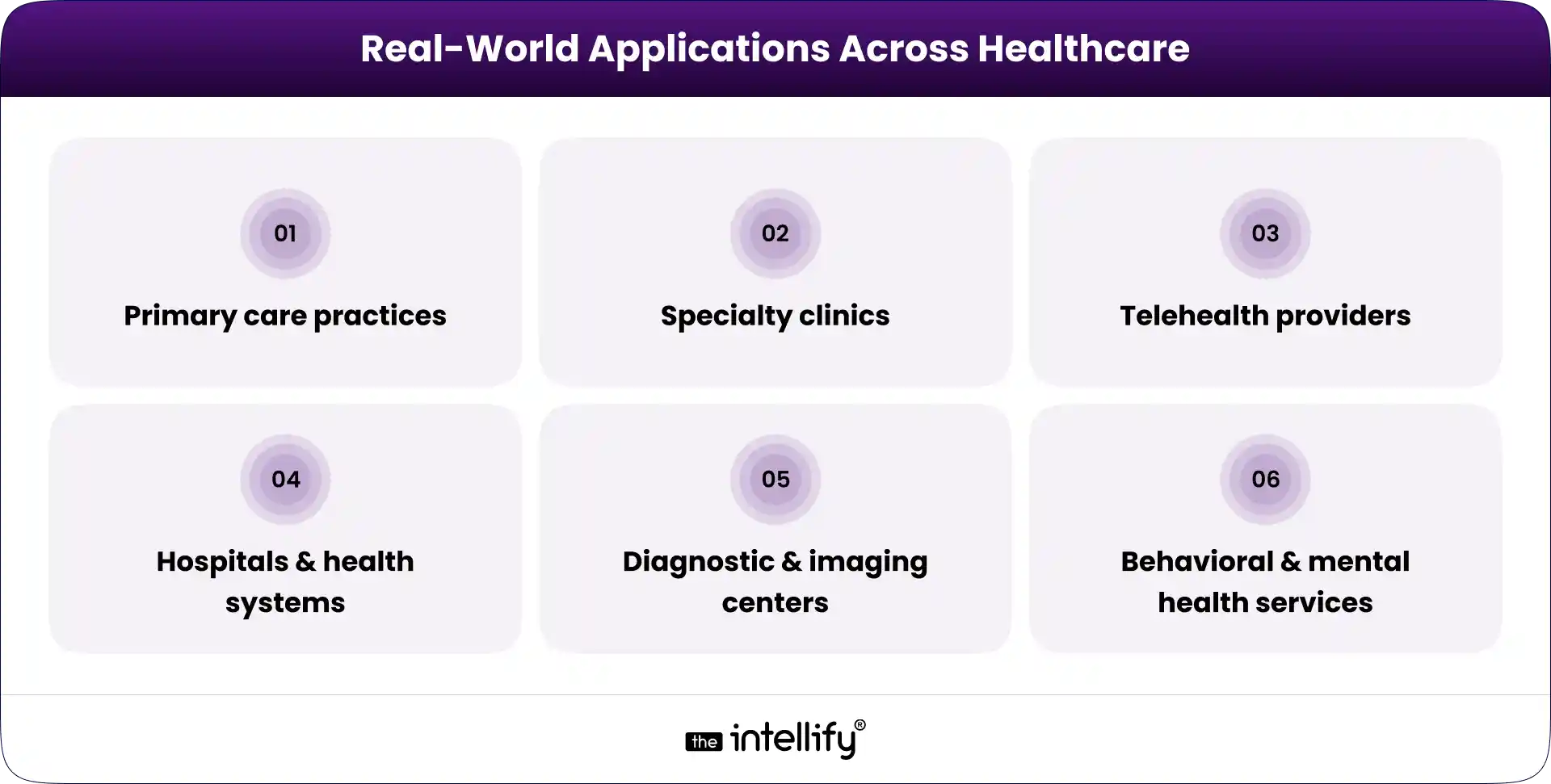
AI appointment scheduling is not limited to one type of healthcare organization. Its value extends across multiple care environments.
Primary care practices
Primary care providers often manage high patient volumes and diverse appointment types. AI scheduling helps optimize calendars, reduce wait times, and improve access to preventive care.
Specialty clinics
Specialty practices often deal with complex scheduling requirements. Whether it’s cardiology, dermatology, orthopedics, or oncology, intelligent scheduling helps coordinate providers, resources, and patient demand more effectively.
Hospitals and health systems
Large healthcare systems face enormous scheduling complexity. AI supports enterprise-wide scheduling optimization across departments, facilities, and care teams.
Telehealth providers
Virtual care depends heavily on efficient scheduling. AI helps manage provider availability, virtual appointment coordination, and patient communications.
Diagnostic and imaging centers
Imaging services often require specialized equipment and coordinated staffing. AI scheduling improves resource utilization while reducing patient wait times.
Behavioral and mental health services
Mental health providers frequently encounter high cancellation rates and ongoing treatment plans. Intelligent scheduling helps maintain appointment continuity and improve patient engagement throughout long-term care programs.
AI Scheduling and EHR Integration: Building Connected Healthcare Workflows
Why EHR integration matters
Scheduling systems deliver the most value when connected to Electronic Health Records (EHRs). Integration allows appointment workflows to synchronize with patient records, provider availability, and care plans.
Benefits of combining scheduling and EHR systems
Organizations can benefit from:
- Reduced duplicate data entry
- Improved care coordination
- Faster scheduling workflows
- Better patient visibility
- More accurate records
Important integration considerations for healthcare providers
Before implementation, providers should evaluate:
- EHR compatibility
- API availability
- Data synchronization capabilities
- Security requirements
HIPAA compliance and data security in EHR-connected workflows
Any AI scheduling solution handling patient data should support HIPAA-compliant processes, encryption, audit logging, access controls, and secure data management.
Organizations should also monitor evolving healthcare AI regulations, including requirements related to transparency and patient communication.
Measuring the Success of AI-Powered Scheduling
Healthcare organizations should establish performance metrics before implementation. Common KPIs include:
- Appointment completion rates
- No-show reduction percentages
- Provider utilization levels
- Schedule fill rates
- Patient wait times
- Patient satisfaction scores
- Online scheduling adoption rates
Tracking these metrics helps organizations identify optimization opportunities and measure ROI.
Common Challenges & Best Practices for Successful Implementation
While AI scheduling offers significant benefits, implementation requires careful planning. Common challenges include:
- Data privacy concerns
- System integration complexity
- Staff adoption issues
- Workflow adjustments
Best practices include defining clear objectives, prioritizing patient experience, Training staff thoroughly, monitoring performance continuously, and maintaining strong governance and compliance processes.
Organizations that treat AI scheduling as a long-term operational initiative typically achieve the best results.
Future of AI Appointment Scheduling
The future of healthcare scheduling will become even more intelligent.
Predictive scheduling based on patient behavior
AI systems will increasingly anticipate scheduling needs based on patient history, treatment plans, and behavioral patterns.
Conversational scheduling assistants
Patients will book appointments through natural conversations using chatbots and virtual assistants.
Voice-enabled appointment management
Conversational Voice AI will make scheduling more accessible, particularly for older adults and patients who prefer phone interactions.
Personalized scheduling experiences
Future systems will tailor appointment recommendations based on individual preferences and healthcare needs.
The evolution of intelligent healthcare operations
Scheduling is becoming part of a broader healthcare automation strategy that includes patient engagement, workforce planning, care coordination, and operational optimization.
Conclusion
Appointment scheduling plays a bigger role in healthcare performance than many organizations realize. It affects patient access, provider productivity, operational efficiency, and revenue generation.
AI appointment scheduling helps healthcare providers move beyond manual processes by automating workflows, reducing no-shows, optimizing provider availability, and improving patient experiences.
As healthcare organizations continue their digital transformation in 2026, intelligent scheduling is becoming a strategic investment rather than simply an administrative upgrade.
Providers that embrace AI-driven scheduling today will be better positioned to deliver efficient, connected, and patient-centered care in the years ahead.
Looking to Build a Custom AI Appointment Scheduling Solution?
Every healthcare organization has unique scheduling challenges, workflows, compliance requirements, and patient engagement goals.
At The Intellify, we help healthcare providers design and develop custom AI-powered scheduling solutions that integrate with EHR systems, automate patient communications, reduce no-shows, and improve operational efficiency.
Whether you’re modernizing an existing scheduling process or building a fully connected patient access platform, our team can help create a solution tailored to your organization’s needs.
Frequently Asked Questions (FAQs)
1. How does AI make appointment booking easier for patients?
Patients can book appointments anytime, view available slots instantly, and avoid long phone calls or back-and-forth scheduling. AI-powered systems also provide automated confirmations, reminders, and rescheduling options, creating a more convenient healthcare experience.
2. Can AI scheduling software manage both in-person and virtual appointments?
Yes. Most AI scheduling solutions can manage in-person visits, telehealth appointments, and hybrid care models from a single platform. This helps healthcare organizations provide flexible scheduling options while maintaining a consistent patient experience.
3. Will AI appointment scheduling replace front-desk staff?
No. AI automates repetitive scheduling tasks such as appointment booking, reminders, and rescheduling. This allows front-desk staff to focus on patient support, care coordination, and other high-value responsibilities that require human interaction.
4. What should healthcare providers look for in an AI scheduling solution?
Healthcare providers should look for features such as EHR integration, automated reminders, self-service scheduling, reporting and analytics, HIPAA-compliant security, and scalability. The right solution should fit current operational needs while supporting future growth.
5. What is the biggest benefit of AI appointment scheduling in healthcare?
The biggest benefit is improved scheduling efficiency. AI helps reduce administrative workload, optimize provider availability, minimize no-shows, and make it easier for patients to access care. This leads to better patient experiences and more efficient healthcare operations.


Written By, Shravan Rajpurohit
Shravan Rajpurohit is the Co-Founder & CEO of The Intellify, a leading Custom Software Development company that empowers startups, product development teams, and Fortune 500 companies. With over 10 years of experience in marketing, sales, and customer success, Shravan has been driving digital innovation since 2018, leading a team of 50+ creative professionals. His mission is to bridge the gap between business ideas and reality through advanced tech solutions, aiming to make The Intellify a global leader. He focuses on delivering excellence, solving real-world problems, and pushing the limits of digital transformation.

How to Integrate AI Into an Existing DPC Platform Without Rebuilding It
Summary: This blog explains how to integrate AI into an existing Direct Primary Care (DPC) platform without rebuilding the entire system. It covers AI use cases, API integrations, implementation steps, HIPAA compliance, security considerations, common challenges, and costs. DPC practices can use these insights to modernize existing software, streamline administrative workflows, and improve operational efficiency. […]

How to Scale a Direct Primary Care Practice With Technology
Summary: This guide explains how technology can help Direct Primary Care practices scale without increasing administrative workload at the same pace. It covers DPC software, membership management, scheduling, billing, patient communication, automation, AI, and healthcare platform modernization, while outlining practical ways practices can build a more connected and scalable technology infrastructure. Running a Direct […]
How to Modernize a Direct Primary Care (DPC) Platform
Summary: This guide explains how to modernize a Direct Primary Care (DPC) platform for better scalability, security, patient experience, and operational efficiency. It covers essential DPC software features, legacy system assessment, platform integrations, AI opportunities, HIPAA considerations, modernization costs, common challenges, and practical steps for deciding between modernization and a complete rebuild. Direct Primary […]
How to Integrate AI Into an Existing DPC Platform Without Rebuilding It
Summary: This blog explains how to integrate AI into an existing Direct Primary Care (DPC) platform without rebuilding the entire system. It covers AI use cases, API integrations, implementation steps, HIPAA compliance, security considerations, common challenges, and costs. DPC practices can use these insights to modernize existing software, streamline administrative workflows, and improve operational efficiency. […]
How to Scale a Direct Primary Care Practice With Technology
Summary: This guide explains how technology can help Direct Primary Care practices scale without increasing administrative workload at the same pace. It covers DPC software, membership management, scheduling, billing, patient communication, automation, AI, and healthcare platform modernization, while outlining practical ways practices can build a more connected and scalable technology infrastructure. Running a Direct […]
How to Modernize a Direct Primary Care (DPC) Platform
Summary: This guide explains how to modernize a Direct Primary Care (DPC) platform for better scalability, security, patient experience, and operational efficiency. It covers essential DPC software features, legacy system assessment, platform integrations, AI opportunities, HIPAA considerations, modernization costs, common challenges, and practical steps for deciding between modernization and a complete rebuild. Direct Primary […]
0
+0
+0
+0
+Committed Delivery Leads To Client Satisfaction
Client Testimonials that keep our expert's spirits highly motivated to deliver extraordinary solutions.

Christopher Seny
My experience working with The Intellify, has been a great experience. The team has a wealth of expertise in the tech space. Working with the intellify was a growing experience for me, I learned a lot. The team keeps great communication & responds fast to new ideas & suggestions. The team also provides great suggestions & solutions as well. I couldn’t imagine working with anybody else on this project & it has been a blessing working with, The Intellify.

Izandi Serdyn
The Intellify delivered a platform from scratch, involving the client at every stage. The team was communicative, responsive, and punctual throughout the engagement. Virtual meetings and emails ensured seamless project management. Customers can expect a team that can work fast.

Kya Johnson
The app serves as an effective introduction for users to the product and its characters. Responsive and faithful to initial requirements, The Intellify’s team exceeded initial expectations. Internal stakeholders were particularly pleased with their communication.

Stefan Wyk
Working with The Intellify to develop our website was an outstanding experience. Their team displayed exceptional professionalism, creativity, and technical expertise throughout the entire process. The final product exceeded our expectations, delivering a sleek, user-friendly, and highly functional website. We highly recommend The Intellify to anyone in need of top-tier web development services.

Steve Thorpe
The Intellify’s work has been met with high praise from internal and external stakeholders. The team is efficient, diligent, and reliable in their service. They go above and beyond in terms of communication and project management. The Intellify is a responsive vendor that gets the job done.

Tal Dotan
I’ve been working with The Intellify for the last 3 years. During this period of time we’ve planned and executed projects in both small and large scale. Working with The Intellify was and still is the best decision I’ve made when rising up Divo, I strongly recommend to work with them in any type of project.


 +1-302-803-4983