Mobile Banking App Development: Features, Security, Compliance & Cost

By Darshak Doshi
April 5, 2026
Summary:
Mobile banking app development is becoming essential as more users prefer to manage their finances on mobile. This blog gives a clear view of what it takes to build a banking app, from planning the right approach to understanding how everything comes together. It walks through the overall process, important decisions, and what businesses should consider before getting started. The aim is to help you move forward with clarity and build a practical, reliable, and ready-for-real-users solution.
Digital banking has changed the way people interact with financial services. What once required visiting a branch can now be done instantly through a mobile app, whether it’s transferring money, checking balances, or paying bills. This shift has made banking more accessible, faster, and convenient for users across different age groups.
As user expectations continue to grow, mobile-first banking has become essential for businesses. People expect seamless experiences, quick transactions, and strong security in just a few taps. In this guide, you’ll understand how mobile banking apps are developed, what features they need, how security and compliance work, and what it costs to build one.
What is a Mobile Banking Application?
Mobile banking applications allow users to access and manage their financial services through smartphones. These apps are designed to make everyday banking simple, fast, and available anytime without needing physical interaction.
In real-world usage, users can check balances, transfer funds, pay bills, and manage accounts directly from their phones. This type of application is widely used by banks, fintech startups, and enterprises that want to offer digital financial services to their customers.
As digital adoption continues to grow, these apps are becoming a core part of how modern banking services are delivered.
Types of Mobile Banking Apps
Retail Banking Apps (for everyday users)
Retail banking apps are designed for individual users who want to handle daily financial activities like checking balances, transferring money, and paying bills. These apps focus on simplicity and convenience to make everyday banking tasks easy.
Corporate Banking Apps (for businesses)
Corporate banking apps are built for businesses that need to manage bulk transactions, payroll, and financial operations. They offer more control, advanced features, and better management tools for handling business finances.
Neo-banking / Digital-Only Apps
Neo-banking apps operate completely online without physical branches and focus on digital-first experiences. They offer faster services, modern interfaces, and innovative features tailored for tech-savvy users.
How each type serves different user needs
Each type of banking app is designed based on specific user requirements, whether it’s individuals, businesses, or digital-first customers. This helps deliver more relevant and efficient financial solutions.
Why Businesses Are Investing in Mobile Banking Solutions
Rising demand for digital financial services
The demand for digital banking has increased as users prefer managing finances through mobile apps. Businesses are adopting these solutions to meet changing customer expectations and stay competitive.
Better customer experience
Mobile apps provide quick and easy access to financial services, improving overall user satisfaction. A smooth experience helps build trust and long-term customer relationships.
Reduced operational costs
Digital solutions reduce the need for physical infrastructure and manual processes. This helps businesses save costs while improving efficiency.
Faster service delivery
Mobile banking enables instant transactions and real-time updates, making services quicker and more efficient. This improves the overall user experience.
Competitive advantage in fintech market
Businesses that invest in mobile banking solutions stay ahead in the competitive fintech space. It helps them attract and retain users more effectively.
Essential Features of a Mobile Banking App
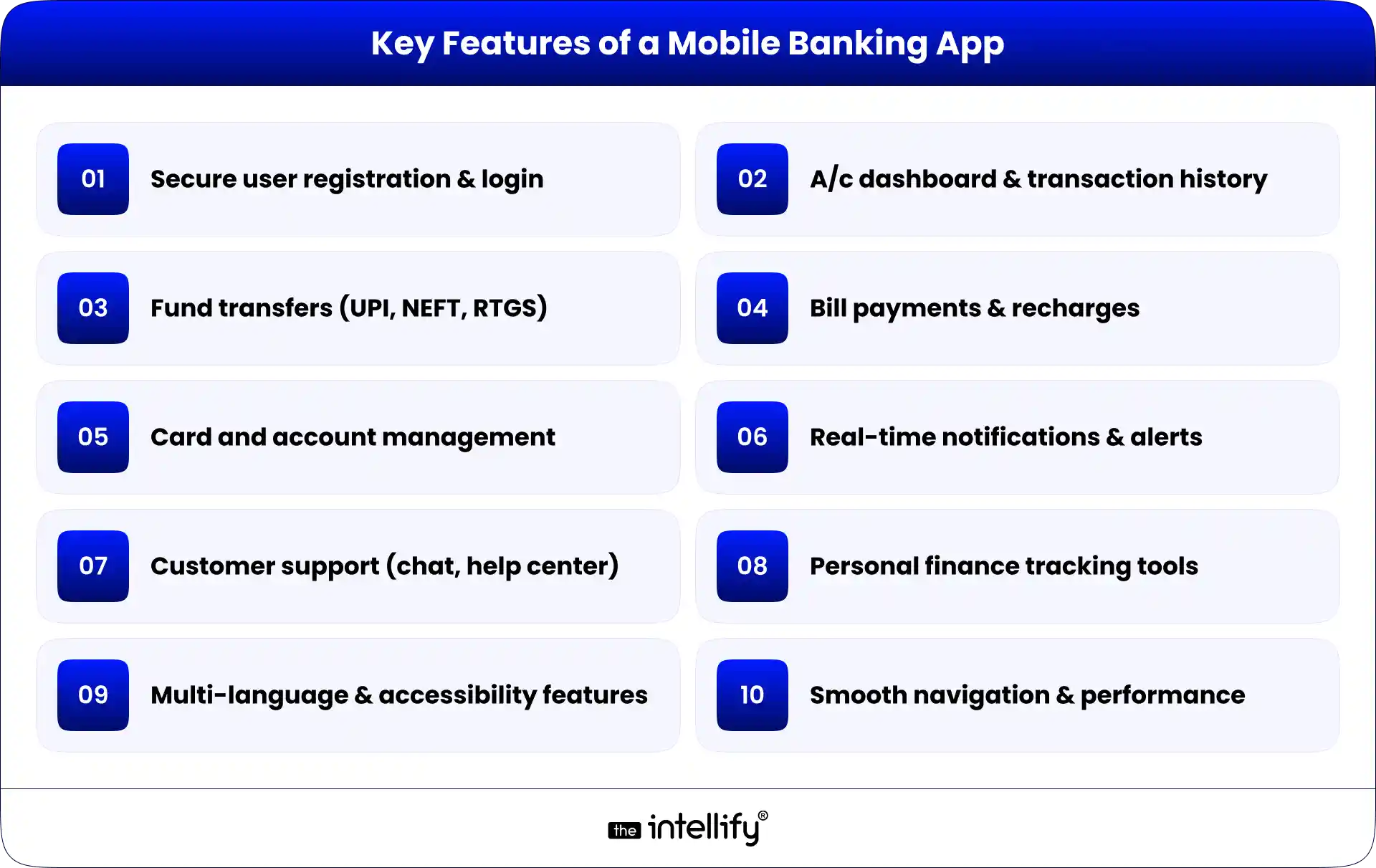
Secure user registration & login (OTP, biometrics)
Secure login methods ensure that only authorized users can access the app. Features like OTP and biometrics make the process both safe and convenient.
Account dashboard & transaction history
A clear dashboard allows users to view account balances and transaction history in one place. This helps users stay informed about their financial activities.
Fund transfers (UPI, NEFT, RTGS)
Users can transfer money quickly using multiple payment options. These features provide flexibility and convenience for different types of transactions.
Bill payments & recharges
Users can pay bills and recharge services directly through the app. This saves time and reduces dependency on multiple platforms.
Card and account management
Users can manage their cards, set limits, or block them when needed. This gives users more control over their accounts.
Real-time notifications & alerts
Instant alerts keep users updated about transactions and account activities. This improves transparency and helps detect any unusual activity quickly.
Customer support (chat, help center)
In-app support allows users to resolve issues quickly without visiting a branch. It improves user satisfaction and convenience.
Personal finance tracking tools
These tools help users track spending and manage budgets effectively. It provides better financial insights and planning.
Multi-language & accessibility features
Supporting multiple languages makes the app accessible to a wider audience. It ensures inclusivity and better user experience.
Simple navigation and clean interface
A simple design helps users complete tasks easily without confusion. Clean layouts improve usability and engagement.
Fast and smooth app performance
Fast loading speed and smooth performance are essential for user retention. Users prefer apps that work quickly without delays.
Security Measures Every Banking App Must Have
1. End-to-end encryption:- Encryption ensures that user data remains secure during transactions. It protects sensitive information from unauthorized access.
2. Multi-factor authentication (MFA):- MFA adds an extra layer of security by requiring multiple verification steps. This reduces the risk of account breaches.
3. Secure APIs and data storage:- Secure APIs ensure safe communication between systems, while protected storage keeps user data secure. This is critical for maintaining data integrity.
4. Fraud detection and monitoring:- Monitoring systems help detect suspicious activities in real time. This allows quick action to prevent fraud.
5. Session management and device binding:- These features ensure that sessions are secure and linked to specific devices. This prevents unauthorized access from unknown devices.
6. Building user trust through security:- Strong security measures help build user confidence in the app. Trust plays a major role in user retention and engagement.
Compliance and Regulatory Requirements
Importance of regulatory compliance in banking
Compliance ensures that financial operations are carried out securely and within legal boundaries. It helps build user trust while protecting businesses from legal risks and penalties.
KYC (Know Your Customer)
KYC processes verify user identity during onboarding to prevent fraud and unauthorized access. It is a key step in ensuring that only genuine users can access financial services.
AML (Anti-Money Laundering)
AML regulations help monitor and prevent suspicious financial activities such as money laundering. These checks ensure transparency and maintain the integrity of financial systems.
Data protection and privacy standards
Data protection laws ensure that user information is securely stored and handled responsibly. Following these standards is essential to maintain user trust and avoid compliance issues.
Risks of non-compliance
Failing to meet regulatory requirements can lead to heavy penalties and reputational damage. It can also result in loss of customer trust, which is difficult to rebuild.
Mobile Banking App Development Process (Step-by-Step)
1. Planning and requirement analysis: This stage defines the goals, features, and target users of the app. Proper planning ensures a smooth development process.
2. UI/UX design focused on simplicity: Design focuses on making the app easy to use and visually clear. A good design improves user engagement.
3. Development (frontend + backend):- Both frontend and backend systems are developed to ensure functionality and performance. This is the core stage of mobile app development.
4. Testing (security, usability, performance):- Testing ensures the app works smoothly and securely. It helps identify and fix issues before launch.
5. Deployment and launch:- The app is released on platforms like Android and iOS. This makes it available for users to download and use.
6.Ongoing maintenance and updates:- Regular updates improve performance and add new features. Maintenance ensures long-term stability.
Integration & Architecture of Mobile Banking Apps
- Connecting with core banking systems: Integration with core banking systems ensures real-time access to financial data. This keeps transactions accurate and updated.
- Role of APIs and third-party integrations: APIs connect different services like payments and notifications. Third-party integrations enhance app functionality.
- Payment gateway and financial service integrations: Payment gateways enable secure transactions within the app. They support multiple payment methods for user convenience.
- Cloud infrastructure and scalability: Cloud systems help handle growing user demand efficiently. They ensure the app performs well at scale.
- Ensuring smooth and secure data flow: Proper architecture ensures data flows securely between systems. This is important for performance and reliability.
- Payment systems (UPI, cards): Integration with payment systems allows users to make quick transactions. It adds flexibility to financial operations.
- Third-party services (analytics, notifications): These services improve user experience and provide insights. They help businesses track performance and engagement.
Technology Stack Used in Banking Application Development
Frontend (iOS, Android, cross-platform)
Frontend technologies define how users interact with the app across devices. Choosing the right approach ensures smooth performance and a consistent user experience.
Backend frameworks and databases
Backend systems manage data processing, storage, and core functionalities of the app. A strong backend ensures security, reliability, and seamless performance.
Cloud services and hosting
Cloud infrastructure allows the app to scale easily as the number of users grows. It also improves reliability and ensures the app performs well under high demand.
Analytics and monitoring tools
These tools help track user behavior, app performance, and system health. They provide insights that help improve features and user experience over time.
Role of AI in modern banking apps
AI in banking is used to provide personalized insights, automate tasks, and detect unusual activities. It helps make banking apps smarter, faster, and more user-friendly.
Cost of Mobile Banking App Development
- Features and complexity: More features increase the complexity and cost of development. Advanced functionality requires higher investment.
- Security and compliance requirements: Strong security and compliance add to development costs. These are essential for building a reliable app.
- Design and user experience: A well-designed app improves usability but may increase costs. Good design enhances user engagement.
- Integration needs: Integration with systems and services affects overall cost. More integrations require additional effort.
- Estimated cost range (basic vs advanced apps): Basic apps are less expensive, while advanced apps cost more due to added features. The cost depends on project scope.
- Ongoing maintenance and upgrade costs: Maintenance ensures the app stays updated and secure. It is an important part of long-term investment.
Future Trends in Mobile Banking Applications
Mobile banking is continuously evolving with new technologies that improve user experience and efficiency. AI-driven features are helping users get personalized insights, while chatbots and voice banking are making interactions more convenient.
Open banking and API ecosystems are creating more flexible financial services, allowing better integration across platforms. At the same time, blockchain and hyper-personalization are shaping the future by making banking more secure, transparent, and tailored to individual needs.
How to Choose the Right Mobile Banking App Development Partner
Choosing the right banking app development partner is essential for building a secure and scalable banking app. A reliable partner should have experience in financial technology and a strong understanding of security and compliance requirements.
It is important to review their past work, technical expertise, and support capabilities. Asking the right questions before starting the project helps ensure smooth execution and better results in the long run.

Conclusion
Mobile banking app development has become a key part of modern financial services. Businesses need to focus on creating secure, easy-to-use apps that meet evolving user expectations.
By balancing features, security, and cost, companies can build solutions that provide long-term value. With the right strategy and development approach, mobile banking apps can help businesses grow and stay competitive in the digital landscape.
Frequently Asked Questions (FAQs)
1. How much does mobile banking app development cost?
The cost mainly depends on the features, level of security, integrations, and overall design. A basic app will cost less, but a fully secure, scalable banking app with advanced features requires a higher investment.
2. How long does it take to build a mobile banking app?
The timeline varies based on complexity. A simple version can take around 3–6 months, while a more advanced app with full features, integrations, and security layers may take 6–12 months or longer.
3. What features do users expect in a mobile banking app today?
Users expect a smooth and simple experience with features like secure login, quick money transfers, real-time updates, bill payments, and an easy-to-use dashboard. Convenience and speed matter the most.
4. How do mobile banking apps ensure user data security?
Security is handled through encryption, multi-factor authentication, and continuous monitoring of user activity. These measures work together to protect sensitive data and prevent unauthorized access.
5. Can a mobile banking app integrate with existing banking systems?
Yes, mobile banking apps are designed to connect with existing core banking systems using APIs. This allows real-time transactions, accurate data updates, and smooth communication between systems.
6. What are the ongoing costs after launching a banking app?
After launch, you’ll need to invest in maintenance, security updates, hosting, compliance checks, and adding new features. These ongoing efforts keep the app secure and up to date.
7. How important is user experience in a mobile banking app?
User experience plays a big role in retention. If the app is slow, confusing, or difficult to use, users are likely to switch, even if the app has strong features.


Written By, Darshak Doshi
With over a decade of experience, Darshak is a technopreneur specializing in cloud-based applications and product development in healthcare, insurance, and manufacturing. He excels in AWS Cloud, backend development, and immersive technologies like AR/VR to drive innovation and efficiency. Darshak has also explored AI/ML in insurance and healthcare, pushing the boundaries of technology to solve complex problems. His user-focused, results-driven approach ensures he builds scalable cloud solutions, cutting-edge AR/VR experiences, and AI-driven insights that meet today’s demands while anticipating future needs.

Augmented Reality Storytelling: Turning Brand Stories into Immersive Experiences
Summary: This blog explores how Augmented Reality Storytelling helps brands create deeper engagement through immersive, interactive experiences. It explains what AR storytelling is, how it works, real-world brand examples, key benefits, and common use cases across industries. The article also covers essential features of an AR storytelling app, how to choose the right AR app […]
Fuel Delivery App Development: A Complete USA Guide
Summary: This blog covers everything you need to know about fuel delivery app development, including how on-demand fuel delivery works, key features, costs, and legal considerations in the USA. It explains how businesses can build, launch, and scale a fuel delivery app while ensuring safety, compliance, and smooth operations. Whether you’re planning a new fuel […]
How to Build an Instant Delivery App Like Blinkit & Zepto: Step-by-Step Guide
Summary: This blog explains how instant delivery apps like Blinkit and Zepto work, why the quick-commerce model is growing, and how you can build your own platform step by step. It covers features, technology, business models, costs, timelines, and common challenges. You’ll also learn what’s required for real-time delivery, dark-store operations, and logistics planning. If […]
Augmented Reality Storytelling: Turning Brand Stories into Immersive Experiences
Summary: This blog explores how Augmented Reality Storytelling helps brands create deeper engagement through immersive, interactive experiences. It explains what AR storytelling is, how it works, real-world brand examples, key benefits, and common use cases across industries. The article also covers essential features of an AR storytelling app, how to choose the right AR app […]
Fuel Delivery App Development: A Complete USA Guide
Summary: This blog covers everything you need to know about fuel delivery app development, including how on-demand fuel delivery works, key features, costs, and legal considerations in the USA. It explains how businesses can build, launch, and scale a fuel delivery app while ensuring safety, compliance, and smooth operations. Whether you’re planning a new fuel […]
How to Build an Instant Delivery App Like Blinkit & Zepto: Step-by-Step Guide
Summary: This blog explains how instant delivery apps like Blinkit and Zepto work, why the quick-commerce model is growing, and how you can build your own platform step by step. It covers features, technology, business models, costs, timelines, and common challenges. You’ll also learn what’s required for real-time delivery, dark-store operations, and logistics planning. If […]
0
+0
+0
+0
+Committed Delivery Leads To Client Satisfaction
Client Testimonials that keep our expert's spirits highly motivated to deliver extraordinary solutions.

Christopher Seny
My experience working with The Intellify, has been a great experience. The team has a wealth of expertise in the tech space. Working with the intellify was a growing experience for me, I learned a lot. The team keeps great communication & responds fast to new ideas & suggestions. The team also provides great suggestions & solutions as well. I couldn’t imagine working with anybody else on this project & it has been a blessing working with, The Intellify.

Izandi Serdyn
The Intellify delivered a platform from scratch, involving the client at every stage. The team was communicative, responsive, and punctual throughout the engagement. Virtual meetings and emails ensured seamless project management. Customers can expect a team that can work fast.

Kya Johnson
The app serves as an effective introduction for users to the product and its characters. Responsive and faithful to initial requirements, The Intellify’s team exceeded initial expectations. Internal stakeholders were particularly pleased with their communication.

Stefan Wyk
Working with The Intellify to develop our website was an outstanding experience. Their team displayed exceptional professionalism, creativity, and technical expertise throughout the entire process. The final product exceeded our expectations, delivering a sleek, user-friendly, and highly functional website. We highly recommend The Intellify to anyone in need of top-tier web development services.

Steve Thorpe
The Intellify’s work has been met with high praise from internal and external stakeholders. The team is efficient, diligent, and reliable in their service. They go above and beyond in terms of communication and project management. The Intellify is a responsive vendor that gets the job done.

Tal Dotan
I’ve been working with The Intellify for the last 3 years. During this period of time we’ve planned and executed projects in both small and large scale. Working with The Intellify was and still is the best decision I’ve made when rising up Divo, I strongly recommend to work with them in any type of project.


 +1-302-803-4983