How to Build an AI agent for Insurance: Use Cases, Benefits & ROI

By Shravan Rajpurohit
April 9, 2026
Summary:
AI agents are helping insurance companies work faster, reduce manual effort, and improve customer service. They can handle tasks like claims processing, policy updates, fraud checks, and customer support with better speed and accuracy. This blog covers real use cases, key benefits, and how to measure returns from AI adoption. It also shares simple steps to build an AI agent, along with common challenges and best practices for successful implementation.
The insurance industry is changing quickly, fueled by the demand for smarter workflows and enhanced customer experiences. AI agents for insurance are at the forefront of this transformation. These intelligent systems not only streamline operations but also elevate service delivery. In this blog, we’ll explore how to build an AI agent for insurance, its practical applications, the benefits it brings, and the expected return on investment.
Why Insurance Teams Need Smarter Workflows
Insurance operations are becoming increasingly complex and heavily reliant on data. Teams often find themselves spending a lot of time on repetitive tasks. Today’s customers expect faster claims processing, better service, and precise information. Traditional automation methods just can’t keep pace with these changing demands, making a smarter solution necessary.
With intelligent systems like AI agents, the insurance industry can embrace a more efficient and responsive operational model. These systems not only save time but also boost accuracy and service quality.
What Is an AI Agent for Insurance?
An AI agent in Insurance operations is a software solution that leverages artificial intelligence to manage various tasks throughout the insurance lifecycle. Unlike simple chatbots or straightforward automation, AI agents are designed to:
- Understand Inputs: They interpret natural language and data requests.
- Make Decisions: They analyze data to assist in multi-system decision-making.
- Take Actions: They execute tasks like claims processing and policy updates.
In essence, an AI agent functions as an intelligent assistant that enhances operational workflows in the insurance sector.
Why Insurance Processes Are Well-Suited for AI Automation
The insurance industry is ripe for AI automation for several reasons:
- High volume of Repetitive tasks: Many tasks involve repetitive decision-making actions that are perfect for automation.
- Mix of Structured and Unstructured Data: Insurance processes often utilize various data formats, making them ideal for AI analysis.
- Multiple Systems and Handoffs: AI agents can smooth transitions between different software systems, ensuring efficient workflows.
- Frequent Validation and Follow-ups: AI can effectively track and manage validation processes.
These elements create an ideal environment for AI automation in insurance.
Practical Use Cases Across the Insurance Lifecycle
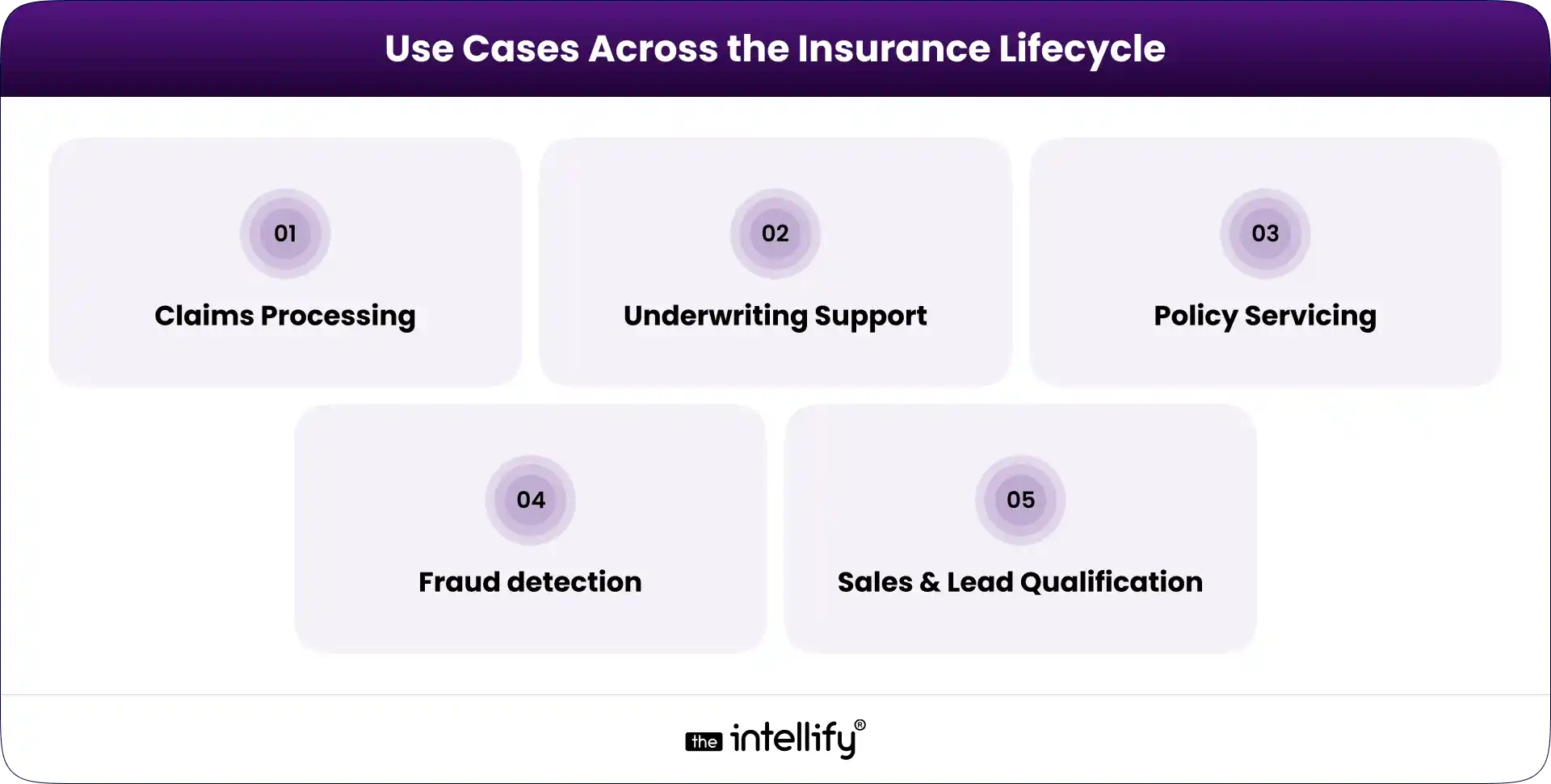
AI agents can play a significant role at various stages of the insurance lifecycle. Here are a few practical use cases:
1. Claims Processing
- Capturing the First Notice of Loss (FNOL)
- Validating documents and routing them
- Providing automatic updates to customers
2. Underwriting Support
- Aggregating data
- Conducting risk assessments and providing insights
3. Policy Servicing
- Automating customer requests
- Managing renewals and updates
4. Fraud detection
- Identifying patterns and anomalies in data
5. Sales & Lead Qualification
- Engaging leads and recommending the best products
Each of these applications can significantly boost efficiency and enhance customer satisfaction.
Business Impact: Where AI Agents Deliver Real Value
Implementing AI solutions for insurance can yield substantial business benefits:
- Faster Turnaround Times: Claims can be processed quicker and more efficiently.
- Reduced operational costs: Automation cuts down on the need for redundant manual work.
- Improved accuracy: Reducing human error enhances overall service quality.
- Better customer experience: Customers receive timely updates and tailored interactions.
- Scalable operations: AI agents can manage increased workloads with ease.
How an AI Agent for Insurance Works in Practice
Here’s a look at how an AI agent operates:
1. Input: Collect data from documents, customer requests, and existing system info.
2. Understanding: Use Natural Language Processing (NLP) to interpret user inputs and pull out relevant information.
3. Decision: Leverage AI models and business logic to make informed decisions.
4. Execution: Carry out workflow actions across various systems.
Example flow:
Claim Submission → Validation → Routing → Automated Update
This streamlined process helps eliminate bottlenecks and significantly improves operational efficiency.
AI Agent Development Process for Insurance: Step-by-Step
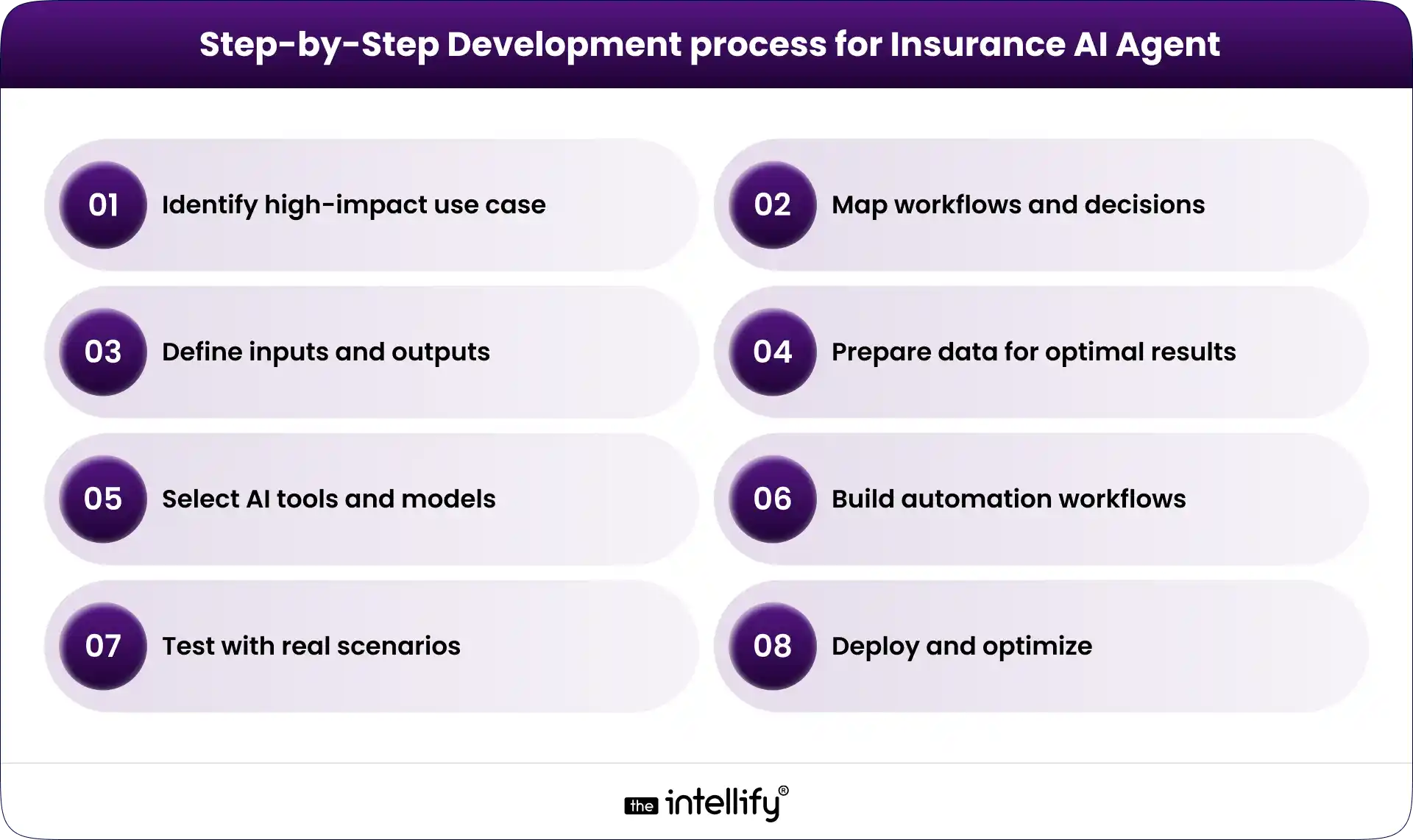
Building an AI agent development solution for insurance requires a methodical approach
1. Identify high-impact use case: Start with a process that stands to gain the most from automation.
2. Map workflows and decisions: Get a thorough understanding of existing processes.
3. Define inputs and outputs: Know what data is needed and what the expected outcomes are.
4. Prepare data: Clean and structure your data for optimal results.
5. Select AI tools and models: Choose the right technology stack for your needs.
6. Build automation workflows: Create efficient workflows that the AI can manage.
7. Test with real scenarios: Validate the system using actual data and situations.
8. Deploy and optimize: Launch the AI agent and continue to improve its functionality.
Systems and Integrations Required for AI-Driven Workflows
To successfully implement AI agents in insurance, you’ll need to integrate with a variety of systems:
- Policy administration systems: For managing policies.
- Claims platforms: To handle claims processing.
- CRM tools: For customer relationship management.
- External data sources: For Know Your Customer (KYC) and verification processes.
- APIs and middleware: To ensure proper connectivity between systems.
- Legacy system integration: To make sure older systems can work seamlessly with modern technology.
Measuring ROI of AI Agents in Insurance
Knowing your return on investment is key. Here’s how to measure it:
- Processing time reduction: Assess how much time AI saves across tasks.
- Cost savings: Compare operational costs before and after implementation.
- Error reduction: Monitor the drop in mistakes with AI support.
- Customer response improvement: Gauge shifts in customer satisfaction levels.
- KPI tracking and benchmarking: Keep an eye on key performance indicators regularly.
Common Implementation Challenges You Should Expect
While the benefits are far-reaching, some challenges might come up:
- Data quality issues: Inaccurate data can hinder AI performance.
- Legacy system integration: Merging old systems with new tech can be complex.
- Compliance requirements: Adhering to regulations is crucial.
- Internal adoption challenges: Teams may resist changes or the introduction of new technologies.
- Trust in AI decisions: Building confidence in AI-generated decisions is essential.
Addressing these challenges early on will help smooth the way for successful implementation.
Best Practices for Scaling Across Insurance Operations
To effectively scale AI agents in your insurance operations:
1. Start with one use case: Focus on a specific, impactful area first.
2. Scale based on results: Analyze outcomes before expanding.
3. Maintain human oversight: Ensure staff can monitor AI decisions.
4. Build flexible workflows: Adapt systems as your business needs evolve.
5. Continuously optimize: Regularly update AI functionalities based on user feedback.
Choosing the Right Approach to AI Agent Development in Insurance
When developing AI agents, keep these points in mind:
- Evaluate workflow complexity: Understand the intricacies of your operations.
- Data readiness: Make sure you have clean, actionable data ready for AI analysis.
- Custom vs Structured AI Solutions: Determine what fits best for your specific needs.
Find development services that are well-versed in the insurance domain, offer scalable AI solutions, and can integrate seamlessly with your existing systems.
How AI Agents Are Shaping the Future of Insurance
AI agents are leading the charge toward the future of insurance through:
1. Autonomous workflows: Diminishing the need for manual oversight.
2. Real-time decision-making: Delivering immediate answers and recommendations.
3. Personalized experiences: Crafting services tailored to individual preferences.
4. Integration with conversational AI: Elevating customer interactions through smooth dialogues.
AI isn’t just a tool; it’s becoming a key player in insurance operations.
Conclusion
Transitioning from manual tasks to intelligent execution is crucial for the insurance landscape. Embracing AI agents can dramatically enhance efficiency, accuracy, and scalability.
By implementing the right strategy and seeking expert assistance, your insurance business can open the door to a future brimming with opportunity and innovation.
Frequently Asked Questions (FAQs)
1. How is an AI agent different from traditional automation in insurance?
Traditional automation follows fixed rules, so it struggles with exceptions. An AI agent can understand context, make decisions, and handle variations in real-time, which makes it much more flexible for insurance workflows.
2. What kind of insurance processes can be fully handled by AI agents?
AI agents can manage tasks like claim intake, document validation, customer queries, and basic underwriting support. Most companies start with partial automation and then expand to more end-to-end workflows over time.
3. How long does it take to build an AI agent for insurance use cases?
It depends on the complexity. A focused use case like claims intake can take a few weeks, while more advanced workflows involving multiple systems may take a few months to fully implement and optimize.
4. What data is required to build an AI agent for insurance?
You typically need access to policy data, claims data, customer interactions, and documents. The more structured and clean the data is, the better the AI agent performs.
5. Can AI agents work with legacy insurance systems?
Yes, but it requires proper integration using APIs or middleware. Many insurance companies don’t replace legacy systems they connect AI agents on top of them to improve workflows.
6. How do AI agents help reduce claim processing time?
They automate steps like document checks, data extraction, and routing. Instead of manual back-and-forth, the process moves faster with fewer delays and fewer errors.
7. How can The Intellify assist in developing an AI agent for insurance?
The Intellify offers tailored AI solutions for insurance companies, ensuring seamless integration, effective workflows, and ongoing support for peak performance.


Written By, Shravan Rajpurohit
Shravan Rajpurohit is the Co-Founder & CEO of The Intellify, a leading Custom Software Development company that empowers startups, product development teams, and Fortune 500 companies. With over 10 years of experience in marketing, sales, and customer success, Shravan has been driving digital innovation since 2018, leading a team of 50+ creative professionals. His mission is to bridge the gap between business ideas and reality through advanced tech solutions, aiming to make The Intellify a global leader. He focuses on delivering excellence, solving real-world problems, and pushing the limits of digital transformation.

Where AI Voice Agents Fit Into a Modern DPC Platform
Summary: AI voice agents can become a practical part of a modern Direct Primary Care (DPC) platform by handling routine phone interactions, appointment scheduling, membership questions, reminders, and call routing. This guide explains where voice AI fits within the DPC technology stack, what tasks it should and shouldn’t handle, HIPAA considerations, integration requirements, and how […]
AI Appointment Scheduling in Healthcare: How It Works, Key Benefits & Costs in 2026
Summary: AI appointment scheduling helps healthcare organizations automate booking, reduce no-shows, optimize provider schedules, and improve patient access to care. This guide explains how AI scheduling works, its key benefits, essential features, implementation costs, EHR integration requirements, and future trends shaping healthcare operations in 2026. A missed appointment doesn’t just create an empty slot in […]
How to Build AI for Real Estate Investment and Market Analysis
Summary: AI for real estate investment is helping investors and property businesses make smarter, faster, and more data-driven decisions. This guide explains how to build an AI-powered real estate investment platform, covering essential features, data sources, AI technologies, market analysis capabilities, development steps, business benefits, and future trends shaping the real estate industry. Real […]
Where AI Voice Agents Fit Into a Modern DPC Platform
Summary: AI voice agents can become a practical part of a modern Direct Primary Care (DPC) platform by handling routine phone interactions, appointment scheduling, membership questions, reminders, and call routing. This guide explains where voice AI fits within the DPC technology stack, what tasks it should and shouldn’t handle, HIPAA considerations, integration requirements, and how […]
AI Appointment Scheduling in Healthcare: How It Works, Key Benefits & Costs in 2026
Summary: AI appointment scheduling helps healthcare organizations automate booking, reduce no-shows, optimize provider schedules, and improve patient access to care. This guide explains how AI scheduling works, its key benefits, essential features, implementation costs, EHR integration requirements, and future trends shaping healthcare operations in 2026. A missed appointment doesn’t just create an empty slot in […]
How to Build AI for Real Estate Investment and Market Analysis
Summary: AI for real estate investment is helping investors and property businesses make smarter, faster, and more data-driven decisions. This guide explains how to build an AI-powered real estate investment platform, covering essential features, data sources, AI technologies, market analysis capabilities, development steps, business benefits, and future trends shaping the real estate industry. Real […]
0
+0
+0
+0
+Committed Delivery Leads To Client Satisfaction
Client Testimonials that keep our expert's spirits highly motivated to deliver extraordinary solutions.

Christopher Seny
My experience working with The Intellify, has been a great experience. The team has a wealth of expertise in the tech space. Working with the intellify was a growing experience for me, I learned a lot. The team keeps great communication & responds fast to new ideas & suggestions. The team also provides great suggestions & solutions as well. I couldn’t imagine working with anybody else on this project & it has been a blessing working with, The Intellify.

Izandi Serdyn
The Intellify delivered a platform from scratch, involving the client at every stage. The team was communicative, responsive, and punctual throughout the engagement. Virtual meetings and emails ensured seamless project management. Customers can expect a team that can work fast.

Kya Johnson
The app serves as an effective introduction for users to the product and its characters. Responsive and faithful to initial requirements, The Intellify’s team exceeded initial expectations. Internal stakeholders were particularly pleased with their communication.

Stefan Wyk
Working with The Intellify to develop our website was an outstanding experience. Their team displayed exceptional professionalism, creativity, and technical expertise throughout the entire process. The final product exceeded our expectations, delivering a sleek, user-friendly, and highly functional website. We highly recommend The Intellify to anyone in need of top-tier web development services.

Steve Thorpe
The Intellify’s work has been met with high praise from internal and external stakeholders. The team is efficient, diligent, and reliable in their service. They go above and beyond in terms of communication and project management. The Intellify is a responsive vendor that gets the job done.

Tal Dotan
I’ve been working with The Intellify for the last 3 years. During this period of time we’ve planned and executed projects in both small and large scale. Working with The Intellify was and still is the best decision I’ve made when rising up Divo, I strongly recommend to work with them in any type of project.


 +1-302-803-4983