How Digital Transformation in Healthcare Is Shaping the Industry’s Future

By Shravan Rajpurohit
April 17, 2026
Summary:
Digital transformation in healthcare is changing how systems, data, and processes work together. It is helping improve coordination, reduce delays, and make operations more efficient. Healthcare organizations are using connected technologies and data to manage services better and respond faster. While there are challenges, many are moving forward step by step to improve their systems. Overall, it is shaping a more connected and efficient future for the healthcare industry.
Digital transformation in healthcare is changing how systems, data, and processes work together. It is helping improve coordination, reduce delays, and make operations more efficient. Healthcare organizations are using connected technologies and data to manage services better and respond faster. While there are challenges, many are moving forward step by step to improve their systems. Overall, it is shaping a more connected and efficient future for the healthcare industry.
It is not just improving how healthcare works today, but also shaping how systems will function in the coming years. As the industry evolves, digital transformation is becoming a key part of long-term healthcare growth.
How Healthcare Systems Are Becoming More Connected
In the past, healthcare often relied on outdated manual processes and isolated systems. Departments worked in silos, resulting in gaps in coordination and efficiency. As a consequence, managing the ever-growing sea of patient and operational data could feel like an uphill battle, leading to frustration for both providers and patients alike.
Nowadays, the demand for interconnected systems is surging. Healthcare providers are starting to understand that the secret to enhancing service delivery lies in building systems that foster communication and collaboration.
This level of connectivity reduces repeated work and improves the overall flow of services. It also helps different parts of the system work together more smoothly.
Digital Transformation in Healthcare as the New Foundation

Digital transformation in healthcare isn’t just about switching to digital formats; it represents a fundamental change in how healthcare systems operate. This transformation aims to connect people, processes, and data into a smooth, cohesive flow.
- Reducing operational gaps: Automation of workflows and system integration helps minimize delays and miscommunications, enabling better care delivery.
- Modern foundation: This transformation forms the solid groundwork on which today’s healthcare systems are built, enhancing patient experiences and operational efficiencies.
What makes Digital Transformation Essential in Healthcare
The rapid pace of change in healthcare brings several challenges:
- Managing Data: The amount of patient and operational data continues to grow. Digital transformation enables healthcare organizations to manage and harness this data for improved decision-making.
- Faster Coordination: As healthcare teams expand, quick coordination across various systems becomes crucial. Digital tools offer real-time data sharing, ensuring everyone stays aligned.
- Meeting Expectations: Today’s patients expect smooth, accessible services. Digital transformation equips healthcare providers to meet these rising expectations.
It also helps bring more consistency in how services are delivered across different systems. As operations grow, managing complexity without digital support becomes difficult.
Where Digital Healthcare Transformation Is Creating Real Impact
Digital healthcare transformation is delivering tangible benefits across the industry:
- Improved coordination: Departments and teams can now communicate effectively, fostering trust and collaboration.
- Faster Communication: Instant messaging systems and data-sharing platforms cut down on waiting times and speed up decision-making.
- Efficient Workflows: Routine processes are now more structured, giving healthcare professionals more time to focus on what matters patient care.
It also improves visibility across systems, helping teams make quicker and more informed decisions.
Technologies Behind Digital Transformation in Healthcare Solutions
Several cutting-edge technologies drive the digital transformation in healthcare solutions:
- AI: This technology speeds up analysis and supports quicker decision-making.
- Cloud Systems: These enable secure access to and sharing of data.
- Connected Devices: They allow for continuous monitoring of patient health.
- Data Platforms: These help organize and simplify vast amounts of information.
- Integration Tools: They link multiple systems, facilitating smooth operations.
Together, these technologies form the backbone of a transformed healthcare landscape, paving the way for smarter, more efficient practices.
How healthcare Operations Are Being Reshaped Internally
Internally, healthcare operations are prioritizing efficiency:
- Reduction in manual work: Automation takes over routine tasks, freeing staff to focus on vital issues.
- Faster process Handling: Fewer bottlenecks in workflows enable healthcare facilities to quickly respond to patient needs.
- Better Use of Resources: By optimizing staff time and hospital resources, organizations can provide improved care.
- Improved Accuracy: Less manual intervention means fewer mistakes, boosting overall service quality.
This allows healthcare organizations to respond faster to changing needs and improve overall service delivery.
The Expanding Role of Data in Healthcare
Gone are the days when data was merely stored away. Now, it plays a vital role in everyday operations:
- Real Time Access: Quick access to data enhances decision-making and planning processes.
- Better Resource Management: Data analytics empower organizations to allocate staff and materials more effectively.
- Connected Systems: A solid data strategy fosters informed systems that can dynamically respond to patient needs.
Over time, this is helping healthcare systems move toward more planned and proactive decision-making.
Challenges in Adopting Digital Transformation in Healthcare
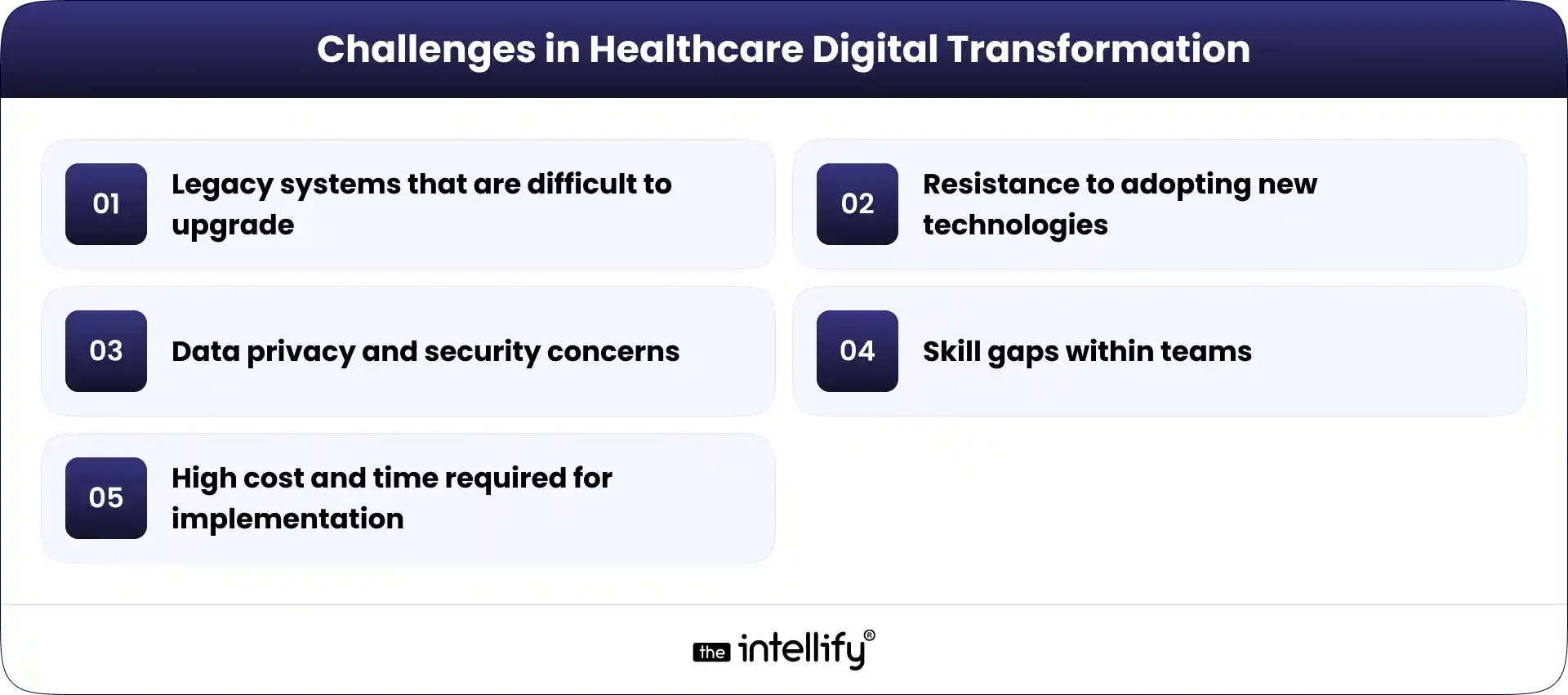
Yet, the path to adopting digital transformation isn’t without its hurdles:
- Legacy Systems: Many organizations struggle with outdated systems that aren’t easy to upgrade.
- Privacy and Security Concerns: Safeguarding sensitive patient data is crucial and can slow technology adoption.
- Resistance to Change: Some staff may be hesitant to embrace new technologies, which can stall progress.
- Skill Gaps: Existing teams might lack the necessary skills for implementation, requiring additional training.
- Implementation Costs: Upgrading systems can be costly and time-consuming, making many organizations hesitant to proceed.
These challenges can slow progress, but with the right approach, they can be managed over time.
How Healthcare Organizations Are Improving Their Systems
Healthcare organizations are cautiously progressing with strategies to enhance their frameworks:
- Gradual adoption: Instead of a complete overhaul, many are choosing incremental improvements that minimize disruption.
- Training Initiatives: Investing in staff training ensures teams are ready to tackle new systems effectively.
- Scalable Solutions: Organizations focus on flexible technology that can adapt as their needs grow.
- Partnerships with Tech Providers: Teaming up with experienced technology providers can lead to better outcomes.
- Long Term Focus: Emphasizing ongoing improvements and results is crucial for sustainable transformation.
The focus is on making systems more stable, reliable, and easier to manage in the long run.
Real-World Applications in Healthcare Services
Digital transformation in healthcare services is already showing its worth in various areas:
- Online Consultations: Telehealth is enhancing patient access to healthcare services.
- Digital Health Records: Streamlined management of information reduces paperwork and makes care more efficient.
- Remote Monitoring: Wearable tech supports continuous patient care, boosting health outcomes.
- Automation: Routine tasks, from scheduling to billing, are increasingly automated to cut delays.
- Better Coordination: Enhanced communication tools ensure smooth service across all touchpoints.
These applications are already changing how healthcare services are delivered and experienced.
How Healthcare Systems Are Changing for the Future
The future of healthcare is on a transformative path:
Connected Systems: Improved integration offers a more holistic view of patient care.
Faster Service Delivery: Automation and streamlined processes ensure prompt care.
Increased Automation: Smart tools and technologies are set to reshape daily operations further.
Improved Coordination: A more connected infrastructure will facilitate stronger relationships among providers.
Healthcare systems are expected to become more proactive rather than reactive in handling needs.
What Healthcare Organizations Need to Focus on Next
Looking ahead, healthcare organizations should concentrate on:
Scalability: Designing systems that can adapt to future challenges.
Digital Strategy: Making digital transformation a cornerstone of long-term planning.
Continuous Improvement: Prioritizing process refinement over merely implementing new tools.
Alignment of Teams: Ensuring that people, processes, and technology work in harmony.
Staying Adaptable: Keeping an open mind toward new technologies and changing patient expectations.
The goal is to build systems that can support continuous change and future growth.
Conclusion:
Digital transformation is no longer a choice; it’s central to how the healthcare industry operates. As organizations embrace these changes, they’re paving the way for more connected, efficient systems that ultimately benefit everyone from healthcare providers to patients.
The journey is just beginning, and healthcare organizations need to remain flexible and proactive to stay relevant in an ever-evolving landscape. By effectively implementing these changes, the future of healthcare looks bright, buoyed by innovation and progress.
Frequently Asked Questions
1. Why do traditional healthcare systems face limitations?
They depend on manual work and disconnected systems, which slows down processes. This makes it harder to manage data, coordinate teams, and deliver services efficiently.
2. How do connected systems improve healthcare services?
They allow information to move smoothly between departments and teams. This improves coordination, reduces errors, and helps deliver services faster.
3.. What changes do healthcare teams notice after going digital?
Teams experience faster workflows and less dependency on paperwork. They also see better accuracy and smoother coordination across different departments.
4. What are the common challenges in digital transformation for healthcare?
Many organizations struggle with outdated systems and data security concerns. They also need time and training to help teams adapt to new ways of working.
5. What should healthcare organizations focus on moving forward?
They should focus on building flexible systems that can adapt over time. Continuous improvement in processes and team readiness is also important for long-term success.


Written By, Shravan Rajpurohit
Shravan Rajpurohit is the Co-Founder & CEO of The Intellify, a leading Custom Software Development company that empowers startups, product development teams, and Fortune 500 companies. With over 10 years of experience in marketing, sales, and customer success, Shravan has been driving digital innovation since 2018, leading a team of 50+ creative professionals. His mission is to bridge the gap between business ideas and reality through advanced tech solutions, aiming to make The Intellify a global leader. He focuses on delivering excellence, solving real-world problems, and pushing the limits of digital transformation.

How to Automate Patient Onboarding in a Direct Primary Care Practice
Summary: Patient onboarding automation helps Direct Primary Care (DPC) practices simplify registration, digital intake forms, membership agreements, payment setup, and patient communication. This blog explains how to automate key onboarding workflows, integrate existing healthcare systems, protect patient information, and measure operational improvements. It also covers implementation best practices to help DPC practices reduce administrative work […]
How to Integrate AI Into an Existing DPC Platform Without Rebuilding It
Summary: This blog explains how to integrate AI into an existing Direct Primary Care (DPC) platform without rebuilding the entire system. It covers AI use cases, API integrations, implementation steps, HIPAA compliance, security considerations, common challenges, and costs. DPC practices can use these insights to modernize existing software, streamline administrative workflows, and improve operational efficiency. […]
How to Scale a Direct Primary Care Practice With Technology
Summary: This guide explains how technology can help Direct Primary Care practices scale without increasing administrative workload at the same pace. It covers DPC software, membership management, scheduling, billing, patient communication, automation, AI, and healthcare platform modernization, while outlining practical ways practices can build a more connected and scalable technology infrastructure. Running a Direct […]
How to Automate Patient Onboarding in a Direct Primary Care Practice
Summary: Patient onboarding automation helps Direct Primary Care (DPC) practices simplify registration, digital intake forms, membership agreements, payment setup, and patient communication. This blog explains how to automate key onboarding workflows, integrate existing healthcare systems, protect patient information, and measure operational improvements. It also covers implementation best practices to help DPC practices reduce administrative work […]
How to Integrate AI Into an Existing DPC Platform Without Rebuilding It
Summary: This blog explains how to integrate AI into an existing Direct Primary Care (DPC) platform without rebuilding the entire system. It covers AI use cases, API integrations, implementation steps, HIPAA compliance, security considerations, common challenges, and costs. DPC practices can use these insights to modernize existing software, streamline administrative workflows, and improve operational efficiency. […]
How to Scale a Direct Primary Care Practice With Technology
Summary: This guide explains how technology can help Direct Primary Care practices scale without increasing administrative workload at the same pace. It covers DPC software, membership management, scheduling, billing, patient communication, automation, AI, and healthcare platform modernization, while outlining practical ways practices can build a more connected and scalable technology infrastructure. Running a Direct […]
0
+0
+0
+0
+Committed Delivery Leads To Client Satisfaction
Client Testimonials that keep our expert's spirits highly motivated to deliver extraordinary solutions.

Christopher Seny
My experience working with The Intellify, has been a great experience. The team has a wealth of expertise in the tech space. Working with the intellify was a growing experience for me, I learned a lot. The team keeps great communication & responds fast to new ideas & suggestions. The team also provides great suggestions & solutions as well. I couldn’t imagine working with anybody else on this project & it has been a blessing working with, The Intellify.

Izandi Serdyn
The Intellify delivered a platform from scratch, involving the client at every stage. The team was communicative, responsive, and punctual throughout the engagement. Virtual meetings and emails ensured seamless project management. Customers can expect a team that can work fast.

Kya Johnson
The app serves as an effective introduction for users to the product and its characters. Responsive and faithful to initial requirements, The Intellify’s team exceeded initial expectations. Internal stakeholders were particularly pleased with their communication.

Stefan Wyk
Working with The Intellify to develop our website was an outstanding experience. Their team displayed exceptional professionalism, creativity, and technical expertise throughout the entire process. The final product exceeded our expectations, delivering a sleek, user-friendly, and highly functional website. We highly recommend The Intellify to anyone in need of top-tier web development services.

Steve Thorpe
The Intellify’s work has been met with high praise from internal and external stakeholders. The team is efficient, diligent, and reliable in their service. They go above and beyond in terms of communication and project management. The Intellify is a responsive vendor that gets the job done.

Tal Dotan
I’ve been working with The Intellify for the last 3 years. During this period of time we’ve planned and executed projects in both small and large scale. Working with The Intellify was and still is the best decision I’ve made when rising up Divo, I strongly recommend to work with them in any type of project.


 +1-302-803-4983