Top AI Trends in Healthcare: Transforming Digital Health in 2026

By Jalaj Shah
April 22, 2026
Summary:
AI trends in healthcare are helping systems become smarter and more data-driven instead of just digital. They support early disease detection, personalized treatments, and remote patient monitoring. This is improving how care is delivered while making hospital operations more efficient. AI also helps reduce the workload on healthcare providers and improves overall patient experience. Despite some challenges, it is becoming an important part of modern, connected healthcare systems.
Why AI is Becoming the Driving Force Behind Digital Health
Healthcare isn’t just going digital anymore; it’s becoming smarter. As technology keeps advancing, artificial intelligence (AI) is reshaping the healthcare landscape in ways we never imagined. With hospitals facing increasing demands to enhance speed, accuracy, and overall patient care, AI is proving to be a crucial ally in bridging the gap between vast amounts of data and actionable decision-making.
In this blog, we’ll delve into AI trends in healthcare that are actively revolutionising digital health. From predictive analytics to personalised treatment plans, these trends are dramatically transforming our approach to healthcare.
Digital Health Transformation in Modern Healthcare Systems
So what does “digital health” really mean today? It goes beyond just having software and applications; it’s about establishing a connected, data-driven healthcare system that genuinely meets patient needs. Modern healthcare systems aren’t just digitizing existing processes; they’re harnessing technology to create a more responsive, integrated, and efficient environment.
Patients today have higher expectations regarding speed, access, and personalized care. They want more than just scheduled visits; they’re looking for tailored health experiences. Digital transformation alone isn’t sufficient adding a robust AI layer is essential to fully leverage the potential of this shift.
The Growing Role of AI in Healthcare Industry
The surge of data in healthcare from electronic health records (EHRs) to wearables and diagnostic tools is monumental. Yet, traditional human-led systems can no longer manage this volume alone. AI isn’t here to replace healthcare professionals; it’s designed to support them. It serves as the backbone of modern healthcare systems, delivering insights and analytics that lead to better patient outcomes.
Today, AI is being used across multiple touchpoints in healthcare, from analyzing patient records to assisting in diagnosis and treatment planning. This shift is helping healthcare professionals rely more on data-backed insights rather than assumptions.
Key AI Trends in Healthcare Driving Digital Health Transformation
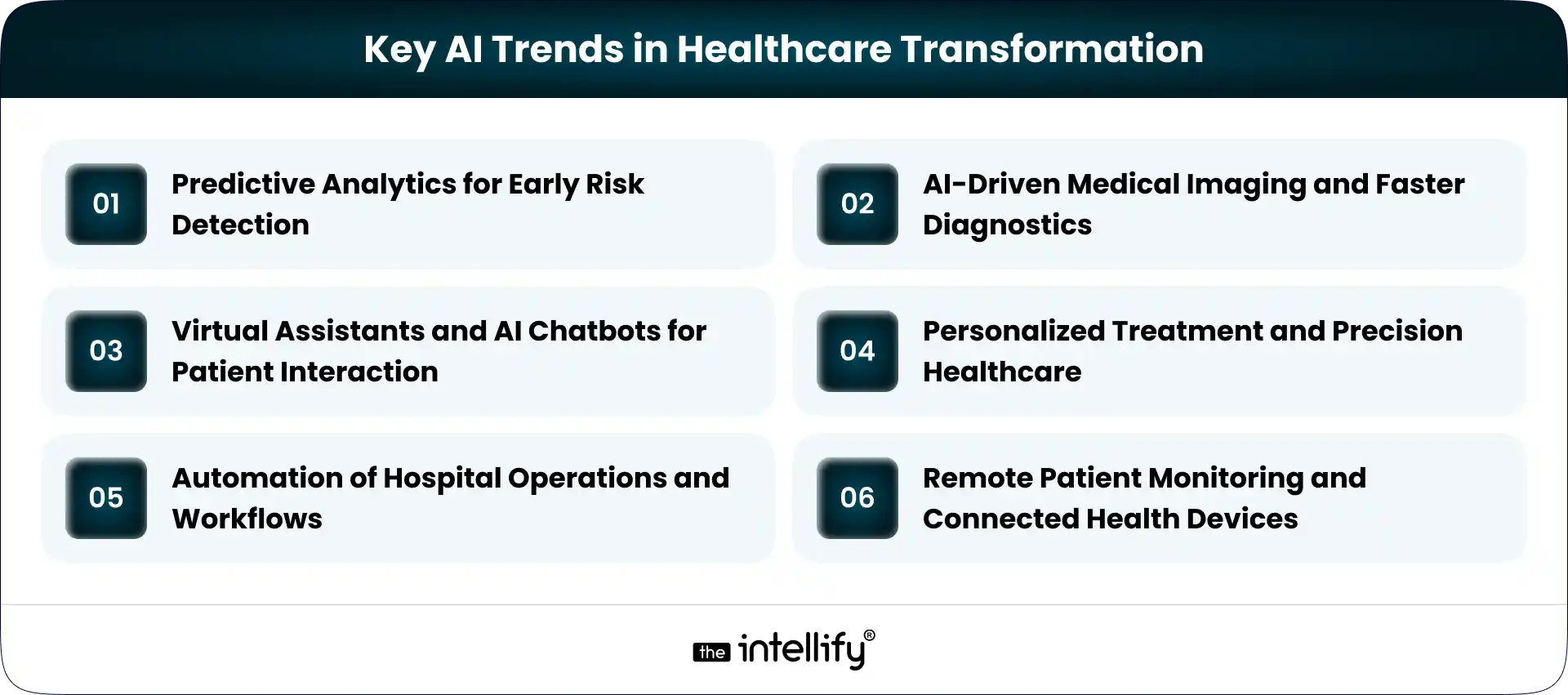
Predictive Analytics for Early Risk Detection
AI’s knack for identifying health risks before symptoms escalate is truly transformative. By analyzing patterns in patient data, healthcare providers can implement preventive measures rather than waiting for issues to arise. This proactive approach is significantly beneficial in chronic disease management and helps alleviate the burden on hospitals.
For example, AI can flag early signs of conditions like heart disease or diabetes based on patient history and lifestyle patterns. This helps hospitals reduce emergency cases and manage patient care more effectively.
AI-Driven Medical Imaging and Faster Diagnostics
AI is stepping up medical imaging, enhancing accuracy in scans like X-rays and MRIs while cutting down on diagnosis time and reducing human error. This assists specialists, offering faster insights that empower them to make well-informed decisions.
This not only improves accuracy but also reduces the workload on radiologists, allowing them to focus on complex cases. Faster diagnosis also means quicker treatment decisions for patients.
Virtual Assistants and AI Chatbots for Patient Interaction
AI chatbots are stepping in to boost patient engagement by delivering round-the-clock support without adding to staff workloads. From scheduling appointments to providing basic consultations, these tools enhance access to healthcare services and allow healthcare professionals to concentrate on critical tasks.
This improves patient convenience by reducing waiting times and makes basic healthcare support available anytime. It also reduces the pressure on hospital front desks and support teams.
Personalized Treatment and Precision Healthcare
AI dives into patient history, genetics, and lifestyle to create tailored treatment plans. This results in better outcomes with fewer unnecessary treatments, ushering in a more efficient, patient-centered healthcare experience.
Automation of Hospital Operations and Workflows
Thanks to AI, hospitals can automate mundane manual tasks like paperwork and administrative duties, substantially reducing the administrative load. This allows healthcare staff to dedicate more time to patient care, ultimately boosting the quality of service.
Automation also reduces the chances of manual errors in billing and records, while helping hospitals manage costs more efficiently over time.
Remote Patient Monitoring and Connected Health Devices
Wearables and IoT devices enable constant health monitoring, providing healthcare professionals with real-time alerts and updates about patients’ conditions. This capability leads to better management of long-term patients and those recovering post-treatment.
This is especially helpful for elderly patients and those with chronic conditions who need regular monitoring without frequent hospital visits.
Real-World Applications of AI in Digital Healthcare
Several real-world applications are illustrating AI’s profound impact on digital healthcare:
- AI Powered Telehealth Platform: These systems are making remote consultations more efficient and accessible. These platforms allow patients to consult doctors remotely, improving access to care.
- Smart diagnostic systems used in hospitals: Hospitals are increasingly relying on AI for accurate diagnostic assistance. AI in healthcare helps doctors detect diseases faster and with better accuracy.
- AI in drug discovery and clinical research: AI can shift through vast datasets, accelerating the drug discovery process. AI speeds up research by analyzing large datasets in less time.
- Intelligent ICU systems: Utilizing AI, these systems monitor patients and enhance emergency response times. These systems monitor patients continuously and alert staff instantly in emergencies.
Impact of AI on Healthcare Businesses and Providers
Incorporating AI is enabling better resource management while alleviating operational pressures on healthcare providers. This allows them to scale services without significantly increasing costs, maintaining a competitive edge in the ever-evolving digital healthcare landscape. Higher patient satisfaction translates to increased trust and retention rates.
AI also helps healthcare organizations make better strategic decisions based on data insights and supports long-term scalability as patient demand grows.
Challenges in Adopting AI for Digital Health Transformation
While the advantages are evident, various challenges still need addressing:
1. Data Privacy and Security Concerns: Safeguarding patient data is critical, and concerns over data security can complicate AI adoption.
2. Integration Issues: Existing legacy systems might clash with new AI solutions, leading to compatibility challenges.
3. High Intial Cost and Technical Complexity: The upfront costs for AI can be quite significant, which can deter some organizations.
4. Resistance to Change: Staff who are accustomed to traditional workflows might resist adopting new processes.
How to Successfully Implement AI in Healthcare Systems
To achieve successful AI integration, consider these strategic steps:
1. Start with clear, Pratical Use Cases: Target specific areas rather than trying to implement everything all at once.
2. Ensure Clean and Accessible Data: High-quality data is vital for the effectiveness of AI.
3. Choose Scalable and Flexible AI Solutions: Invest in technology that can adapt and grow with your organization.
4. Collaborate with Experienced Technology Partners: Working with experts will help ensure a smoother implementation process.
5. Train Teams for Digital Workflows: Proper training ensures that staff can effectively utilize new systems.
What’s Next for AI in Healthcare
We can anticipate an increasing use of predictive and preventive healthcare models that will further connect ecosystems involving hospitals, patients, and devices. As accuracy, speed, and personalization continue to improve, AI will undoubtedly become an integral part of every healthcare system.
As AI continues to evolve, we can expect more advanced and seamless integration into everyday healthcare processes, making it a standard part of modern healthcare systems.
Conclusion:
AI in healthcare is not just a supporting player in digital transformation; it’s at the forefront of driving it. Healthcare is evolving to be smarter, faster, and more patient-centric. Organizations that adapt early will help shape the future of healthcare, providing high-quality care while streamlining operations. Embracing AI isn’t just a choice anymore; It’s a necessity for any healthcare provider aiming for success.
Frequently asked questions (FAQs)
1. What makes AI a key driver behind digital health transformation today?
Digital systems alone manage data, but AI turns that data into useful insights. This ability to predict risks and support decisions is what makes AI central to real transformation in healthcare.
2. How is AI improving decision-making in modern healthcare systems?
AI analyzes large volumes of patient data in seconds, helping doctors make faster and more informed decisions. It reduces guesswork and supports better clinical outcomes without replacing human expertise.
3. In what ways are AI-driven healthcare solutions improving operational efficiency?
AI automates routine tasks like scheduling, billing, and data entry, reducing administrative workload. This allows healthcare teams to focus more on patient care while improving system efficiency.
4. How do AI trends support the shift toward personalized healthcare?
AI studies patient history, behavior, and medical data to suggest tailored treatments. This leads to more effective care plans and reduces the chances of unnecessary or ineffective treatments.
5. Why is integrating AI into existing healthcare systems still a challenge?
Many healthcare systems rely on outdated infrastructure, making integration complex. Along with that, concerns around data security and cost slow down adoption despite clear benefits.
6. How can healthcare organizations scale AI adoption without disrupting operations?
They can start with focused use cases like diagnostics or workflow automation and expand gradually. This step-by-step approach reduces risk and helps teams adapt more smoothly.
7. How are AI trends shaping the next phase of digital health transformation?
AI is pushing healthcare toward more connected, predictive, and patient-focused systems. Over time, it will become a standard layer across all digital healthcare solutions


Written By, Jalaj Shah
The COO and Co-Founder of The Intellify. Jalaj enjoys experimenting with new strategies. His posts are fantastic for businesses seeking innovative development ideas. Discover practical insights from his engaging content.

How to Automate Patient Onboarding in a Direct Primary Care Practice
Summary: Patient onboarding automation helps Direct Primary Care (DPC) practices simplify registration, digital intake forms, membership agreements, payment setup, and patient communication. This blog explains how to automate key onboarding workflows, integrate existing healthcare systems, protect patient information, and measure operational improvements. It also covers implementation best practices to help DPC practices reduce administrative work […]
How to Integrate AI Into an Existing DPC Platform Without Rebuilding It
Summary: This blog explains how to integrate AI into an existing Direct Primary Care (DPC) platform without rebuilding the entire system. It covers AI use cases, API integrations, implementation steps, HIPAA compliance, security considerations, common challenges, and costs. DPC practices can use these insights to modernize existing software, streamline administrative workflows, and improve operational efficiency. […]
How to Scale a Direct Primary Care Practice With Technology
Summary: This guide explains how technology can help Direct Primary Care practices scale without increasing administrative workload at the same pace. It covers DPC software, membership management, scheduling, billing, patient communication, automation, AI, and healthcare platform modernization, while outlining practical ways practices can build a more connected and scalable technology infrastructure. Running a Direct […]
How to Automate Patient Onboarding in a Direct Primary Care Practice
Summary: Patient onboarding automation helps Direct Primary Care (DPC) practices simplify registration, digital intake forms, membership agreements, payment setup, and patient communication. This blog explains how to automate key onboarding workflows, integrate existing healthcare systems, protect patient information, and measure operational improvements. It also covers implementation best practices to help DPC practices reduce administrative work […]
How to Integrate AI Into an Existing DPC Platform Without Rebuilding It
Summary: This blog explains how to integrate AI into an existing Direct Primary Care (DPC) platform without rebuilding the entire system. It covers AI use cases, API integrations, implementation steps, HIPAA compliance, security considerations, common challenges, and costs. DPC practices can use these insights to modernize existing software, streamline administrative workflows, and improve operational efficiency. […]
How to Scale a Direct Primary Care Practice With Technology
Summary: This guide explains how technology can help Direct Primary Care practices scale without increasing administrative workload at the same pace. It covers DPC software, membership management, scheduling, billing, patient communication, automation, AI, and healthcare platform modernization, while outlining practical ways practices can build a more connected and scalable technology infrastructure. Running a Direct […]
0
+0
+0
+0
+Committed Delivery Leads To Client Satisfaction
Client Testimonials that keep our expert's spirits highly motivated to deliver extraordinary solutions.

Christopher Seny
My experience working with The Intellify, has been a great experience. The team has a wealth of expertise in the tech space. Working with the intellify was a growing experience for me, I learned a lot. The team keeps great communication & responds fast to new ideas & suggestions. The team also provides great suggestions & solutions as well. I couldn’t imagine working with anybody else on this project & it has been a blessing working with, The Intellify.

Izandi Serdyn
The Intellify delivered a platform from scratch, involving the client at every stage. The team was communicative, responsive, and punctual throughout the engagement. Virtual meetings and emails ensured seamless project management. Customers can expect a team that can work fast.

Kya Johnson
The app serves as an effective introduction for users to the product and its characters. Responsive and faithful to initial requirements, The Intellify’s team exceeded initial expectations. Internal stakeholders were particularly pleased with their communication.

Stefan Wyk
Working with The Intellify to develop our website was an outstanding experience. Their team displayed exceptional professionalism, creativity, and technical expertise throughout the entire process. The final product exceeded our expectations, delivering a sleek, user-friendly, and highly functional website. We highly recommend The Intellify to anyone in need of top-tier web development services.

Steve Thorpe
The Intellify’s work has been met with high praise from internal and external stakeholders. The team is efficient, diligent, and reliable in their service. They go above and beyond in terms of communication and project management. The Intellify is a responsive vendor that gets the job done.

Tal Dotan
I’ve been working with The Intellify for the last 3 years. During this period of time we’ve planned and executed projects in both small and large scale. Working with The Intellify was and still is the best decision I’ve made when rising up Divo, I strongly recommend to work with them in any type of project.


 +1-302-803-4983