Summary:
Businesses are increasingly adopting AI to improve efficiency, automate workflows, enhance customer experiences, and make smarter decisions. This blog explains how an AI development company helps organizations build custom AI solutions, intelligent applications, and AI automation systems tailored to their needs. It also explores industry use cases, implementation best practices, emerging AI trends, and the key factors to consider when selecting the right AI development partner for long-term success.
Artificial Intelligence is no longer something businesses talk about as a future possibility. It’s already reshaping how companies operate, serve customers, and make decisions every day. A few years ago, businesses relied heavily on traditional software to manage operations. While those systems still play an important role, they often struggle when dealing with large volumes of data, changing customer expectations, or complex decision-making processes. That’s where AI comes in.
Organizations across healthcare, retail, finance, manufacturing, logistics, and many other industries are investing in intelligent systems that can learn from data, automate repetitive work, and deliver insights in real time. Instead of spending hours on manual tasks, teams can focus on strategic work that drives growth. From predicting customer behavior and automating workflows to creating personalized experiences and improving operational efficiency, AI is helping businesses solve challenges that traditional software simply wasn’t designed to handle.
However, building successful AI solutions requires much more than writing code. It demands expertise in machine learning, data engineering, automation, cloud infrastructure, and business strategy. This is why many organizations choose to work with an experienced AI development company that can design, build, and scale AI-powered systems aligned with their business goals.
What Is an AI Development Company and Why Does It Matter?
An AI development company specializes in creating software solutions powered by artificial intelligence technologies such as machine learning, natural language processing, computer vision, predictive analytics, and generative AI.
Unlike traditional software development, where applications follow predefined rules and instructions, AI systems are designed to learn from data, identify patterns, and continuously improve their performance over time.
For example, a traditional customer support platform may follow scripted workflows. An AI-powered platform, on the other hand, can understand customer intent, answer questions intelligently, and improve responses based on previous interactions.
Developing such systems requires specialized expertise in areas including:
- Machine learning engineering
- Data science
- AI model training
- Data architecture
- Cloud computing
- Automation technologies
- AI governance and compliance
Many businesses initially assume that any software development team can build AI solutions. In reality, successful AI projects require unique skills, tools, and methodologies that differ significantly from conventional software development.
Partnering with a specialized AI development company provides access to experienced professionals who understand how to turn business challenges into scalable AI-driven solutions.
How Custom AI Solutions Help Businesses Solve Real Challenges
Every business has unique processes, workflows, and operational challenges. Off-the-shelf software often forces organizations to adapt their operations around the software itself.
Custom AI solutions work differently. They are designed around specific business objectives, allowing companies to solve problems more effectively while maintaining flexibility as they grow.
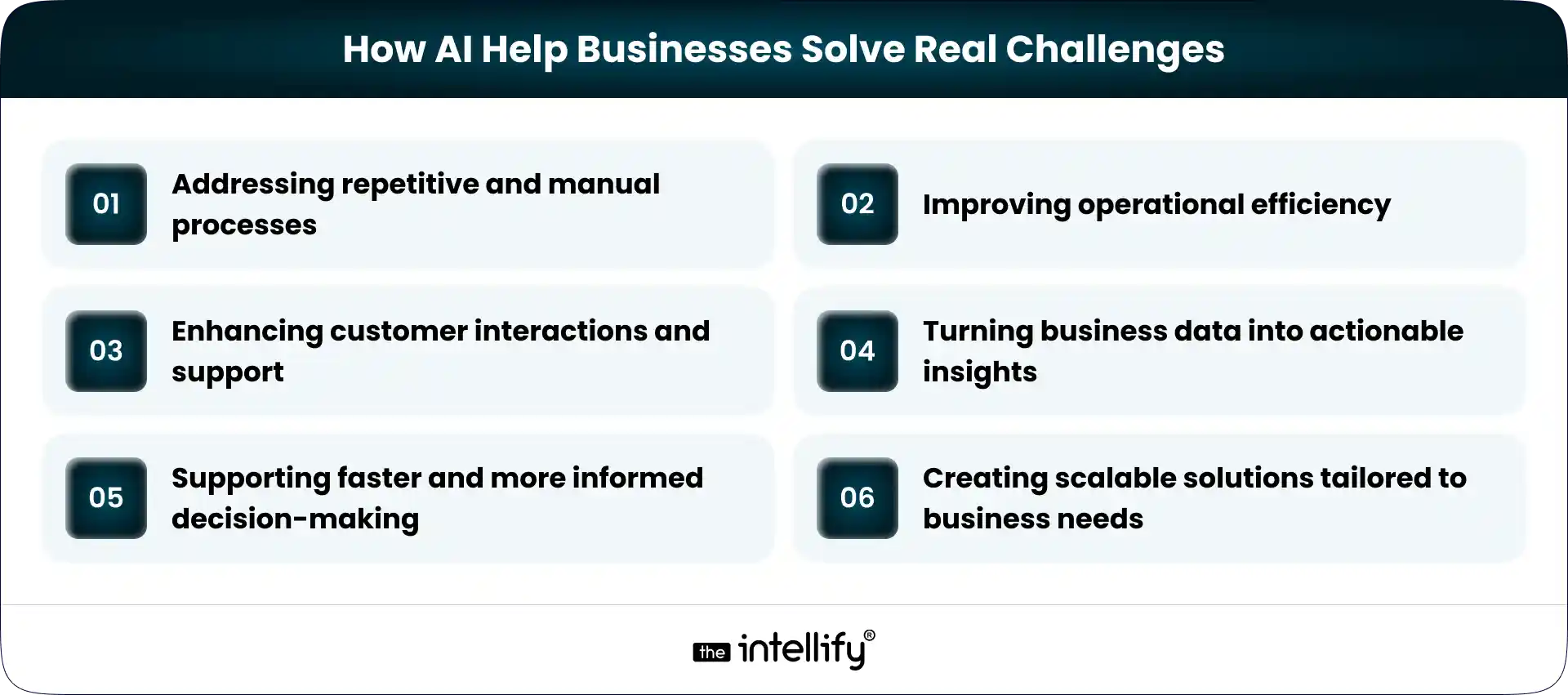
Addressing Repetitive and Manual Processes
Many organizations still rely on employees to perform routine tasks such as data entry, document verification, scheduling, and report generation. AI can automate these activities, reducing workload and minimizing human error.
Improving Operational Efficiency
Intelligent systems help businesses complete tasks faster, streamline workflows, and eliminate bottlenecks across departments.
Enhancing Customer Interactions and Support
AI-powered chatbots, virtual assistants, and recommendation engines can provide instant responses, personalized experiences, and 24/7 customer support.
Turning Business Data Into Actionable Insights
Most companies collect massive amounts of data but struggle to use it effectively. AI solutions analyze data in real time and identify trends, risks, and opportunities that might otherwise go unnoticed.
Supporting Faster and More Informed Decision-Making
Executives and managers can use AI-generated insights to make smarter decisions based on facts rather than assumptions.
Creating Scalable Solutions Tailored to Business Needs
As organizations grow, AI systems can scale alongside operations, handling larger datasets and more complex workflows without significant increases in manual effort.
Core AI Development Services Businesses Should Look For
Choosing the right AI development partner starts with understanding the services they offer.
AI Consulting and Strategy Development
Before implementation begins, businesses need a clear AI roadmap. AI Consulting services help identify opportunities, define objectives, assess feasibility, and create implementation strategies.
Machine Learning Model Development
Machine learning models enable systems to recognize patterns, make predictions, and continuously improve through data analysis.
Natural Language Processing Solutions
Natural Language Processing (NLP) helps machines understand, interpret, and generate human language.
Common applications include:
- Chatbots
- Virtual assistants
- Sentiment analysis
- Document processing
- Language translation
Computer Vision Applications
Computer vision enables systems to analyze images and videos for tasks such as:
- Quality inspection
- Facial recognition
- Medical imaging analysis
- Security monitoring
Generative AI Development
Generative AI solutions can create text, images, code, reports, and business content, helping organizations improve productivity and innovation.
Predictive Analytics Solutions
Predictive models help businesses forecast future outcomes, customer behavior, demand patterns, and operational risks.
AI Integration With Existing Business Systems
Successful AI projects must work seamlessly with CRM, ERP, HRM, and other enterprise systems.
AI Maintenance, Monitoring, and Optimization
AI systems require continuous monitoring, retraining, and optimization to maintain performance and accuracy over time.
AI App Development Services for Intelligent Digital Experiences
Modern users expect digital experiences that are personalized, responsive, and intelligent. This demand has fueled rapid growth in AI app development services across industries.
AI-Powered Mobile Application Development
Mobile apps can leverage AI to provide recommendations, automate tasks, and improve user engagement.
AI-Enabled Web Platforms
AI-powered web applications can personalize content, optimize user journeys, and deliver intelligent interactions.
Smart Business Applications
Organizations are increasingly building internal AI-powered tools that support operations, analytics, and decision-making.
Personalized User Experiences Through AI
AI can analyze user behavior and tailor experiences based on preferences, interests, and previous interactions.
Recommendation and Prediction Engines
Popular examples include:
- Product recommendations
- Content suggestions
- Personalized marketing campaigns
- Demand forecasting
Conversational AI and Virtual Assistants
Conversational AI solutions help businesses engage users through natural and intuitive interactions.
Benefits of Integrating AI Into Modern Applications
Key benefits include:
- Higher customer engagement
- Better user retention
- Faster service delivery
- Personalized experiences
- Improved business intelligence
- Increased operational efficiency
AI Automation Services That Drive Productivity and Growth
Automation has always been a business priority. AI takes automation several steps further by enabling systems to learn, adapt, and make decisions.
Business Process Automation
AI automates repetitive workflows that traditionally require manual intervention.
Intelligent Workflow Management
AI helps coordinate tasks, prioritize activities, and optimize process execution.
Document Processing and Data Extraction
Organizations can automate invoice processing, contract reviews, claims handling, and document classification.
Customer Service Automation
AI-powered assistants can resolve inquiries instantly while escalating complex issues when necessary.
Automated Reporting and Analytics
Instead of manually compiling reports, AI can generate insights automatically from multiple data sources.
Internal Operations Optimization
Departments such as HR, finance, procurement, and operations can benefit significantly from intelligent automation.
Key Business Benefits
- Reduced Manual Effort: Employees spend less time on repetitive work and more time on strategic initiatives.
- Faster Execution of Tasks: Processes that once took hours can often be completed within minutes.
- Improved Accuracy: Automation reduces errors caused by manual processing.
- Lower Operational Costs: Organizations can achieve significant cost savings through improved efficiency.
- Better Resource Utilization: Teams can focus on higher-value activities while AI handles routine operations.
Where AI Workflow Automation Creates the Most Impact
AI workflow automation is delivering measurable results across nearly every department.
Sales and Lead Management
- Lead scoring
- Opportunity prioritization
- Sales forecasting
- Automated follow-ups
Marketing and Campaign Optimization
- Audience segmentation
- Campaign personalization
- Content recommendations
- Performance analysis
Customer Support Operations
- AI chatbots
- Ticket routing
- Customer sentiment analysis
- Automated responses
Human Resources Processes
- Resume screening
- Candidate matching
- Employee onboarding
- Workforce analytics
Finance and Accounting Workflows
- Invoice processing
- Expense management
- Financial forecasting
- Compliance monitoring
Supply Chain and Logistics Management
- Inventory optimization
- Route planning
- Demand forecasting
- Vendor management
Project and Operations Management
- Resource allocation
- Project monitoring
- Risk identification
- Performance tracking
Industry Applications of AI Solutions
Healthcare
Healthcare organizations are using AI to improve patient care and operational efficiency.
- Patient Engagement: AI assistants help patients schedule appointments and receive support.
- Medical Data Analysis: AI can identify patterns across large medical datasets.
- Diagnostic Support: Advanced algorithms assist clinicians in detecting conditions earlier and more accurately.
Retail and eCommerce
- Product Recommendations: AI delivers personalized shopping experiences.
- Demand Forecasting: Retailers can predict inventory requirements more accurately.
- Customer Personalization: Businesses tailor promotions and experiences based on customer behavior.
Banking and Financial Services
- Fraud Detection: AI identifies suspicious transactions in real time.
- Risk Assessment: Financial institutions improve lending and investment decisions.
- Customer Support Automation: Virtual assistants provide faster service and lower support costs.
Manufacturing
- Predictive Maintenance: AI predicts equipment failures before they occur.
- Quality Control: Computer vision systems identify defects during production.
- Production Optimization: Manufacturers improve efficiency and reduce waste.
Insurance
- Claims Processing: AI accelerates claim reviews and approvals.
- Risk Analysis: Insurers can assess policy risk more accurately.
- Customer Service Automation: Virtual agents provide policyholder support around the clock.
Key Factors That Determine the Success of AI Development Solutions
Several factors influence whether an AI initiative succeeds or struggles.
- Clearly Defined Business Objectives: AI should solve real business problems, not exist simply because it’s trendy.
- Availability of Quality Data: Even the best algorithms cannot compensate for poor-quality data.
- Scalability Considerations: Solutions should support future growth and evolving business needs.
- Integration With Existing Systems: Seamless connectivity improves adoption and usability.
- User Adoption and Change Management: Employees must understand and trust AI-driven processes.
- Ongoing Optimization and Support: AI requires continuous improvements to remain effective.
- Security, Compliance, and Governance Requirements: Strong governance ensures data privacy, compliance, and responsible AI usage.
How to Choose the Right AI Development Company
Selecting the right partner can significantly influence project outcomes.
Technical Expertise and AI Capabilities: Evaluate experience across machine learning, NLP, computer vision, and automation technologies.
Industry-Specific Experience: Industry knowledge often leads to faster implementation and better results.
Portfolio and Case Studies: Review previous projects and measurable outcomes.
Development Methodology and Transparency: Look for structured processes and open communication.
Security and Compliance Standards: Ensure the company follows recognized security frameworks and compliance requirements.
Scalability and Future Support: Choose a partner capable of supporting long-term growth.
Communication and Collaboration Approach: Strong collaboration often determines project success more than technology alone.
Questions to Ask Before Selecting a Partner
- What industries have they worked with?
- How do they measure project success?
- What support is provided after deployment?
- How do they ensure data security and compliance?
Emerging Trends Shaping the Future of AI Development
The AI landscape continues to evolve rapidly.
- Generative AI Adoption Across Industries: Organizations are increasingly integrating generative AI into daily operations.
- AI Agents and Autonomous Workflows: AI agents are beginning to manage tasks with minimal human intervention.
- Hyperautomation Strategies: Businesses are combining AI, automation, and analytics to streamline operations end-to-end.
- Industry-Specific AI Platforms: Purpose-built AI solutions are becoming more common across sectors.
- Responsible and Ethical AI Practices: Organizations are prioritizing transparency, fairness, and accountability.
- AI-Powered Decision Intelligence: AI is moving beyond predictions and supporting strategic decision-making.
- The Growing Role of Human-AI Collaboration: The future isn’t humans versus AI. It’s humans working alongside AI to achieve better outcomes.
Why Businesses Are Partnering With AI Development Companies for Long-Term Innovation
Businesses aren’t adopting AI simply to follow a trend. They’re investing because it delivers measurable advantages.
- Accelerating Digital Transformation Initiatives: AI helps organizations modernize processes faster.
- Building Competitive Advantages Through AI: Companies that effectively use AI often outperform slower-moving competitors.
- Scaling Operations More Efficiently: Growth becomes easier when repetitive work is automated.
- Improving Customer Experiences: Personalized and intelligent interactions increase satisfaction and loyalty.
- Unlocking New Revenue Opportunities: AI can create entirely new products, services, and business models.
- Future-Proofing Business Growth: Organizations that embrace AI today are better positioned for tomorrow’s challenges.

Conclusion
Artificial intelligence is quickly becoming a core part of modern business strategy. From improving operational efficiency and automating repetitive tasks to enhancing customer experiences and supporting smarter decision-making, AI is transforming how organizations compete and grow.
Custom AI solutions, intelligent applications, and AI automation services enable businesses to address unique challenges while creating scalable systems that evolve alongside their needs. Whether it’s predictive analytics, workflow automation, generative AI, or conversational experiences, the opportunities continue to expand across every major industry.
The success of any AI initiative, however, depends heavily on choosing the right AI development company. An experienced partner like The Intellify can help identify opportunities, build tailored solutions, integrate AI into existing systems, and ensure long-term optimization. As AI adoption accelerates worldwide, businesses that invest strategically today will be better equipped to innovate, adapt, and achieve sustainable growth in the years ahead.
Frequently Asked Questions
Q1. How do I know if my business is ready for AI development?
If your business relies on repetitive processes, manual decision-making, or large amounts of data, AI can help improve efficiency, automate workflows, and generate valuable insights. An AI development company can assess your operations and identify the most impactful opportunities for AI adoption.
Q2. What are the benefits of choosing custom AI solutions over ready-made tools?
Custom AI solutions are designed specifically for your business goals, workflows, and data. Unlike off-the-shelf software, they offer greater flexibility, scalability, and long-term value while addressing unique operational challenges.
Q3. Can an AI development company integrate AI into existing business systems?
Yes. Most AI solutions can be integrated with existing platforms such as CRM, ERP, HR, and customer support systems. This allows businesses to enhance current processes without replacing their existing technology infrastructure.
Q4. What should I look for when selecting an AI development company?
Look for technical expertise, industry experience, successful project delivery, security standards, transparent communication, and ongoing support capabilities. Reviewing case studies and client success stories can also help evaluate a company’s capabilities.
Q5. How can businesses measure the return on investment from AI solutions?
Businesses can measure AI ROI through improvements in operational efficiency, productivity, customer satisfaction, cost savings, revenue growth, and process automation. Establishing clear KPIs before implementation helps track success more effectively.



Written By, Jalaj Shah
The COO and Co-Founder of The Intellify. Jalaj enjoys experimenting with new strategies. His posts are fantastic for businesses seeking innovative development ideas. Discover practical insights from his engaging content.

Where AI Voice Agents Fit Into a Modern DPC Platform
Summary: AI voice agents can become a practical part of a modern Direct Primary Care (DPC) platform by handling routine phone interactions, appointment scheduling, membership questions, reminders, and call routing. This guide explains where voice AI fits within the DPC technology stack, what tasks it should and shouldn’t handle, HIPAA considerations, integration requirements, and how […]
AI Appointment Scheduling in Healthcare: How It Works, Key Benefits & Costs in 2026
Summary: AI appointment scheduling helps healthcare organizations automate booking, reduce no-shows, optimize provider schedules, and improve patient access to care. This guide explains how AI scheduling works, its key benefits, essential features, implementation costs, EHR integration requirements, and future trends shaping healthcare operations in 2026. A missed appointment doesn’t just create an empty slot in […]
How to Build AI for Real Estate Investment and Market Analysis
Summary: AI for real estate investment is helping investors and property businesses make smarter, faster, and more data-driven decisions. This guide explains how to build an AI-powered real estate investment platform, covering essential features, data sources, AI technologies, market analysis capabilities, development steps, business benefits, and future trends shaping the real estate industry. Real […]
Where AI Voice Agents Fit Into a Modern DPC Platform
Summary: AI voice agents can become a practical part of a modern Direct Primary Care (DPC) platform by handling routine phone interactions, appointment scheduling, membership questions, reminders, and call routing. This guide explains where voice AI fits within the DPC technology stack, what tasks it should and shouldn’t handle, HIPAA considerations, integration requirements, and how […]
AI Appointment Scheduling in Healthcare: How It Works, Key Benefits & Costs in 2026
Summary: AI appointment scheduling helps healthcare organizations automate booking, reduce no-shows, optimize provider schedules, and improve patient access to care. This guide explains how AI scheduling works, its key benefits, essential features, implementation costs, EHR integration requirements, and future trends shaping healthcare operations in 2026. A missed appointment doesn’t just create an empty slot in […]
How to Build AI for Real Estate Investment and Market Analysis
Summary: AI for real estate investment is helping investors and property businesses make smarter, faster, and more data-driven decisions. This guide explains how to build an AI-powered real estate investment platform, covering essential features, data sources, AI technologies, market analysis capabilities, development steps, business benefits, and future trends shaping the real estate industry. Real […]
0
+0
+0
+0
+Committed Delivery Leads To Client Satisfaction
Client Testimonials that keep our expert's spirits highly motivated to deliver extraordinary solutions.

Christopher Seny
My experience working with The Intellify, has been a great experience. The team has a wealth of expertise in the tech space. Working with the intellify was a growing experience for me, I learned a lot. The team keeps great communication & responds fast to new ideas & suggestions. The team also provides great suggestions & solutions as well. I couldn’t imagine working with anybody else on this project & it has been a blessing working with, The Intellify.

Izandi Serdyn
The Intellify delivered a platform from scratch, involving the client at every stage. The team was communicative, responsive, and punctual throughout the engagement. Virtual meetings and emails ensured seamless project management. Customers can expect a team that can work fast.

Kya Johnson
The app serves as an effective introduction for users to the product and its characters. Responsive and faithful to initial requirements, The Intellify’s team exceeded initial expectations. Internal stakeholders were particularly pleased with their communication.

Stefan Wyk
Working with The Intellify to develop our website was an outstanding experience. Their team displayed exceptional professionalism, creativity, and technical expertise throughout the entire process. The final product exceeded our expectations, delivering a sleek, user-friendly, and highly functional website. We highly recommend The Intellify to anyone in need of top-tier web development services.

Steve Thorpe
The Intellify’s work has been met with high praise from internal and external stakeholders. The team is efficient, diligent, and reliable in their service. They go above and beyond in terms of communication and project management. The Intellify is a responsive vendor that gets the job done.

Tal Dotan
I’ve been working with The Intellify for the last 3 years. During this period of time we’ve planned and executed projects in both small and large scale. Working with The Intellify was and still is the best decision I’ve made when rising up Divo, I strongly recommend to work with them in any type of project.


 +1-302-803-4983