How to Build AI for Real Estate Investment and Market Analysis

By Darshak Doshi
June 5, 2026
Summary:
AI for real estate investment is helping investors and property businesses make smarter, faster, and more data-driven decisions. This guide explains how to build an AI-powered real estate investment platform, covering essential features, data sources, AI technologies, market analysis capabilities, development steps, business benefits, and future trends shaping the real estate industry.
Real estate has always been a data-heavy industry. Investors study property prices, rental demand, economic conditions, local development plans, interest rates, and dozens of other factors before making decisions. For years, this process relied heavily on spreadsheets, manual research, and experience.
The problem? Today’s real estate market moves much faster than it did a decade ago. Thousands of properties enter and leave the market every day. Economic shifts can influence prices almost overnight. Investor sentiment changes quickly. Traditional analysis methods often struggle to keep pace with the sheer volume of information available. This is where AI for Real Estate Investment is creating a major shift.
Artificial intelligence helps investors analyze massive datasets, identify opportunities, predict market trends, and reduce risk with greater speed and accuracy. Instead of spending days researching properties, investors can access AI-powered insights within minutes.
For real estate businesses, investment firms, property developers, and proptech startups, AI is becoming an essential tool for gaining a competitive edge. Companies that successfully implement AI-driven solutions can improve investment decisions, streamline operations, and uncover opportunities that may otherwise go unnoticed.
Understanding AI for Real Estate Investment
What AI for real estate investment means
AI for real estate investment refers to using artificial intelligence and machine learning technologies to analyze property markets, evaluate investment opportunities, forecast trends, and support decision-making.
Rather than relying solely on historical reports and manual analysis, AI continuously processes large volumes of structured and unstructured data to generate insights.
How AI differs from traditional property analysis methods
Traditional investment analysis often depends on:
- Manual market research
- Historical sales comparisons
- Spreadsheet calculations
- Expert judgment
AI expands these capabilities by identifying hidden patterns, processing data at scale, and generating predictions that humans might overlook.
The role of AI in supporting smarter investment decisions
AI serves as a decision-support system. It helps investors answer critical questions such as:
- Which property offers the best return potential?
- Which markets are likely to appreciate?
- What risks exist in a specific investment?
- How will rental demand change over time?
Key challenges AI helps solve for investors and real estate companies
AI can address several long-standing challenges:
- Information overload
- Slow decision-making
- Inaccurate property valuation
- Market uncertainty
- Portfolio optimization difficulties
Why Real Estate Investors Are Adopting AI-Driven Market Intelligence
The real estate industry is experiencing a rapid shift toward data-driven investing.
Handling large volumes of market and property data
Modern property markets generate enormous amounts of information. AI can process millions of records far faster than human analysts.
Identifying profitable opportunities faster
Investors no longer need to manually screen hundreds of listings. AI systems can automatically rank opportunities based on investment criteria.
Improving decision-making with predictive insights
Predictive analytics helps investors understand future trends instead of simply reacting to historical data.
Reducing investment risks
AI can detect warning signs such as declining neighborhood demand, market saturation, or economic instability.
Enhancing portfolio performance and efficiency
With better visibility into performance metrics, investors can optimize portfolio allocation and improve long-term returns.
The Core Capabilities of AI in Market Analysis
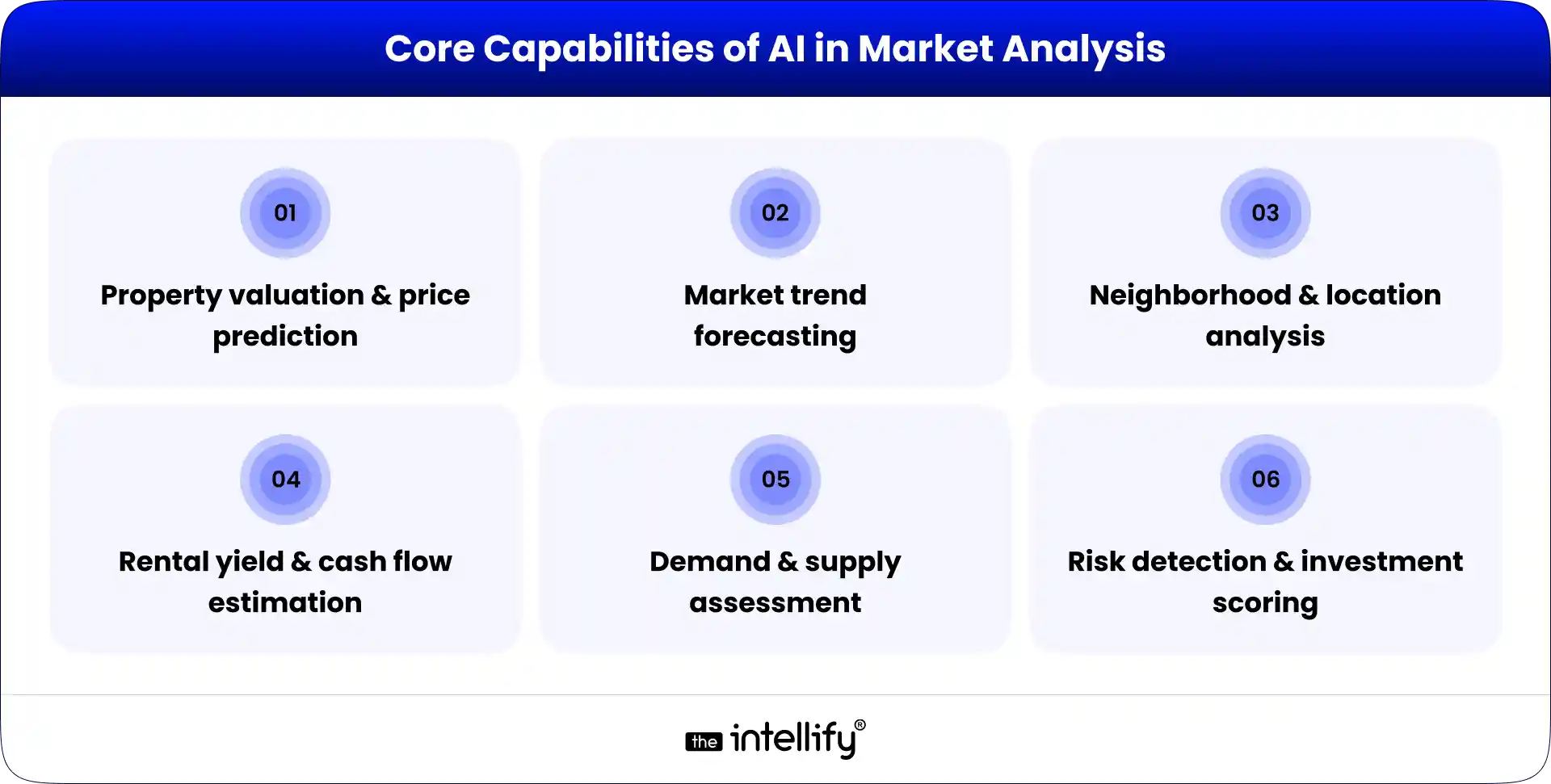
Property valuation and price prediction
Machine learning models estimate property values by analyzing location, amenities, historical sales, market trends, and comparable properties.
Market trend forecasting
AI identifies future price movements, growth patterns, and emerging investment hotspots.
Neighborhood and location analysis
Location remains one of the most important factors in real estate. AI evaluates crime rates, schools, infrastructure projects, transportation access, and demographic shifts.
Rental yield and cash flow estimation
AI calculates expected rental income and long-term cash flow projections.
Demand and supply assessment
Understanding local supply and demand helps investors avoid oversaturated markets.
Risk detection and investment scoring
AI-generated investment scores help prioritize opportunities based on risk-adjusted returns.
Essential Data Sources Behind Successful AI Models
The success of any AI real estate investment platform depends heavily on data quality.
- Property listings and transaction records: Current and historical listings provide foundational market intelligence.
- Historical sales and pricing data: Past sales trends help train predictive models.
- Rental market information: Rental pricing, occupancy rates, and lease trends support income forecasting.
- Economic and demographic indicators: Population growth, employment rates, income levels, and consumer spending patterns significantly influence property markets.
- Geographic and location intelligence data: GIS datasets provide detailed spatial insights.
- Public records and regulatory datasets: Government records often include permits, ownership history, zoning information, and tax assessments.
Real-time market signals and alternative data sources
These may include:
- Social media trends
- Mobility data
- Search trends
- Construction activity
- Consumer sentiment indicators
Sometimes the smallest signals reveal the biggest opportunities. That’s kinda fascinating, honestly.
Key Features to Include When Building AI for Real Estate Investment
Intelligent property recommendation engine
The platform should recommend properties based on investor preferences and financial goals.
Investment opportunity scoring
A scoring system simplifies decision-making by ranking investments according to predefined criteria.
Predictive market analytics dashboard
Dashboards should display forecasts, trends, and investment insights in a user-friendly format.
Automated property valuation
Automated valuation models provide instant pricing estimates.
Portfolio performance monitoring
Investors need real-time visibility into asset performance.
Risk assessment and alerts
The system should automatically flag high-risk investments and changing market conditions.
Natural language search and reporting
Users should be able to ask questions such as:
“Which neighborhoods are expected to grow by more than 10% next year?”
Real-time market intelligence
Live updates help investors react quickly to market changes.

Step-by-Step Process to Build AI-Powered Real Estate Solution
Define investment goals and business objectives
Start by identifying the problem your platform will solve. Common objectives include:
- Property discovery
- Market forecasting
- Portfolio optimization
- Risk management
Identify data requirements and sources
Determine what datasets are required and where they will come from.
Collect, clean, and prepare real estate data
Data preparation often consumes the largest portion of the project timeline. Poor-quality data leads to poor predictions. It’s frustrating, but true.
Select the right AI and machine learning models
Choose models based on business requirements. Examples include:
- Regression models
- Random forests
- Gradient boosting
- Neural networks
- Time-series forecasting models
Train and validate the system
Training involves teaching models using historical data while validation ensures accuracy.
Design dashboards and user experiences
The best predictions are useless if users can’t understand them. Focus on simplicity and clarity.
Integrate external platforms and APIs
Many real estate platforms rely on integrations with:
- MLS databases
- Property listing providers
- Economic data APIs
- Mapping services
- CRM systems
Test, deploy, and continuously optimize the solution
AI systems require ongoing refinement as market conditions evolve.
Choosing the Right AI Technologies for Real Estate Applications
Machine learning for forecasting and predictions
Machine learning remains the foundation of most AI investment platforms.
Predictive analytics for investment planning
Predictive models help forecast future property values and market demand.
Natural language processing for research and document analysis
NLP can analyze:
- Property descriptions
- Market reports
- News articles
- Legal documents
- Investor communications
Computer vision for property image evaluation
Computer vision allows AI to assess property conditions through photographs and videos.
Generative AI for reporting and market insights
Generative AI can automatically create:
- Market summaries
- Investment reports
- Property analyses
- Executive dashboards
Cloud infrastructure and data management tools
Cloud platforms provide scalability, security, and processing power. Popular choices include:
- Amazon Web Services
- Microsoft Azure
- Google Cloud
Real-World Applications of AI in Real Estate Investment
Property investment platforms
Investment marketplaces use AI to recommend opportunities and automate due diligence.
Commercial real estate analysis
Commercial investors use AI to evaluate office buildings, retail centers, warehouses, and industrial assets.
Real estate investment companies
Investment firms leverage AI to identify acquisition opportunities faster.
Property development and land acquisition
Developers use AI to assess land suitability and forecast future demand.
Rental portfolio management
Property owners can optimize rental pricing and occupancy rates.
Real estate funds and institutional investing
Institutional investors use AI for portfolio diversification and large-scale asset analysis.
Common Challenges in AI Real Estate Projects and How to Overcome Them
- Data quality and availability issues: Invest in strong data governance processes from the beginning.
- Market volatility and prediction accuracy: Markets change. AI models must adapt regularly to remain effective.
- Compliance and regulatory requirements: Ensure compliance with privacy regulations and local property laws.
- Integration with existing systems: Use APIs and modular architectures to simplify integration efforts.
- Building trust in AI-generated recommendations: Transparency matters. Users should understand how recommendations are generated.
- Ongoing model monitoring and improvements: Continuous monitoring helps maintain performance as market conditions evolve.
Measuring the Success of an AI-Powered Investment Platform
- Prediction accuracy and model performance: Track forecast accuracy and model reliability.
- Improvements in investment returns: Measure whether AI-driven recommendations improve overall returns.
- Reduction in research and analysis time: Evaluate productivity gains achieved through automation.
- User adoption and engagement: Monitor how frequently investors use AI features.
- Portfolio growth metrics: Analyze asset growth, diversification, and performance improvements.
- Operational efficiency gains: Measure reductions in manual work and operational costs.
The Future of AI in Real Estate Investment and Market Analysis
The future looks surprisingly exciting. AI is moving beyond simple forecasting and into intelligent decision support.
Real-time investment intelligence
Future systems will continuously monitor markets and provide instant recommendations.
Autonomous property screening
AI will automatically identify, evaluate, and rank investment opportunities.
Personalized investment recommendations
Every investor will receive tailored recommendations based on goals, risk tolerance, and portfolio strategy.
Generative AI for market research and reporting
Automated reports will become more sophisticated and highly personalized.
Digital twins and property simulations
Digital twins will allow investors to simulate future scenarios before making decisions.
Emerging opportunities for real estate businesses
Businesses that adopt AI early will be better positioned to adapt to changing markets and customer expectations.
There’s still some uncertainty around how quickly adoption will happen, but one thing seems pretty clear: AI isn’t a passing trend in real estate. It’s becoming part of the industry’s foundation.
Conclusion
AI is transforming how real estate investments are evaluated, analyzed, and managed. By combining advanced analytics, machine learning, predictive forecasting, and automation, businesses can make smarter decisions with greater speed and confidence.
However, successful implementation requires more than simply deploying algorithms. Organizations need high-quality data, well-defined objectives, scalable infrastructure, and continuous optimization strategies.
Whether you’re building an AI investment platform, enhancing market analysis capabilities, or creating new proptech solutions, the opportunity is significant. As real estate markets become increasingly data-driven, businesses that invest in AI today will be better prepared for the future of intelligent property investing.

Build AI-Powered Real Estate Investment Solutions with The Intellify
At The Intellify, we help real estate companies, investment firms, proptech startups, and property developers build custom AI solutions tailored to their business goals.
From predictive market analytics and intelligent property recommendation engines to automated valuation models and investment intelligence platforms, our team develops scalable AI systems that transform complex real estate data into actionable insights.
If you’re planning to build an AI-powered real estate investment platform, our experts can help you design, develop, and deploy a solution that drives smarter investment decisions and long-term growth.
Frequently Asked Questions (FAQs)
1. What data is needed to build an AI solution for real estate investment?
AI works best with property listings, transaction records, rental market data, demographic information, economic indicators, and location intelligence. High-quality and up-to-date data helps improve prediction accuracy and investment insights.
2. Can AI help find better real estate investment opportunities?
Yes. AI can analyze thousands of properties, market trends, and investment factors in real time to identify opportunities that match specific investment goals. This allows investors to make faster and more informed decisions.
3. How accurate are AI-powered real estate predictions?
AI can uncover patterns and market signals that are difficult to identify through manual analysis. While no model can predict the future with complete certainty, AI-driven insights often improve decision-making by providing data-backed forecasts and risk assessments.
4. What features should an AI real estate investment platform have?
An effective AI investment platform typically includes automated property valuation, investment opportunity scoring, predictive market analytics, portfolio monitoring, risk assessment tools, and real-time market intelligence dashboards.
5. Can AI be added to an existing real estate platform?
Yes. AI capabilities can be integrated into existing real estate websites, portals, CRM systems, or investment platforms through APIs and custom development. This enables businesses to enhance their services without rebuilding their entire technology stack.


Written By, Darshak Doshi
With over a decade of experience, Darshak is a technopreneur specializing in cloud-based applications and product development in healthcare, insurance, and manufacturing. He excels in AWS Cloud, backend development, and immersive technologies like AR/VR to drive innovation and efficiency. Darshak has also explored AI/ML in insurance and healthcare, pushing the boundaries of technology to solve complex problems. His user-focused, results-driven approach ensures he builds scalable cloud solutions, cutting-edge AR/VR experiences, and AI-driven insights that meet today’s demands while anticipating future needs.

Where AI Voice Agents Fit Into a Modern DPC Platform
Summary: AI voice agents can become a practical part of a modern Direct Primary Care (DPC) platform by handling routine phone interactions, appointment scheduling, membership questions, reminders, and call routing. This guide explains where voice AI fits within the DPC technology stack, what tasks it should and shouldn’t handle, HIPAA considerations, integration requirements, and how […]
AI Appointment Scheduling in Healthcare: How It Works, Key Benefits & Costs in 2026
Summary: AI appointment scheduling helps healthcare organizations automate booking, reduce no-shows, optimize provider schedules, and improve patient access to care. This guide explains how AI scheduling works, its key benefits, essential features, implementation costs, EHR integration requirements, and future trends shaping healthcare operations in 2026. A missed appointment doesn’t just create an empty slot in […]
Top AI Development Company for Custom AI Solutions & Services
Summary: Businesses are increasingly adopting AI to improve efficiency, automate workflows, enhance customer experiences, and make smarter decisions. This blog explains how an AI development company helps organizations build custom AI solutions, intelligent applications, and AI automation systems tailored to their needs. It also explores industry use cases, implementation best practices, emerging AI trends, and […]
Where AI Voice Agents Fit Into a Modern DPC Platform
Summary: AI voice agents can become a practical part of a modern Direct Primary Care (DPC) platform by handling routine phone interactions, appointment scheduling, membership questions, reminders, and call routing. This guide explains where voice AI fits within the DPC technology stack, what tasks it should and shouldn’t handle, HIPAA considerations, integration requirements, and how […]
AI Appointment Scheduling in Healthcare: How It Works, Key Benefits & Costs in 2026
Summary: AI appointment scheduling helps healthcare organizations automate booking, reduce no-shows, optimize provider schedules, and improve patient access to care. This guide explains how AI scheduling works, its key benefits, essential features, implementation costs, EHR integration requirements, and future trends shaping healthcare operations in 2026. A missed appointment doesn’t just create an empty slot in […]
Top AI Development Company for Custom AI Solutions & Services
Summary: Businesses are increasingly adopting AI to improve efficiency, automate workflows, enhance customer experiences, and make smarter decisions. This blog explains how an AI development company helps organizations build custom AI solutions, intelligent applications, and AI automation systems tailored to their needs. It also explores industry use cases, implementation best practices, emerging AI trends, and […]
0
+0
+0
+0
+Committed Delivery Leads To Client Satisfaction
Client Testimonials that keep our expert's spirits highly motivated to deliver extraordinary solutions.

Christopher Seny
My experience working with The Intellify, has been a great experience. The team has a wealth of expertise in the tech space. Working with the intellify was a growing experience for me, I learned a lot. The team keeps great communication & responds fast to new ideas & suggestions. The team also provides great suggestions & solutions as well. I couldn’t imagine working with anybody else on this project & it has been a blessing working with, The Intellify.

Izandi Serdyn
The Intellify delivered a platform from scratch, involving the client at every stage. The team was communicative, responsive, and punctual throughout the engagement. Virtual meetings and emails ensured seamless project management. Customers can expect a team that can work fast.

Kya Johnson
The app serves as an effective introduction for users to the product and its characters. Responsive and faithful to initial requirements, The Intellify’s team exceeded initial expectations. Internal stakeholders were particularly pleased with their communication.

Stefan Wyk
Working with The Intellify to develop our website was an outstanding experience. Their team displayed exceptional professionalism, creativity, and technical expertise throughout the entire process. The final product exceeded our expectations, delivering a sleek, user-friendly, and highly functional website. We highly recommend The Intellify to anyone in need of top-tier web development services.

Steve Thorpe
The Intellify’s work has been met with high praise from internal and external stakeholders. The team is efficient, diligent, and reliable in their service. They go above and beyond in terms of communication and project management. The Intellify is a responsive vendor that gets the job done.

Tal Dotan
I’ve been working with The Intellify for the last 3 years. During this period of time we’ve planned and executed projects in both small and large scale. Working with The Intellify was and still is the best decision I’ve made when rising up Divo, I strongly recommend to work with them in any type of project.


 +1-302-803-4983