Why Healthcare Providers Miss Patient Calls (And How AI Fixes It)

By Jalaj Shah
August 7, 2026
Summary:
Healthcare providers frequently miss patient calls due to busy front desks, high call volumes, and administrative workloads. Every unanswered call can result in lost appointments, reduced patient satisfaction, and missed revenue. This blog explores the key reasons behind missed patient calls and explains how AI voice agents help healthcare organizations improve patient communication, automate appointment scheduling, and support staff more efficiently.
A patient calls your clinic to book an appointment, reschedule a visit, or ask a simple question. But no one answers. For healthcare providers, a missed patient call is more than just a missed conversation. It can lead to lost appointments, frustrated patients, and missed revenue. Most of the time, the problem isn’t poor service; it’s busy front desks, high call volumes, and staff managing multiple responsibilities at once.
To bridge this gap, many healthcare providers are adopting AI voice agents that answer calls instantly, schedule appointments, handle routine inquiries, and support patients 24/7. In this article, we’ll explore why healthcare providers miss patient calls, the hidden impact of those missed opportunities, and how AI voice agents are helping clinics deliver a better patient experience.
Why Healthcare Providers Miss Patient Calls
Most healthcare providers don’t miss patient calls because of poor service. They miss them because front-desk teams are managing multiple responsibilities at the same time. As patient demand continues to grow, answering every call has become increasingly difficult.
Busy Front Desks and Overwhelmed Staff
Receptionists do much more than answer phones. They check in patients, verify insurance, manage appointments, process payments, and support clinical teams. During busy hours, handling in-person patients often takes priority, causing incoming calls to be delayed or missed.
Limited Office Hours
Patients don’t only call during business hours. Many try to schedule appointments in the evenings, on weekends, or during holidays. If they reach voicemail instead of a person, many won’t wait for a callback and may contact another provider.
Multiple Administrative Responsibilities
Front-desk staff also manage referrals, prescription requests, billing inquiries, patient records, and other administrative tasks. With so many responsibilities competing for attention, answering every call immediately isn’t always possible.
High Call Volumes During Peak Hours
Morning rushes, lunch hours, and seasonal illness periods often bring a surge of incoming calls. When several patients call at once, long hold times become unavoidable, leading some callers to abandon the call and look elsewhere.
The Hidden Cost of Missed Patient Calls
A missed phone call may seem like a small issue, but its impact can quickly add up. From lost appointments to increased administrative work, unanswered calls affect both patient experience and clinic performance.
Lost Appointments
Every unanswered call is a missed opportunity to book an appointment. If patients can’t reach your clinic, many will simply contact another provider instead, resulting in lost revenue and fewer patients receiving timely care.
Patients Choosing Another Provider
Today’s patients expect quick responses. When a clinic doesn’t answer the phone, many assume communication will be difficult and choose a provider that’s easier to reach, even if the quality of care is comparable.
Lower Patient Satisfaction
The patient experience starts with the first interaction. Long hold times, missed calls, or delayed callbacks can create frustration and weaken trust before a patient even visits the clinic.
Increased Workload for Staff
Missed calls don’t disappear; they come back as voicemails, callback requests, and scheduling changes. This creates extra administrative work, increases staff stress, and reduces overall efficiency.
Why Traditional Solutions No Longer Work
Hiring more receptionists used to be the go-to solution for managing patient calls. Today, that’s becoming harder to sustain due to staffing shortages, rising labor costs, and employee turnover.
Even with a larger front-desk team, every call can’t always be answered. Staff are busy assisting patients, handling administrative tasks, taking breaks, or working within fixed office hours.
Many clinics have also turned to voicemail or outsourced answering services. While these options help capture calls, they often don’t provide the instant response patients expect.
As patient expectations continue to evolve, healthcare providers need a solution that can answer every call, support staff, and remain available 24/7not just during office hours.
How AI Voice Agents Solve the Problem
Healthcare providers don’t need to replace their front-desk teams; they need technology that helps them work more efficiently. AI voice agents answer calls, automate routine tasks, and ensure patients receive timely support without adding to staff workload.
Answer Every Call Instantly
AI voice agents answer every incoming call within seconds, eliminating long hold times and ensuring patients always reach someone, even during peak hours or after the clinic has closed.
Book Appointments Automatically
Patients can book, reschedule, or cancel appointments through a natural voice conversation. The AI follows the clinic’s scheduling rules and updates the calendar automatically.
Handle Common Patient Questions
From office hours and insurance inquiries to provider availability and clinic directions, AI can answer routine questions instantly, allowing staff to focus on patient care.
Route Urgent Calls to Staff
When a patient requires immediate assistance or needs to speak with a specific department, the AI can identify the request and transfer the call to the appropriate team member.
Work 24/7 Without Breaks
Unlike traditional front desks, AI voice agents remain available around the clock. Whether it’s after hours, weekends, or holidays, patients can receive support whenever they call.
A Typical Patient Journey With AI
Here’s how a typical patient interaction flows when an AI voice agent handles the conversation:
Step 1: Patient Calls the Clinic
A patient calls to book an appointment, reschedule a visit, or ask a question, whether it’s during office hours or after the clinic has closed.
Step 2: AI Answers Instantly
Instead of reaching voicemail or waiting on hold, the AI voice agent answers the call immediately and understands the patient’s request through natural conversation.
Step 3: Appointment Is Scheduled
The AI checks real-time availability, books or reschedules the appointment based on the clinic’s scheduling rules, and captures any necessary patient information.
Step 4: Confirmation Is Sent
Once the appointment is confirmed, the patient automatically receives a confirmation via SMS or email with all the relevant details.
Step 5: Clinic Staff Stay Updated
The appointment is synced with the clinic’s scheduling system, allowing front-desk staff to view the latest bookings without any manual data entry.
Step 6: Automated Reminders & Follow-ups
Before the appointment, the AI sends reminders to reduce no-shows. If the patient needs to cancel or reschedule, the AI can handle that conversation as well.
The result? Patients receive quick, convenient support at any time, while healthcare teams spend less time managing phone calls and more time focusing on patient care.
Benefits for Healthcare Providers
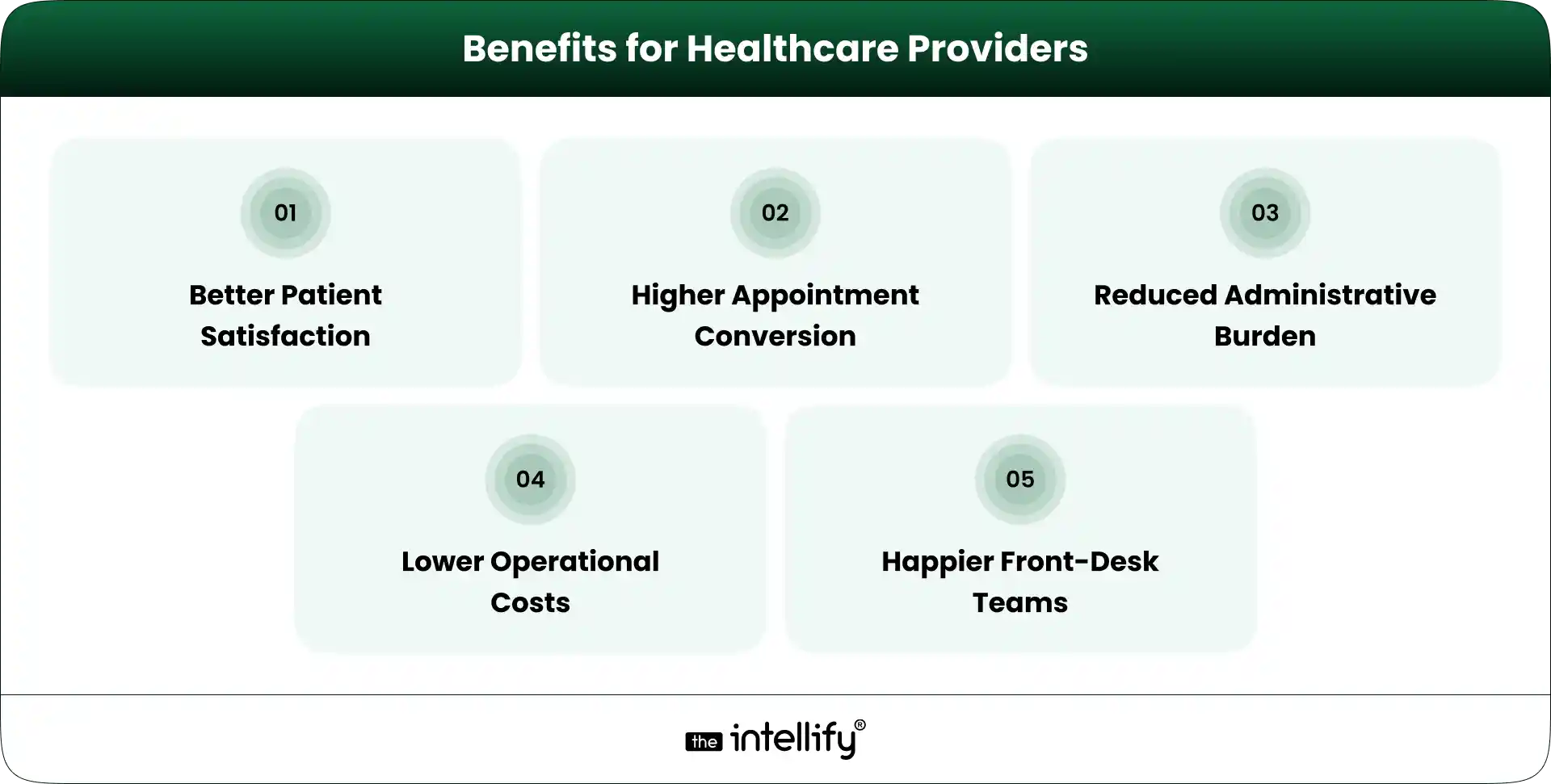
Adopting AI in healthcare isn’t just about answering more calls. It improves several areas of healthcare operations simultaneously.
Better Patient Satisfaction
Patients appreciate fast responses. When someone calls a clinic and immediately receives help instead of waiting on hold, the overall experience improves. Quick communication builds trust before the patient even walks through the door.
Higher Appointment Conversion
Every answered call creates an opportunity to schedule care. By responding instantly and simplifying the booking process, healthcare providers can convert more inquiries into confirmed appointments while reducing the number of abandoned calls.
Reduced Administrative Burden
Routine conversations consume a significant portion of a receptionist’s day. When AI handles appointment scheduling, FAQs, and basic requests, administrative teams can focus on patients who require personal attention, improving efficiency across the practice.
Lower Operational Costs
Hiring additional staff isn’t always practical. AI voice agents help healthcare providers manage increasing call volumes without expanding front-desk teams, making operations more scalable over time.
Happier Front-Desk Teams
Receptionists often feel overwhelmed when balancing in-person patients with constant phone calls. By handling repetitive conversations, AI reduces pressure on staff and allows them to concentrate on tasks that genuinely require empathy, judgment, and human interaction.
Can AI Replace Your Front Desk?
The short answer is no. Healthcare is built on trust and human relationships. Patients still value speaking with compassionate professionals, especially when discussing complex medical concerns.
AI isn’t designed to replace receptionists; it complements them. Think of it as another member of the administrative team that never misses a call, never gets overwhelmed during busy hours, and can manage repetitive conversations consistently.
This human-plus-AI approach allows clinics to improve efficiency while ensuring patients still receive personal care whenever it’s needed.
What to Look for in an AI Healthcare Voice Agent
Not every AI solution is built for healthcare. Before choosing a platform, healthcare providers should evaluate whether it meets both operational and compliance requirements.
Look for features such as:
- HIPAA-ready architecture to support patient data privacy.
- Natural, conversational voice interactions that don’t feel robotic.
- Integration with EHR and practice management systems.
- CRM connectivity for better patient communication.
- Analytics dashboards to monitor call volumes and outcomes.
- Multi-language support for diverse patient populations.
- Fast deployment without disrupting existing workflows.
Solutions like Alris AI by The Intellify are designed around these requirements, helping healthcare organizations automate patient conversations while fitting into their existing operational processes.
Why Clinics Are Adopting AI Faster in 2026
Healthcare providers are increasingly adopting AI to improve patient communication and streamline daily operations. Here are the key reasons driving this shift:
- Rising Patient Expectations: Patients expect quick responses, easy appointment scheduling, and support beyond regular office hours.
- Ongoing Staffing Challenges: Many clinics continue to face front-desk staffing shortages, making it difficult to manage growing call volumes efficiently.
- Increasing Competition: With more healthcare options available, clinics need to deliver faster and more convenient patient experiences to stay competitive.
- Affordable AI Solutions: AI voice technology has become more accessible and cost-effective, making it practical for clinics of all sizes- not just large hospital systems.
- Reduced Administrative Work: AI automates routine conversations, allowing healthcare staff to spend more time on patient care instead of repetitive administrative tasks.
Final Thoughts
Healthcare providers don’t lose patients because they deliver poor medical care. More often, they lose opportunities because patients can’t reach them when they need help.
As patient expectations continue to evolve, answering every call is no longer just a customer service goal- it’s an essential part of delivering accessible healthcare.
AI voice agents offer a practical way to bridge that gap. By answering calls instantly, automating appointment scheduling, handling routine inquiries, and supporting front-desk teams, they help healthcare providers improve both operational efficiency and the patient experience.
If your practice is exploring ways to reduce missed calls without adding more administrative burden, solutions like Alris AI by The Intellify can help create a more responsive and efficient communication workflow.
Frequently Asked Questions (FAQs)
1. Why do healthcare providers miss patient calls?
Healthcare providers often miss calls because front-desk staff manage multiple responsibilities simultaneously, including patient check-ins, scheduling, insurance verification, billing, and administrative tasks. High call volumes and limited office hours also contribute to missed calls.
2. How much revenue can missed calls cost a clinic?
The financial impact varies depending on the practice, but every unanswered call represents a potential missed appointment. Over time, even a small number of missed appointments each week can result in substantial revenue loss while also reducing patient retention.
3. Can AI schedule medical appointments?
Yes. Modern AI voice agents can schedule, reschedule, and cancel appointments by following predefined scheduling rules and integrating with existing healthcare systems.
4. Is an AI voice agent HIPAA compliant?
It depends on the provider. Healthcare organizations should choose AI solutions designed with HIPAA-ready security practices and appropriate safeguards for handling protected health information.
5. Does AI replace receptionists?
No. AI supports reception teams by handling repetitive conversations and routine administrative tasks. Human staff continues to manage complex situations that require empathy, judgment, and personalized assistance.
6. Can Alris AI integrate with existing healthcare systems?
Yes. Alris AI by The Intellify is designed to integrate with healthcare workflows and can connect with scheduling systems, CRM platforms, and other operational tools, helping providers automate patient communication without disrupting existing processes.


Written By, Jalaj Shah
The COO and Co-Founder of The Intellify. Jalaj enjoys experimenting with new strategies. His posts are fantastic for businesses seeking innovative development ideas. Discover practical insights from his engaging content.

How to Scale a Direct Primary Care Practice With Technology
Summary: This guide explains how technology can help Direct Primary Care practices scale without increasing administrative workload at the same pace. It covers DPC software, membership management, scheduling, billing, patient communication, automation, AI, and healthcare platform modernization, while outlining practical ways practices can build a more connected and scalable technology infrastructure. Running a Direct […]
How to Modernize a Direct Primary Care (DPC) Platform
Summary: This guide explains how to modernize a Direct Primary Care (DPC) platform for better scalability, security, patient experience, and operational efficiency. It covers essential DPC software features, legacy system assessment, platform integrations, AI opportunities, HIPAA considerations, modernization costs, common challenges, and practical steps for deciding between modernization and a complete rebuild. Direct Primary […]
Where AI Voice Agents Fit Into a Modern DPC Platform
Summary: AI voice agents can become a practical part of a modern Direct Primary Care (DPC) platform by handling routine phone interactions, appointment scheduling, membership questions, reminders, and call routing. This guide explains where voice AI fits within the DPC technology stack, what tasks it should and shouldn’t handle, HIPAA considerations, integration requirements, and how […]
How to Scale a Direct Primary Care Practice With Technology
Summary: This guide explains how technology can help Direct Primary Care practices scale without increasing administrative workload at the same pace. It covers DPC software, membership management, scheduling, billing, patient communication, automation, AI, and healthcare platform modernization, while outlining practical ways practices can build a more connected and scalable technology infrastructure. Running a Direct […]
How to Modernize a Direct Primary Care (DPC) Platform
Summary: This guide explains how to modernize a Direct Primary Care (DPC) platform for better scalability, security, patient experience, and operational efficiency. It covers essential DPC software features, legacy system assessment, platform integrations, AI opportunities, HIPAA considerations, modernization costs, common challenges, and practical steps for deciding between modernization and a complete rebuild. Direct Primary […]
Where AI Voice Agents Fit Into a Modern DPC Platform
Summary: AI voice agents can become a practical part of a modern Direct Primary Care (DPC) platform by handling routine phone interactions, appointment scheduling, membership questions, reminders, and call routing. This guide explains where voice AI fits within the DPC technology stack, what tasks it should and shouldn’t handle, HIPAA considerations, integration requirements, and how […]
0
+0
+0
+0
+Committed Delivery Leads To Client Satisfaction
Client Testimonials that keep our expert's spirits highly motivated to deliver extraordinary solutions.

Christopher Seny
My experience working with The Intellify, has been a great experience. The team has a wealth of expertise in the tech space. Working with the intellify was a growing experience for me, I learned a lot. The team keeps great communication & responds fast to new ideas & suggestions. The team also provides great suggestions & solutions as well. I couldn’t imagine working with anybody else on this project & it has been a blessing working with, The Intellify.

Izandi Serdyn
The Intellify delivered a platform from scratch, involving the client at every stage. The team was communicative, responsive, and punctual throughout the engagement. Virtual meetings and emails ensured seamless project management. Customers can expect a team that can work fast.

Kya Johnson
The app serves as an effective introduction for users to the product and its characters. Responsive and faithful to initial requirements, The Intellify’s team exceeded initial expectations. Internal stakeholders were particularly pleased with their communication.

Stefan Wyk
Working with The Intellify to develop our website was an outstanding experience. Their team displayed exceptional professionalism, creativity, and technical expertise throughout the entire process. The final product exceeded our expectations, delivering a sleek, user-friendly, and highly functional website. We highly recommend The Intellify to anyone in need of top-tier web development services.

Steve Thorpe
The Intellify’s work has been met with high praise from internal and external stakeholders. The team is efficient, diligent, and reliable in their service. They go above and beyond in terms of communication and project management. The Intellify is a responsive vendor that gets the job done.

Tal Dotan
I’ve been working with The Intellify for the last 3 years. During this period of time we’ve planned and executed projects in both small and large scale. Working with The Intellify was and still is the best decision I’ve made when rising up Divo, I strongly recommend to work with them in any type of project.


 +1-302-803-4983