Summary:
AI voice agents can become a practical part of a modern Direct Primary Care (DPC) platform by handling routine phone interactions, appointment scheduling, membership questions, reminders, and call routing. This guide explains where voice AI fits within the DPC technology stack, what tasks it should and shouldn’t handle, HIPAA considerations, integration requirements, and how practices can adopt voice automation without replacing their existing software.
Direct Primary Care (DPC) is built around access. Patients pay a recurring membership fee in exchange for more direct, ongoing access to primary care, often through in-person visits, virtual care, messaging, and other communication channels.
That creates an interesting technology challenge. A DPC practice may have a modern patient portal, online scheduling, automated billing, and an EHR. But patients still call.
They call to book an appointment. They call because they cannot find something in the portal. They call about a membership. Sometimes they simply want to speak with someone. For a small DPC team, those calls can quickly become a daily interruption.
This is where AI voice agents for DPC can fit into a modern platform. Not as a replacement for physicians or staff, but as a voice-based layer that handles routine conversations and connects patients with the right workflow.
The key is integration. A voice agent works best when it is connected to the DPC platform rather than operating as another isolated phone system.
Why Voice Still Matters in Direct Primary Care
DPC is different from traditional fee-for-service primary care. Patients typically pay a monthly, quarterly, or annual fee directly to the practice for a defined set of primary care services. That model can support more accessible and continuous communication between patients and physicians.
And that communication does not always happen through an app. Some patients prefer messaging. Others prefer online scheduling. Many still prefer picking up the phone.
For a DPC practice, this creates a simple problem: access is part of the value proposition, but handling every call manually does not scale very well.
Staff may spend time answering questions such as:
- “Can I schedule a visit for tomorrow?”
- “Can I reschedule my appointment?”
- “What are your membership options?”
- “Is my membership active?”
- “Can the doctor see me virtually?”
- “What should I do before my appointment?”
None of these questions necessarily require a physician. Yet someone still has to answer.
AI voice agents can take over a defined portion of these conversations, allowing staff to spend more time on requests that actually need human judgment.
What an AI Voice Agent Actually Does in a DPC Platform
An AI voice agent is more than an automated phone menu. A traditional IVR might ask a caller to press 1 for appointments or press 2 for billing. A voice agent can understand a natural request, determine what the patient needs, and trigger an approved workflow.
For example: “I need to move my appointment from Thursday to Friday afternoon.”
Instead of simply routing the call, an integrated voice agent could identify the patient’s request, check available appointment slots, confirm the patient’s identity according to the practice’s workflow, and complete or initiate the scheduling process.
Answers inbound calls
The agent can provide information about office hours, services, locations, membership processes, appointment availability, and other approved practice information.
Handles appointment workflows
Depending on the integrations and permissions, the agent can help patients book, cancel, or reschedule appointments. This can be particularly useful outside normal office hours.
Supports membership-related questions
Because membership management is central to DPC, voice AI can assist with routine questions about enrollment, renewal, billing status, plans, or account processes.
DPC platforms already need to manage membership enrollment, recurring payments, scheduling, communication, and related workflows. Voice simply becomes another interface for accessing those functions.
Routes patient requests
Not every call should be automated. If a patient needs to speak with a nurse, has a complex administrative issue, or requests something outside the agent’s approved capabilities, the system can route the conversation to the appropriate staff member. That boundary matters.
Where AI Voice Agents Fit Across the DPC Patient Journey
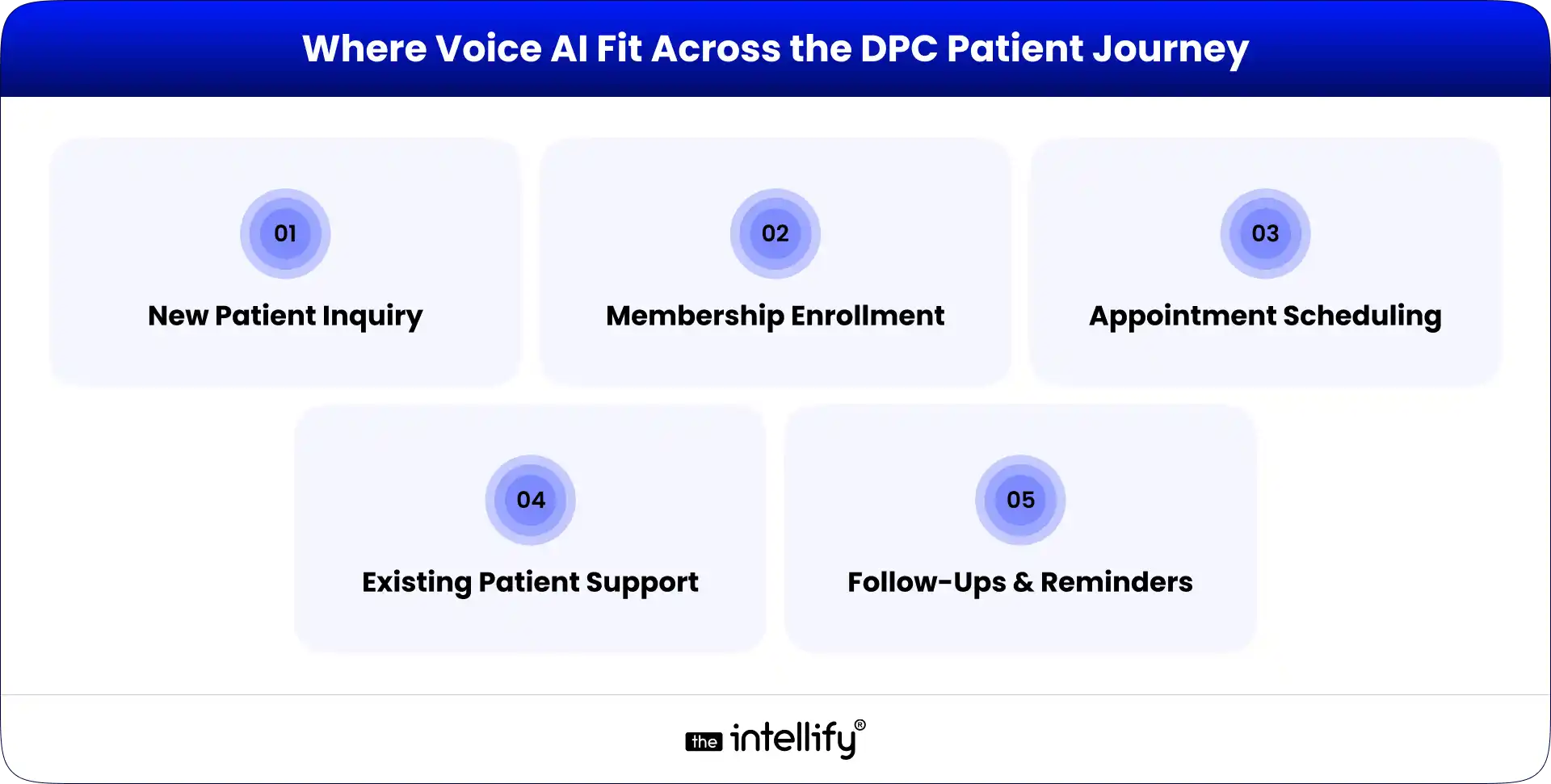
The most useful way to think about voice AI is not as a standalone feature. Think of it as a layer across the patient journey.
1. New Patient Inquiry
A prospective member may call after finding a DPC practice online. The voice agent can answer basic questions about membership, services, availability, and how enrollment works.
It can also capture contact details or direct the caller to the appropriate enrollment workflow. This means fewer prospective patients reach voicemail simply because the team is busy.
2. Membership Enrollment
Once a patient decides to join, the voice agent can guide them through the next steps.
For example, it could explain how to complete registration, direct them to a secure enrollment page, or answer basic questions about the membership process.
The important point is that the AI should not invent information. It should pull approved information from the platform or knowledge source.
3. Appointment Scheduling
This is one of the clearest use cases. A patient calls: “I need a follow-up next week.”
The voice agent can determine the type of appointment, check scheduling rules, offer appropriate availability, and confirm the booking if the system allows it.
If no suitable appointment is available, the conversation can be escalated rather than forcing an automated answer.
4. Existing Patient Support
After enrollment, patients may call for routine administrative needs. The AI agent can help with approved requests such as appointment changes, office information, basic membership questions, and other non-clinical tasks.
This can reduce the number of repetitive calls reaching front-office staff.
5. Follow-Ups and Reminders
Voice AI can also support outbound communication when appropriate.
For example, a practice could use an automated voice workflow to remind patients about appointments or follow up on an administrative request.
The exact workflow should depend on the practice’s policies, consent requirements, and technical setup.
What AI Voice Agents Should Not Handle
This is where healthcare voice AI needs a different mindset from ordinary customer-service automation. A DPC voice agent should have clear limits.
It should not independently diagnose a patient, make clinical decisions, or present itself as a physician. It should not be used as an emergency response system.
If a caller describes a potentially urgent or emergency situation, the workflow should follow predefined escalation instructions rather than asking the AI to “figure it out.”
The same principle applies to sensitive clinical questions.
A patient might say: “I’ve been having chest pain since this morning. What should I take?”
That is not an appointment-booking problem. The system needs to recognize that the request falls outside its permitted scope and move the caller to the appropriate human or emergency pathway.
The best voice agent is not the one that answers everything. It is the one that knows when not to answer.
How an AI Voice Agent Connects With the DPC Technology Stack
A voice agent becomes much more useful when it can securely interact with the systems already running the practice. A modern DPC platform may include:
- Patient portal
- DPC membership management
- Scheduling
- EHR/EMR
- Billing and payments
- Telehealth
- Patient messaging
- CRM
- Notifications and reminders
- Reporting and analytics
The voice agent can sit above these systems as a conversational interface.
A simplified workflow looks like this: Patient call → AI voice agent → Intent detection → Authentication/permissions → DPC platform or integrated system → Action → Confirmation or human escalation
For example:
“I want to reschedule my appointment.”
↓
AI identifies scheduling intent
↓
Checks the relevant scheduling system
↓
Offers permitted appointment options
↓
Patient confirms
↓
The Appointment is updated
↓
AI confirms the change
That is far more useful than simply sending the caller to an extension.
HIPAA and Security Considerations
Healthcare voice AI cannot be treated like a generic customer-service chatbot.
If a voice solution creates, receives, maintains, or transmits protected health information on behalf of a covered healthcare provider, the vendor relationship may fall under HIPAA business associate requirements. HHS specifically lists third-party AI tools that interact with PHI for activities such as appointment scheduling as an example of a potential business associate service.
That means a DPC practice evaluating voice AI should look beyond the quality of the conversation. Important considerations include:
- PHI handling
- Encryption
- Access controls
- Authentication
- Audit logging
- Data retention
- Secure API integrations
- Vendor agreements and BAAs, where applicable
- Role-based permissions
- Human escalation procedures
“AI-powered” and ” HIPAA-compliant” are not interchangeable terms. Compliance depends on how the solution is designed, deployed, integrated, and operated.
For a DPC platform, security should be part of the architecture from the beginning, not something added after the voice agent is already live.
AI Voice Agent vs. Traditional Phone Support
Traditional phone support still has an important role in healthcare. The issue is not that humans are bad at answering phones. The issue is that repetitive calls consume a finite amount of staff time.
| Traditional Phone Support | AI Voice Agent |
|---|---|
| Staff answers each call | AI handles defined routine calls |
| Limited by staff availability | Can operate beyond office hours |
| Repetitive questions consume time | Common questions can be automated |
| Manual scheduling | Can connect to scheduling workflows |
| Human escalation is natural | Complex requests can be escalated |
| Scaling requires more staff time | Scaling can be more software-driven |
This does not mean every DPC practice needs to replace its phone team.
In many cases, the better model is AI for routine requests + humans for exceptions and higher-value conversations. That hybrid approach is much more practical.
How to Add Voice AI Without Rebuilding the Entire DPC Platform
A common concern is that adding AI means replacing the existing DPC platform. It doesn’t have to. If the current platform already handles membership, scheduling, patient records, and communication reasonably well, voice AI can potentially be introduced as an additional interface.
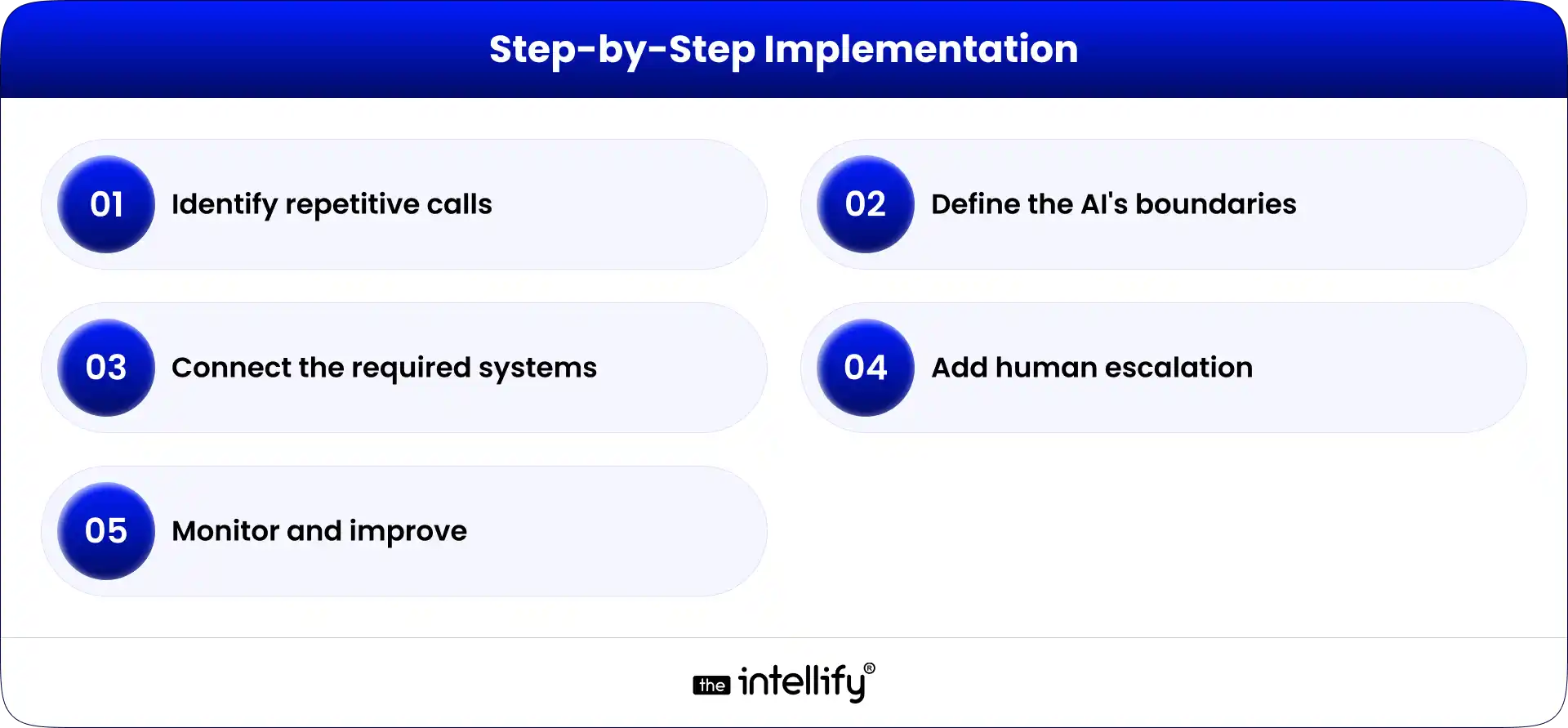
The implementation can happen in stages.
Step 1: Identify repetitive calls
Start with call data. Which requests appear most often? Appointment scheduling? Membership questions? Directions? Prescription-related calls? Billing? Do not automate everything at once.
Step 2: Define the AI’s boundaries
Create a clear list of what the agent can and cannot do. This is especially important for clinical and sensitive requests.
Step 3: Connect the required systems
Use secure APIs and integrations to connect the voice layer with scheduling, membership, CRM, or other relevant systems.
Step 4: Add human escalation
Every production healthcare voice workflow should have a clear path to a human when automation reaches its limit.
Step 5: Monitor and improve
Review failed calls, transfers, misunderstood requests, and patient feedback. Voice AI gets better when the workflow gets better.
If the underlying DPC platform itself is outdated, modernization may be necessary before adding advanced AI capabilities. The Intellify’s DPC platform modernization approach includes AI and EHR/EMR integrations, cloud-native architecture, workflow automation, and patient experience modernization.
When a DPC Practice Should Consider Voice AI
Voice AI makes the most sense when phone demand is creating a real operational problem. Consider it if:
- Staff frequently miss calls.
- Patients regularly wait for callbacks.
- Appointment requests consume significant staff time.
- The practice receives the same questions every day.
- After-hours calls are common.
- The DPC platform already has digital workflows that voice could access.
- The practice wants to scale without adding phone support at the same rate.
On the other hand, a small practice with very low call volume may not need sophisticated voice automation yet. Technology should solve a problem, not create another project for the team to manage.
Conclusion
AI voice agents can become a useful part of a modern DPC platform, but their role should be clearly defined.
They can handle routine conversations, support appointment workflows, answer approved questions, assist with membership-related requests, and route more complex issues to people.
The bigger opportunity is integration. When voice AI connects with the DPC platform, scheduling system, membership management, EHR, and communication workflows, the phone stops being a disconnected channel and becomes another way for patients to interact with the practice.
For DPC organizations modernizing their technology, that distinction matters.
The goal isn’t to make the practice “more AI.” The goal is to make access easier for patients and repetitive work lighter for staff without compromising clinical judgment, privacy, or the physician-patient relationship.
The Intellify works with healthcare organizations on DPC platform modernization, AI integration, EHR/EMR connectivity, and workflow automation. Its Healthcare2U engagement involved modernizing a large U.S. DPC platform, with reported improvements including 30% faster navigation efficiency and 2X admin task efficiency.
If your DPC platform is already working but struggling with scale, disconnected workflows, or manual patient communication, the next step may not be a complete rebuild. It may be identifying where intelligent automation, including voice, can fit into what you already have.
Frequently Asked Questions (FAQs)
1. What is an AI voice agent for DPC?
An AI voice agent is a conversational system that can answer phone calls, understand patient requests, provide approved information, and perform selected workflows such as appointment scheduling or routing. In a DPC environment, it works best as a support layer connected to the existing platform.
2. Can AI voice agents schedule DPC appointments?
Yes, if the voice agent is securely integrated with the practice’s scheduling system and is given appropriate permissions. It can identify scheduling requests, check available slots, book or reschedule appointments, and confirm the outcome.
3. Can an AI voice agent answer medical questions?
It should not independently diagnose conditions or make clinical decisions. Healthcare voice systems should have defined boundaries and escalation workflows for clinical, urgent, or sensitive requests.
4. Are AI voice agents HIPAA-compliant?
A voice agent is not automatically HIPAA-compliant simply because it uses healthcare terminology or is marketed for healthcare. If it handles PHI on behalf of a covered entity, HIPAA requirements may apply, including business associate considerations. The technical architecture, vendor relationship, security controls, and operating procedures all matter.
5. Do DPC practices need to replace their existing software to use voice AI?
Not necessarily. A voice agent can often be added as a new interface through APIs and integrations. However, older DPC platforms may need modernization if their architecture cannot securely support new integrations or automation.
6. What can AI voice agents automate in a DPC practice?
Common opportunities include appointment scheduling, cancellations, rescheduling, practice information, membership-related questions, routine administrative requests, reminders, and call routing. The exact scope should be based on the practice’s workflows and compliance requirements.



Written By, Darshak Doshi
With over a decade of experience, Darshak is a technopreneur specializing in cloud-based applications and product development in healthcare, insurance, and manufacturing. He excels in AWS Cloud, backend development, and immersive technologies like AR/VR to drive innovation and efficiency. Darshak has also explored AI/ML in insurance and healthcare, pushing the boundaries of technology to solve complex problems. His user-focused, results-driven approach ensures he builds scalable cloud solutions, cutting-edge AR/VR experiences, and AI-driven insights that meet today’s demands while anticipating future needs.

How AI Is Transforming Direct Primary Care: Use Cases, Benefits & Implementation
Summary: This guide explains how AI is transforming direct primary care (DPC) by improving patient communication, appointment scheduling, membership management, administrative workflows, and voice-based support. It covers practical AI use cases, benefits, HIPAA and security considerations, implementation steps, costs, and build-vs-buy decisions to help DPC practices evaluate and adopt AI technology effectively. Direct primary […]
HIPAA Compliant Software Development Guide 2026
Summary: This guide explains how to develop HIPAA-compliant software in 2026. It covers key requirements such as data encryption, access controls, audit logs, secure APIs, cloud security, BAAs, risk assessments, and security testing. It also includes a practical checklist to help healthcare organizations build secure software while addressing current HIPAA Security Rule requirements and emerging […]
How to Build a Direct Primary Care (DPC) Membership Platform
Summary: This guide explains how to build a modern Direct Primary Care (DPC) membership platform, covering essential features such as patient onboarding, membership management, recurring billing, scheduling, EHR integration, and secure communication. It also explores how AI and voice agents can automate DPC workflows, reduce administrative workload, improve patient engagement, and help practices modernize existing […]
How AI Is Transforming Direct Primary Care: Use Cases, Benefits & Implementation
Summary: This guide explains how AI is transforming direct primary care (DPC) by improving patient communication, appointment scheduling, membership management, administrative workflows, and voice-based support. It covers practical AI use cases, benefits, HIPAA and security considerations, implementation steps, costs, and build-vs-buy decisions to help DPC practices evaluate and adopt AI technology effectively. Direct primary […]
HIPAA Compliant Software Development Guide 2026
Summary: This guide explains how to develop HIPAA-compliant software in 2026. It covers key requirements such as data encryption, access controls, audit logs, secure APIs, cloud security, BAAs, risk assessments, and security testing. It also includes a practical checklist to help healthcare organizations build secure software while addressing current HIPAA Security Rule requirements and emerging […]
How to Build a Direct Primary Care (DPC) Membership Platform
Summary: This guide explains how to build a modern Direct Primary Care (DPC) membership platform, covering essential features such as patient onboarding, membership management, recurring billing, scheduling, EHR integration, and secure communication. It also explores how AI and voice agents can automate DPC workflows, reduce administrative workload, improve patient engagement, and help practices modernize existing […]
0
+0
+0
+0
+Committed Delivery Leads To Client Satisfaction
Client Testimonials that keep our expert's spirits highly motivated to deliver extraordinary solutions.

Christopher Seny
My experience working with The Intellify, has been a great experience. The team has a wealth of expertise in the tech space. Working with the intellify was a growing experience for me, I learned a lot. The team keeps great communication & responds fast to new ideas & suggestions. The team also provides great suggestions & solutions as well. I couldn’t imagine working with anybody else on this project & it has been a blessing working with, The Intellify.

Izandi Serdyn
The Intellify delivered a platform from scratch, involving the client at every stage. The team was communicative, responsive, and punctual throughout the engagement. Virtual meetings and emails ensured seamless project management. Customers can expect a team that can work fast.

Kya Johnson
The app serves as an effective introduction for users to the product and its characters. Responsive and faithful to initial requirements, The Intellify’s team exceeded initial expectations. Internal stakeholders were particularly pleased with their communication.

Stefan Wyk
Working with The Intellify to develop our website was an outstanding experience. Their team displayed exceptional professionalism, creativity, and technical expertise throughout the entire process. The final product exceeded our expectations, delivering a sleek, user-friendly, and highly functional website. We highly recommend The Intellify to anyone in need of top-tier web development services.

Steve Thorpe
The Intellify’s work has been met with high praise from internal and external stakeholders. The team is efficient, diligent, and reliable in their service. They go above and beyond in terms of communication and project management. The Intellify is a responsive vendor that gets the job done.

Tal Dotan
I’ve been working with The Intellify for the last 3 years. During this period of time we’ve planned and executed projects in both small and large scale. Working with The Intellify was and still is the best decision I’ve made when rising up Divo, I strongly recommend to work with them in any type of project.


 +1-302-803-4983