How AI Is Transforming Customer Service & Business Growth in 2026

By Darshak Doshi
February 10, 2026
Summary:
Customer service in 2026 looks very different from what it did just a few years ago. Long hold times, repetitive emails, and scripted replies are slowly fading out. In their place, AI-driven chatbots, voice agents, and smart analytics are helping businesses respond faster, personalize conversations, and grow revenue. This article walks through real use cases, common mistakes, practical implementation steps, and future trends, showing how companies can use AI to build better customer relationships without losing the human touch.
Why AI in 2026 Is a Turning Point for Businesses
The world of customer service is changing fast, thanks to new developments in artificial intelligence (AI). By 2026, businesses that tap into AI will not just improve customer experiences, they’ll see significant growth as well. From state-of-the-art chatbots to clever voice agents, AI is transforming how companies interact with their customers. In this blog, we’ll explore how AI is reshaping these interactions, the technologies fueling this shift, and how businesses can effectively take advantage of these innovations.
The Evolution of Customer Experience in the AI Era
From Reactive Support to Predictive Service
Remember when businesses only reacted to customer questions? Well, those days are over. Nowadays, predictive service is the name of the game. AI analyzes customer behavior, anticipating needs before they turn into problems. This means businesses can offer solutions proactively.
The Rise of Self-Service and Instant Answers
Today’s customers are looking for self-service options that let them find answers on their own, quickly. AI-driven chatbots provide these instant responses, enabling users to resolve their queries without enduring long wait times.
Customers Now Expect Personalization at Scale
Thanks to AI, companies can offer personalized experiences tailored to individual preferences. Customers increasingly expect customized solutions, and if businesses fail to meet these expectations, they run the risk of losing engagement.
Why Traditional Support Models No Longer Scale
Old-school customer support, which heavily relies on human agents, is struggling to meet the demands of a tech-savvy audience. AI solutions can easily scale up to manage numerous inquiries at once, greatly improving overall customer satisfaction.
Key AI Technologies Powering Business Transformation in 2026
AI Chatbots vs AI Agents
While AI chatbots tend to handle straightforward inquiries, AI agents are stepping up their game. They can manage more complex interactions and escalate issues to human agents when necessary. It’s important to recognize this difference for successful implementation.
AI Voice Agents and Conversational AI
AI voice agents have changed how we interact with businesses by allowing voice-based communication. Thanks to conversational AI, these interactions feel more human and relatable, fostering meaningful connections with customers.
Generative AI for Responses, Emails, and Proposals
Generative AI can whip up responses, emails, and even proposals, making communication much smoother while keeping it personalized. This tech cuts down on those repetitive tasks that used to eat up time.
Predictive Analytics and Customer Insights
Predictive analytics allow companies to forecast trends and understand customer behavior, which helps in tailoring services and products. This way, businesses can stay one step ahead.
AI-Powered CRM and Revenue Intelligence
With the help of AI, Customer Relationship Management (CRM) systems can analyze vast amounts of data, offering actionable insights. This data-driven approach strengthens relationships and boosts revenue through targeted strategies.
Machine Learning for Demand Forecasting
Machine learning algorithms look at past customer behaviors and market trends, enabling accurate predictions of future demand. This enables businesses to optimize their inventory effectively and meet customer needs.
How AI Is Transforming Customer Service
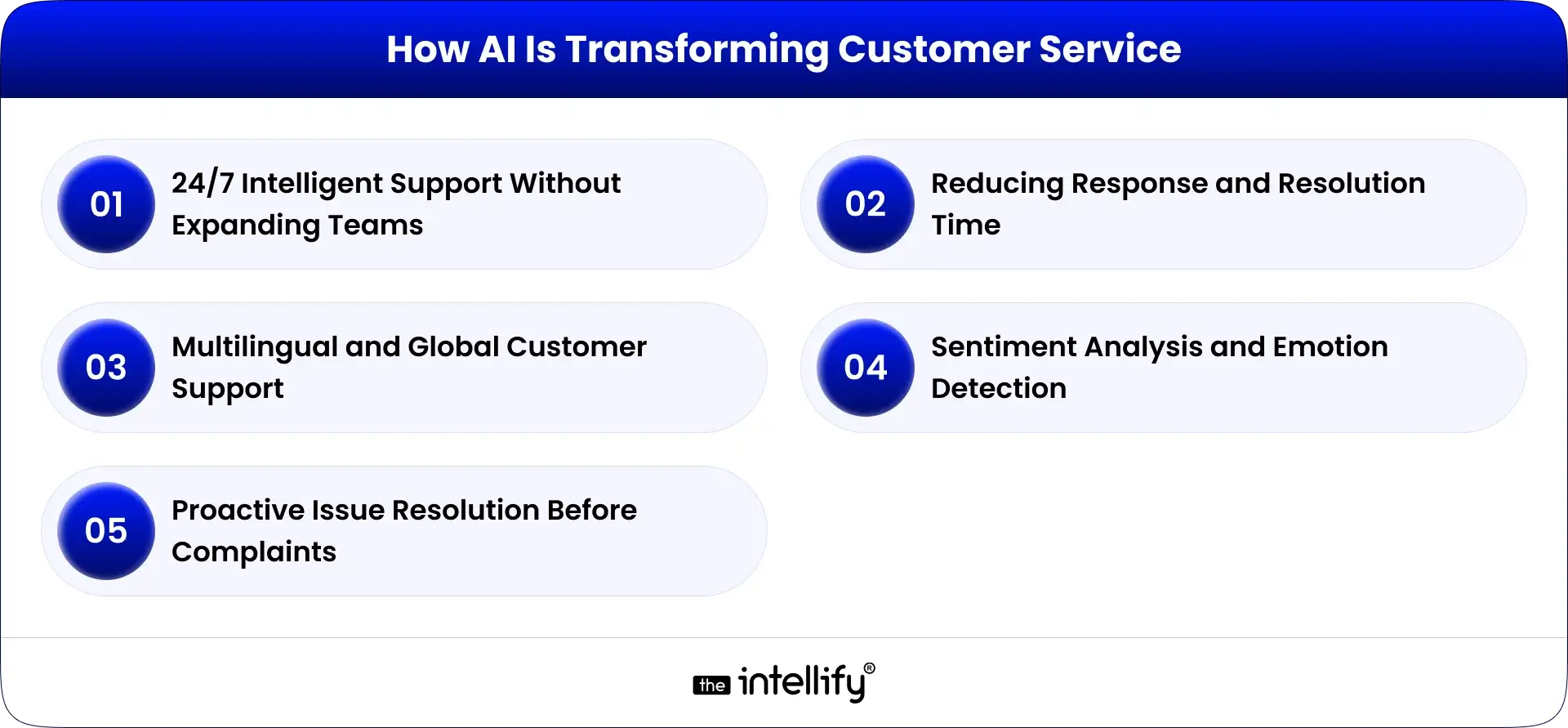
24/7 Intelligent Support Without Expanding Teams
AI solutions are available around the clock, handling inquiries without the need for additional staff. This ensures customers receive help no matter when they reach out.
Reducing Response and Resolution Time
AI technologies drastically cut down wait times by efficiently processing inquiries. This quick responsiveness leads to happier customers and increased loyalty.
Multilingual and Global Customer Support
AI can support multiple languages, making it easier for businesses to cater to a diverse customer base. This is particularly important for companies aiming for global expansion.
Sentiment Analysis and Emotion Detection
AI digs into customer interactions to gauge sentiment and emotion, allowing businesses to tailor their responses based on the customer’s mood. This leads to far more empathetic and effective communication.
Proactive Issue Resolution Before Complaints
With AI’s predictive capabilities, businesses can spot potential issues before they become complaints. By tackling concerns proactively, companies enhance satisfaction and minimize grievances.
How AI Is Driving Sales and Revenue Growth
AI-Based Lead Scoring and Qualification
AI improves lead scoring by diving into data to pinpoint the most promising prospects. This accuracy helps sales teams focus their energy where it matters most.
Automated Follow-Ups and Smart Outreach
Automation streamlines follow-ups, ensuring that no potential customer slips through the cracks. AI sends timely outreach based on customer interactions, boosting engagement and conversions.
Personalization in Sales Conversations
With AI, sales teams can customize their conversations, addressing the unique needs and preferences of customers. This tailored engagement can lead to a noticeable uptick in sales.
Real-Time Sales Forecasting
AI delivers real-time data, helping businesses accurately forecast sales trends. This insight supports strategic planning and efficient resource allocation.
AI as a Sales Co-Pilot for Teams
AI acts as a valuable support system for sales teams, offering suggestions and insights that help close deals. This collaboration enhances both efficiency and effectiveness.
Use cases of AI in customer service across industries
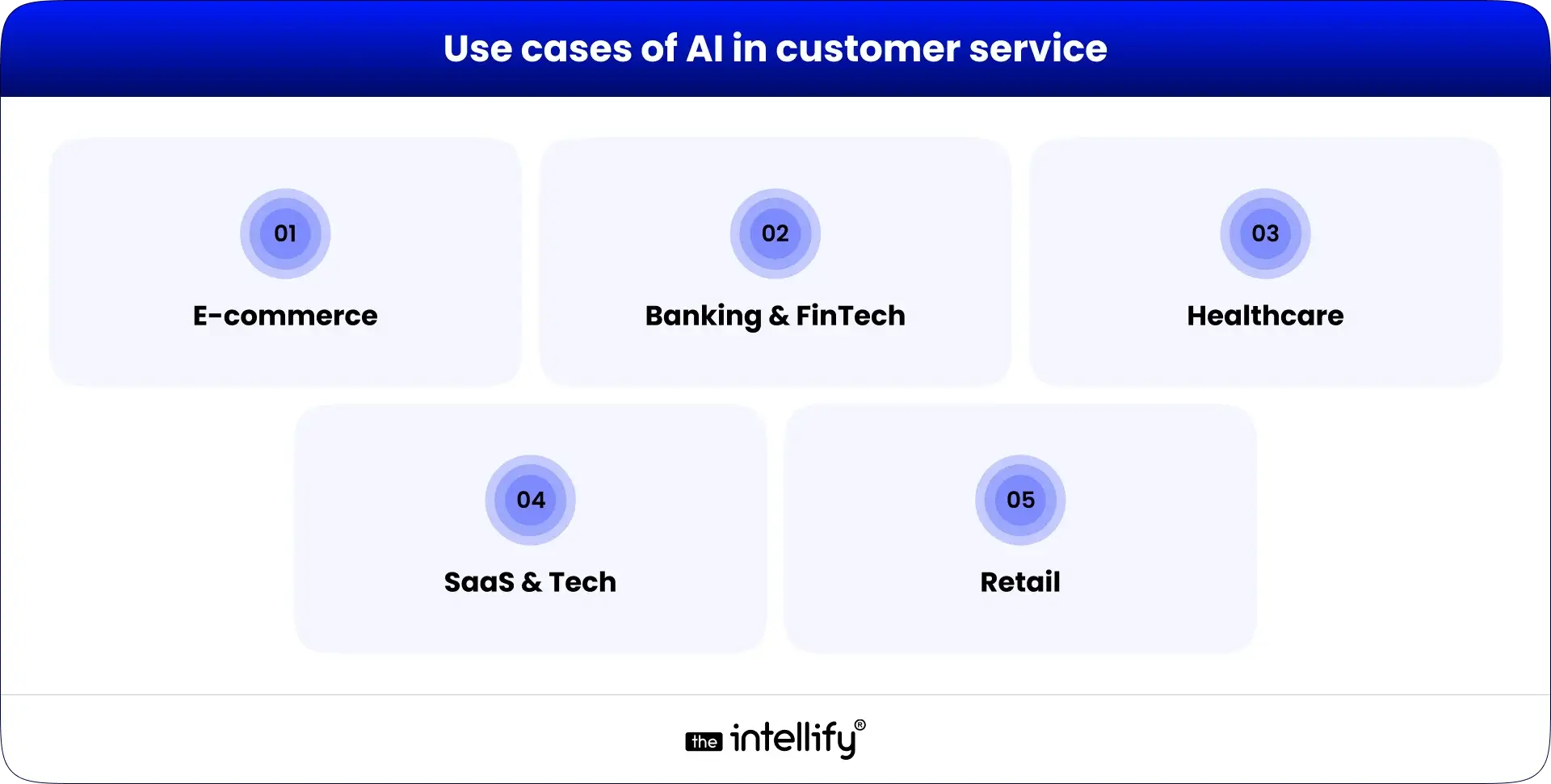
E-commerce: Personalized Recommendations and AI Assistants
E-commerce platforms are leveraging AI for personalized recommendations, enhancing customer satisfaction, and driving sales through targeted suggestions.
Banking & FinTech: Fraud Detection and Smart Support
In the financial sector, AI plays a critical role in fraud detection and offers smart customer support options, balancing security with an enhanced user experience.
Healthcare: AI Triage and Patient Support
AI triage solutions simplify patient interactions, making it easier to direct them to the right healthcare services quickly and efficiently.
SaaS & Tech: Intelligent Help Desks
AI-powered help desks in SaaS firms automate support tasks, ensuring users receive prompt assistance when they need it.
Retail: AI Voice Agents and Omnichannel Engagement
Retailers are now incorporating AI voice agents into their customer engagement strategies, enabling seamless experiences across various channels.
Real-World Applications of AI in Customer Service
Managing High Support Volumes
AI systems are capable of handling thousands of inquiries at the same time, which is essential for businesses facing spikes in customer interactions.
Automating Bookings and Orders
AI takes charge of booking processes and order management, cutting down on human error and boosting overall efficiency.
Secure Customer Verification
AI-powered verification systems enhance security by confirming customer identities while maintaining a seamless user experience.
Personalized Upselling and Cross-Selling
Custom AI algorithms can spot upselling and cross-selling opportunities, driving revenue while also improving customer satisfaction.

Key Trends Driving AI Transformation in 2026
AI-Augmented Teams (Human + AI Collaboration)
The collaboration between human agents and AI will shift workflows, blending empathy with efficiency for better results.
Hyper-Personalization at Scale
Businesses are increasingly adopting hyper-personalization, delivering tailored experiences at every single customer touchpoint.
Autonomous AI Workflows
Autonomous systems will streamline operations, allowing for real-time adjustments based on data insights without the need for human intervention.
Real-Time Data Integration
Real-time data processing will enable businesses to quickly adapt to changes, maintaining a competitive edge.
Ethical and Responsible AI Adoption
As AI becomes more widespread, a focus on ethical practices ensuring fairness, transparency, and accountability will take center stage.
How AI Is Helping Businesses Grow
Improved Customer Satisfaction
AI-driven solutions lead to faster service and more personalized experiences, directly boosting customer satisfaction.
Operational Cost Reduction
By automating routine tasks, businesses can cut down on operational costs, freeing up resources for more strategic initiatives.
Faster Decision-Making
AI quickly provides actionable insights, allowing businesses to make informed decisions more efficiently.
Increased Conversion and Retention Rates
AI-driven personalization results in higher conversion rates and improved customer retention, supporting sustainable business growth.
Scalable Business Growth
AI solutions offer the scalability businesses need to grow without sacrificing quality or service efficiency.
Common Concerns and Challenges
Data Privacy and Compliance
Businesses must navigate the complex world of regulations to safeguard customer data while utilizing AI technologies.
AI Bias and Transparency
Ensuring AI systems are unbiased and transparent is a challenge that businesses must tackle with careful oversight.
Over-Automation Risks
Finding the right balance between automation and human interaction is key to maintaining strong customer relationships.
Integration with Legacy Systems
Companies often face hurdles when integrating AI with existing systems to maximize efficiency.
Workforce Resistance and Change Management
Change may encounter pushback from employees, making change management strategies vital for smooth integration.
Common Implementation Mistakes
Starting Without Clear Business Goals
Businesses need to establish clear objectives when adopting AI to ensure that their actions align with broader strategies.
Ignoring Customer Experience Design
Focusing solely on technology while neglecting the customer experience can lead to unsatisfactory results.
Underestimating Data Quality
High-quality data is key to AI’s success; overlooking this can negatively impact effectiveness.
Failing to Train Teams
It’s essential for employees to understand and effectively work with AI technologies for successful implementation.
Best Practices for Smooth AI Implementation
Starting small, prioritizing data quality, and providing ongoing training for teams are vital for maximizing the chances of successful adoption.
Step-by-Step: Practical Roadmap to Implement AI
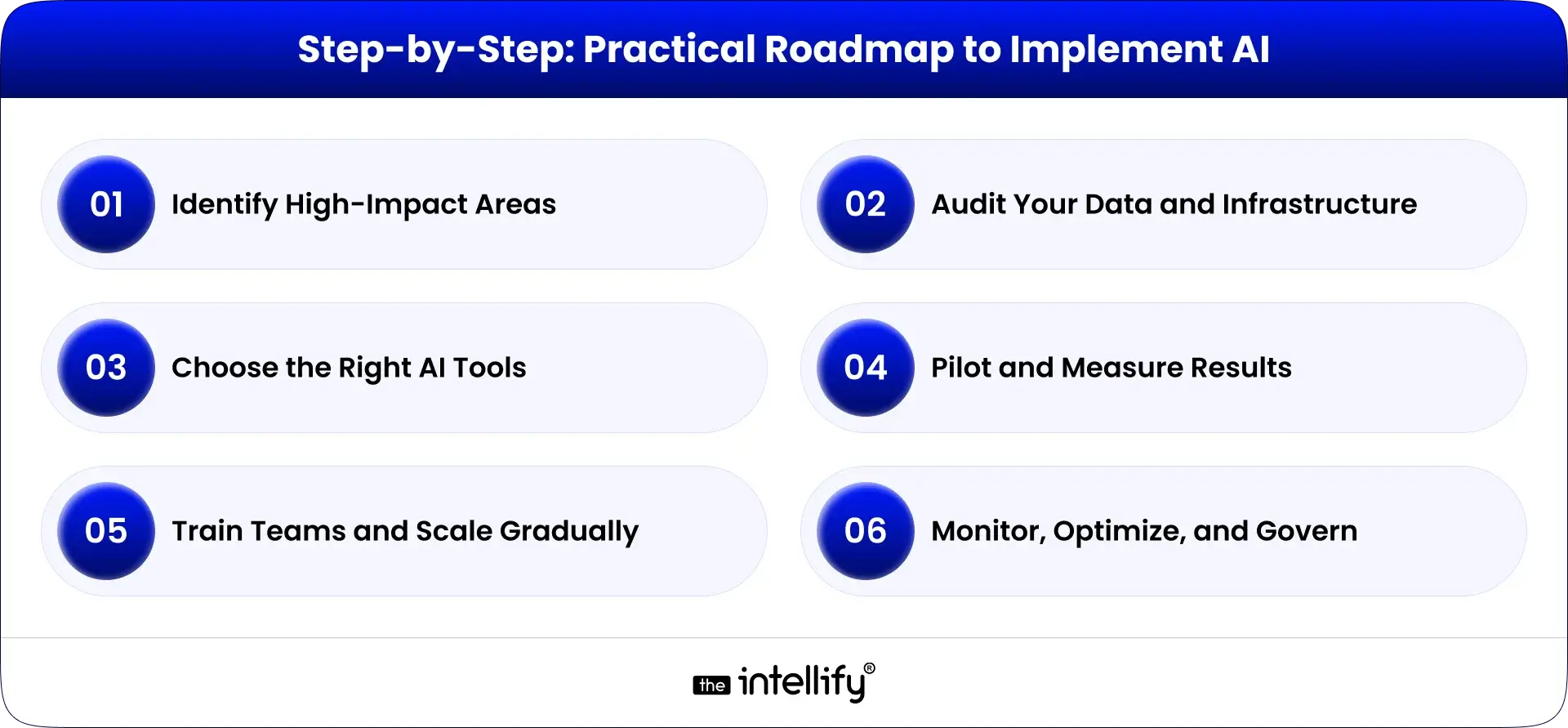
Step 1 – Identify High-Impact Areas
Figure out which areas of your operations stand to benefit the most from integrating AI.
Step 2 – Audit Your Data and Infrastructure
Take stock of your current systems to see what data you have and how it can be effectively utilized.
Step 3 – Choose the Right AI Tools
Partnering with experienced AI development services providers can simplify integration and reduce deployment risks.
Step 4 – Pilot and Measure Results
Run a pilot program to assess performance and gather insights before rolling out the full-scale deployment.
Step 5 – Train Teams and Scale Gradually
Offer training for your teams to ensure they can effectively and responsibly use AI technologies.
Step 6 – Monitor, Optimize, and Govern
Keep a continuous eye on the performance of your AI systems to optimize outcomes and ensure compliance with regulations.
The Future of AI in Business Beyond 2026
AI as Core Infrastructure, Not a Tool
In the coming years, AI will become integral to operations rather than just a tool, shaping business strategies at their foundation.
Autonomous Decision Systems
We’re likely to see fully autonomous systems making strategic decisions without any human oversight.
AI-Driven Innovation Cycles
AI will enable swifter innovation cycles, allowing businesses to respond rapidly to market changes.
The Rise of AI-Native Companies
New companies built around AI technologies will emerge as major players, transforming entire industries.

Conclusion
As we approach 2026, integrating AI into customer service is no longer optional; it’s becoming essential for sustainable growth. Businesses that adopt AI strategically will see faster responses, smarter decisions, and more personalized customer experiences.
But success isn’t just about using AI tools it’s about aligning them with clear business goals and scalable execution. With the right roadmap and guidance from experienced teams like The Intellify, companies can turn AI from simple automation into a long-term competitive advantage.
Frequently Asked Questions (FAQs)
1. What is AI in Customer service?
AI in customer service refers to using technology to enhance customer interactions and improve support processes, employing tools like chatbots and voice agents.
2. How does AI improve customer experience?
AI enhances the customer experience by offering personalized responses, reducing wait times, and providing support around the clock.
3. What are the differences between AI chatbots and AI agents?
AI chatbots primarily handle straightforward inquiries, while AI agents manage more complex interactions and can escalate issues when needed.
4. What industries are benefiting from AI in customer service?
Industries such as e-commerce, banking, healthcare, SaaS, and retail are successfully harnessing AI to elevate customer care.
5. How can businesses integrate AI effectively?
Successful AI integration starts with identifying key areas for improvement and selecting suitable tools, alongside training staff to utilize the technology.
6. What concerns should companies have about using AI?
Businesses need to focus on ensuring data privacy, addressing potential AI biases, and finding a balance between automation and human interaction.
7. How The Intellify is helping businesses with AI?
The Intellify offers customized AI solutions aimed at enhancing customer experiences, optimizing operations, and driving growth.


Written By, Darshak Doshi
With over a decade of experience, Darshak is a technopreneur specializing in cloud-based applications and product development in healthcare, insurance, and manufacturing. He excels in AWS Cloud, backend development, and immersive technologies like AR/VR to drive innovation and efficiency. Darshak has also explored AI/ML in insurance and healthcare, pushing the boundaries of technology to solve complex problems. His user-focused, results-driven approach ensures he builds scalable cloud solutions, cutting-edge AR/VR experiences, and AI-driven insights that meet today’s demands while anticipating future needs.

AI Workflow Automation Explained: Benefits, Use Cases, and ROI for Businesses
Summary: AI workflow automation helps businesses achieve faster ROI by optimizing repetitive and time-consuming processes. It improves efficiency, reduces costs, and enhances decision-making by leveraging data and intelligent systems. From customer service to internal operations, organizations can streamline workflows and scale effectively. By starting with high-impact use cases and tracking performance metrics, businesses can unlock […]
AI in Healthcare Administration: Streamlining Hospital Operations
Summary The growing complexity of healthcare administration is driving the need for smarter, more efficient solutions. Automation technologies are helping streamline key processes such as scheduling, billing, and data management, reducing manual workload and improving accuracy. This enables faster operations, better coordination, and enhanced patient experiences. As adoption increases, healthcare organizations are moving toward more […]

HIPAA-Compliant AI for Healthcare Platforms: Architecture, Security & Practices
Summary: Healthcare organizations are increasingly using AI to improve diagnostics, operations, and patient engagement. However, handling sensitive medical data requires strict privacy and regulatory safeguards. This guide explains how to design HIPAA compliant AI systems for healthcare platforms. It covers key AI architecture components, security measures, compliance practices, and common challenges organizations face when using […]
AI Workflow Automation Explained: Benefits, Use Cases, and ROI for Businesses
Summary: AI workflow automation helps businesses achieve faster ROI by optimizing repetitive and time-consuming processes. It improves efficiency, reduces costs, and enhances decision-making by leveraging data and intelligent systems. From customer service to internal operations, organizations can streamline workflows and scale effectively. By starting with high-impact use cases and tracking performance metrics, businesses can unlock […]
Healthcare Membership Platform Development: Guide for Startups & DPC Providers
Summary: Healthcare membership platform development is transforming how providers deliver continuous, subscription-based care. This guide explains how membership models help organizations improve patient engagement, generate predictable revenue, and streamline operations. It covers essential features, development strategies, integration needs, and the role of automation and AI in modern healthcare systems. Whether you’re a startup or a […]
AI in Healthcare Administration: Streamlining Hospital Operations
Summary The growing complexity of healthcare administration is driving the need for smarter, more efficient solutions. Automation technologies are helping streamline key processes such as scheduling, billing, and data management, reducing manual workload and improving accuracy. This enables faster operations, better coordination, and enhanced patient experiences. As adoption increases, healthcare organizations are moving toward more […]
0
+0
+0
+0
+Committed Delivery Leads To Client Satisfaction
Client Testimonials that keep our expert's spirits highly motivated to deliver extraordinary solutions.

Christopher Seny
My experience working with The Intellify, has been a great experience. The team has a wealth of expertise in the tech space. Working with the intellify was a growing experience for me, I learned a lot. The team keeps great communication & responds fast to new ideas & suggestions. The team also provides great suggestions & solutions as well. I couldn’t imagine working with anybody else on this project & it has been a blessing working with, The Intellify.

Izandi Serdyn
The Intellify delivered a platform from scratch, involving the client at every stage. The team was communicative, responsive, and punctual throughout the engagement. Virtual meetings and emails ensured seamless project management. Customers can expect a team that can work fast.

Kya Johnson
The app serves as an effective introduction for users to the product and its characters. Responsive and faithful to initial requirements, The Intellify’s team exceeded initial expectations. Internal stakeholders were particularly pleased with their communication.

Stefan Wyk
Working with The Intellify to develop our website was an outstanding experience. Their team displayed exceptional professionalism, creativity, and technical expertise throughout the entire process. The final product exceeded our expectations, delivering a sleek, user-friendly, and highly functional website. We highly recommend The Intellify to anyone in need of top-tier web development services.

Steve Thorpe
The Intellify’s work has been met with high praise from internal and external stakeholders. The team is efficient, diligent, and reliable in their service. They go above and beyond in terms of communication and project management. The Intellify is a responsive vendor that gets the job done.

Tal Dotan
I’ve been working with The Intellify for the last 3 years. During this period of time we’ve planned and executed projects in both small and large scale. Working with The Intellify was and still is the best decision I’ve made when rising up Divo, I strongly recommend to work with them in any type of project.


 +1-302-803-4983