Summary
Augmented Reality is changing how people explore and buy furniture by allowing them to visualize products in their own spaces before making a purchase. This technology helps reduce uncertainty, improves buying confidence, and creates a more interactive shopping experience. In this blog, we explore how AR is being used across the furniture industry, its benefits for businesses and customers, and what the future of AR in furniture retail may look like.
Augmented Reality(AR) puts digital elements into the real world, using a smartphone or tablet. Rather than wonder how a piece of furniture might appear in your house, AR shows you immediately.
Imagining what it will look like in one’s home has always been part of buying furniture. We imagine how a sofa will sit in the living room or if a table will coordinate with the wall colour. Even online shopping sounds doubtful, and that’s with all of its ease.
Customers demand greater certainty before making a purchase, particularly when buying high-value products. They want confidence, not guesswork. AR is becoming so crucial, which is the reason. It’s not just enhancing the shopping experience it’s transforming how furniture is experienced, marketed and sold.
The Furniture Industry Before AR
Furniture retail relied on physical showrooms before AR.” Customers needed to visit stores to try products, touch materials and understand size.
Shopping moved online, and convenience improved, but so did uncertainty. Photos and measurements were helpful, but a lot of shoppers still found it difficult to picture how a product would look in their own homes.
This often led to hesitation. It takes a lot of confidence to buy big purchases such as beds, wardrobes, or sofas. Without it, buyers postpone decisions or skip purchases entirely.
Return rates, too, became a problem. Products returned when expectations and reality failed to align. Resource taxes increased the burden on brands, creating additional costs and operational pressure.
What Augmented Reality Means for the Furniture Industry
From a broader business perspective, AR in furniture is more than a feature. It connects digital browsing with the real-world environment. Instead of relying only on static images, customers can interact with products. They can place furniture inside their own rooms and see how it fits before buying.
This shifts the buying journey from imagination-based to experience-based. Customers move from guessing to seeing.
AR also supports a connected retail journey. A shopper may explore online, visualize at home, and visit a store for final confirmation. Since AR works directly on smartphones, it is far more practical for furniture retail than more complex technologies.
How Augmented Reality Is Transforming the Customer Experience
Real-Time Room Visualization
One of the biggest advantages of AR is true-to-scale placement. Customers can position furniture in their room and view it from different angles.
They can check spacing, alignment, and overall fit. This makes measurements easier to understand because the product appears in context.
Personalization & Customization
AR enables customers to test different colors, finishes, and materials. A wooden table will always look darker or lighter.
Customers can experiment with layout options and compare styles without needing to move tangible goods. It turns the process of writing to engage with readers.
Confident Buying Decisions
Customer skepticism naturally diminishes when they can visualize how a product will fit in their own home. They are more confident in their decision. The clearer the visualization, the clearer the decision.
Business Benefits of AR for Furniture Brands
1. Increased Conversion Rates
If customers are confident, they will make the purchase. AR eliminates ambiguity that can lead to indecision.
2. Reduced Product Returns
More visualization leads to fewer surprises later in delivery. This means decreasing return rates when customers know what to expect.
3. Higher Customer Engagement
Interactive experiences increase dwell time on websites and apps. In fact, customers are more engaged when they proactively explore products.
4. Stronger Brand Positioning
Offering AR makes brands look innovative and customer-focused. This creates an image that is modern and aspirational.
5. Improved Customer Retention
Positive buying experiences create trust. Happy customers are returning customers and potential brand advocates.

Examples of Augmented Reality in the Furniture Industry
IKEA
After all, IKEA was among the first furniture brands to come up with AR by introducing the IKEA Place app. An app that lets you see life-sized models of furniture sitting in your living room using your smartphone camera.
This allows shoppers to visualize how a sofa, chair or table would look and fit in their space before buying it. This new feature employed early is what helped IKEA make online furniture shopping more feasible and assured.
Wayfair
Wayfair embeds augmented reality directly in its mobile app, allowing shoppers to see how furniture would look in their homes. Users can put items in their room and see them from various angles to measure size and placement.
Because Wayfair sells furniture primarily online, this feature assists customers in sorting through their options more easily and feeling more confident about selecting large items.
Overstock
Similarly, Overstock implemented augmented reality to enhance the online shopping for furniture. The mobile app allows customers to visualize furniture items in their own rooms before they place an order.
That makes it easier to conceptualize scale and layout, which in turn reduces uncertainty when ordering furniture online.
Amazon
AR View a feature that enables customers to see what furniture and home products would look like in their homes with a smartphone.
Shoppers can move virtual items around and see how they compare with other furniture. This functionality enhances the online browsing of products and aids customers in faster purchase decision-making with confidence.
KisTag
KisTag has explored augmented reality to help customers visualize kitchen furniture and storage solutions within their space. This allows users to understand layout, size, and placement before selecting a product.
Kis Tag also collaborated with The Intellify to implement an AR experience for kitchen furniture visualization. To explore the complete project implementation and results, readers can view the detailed case study.:- https://theintellify.com/work/kistag-ar-and-vr-solution/.
How to Incorporate AR into Your Furniture Business
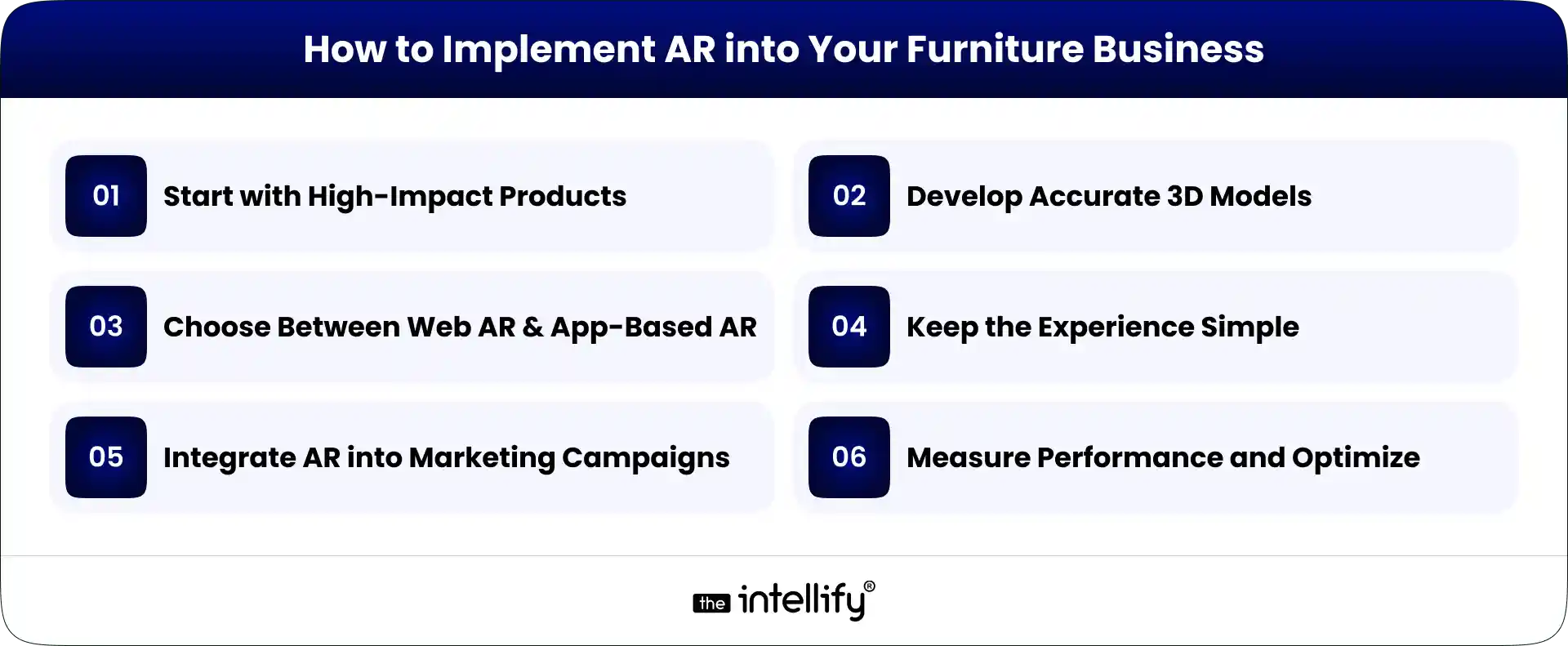
Start with High-Impact Products
First, focus on products in which size and fit are of the greatest importance, like sofas, beds and dining tables. These matters are best aided through visualization. Launching AR with selected products allows you to test impact before expanding further.
Develop Accurate 3D Models
Accuracy builds trust. Models have to closely mirror real-world item dimensions, materials and colors. When customers see realistic visuals, confidence increases. Poor rendering can create confusion instead.
Choose Between Web AR and App-Based AR
Web AR enables customers to use the feature straight from a browser. That way you don’t have to download it. App-based AR can have more additional features, so the right option is highly dependent on your customer behavior and goals.
Keep the Experience Simple
It should be a simple and straightforward process. If customers find this feature hard to activate, they might just not use it. How easy it is to figure things out, whether the program loads up quickly.
Integrate AR into Marketing Campaigns
Clearly advertise AR on product pages, ads and social channels. Customers must know that it exists. Showcasing the advantage of viewing items within their own environment boosts interaction.
Measure Performance and Optimize
Analyze metrics like engagement time, conversions, and return rates post-AR implementation. Utilize these insights to progressively enhance models, broaden features and user experience.
AR in Physical Stores and Hybrid Retail
AR also enhances in-store experiences. Interactive displays allow customers to browse more choices without adding physical inventory.
Endless aisle concepts enable shoppers to digitally browse even more products as they’re in the store. It is also a boon for hybrid shopping, linking online and offline elements into one seamless journey.
A customer may research a product online, see how it looks in their own home through AR, and visit the store to complete the purchase.
Challenges of Implementing AR in Furniture
This effort also involves investment in 3D modeling and technology integration. But furniture brands have to plan the implementation well in advance so that it works seamlessly within their digital platforms.
There are also potential compatibility issues for devices. Some customers may require some help to use the feature comfortably. It is therefore also important to maintain the outlook, having accurate sizing, textures, and details of the product helps in building trust and improving the experience.
Opportunities and Emerging Trends
Adoption of AR use cases requires 3D modeling and technology integration investment. Long-term, this will add value to their e-commerce platforms, but it needs to be implemented carefully so that the infrastructure can accommodate and deliver it successfully.
There could also be some compatibility challenges on different devices. Certainly, some customers will require help using the feature. It is also crucial to stay true to the visuals, as accurate sizing, textures and product details build trust and enhance the overall experience.
The Future Outlook for AR in Furniture
AR is gradually becoming part of core retail strategy rather than an optional feature. As customers expect more clarity and interaction before buying, visualization tools will likely become standard across online furniture platforms.
In the future, AR may also support design planning and help brands understand customer preferences based on how people interact with products in their own spaces.
Companies that invest thoughtfully in AR today are likely to build stronger competitive positioning tomorrow, as furniture shopping continues to shift from guessing about products to experiencing them before purchase.

Conclusion
Augmented Reality is redefining the furniture industry by reducing uncertainty and improving clarity. It helps customers make confident decisions while also supporting brands through better engagement and overall performance.
AR-powered visualization tools enhance the buying experience and reduce hesitation during the purchase process. As customer expectations continue to evolve, AR will become increasingly common across furniture retail. Businesses that adopt it strategically and focus on delivering real value will be better positioned to meet changing customer expectations and remain competitive in the market.
Frequently Asked Questions (FAQs)
1. How is augmented reality used in the furniture industry?
Augmented reality is used to let customers place virtual furniture inside their real rooms using a smartphone or tablet. It helps them see how a sofa, table, or bed will look and fit before buying. Brands use AR to improve shopping confidence, reduce returns, and make the buying experience more interactive.
2. How does AR help customers choose the right furniture?
AR allows customers to visualize furniture in their own space at true scale. They can check size, layout, and style instantly. This removes guesswork and makes decision-making easier, especially for large or expensive items.
3. How accurate is augmented reality for furniture placement?
Most AR tools are quite accurate when placing furniture in a room. They use your phone’s camera and sensors to measure space and adjust the size correctly. While lighting and room setup can slightly affect precision, the preview is usually reliable enough to help customers make confident decisions.
4. How does augmented reality improve online furniture conversion rates?
AR improves conversion rates by reducing hesitation during the buying process. When customers can visualize products in their own space, they feel more confident and are more likely to complete their purchase rather than abandon their cart.
5. Is AR expensive for furniture companies to implement?
There is an initial investment in creating 3D models and integrating the technology. However, many brands see long-term value through higher sales and lower return costs. Over time, AR often becomes a smart strategic investment rather than just a tech upgrade.
6. Can customers customize furniture using augmented reality?
Yes, many AR tools allow customers to change colors, materials, and finishes in real time. This makes the experience more personal and helps buyers choose styles that match their home decor.



Written By, Jalaj Shah
The COO and Co-Founder of The Intellify. Jalaj enjoys experimenting with new strategies. His posts are fantastic for businesses seeking innovative development ideas. Discover practical insights from his engaging content.


Virtual Reality in Education: Applications, Benefits & Future of Learning
Summary: Virtual reality in education is changing how students learn by making lessons more interactive and practical. Instead of only reading or listening, learners can explore concepts through immersive experiences. This blog explains how VR is used across subjects, its key benefits, real-world applications, challenges, and future trends. It also covers how institutions can adopt […]

Indoor Navigation with AR: The Future of Smart Wayfinding Systems
Summary: AR-powered indoor navigation is helping businesses deliver smarter and more seamless wayfinding experiences. By guiding users with real-time visual directions, it eliminates confusion in complex environments like hospitals, malls, airports, and campuses. These solutions not only improve visitor satisfaction but also enhance operational efficiency and accessibility. As demand for smarter buildings grows, indoor navigation […]

How Augmented Reality in Education is Transforming Learning Apps for Kids
Summary: Augmented Reality in education is transforming how children learn by making lessons more interactive, visual, and engaging. Instead of relying only on text or videos, AR allows kids to explore 3D models, animations, and real-world simulations, improving understanding and retention. This blog covers how AR learning apps work, their key features, real-world applications, benefits, […]
Virtual Reality in Education: Applications, Benefits & Future of Learning
Summary: Virtual reality in education is changing how students learn by making lessons more interactive and practical. Instead of only reading or listening, learners can explore concepts through immersive experiences. This blog explains how VR is used across subjects, its key benefits, real-world applications, challenges, and future trends. It also covers how institutions can adopt […]
Indoor Navigation with AR: The Future of Smart Wayfinding Systems
Summary: AR-powered indoor navigation is helping businesses deliver smarter and more seamless wayfinding experiences. By guiding users with real-time visual directions, it eliminates confusion in complex environments like hospitals, malls, airports, and campuses. These solutions not only improve visitor satisfaction but also enhance operational efficiency and accessibility. As demand for smarter buildings grows, indoor navigation […]
How Augmented Reality in Education is Transforming Learning Apps for Kids
Summary: Augmented Reality in education is transforming how children learn by making lessons more interactive, visual, and engaging. Instead of relying only on text or videos, AR allows kids to explore 3D models, animations, and real-world simulations, improving understanding and retention. This blog covers how AR learning apps work, their key features, real-world applications, benefits, […]
0
+0
+0
+0
+Committed Delivery Leads To Client Satisfaction
Client Testimonials that keep our expert's spirits highly motivated to deliver extraordinary solutions.

Christopher Seny
My experience working with The Intellify, has been a great experience. The team has a wealth of expertise in the tech space. Working with the intellify was a growing experience for me, I learned a lot. The team keeps great communication & responds fast to new ideas & suggestions. The team also provides great suggestions & solutions as well. I couldn’t imagine working with anybody else on this project & it has been a blessing working with, The Intellify.

Izandi Serdyn
The Intellify delivered a platform from scratch, involving the client at every stage. The team was communicative, responsive, and punctual throughout the engagement. Virtual meetings and emails ensured seamless project management. Customers can expect a team that can work fast.

Kya Johnson
The app serves as an effective introduction for users to the product and its characters. Responsive and faithful to initial requirements, The Intellify’s team exceeded initial expectations. Internal stakeholders were particularly pleased with their communication.

Stefan Wyk
Working with The Intellify to develop our website was an outstanding experience. Their team displayed exceptional professionalism, creativity, and technical expertise throughout the entire process. The final product exceeded our expectations, delivering a sleek, user-friendly, and highly functional website. We highly recommend The Intellify to anyone in need of top-tier web development services.

Steve Thorpe
The Intellify’s work has been met with high praise from internal and external stakeholders. The team is efficient, diligent, and reliable in their service. They go above and beyond in terms of communication and project management. The Intellify is a responsive vendor that gets the job done.

Tal Dotan
I’ve been working with The Intellify for the last 3 years. During this period of time we’ve planned and executed projects in both small and large scale. Working with The Intellify was and still is the best decision I’ve made when rising up Divo, I strongly recommend to work with them in any type of project.


 +1-302-803-4983