How Augmented Reality is Transforming Online Shopping in E-commerce

By Shravan Rajpurohit
March 20, 2026
Summary:
Online shopping often means customers cannot often physically experience products, which creates uncertainty for customers. This blog explains how Augmented Reality (AR) helps solve that by allowing shoppers to visualise products in real-world settings before buying. It covers how AR improves product understanding, boosts confidence, and reduces returns, along with real use cases, benefits, challenges, and what the future of interactive shopping could look like in e-commerce.
The Changing Landscape of Online Shopping
Online shopping has quietly become part of everyday life. Most people don’t even think twice anymore before ordering something from their phone, whether it’s a pair of shoes, a phone charger, or even a sofa.
But there’s still one small frustration that never really went away. You can’t touch the product. You can’t try it. And sometimes… you just don’t know if it’ll look good once it arrives. Almost everyone has had that moment, opening a package and thinking, “This looked better online.” That uncertainty is still there, even today.
This is where technologies like Augmented Reality (AR) are starting to make a difference. Instead of guessing, people can now actually see how a product might look in real life. It doesn’t completely replace physical shopping, but it gets surprisingly close. And slowly, this is changing how people shop online.
Understanding Augmented Reality in E-commerce
Augmented Reality, or AR, sounds complicated at first, but it’s actually pretty simple. It just means adding digital elements into the real world using your phone’s camera.
For example, you point your camera at your living room, and suddenly, there’s a virtual chair sitting in the corner. It’s not really there, but it looks real enough to help you decide.
In e-commerce, this solves a very basic problem: imagination. Instead of trying to picture how something might look, customers can actually see it. That small shift makes a big difference.
It’s also worth clearing up one common confusion. AR is not the same as Virtual Reality (VR). VR takes you into a completely digital world. AR, on the other hand, keeps you in the real world and just adds things to it. And the best part? You don’t need any fancy headset. Just a smartphone… which most people already have in their hands anyway.
Market Demand for Interactive Shopping in E-commerce
Customer expectations have changed. A lot. Earlier, a few product images and a short description were enough. Now, that feels… incomplete. People want to know:
- How big is it really?
- Will it match my space?
- Will it suit me?
Because of this, many e-commerce businesses are slowly moving toward more interactive experiences. Not because it’s trendy, but because customers expect it. Big brands started experimenting with this first, but now even mid-sized retailers are catching up. The competition is getting tighter, and just listing products isn’t enough anymore.
If a customer can experience a product before buying, even in a small way, they’re more likely to trust what they’re seeing. And trust, in online shopping, matters a lot.
How Augmented Reality Enhances the Online Shopping Experience
One of the biggest improvements in online shopping is the ability to explore products more realistically. Instead of relying only on static images, customers can now view items in 3D and examine them from different angles.
Many retailers also offer virtual try-on features for products like glasses, accessories, and cosmetics. This allows shoppers to see how an item may look on them before making a purchase.
Another useful feature is real-world product placement. For example, someone buying furniture can place a digital sofa or table in their living room using their phone camera to see how it fits within the space.
By allowing shoppers to interact with products before buying, AR brings a level of clarity that traditional product images often cannot provide. This helps customers feel more confident when making purchase decisions.
Key Benefits of AR for E-commerce Businesses
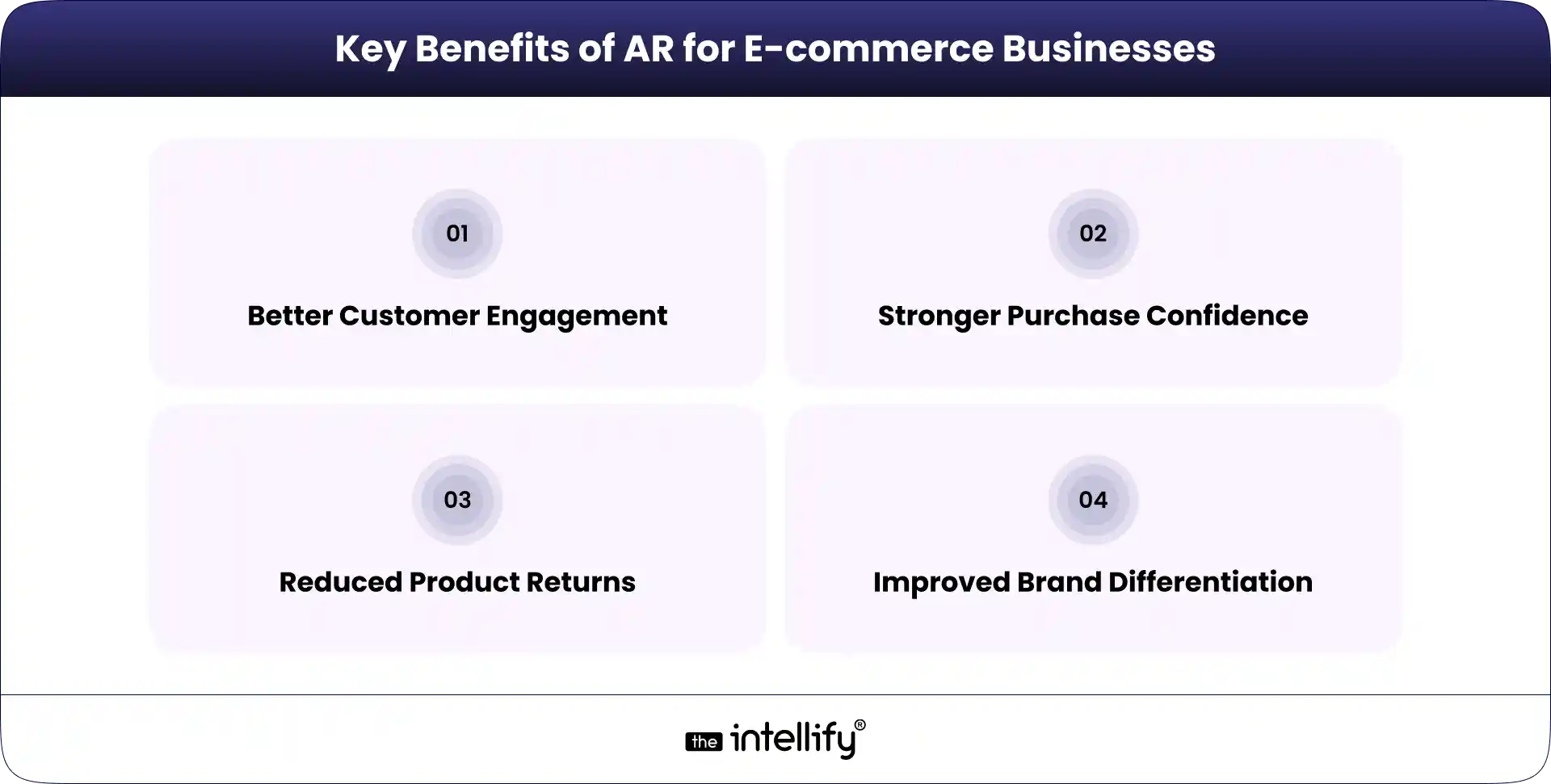
Introducing interactive experiences isn’t just about looking modern. It actually solves real problems for businesses.
- Better Customer Engagement: When people can interact with products, they naturally spend more time exploring. It’s not forced it just happens.
- Stronger Purchase Confidence: Seeing a product in context helps customers feel more sure about their decision. Less guessing, fewer second thoughts.
- Reduced Product Returns: This one’s big. When customers know what to expect, they’re less likely to return items later.
- Improved Brand Differentiation: Let’s be honest, most online stores still look the same. Adding interactive features makes a brand stand out without shouting for attention.
These benefits show why many online retailers are exploring such technologies as part of their long-term digital commerce strategy.
Industries Successfully Using AR for Online Shopping
Several industries have already started using AR for online shopping to improve product experiences.
Fashion and apparel industry: virtual fitting tools help customers see how clothes or accessories might look. It’s not exact, but it’s helpful.
Beauty and cosmetics sector: allows users to test different makeup shades digitally using their phone camera, helping them choose products more confidently.
Furniture and home décor industry, customers can see how items such as sofas, tables, or lamps will appear inside their living spaces before placing an order.
Eyewear industry also uses virtual try-on tools that allow shoppers to see how different frames suit their face.
Even industries like electronics and automotive are experimenting with similar ideas showing features more interactively instead of just listing them.
As these tools become easier to implement, more industries are expected to adopt them to improve how customers explore products online.

Challenges and Limitations of AR in E-commerce
Of course, it’s not all smooth. Creating these experiences takes effort. Building accurate 3D models isn’t quick, and it’s definitely not cheap.
Device compatibility is another issue. Not all smartphones support advanced AR features, especially older ones. Then there’s the user side of things. Some people still find these tools confusing or simply ignore them.
There’s also the matter of privacy. When apps ask for camera access, users can feel a bit unsure and that hesitation is understandable. So yes, there are challenges. But despite that, many businesses are still exploring AR because the potential upside is hard to ignore.
The Future of AR in E-commerce Industry
The future of interactive shopping experiences looks promising as technology continues to improve.
Since most online purchases already happen through smartphones, mobile devices will likely remain the primary platform for these features. This makes it easier for shoppers to access them without needing additional hardware.
We may also see deeper integration with technologies like artificial intelligence to create more personalized product recommendations. Virtual showrooms and digital product demonstrations could become more common, helping customers explore items in more engaging ways.
As digital commerce continues to evolve, AR is likely to become a common feature that helps shoppers make more informed decisions online.
Conclusion
Online shopping isn’t standing still. It keeps changing, sometimes slowly, sometimes all at once. AR in E-commerce are helping close the gap between digital and physical shopping. They don’t solve everything, but they make product understanding clearer and that matters.
When people can see how something might look or fit before buying, they feel more comfortable making a decision. For businesses, this means fewer returns, better engagement, and stronger trust over time. It’s not about adding flashy features. It’s about making the experience a little more real. And honestly, that’s what most shoppers were missing all along.

Frequently asked questions (FAQs)
1. Why are e-commerce brands investing in Augmented Reality features?
Because basic product images don’t always answer real questions. Brands are using AR to make product browsing feel a bit more real. When people can actually see how something might look or fit, they spend more time exploring and usually feel more confident before buying. It’s not magic, but it definitely helps.
2. Which products benefit the most from Augmented Reality in online stores?
Anything where looks or fit matter. Furniture is a big one you want to know if it fits your space. Same with clothes, glasses, or even makeup. Home décor items too. Basically, if you’ve ever thought “Will this actually look good?”… that’s where AR helps the most.
3. Can Augmented Reality help reduce product returns in e-commerce?
Yes, and this is one of the main reasons businesses care about it. When people know what they’re getting, there are fewer surprises later. And fewer surprises usually mean fewer returns. It doesn’t eliminate returns completely, but it definitely reduces them.
4. Do customers need special devices to use Augmented Reality while shopping online?
No, not really. Most AR features work directly on a smartphone or tablet. You just open the camera, and that’s it. No headset, no extra setup. Which is probably why more people are actually starting to use it.
5. Does Augmented Reality influence customer buying decisions?
Yes… more than you might expect. A lot of online shopping hesitation comes from uncertainty. When you remove some of that—by showing how a product might look in real life people feel more sure. And when they feel sure, they’re more likely to buy.
6. What challenges do businesses face when introducing Augmented Reality in e-commerce?
It’s not as easy as it looks.
Creating accurate 3D models takes time. Making sure everything works smoothly across different devices can also be tricky. And yes, it needs investment.
But even with these challenges, many businesses are still moving forward with it because the long-term benefits are hard to ignore.


Written By, Shravan Rajpurohit
Shravan Rajpurohit is the Co-Founder & CEO of The Intellify, a leading Custom Software Development company that empowers startups, product development teams, and Fortune 500 companies. With over 10 years of experience in marketing, sales, and customer success, Shravan has been driving digital innovation since 2018, leading a team of 50+ creative professionals. His mission is to bridge the gap between business ideas and reality through advanced tech solutions, aiming to make The Intellify a global leader. He focuses on delivering excellence, solving real-world problems, and pushing the limits of digital transformation.

Virtual Reality in Education: Applications, Benefits & Future of Learning
Summary: Virtual reality in education is changing how students learn by making lessons more interactive and practical. Instead of only reading or listening, learners can explore concepts through immersive experiences. This blog explains how VR is used across subjects, its key benefits, real-world applications, challenges, and future trends. It also covers how institutions can adopt […]
Indoor Navigation with AR: The Future of Smart Wayfinding Systems
Summary: AR-powered indoor navigation is helping businesses deliver smarter and more seamless wayfinding experiences. By guiding users with real-time visual directions, it eliminates confusion in complex environments like hospitals, malls, airports, and campuses. These solutions not only improve visitor satisfaction but also enhance operational efficiency and accessibility. As demand for smarter buildings grows, indoor navigation […]
How Augmented Reality in Education is Transforming Learning Apps for Kids
Summary: Augmented Reality in education is transforming how children learn by making lessons more interactive, visual, and engaging. Instead of relying only on text or videos, AR allows kids to explore 3D models, animations, and real-world simulations, improving understanding and retention. This blog covers how AR learning apps work, their key features, real-world applications, benefits, […]
Virtual Reality in Education: Applications, Benefits & Future of Learning
Summary: Virtual reality in education is changing how students learn by making lessons more interactive and practical. Instead of only reading or listening, learners can explore concepts through immersive experiences. This blog explains how VR is used across subjects, its key benefits, real-world applications, challenges, and future trends. It also covers how institutions can adopt […]
Indoor Navigation with AR: The Future of Smart Wayfinding Systems
Summary: AR-powered indoor navigation is helping businesses deliver smarter and more seamless wayfinding experiences. By guiding users with real-time visual directions, it eliminates confusion in complex environments like hospitals, malls, airports, and campuses. These solutions not only improve visitor satisfaction but also enhance operational efficiency and accessibility. As demand for smarter buildings grows, indoor navigation […]
How Augmented Reality in Education is Transforming Learning Apps for Kids
Summary: Augmented Reality in education is transforming how children learn by making lessons more interactive, visual, and engaging. Instead of relying only on text or videos, AR allows kids to explore 3D models, animations, and real-world simulations, improving understanding and retention. This blog covers how AR learning apps work, their key features, real-world applications, benefits, […]
0
+0
+0
+0
+Committed Delivery Leads To Client Satisfaction
Client Testimonials that keep our expert's spirits highly motivated to deliver extraordinary solutions.

Christopher Seny
My experience working with The Intellify, has been a great experience. The team has a wealth of expertise in the tech space. Working with the intellify was a growing experience for me, I learned a lot. The team keeps great communication & responds fast to new ideas & suggestions. The team also provides great suggestions & solutions as well. I couldn’t imagine working with anybody else on this project & it has been a blessing working with, The Intellify.

Izandi Serdyn
The Intellify delivered a platform from scratch, involving the client at every stage. The team was communicative, responsive, and punctual throughout the engagement. Virtual meetings and emails ensured seamless project management. Customers can expect a team that can work fast.

Kya Johnson
The app serves as an effective introduction for users to the product and its characters. Responsive and faithful to initial requirements, The Intellify’s team exceeded initial expectations. Internal stakeholders were particularly pleased with their communication.

Stefan Wyk
Working with The Intellify to develop our website was an outstanding experience. Their team displayed exceptional professionalism, creativity, and technical expertise throughout the entire process. The final product exceeded our expectations, delivering a sleek, user-friendly, and highly functional website. We highly recommend The Intellify to anyone in need of top-tier web development services.

Steve Thorpe
The Intellify’s work has been met with high praise from internal and external stakeholders. The team is efficient, diligent, and reliable in their service. They go above and beyond in terms of communication and project management. The Intellify is a responsive vendor that gets the job done.

Tal Dotan
I’ve been working with The Intellify for the last 3 years. During this period of time we’ve planned and executed projects in both small and large scale. Working with The Intellify was and still is the best decision I’ve made when rising up Divo, I strongly recommend to work with them in any type of project.


 +1-302-803-4983