Augmented Reality for Real Estate: Future of Interactive Property Showcases

By Shravan Rajpurohit
January 8, 2026
Summary:
This blog explains how augmented reality for real estate is transforming the way properties are showcased and explored. It covers what AR property experiences are, how they help buyers visualize spaces more clearly, and where they fit into modern real estate marketing. The article also highlights key benefits, real-world use cases, development considerations, costs, challenges, and future trends, helping real estate businesses understand when and how AR property showcases can add real value.
Property buying has always been emotional, exciting, stressful and sometimes confusing.
You walk into a space and try to imagine your life there. Where the couch would go. Whether sunlight hits the kitchen in the morning. If the bedroom feels too tight or just right.
Now compare that to scrolling through photos on a listing site. Flat images. Odd angles. A wide lens doing its best to make a small room look… hopeful.
That gap between seeing and understanding is where augmented reality for real estate quietly steps in. Not with noise. Not with hype. But with clarity.
AR property showcases are changing how people explore, evaluate, and emotionally connect with properties. And they’re doing it in a way that feels natural, not forced. Almost obvious once you see it.
What Is Augmented Reality in Real Estate?
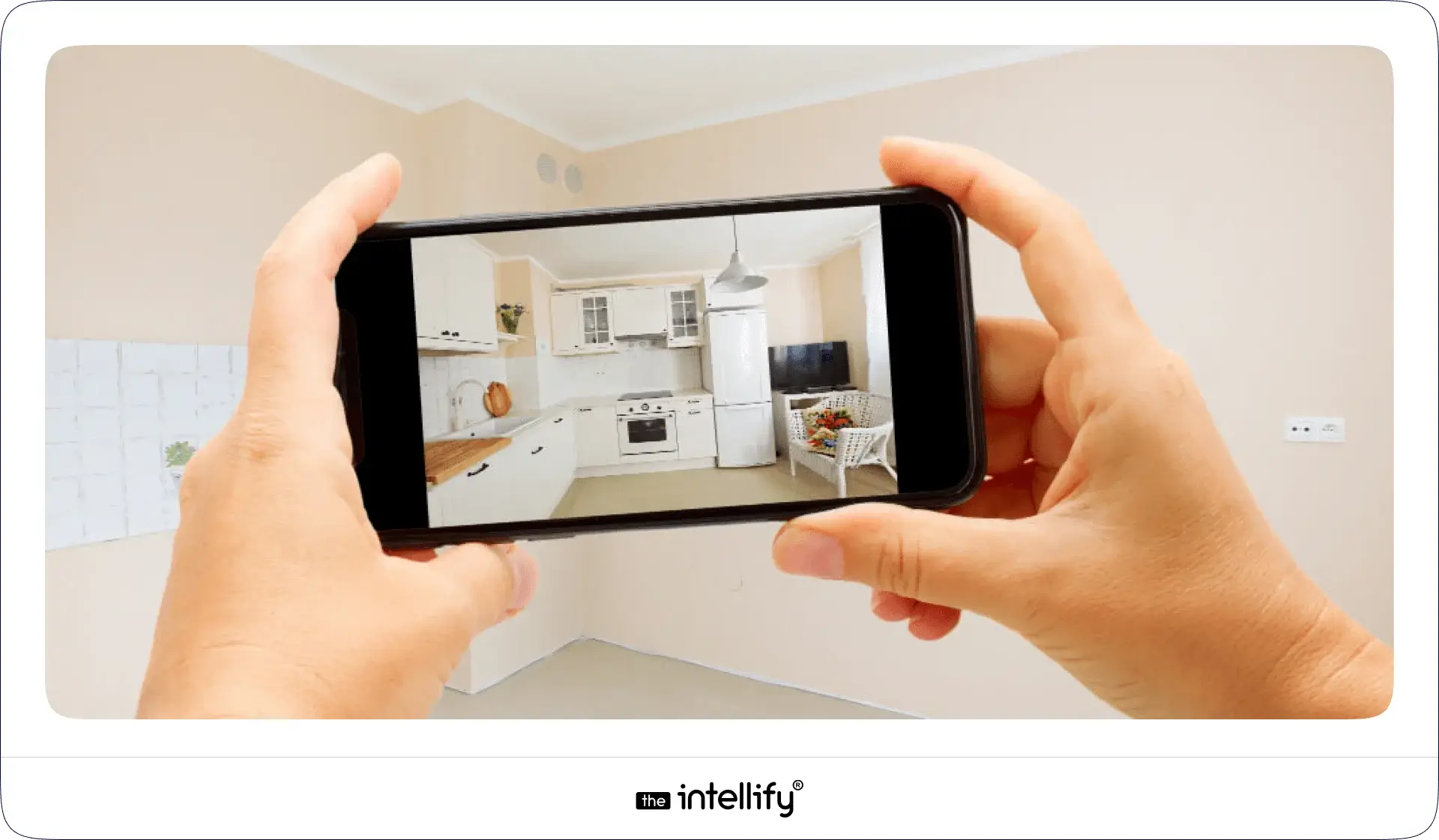
Augmented reality adds digital elements to the real world using a phone or tablet camera. That’s it. No headsets. No complicated setup.
In real estate, augmented reality in real estate means you can point a device at a space or even a printed floor plan and see something more layered on top of it. A furnished room. A finished building. A clearer picture.
It’s different from virtual reality, which pulls users into a fully digital world. AR keeps people grounded in their real surroundings. That’s why it works so well here.
You’re not escaping reality. You’re enhancing it. This small distinction is important. Buyers don’t want a tech demo. They want understanding. AR gives them that without asking too much in return.
The Rise of Interactive Property Experiences
Property discovery used to start with site visits. Now it often starts on a phone, late at night, half-distracted, maybe with coffee gone cold on the table. Buyers want answers fast. They want to know:
- Will this space actually work for me?
- Can I see beyond the staging?
- Is this worth a visit or not?
Static listings struggle here. Videos help, sure. But they still push information one way. Interactive experiences changed that.
With AR in real estate, buyers explore at their own pace. They linger where they care. They skip what they don’t. That control builds trust. Quietly and trust moves deals forward.
What Are AR Property Showcases?
An AR property showcase is an interactive way to explore a property using augmented reality. Instead of flipping through images, users interact with the space.
They might:
- View a full 3D apartment model on their living room table
- Walk through an empty unit and see it furnished
- Scan a brochure and watch a building rise, floor by floor
It’s simple on the surface. Powerful underneath. The experience feels personal. Almost hands-on and that’s the point.
Key Use Cases of Augmented Reality for Real Estate Property Showcases
1) AR Virtual Property Walk throughs
Not every buyer can visit every property. Distance, time, traffic it adds up. AR walkthroughs give buyers a strong first impression without stepping on-site. They explore layouts. Get a sense of flow. Decide if it’s worth the next step. That alone saves everyone time.
2) Visualizing Under-Construction & Pre-Launch Properties
This is where augmented reality for real estate really shines. An empty plot can feel abstract. Risky. Hard to believe in. AR replaces that doubt with visuals. Buyers see the finished building placed right there. Windows. Balconies. Height. Scale. Suddenly, it feels real.
3) Interior Design & Customization Using AR
Some buyers hesitate because they can’t see past the current setup. Or lack of one. AR lets them try things out. Furniture. Layouts. Colors. That moment when someone says, “Oh, this actually works” is powerful.
4) Interactive AR Floor Plans
Flat floor plans confuse people. Dimensions on paper don’t always translate well. AR floor plans show space in real scale. Buyers walk around them. Understand room relationships. Notice things they’d otherwise miss. Fewer surprises later.
5) On-Site AR Experiences for Sales & Events
During site visits or exhibitions, AR adds depth. A tablet. A phone. A quick scan. Information appears right where it’s needed. Clean. Visual. No long explanations. It keeps conversations focused and grounded.
Benefits of Augmented Reality in Real Estate
1) Benefits for Property Buyers
AR reduces guesswork. Instead of mentally stitching together photos, dimensions, and descriptions, they see things clearly. They understand space. They feel orientation. They notice details they would otherwise miss like how close the dining area is to the kitchen or whether a bedroom feels cramped once a bed is placed. That clarity lowers anxiety, which is often the biggest hidden blocker in property decisions.
2) Benefits for Real Estate Agents
AR quietly improves lead quality. Buyers who spend time interacting with an AR property showcase usually come with better questions. They’ve already filtered themselves. Conversations become more focused, less repetitive, and far more productive. Fewer casual browsers. More serious intent.
3) Benefits for Developers & Builders
The benefit is scale. Physical show units, brochures, and repeated walkthroughs all cost time and money. AR property showcases work around the clock. They don’t wear out. They don’t need to be rebuilt every time a layout changes. And they allow teams to present future properties with confidence instead of promises.
In simple terms, augmented reality in real estate helps everyone waste less time and make better decisions faster.
How AR Property Showcases Improve Marketing & Sales Conversion
People spend more time with interactive content. That’s not theory. It’s behavior. AR experiences hold attention. Buyers explore longer. Ask better questions. Remember what they saw. That memory matters when decisions are made days or weeks later. Better understanding leads to fewer drop-offs. Fewer “maybe later” conversations.
Real-World Applications of AR Property Showcases
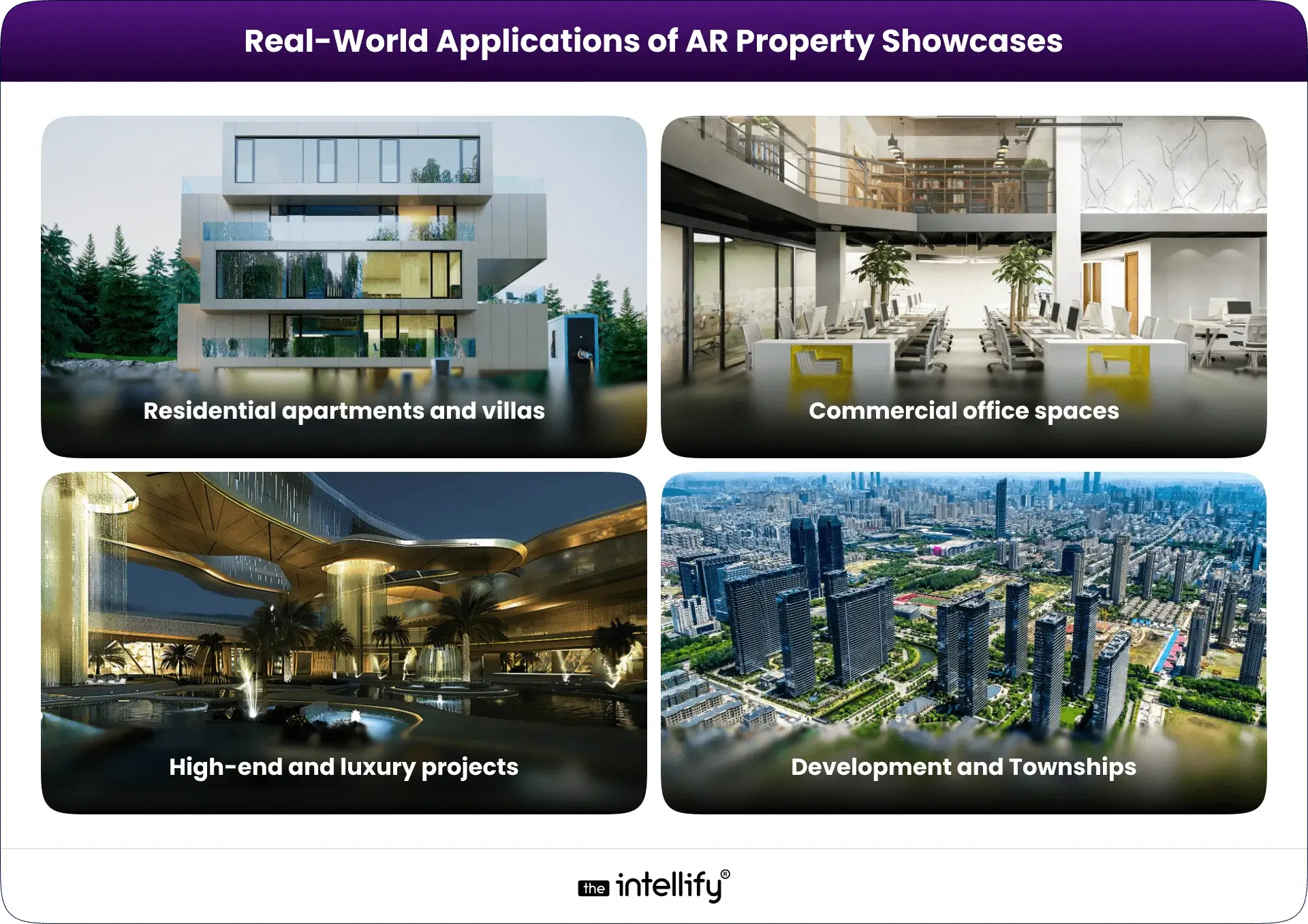
AR property showcases are not limited to high-end or experimental projects. They’re being used wherever buyers need help visualizing value.
1) Residential apartments and villas
In residential real estate, AR helps buyers understand how an empty apartment could feel once lived in. It removes that awkward moment during site visits when someone says, “It looks smaller than I expected,” even though the dimensions were clearly mentioned online.
2) Commercial office spaces
In commercial properties, AR helps businesses visualize layouts, seating plans, or workspace flow. Decision-makers can see how a space supports daily operations rather than guessing from floor plans.
3) High-end and luxury projects
Luxury and premium developments use AR differently. Here, the focus is often on experience how the space feels at different times of day, how materials come together, how design choices affect mood. AR supports storytelling without overexplaining.
4) Development and Townships
Large-scale developments and townships use AR to show the bigger picture. Roads, green spaces, amenities, and connectivity become easier to understand when people can see them layered over reality.
Across all these cases, the goal is the same: reduce confusion and replace it with clarity.
How AR Property Showcase Apps Are Built
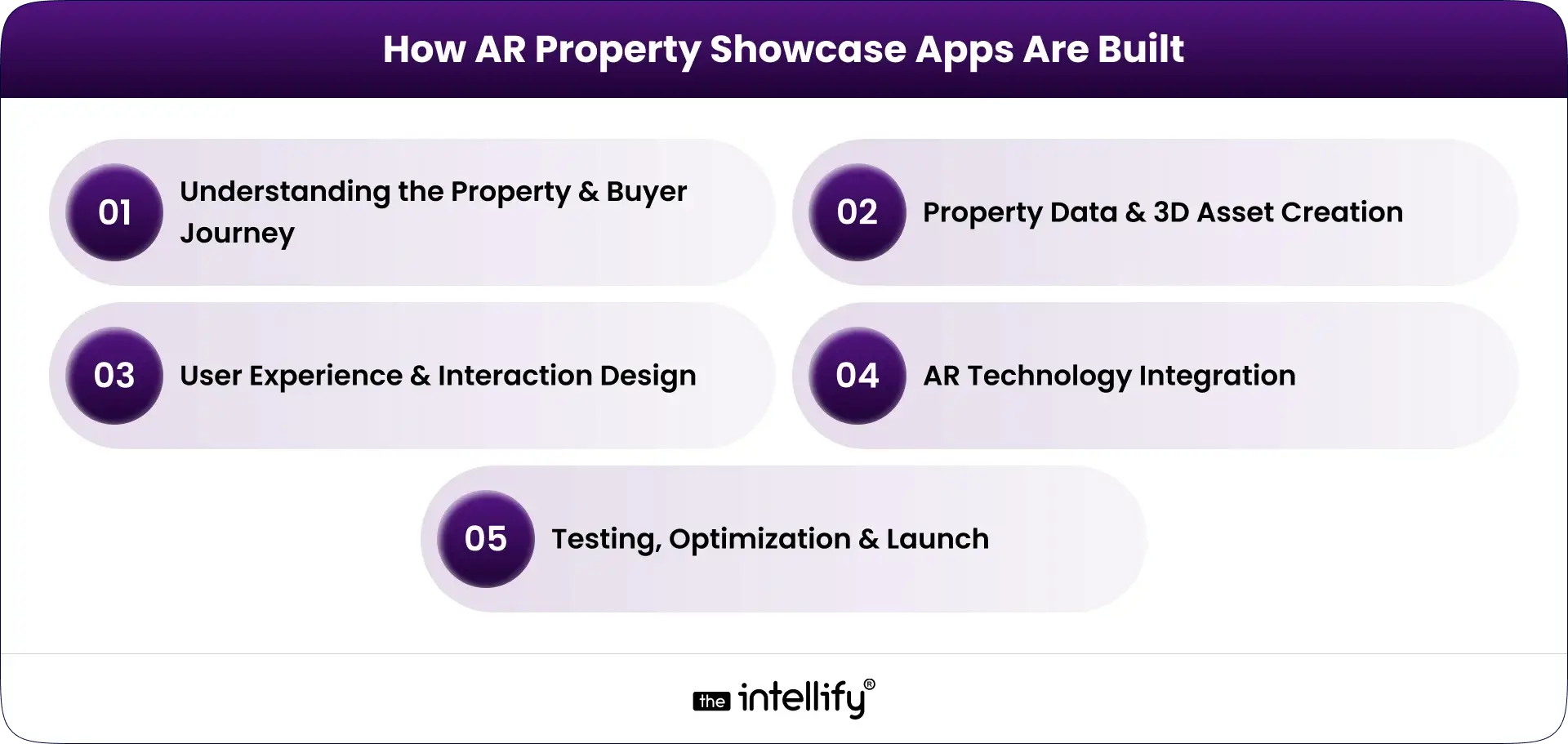
Building an AR property showcase app is a step-by-step process. Skipping steps usually leads to clunky experiences.
1. Understanding the Property & Buyer Journey
- Identify the type of property (residential, commercial, mixed-use)
- Map where AR fits in the buyer journey (discovery, comparison, site visit)
- Define what buyers struggle to visualize today
- Decide what the AR experience should clarify or simplify
2. Property Data & 3D Asset Creation
- Convert floor plans and elevations into accurate 3D models
- Maintain real-world scale and proportions
- Optimize models for mobile performance (not just visual quality)
- Validate designs with real property data to avoid mismatches
3. User Experience & Interaction Design
- Keep navigation simple and obvious
- Limit on-screen clutter and controls
- Design flows for non-technical users
- Focus on clarity, not “cool” effects
4. AR Technology Integration
- Integrate AR functionality using platforms like ARKit and ARCore
- Ensure stable object placement and tracking
- Optimize performance for different lighting conditions
- Test AR behavior in real physical environments
5. Testing, Optimization & Launch
- Test across multiple devices and OS versions
- Validate load times and interaction smoothness
- Fix edge cases before public release
- Prepare the app for future property updates and scalability
Cost & Timeline Factors for AR Real Estate App Development
There’s no fixed cost for AR real estate apps. Several factors influence both the budget and timeline. It depends on:
1) Key Cost Drivers
- Number of properties to be showcased
- Level of visual detail and realism
- Type of interactions (walkthroughs, customization, animations)
- Platform requirements (iOS, Android, or both)
- Need for future scalability and updates
2) Timeline Influencers
- Availability and accuracy of property data
- Complexity of 3D modeling
- Approval cycles and design iterations
- Testing across different devices and conditions
3) Long-Term Cost Considerations
- Maintenance and updates as properties evolve
- Adding new projects or phases
- Optimizing performance as devices change
- Expanding features based on user feedback
Well-planned AR apps cost more upfront but save money over time by reducing physical marketing efforts and repeated manual work.
Challenges of Implementing Augmented Reality in Real Estate
AR brings value, but it also introduces practical challenges that need planning. Some common challenges are:
- Device compatibility across older and newer smartphones
- Performance issues in low-light or cluttered environments
- Keeping 3D visuals aligned with real property dimensions
- User hesitation toward new technology
Most AR issues aren’t technical limitations they’re experience design problems that improve with testing and refinement.
How to Choose the Right AR App Development Partner
When planning to build an AR property showcase, choosing the right AR app development company is critical. Look for teams that:
- Experience with real estate or spatial visualization
- Have experience in AR and 3D visualization
- Focus on usability, not just technology
- Offer long-term support and scalability
Think Beyond the First Version
Properties change over time. Your AR app should too.
Choose a partner who plans for updates, long-term support, and future growth. A good partner builds something practical, something buyers trust, and teams can rely on.
The Future of AR Property Showcases in Real Estate
AR in real estate is moving from novelty to normal. The focus is shifting away from “wow” moments and toward usefulness.
AR Will Become an Expectation
As buyers grow used to interactive experiences, static listings will feel incomplete. AR property showcases will slowly become part of the standard discovery process.
Experiences Will Feel More Personal
Future AR showcases will adapt to buyers instead of showing the same view to everyone. Layouts, styles, and information will adjust based on preferences.
AR Will Blend Into the Process
AR won’t feel like a separate tool. It will quietly support property discovery, site visits, and sales conversations without drawing attention to itself.

Conclusion
Buying property is about confidence. When people clearly understand a space, decisions come faster, and they feel safer. Augmented reality helps remove uncertainty by showing properties as they truly are or as they will be. It improves how buyers explore, compare, and decide, without adding complexity.
For real estate businesses, AR property showcases are no longer experimental. They’re a practical way to communicate value, reduce friction, and stand out quietly. Now is a good time to adopt AR, not because it looks impressive, but because it makes property decisions easier for everyone involved.
Frequently Asked Questions (FAQs)
1. What is augmented reality for real estate?
Augmented reality for real estate lets buyers view digital property elements, such as 3D models or interiors, over real spaces using a smartphone. It helps people understand layouts, scale, and design more clearly before making property decisions.
2. How is AR different from virtual tours in real estate?
Virtual tours are fixed videos or images, while AR is interactive. AR allows buyers to move freely, explore spaces in real scale, and view properties from multiple angles in real time.
3. How do AR property showcases help real estate buyers?
AR property showcases help buyers visualize properties accurately, reduce confusion, and build confidence. This makes it easier to shortlist properties and make informed decisions faster.
4. Can augmented reality be used for under-construction properties?
Yes. AR can show completed buildings and interiors over real sites or floor plans, helping buyers understand how under-construction properties will look once finished.
5. Do AR property showcase apps work on normal smartphones?
Yes. Most AR property showcase apps work on standard smartphones and tablets that support modern AR features. No special devices are required.
6. How do I choose the right company to build an AR real estate app?
Choose a company with experience in real estate visualization, strong AR expertise, and a focus on usability, accuracy, and long-term scalability.
7. How can The Intellify help with AR property showcase development?
The Intellify builds custom AR property showcase apps that help buyers visualize spaces clearly and support real estate businesses with practical, scalable AR solutions.


Written By, Shravan Rajpurohit
Shravan Rajpurohit is the Co-Founder & CEO of The Intellify, a leading Custom Software Development company that empowers startups, product development teams, and Fortune 500 companies. With over 10 years of experience in marketing, sales, and customer success, Shravan has been driving digital innovation since 2018, leading a team of 50+ creative professionals. His mission is to bridge the gap between business ideas and reality through advanced tech solutions, aiming to make The Intellify a global leader. He focuses on delivering excellence, solving real-world problems, and pushing the limits of digital transformation.

Indoor Navigation with AR: The Future of Smart Wayfinding Systems
Summary: AR-powered indoor navigation is helping businesses deliver smarter and more seamless wayfinding experiences. By guiding users with real-time visual directions, it eliminates confusion in complex environments like hospitals, malls, airports, and campuses. These solutions not only improve visitor satisfaction but also enhance operational efficiency and accessibility. As demand for smarter buildings grows, indoor navigation […]
How Augmented Reality in Education is Transforming Learning Apps for Kids
Summary: Augmented Reality in education is transforming how children learn by making lessons more interactive, visual, and engaging. Instead of relying only on text or videos, AR allows kids to explore 3D models, animations, and real-world simulations, improving understanding and retention. This blog covers how AR learning apps work, their key features, real-world applications, benefits, […]
How Augmented Reality Is Redefining the Furniture Industry
Summary Augmented Reality is changing how people explore and buy furniture by allowing them to visualize products in their own spaces before making a purchase. This technology helps reduce uncertainty, improves buying confidence, and creates a more interactive shopping experience. In this blog, we explore how AR is being used across the furniture industry, its […]
Indoor Navigation with AR: The Future of Smart Wayfinding Systems
Summary: AR-powered indoor navigation is helping businesses deliver smarter and more seamless wayfinding experiences. By guiding users with real-time visual directions, it eliminates confusion in complex environments like hospitals, malls, airports, and campuses. These solutions not only improve visitor satisfaction but also enhance operational efficiency and accessibility. As demand for smarter buildings grows, indoor navigation […]
How Augmented Reality in Education is Transforming Learning Apps for Kids
Summary: Augmented Reality in education is transforming how children learn by making lessons more interactive, visual, and engaging. Instead of relying only on text or videos, AR allows kids to explore 3D models, animations, and real-world simulations, improving understanding and retention. This blog covers how AR learning apps work, their key features, real-world applications, benefits, […]
How Augmented Reality Is Redefining the Furniture Industry
Summary Augmented Reality is changing how people explore and buy furniture by allowing them to visualize products in their own spaces before making a purchase. This technology helps reduce uncertainty, improves buying confidence, and creates a more interactive shopping experience. In this blog, we explore how AR is being used across the furniture industry, its […]
0
+0
+0
+0
+Committed Delivery Leads To Client Satisfaction
Client Testimonials that keep our expert's spirits highly motivated to deliver extraordinary solutions.

Christopher Seny
My experience working with The Intellify, has been a great experience. The team has a wealth of expertise in the tech space. Working with the intellify was a growing experience for me, I learned a lot. The team keeps great communication & responds fast to new ideas & suggestions. The team also provides great suggestions & solutions as well. I couldn’t imagine working with anybody else on this project & it has been a blessing working with, The Intellify.

Izandi Serdyn
The Intellify delivered a platform from scratch, involving the client at every stage. The team was communicative, responsive, and punctual throughout the engagement. Virtual meetings and emails ensured seamless project management. Customers can expect a team that can work fast.

Kya Johnson
The app serves as an effective introduction for users to the product and its characters. Responsive and faithful to initial requirements, The Intellify’s team exceeded initial expectations. Internal stakeholders were particularly pleased with their communication.

Stefan Wyk
Working with The Intellify to develop our website was an outstanding experience. Their team displayed exceptional professionalism, creativity, and technical expertise throughout the entire process. The final product exceeded our expectations, delivering a sleek, user-friendly, and highly functional website. We highly recommend The Intellify to anyone in need of top-tier web development services.

Steve Thorpe
The Intellify’s work has been met with high praise from internal and external stakeholders. The team is efficient, diligent, and reliable in their service. They go above and beyond in terms of communication and project management. The Intellify is a responsive vendor that gets the job done.

Tal Dotan
I’ve been working with The Intellify for the last 3 years. During this period of time we’ve planned and executed projects in both small and large scale. Working with The Intellify was and still is the best decision I’ve made when rising up Divo, I strongly recommend to work with them in any type of project.


 +1-302-803-4983