Enterprise VR Training: Real Use Cases, Business Benefits & Implementation Guide

By Darshak Doshi
March 13, 2026
Summary:
Enterprise VR training allows organizations to train employees through immersive simulations instead of traditional classroom methods. This blog explores how virtual reality training is used across industries like healthcare, manufacturing, construction, and retail to improve workforce readiness. It also explains the key benefits, including better engagement, faster onboarding, improved safety, and consistent training delivery. Additionally, the guide covers real-world use cases, implementation strategies, common challenges, and best practices for successfully adopting VR training programs.
Why Traditional Training Is No Longer Enough
Let’s be honest. A lot of workplace training still feels stuck in the past. Slide decks, long manuals, and classroom sessions… employees sit through them, nod politely, and then forget half of it a week later. In fast-moving industries, that approach just doesn’t hold up anymore.
Companies today need people to learn faster. They also need them to practice safely, especially when mistakes can be expensive or dangerous. Traditional training struggles with both. It can be slow to scale, expensive to repeat, and honestly, not very engaging.
That’s one reason many organizations are starting to explore simulation-based learning. Instead of explaining a task, they let employees actually experience it. This is where enterprise VR training enters the picture. Virtual reality creates realistic environments where employees can practice situations that normally require expensive equipment, complex setups, or risky real-world scenarios.
In this blog, we’ll walk through what enterprise VR training actually means, where companies are using it today, the benefits it brings, and how organizations can roll it out step by step.
What Is Enterprise VR Training?
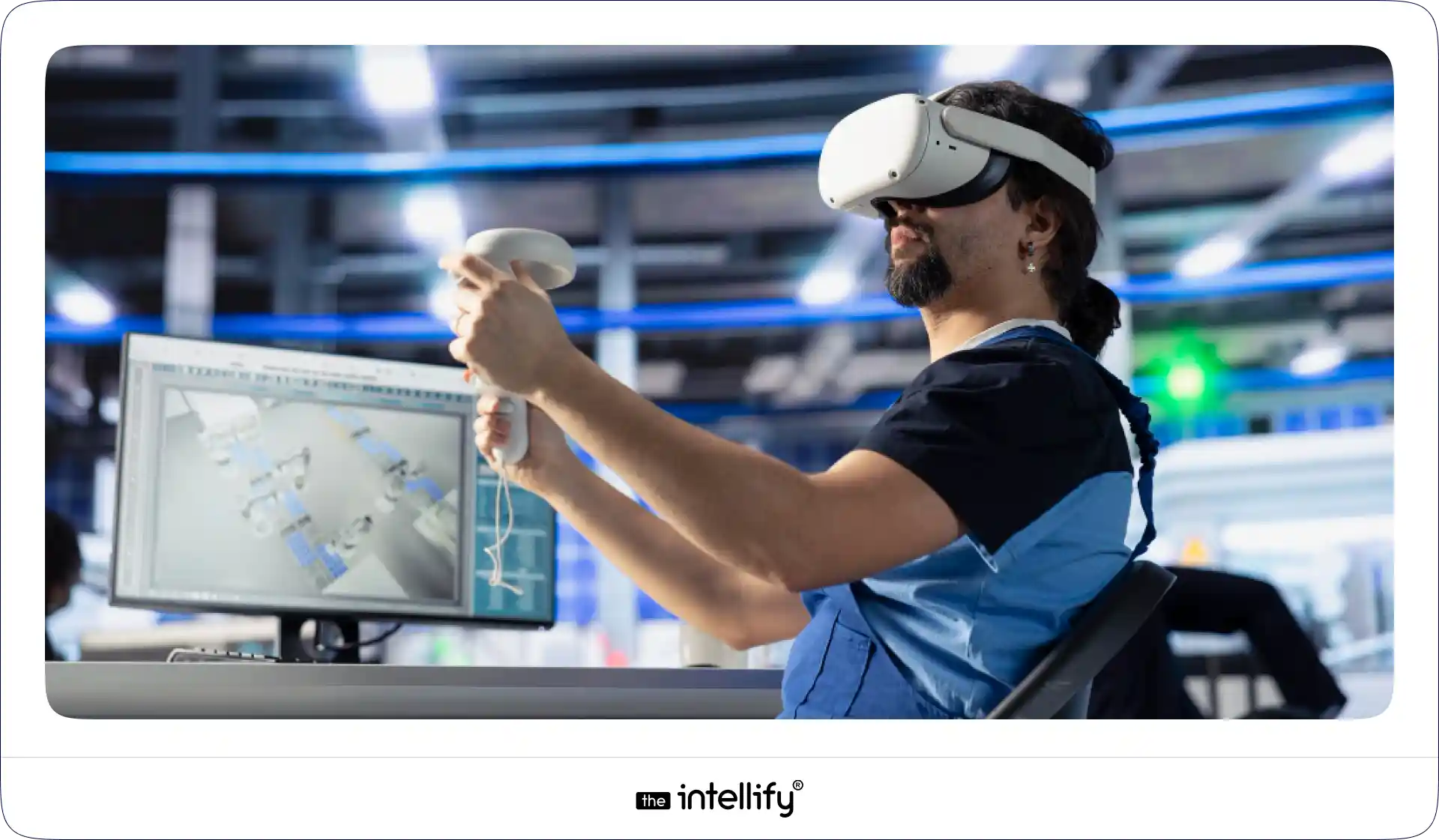
Enterprise VR training simply means using virtual reality to train employees inside a business environment. Instead of learning from a manual or presentation, employees step into a virtual scenario. They can interact with equipment, respond to situations, and practice decisions in a controlled digital space. The experience feels surprisingly real. That’s what makes the learning stick.
Skills taught through realistic simulations
VR training can support several types of learning.
Technical Skills
- Operating machinery
- Using specialized tools
- Software workflow training
Soft Skills
- Leadership scenarios
- Communication practice
- Team collaboration exercises
Safety Protocols
- Emergency response
- Hazard recognition
- Crisis management situations
Because the scenarios feel real, employees tend to stay focused and remember the process better.
Industries rapidly adopting this approach:
A growing number of industries are exploring VR training. Some of the most active sectors include:
- Healthcare
- Manufacturing
- Retail
- Construction
These industries often deal with complex operations or safety-critical work, which makes immersive training particularly useful.
How Virtual Reality Training Programs Work Inside Organizations
VR training programs usually involve a mix of hardware, software, and carefully designed content.
Once everything is in place, employees can access training modules through structured sessions or on their own schedule.
Core components
- Devices: VR headsets and handheld controllers allow employees to interact with the virtual environment.
- Software platforms: Learning management systems store and deliver training modules while tracking employee progress.
- Content: This is the heart of VR training. Companies either use ready-made modules or create custom scenarios based on their real workflows.
Learning formats
Organizations typically offer VR training in two formats.
- Instructor-led training: A trainer guides the session while employees participate in the virtual exercise.
- Self-guided learning: Employees can complete modules independently, whenever they have time.
This flexibility often makes training easier to schedule.
Tracking Performance
Many VR training platforms include built-in analytics. Managers can track how employees perform during simulations, how long tasks take, and where mistakes occur. These insights help companies improve both the training program and real operational processes.
Real-World Applications Across Key Industries
Virtual reality training is already being used across several industries. Each one applies it in slightly different ways.
Manufacturing and industrial safety preparedness
In manufacturing environments, employees often work with heavy machinery and complex systems. VR allows workers to practice operating equipment and following safety procedures before stepping onto the production floor. That preparation reduces risk and builds confidence.
Healthcare simulation
Healthcare training often involves delicate procedures where mistakes can have serious consequences. VR simulations allow doctors, nurses, and medical staff to practice procedures repeatedly without putting patients at risk. Over time, this improves both accuracy and response times.
Construction and field workforce readiness
Construction sites are unpredictable. Conditions change constantly. With VR, teams can simulate hazards such as equipment failures, unsafe structures, or emergency situations. Workers learn how to respond before they ever face those conditions in real life.
Retail and customer interaction training
Retail employees deal with people all day. Sometimes those situations are smooth. Sometimes… not so much. VR scenarios allow staff to practice customer interactions, conflict resolution, and service situations in a realistic setting.
Emergency response training
First responders often need to make decisions quickly under pressure. Virtual environments can recreate emergency scenarios like fires, accidents, or disaster situations. Trainees learn how to react calmly and follow procedures.
Leadership and Soft Skills Development
Not all VR training is technical. Companies also use immersive simulations to practice leadership situations. Employees can experience conversations involving feedback, negotiations, or team challenges. It’s a safe place to experiment and learn.
Why Companies Are Investing in VR Training Solutions
Organizations aren’t adopting VR just because it looks impressive. There are some very practical reasons behind it.
Higher engagement compared to traditional methods
Traditional training can feel passive. Employees listen, watch, and take notes. In VR, they participate. The interactive nature keeps attention high, which usually leads to better learning outcomes.
Better Knowledge Retention
People tend to remember experiences more than instructions. Because VR training solutions involves active participation, employees retain more information and apply it more confidently later.
Safe Practice Environment
Virtual training allows employees to practice difficult or risky tasks without real consequences. Mistakes become learning opportunities instead of costly problems.
Consistent Training Delivery
Large organizations often struggle to deliver the same training quality across different locations. VR modules ensure every employee receives the same experience.
Lower Dependence on Physical Equipment
Traditional training may require expensive equipment, travel, or facility setups. VR reduces many of these logistical costs.
Evaluating Business Impact and Return on Investment
Companies also evaluate VR training through measurable outcomes.
Long-term Cost Savings
While VR training requires an upfront investment, organizations often save money over time. Less travel, fewer physical training setups, and faster learning cycles all contribute to lower long-term costs.
Faster Onboarding
New employees can learn processes quickly through immersive practice. This shortens onboarding time and helps teams become productive sooner.
Reduction in Errors and Incidents
Well-trained employees make fewer mistakes. In safety-critical industries, that can significantly reduce workplace incidents.
Measuring Outcomes
Organizations usually track both financial and operational metrics. These insights help determine whether the training program is delivering real value.
When Enterprise VR Training Makes Strategic Sense
VR training is particularly useful in situations like these:
- Complex Procedures – tasks involving multiple steps or specialized tools
- Distributed Workforce – teams spread across locations that require consistent training
- Need for standardization – ensuring everyone follows the same process
- Rapid Scaling – training large groups quickly without major logistical challenges
When these factors exist, VR can offer a practical advantage.
Common Challenges and How to Address Them
Like any new technology, VR training also comes with a few challenges.
Upfront Investment
Initial costs can include hardware, content development, and integration. However, organizations usually balance these expenses against long-term efficiency gains.
Content Maintenance
Training content must stay up to date. Processes change, equipment evolves, and regulations shift. Planning regular updates helps keep simulations relevant.
Device Management
Managing headsets across multiple locations requires planning. Clear processes for storage, updates, and maintenance can simplify this.
Employee Adoption
Some employees may feel unsure about using VR at first. Simple onboarding sessions and intuitive design usually solve that problem quickly.
Identifying Unnecessary Situations for VR
Not every training scenario requires virtual reality. Organizations should carefully assess where immersive learning truly adds value.
Step-by-Step Implementation Roadmap
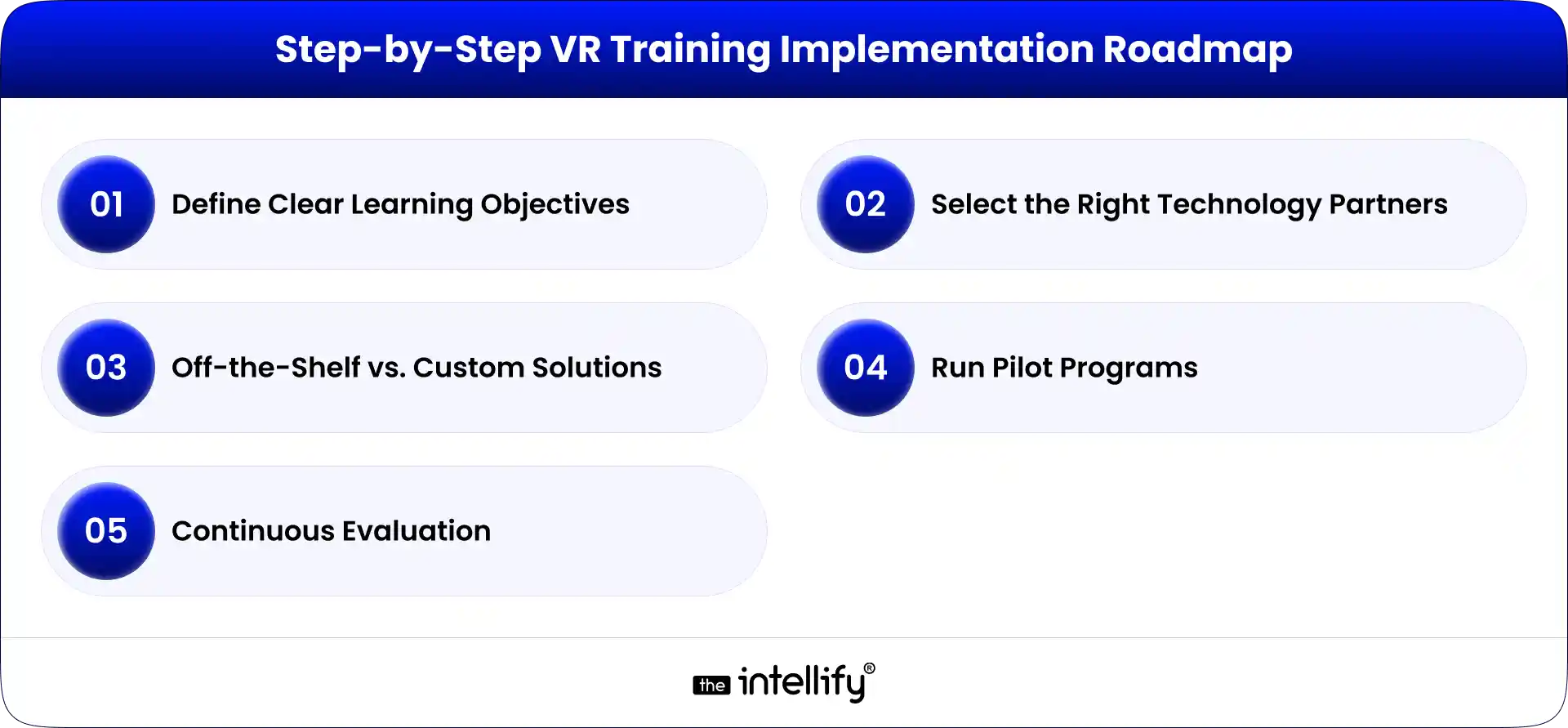
1. Define Clear Learning Objectives:- Start by identifying the exact skills or processes the training should address. Clear goals make program design much easier.
2. Select the Right Technology Partners:- Choosing the right platform and development partner matters. The technology should match your organization’s scale, industry, and training needs.
3. Off-the-Shelf vs. Custom Solutions:- Some companies begin with ready-made training modules. Others build custom simulations tailored to their workflows. Both options have advantages depending on the situation.
4. Run Pilot Programs:- Before rolling out VR training across the organization, it helps to run a pilot. Small tests reveal technical issues, usability concerns, and areas for improvement.
5. Continuous Evaluation:- Training programs should evolve over time. Regular evaluation helps refine content and improve learning outcomes.
Best Practices for Long-Term Success
Start with high-impact training scenarios: Focus on areas where immersive learning makes the biggest difference.
Design Realistic Experiences: Simulations should reflect real working environments as closely as possible.
Combine Learning Methods: VR works best when paired with other training formats.
Onboard New Users: Short orientation sessions help employees feel comfortable with the technology.
Use Analytics: Performance data helps refine training programs over time.
The Future of Enterprise Training with VR
Virtual reality training is still evolving. As technology improves, we’re seeing it merge with artificial intelligence, augmented reality, and mixed reality systems. Devices are also becoming more affordable and easier to manage.
In the coming years, VR may extend beyond training into real-time operational support, helping employees solve problems while they work. For many organizations, immersive learning is no longer an experiment. It’s slowly becoming part of the everyday training toolkit.
Final Thought
Enterprise VR training is changing the way companies prepare their workforce. Instead of passive learning, employees step into realistic situations and learn through experience. That shift leads to stronger engagement, faster onboarding, and better decision-making.
For organizations dealing with complex processes, safety concerns, or large distributed teams, immersive training offers a practical way to improve learning outcomes. Many companies exploring this space including platforms like The Intellify are focusing on making such experiences easier to deploy and scale across teams. And honestly, compared to sitting through another slide deck… most employees probably won’t miss the old approach.
Frequently Asked Questions (FAQs)
1. How does enterprise VR training improve employee performance compared to traditional training?
Unlike classroom sessions or manuals, VR lets employees learn by actually doing tasks in a simulated environment. This hands-on experience improves memory, confidence, and decision-making. People make fewer mistakes later because they’ve already practiced real scenarios safely.
2. Is VR training only useful for technical or high-risk jobs?
Not at all. While it’s extremely valuable for dangerous or complex tasks, companies also use it for customer service, leadership development, onboarding, and communication skills. Any role that benefits from practice and realistic scenarios can gain value from immersive training.
3. How long does it typically take to implement VR training in an organization?
It depends on the complexity. A small pilot program can be launched in a few weeks, especially using ready-made solutions. Large-scale custom deployments across multiple locations may take several months, including planning, content creation, testing, and rollout.
4. Can VR training reduce workplace accidents and safety incidents?
Yes, especially in industries like manufacturing, construction, and energy. Employees can practice hazardous situations without real danger, learn proper procedures, and understand the consequences of mistakes. This preparation often leads to safer behavior on the job.
5. Do employees need prior experience with VR to use it effectively?
No. Most modern systems are designed for first-time users. A short orientation session is usually enough for employees to become comfortable with the controls and navigation. Many people find it intuitive after just a few minutes.
6. How can The Intellify assist with VR training implementation?
We specialize in tailored VR training solutions that align with your business needs, offering support from the initial planning stage through full deployment and evaluation.
7. How much does enterprise VR training cost to implement?
The cost depends on factors such as VR hardware, software platforms, and whether the training content is custom-built or ready-made. Small pilot programs can start with lower investment, while large enterprise deployments may require more resources.
8. What types of companies benefit the most from VR training programs?
Industries that involve complex operations or safety training benefit the most from VR training. This includes healthcare, manufacturing, construction, logistics, energy, and retail, where employees need hands-on practice and realistic simulations


Written By, Darshak Doshi
With over a decade of experience, Darshak is a technopreneur specializing in cloud-based applications and product development in healthcare, insurance, and manufacturing. He excels in AWS Cloud, backend development, and immersive technologies like AR/VR to drive innovation and efficiency. Darshak has also explored AI/ML in insurance and healthcare, pushing the boundaries of technology to solve complex problems. His user-focused, results-driven approach ensures he builds scalable cloud solutions, cutting-edge AR/VR experiences, and AI-driven insights that meet today’s demands while anticipating future needs.

Indoor Navigation with AR: The Future of Smart Wayfinding Systems
Summary: AR-powered indoor navigation is helping businesses deliver smarter and more seamless wayfinding experiences. By guiding users with real-time visual directions, it eliminates confusion in complex environments like hospitals, malls, airports, and campuses. These solutions not only improve visitor satisfaction but also enhance operational efficiency and accessibility. As demand for smarter buildings grows, indoor navigation […]
How Augmented Reality in Education is Transforming Learning Apps for Kids
Summary: Augmented Reality in education is transforming how children learn by making lessons more interactive, visual, and engaging. Instead of relying only on text or videos, AR allows kids to explore 3D models, animations, and real-world simulations, improving understanding and retention. This blog covers how AR learning apps work, their key features, real-world applications, benefits, […]
How Augmented Reality Is Redefining the Furniture Industry
Summary Augmented Reality is changing how people explore and buy furniture by allowing them to visualize products in their own spaces before making a purchase. This technology helps reduce uncertainty, improves buying confidence, and creates a more interactive shopping experience. In this blog, we explore how AR is being used across the furniture industry, its […]
Indoor Navigation with AR: The Future of Smart Wayfinding Systems
Summary: AR-powered indoor navigation is helping businesses deliver smarter and more seamless wayfinding experiences. By guiding users with real-time visual directions, it eliminates confusion in complex environments like hospitals, malls, airports, and campuses. These solutions not only improve visitor satisfaction but also enhance operational efficiency and accessibility. As demand for smarter buildings grows, indoor navigation […]
How Augmented Reality in Education is Transforming Learning Apps for Kids
Summary: Augmented Reality in education is transforming how children learn by making lessons more interactive, visual, and engaging. Instead of relying only on text or videos, AR allows kids to explore 3D models, animations, and real-world simulations, improving understanding and retention. This blog covers how AR learning apps work, their key features, real-world applications, benefits, […]
How Augmented Reality Is Redefining the Furniture Industry
Summary Augmented Reality is changing how people explore and buy furniture by allowing them to visualize products in their own spaces before making a purchase. This technology helps reduce uncertainty, improves buying confidence, and creates a more interactive shopping experience. In this blog, we explore how AR is being used across the furniture industry, its […]
0
+0
+0
+0
+Committed Delivery Leads To Client Satisfaction
Client Testimonials that keep our expert's spirits highly motivated to deliver extraordinary solutions.

Christopher Seny
My experience working with The Intellify, has been a great experience. The team has a wealth of expertise in the tech space. Working with the intellify was a growing experience for me, I learned a lot. The team keeps great communication & responds fast to new ideas & suggestions. The team also provides great suggestions & solutions as well. I couldn’t imagine working with anybody else on this project & it has been a blessing working with, The Intellify.

Izandi Serdyn
The Intellify delivered a platform from scratch, involving the client at every stage. The team was communicative, responsive, and punctual throughout the engagement. Virtual meetings and emails ensured seamless project management. Customers can expect a team that can work fast.

Kya Johnson
The app serves as an effective introduction for users to the product and its characters. Responsive and faithful to initial requirements, The Intellify’s team exceeded initial expectations. Internal stakeholders were particularly pleased with their communication.

Stefan Wyk
Working with The Intellify to develop our website was an outstanding experience. Their team displayed exceptional professionalism, creativity, and technical expertise throughout the entire process. The final product exceeded our expectations, delivering a sleek, user-friendly, and highly functional website. We highly recommend The Intellify to anyone in need of top-tier web development services.

Steve Thorpe
The Intellify’s work has been met with high praise from internal and external stakeholders. The team is efficient, diligent, and reliable in their service. They go above and beyond in terms of communication and project management. The Intellify is a responsive vendor that gets the job done.

Tal Dotan
I’ve been working with The Intellify for the last 3 years. During this period of time we’ve planned and executed projects in both small and large scale. Working with The Intellify was and still is the best decision I’ve made when rising up Divo, I strongly recommend to work with them in any type of project.


 +1-302-803-4983