HIPAA-Compliant AI for Healthcare Platforms: Architecture, Security & Practices

By Shravan Rajpurohit
March 15, 2026

Summary:
Healthcare organizations are increasingly using AI to improve diagnostics, operations, and patient engagement. However, handling sensitive medical data requires strict privacy and regulatory safeguards. This guide explains how to design HIPAA compliant AI systems for healthcare platforms. It covers key AI architecture components, security measures, compliance practices, and common challenges organizations face when using patient data. The article also explores how healthcare providers can safely adopt AI in healthcare while maintaining patient privacy and regulatory compliance.
Why AI in Healthcare Must Be Built Around Compliance
AI is quietly becoming part of everyday healthcare. Hospitals use it to analyze scans, clinics rely on it to manage appointments, and digital health platforms use it to guide patients through symptoms or treatment plans. Just a few years ago, many of these things sounded futuristic. Now they’re slowly becoming normal.
But healthcare data isn’t like other types of data. A person’s medical history, prescriptions, mental health records, and diagnostic reports are deeply personal. Patients share this information because they trust providers to protect it. Break that trust, and the consequences go far beyond a technical failure.
That’s why privacy and compliance sit at the center of modern healthcare technology. Regulations around HIPAA compliance in healthcare have grown stricter over time, and for good reason. Data breaches in the healthcare sector remain one of the most damaging types of cyber incidents. A single leak can expose thousands or sometimes millions of patient records.
AI introduces even more complexity. Machine learning systems need data to learn patterns, improve predictions, and generate insights. But if that data includes protected health information (PHI), the way it is collected, stored, processed, and shared must follow strict security rules.
In other words, compliance isn’t something you “add later.” It has to be built into the foundation.
This guide explains how healthcare organizations and technology providers can design AI systems that respect privacy, meet regulatory expectations, and still deliver meaningful innovation. We’ll walk through architecture decisions, security practices, and real-world considerations involved in building HIPAA compliant AI platforms.
The Role of AI in Modern Healthcare Platforms
Healthcare has always generated enormous amounts of data lab results, imaging scans, patient records, treatment outcomes, and more. For years, much of that information sat in systems that were difficult to analyze or connect. AI is changing that
Today, AI in Healthcare is helping providers turn raw data into useful insights.
For example, diagnostic AI systems can analyze medical images and highlight patterns that might indicate disease. Virtual assistants can help patients schedule appointments or get medication reminders. Hospitals use AI to optimize staffing and predict patient admissions. Even administrative tasks like insurance processing and documentation are becoming more automated.
These tools are pushing healthcare toward more data-driven decision making. Instead of relying only on manual reviews or intuition, clinicians can use AI-powered insights to support diagnoses, treatment planning, and patient monitoring.
But there’s another shift happening too.
Healthcare technology is moving away from isolated tools toward integrated platforms. A hospital might use one platform to manage electronic health records (EHR), another for telemedicine, and another for analytics. AI needs to work across these systems—not just within one small application.
That’s where architecture becomes important. AI models must connect with patient records, clinical workflows, and operational systems without breaking compliance rules. Designing that infrastructure properly is what allows healthcare platforms to scale safely.
What HIPAA Compliance Means for AI Systems
To understand compliance in healthcare AI, it helps to start with the basics.
The Health Insurance Portability and Accountability Act (HIPAA) is a U.S. regulation designed to protect patient health information. Its primary goal is to ensure that sensitive medical data is handled securely and only accessed by authorized individuals. The law specifically focuses on protecting Protected Health Information (PHI). This includes:
- Patient names
- Addresses
- Medical records
- Test results
- Insurance details
- Treatment histories
If a piece of information can identify a patient and is related to their healthcare, it usually falls under PHI protection.
For traditional healthcare systems, compliance mainly involves secure storage and controlled access. AI systems introduce new concerns.
Machine learning models often require large datasets for training. If those datasets contain PHI, developers must carefully control how the data is used, processed, and stored. There’s also the risk that AI models could unintentionally expose sensitive information through logs, outputs, or data pipelines.
Another important distinction is responsibility.
Healthcare providers, insurance companies, and hospitals are considered “covered entities” under HIPAA. Technology vendors that process or manage healthcare data on their behalf are considered “business associates.” Both groups share responsibility for protecting patient information.
Non-compliance can have serious consequences. Organizations may face financial penalties, legal investigations, and reputational damage. In healthcare, losing trust is often harder to recover from than paying a fine.
Key Challenges of Using AI with Sensitive Health Data
Using AI in healthcare sounds promising, and in many ways it is, but it also brings several challenges that technology teams must navigate carefully.
Data access limitations and fragmentation.
Healthcare data is often fragmented across multiple systems. Hospitals may store records in different databases, labs use separate systems, and imaging tools operate on their own infrastructure. Bringing all that data together for AI training can be complicated, both technically and legally.
Risk of data leakage during model training
Machine learning models learn patterns from datasets. If those datasets contain identifiable patient information, there’s a risk that the model could memorize sensitive data. That creates potential exposure if the model outputs or logs reveal details from training data.
Bias and ethical concerns challenge
Healthcare datasets sometimes reflect historical inequalities in treatment or access to care. If AI models are trained on biased data, they may produce unfair or inaccurate recommendations for certain patient groups.
Integration with legacy systems
Integration with legacy healthcare systems also creates friction. Many hospitals still rely on older software that wasn’t designed for modern AI workflows. Connecting these systems securely requires careful planning and sometimes significant upgrades.
Balancing innovation with strict compliance rules
Finally, organizations must balance innovation with compliance. Healthcare teams often want to experiment with new technologies, but regulatory requirements limit how data can be used. Navigating that balance takes both technical expertise and strong governance.
Foundations of HIPAA-Compliant AI in Healthcare Platforms
Building HIPAA-compliant AI starts with a simple mindset:
Privacy-first design approach
Instead of designing AI systems and then trying to make them compliant later, organizations should begin with privacy and security principles from the start. This approach is often called “privacy-first design.”
Minimum necessary data usage
AI systems should only access the data required for a specific task. If a model only needs anonymized medical records for pattern analysis, there’s no reason to include patient names or addresses.
Data de-identification and anonymization practices
De-identification removes personal identifiers from datasets so individuals cannot easily be recognized. In many cases, AI models can be trained on anonymized data without compromising accuracy.
Secure data handling across the AI lifecycle
Security must also be maintained across the entire AI lifecycle:
- Data collection
- Data storage
- Model training
- Model deployment
- Continuous monitoring
Each stage introduces potential risks that need to be controlled.
Importance of governance and accountability
Governance is another critical piece. Organizations need clear policies defining who can access data, how models are trained, and how compliance is monitored. Without accountability structures, even well-designed systems can drift into risky territory over time.
Designing Secure AI Architecture for Healthcare
A well-designed AI architecture acts as the backbone of a healthcare platform. It ensures that data moves safely through each stage of processing while maintaining compliance and performance.
Most healthcare AI architectures include several key layers.
1. Data ingestion:- This layer collects information from sources such as EHR systems, medical devices, imaging platforms, and patient apps. Because these sources may contain PHI, secure transfer protocols are essential.
2. Data storage:- Healthcare data often lives in encrypted databases or data lakes that enforce strict access controls. Storage systems must support compliance requirements while still allowing data scientists to work with datasets efficiently.
3. Processing layer:- Handles data preparation, cleaning, and transformation. AI models rely on structured, well-organized data, so this stage is critical for both performance and compliance.
4. Model layers are where machine learning models are trained and deployed. Secure environments should isolate training pipelines from external access and log all activity.
Healthcare platforms also need to decide between cloud-based and on-premise infrastructure.
- Cloud environments offer scalability and modern security tools, but organizations must ensure their cloud providers support healthcare compliance standards.
- On-premise systems provide more direct control but can be harder to scale.
Finally, interoperability is essential. AI systems must integrate with EHR platforms, clinical decision tools, and hospital management systems without exposing sensitive data.

Security Measures Required for Compliance
Even the best architecture needs strong security controls to protect patient data.
Encryption for data at rest and in transit
Healthcare platforms should encrypt data both at rest (when stored) and in transit (when being transferred between systems). Encryption ensures that even if data is intercepted, it cannot be read without the proper keys.
Access controls and identity management
Systems should use identity management tools that restrict access based on roles. A data scientist may need anonymized datasets for model training, while a clinician may need full patient records for treatment decisions. Each user should only access the data necessary for their role.
Audit logs and monitoring
Audit logs also play a critical role. These logs track who accessed data, when it was accessed, and what actions were performed. If suspicious activity occurs, logs help investigators identify the source quickly.
Secure APIs and integrations
Healthcare platforms also rely heavily on APIs to connect systems. These APIs must be secured using authentication protocols and rate limiting to prevent unauthorized access.
Incident response readiness
Organizations need clear incident response plans. If a breach or vulnerability is detected, teams should know exactly how to contain the issue, notify stakeholders, and restore secure operations.
Best Practices for Building & Deploying HIPAA-Compliant AI
Building HIPAA-compliant AI systems requires discipline throughout the development process.
Privacy-by-design during development
Development teams should integrate compliance checks directly into their workflows. Security reviews, data protection checks, and documentation should be part of the development cycle, not an afterthought.
Testing models without exposing real patient data
Developers often use real datasets for testing models, but exposing real patient data during experimentation can create unnecessary risk. Many organizations use synthetic or anonymized datasets for model validation instead.
Vendor risk assessment and compliance checks
Healthcare platforms often rely on external vendors for AI tools, cloud services, or analytics platforms. Each vendor must meet the same compliance standards as the healthcare organization itself. This typically involves formal security reviews and signed compliance agreements.
Documentation and compliance workflows
Documentation is equally important. Organizations should maintain records showing how data is handled, how models are trained, and how compliance requirements are met. Regulators and auditors often request this documentation during investigations.
Ongoing monitoring after deployment
Even after deployment, monitoring must continue. AI systems evolve over time as data changes and models update. Regular reviews ensure that compliance standards remain intact.
Practical Use Cases of AI in Healthcare
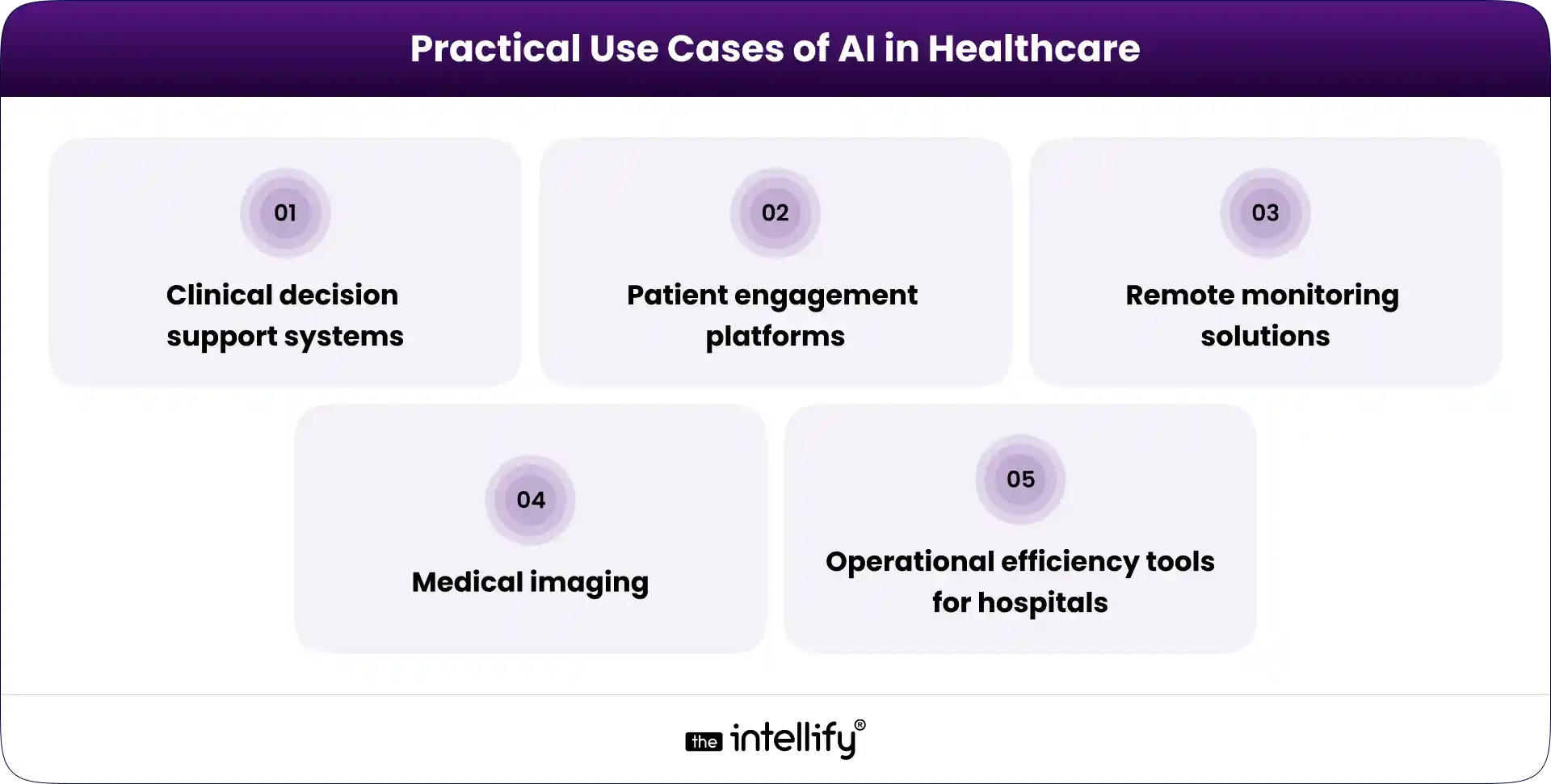
AI applications in healthcare are expanding quickly, but many of the most useful solutions focus on improving efficiency and decision-making rather than replacing clinicians.
Clinical decision support systems: These tools analyze patient data and medical research to help doctors evaluate possible diagnoses or treatment options.
Patient engagement platforms are another growing area. AI chatbots and virtual assistants can answer basic health questions, schedule appointments, and remind patients to take medications.
Remote monitoring solutions use AI to analyze data from wearable devices and connected health tools. Doctors can detect changes in patient health earlier, which helps prevent complications.
Medical imaging, AI models can analyze scans such as X-rays or MRIs and highlight potential abnormalities. Radiologists still review results, but AI can help prioritize urgent cases.
Operational efficiency tools for hospitals: Predictive models can estimate patient admissions, manage staffing schedules, and optimize supply chains.
These practical uses show how AI can support healthcare professionals without interfering with patient safety or privacy.
A U.S.-based Direct Primary Care platform improved patient access and care coordination by implementing a secure digital solution across its services. The system streamlined operations for providers while keeping sensitive health data protected under strict privacy standards. This shows how modern AI-enabled technology can enhance healthcare delivery without compromising compliance. View the complete case study for more details: https://theintellify.com/work/healthcare2u/
How AI Is Helping Healthcare Go Digital
Healthcare organizations around the world are going through digital transformation. Paper records are disappearing, telemedicine is expanding, and patient services are moving online.
AI plays an important role in this shift.
1. When designed responsibly, AI enables innovation without compromising trust. Healthcare providers can analyze large datasets, automate routine processes, and deliver more personalized care.
2. Patients benefit as well. Digital health platforms can provide faster responses, easier access to care, and more consistent monitoring for chronic conditions.
3. AI also supports scalability. Healthcare systems are under constant pressure from rising patient volumes and limited resources. Intelligent automation helps organizations manage workloads more efficiently.
4. Perhaps most importantly, strong compliance frameworks create long-term credibility. When patients know their data is handled responsibly, they are more likely to adopt digital health services.
5. For healthcare providers and technology companies alike, secure AI systems can become a meaningful competitive advantage.
Common Mistakes Organizations Should Avoid
Even organizations with strong intentions sometimes make mistakes when implementing AI in healthcare.
Treating compliance as a one-time task
One common issue is treating compliance as a one-time project. Regulations evolve, technology changes, and new risks emerge over time. Compliance requires continuous monitoring and updates.
Using generic AI tools not designed for healthcare
Another mistake is using generic AI tools that were not designed for healthcare environments. These tools may lack the security features required for handling PHI.
Poor data governance practices
Poor data governance can also create problems. Without clear rules for data access, retention, and sharing, organizations may unintentionally expose sensitive information.
Lack of cross-functional collaboration
Lack of collaboration is another challenge. Building compliant healthcare AI systems requires input from multiple teams of technical experts, legal advisors, compliance officers, and clinicians. When these groups work in isolation, gaps often appear.
Underestimating ongoing maintenance needs
Finally, some organizations underestimate the effort required to maintain AI systems. Models require updates, security checks, and performance monitoring over time. Ignoring these responsibilities can create long-term risks.
Conclusion
AI has enormous potential to improve healthcare systems. It can support clinicians, streamline operations, and help organizations deliver better care. But healthcare technology operates in an environment where trust is essential. Patients expect their data to remain private and secure. Any AI system that processes medical information must respect that responsibility.
Building compliant systems requires thoughtful architecture, strong security practices, and clear governance. Organizations that prioritize privacy from the beginning are better positioned to innovate safely. A principle followed by responsible technology teams across the industry, including companies like The Intellify that work closely with data-sensitive solutions. For decision-makers and product teams, the key takeaway is simple: innovation and compliance are not opposing goals. When implemented correctly, they reinforce each other.
The future of healthcare AI will belong to platforms that combine intelligent technology with responsible data protection. And the organizations that understand this balance today will shape the healthcare systems of tomorrow.

Frequently Asked Questions (FAQs)
1. Can AI use patient data without breaking HIPAA laws?
Yes, but only with safeguards. Data is usually anonymized or de-identified so individuals cannot be identified. In some cases, patient consent or legal agreements are also required.
2. Which healthcare platforms typically use HIPAA-compliant AI?
Telehealth apps, patient portals, remote monitoring tools, clinical decision systems, and hospital management platforms commonly use it. Any system handling patient data can benefit from secure AI.
3. Is cloud-based AI safe for healthcare use?
It can be safe if the cloud provider meets healthcare security standards. Proper configuration, encryption, and access controls are essential. Organizations still remain responsible for protecting the data.
4. What happens if healthcare AI is not HIPAA compliant?
Organizations risk data breaches, legal penalties, and loss of patient trust. It can also damage reputation and disrupt services. Compliance helps prevent these risks.
5. Do startups also need HIPAA-compliant AI systems?
Yes. If a startup handles patient health information, it must follow HIPAA rules regardless of size. Building compliance early is easier than fixing problems later.


Written By, Shravan Rajpurohit
Shravan Rajpurohit is the Co-Founder & CEO of The Intellify, a leading Custom Software Development company that empowers startups, product development teams, and Fortune 500 companies. With over 10 years of experience in marketing, sales, and customer success, Shravan has been driving digital innovation since 2018, leading a team of 50+ creative professionals. His mission is to bridge the gap between business ideas and reality through advanced tech solutions, aiming to make The Intellify a global leader. He focuses on delivering excellence, solving real-world problems, and pushing the limits of digital transformation.


Virtual Reality in Education: Applications, Benefits & Future of Learning
Summary: Virtual reality in education is changing how students learn by making lessons more interactive and practical. Instead of only reading or listening, learners can explore concepts through immersive experiences. This blog explains how VR is used across subjects, its key benefits, real-world applications, challenges, and future trends. It also covers how institutions can adopt […]
Healthcare Membership Management System: Key Features & Architecture
Summary: A healthcare membership management system helps providers handle patient subscriptions, billing, and communication in one place. This blog covers how these systems work, their key features, and why they are important for clinics, hospitals, and wellness providers. It also highlights how they improve efficiency, reduce manual work, and help deliver better patient care while […]
AI Workflow Automation Explained: Benefits, Use Cases, and ROI for Businesses
Summary: AI workflow automation helps businesses achieve faster ROI by optimizing repetitive and time-consuming processes. It improves efficiency, reduces costs, and enhances decision-making by leveraging data and intelligent systems. From customer service to internal operations, organizations can streamline workflows and scale effectively. By starting with high-impact use cases and tracking performance metrics, businesses can unlock […]
AI Workflow Automation Explained: Benefits, Use Cases, and ROI for Businesses
Summary: AI workflow automation helps businesses achieve faster ROI by optimizing repetitive and time-consuming processes. It improves efficiency, reduces costs, and enhances decision-making by leveraging data and intelligent systems. From customer service to internal operations, organizations can streamline workflows and scale effectively. By starting with high-impact use cases and tracking performance metrics, businesses can unlock […]
AI in Healthcare Administration: Streamlining Hospital Operations
Summary The growing complexity of healthcare administration is driving the need for smarter, more efficient solutions. Automation technologies are helping streamline key processes such as scheduling, billing, and data management, reducing manual workload and improving accuracy. This enables faster operations, better coordination, and enhanced patient experiences. As adoption increases, healthcare organizations are moving toward more […]
Insurance Claims Automation with AI: A Smart Vendor Evaluation Guide
Summary: Insurance claims automation uses AI to streamline the claims lifecycle from FNOL to settlement by reducing manual work, improving accuracy, and speeding up claim decisions. This guide explains how AI enhances claims processing, where human oversight remains important, and what insurers should evaluate when selecting an automation vendor. It also highlights key factors like […]
0
+0
+0
+0
+Committed Delivery Leads To Client Satisfaction
Client Testimonials that keep our expert's spirits highly motivated to deliver extraordinary solutions.

Christopher Seny
My experience working with The Intellify, has been a great experience. The team has a wealth of expertise in the tech space. Working with the intellify was a growing experience for me, I learned a lot. The team keeps great communication & responds fast to new ideas & suggestions. The team also provides great suggestions & solutions as well. I couldn’t imagine working with anybody else on this project & it has been a blessing working with, The Intellify.

Izandi Serdyn
The Intellify delivered a platform from scratch, involving the client at every stage. The team was communicative, responsive, and punctual throughout the engagement. Virtual meetings and emails ensured seamless project management. Customers can expect a team that can work fast.

Kya Johnson
The app serves as an effective introduction for users to the product and its characters. Responsive and faithful to initial requirements, The Intellify’s team exceeded initial expectations. Internal stakeholders were particularly pleased with their communication.

Stefan Wyk
Working with The Intellify to develop our website was an outstanding experience. Their team displayed exceptional professionalism, creativity, and technical expertise throughout the entire process. The final product exceeded our expectations, delivering a sleek, user-friendly, and highly functional website. We highly recommend The Intellify to anyone in need of top-tier web development services.

Steve Thorpe
The Intellify’s work has been met with high praise from internal and external stakeholders. The team is efficient, diligent, and reliable in their service. They go above and beyond in terms of communication and project management. The Intellify is a responsive vendor that gets the job done.

Tal Dotan
I’ve been working with The Intellify for the last 3 years. During this period of time we’ve planned and executed projects in both small and large scale. Working with The Intellify was and still is the best decision I’ve made when rising up Divo, I strongly recommend to work with them in any type of project.


 +1-302-803-4983