Virtual Reality in Education: Applications, Benefits & Future of Learning

By Jalaj Shah
April 3, 2026
Summary:
Virtual reality in education is changing how students learn by making lessons more interactive and practical. Instead of only reading or listening, learners can explore concepts through immersive experiences. This blog explains how VR is used across subjects, its key benefits, real-world applications, challenges, and future trends. It also covers how institutions can adopt VR effectively with the right strategy, tools, and support, including the role of VR development services in building meaningful learning experiences.
Why Immersive Technology Is Transforming Education
Education isn’t what it used to be. And honestly, it couldn’t stay the same. Students today are used to screens, interaction, and fast feedback. Sitting through long lectures with just slides? It works sometimes, but not always. Attention drops. You can almost feel it in a classroom.
That’s where virtual reality in education starts to make sense. Instead of just reading about something, students can actually experience it. Walk through a historical site. Look inside the human body. Try things, mess up, try again. It shifts learning from passive to active. And that small shift changes everything.
In this blog, we’ll go through how VR in education works, where it’s actually useful (not just hype), what challenges exist, and where things are heading next.
Understanding Virtual Reality in Education
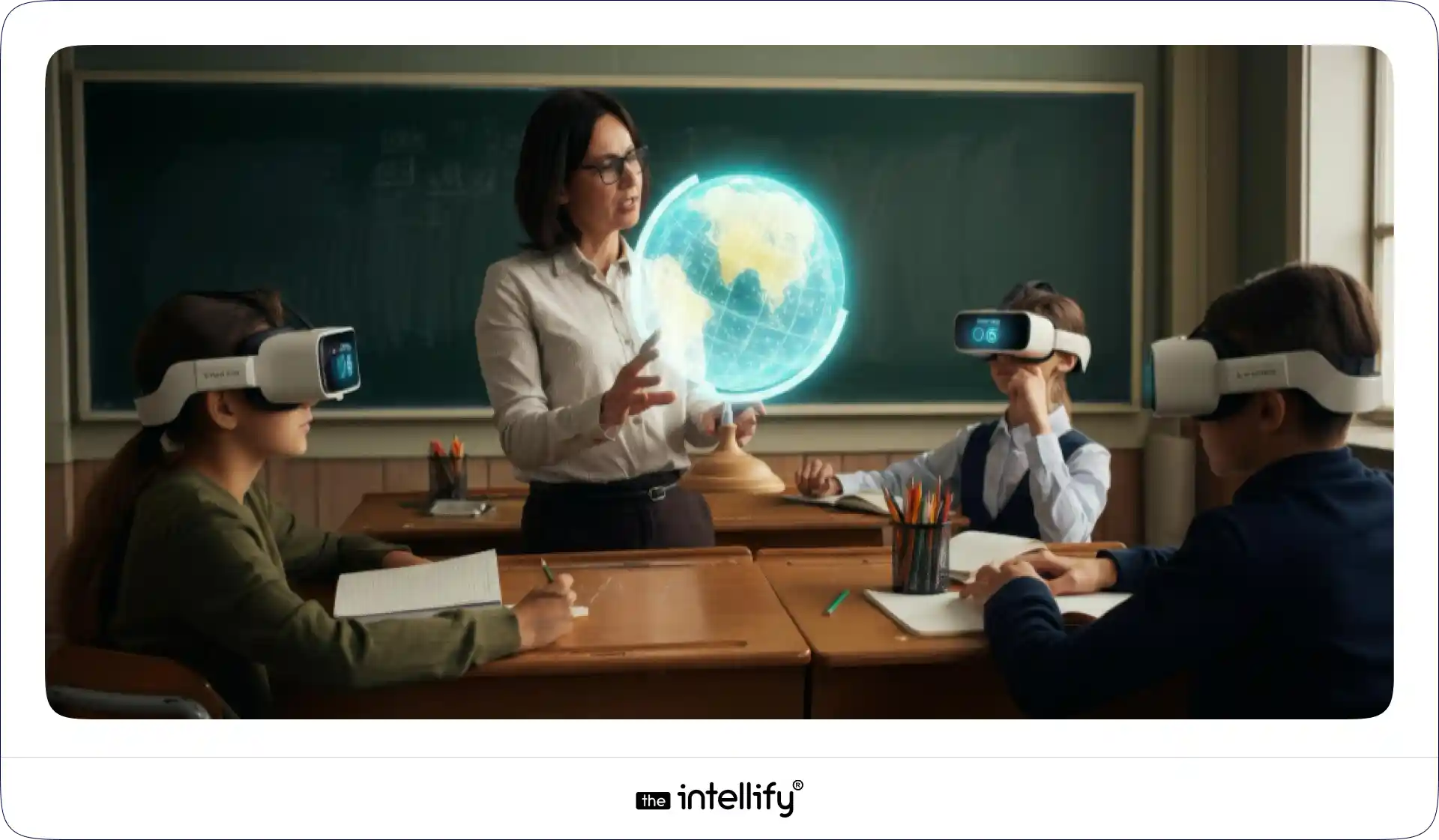
Virtual reality in education refers to computer-generated environments that learners can interact with as if they were physically present. By wearing a VR headset, students are immersed in a digital world where they can look around, move, and engage with objects naturally.
There are different levels of immersion. Fully immersive VR completely replaces the real world, while semi-immersive experiences combine digital environments with some awareness of surroundings. These systems typically use headsets, motion controllers, sensors, and specialized software designed for educational purposes.
Unlike augmented reality, which overlays digital elements onto the real world, VR creates an entirely simulated environment. This makes it especially useful for situations that are difficult, dangerous, expensive, or impossible to recreate in a traditional classroom. From exploring distant planets to practicing complex procedures, VR opens up learning opportunities that were previously out of reach.
The Role of Virtual Reality in Education Today
What once seemed futuristic is now becoming part of everyday learning. Schools, universities, and training institutions across the world are gradually integrating VR into their teaching strategies.
In many cases, VR supplements traditional instruction rather than replacing it. Teachers use it to demonstrate complex ideas, provide virtual field experiences, or allow students to practice skills in realistic scenarios. It is also proving valuable in remote and hybrid learning environments, where immersive interaction can reduce the sense of distance.
Professional education and workforce training are seeing particularly rapid adoption. Fields that require hands-on experience, such as healthcare, engineering, and technical trades, benefit greatly from safe, repeatable simulations. Institutions are increasingly recognizing that immersive tools can improve engagement while better preparing students for real-world challenges.
Key Applications Across Subjects and Training Areas
- Science and virtual laboratories: Students can run experiments without worrying about safety or cost. No broken equipment. No chemical risks. Just repeat and learn.
- Medical and healthcare training: Future doctors can practice procedures again and again. No pressure of real patients. It builds confidence slowly but surely.
- Engineering and technical education: Machines, systems, structures they make more sense when you interact with them. VR lets students take things apart and rebuild them.
- Humanities and cultural studies: History feels different when you can walk through it. Ancient cities, landmarks, it’s more than just reading dates.
- Language learning: Instead of memorizing phrases, students actually use them. Conversations feel real. That’s where fluency starts.
- Vocational and skills training: Construction, manufacturing, equipment handling—these need repetition. VR allows that without risk.
- Special education support: Some students need calmer, controlled environments. VR can be adjusted to reduce distractions and support different learning needs.
Benefits for Students, Teachers, and Institutions
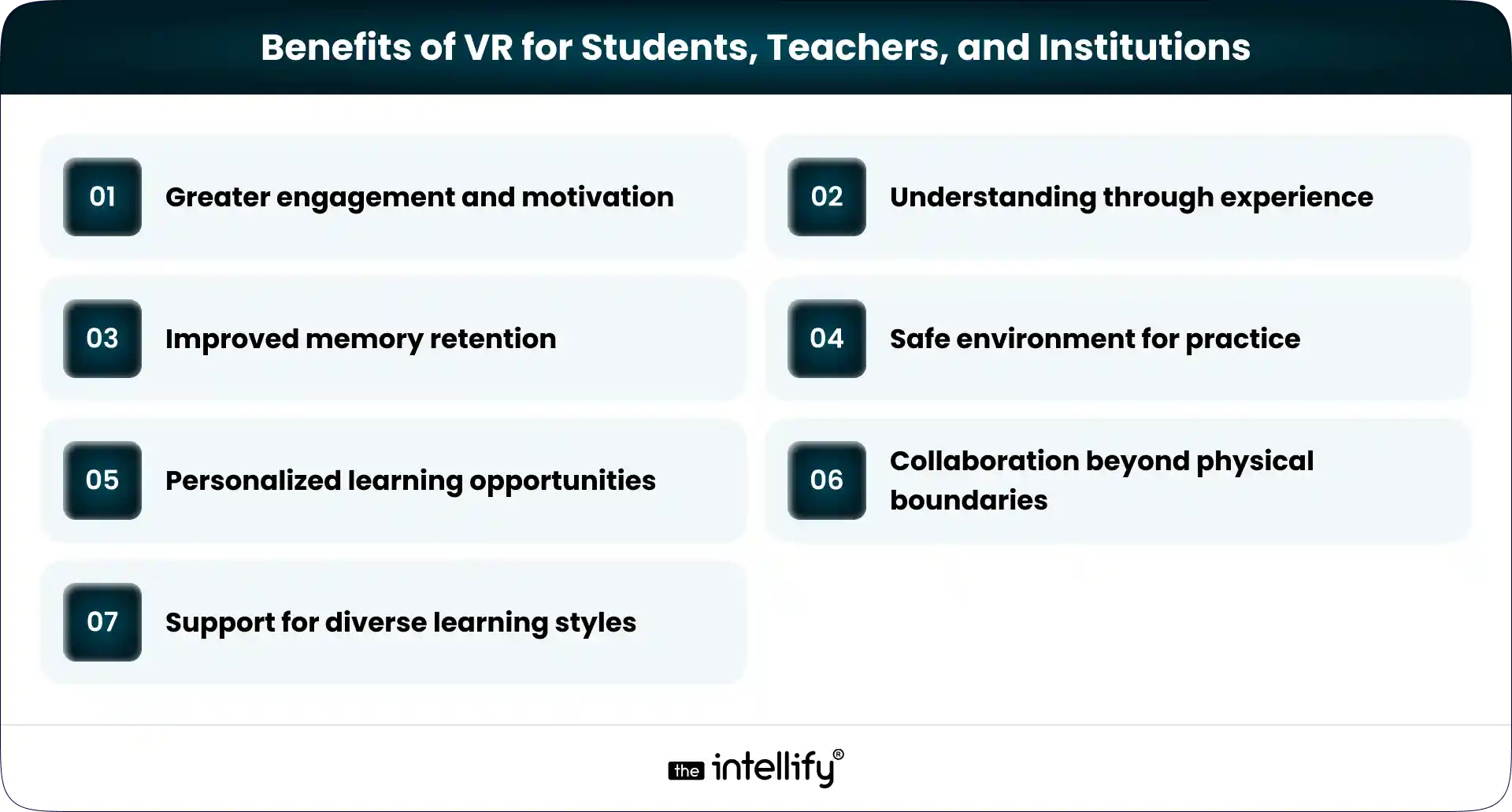
Greater engagement and motivation
Immersive experiences capture attention naturally. Students tend to stay focused longer because they feel involved rather than passive.
Deeper understanding through experience
Seeing and doing often leads to clearer comprehension than reading alone. Complex ideas become easier to grasp when learners interact with them directly.
Improved memory retention
Experiences tend to stay in memory longer than abstract information, helping students recall what they learned.
Safe environment for practice
Tasks that would be risky or costly in real life can be rehearsed without consequences, allowing students to learn from mistakes.
Personalized learning opportunities
Some VR systems adapt to individual progress, enabling students to move at a pace that suits them.
Collaboration beyond physical boundaries
Students can work together in shared virtual spaces, even if they are located in different places.
Support for diverse learning styles
Visual, auditory, and hands-on learners all benefit from immersive environments that combine multiple forms of interaction.
Real-World Examples of VR in Education
Virtual field trips:
Students explore oceans, space, or historical places without leaving the classroom. No logistics, no travel costs.
University simulations and labs:
Some universities now rely on VR labs for complex subjects. Less theory, more interaction.
Medical and technical programs:
Simulations help students practice before entering real environments. Fewer mistakes later.
Corporate learning initiatives:
Companies use VR to train employees in:
- Customer service
- Safety procedures
- Operations
Measurable engagement gains:
Many institutions report better participation. Students ask more questions. They’re more curious. That’s usually a good sign.
How Augmented Reality (AR) Complements VR in Learning
1. Different approaches to immersion:- VR creates a fully digital environment, while AR enhances the real world with digital overlays. Each serves different learning needs.
2. When AR is more practical:- Activities that require awareness of the physical environment, such as lab work or field studies, often benefit more from AR.
3. Classroom applications:- AR can bring textbooks to life with interactive 3D models, animations, or contextual information displayed on devices.
4. Blended learning possibilities:- Using both technologies together allows students to explore concepts deeply in VR and then apply them in real-world settings using AR.
5. Future of mixed reality:- Emerging technologies aim to merge physical and digital spaces seamlessly, offering even more flexible learning experiences.
One example is the RainbowMe AR storytelling app, where kids scan storybook pages and watch characters come to life around them. This turns reading into an interactive experience, making stories easier to follow and more enjoyable to learn from. You can learn more about this real-world example here:- https://theintellify.com/work/rainbowme-ar-application-for-storytelling/
Challenges and Limitations of Implementing VR Solutions
Bringing virtual reality in education into classrooms sounds exciting, but the reality is a bit more layered.
Cost:
The biggest challenge is still cost. Good VR headsets, compatible devices, and quality content require investment. For schools managing tight budgets, scaling this across classrooms isn’t always practical. Some institutions try to manage this by working with VR development services that offer modular or subscription-based solutions, which can reduce upfront costs but it’s still not a small decision.
Content alignment:
Not every VR experience fits educational goals. If the content doesn’t match the curriculum, it may engage students briefly but won’t deliver real learning value. That’s why many institutions prefer customized solutions built specifically for their needs.
Teacher readiness:
Is another factor. Educators need time to learn, adapt, and integrate VR into lessons. Without proper training, even useful tools can go unused.
Physical limitations
Like motion sickness or eye strain, which limit usage time. Add infrastructure needs space, connectivity, and support and it becomes clear that adoption requires planning.
So yes, the potential is there, but implementation needs to be thoughtful, not rushed.
Opportunities and Future Trends in VR-Driven Learning
More affordable and accessible devices
VR hardware is slowly becoming more practical. Headsets are getting lighter, wireless, and less expensive. That makes it easier for schools to adopt without needing huge budgets. It’s not “cheap” yet, but it’s definitely moving in that direction. Over time, this could shift VR from special labs into regular classrooms.
AI-powered personalized learning
This is where things get interesting. Future VR systems may adjust lessons based on how each student learns. If someone struggles, the system slows down. If they’re doing well, it pushes them forward. It’s not perfect yet, but the idea of learning at your own pace inside an immersive environment feels like a big step.
Virtual campuses and shared digital spaces
Some institutions are already experimenting with virtual campuses. Students attend lectures, interact with peers, and collaborate in shared spaces without being physically present. It still feels a bit early, but you can see where it’s heading.
Global remote classrooms
VR removes location barriers in a very real way. Students from different countries can join the same class, interact, and learn together. It’s not just about access it’s also about exposure to different perspectives, which traditional classrooms don’t always offer.
Workforce training and lifelong learning
Learning doesn’t stop after school anymore. Industries keep evolving, and people need to keep up. VR makes it easier to train for new roles, tools, or processes without disrupting real operations. It’s practical, repeatable, and safer in many cases.
Transformation of education systems
Over time, education may shift away from just delivering information. The focus could move more toward applying knowledge solving problems, building skills, and learning by doing. VR supports that kind of learning naturally, which is why it’s gaining attention.
How Institutions Can Successfully Adopt VR for Learning
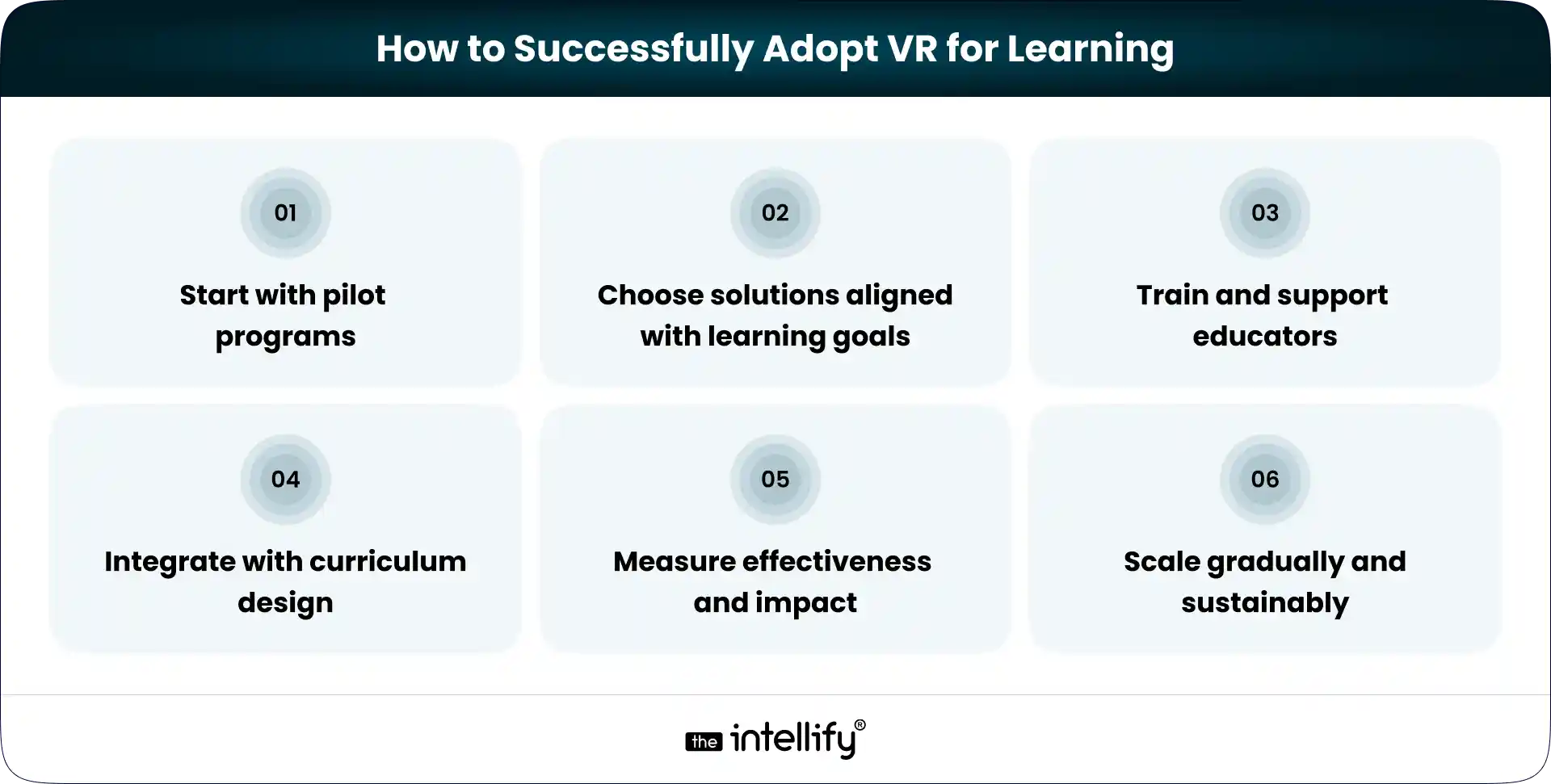
Start with pilot programs
Jumping straight into full-scale adoption usually doesn’t work. It’s better to test things first. A small pilot maybe one subject or a limited group helps institutions understand how VR for education actually performs in real conditions. You get honest feedback, spot issues early, and avoid wasting resources.
Choose solutions aligned with learning goals
Not every VR tool fits every subject. Some look great but don’t add real value. Institutions should focus on solutions that directly support what students need to learn. This is where working with experienced VR development services can help custom or tailored solutions tend to align better with actual curriculum needs.
Train and support educators
Teachers are at the center of this. If they’re not comfortable, adoption slows down simple as that. Training should be practical, not overwhelming. Ongoing support also matters, especially in the early stages when things don’t always go as planned.
Integrate with curriculum design
VR shouldn’t feel like an extra activity. It should fit naturally into the lesson. When it supports existing topics rather than replacing them it becomes more useful and easier to manage.
Measure effectiveness and impact
It’s important to track what’s actually happening. Are students more engaged? Are they understanding concepts better? Data, feedback, even small observations all of it helps in figuring out if VR is worth continuing or expanding.
Scale gradually and sustainably
Once things start working, growth should be steady. Expanding step by step reduces risk and keeps things manageable. Many institutions also work with a VR development partner to ensure their solutions can scale without needing constant rework.
Adoption isn’t about rushing. It’s about getting it right, one step at a time.

Final Thought
Virtual reality is redefining how knowledge can be experienced, not just delivered. By making learning interactive, practical, and engaging, it offers new possibilities across academic, professional, and lifelong education.
Its success, however, depends on thoughtful implementation. Technology works best when it supports strong teaching practices rather than trying to replace them. As tools become more accessible and content continues to evolve, immersive learning is likely to become a natural part of education systems worldwide.
The future of learning may not be limited by physical classrooms at all. Instead, it may be shaped by the experiences we can create and virtual reality is opening the door to those possibilities.
Frequently Asked Questions (FAQS)
1. How is virtual reality used in classrooms today?
VR is mainly used to support lessons with interactive experiences. Students can explore virtual labs, historical places, or complex concepts in 3D instead of just reading about them. It helps make learning more engaging and easier to understand.
2. Does VR actually improve learning or just make classes more fun?
It does both. VR makes lessons interesting, but it also helps students remember concepts better because they experience them directly. Learning by doing often leads to deeper understanding than memorizing information.
3. Which subjects benefit the most from VR-based learning?
Subjects that involve practical skills or complex visuals benefit the most. Science, medicine, engineering, and geography are common examples. However, VR can also enhance history, language learning, and vocational training.
4. How is VR different from augmented reality in education?
VR creates a completely digital environment that students can explore, while AR adds digital elements to the real world. VR is more immersive, whereas AR is useful for enhancing classroom activities without isolating learners.
5. What are the main challenges of using VR in schools?
The biggest challenges are cost, equipment needs, and teacher training. Schools also need reliable technology infrastructure and suitable content. Without proper planning, adoption can be difficult.
6. Can VR support online or remote learning?
Yes, VR can create shared virtual spaces where students interact with content and sometimes with each other. This makes remote learning feel more engaging than standard video-based classes. However, it usually works best as a complement, not a complete replacement.
7. What should schools consider before adopting VR?
Schools should first identify clear learning goals and start with small pilot programs. Training teachers and choosing the right content are just as important as buying equipment. A gradual approach helps ensure long-term success.


Written By, Jalaj Shah
The COO and Co-Founder of The Intellify. Jalaj enjoys experimenting with new strategies. His posts are fantastic for businesses seeking innovative development ideas. Discover practical insights from his engaging content.

Healthcare Membership Management System: Key Features & Architecture
Summary: A healthcare membership management system helps providers handle patient subscriptions, billing, and communication in one place. This blog covers how these systems work, their key features, and why they are important for clinics, hospitals, and wellness providers. It also highlights how they improve efficiency, reduce manual work, and help deliver better patient care while […]
Indoor Navigation with AR: The Future of Smart Wayfinding Systems
Summary: AR-powered indoor navigation is helping businesses deliver smarter and more seamless wayfinding experiences. By guiding users with real-time visual directions, it eliminates confusion in complex environments like hospitals, malls, airports, and campuses. These solutions not only improve visitor satisfaction but also enhance operational efficiency and accessibility. As demand for smarter buildings grows, indoor navigation […]
Healthcare Membership Platform Development: Guide for Startups & DPC Providers
Summary: Healthcare membership platform development is transforming how providers deliver continuous, subscription-based care. This guide explains how membership models help organizations improve patient engagement, generate predictable revenue, and streamline operations. It covers essential features, development strategies, integration needs, and the role of automation and AI in modern healthcare systems. Whether you’re a startup or a […]
Healthcare Membership Management System: Key Features & Architecture
Summary: A healthcare membership management system helps providers handle patient subscriptions, billing, and communication in one place. This blog covers how these systems work, their key features, and why they are important for clinics, hospitals, and wellness providers. It also highlights how they improve efficiency, reduce manual work, and help deliver better patient care while […]
Healthcare Membership Platform Development: Guide for Startups & DPC Providers
Summary: Healthcare membership platform development is transforming how providers deliver continuous, subscription-based care. This guide explains how membership models help organizations improve patient engagement, generate predictable revenue, and streamline operations. It covers essential features, development strategies, integration needs, and the role of automation and AI in modern healthcare systems. Whether you’re a startup or a […]
AI in Healthcare Administration: Streamlining Hospital Operations
Summary The growing complexity of healthcare administration is driving the need for smarter, more efficient solutions. Automation technologies are helping streamline key processes such as scheduling, billing, and data management, reducing manual workload and improving accuracy. This enables faster operations, better coordination, and enhanced patient experiences. As adoption increases, healthcare organizations are moving toward more […]
0
+0
+0
+0
+Committed Delivery Leads To Client Satisfaction
Client Testimonials that keep our expert's spirits highly motivated to deliver extraordinary solutions.

Christopher Seny
My experience working with The Intellify, has been a great experience. The team has a wealth of expertise in the tech space. Working with the intellify was a growing experience for me, I learned a lot. The team keeps great communication & responds fast to new ideas & suggestions. The team also provides great suggestions & solutions as well. I couldn’t imagine working with anybody else on this project & it has been a blessing working with, The Intellify.

Izandi Serdyn
The Intellify delivered a platform from scratch, involving the client at every stage. The team was communicative, responsive, and punctual throughout the engagement. Virtual meetings and emails ensured seamless project management. Customers can expect a team that can work fast.

Kya Johnson
The app serves as an effective introduction for users to the product and its characters. Responsive and faithful to initial requirements, The Intellify’s team exceeded initial expectations. Internal stakeholders were particularly pleased with their communication.

Stefan Wyk
Working with The Intellify to develop our website was an outstanding experience. Their team displayed exceptional professionalism, creativity, and technical expertise throughout the entire process. The final product exceeded our expectations, delivering a sleek, user-friendly, and highly functional website. We highly recommend The Intellify to anyone in need of top-tier web development services.

Steve Thorpe
The Intellify’s work has been met with high praise from internal and external stakeholders. The team is efficient, diligent, and reliable in their service. They go above and beyond in terms of communication and project management. The Intellify is a responsive vendor that gets the job done.

Tal Dotan
I’ve been working with The Intellify for the last 3 years. During this period of time we’ve planned and executed projects in both small and large scale. Working with The Intellify was and still is the best decision I’ve made when rising up Divo, I strongly recommend to work with them in any type of project.


 +1-302-803-4983