Augmented Reality in Retail: How It Improves the Shopping Experience

By Darshak Doshi
May 15, 2026
Summary:
Shopping today is becoming more interactive and experience-driven, with technologies like augmented reality in retail helping customers make better decisions. By enabling virtual try-ons and real-world product visualization, AR reduces uncertainty and improves confidence before purchase. This blog explores how AR enhances customer experience, connects online and in-store journeys, and helps businesses achieve higher conversions, fewer returns, and stronger engagement.
Changing Expectations in the Retail Shopping Experience
Shopping today is no longer just about finding the right product at the right price. People expect more clarity and confidence before they buy. With so many options available online, customers want to understand how a product will actually look, feel, or fit into their lives before making a decision.
At the same time, traditional product pages are not always enough. Images and videos give some idea, but they don’t fully answer real questions customers have in mind. This is why there’s a growing shift toward more interactive and experience-driven shopping, where people can explore products in a more realistic and meaningful way.
Understanding Augmented Reality in Retail Environments
Augmented reality in retail allows customers to see digital products in their real-world environment using their phone, tablet, or in-store screens. Instead of imagining how something might look, they can place it in their space or try it virtually. This makes the shopping experience more practical and easier to understand.
It works across different touchpoints. On websites or apps, customers can use their camera to interact with products, while in physical stores, tools like smart mirrors or AR displays enhance product discovery. Compared to traditional online shopping, this approach feels more real and helps bridge the gap between browsing and actually experiencing a product.
Where Traditional Shopping Falls Short for Customers
Lack of real-world context
Most online listings don’t show how a product fits into real life. Customers often struggle to judge size, placement, or overall look, which makes decisions harder.
Uncertainty in buying decisions
When customers feel unsure, they tend to delay purchases or keep comparing options. This slows down the buying process and creates friction.
Dependence on guesswork
Without proper visualization, people rely on assumptions. In many cases, this leads to mismatched expectations after purchase.
Gap between online and in-store experience
In-store shopping allows customers to touch and try products, while online shopping doesn’t offer that same confidence. This gap often leads to hesitation or incomplete purchases.
How AR in Retail Helps Customers Make Better Buying Decisions
Visualizing products in real environments
AR in retail allows customers to see products in their own space, whether it’s furniture in a room or decor on a wall. As a result, the experience feels more real and easier to relate to.
Trying products virtually
From clothes to eyewear, customers can try products without physically using them. This makes it easier to understand fit, style, and overall appearance before buying.
Reducing confusion
When customers can clearly see how a product looks and works, many of their doubts are removed. This simplifies the entire decision-making process.
Building confidence while choosing
With better clarity, customers feel more sure about their choices. This often leads to quicker decisions and fewer second thoughts.
Practical Use Cases of AR in Retail Industry
Virtual try-ons
Retailers use AR to let customers try products like clothes, eyewear, or makeup without physically using them. This makes it easier to compare options and choose what suits them best.
Product placement in real spaces
Furniture and home decor brands allow customers to place products in their own rooms using their phone camera. This gives a clearer idea of size, fit, and how the product blends with the surroundings.
Interactive product experiences
AR can highlight product features in a more visual way. Instead of relying only on descriptions, customers can explore how a product works in a more practical manner.
In-store AR features
Physical stores use tools like smart mirrors or AR screens to improve product discovery. These features make browsing more engaging and reduce the effort of trying multiple items manually.
Online vs in-store AR usage
Online AR focuses on helping customers make decisions from home, while in-store AR enhances the physical shopping experience. Together, they create a more complete and connected journey.
Creating More Personalized Shopping Experiences with AR
Personalized product previews
AR can display products based on what a customer prefers or searches for. This makes the experience feel more relevant instead of showing the same options to everyone.
Integration with smart recommendations
When combined with customer data, AR can suggest products that match past behavior or interests. For example, it can highlight items similar to what a user has already explored.
Context-based experiences
AR can adapt based on location, time, or usage. Showing how a product fits into a specific environment makes the experience more practical and relatable.
More engaging shopping journeys
When the experience feels personalized, customers naturally spend more time exploring. This increases engagement and improves the chances of conversion.
Business Benefits of AR for Retailers
- Improved conversion rates: When customers understand a product clearly, they are more confident in their decision. This directly increases the likelihood of completing a purchase.
- Reduced returns: Clear expectations before buying help reduce mismatches after delivery. As a result, return rates tend to decrease.
- Higher engagement: Interactive experiences keep customers involved for longer periods. This improves overall interaction with the brand.
- Stronger brand recall: Unique and interactive experiences leave a lasting impression. Customers are more likely to remember and return to brands that offer something different.
Augmented Reality in Retail: Applications Across Key Segments
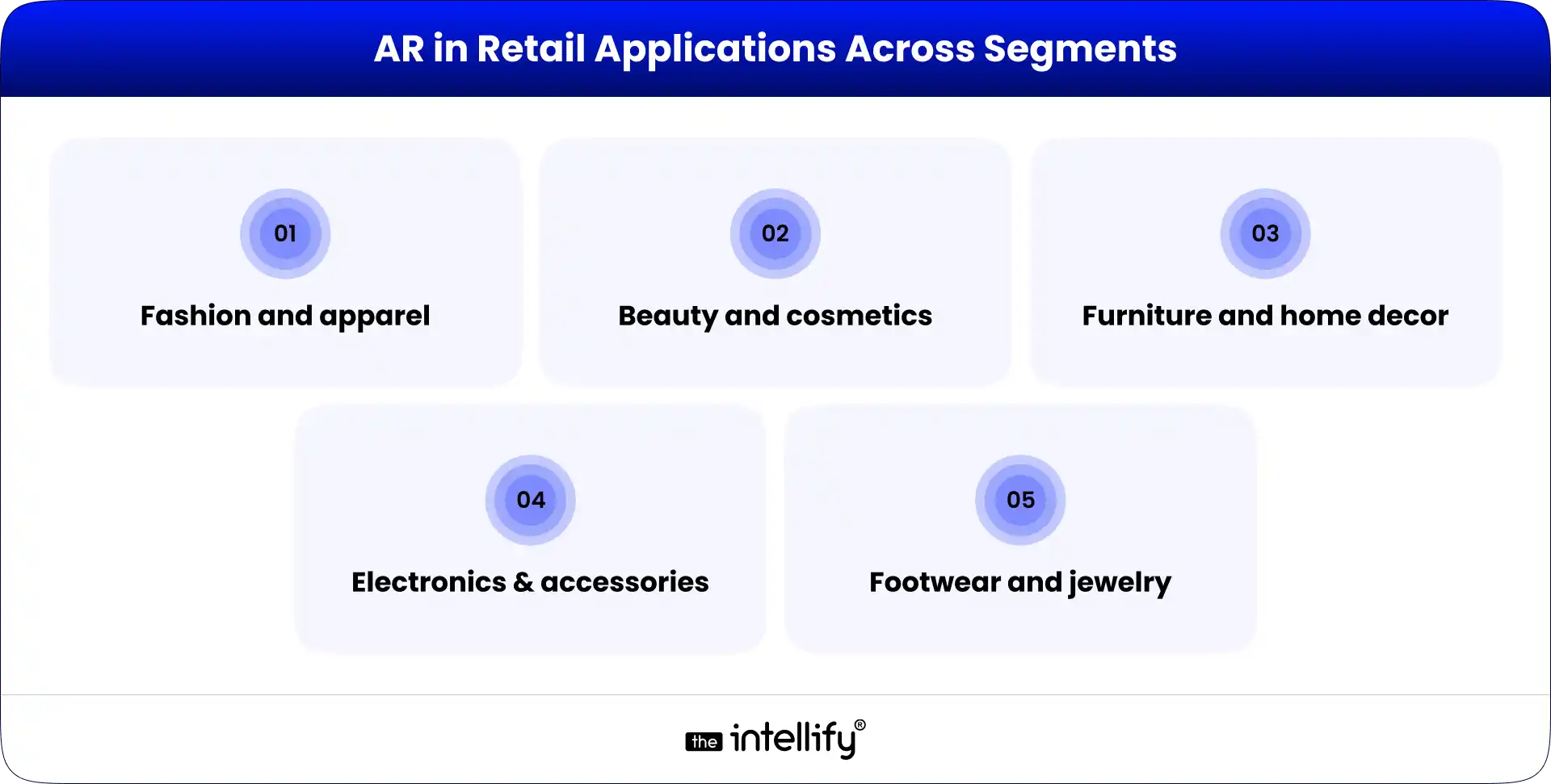
- Fashion and apparel: Customers can try outfits virtually and see how they look before buying. This reduces effort and helps in making quicker decisions.
- Beauty and cosmetics: AR allows users to test shades and products in real time. This removes confusion and helps them choose more accurately.
- Furniture and home decor: Customers can place furniture in their own space and see how it fits with their surroundings. This avoids mistakes related to size or design.
- Electronics and accessories: AR makes it easier to explore product features visually. Customers can understand usability without relying only on specifications.
- Footwear and jewelry: These categories benefit from better visualization of design and fit. Customers can notice finer details, which supports better decision-making.
Challenges in Adopting AR in Retail Solutions
Development and setup: Building AR experiences requires planning, tools, and investment. For larger product catalogs, this process can take time initially.
Device compatibility: Not all devices support AR at the same level. Ensuring a smooth experience across different platforms can be a challenge.
User adoption: Some customers may not be familiar with AR features right away. Keeping the experience simple is important to encourage usage.
Content maintenance: AR depends on accurate and updated 3D models. Maintaining this content consistently requires ongoing effort.
Opportunities for Retail Growth Using AR
Connecting online and offline retail: AR helps bring consistency between digital and physical shopping. Customers can move between both without losing context.
Creating unique experiences: Retailers can offer something more interactive and memorable. This helps them stand out in a competitive market.
Supporting omnichannel strategies: AR works across apps, websites, and stores. It ensures a smoother and more connected customer journey.
Building customer trust: When customers feel confident in their decisions, trust naturally increases. Over time, this leads to repeat purchases and stronger relationships.
The Future of AR for Retail Experiences
AR for the retail industry is becoming more accessible, especially with mobile and web-based experiences. Customers no longer need advanced tools simple devices are enough to access AR features, making it easier for brands to adopt.
As AR continues to evolve, it will work more closely with data and personalization systems. This will make shopping more intuitive, where customers can explore, compare, and decide in a seamless way across both online and offline channels.

Conclusion
Augmented reality is helping customers shop with more clarity and confidence. It reduces uncertainty, improves understanding, and makes the entire process more engaging. For businesses, it brings better conversions, fewer returns, and stronger customer connections.
As adoption grows, AR will become a natural part of retail experiences. It will continue to close the gap between online and in-store shopping, making the journey smoother and more effective for both customers and retailers.
Frequently Asked Questions (FAQs)
1. Is augmented reality in retail only useful for online shopping?
No, it works in both. Online, it helps customers visualize products at home. In physical stores, it’s used through smart mirrors, product scanners, or guided experiences to make shopping more interactive.
2. What kind of products benefit the most from AR in retail?
Products where size, fit, or appearance matters the most like clothing, furniture, beauty products, eyewear, and even footwear—see the biggest impact from AR experiences.
3. Does AR really reduce product returns in eCommerce?
Yes, because customers know what to expect before buying. When they can visualize size, fit, or placement accurately, there are fewer surprises after delivery, which naturally reduces returns.
4. Is augmented reality expensive for retailers to implement?
It depends on the scale. Basic AR features like product visualization can be implemented with moderate investment, while advanced experiences (like full virtual stores) require more resources and planning.
5. How is AR different from regular product images or videos?
Images and videos show a fixed view, while AR allows customers to interact with the product in their own space. This makes the experience more realistic and useful for decision-making.
6. Can AR personalize the shopping experience for each customer?
Yes, AR can be combined with data and AI to show products based on user preferences, past behavior, or even real-time context, making the experience more relevant and tailored.


Written By, Darshak Doshi
With over a decade of experience, Darshak is a technopreneur specializing in cloud-based applications and product development in healthcare, insurance, and manufacturing. He excels in AWS Cloud, backend development, and immersive technologies like AR/VR to drive innovation and efficiency. Darshak has also explored AI/ML in insurance and healthcare, pushing the boundaries of technology to solve complex problems. His user-focused, results-driven approach ensures he builds scalable cloud solutions, cutting-edge AR/VR experiences, and AI-driven insights that meet today’s demands while anticipating future needs.

Virtual Reality in E-commerce: The Future of Immersive Online Shopping
Summary: Virtual reality is making online shopping more engaging by helping customers explore products in a more real and interactive way. Instead of guessing from images, people can see details, try items virtually, and feel more confident before buying. This reduces confusion and returns while improving overall satisfaction. As technology grows, more businesses are using […]
Virtual Reality in Education: Applications, Benefits & Future of Learning
Summary: Virtual reality in education is changing how students learn by making lessons more interactive and practical. Instead of only reading or listening, learners can explore concepts through immersive experiences. This blog explains how VR is used across subjects, its key benefits, real-world applications, challenges, and future trends. It also covers how institutions can adopt […]
Indoor Navigation with AR: The Future of Smart Wayfinding Systems
Summary: AR-powered indoor navigation is helping businesses deliver smarter and more seamless wayfinding experiences. By guiding users with real-time visual directions, it eliminates confusion in complex environments like hospitals, malls, airports, and campuses. These solutions not only improve visitor satisfaction but also enhance operational efficiency and accessibility. As demand for smarter buildings grows, indoor navigation […]
Virtual Reality in E-commerce: The Future of Immersive Online Shopping
Summary: Virtual reality is making online shopping more engaging by helping customers explore products in a more real and interactive way. Instead of guessing from images, people can see details, try items virtually, and feel more confident before buying. This reduces confusion and returns while improving overall satisfaction. As technology grows, more businesses are using […]
Virtual Reality in Education: Applications, Benefits & Future of Learning
Summary: Virtual reality in education is changing how students learn by making lessons more interactive and practical. Instead of only reading or listening, learners can explore concepts through immersive experiences. This blog explains how VR is used across subjects, its key benefits, real-world applications, challenges, and future trends. It also covers how institutions can adopt […]
Indoor Navigation with AR: The Future of Smart Wayfinding Systems
Summary: AR-powered indoor navigation is helping businesses deliver smarter and more seamless wayfinding experiences. By guiding users with real-time visual directions, it eliminates confusion in complex environments like hospitals, malls, airports, and campuses. These solutions not only improve visitor satisfaction but also enhance operational efficiency and accessibility. As demand for smarter buildings grows, indoor navigation […]
0
+0
+0
+0
+Committed Delivery Leads To Client Satisfaction
Client Testimonials that keep our expert's spirits highly motivated to deliver extraordinary solutions.

Christopher Seny
My experience working with The Intellify, has been a great experience. The team has a wealth of expertise in the tech space. Working with the intellify was a growing experience for me, I learned a lot. The team keeps great communication & responds fast to new ideas & suggestions. The team also provides great suggestions & solutions as well. I couldn’t imagine working with anybody else on this project & it has been a blessing working with, The Intellify.

Izandi Serdyn
The Intellify delivered a platform from scratch, involving the client at every stage. The team was communicative, responsive, and punctual throughout the engagement. Virtual meetings and emails ensured seamless project management. Customers can expect a team that can work fast.

Kya Johnson
The app serves as an effective introduction for users to the product and its characters. Responsive and faithful to initial requirements, The Intellify’s team exceeded initial expectations. Internal stakeholders were particularly pleased with their communication.

Stefan Wyk
Working with The Intellify to develop our website was an outstanding experience. Their team displayed exceptional professionalism, creativity, and technical expertise throughout the entire process. The final product exceeded our expectations, delivering a sleek, user-friendly, and highly functional website. We highly recommend The Intellify to anyone in need of top-tier web development services.

Steve Thorpe
The Intellify’s work has been met with high praise from internal and external stakeholders. The team is efficient, diligent, and reliable in their service. They go above and beyond in terms of communication and project management. The Intellify is a responsive vendor that gets the job done.

Tal Dotan
I’ve been working with The Intellify for the last 3 years. During this period of time we’ve planned and executed projects in both small and large scale. Working with The Intellify was and still is the best decision I’ve made when rising up Divo, I strongly recommend to work with them in any type of project.


 +1-302-803-4983