AI for Insurance Fraud Detection: Preventing Deepfakes, Fake Claims & Fraud

By Darshak Doshi
May 28, 2026
Summary:
AI is transforming insurance fraud detection by helping insurers identify fake claims, deepfakes, synthetic identities, and other emerging fraud risks faster than traditional methods. This blog covers how AI-powered fraud detection works, its benefits, real-world applications, implementation challenges, and why insurers are increasingly investing in intelligent fraud prevention solutions.
Insurance fraud has always been a costly problem. Every year, insurers lose billions of dollars to false claims, identity theft, and organized fraud schemes. Unfortunately, those losses rarely stay with insurance companies alone. They often trickle down to policyholders through higher premiums, stricter claim reviews, and longer processing times.
For years, insurers relied on manual investigations and rule-based systems to identify suspicious claims. Those methods worked reasonably well when fraud was simpler. But things have changed.
Today, fraudsters use advanced digital tools to create fake documents, manipulate images, generate synthetic identities, and even produce convincing deepfake videos and voice recordings. What once required a criminal network can now be done with a laptop and a few AI-powered tools.
At the same time, insurance companies are processing more claims digitally than ever before. Online onboarding, mobile claim submissions, and automated customer interactions have improved convenience, but they’ve also created new opportunities for fraud.
This is where AI for insurance fraud detection is making a real difference. Modern AI systems can analyze massive amounts of data, identify unusual patterns, detect manipulated media, and flag suspicious behavior in real time. Instead of waiting for fraud to happen, insurers can proactively prevent it.
The New Face of Insurance Fraud in the Digital Era
Insurance fraud is no longer limited to exaggerated repair bills or staged accidents. The fraud landscape has evolved significantly over the last decade.
Digital transformation has changed how insurers interact with customers, process claims, and verify identities. While these advancements improve efficiency, they also introduce new vulnerabilities. Fraudsters now exploit digital channels in ways that traditional systems often struggle to detect.
Some of the most common fraud types affecting insurers today include:
Fake Claims
Fraudsters submit claims for events that never occurred or inflate legitimate losses to receive larger payouts.
Identity Theft
Criminals steal personal information and use it to obtain policies, submit claims, or access insurance benefits.
Synthetic Identity Fraud
Instead of stealing an entire identity, fraudsters combine real and fabricated information to create entirely new personas that appear legitimate.
Deepfake-Based Fraud Attempts
AI-generated videos, images, and voice recordings are increasingly being used to impersonate policyholders and manipulate claim evidence.
Staged Accidents and Document Manipulation
Organized fraud rings may stage accidents, alter medical records, modify invoices, or submit forged documents to support fraudulent claims.
The growing use of online claim processing and digital onboarding means insurers must evaluate vast amounts of information quickly. Manual reviews alone can no longer keep up with the speed and sophistication of modern fraud tactics.
As fraud becomes more intelligent, fraud detection systems must become smarter too.
Why Traditional Fraud Detection Methods Are No Longer Enough
Many insurance companies still rely heavily on rule-based fraud detection systems. These systems flag claims when specific conditions are met.
For example:
- Claim amount exceeds a predefined threshold
- Multiple claims are submitted within a short period
- Certain high-risk locations appear repeatedly
While these rules can identify some suspicious activities, they have significant limitations.
Too Many False Positives
Rule-based systems often flag legitimate claims as suspicious. This creates unnecessary investigations and delays for honest customers.
Manual Investigations Slow Everything Down
Human investigators are valuable, but they can only review a limited number of cases at a time. As claim volumes increase, investigation backlogs grow.
Fraudsters Adapt Quickly
Once criminals understand the rules being used, they adjust their tactics to avoid triggering alerts. Static systems struggle to keep pace with constantly evolving fraud techniques.
Massive Data Volumes Are Difficult to Manage
Modern insurers process millions of data points across claims, policies, customer interactions, documents, and external databases. Manually identifying hidden fraud patterns within that volume of information is nearly impossible.
Lack of Real-Time Detection
Traditional methods often identify fraud after a claim has already been processed and paid. Recovering fraudulent payouts is far more difficult than preventing them in the first place.
The consequences extend beyond financial losses. Insurers may face:
- Higher operational costs
- Reduced customer trust
- Slower claim approvals
- Compliance challenges
- Increased regulatory scrutiny
- To stay ahead, insurance companies need systems capable of learning, adapting, and identifying risks as they emerge.
How AI-Powered Insurance Fraud Detection Works

At its core, AI-driven fraud detection uses advanced algorithms to analyze data, recognize patterns, and identify suspicious behavior that may indicate fraud. Unlike traditional systems that depend solely on predefined rules, AI continuously learns from new information and improves over time.
What AI-Driven Fraud Detection Means in Insurance
AI examines large volumes of data from multiple sources, including:
- Claims records
- Customer profiles
- Policy information
- Payment histories
- Images and videos
- Call transcripts
- External databases
By analyzing these data sources together, AI can identify subtle connections that humans might overlook.
Machine Learning Identifies Suspicious Patterns
Machine learning models learn from historical fraud cases and legitimate claims. Over time, these models become better at recognizing behaviors commonly associated with fraudulent activity.
For example, AI may detect:
- Unusual claim frequencies
- Inconsistent customer information
- Repeated use of specific repair vendors
- Abnormal payment patterns
These insights help investigators focus on cases with the highest fraud risk.
Predictive Analytics Detects Anomalies
Predictive analytics evaluates current claims against expected patterns. When something falls outside normal behavior, the system assigns a higher risk score. This allows insurers to identify potential fraud before claims are approved.
Real-Time Claim Monitoring
One of the biggest advantages of AI in fraud detection is speed. AI systems can analyze claims the moment they are submitted, providing immediate risk assessments. This enables faster decision-making while reducing opportunities for fraudsters to exploit delays.
Key Components of AI-Powered Fraud Detection
- Data Analysis: AI processes structured and unstructured data from multiple sources simultaneously.
- Behavioral Pattern Recognition: The system identifies customer behaviors that differ from established patterns.
- Image and Document Verification: AI can detect altered documents, manipulated images, and forged evidence.
- Natural Language Processing (NLP): NLP analyzes claim descriptions, customer communications, and supporting documents to uncover inconsistencies.
- Automated Fraud Alerts: High-risk claims are automatically flagged for further investigation, allowing fraud teams to prioritize their efforts effectively.
By combining these capabilities, AI provides a more proactive and intelligent approach to insurance fraud detection.
Detecting Fake Claims Before They Turn Into Major Losses
Fake claims remain one of the most common forms of insurance fraud. Some involve completely fabricated incidents, while others involve exaggerating legitimate losses to secure larger payouts.
The challenge is that fraudulent claims often look genuine at first glance. This is where AI for insurance fraud detection helps insurers act faster and more accurately.
How AI Analyzes Claim History and Customer Behavior
AI reviews years of historical claims data and compares new submissions against established patterns.
For example, it can identify:
- Customers who file claims unusually often
- Repeated claims involving similar circumstances
- Suspicious relationships between claimants and service providers
- Patterns commonly linked to known fraud cases
Instead of relying solely on predefined rules, AI evaluates the full context of a claim.
Identifying Duplicate or Inconsistent Claims
Fraudsters sometimes submit the same claim to multiple insurers or attempt to reuse supporting documents. AI can automatically detect:
- Duplicate claim submissions
- Matching photos across multiple cases
- Inconsistent timelines
- Contradicting information in documents
What might take hours for a human investigator can be identified in seconds.
Spotting Unusual Claim Timing and Transaction Patterns
Timing often reveals hidden fraud. For example:
- Claims submitted immediately after policy activation
- Multiple claims filed within a short timeframe
- Sudden changes in customer behavior
AI continuously monitors these signals and flags unusual activity for review.
Automated Document Cross-Checking
Insurance claims often include invoices, repair estimates, medical records, and supporting documents. AI can compare information across multiple sources to verify accuracy and identify inconsistencies automatically.
The result is:
- Faster claim validation
- Reduced human error
- More efficient investigations
- Better allocation of fraud investigation resources
AI in Fraud Detection for Deepfake and Manipulated Media Attacks
Deepfake technology has become one of the fastest-growing threats facing insurers today. A few years ago, creating realistic fake videos or synthetic voice recordings required advanced technical expertise. Today, publicly available AI tools can generate convincing content within minutes. That reality has many insurers understandably concerned.
How Deepfakes Are Creating New Risks
Fraudsters may use:
- AI-generated voice recordings
- Manipulated claim photos
- Synthetic video evidence
- Fake identity verification videos
These attacks can be used to bypass verification processes, support false claims, or impersonate legitimate policyholders.
Why Manual Verification Is No Longer Enough
Human reviewers are often unable to detect sophisticated media manipulation. Many deepfakes are designed specifically to exploit human trust. Even experienced investigators can struggle to identify subtle alterations.
How AI Helps Detect Deepfakes
AI-powered fraud detection systems analyze media at a level humans cannot.
Deepfake Detection Algorithms
These models examine digital content for signs of manipulation.
Facial Inconsistency Analysis
AI identifies irregular eye movement, facial distortions, unnatural expressions, and rendering artifacts.
Voice Pattern Analysis
Voice authentication tools compare speech characteristics against verified customer records.
Metadata Verification
AI examines metadata, timestamps, device information, and file histories to detect tampering.
Real-Time Media Verification
Some insurers now verify uploaded images and videos immediately during claim submission. This reduces the likelihood of manipulated evidence entering the claims process.
As deepfake technology improves, insurers are increasingly investing in AI-powered defenses to stay ahead of emerging threats.
Understanding Synthetic Identity Fraud in Insurance
Synthetic identity fraud is one of the most difficult forms of fraud to detect. Unlike traditional identity theft, fraudsters do not steal a complete identity. Instead, they create entirely new identities by combining real and fake information.
For example, they may use:
- A legitimate Social Security number
- A fabricated name
- A fake address
- Newly created digital profiles
Over time, these synthetic identities build credibility and eventually gain access to insurance products.
Why Synthetic Identities Are Hard to Detect
Synthetic identities often pass traditional verification checks because portions of the information are legitimate. As a result, fraud can remain hidden for months or even years.
How AI Helps Identify Synthetic Fraud
AI excels at finding connections across large datasets. It can detect subtle indicators such as:
- Shared contact information
- Unusual application patterns
- Suspicious digital behaviors
- Inconsistent identity histories
AI-Based Identity Verification
Advanced AI systems compare customer information across multiple databases to validate authenticity.
Behavioral Analytics
AI evaluates how users interact with applications, portals, and digital services. Behavior that differs from normal customer activity can trigger additional verification.
Risk Scoring for Suspicious Profiles
Each profile receives a risk score based on hundreds of data points. High-risk identities can be reviewed before policies are issued or claims are approved.
Key Benefits of AI for Insurance Fraud Detection
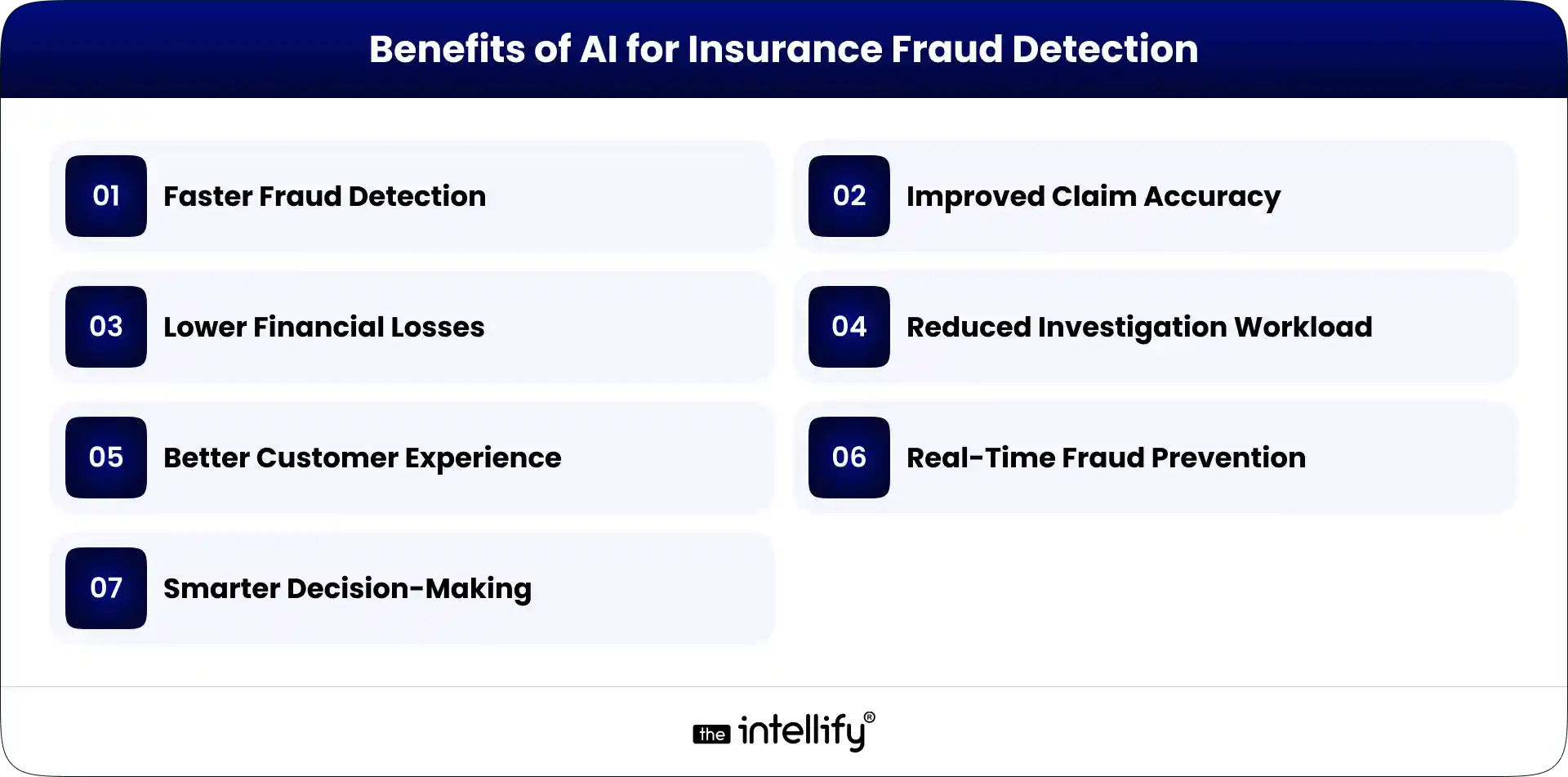
The benefits of AI-powered fraud detection extend far beyond preventing financial losses.
- Faster Fraud Detection: AI evaluates claims in real time, helping insurers identify suspicious activity earlier.
- Improved Claim Accuracy: Automated analysis reduces the risk of overlooking critical warning signs.
- Lower Financial Losses: Preventing fraudulent payouts directly improves profitability.
- Reduced Investigation Workload: Investigators can focus on high-risk cases rather than reviewing every claim manually.
- Better Customer Experience: Legitimate customers benefit from faster approvals and fewer unnecessary delays.
- Real-Time Fraud Prevention: Potential fraud can be identified before payments are issued.
- Smarter Decision-Making: AI provides data-driven insights that improve risk management and operational planning.
Business Impact
Insurers also benefit from:
- Higher operational efficiency
- Scalable fraud monitoring capabilities
- Better regulatory compliance
- Improved fraud investigation outcomes
Fraud Detection in Insurance Industry: Real-World Use Cases
AI in insurance is already being used across multiple insurance sectors.
Auto Insurance Claim Fraud
AI analyzes accident photos, repair estimates, telematics data, and claim histories to identify suspicious claims.
Health Insurance Billing Fraud
Machine learning models detect unusual billing patterns, duplicate procedures, and inflated medical charges.
Life Insurance Identity Verification
AI verifies customer identities during onboarding and claims processing to reduce impersonation risks.
Property and Accident Claim Investigations
Image recognition technology helps assess damage authenticity and detect manipulated evidence.
Fraud Monitoring During Digital Onboarding
AI continuously evaluates customer applications for identity fraud, synthetic identities, and document manipulation.
Many insurers now integrate AI throughout the claims lifecycle, allowing earlier detection and more effective investigations.
Challenges Insurance Companies Face While Implementing AI
Despite its advantages, implementing AI for fraud detection is not without challenges.
Data Privacy and Compliance Concerns
Insurance companies must comply with strict regulations regarding customer data usage and storage.
Poor-Quality or Fragmented Data
AI models depend on accurate information. Incomplete or inconsistent data can reduce effectiveness.
Bias in AI Models
Poorly trained models may unintentionally create unfair outcomes. Regular monitoring and governance are essential.
Integration with Legacy Systems
Many insurers still rely on older technology infrastructure. Connecting AI tools with existing systems can be complex and time-consuming.
Need for Human Oversight
AI is powerful, but it should not operate entirely on its own. Human investigators remain critical for reviewing complex cases and making final decisions. The most successful fraud programs combine technology and human expertise.
Why Insurers Are Investing More in AI-Driven Fraud Prevention
Insurance companies face increasing pressure to improve efficiency while protecting customers and profitability. Several factors are driving investment in AI-powered insurance fraud detection.
Growing Sophistication of Digital Fraud
Fraudsters are using increasingly advanced tools and techniques. Traditional defenses are struggling to keep pace.
Rising Pressure to Reduce Claim Leakage
Every fraudulent payout impacts profitability. Insurers are looking for more effective ways to reduce losses.
Need for Faster Claim Processing
Customers expect quick claim decisions. AI helps accelerate reviews while maintaining fraud controls.
Competitive Advantage Through Automation
Organizations that use intelligent fraud detection often achieve faster operations and better customer experiences.
Maintaining Customer Trust
Trust remains one of the most valuable assets in insurance. Strong fraud prevention protects both customers and insurers.

Conclusion
Insurance fraud is evolving rapidly. From fake claims and identity theft to deepfakes and synthetic identities, today’s fraud landscape looks very different from what insurers faced just a few years ago.
Traditional detection methods still play a role, but they are no longer enough on their own. Fraudsters adapt quickly, operate digitally, and exploit gaps that manual reviews often miss.
AI for insurance fraud detection provides a smarter and more scalable approach. By analyzing large volumes of data, detecting suspicious behavior, identifying manipulated media, and monitoring claims in real time, AI helps insurers respond to emerging threats more effectively.
The future of fraud detection in insurance will depend on intelligent systems that combine automation, analytics, and human expertise. Insurers that invest early in AI-driven fraud prevention will be better positioned to reduce losses, improve operational efficiency, and maintain customer trust in an increasingly complex digital world.
Frequently asked questions
1. How does AI help insurance companies detect fraud faster?
AI analyzes large amounts of claims data in real time to spot unusual patterns, suspicious behavior, and inconsistencies that may indicate fraud.
2. Can AI detect deepfake videos and fake documents in insurance claims?
Yes, AI tools can identify manipulated images, altered documents, fake videos, and synthetic voice recordings by analyzing digital patterns that are difficult to detect manually.
3. What is synthetic identity fraud in insurance?
Synthetic identity fraud happens when criminals combine real and fake personal information to create false identities for fraudulent insurance activities.
4. Which types of insurance fraud can AI identify?
AI can help detect fake claims, billing fraud, identity fraud, staged accidents, document manipulation, and suspicious claim activities across different insurance sectors.
5. Does AI replace human investigators in insurance fraud cases?
No, AI supports investigators by identifying high-risk claims faster, but human expertise is still important for verification and final decision-making.


Written By, Darshak Doshi
With over a decade of experience, Darshak is a technopreneur specializing in cloud-based applications and product development in healthcare, insurance, and manufacturing. He excels in AWS Cloud, backend development, and immersive technologies like AR/VR to drive innovation and efficiency. Darshak has also explored AI/ML in insurance and healthcare, pushing the boundaries of technology to solve complex problems. His user-focused, results-driven approach ensures he builds scalable cloud solutions, cutting-edge AR/VR experiences, and AI-driven insights that meet today’s demands while anticipating future needs.

Where AI Voice Agents Fit Into a Modern DPC Platform
Summary: AI voice agents can become a practical part of a modern Direct Primary Care (DPC) platform by handling routine phone interactions, appointment scheduling, membership questions, reminders, and call routing. This guide explains where voice AI fits within the DPC technology stack, what tasks it should and shouldn’t handle, HIPAA considerations, integration requirements, and how […]
AI Appointment Scheduling in Healthcare: How It Works, Key Benefits & Costs in 2026
Summary: AI appointment scheduling helps healthcare organizations automate booking, reduce no-shows, optimize provider schedules, and improve patient access to care. This guide explains how AI scheduling works, its key benefits, essential features, implementation costs, EHR integration requirements, and future trends shaping healthcare operations in 2026. A missed appointment doesn’t just create an empty slot in […]
How to Build AI for Real Estate Investment and Market Analysis
Summary: AI for real estate investment is helping investors and property businesses make smarter, faster, and more data-driven decisions. This guide explains how to build an AI-powered real estate investment platform, covering essential features, data sources, AI technologies, market analysis capabilities, development steps, business benefits, and future trends shaping the real estate industry. Real […]
Where AI Voice Agents Fit Into a Modern DPC Platform
Summary: AI voice agents can become a practical part of a modern Direct Primary Care (DPC) platform by handling routine phone interactions, appointment scheduling, membership questions, reminders, and call routing. This guide explains where voice AI fits within the DPC technology stack, what tasks it should and shouldn’t handle, HIPAA considerations, integration requirements, and how […]
AI Appointment Scheduling in Healthcare: How It Works, Key Benefits & Costs in 2026
Summary: AI appointment scheduling helps healthcare organizations automate booking, reduce no-shows, optimize provider schedules, and improve patient access to care. This guide explains how AI scheduling works, its key benefits, essential features, implementation costs, EHR integration requirements, and future trends shaping healthcare operations in 2026. A missed appointment doesn’t just create an empty slot in […]
How to Build AI for Real Estate Investment and Market Analysis
Summary: AI for real estate investment is helping investors and property businesses make smarter, faster, and more data-driven decisions. This guide explains how to build an AI-powered real estate investment platform, covering essential features, data sources, AI technologies, market analysis capabilities, development steps, business benefits, and future trends shaping the real estate industry. Real […]
0
+0
+0
+0
+Committed Delivery Leads To Client Satisfaction
Client Testimonials that keep our expert's spirits highly motivated to deliver extraordinary solutions.

Christopher Seny
My experience working with The Intellify, has been a great experience. The team has a wealth of expertise in the tech space. Working with the intellify was a growing experience for me, I learned a lot. The team keeps great communication & responds fast to new ideas & suggestions. The team also provides great suggestions & solutions as well. I couldn’t imagine working with anybody else on this project & it has been a blessing working with, The Intellify.

Izandi Serdyn
The Intellify delivered a platform from scratch, involving the client at every stage. The team was communicative, responsive, and punctual throughout the engagement. Virtual meetings and emails ensured seamless project management. Customers can expect a team that can work fast.

Kya Johnson
The app serves as an effective introduction for users to the product and its characters. Responsive and faithful to initial requirements, The Intellify’s team exceeded initial expectations. Internal stakeholders were particularly pleased with their communication.

Stefan Wyk
Working with The Intellify to develop our website was an outstanding experience. Their team displayed exceptional professionalism, creativity, and technical expertise throughout the entire process. The final product exceeded our expectations, delivering a sleek, user-friendly, and highly functional website. We highly recommend The Intellify to anyone in need of top-tier web development services.

Steve Thorpe
The Intellify’s work has been met with high praise from internal and external stakeholders. The team is efficient, diligent, and reliable in their service. They go above and beyond in terms of communication and project management. The Intellify is a responsive vendor that gets the job done.

Tal Dotan
I’ve been working with The Intellify for the last 3 years. During this period of time we’ve planned and executed projects in both small and large scale. Working with The Intellify was and still is the best decision I’ve made when rising up Divo, I strongly recommend to work with them in any type of project.


 +1-302-803-4983