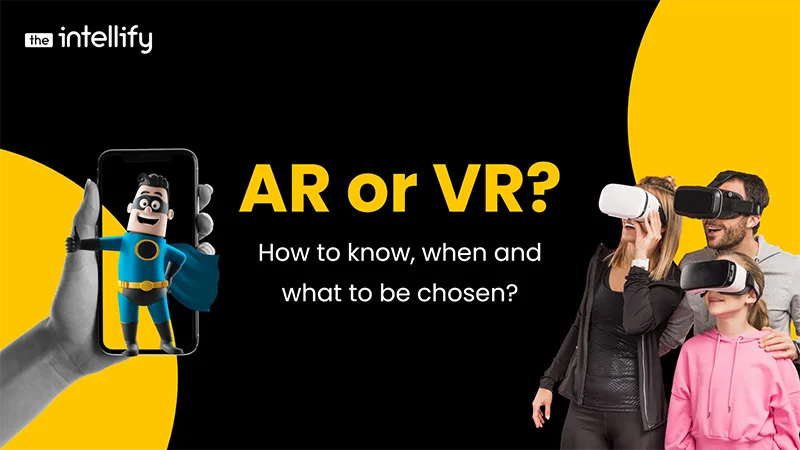
Augmented Reality vs Virtual Reality: Which One Suits Your Needs?
In today’s digital landscape, Augmented Reality (AR) and Virtual Reality App Development (VR) have emerged as revolutionary technologies, transforming how brands engage with customers. AR and VR offer immersive experiences, but they do so in distinct ways, each with capabilities, benefits, and limitations.
Let’s explore how these technologies can redefine customer service, product experience, and brand interaction.
Understanding Augmented Reality and Virtual Reality
Augmented Reality enhances the real-world environment with digital overlays such as images, videos, or interactive elements. It allows users to experience a blended reality where the physical world is augmented by digital enhancements. In contrast, Virtual Reality completely immerses the user in a simulated environment, cutting off physical surroundings for a fully virtual experience.
Example: In Virtual Reality, you can interact with a cow in a virtual field, fully immersed in the digital environment. Meanwhile, in Augmented Reality, you might see a digital cow pop out from a scanned image, blending seamlessly with the physical world.
Key Differences Between AR and VR
| Feature | Augmented Reality (AR) | Virtual Reality (VR) |
|---|---|---|
| Experience | Enhances real-world settings | Creates a fully simulated digital world |
| Physical Environment | Requires physical surroundings | Isolates from the physical environment |
| Hardware | Works on smartphones, tablets, AR glasses | Needs VR headsets and controllers |
| Use Cases | Retail, healthcare, navigation, gaming | Gaming, training, simulations, entertainment |
Both technologies aim to deliver immersive experiences, but their applications and use cases cater to different needs. While AR thrives in environments that require a connection to the real world, VR excels in scenarios where complete immersion is critical.
The Future of AR and VR
The future of AR and VR is incredibly promising, with rapid advancements and increasing commercial applications. Industries like retail, healthcare, education, and entertainment are already harnessing these technologies for enhanced engagement.
In the next few years, AR and VR are expected to become a one-stop solution for businesses, offering engaging and interactive digital solutions with minimal investment.
Why Choose AR or VR?
- Augmented Reality (AR) is the ideal choice if your project demands interaction with the physical environment.
- If your goal is to create a fully immersive digital experience free from real-world distractions, Virtual Reality (VR) is your go-to technology.
Let’s Explore AR and VR Solutions Together
At The Intellify, we deliver tailored AR and VR solutions that align with your conceptual ideas. Whether you’re looking to create an interactive augmented experience or a fully immersive virtual environment, our team guides you every step of the way.
Let’s discuss how these technologies can transform your business and create a unique customer experience. Together, we can identify the right solution—AR or VR—to bring your vision to life.
Conclusion
Augmented Reality (AR) and Virtual Reality (VR) offer incredible opportunities to transform user experiences and business solutions. Choosing the right technology depends on your project’s requirements—whether it’s enhancing the real world or creating an immersive virtual environment.
At The Intellify, we provide expert guidance to help you select and implement the best solution. Ready to innovate? Contact us to bring your vision to life with cutting-edge AR and VR technologies!



Written By, Jalaj Shah
The COO and Co-Founder of The Intellify. Jalaj enjoys experimenting with new strategies. His posts are fantastic for businesses seeking innovative development ideas. Discover practical insights from his engaging content.

Virtual Reality in Education: Applications, Benefits & Future of Learning
Summary: Virtual reality in education is changing how students learn by making lessons more interactive and practical. Instead of only reading or listening, learners can explore concepts through immersive experiences. This blog explains how VR is used across subjects, its key benefits, real-world applications, challenges, and future trends. It also covers how institutions can adopt […]
Indoor Navigation with AR: The Future of Smart Wayfinding Systems
Summary: AR-powered indoor navigation is helping businesses deliver smarter and more seamless wayfinding experiences. By guiding users with real-time visual directions, it eliminates confusion in complex environments like hospitals, malls, airports, and campuses. These solutions not only improve visitor satisfaction but also enhance operational efficiency and accessibility. As demand for smarter buildings grows, indoor navigation […]
How Augmented Reality in Education is Transforming Learning Apps for Kids
Summary: Augmented Reality in education is transforming how children learn by making lessons more interactive, visual, and engaging. Instead of relying only on text or videos, AR allows kids to explore 3D models, animations, and real-world simulations, improving understanding and retention. This blog covers how AR learning apps work, their key features, real-world applications, benefits, […]
Virtual Reality in Education: Applications, Benefits & Future of Learning
Summary: Virtual reality in education is changing how students learn by making lessons more interactive and practical. Instead of only reading or listening, learners can explore concepts through immersive experiences. This blog explains how VR is used across subjects, its key benefits, real-world applications, challenges, and future trends. It also covers how institutions can adopt […]
Indoor Navigation with AR: The Future of Smart Wayfinding Systems
Summary: AR-powered indoor navigation is helping businesses deliver smarter and more seamless wayfinding experiences. By guiding users with real-time visual directions, it eliminates confusion in complex environments like hospitals, malls, airports, and campuses. These solutions not only improve visitor satisfaction but also enhance operational efficiency and accessibility. As demand for smarter buildings grows, indoor navigation […]
How Augmented Reality in Education is Transforming Learning Apps for Kids
Summary: Augmented Reality in education is transforming how children learn by making lessons more interactive, visual, and engaging. Instead of relying only on text or videos, AR allows kids to explore 3D models, animations, and real-world simulations, improving understanding and retention. This blog covers how AR learning apps work, their key features, real-world applications, benefits, […]
0
+0
+0
+0
+Committed Delivery Leads To Client Satisfaction
Client Testimonials that keep our expert's spirits highly motivated to deliver extraordinary solutions.

Christopher Seny
My experience working with The Intellify, has been a great experience. The team has a wealth of expertise in the tech space. Working with the intellify was a growing experience for me, I learned a lot. The team keeps great communication & responds fast to new ideas & suggestions. The team also provides great suggestions & solutions as well. I couldn’t imagine working with anybody else on this project & it has been a blessing working with, The Intellify.

Izandi Serdyn
The Intellify delivered a platform from scratch, involving the client at every stage. The team was communicative, responsive, and punctual throughout the engagement. Virtual meetings and emails ensured seamless project management. Customers can expect a team that can work fast.

Kya Johnson
The app serves as an effective introduction for users to the product and its characters. Responsive and faithful to initial requirements, The Intellify’s team exceeded initial expectations. Internal stakeholders were particularly pleased with their communication.

Stefan Wyk
Working with The Intellify to develop our website was an outstanding experience. Their team displayed exceptional professionalism, creativity, and technical expertise throughout the entire process. The final product exceeded our expectations, delivering a sleek, user-friendly, and highly functional website. We highly recommend The Intellify to anyone in need of top-tier web development services.

Steve Thorpe
The Intellify’s work has been met with high praise from internal and external stakeholders. The team is efficient, diligent, and reliable in their service. They go above and beyond in terms of communication and project management. The Intellify is a responsive vendor that gets the job done.

Tal Dotan
I’ve been working with The Intellify for the last 3 years. During this period of time we’ve planned and executed projects in both small and large scale. Working with The Intellify was and still is the best decision I’ve made when rising up Divo, I strongly recommend to work with them in any type of project.


 +1-302-803-4983