Why Digital Transformation in 2026 Is About Strategy, Not Tools

By Shravan Rajpurohit
January 25, 2026
Summary:
Digital transformation is no longer about adopting the latest tools or technologies. It’s about building the right strategy first. This blog explains what digital transformation really means today, why tool-led approaches fail, and how strategy-driven transformation delivers real business value. It covers key pillars, trends, benefits, challenges, and how businesses can succeed by choosing the right digital transformation approach and partners.
Digital transformation sounds exciting on paper. In real life? It’s often messy. Loud. A little exhausting. New tools get rolled out. Teams nod in meetings. Nothing really changes.
By 2026, one thing is painfully clear: digital transformation doesn’t fail because companies choose the wrong tools. It fails because they never had a strategy to begin with.
I’ve watched organizations invest heavily in software while basic problems linger slow approvals, confused teams, customers quietly drifting away. The tech stack looks impressive. The results don’t.
So let’s talk honestly. No hype. No buzzwords. Just a grounded look at why digital transformation in 2026 is about strategy, not tools, and what that actually means if you’re trying to grow a business.
What Digital Transformation Really Means in 2026
If you’re still asking what digital transformation is, here’s the short answer:
It’s not about becoming “more digital.” It’s about changing how your business works, using technology as support, not as the star of the show.
Back in the early days, digital transformation meant websites, CRMs, and cloud storage. Later, it meant mobile apps, analytics, and automation. Now? In 2026? It means rethinking decisions, workflows, customer journeys, and ownership.
A quick clarity check:
- Digitization = turning paper into files
- Digitalization = improving processes with tech
- Digital transformation = redesigning the business itself
That last step is where the real work is. And also where most companies hesitate. Because it forces uncomfortable conversations.
The Big Myth: Buying Tools Equals Digital Transformation
This myth refuses to die. Somewhere along the way, digital transformation became confused with shopping. New CRM. New ERP. New AI tool everyone’s talking about on LinkedIn. Done, right?
Not even close. Buying tools feels productive. Changing habits does not. One is quick. The other is slow and slightly annoying. I once walked into an office where a brand-new system was live, but teams were still tracking work in spreadsheets “just in case.” The smell of panic coffee was strong that morning.
Tools don’t fix confusion. They just give confusion a nicer interface.
Why Strategy Is the Real Driver of Digital Transformation
Here’s the quiet truth:
Technology amplifies whatever already exists. If your strategy is unclear, tech will spread that confusion faster. If your strategy is solid, technology becomes powerful.
A real digital transformation strategy answers simple questions:
- What outcome are we chasing?
- Which problems actually matter?
- What should feel easier for customers?
- What work should stop happening?
Without these answers, even the best digital transformation solutions fall flat. In 2026, companies that win start with intent. Tools come later. Sometimes much later.
Core Pillars of Successful Digital Transformation Strategies
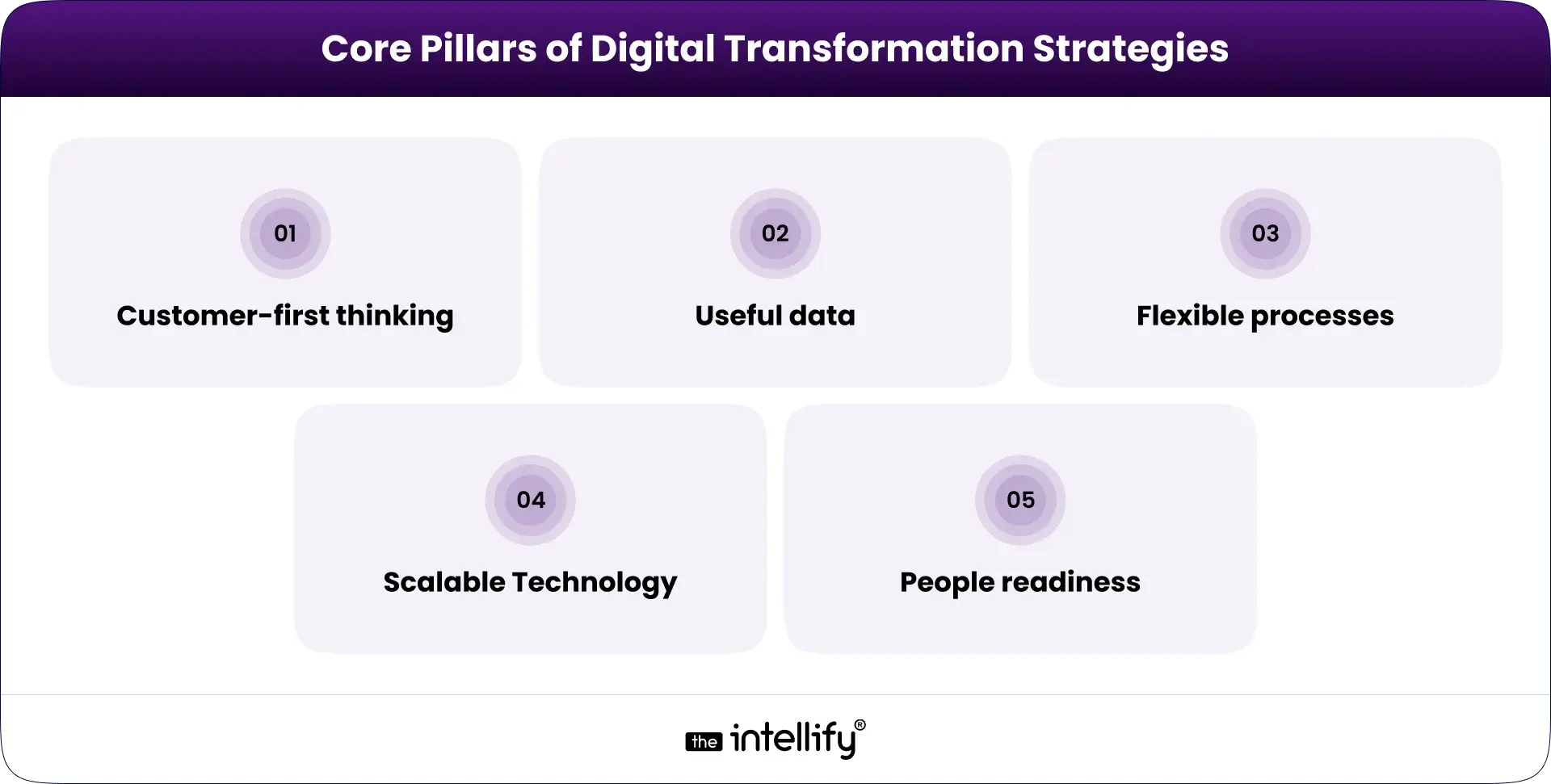
Successful digital transformation strategies aren’t built in a sprint. They’re built through deliberate choices that hold up under pressure. Over time, patterns emerge. The companies that get this right usually focus on a few unglamorous but essential pillars.
Customer-first thinking
This sounds obvious, but it’s often misunderstood. Customer-first doesn’t mean adding more features or channels. It means understanding where customers feel friction, long wait times, confusing handoffs, repeated questions, and removing those points quietly.
The best strategies obsess over moments, not journeys. A failed payment. A delayed response. A confusing screen. Fixing these moments creates real impact.
Useful data
Many businesses are drowning in data and still guessing. Good digital transformation strategies focus on decision-ready data, not volume.
If a report doesn’t help someone decide faster or better, it’s noise. Strategy-first teams identify:
- Who needs data
- When they need it
- What action it should trigger
Everything else is optional.
Flexible processes
Perfect workflows look great in diagrams and fall apart in reality. People work around them. Shortcuts appear. Shadow systems creep in.
Strong strategies accept this and design for flexibility. They leave room for exceptions. They adapt as the business grows. They don’t assume humans behave like flowcharts.
Scalable Technology
Scalability shouldn’t feel dramatic. When systems are right, growth feels… boring. No panic. No midnight fixes. No emergency calls.
That calm comes from strategic architecture decisions early on, choices made with tomorrow in mind, not just today’s urgency.
People readiness
This pillar gets ignored more than it should. Digital transformation asks people to change habits, give up control, and learn new ways of working.
If teams don’t trust the intent behind the change, resistance is inevitable. Clear communication, realistic training, and honest timelines matter more than most tools.
Benefits of Digital Transformation When Strategy Comes First
When strategy leads, the benefits of digital transformation feel less like promises and more like relief.
1. Decision-making improves first. Fewer meetings. Less back-and-forth. People know what to act on and when.
2. Teams stop wasting energy. Manual work drops. Duplicate efforts fade. People focus on work that actually matters.
3. Customer experience improves quietly, not through flashy changes, but through fewer mistakes and smoother interactions. Customers don’t always notice what changed; they just feel it.
4. Costs reduce naturally. Not through layoffs or cuts, but through efficiency. Less rework. Fewer delays. Better use of time.
5. Most importantly, growth feels controlled. Expansion doesn’t break systems. New markets don’t create chaos. Strategy absorbs pressure.
Why Digital Transformation Fails: Common Challenges
Digital transformation doesn’t usually fail loudly. It fades. Momentum slows. Enthusiasm drops. People stop caring. The most common digital transformation challenges are surprisingly consistent.
- No shared vision
- Siloed departments
- Fear of change
- Measuring the wrong outcomes
Over-reliance on vendors to “figure it out.”
None of these can be solved with software alone. They need leadership, patience, and a clear plan.
Digital Transformation as a Service: Why Companies Are Choosing This Model
This is where digital transformation as a service makes sense for many businesses.
Transformation today is complex. It touches systems, people, culture, and leadership. Few organizations have all the skills in-house. Companies are choosing this model because it offers:
- Strategic guidance, not just execution
- Experience across industries
- Faster learning curves
- Lower risk of expensive missteps
A good digital transformation company doesn’t just deliver solutions. It challenges assumptions. It asks uncomfortable questions. It helps teams see blind spots. And importantly, it stays involved after launch, where most problems actually surface.
Digital Transformation Trends That Matter in 2026
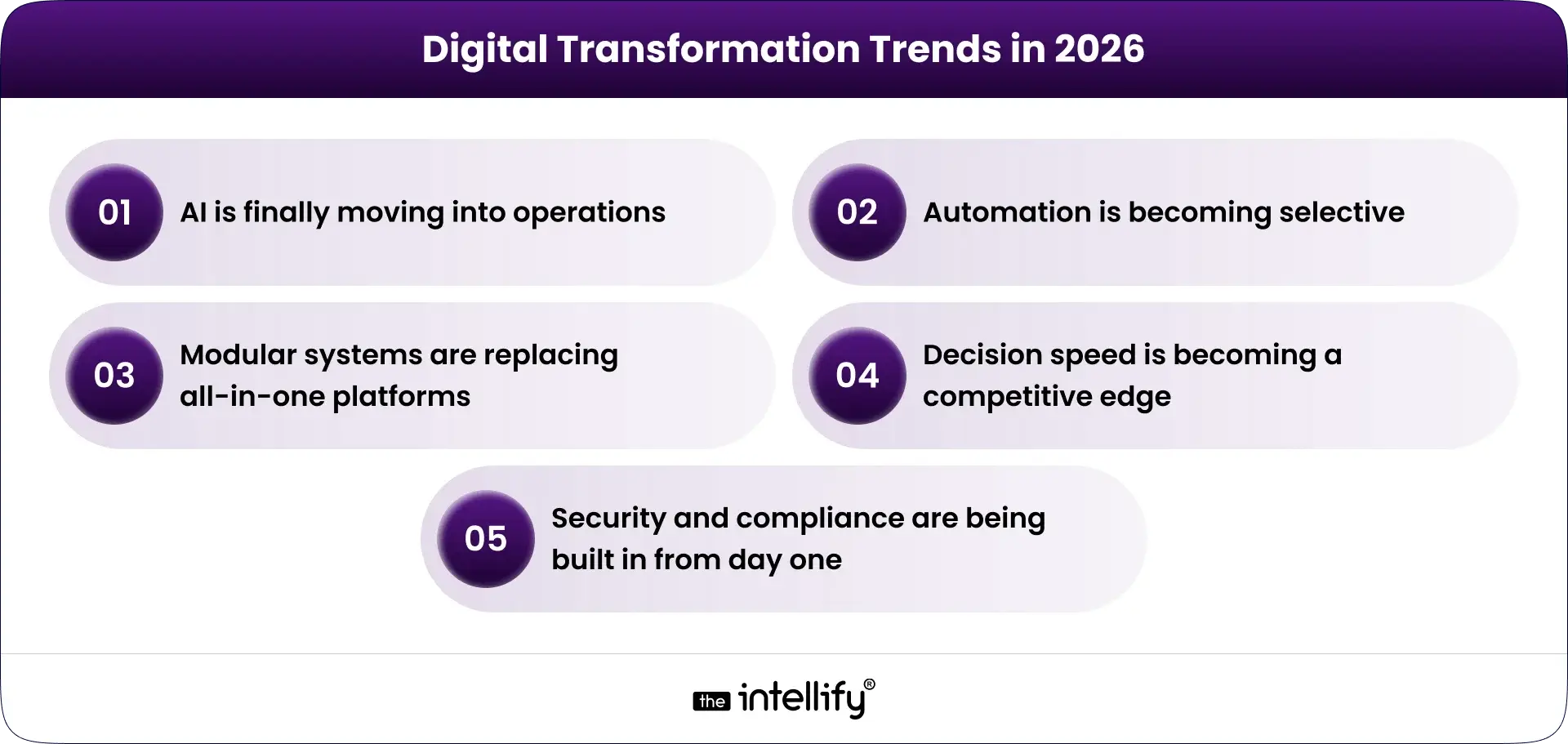
There’s no shortage of trends floating around. Most fade fast. A few actually stick because they solve real problems. Here are the digital transformation trends that matter in 2026, not because they’re new, but because they’re practical.
1. AI is finally moving into operations. Not as a headline feature, but as quiet support. It helps route work, flag issues early, and reduce manual effort. When AI works well, people barely notice it.
2. Automation is becoming selective. Businesses are no longer trying to automate everything. They’re automating what slows people down: approvals, data handoffs, repetitive checks. Less noise. More focus.
3. Modular systems are replacing all-in-one platforms. Companies want flexibility. They want to swap parts without tearing everything down. Strategy-first organizations choose systems that evolve, not lock them in.
4. Decision speed is becoming a competitive edge. Faster insights. Clear signals. Less waiting. This isn’t about dashboards, it’s about confidence.
5. Security and compliance are being built in from day one. Not bolted on. Not postponed. Because the cost of ignoring them is now very real.
How to Choose the Right Digital Transformation Partner
Choosing a partner is less about credentials and more about behavior.
The right digital transformation services partner starts with questions, not demos. They listen more than they pitch. They talk openly about trade-offs. They explain what not to do. They don’t promise instant results.
Ask them how they handle:
- Internal resistance
- Scope changes
- Long-term ownership
- Post-launch reality
Red flags are easy to spot. Tool-first conversations. Overconfidence. Vague success stories.
A strong partner aligns with your strategy or helps you build one before touching technology.
The Future of Digital Transformation: What Comes After 2026
After 2026, digital transformation won’t feel like a program or initiative. It’ll feel routine. Businesses will expect systems to evolve continuously. Strategy reviews will be regular. Technology updates won’t cause panic.
The idea of “being done” with transformation will disappear. Instead, companies will adapt in smaller, steadier steps. Strategy will remain the anchor, technology will keep shifting, and people will stay at the center.
The organizations that thrive won’t chase trends. They’ll stay clear on direction and adjust calmly as the world changes.

Conclusion: Strategy Is the Only Sustainable Advantage
In 2026, digital transformation isn’t about having the latest tools. Everyone has tools. That’s not special anymore. What matters is:
- Clear intent
- Thoughtful execution
- A strategy that connects people, processes, and technology
When businesses get this right, digital transformation solutions stop feeling risky. They start feeling inevitable, and that’s where real growth happens quietly, steadily, and with far less stress. If you’re exploring digital transformation and wondering where to start, start with strategy, the rest will follow.
Frequently Asked Questions (FAQs)
1. What is digital transformation in 2026?
In 2026, digital transformation is about redesigning how a business operates, makes decisions, and serves customers. Technology supports this change, but strategy defines the direction. Companies now focus more on outcomes and adaptability than on adopting tools.
2. Why do most digital transformation initiatives fail?
Most initiatives fail due to unclear strategy, weak leadership alignment, and low employee adoption. Tools are often implemented without fixing processes or ownership, which leads to poor results despite heavy investment.
3. How is digital transformation different from digitalization?
Digitalization improves existing processes using technology, while digital transformation rethinks the entire business model. Transformation changes how work is done, not just how tools are used.
4. What are the biggest digital transformation challenges today?
The biggest challenges include lack of vision, internal resistance to change, siloed teams, and measuring the wrong success metrics. These issues are strategic and cultural, not technical.
5. What are the key benefits of digital transformation?
Key benefits include faster decision-making, better customer experience, improved efficiency, lower operational costs, and scalable growth when transformation is guided by a clear strategy.
6. What is digital transformation as a service?
Digital transformation as a service provides ongoing strategic and execution support instead of a one-time project. It helps businesses continuously adapt while reducing risk and internal strain.
7. How do I choose the right digital transformation company?
Choose a company that starts with business strategy, understands change management, and focuses on long-term outcomes. Firms like The Intellify emphasize alignment between people, processes, and technology rather than tool-first implementations.


Written By, Shravan Rajpurohit
Shravan Rajpurohit is the Co-Founder & CEO of The Intellify, a leading Custom Software Development company that empowers startups, product development teams, and Fortune 500 companies. With over 10 years of experience in marketing, sales, and customer success, Shravan has been driving digital innovation since 2018, leading a team of 50+ creative professionals. His mission is to bridge the gap between business ideas and reality through advanced tech solutions, aiming to make The Intellify a global leader. He focuses on delivering excellence, solving real-world problems, and pushing the limits of digital transformation.

Digital Twin in Manufacturing & Industrial Operations: A Practical Guide
Summary: Digital twin in manufacturing enables organizations to improve visibility, efficiency, and decision-making across industrial operations. Creating real-time digital replicas of physical assets, it supports predictive maintenance, process optimisation, and smarter planning. The guide covers how the technology works, key benefits, practical use cases, implementation challenges, and future trends, helping manufacturers understand how to adopt […]
Digital Transformation in Healthcare: Strategy for Membership Platforms
Summary: Digital transformation is helping healthcare organizations build modern membership platforms that improve patient experience and operational efficiency. This blog explains how technologies like telehealth, AI, secure patient portals, and subscription billing systems support the growth of membership-based healthcare models. It also explores key platform components, implementation strategies, industry challenges, and future trends. With the […]
How to Choose the Right Digital Transformation Partner for Healthcare Platforms
Summary: Healthcare platforms can no longer rely on outdated systems. This blog explains why digital transformation in healthcare industry has become essential and how the right digital transformation partner can shape long-term success. It covers modernization challenges, AI automation in healthcare, operational improvements, and key factors to consider before choosing a partner. The goal is […]
Healthcare Membership Platform Development: Guide for Startups & DPC Providers
Summary: Healthcare membership platform development is transforming how providers deliver continuous, subscription-based care. This guide explains how membership models help organizations improve patient engagement, generate predictable revenue, and streamline operations. It covers essential features, development strategies, integration needs, and the role of automation and AI in modern healthcare systems. Whether you’re a startup or a […]
Digital Twin in Manufacturing & Industrial Operations: A Practical Guide
Summary: Digital twin in manufacturing enables organizations to improve visibility, efficiency, and decision-making across industrial operations. Creating real-time digital replicas of physical assets, it supports predictive maintenance, process optimisation, and smarter planning. The guide covers how the technology works, key benefits, practical use cases, implementation challenges, and future trends, helping manufacturers understand how to adopt […]
AI in Healthcare Administration: Streamlining Hospital Operations
Summary The growing complexity of healthcare administration is driving the need for smarter, more efficient solutions. Automation technologies are helping streamline key processes such as scheduling, billing, and data management, reducing manual workload and improving accuracy. This enables faster operations, better coordination, and enhanced patient experiences. As adoption increases, healthcare organizations are moving toward more […]
0
+0
+0
+0
+Committed Delivery Leads To Client Satisfaction
Client Testimonials that keep our expert's spirits highly motivated to deliver extraordinary solutions.

Christopher Seny
My experience working with The Intellify, has been a great experience. The team has a wealth of expertise in the tech space. Working with the intellify was a growing experience for me, I learned a lot. The team keeps great communication & responds fast to new ideas & suggestions. The team also provides great suggestions & solutions as well. I couldn’t imagine working with anybody else on this project & it has been a blessing working with, The Intellify.

Izandi Serdyn
The Intellify delivered a platform from scratch, involving the client at every stage. The team was communicative, responsive, and punctual throughout the engagement. Virtual meetings and emails ensured seamless project management. Customers can expect a team that can work fast.

Kya Johnson
The app serves as an effective introduction for users to the product and its characters. Responsive and faithful to initial requirements, The Intellify’s team exceeded initial expectations. Internal stakeholders were particularly pleased with their communication.

Stefan Wyk
Working with The Intellify to develop our website was an outstanding experience. Their team displayed exceptional professionalism, creativity, and technical expertise throughout the entire process. The final product exceeded our expectations, delivering a sleek, user-friendly, and highly functional website. We highly recommend The Intellify to anyone in need of top-tier web development services.

Steve Thorpe
The Intellify’s work has been met with high praise from internal and external stakeholders. The team is efficient, diligent, and reliable in their service. They go above and beyond in terms of communication and project management. The Intellify is a responsive vendor that gets the job done.

Tal Dotan
I’ve been working with The Intellify for the last 3 years. During this period of time we’ve planned and executed projects in both small and large scale. Working with The Intellify was and still is the best decision I’ve made when rising up Divo, I strongly recommend to work with them in any type of project.


 +1-302-803-4983