AI in the Metaverse: Future Applications & What’s Next

Summary:
This blog explores how AI in the metaverse is slowly reshaping the way we interact with digital spaces. It breaks down how AI personalizes virtual worlds, improves navigation, and makes avatars, environments, and conversations feel more lifelike. You’ll also find practical tips on getting started, plus a look at what the future may hold after 2025, from smarter storytelling to safer virtual environments. It’s a simple, realistic guide for anyone curious about how AI and the metaverse are evolving together.

As we move into a time where our digital and real lives keep blending (sometimes a little too smoothly), the idea of AI in the metaverse starts to feel less sci-fi and more like… well, Tuesday afternoon. Picture a space where you hop between virtual worlds the same way you’d jump through apps on your phone, only these spaces actually react to you. They learn from you. They even feel a bit alive.
In this blog, we’re walking through how AI is shaping the metaverse today, what it’ll look like after 2025, and how you can actually prepare for it instead of just watching from the sidelines.


Understanding the Intersection: AI + Metaverse

The metaverse isn’t some giant game world (even though it can look like it sometimes). It’s a whole digital universe where people meet, learn, create, work, and occasionally get lost because the map was too tiny. When you mix AI into that universe, everything becomes much more responsive. More personal. More… human-ish.
AI makes virtual spaces smarter: it notices what people enjoy, how they move around, and what they ignore. Then it shifts quietly to make the whole experience feel natural instead of clunky.
And as the metaverse grows, AI becomes the thing that keeps it from turning into a confusing maze. Instead, it becomes a place that adapts, almost like it’s thinking on its own.


What is the Role of AI in the Metaverse?
Role of AI in the Metaverse

AI’s job in the metaverse isn’t just automating a few tasks. It’s more like shaping the entire vibe of the experience.
Here’s what it really does:

  • Creating Realistic Interactions: With natural language tech, you can talk to virtual characters and not feel like you’re chatting with a 2005 chatbot.
  • Personalization: AI keeps track of what users prefer (calm spaces, bright colors, quiet rooms, giant dragons, you know, normal stuff) and adjusts the world accordingly.
  • Automating Content Creation: Building huge virtual worlds by hand takes forever. AI helps create environments, props, or storylines in minutes, not months.

When these pieces come together, the metaverse feels closer to a living ecosystem than a static platform.


Integration of AI in the Metaverse

Bringing AI into the metaverse isn’t something you do overnight. It’s more like renovating a house you still live in… everything has to be done carefully, or someone bumps their head on a misplaced virtual door.
Here are the big areas to focus on:

  • User Experience (UX) Enhancements: AI helps smooth out all the annoying friction in navigation, menus, and interactions. The stuff nobody likes thinking about.
  • User Data Collection: You’ll need to know how people behave inside your virtual world. Not in a creepy way, just enough to understand what’s working and what’s meh.
  • Data Analysis: Once you collect the data, AI helps make sense of it. Trends, patterns, random user habits, AI spots it all.
  • 3D Modeling Tools: Tools like Unity or Unreal Engine now include AI features that make designing environments way less painful.
  • Cloud Computing: Since virtual worlds can get big (really big), cloud tech keeps everything running without the system wheezing like an old laptop.
  • Creative Assistance: Generative AI helps artists spark ideas or whip up assets faster.
  • Cross-functional Teams: Your tech, creative, and marketing folks need to stay aligned, or the whole thing gets messy fast.

Using these together helps create a metaverse that doesn’t just look cool, it works smoothly, too.
 

Metaverse AI Solutions


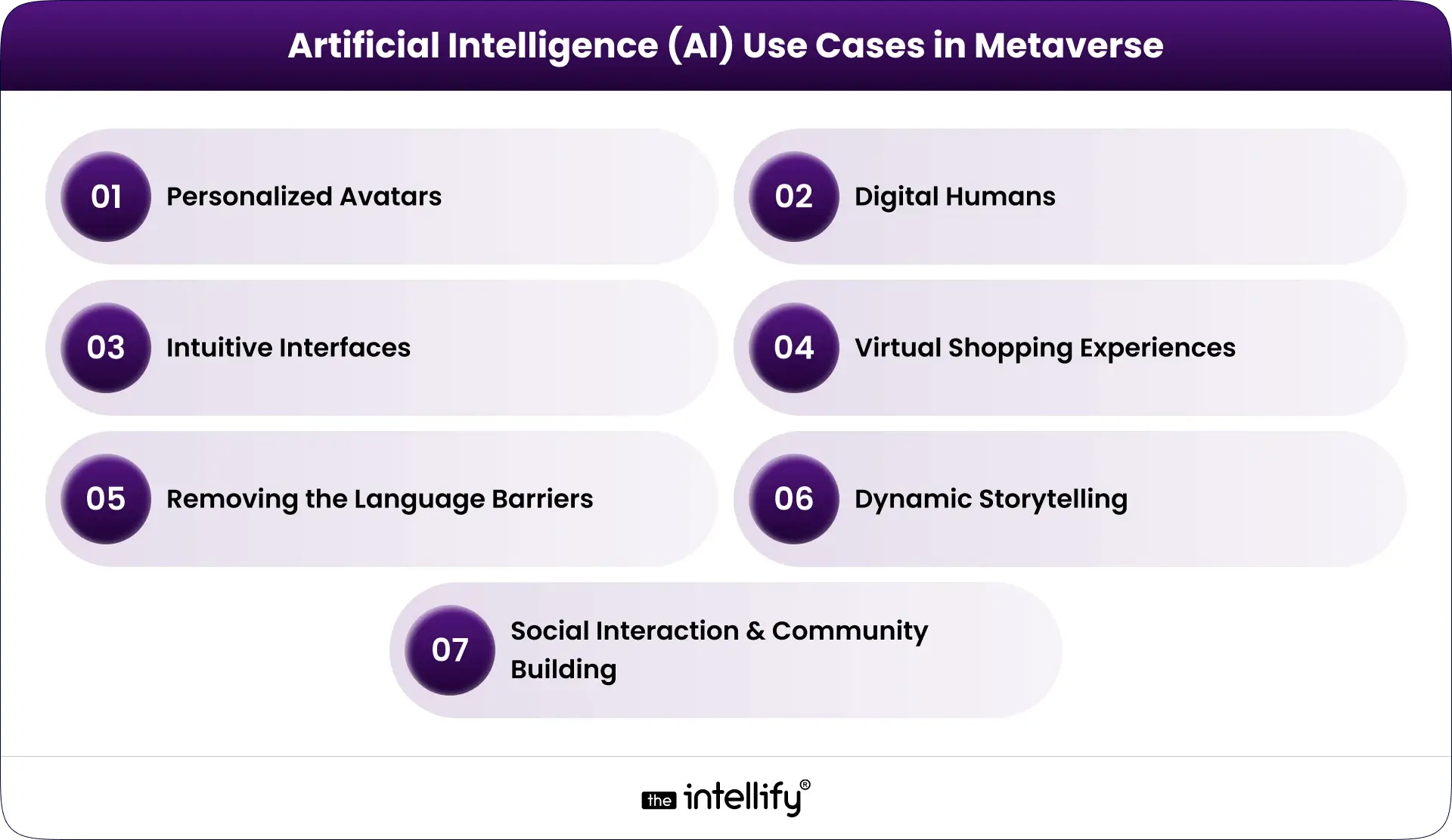
Artificial Intelligence (AI) Use Cases in Metaverse

The next few years are going to be packed with new AI-driven use cases inside the metaverse. Here are the ones already taking shape:
AI Use Cases in Metaverse

Personalized Avatars

AI helps people create avatars that actually feel like themselves. Not the weird potato-shaped versions we’ve seen in older platforms. Realistic ones that reflect your style without you spending two hours choosing eyebrow shapes.

Digital Humans

Imagine speaking with a digital person who blinks, pauses, and reacts the way a real human would. AI makes these “digital humans” capable of emotional responses, making virtual interactions less awkward and more natural.

Intuitive Interfaces

Instead of clicking through menus that go eight layers deep, AI lets users navigate with gestures, voice, or simple movements. More “just tap here,” less “wait… where is the settings button?”

Virtual Shopping Experiences

Virtual try-ons clothes, shoes, furniture, makeup, whatever. AI makes these feel realistic, almost like standing in a store, minus the overly strong perfume smell.

Social Interaction and Community Building

AI-driven bots help spark conversations or keep communities alive when people are shy or simply lurking (we’ve all been there).

Dynamic Storytelling

AI creates storylines that change depending on your decisions. Like old-school RPGs, but smarter and way less predictable.

Removing the Language Barriers

Real-time translation lets people from different countries interact without awkward pauses or Google Translate tabs open on the side.

And honestly, this list is just warming up. As AI gets better, the metaverse becomes richer, more responsive, and far more global.


How to Get Started with Metaverse AI

If you’re thinking of stepping into metaverse AI, here’s a simple, realistic starting plan:

  • Assess Your Infrastructure: Check what you already have. Old systems? Limited storage? Slow servers? Better to know upfront before diving deep and regretting it later.
  • Start Small: Run small prototypes first. A single feature. A tiny environment. Something manageable. No one builds a massive virtual world on day one (well… they try, but it usually collapses).
  • Collaborate with Experts: Teams like The Intellify already work on AI + metaverse projects. Bringing in experts saves a lot of guesswork and your sanity.
  • Monitor and Iterate: Test. Tweak. Repeat. Watch how users behave and adjust things over time. The best metaverse experiences are shaped slowly, not rushed.


The Future of Metaverse and AI

Looking beyond 2025, AI will push the metaverse into new territory. Here’s what’s coming:

  • Hyper-Personalization: Experiences will adjust automatically to your behavior, like a room changing lighting or sound based on your mood.
  • Enhanced Contextual Awareness: AI will read user emotions, gestures, and habits to shape more intuitive environments.
  • Fostering Creativity: Artists will be able to design huge worlds with AI as their creative partner faster, simpler, and maybe even fun.
  • Improved User Security: AI will help spot suspicious behavior early, making digital interactions safer.
  • Sustainability Measures: Virtual worlds still consume real-world energy. AI will help cut waste and optimize resources behind the scenes.

Businesses and creators who tap into these shifts early will be way ahead of the curve.

 

AI Metaverse Services


Conclusion

The blend of AI and the metaverse is already reshaping how people connect, learn, and explore digital spaces. From surprisingly emotional digital humans to adaptive storytelling, the possibilities feel wide open.
For businesses willing to experiment and evolve, this space offers huge room for innovation.
At The Intellify, we help organizations understand and apply AI within the metaverse in a way that actually makes sense, not just buzzwords on a slide. If you’re ready to take the first step, we’re here to walk with you.


Frequently Asked Questions (FAQs)

1. What is AI in the Metaverse?

AI in the metaverse means using artificial intelligence to improve interactions, personalize environments, and make navigation smoother inside digital worlds.

2. How does AI improve user experience in the metaverse?

AI tailors the experience to each user with more intuitive controls, smarter interactions, and content that shifts based on personal behavior.

3. What are some applications of AI in the metaverse?

Some examples include avatar creation, digital humans, real-time translation, voice-based interfaces, and dynamic storytelling.

4. How can I start integrating AI into a metaverse project?

Start small, research the tools available, and choose AI features that match the purpose of your virtual world.

5. What trends should I expect in the future of AI and the metaverse?

Expect more contextual awareness, safer environments, stronger personalization, and easier content creation.

6. How can I make my business stand out in the metaverse with AI?

Focus on offering experiences that feel personal, helpful, and well-designed based on user behavior, not generic features.

7. How can The Intellify assist in implementing Metaverse AI solutions?

The Intellify helps organizations build and integrate AI-driven features that improve customer engagement and create more meaningful virtual experiences.

The Ultimate Guide to Digital Twin Technology: Everything You Need to Know

How Do Digital Twins Bridge to Our Virtual Future?

Imagine a world where you could test a jet engine to its breaking point without ever leaving the ground, perform complex surgery on a patient before they even enter the operating room, or fix a critical failure in a power plant from thousands of miles away. This isn’t science fiction. This is the world being built today with digital twin technology. This revolutionary concept is creating a dynamic, living bridge between our physical and digital universes.

As industries grapple with unprecedented complexity and a relentless demand for efficiency and sustainability, digital twins are emerging as a cornerstone of the next industrial and digital revolution. This guide will take you on a deep dive into this transformative technology. We will explore what digital twins are, how they work, their real-world applications reshaping entire sectors, and their foundational role in building the future, including the much-discussed metaverse. Whether you’re a business leader, an engineer, or simply curious about the future of technology, this is your ultimate resource for understanding the power of digital twinning.


What is a Digital Twin? A Living, Breathing Blueprint

What is a Digital Twin? A Living, Breathing Blueprint

At its core, a digital twin definition is remarkably intuitive: it is a virtual, real-time representation of a physical object, process, or system. Think of it not as a static blueprint or a simple 3D model, but as a living, breathing digital counterpart that continuously evolves and mirrors the state, condition, and behaviour of its physical twin.

The magic of this technology lies in the constant, bi-directional flow of data. This connection, often referred to as the “digital thread,” is what gives the twin its life. Sensors attached to the physical asset, be it a wind turbine, a human heart, or an entire city, collect real-time data and feed it to the virtual model. The model then uses this data to simulate, predict, and analyse, providing insights that can be fed back to influence the physical object.

To truly grasp the concept, it’s helpful to distinguish it from its less advanced relatives:

  • Digital Model: This is a digital prototype without any automated, real-time data exchange with a physical counterpart. For example, a 3D CAD drawing of a car engine is used for design purposes.
  • Digital Shadow: Here, data flows in one direction, from the physical asset to the digital one. The digital object’s state changes in response to changes in the physical object’s state, but not vice versa. It shows what is happening.
  • Digital Twin: This represents a complete, two-way communication loop. The virtual model not only reflects the physical asset but can also send information back to control or optimize its operations. It shows what is happening, what will happen, and what could happen under different scenarios.

The idea itself has roots in NASA’s Apollo missions, where ground crews used detailed physical replicas to mirror spacecraft conditions and troubleshoot problems in space. Today, fueled by the Internet of Things (IoT), cloud computing, and artificial intelligence, this concept has evolved into the sophisticated, data-driven technology we know as the digital twin.


How Does Digital Twin Technology Work? The Engine Room of Innovation

The operational mechanics of a digital twin are a sophisticated symphony of cutting-edge technologies working in concert. The process can be broken down into a continuous, cyclical flow:

How Does Digital Twin Technology Work? The Engine Room of Innovation

  1. Sense & Collect: The journey begins in the physical world. IoT sensors embedded within or attached to an asset collect a vast array of data, including temperature, pressure, vibration, operational output, and environmental conditions.
  1. Communicate & Aggregate: This raw data is securely transmitted, often via wireless networks, to a cloud-based platform. Here, it is aggregated, cleaned, and contextualized, preparing it for analysis.
  1. Model & Integrate: The processed data is fed into a highly detailed virtual model. This model isn’t just a visual replica; it’s a sophisticated physics-based simulation that understands the asset’s engineering properties, materials, and potential behaviours. This is where engineering simulation software and process simulation software play a crucial role.
  1. Analyse & Predict: This is where the AI digital twin truly shines. Advanced analytics and machine learning algorithms scrutinize the real-time data stream against the model’s historical and simulated datasets. This enables the system to move beyond simple monitoring to perform predictive analysis, forecasting potential failures, identifying inefficiencies, and diagnosing issues before they become critical.
  1. Visualise & Act: The insights are presented to human operators through intuitive dashboards and visualizations. In its most advanced form, the digital twin can act autonomously on these insights, sending commands back to the physical asset to adjust its parameters, optimize its performance, or trigger a maintenance protocol.

This closed-loop system establishes a robust feedback mechanism, enabling continuous improvement and intelligent automation on a scale that has never been possible before.


Real-World Applications: Where Digital Twins Are Making an Impact

The applications of digital twin technology are as vast as the physical world itself. From the factory floor to the operating room, it is driving unprecedented Value.

Real-World Applications: Where Digital Twins Are Making an Impact

Digital Twin in Manufacturing and Warehousing

The manufacturing sector has been an early and enthusiastic adopter of these technologies. Here, digital twins are used to create virtual replicas of entire production lines, products, and supply chains.

  • Predictive Maintenance: Unilever utilises digital twins for its factories, creating virtual models of equipment to forecast when maintenance is required, thereby preventing costly downtime and optimising production schedules.
  • Process Optimisation: A warehouse digital twin can simulate the flow of goods, test new automation layouts, and optimise robotic pathways, thereby dramatically improving logistics and fulfilment efficiency. Companies can test changes in their manufacturing simulation software before incurring any costs for physical alterations.
  • Product Innovation: Automakers such as BMW and Maserati utilize digital twins throughout the vehicle lifecycle. By creating a virtual model of a car that is fed data from its real-world counterpart, they can test software updates, simulate performance under various conditions, and gather insights to inform future design improvements.


Digital Twins in Healthcare

The potential of digital twins in healthcare is profound, promising a new era of personalized medicine.

  • The Human Digital Twin: Researchers are developing virtual models of human organs, and eventually, entire bodies. These “human digital twins” can be used to simulate a patient’s response to different drugs and treatments, allowing doctors to tailor therapies for maximum effectiveness and minimal side effects.
  • Surgical Planning and Simulation: Surgeons can use a digital twin of a patient’s organ, created from MRI or CT scans, to practice and plan complex procedures. This use of simulation in healthcare reduces risks, improves outcomes, and enhances surgical training.
  • Hospital Operations: Hospitals can create a digital twin of their entire facility to optimize patient flow, manage bed capacity, and streamline the allocation of medical equipment and staff, especially during emergencies.


Digital Twin for Urban Planning and Smart Cities

Cities are complex, dynamic systems, making them ideal candidates for digital twinning.

  • Sustainable Urban Development: Singapore has created a complete, dynamic 3D digital twin of the entire city-state. Planners utilise this model to simulate the environmental impact of new construction, optimise public transportation routes, and test strategies for enhancing energy efficiency and improving air quality.
  • Infrastructure Management: A digital twin for urban planning can monitor the structural health of bridges, tunnels, and public buildings in real-time, predicting maintenance needs and ensuring public safety.
  • Disaster Response: By simulating the effects of floods, earthquakes, or other emergencies, city officials can develop more effective evacuation plans and emergency response strategies.


The Unmistakable Benefits of Digital Twinning

The rapid adoption of this technology is driven by a compelling set of advantages that directly translate into business value. The core digital twin benefits include:

  • Reduced Downtime and Costs: Predictive maintenance enables companies to address issues before they occur, resulting in significant savings in lost productivity and repair costs.
  • Enhanced R&D and Faster Innovation: Simulating products and processes in the virtual world significantly reduces development cycles and enables more experimentation without the need for physical prototypes.
  • Improved Operational Efficiency: By optimizing processes in real-time, from factory workflows to city-wide energy consumption, digital twins unlock significant efficiency gains.
  • Increased Safety and Risk Mitigation: Testing extreme scenarios or hazardous operations in a virtual environment without any real-world risk is a game-changer for high-stakes industries like aerospace and energy.
  • Greater Sustainability: Digital twins are powerful tools for modelling and reducing energy consumption, waste, and carbon emissions across a product’s lifecycle.


Challenges and Ethical Considerations on the Path to Adoption

Despite its immense potential, implementing a digital twin poses significant challenges.

  • High Initial Investment: The cost of sensors, software, and the expertise needed to build and maintain a digital twin can be substantial.
  • Data Security and Privacy: Digital twins rely on vast amounts of data, which raises critical concerns about cybersecurity and, especially in healthcare and smart cities, data privacy.
  • System Integration: Integrating a digital twin platform with legacy IT and operational systems can be a complex and time-consuming process.
  • Ethical Dilemmas: The concept of a “human digital twin” raises profound moral questions about data ownership, consent, and the potential for a new form of digital divide. Similarly, city-wide digital twins can be perceived as tools for mass surveillance if not governed by transparent and ethical frameworks.


The Future is Twinned: AI, the Metaverse, and Beyond

The evolution of digital twin technology is far from over. Its convergence with other disruptive technologies is paving the way for a future that is more intelligent, immersive, and interconnected.

The Rise of the AI Digital Twin

Artificial intelligence is the brain that makes the digital twin intelligent. As AI digital twin systems become more sophisticated, they will move beyond prediction to prescription and even autonomous action. These “Intelligent Acting Digital Twins” (IADTs) will be able to self-optimize, learn from their environment, and make complex decisions without human intervention, heralding a new era of automation.

Digital Twins: The Foundation of the Metaverse

Many are asking, What is the metaverse?‘ In essence, it is a persistent, collective, and shared virtual space where users can interact with each other and with digital objects. For the metaverse to be more than just a video game, it needs to be grounded in reality.

This is where digital twins become indispensable. They will serve as the foundational layer, providing the metaverse with real-world context, physics, and data. A metaverse app could enable an engineer to walk through a digital twin of a warehouse, collaborating with colleagues from around the world to solve a problem. It could allow a city planner to experience the future impact of their designs in an immersive, true-to-life virtual environment. Digital twins will ensure that the metaverse is not just an escape from reality, but a powerful new interface for understanding and interacting with it.


Getting Started with Digital Twins: Your Adoption Guide

For organizations looking to embark on this journey, the key is to start strategically.

Getting Started with Digital Twins: Your Adoption Guide

  • Identify a High-Value Use Case: Don’t try to twine everything at once. Start with a specific, high-impact problem, such as a critical piece of machinery prone to failure or a particularly inefficient process.
  • Assess Your Readiness: Evaluate your data infrastructure, technical expertise, and organizational culture to determine your readiness for a successful implementation. Building a digital twin requires a solid foundation of data management and a willingness to embrace data-driven decision-making.
  • Select the Right Technology Partner: The market for digital twin software and
    top digital twin solution providers is experiencing rapid growth. Leaders like Microsoft (Azure Digital Twins), NVIDIA (Omniverse), Siemens (Xcelerator), Dassault Systèmes (3DEXPERIENCE), and PTC (ThingWorx) offer powerful platforms to build and scale your solutions.
  • Start Small, Demonstrate Value, and Scale: Begin with a pilot project to prove the concept and demonstrate a clear return on investment. Build on the success of this initial project to generate momentum and scale your digital twin strategy across the organization.

CTA

Conclusion: The Dawn of a Mirrored World

Digital twin technology is more than just a technological buzzword; it represents a fundamental shift in how we interact with the physical world. By creating living, data-rich virtual counterparts of our most critical assets and systems, we are unlocking unprecedented levels of insight, efficiency, and innovation. From optimizing a single machine to managing the complexities of an entire city, digital twins are empowering us to not only see the present more clearly but also to predict and shape a better future accurately. The mirrored world is here, poised to change everything.


View
Case Study