Virtual Property Tours: How VR Is Transforming Real Estate Experiences

Summary:
Virtual Property Tours are changing how real estate businesses present and sell properties. This blog explains how Virtual Property Tours using VR help buyers explore spaces remotely, understand layouts better, and make confident decisions. It covers real-world use cases, key benefits, and how businesses can build effective VR property tour apps to improve engagement, reduce site visits, and generate higher-quality real estate leads


Buying a property has never been simple. Even today, it usually means rearranging your schedule, driving across town, meeting strangers, and walking through spaces that don’t quite match the photos you saw online. Sometimes the room feels smaller. Sometimes the light isn’t what you expected. And sometimes… it just doesn’t click.

This is where Virtual Property Tours step in, not as a flashy trend, but as a practical solution. Using VR, buyers can explore properties calmly, clearly, and on their own terms. For real estate businesses, this shift is creating better leads, faster decisions, and fewer wasted site visits.

Let’s walk through how it all works, without jargon or hype.


The Shift From Physical Visits to Virtual Property Tours

For years, real estate relied heavily on physical visits. That was the moment of truth. Everything else, photos, brochures, videos, was just a warm-up. But buyer behavior has changed.

People now research deeply before committing time. They shop online, work remotely, and make major decisions digitally. Property buying is following the same path.

Virtual Property Tours don’t replace physical visits. They refine them. By the time a buyer steps on-site, they already understand the layout and flow of the space. The visit becomes confirmation, not exploration. That alone changes the pace of sales conversations.


What Are Virtual Property Tours?
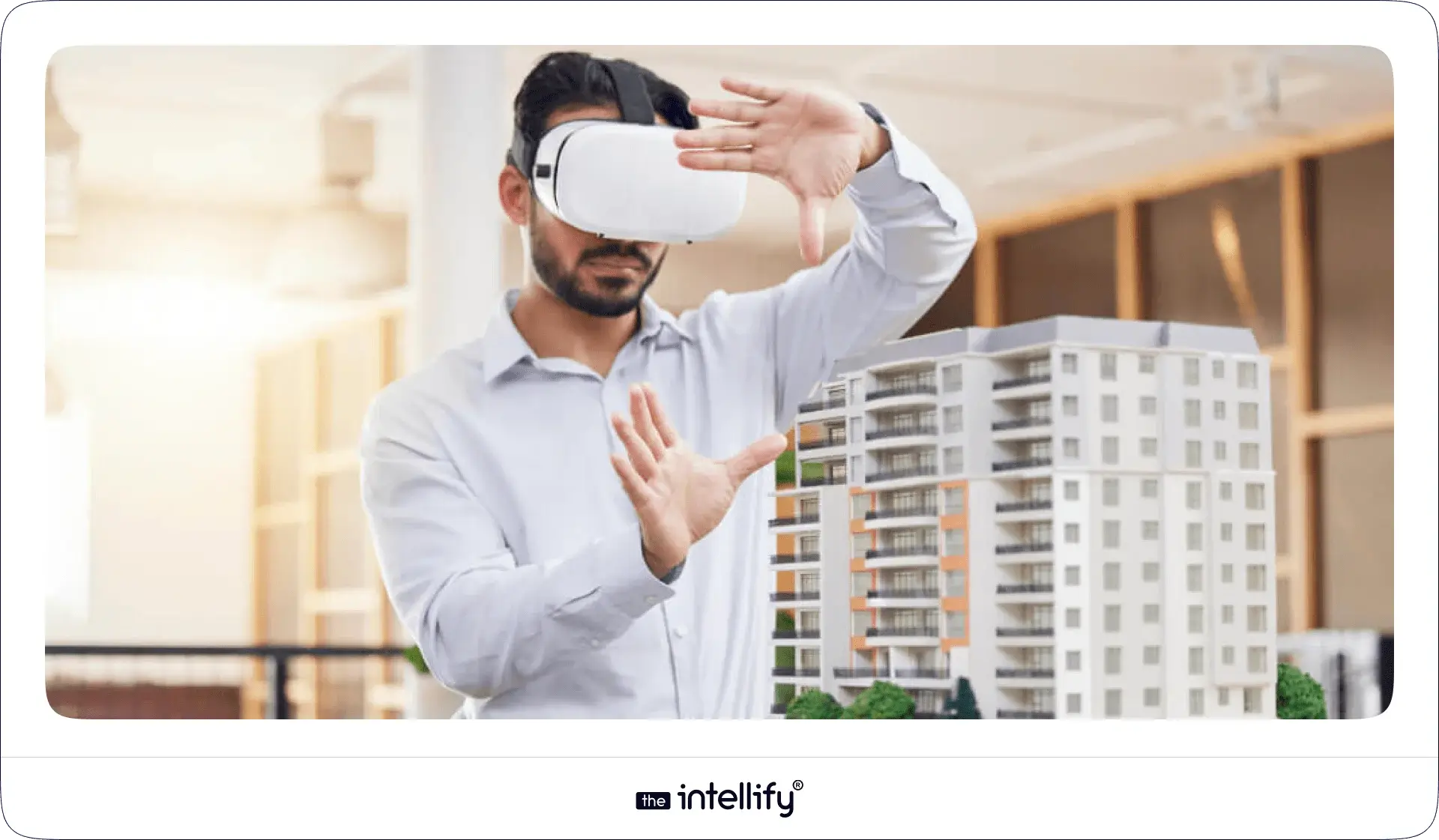
Virtual Property Tours

At a basic level, a virtual property tour allows someone to explore a property digitally. But there are different levels to this experience:

  • Photo-based tours (static and limited)
  • Video walkthroughs (guided but passive)
  • Fully immersive VR tours (interactive and user-controlled)

Virtual Property Tours Using VR sit at the top of this list. Instead of watching someone else walk through a property, users move through it themselves. They choose where to look, when to pause, and what to explore.

It feels closer to a real visit without the pressure or time commitment.


How Virtual Property Tours Using VR Actually Work

This sounds technical, but the process is quite straightforward.

Step 1: Property Capture

The property is scanned using 3D cameras or spatial imaging tools. Every room, corner, and connection is recorded.

Step 2: Digital Environment Creation

The captured data is converted into a virtual environment that mirrors the real space. Proportions matter here. Accuracy is key.

Step 3: User Access

Buyers access the tour through:

  • VR headsets
  • Mobile phones
  • Desktop browsers

A good VR Property Tour works smoothly across all three. No learning curve. No confusion.


Why Real Estate Businesses Are Adopting VR Property Tours

Real estate teams didn’t wake up one day and decide to chase VR because it sounded cool. They adopted it because their old way of working started slowing them down.

Buyers today come prepared. They’ve already checked listings, compared prices, and scanned neighborhoods online. When they book a visit, they expect clarity, not surprises. VR Property Tours help close that gap early.

Instead of spending hours on initial walkthroughs, businesses now use VR as a first filter. Buyers explore the property virtually, form opinions, and then move forward only if it feels right.

That alone changes daily operations.

What’s pushing adoption forward

  • Time pressure: Agents and sales teams juggle multiple listings. VR reduces repetitive walkthroughs that lead nowhere.
  • Remote decision-making: Many buyers aren’t local anymore. Job transfers, relocations, and remote work mean people shop from afar.
  • Higher buyer expectations: Static photos feel outdated. Buyers want context, flow, and realism.
  • Cost control: Fewer site visits mean less prep, fewer staff hours, and lower operational overhead.

There’s also a subtle emotional benefit. When buyers feel informed before visiting, conversations feel calmer. Less convincing. More confirming. That’s a healthier sales process for everyone involved.

 

VR property tour solutions


Real Estate Virtual Tour Using VR vs Traditional Virtual Tours

Traditional virtual tours do their job, but they stop short. Here’s the practical difference:

Traditional Virtual Tours

  • Click-based navigation
  • Limited sense of space
  • Easy to forget after viewing

Real Estate Virtual Tour Using VR

  • Natural movement
  • Clear spatial understanding
  • Stronger emotional connection

With VR, buyers don’t memorize layouts. They understand them. That clarity reduces doubt and speeds up decisions.


Key Use Cases of VR Property Tours Across Real Estate Segments

Use Cases of VR Property Tours

VR 360° Virtual Tours aren’t limited to one type of real estate. They’re being used across all boards.

Residential Properties

  • Buyers explore layouts before booking visits
  • Families compare homes without travel fatigue

Luxury Homes

  • International and out-of-state buyers view properties remotely
  • Fewer unnecessary in-person showings

Commercial Real Estate

  • Businesses visualize offices, retail spaces, and warehouses
  • Better planning before leasing decisions

Under-Construction Projects

  • Buyers walk through properties that don’t physically exist yet
  • Fewer misunderstandings about final layouts

Sales Galleries & Events

  • VR replaces physical models and brochures
  • One setup, multiple properties

Each use case saves time and improves clarity.


Benefits of VR Property Tours for Buyers and Sellers

The benefits show up quickly on both sides.

For Buyers

  • Explore properties anytime, anywhere
  • Understand the layout and flow before visiting
  • Feel more confident making shortlists

For Sellers and Developers

  • Fewer low-intent inquiries
  • Better-qualified leads
  • Shorter sales cycles

Instead of pushing properties, teams spend time answering meaningful questions.


What Makes a High-Quality Real Estate VR Tour App?

Not all VR tours are created equal. Quality makes a noticeable difference.

  • A strong Real Estate VR tour app should include:
  • Simple navigation (no instructions needed)
  • Accurate room proportions
  • Smooth movement without lag
  • Support across devices
  • Subtle, consistent branding

Optional but valuable:

  • User behavior tracking
  • Heatmaps showing popular areas
  • Integration with sales tools

When the experience feels natural, users stay longer.
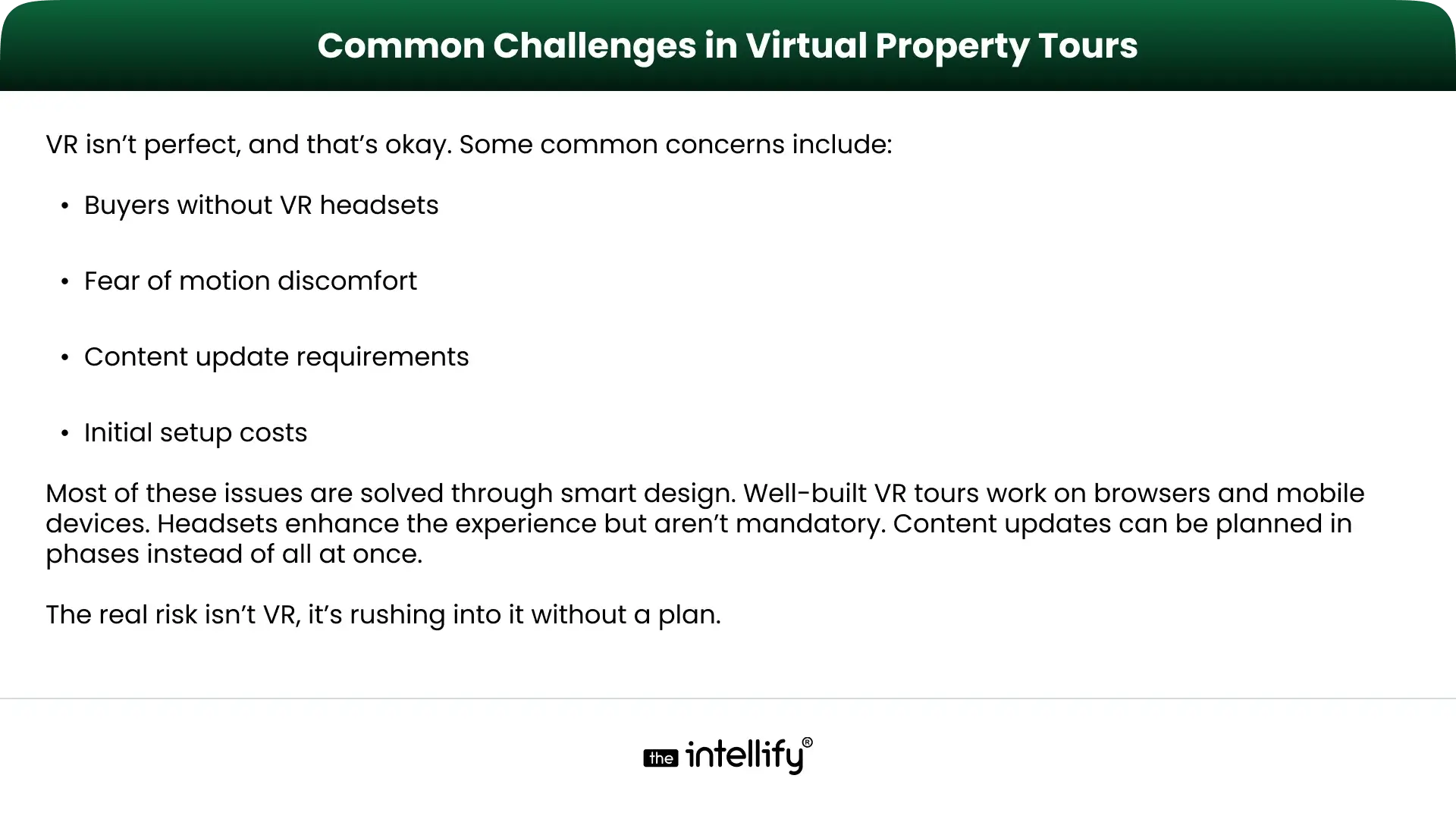
Challenges in Virtual Property Tours

Why Businesses Are Investing in Custom VR Property Tour Apps

Off-the-shelf tools can work for basic needs. They’re quick to deploy and cheaper upfront. But many businesses hit a wall sooner than expected. Custom VR app development give real estate businesses control over experience, branding, and future growth.

Where custom apps make a real difference

  • Brand consistency: Custom apps reflect the company’s identity. Colors, tone, and navigation are all aligned with how the brand wants to feel.
  • Scalability: As listings grow, custom platforms handle expansion smoothly. No redesign every few months.
  • Better performance: Optimized apps load faster and run smoother, especially across devices.
  • Integration with sales systems: CRMs, booking tools, analytics, everything connects instead of living in silos.

For businesses serious about growth, Virtual property tours using VR become part of their long-term sales strategy, not just a marketing experiment.


How to Get Started With Virtual Property Tours Using VR

Getting started doesn’t require a massive rollout. In fact, starting small often works better. The first step isn’t technology, it’s intent.

Ask yourself:

  • Are buyers asking for more details before visits?
  • Are site visits time-consuming and repetitive?
  • Are online listings failing to stand out?

If the answer is yes, VR is worth exploring.

1. Start with one property: Choose a representative listing. Not the biggest or fanciest, just a solid example.

2. Define the experience: Decide what matters most:

  • Layout clarity?
  • Interior finishes?
  • Overall flow?

3. Choose the right format: Ensure the tour works on:

  • Mobile
  • Desktop
  • VR headsets (optional, not mandatory)

4. Test with real users: Watch how people move. Where they pause. Where they exit.

5. Refine and scale: Improve visuals, navigation, and performance before expanding to more listings.

Then expand gradually, improving visuals and features over time.
 

Immersive Property Tours


Conclusion

Virtual tours aren’t replacing human interaction. They’re improving it. Buyers arrive informed. Sellers save time. Agents focus on serious conversations. As expectations continue to shift, Virtual Property Tours will move from “nice to have” to “expected.” Those who adapt early build trust. Those who wait scramble later.

It’s not about being futuristic. It’s about being practical.


Frequently Asked Questions (FAQs)

1. What are virtual property tours, and how do they work?

Virtual Property Tours allow buyers to explore a property digitally without visiting it physically at the start. Using VR technology, the property is recreated in a 3D environment where users can move through rooms, look around freely, and understand the layout. These tours work on VR headsets, mobiles, or desktops, making them accessible to most buyers and investors.

2. How are Virtual Property Tours using VR better than normal virtual tours?

Normal virtual tours are usually image-based or video-led, which limits interaction. Virtual Property Tours Using VR feel more realistic because users control their movement and viewing angles. This helps buyers understand space, flow, and proportions better. As a result, engagement is higher, and buyers feel more confident before scheduling a site visit.

3. Do buyers need a VR headset to view a VR property tour?

No, a VR headset is not required. Most VR Property Tours are designed to work smoothly on mobile phones and web browsers. A headset simply enhances the experience but is optional. This flexibility ensures that more buyers can access the tour without any technical barriers.

4. Are VR property tours useful for under-construction or off-plan projects?

Yes, VR property tours are especially valuable for under-construction or off-plan projects. A Real Estate Virtual Tour Using VR allows buyers to walk through a digital version of the property before it is built. This helps them understand layouts, room sizes, and overall design clearly, reducing confusion and increasing trust during early-stage sales.

5. How much does it cost to build a Real Estate VR tour app?

The cost of a Real Estate VR tour app depends on factors like the number of properties, the level of detail, and required features. Simple tours are more affordable, while custom apps with branding, analytics, and integrations cost more. Companies like The Intellify help businesses choose the right approach so the investment stays practical and goal-focused.

6. Can virtual property tours help generate more real estate leads?

Yes, virtual property tours often lead to better-quality inquiries. Buyers who explore a property through VR already understand the space and show higher intent. This means fewer casual inquiries and more serious prospects. Many real estate businesses use Virtual Property Tours to improve lead quality and shorten their sales cycle.

7. How long does it take to develop a VR property tour solution?

Development time depends on the complexity of the tour and the features required. A basic VR property tour can be ready within a few weeks, while custom solutions take longer. Experienced teams like The Intellify usually follow a phased approach, starting with a pilot tour and then scaling, so businesses can see results without long delays.
Virtual Tours vs. In-person Viewings: What Middle East Buyers Prefer (2026)

Summary
In 2026, immersive virtual tours are a baseline expectation across Gulf property listings: they extend reach, qualify higher-quality leads, and shorten time to offer. In-person viewings remain essential for tactile verification and closing premium purchases. The most effective teams apply a virtual-first, trust-aware approach: use virtual assets to inform and qualify, then deploy tightly scoped in-person visits to validate and close. This article gives an operational playbook, vendor checklist, booking and visit scripts, and measurable KPIs you can implement now.


Introduction: Why this comparison matters now

Real estate in the Middle East has undergone rapid changes. Rising international investment, widespread off-plan development, and a mobile-first buyer base mean listings must perform online before they perform in person. Buyers are busy and often remote; they expect clear visuals, accurate documents, and fast scheduling. This puts pressure on agents and developers to deliver professional virtual experiences while retaining the trust-building power of in-person viewings.

The most practical answer is not “virtual replaces physical” or “physical replaces virtual.” It is a disciplined hybrid model that uses virtual tours to widen the funnel and in-person visits to remove final risk and close deals. Below is a refined, actionable guide you can apply immediately.


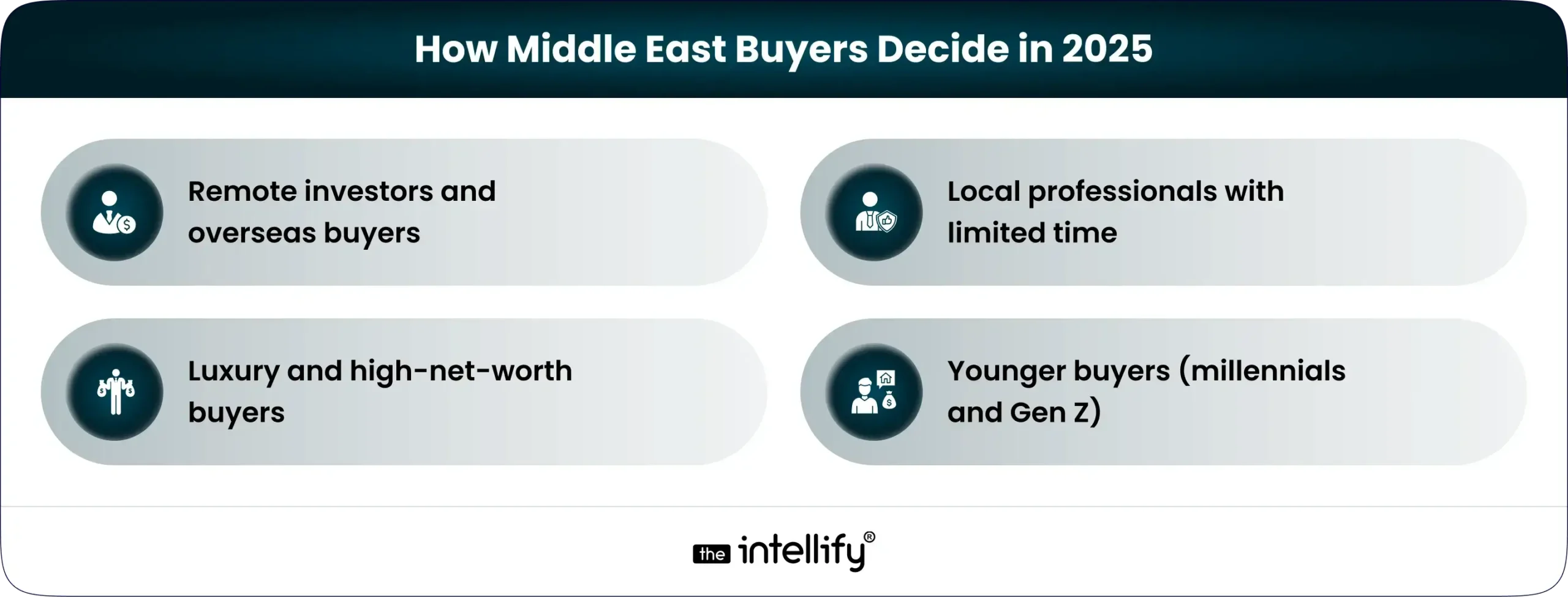
How Middle East buyers decide in 2026

Middle East buyers approach

Buyer intent now clusters into four distinct groups, each of which requires a specific operational approach:

  • Remote investors and overseas buyers. These buyers shortlist from afar and rely on 3D walkthroughs, accurate floor plans, neighbourhood videos, and clear documentation. A guided virtual tour can replace initial travel and, in many cases, lead directly to offers or targeted physical inspections.
  • Local professionals with limited time. Research often happens after work. They expect to validate fit quickly online and will book one or two targeted viewings only if the virtual presentation confirms suitability. Speed and accuracy matter most for this segment.
  • Luxury and high-net-worth buyers. Virtual assets narrow options, but tactile verification of finishes, acoustics, sightlines, and service expectations remains crucial. These buyers typically require curated, private in-person visits before signing.
  • Younger buyers (millennials and Gen Z). Comfortable with technology, many are willing to buy sight-unseen when presented with high-quality visual proof and reliable documentation.


Measurable advantages of virtual tours

Advantages of virtual tours

When executed consistently, virtual tours yield operational benefits that translate to faster sales and higher seller confidence:

  • Higher lead quality. Immersive listings set realistic expectations; prospects who complete tours are more likely to contact the agent with intent.
  • Faster qualification. Agents spend less time on low-probability visits because mismatches are revealed earlier in the funnel.
  • Increased geographic reach. Overseas and cross-city buyers can evaluate more properties in less time, increasing the buyer pool.
  • Reusable marketing assets. Tours power social campaigns, email sequences, and downloadable brochures that typically convert better than static photos.

These outcomes are repeatable when you standardize capture, publish quickly, and track the right metrics.


Why in-person viewings remain indispensable

Virtual tools are powerful, but they do not replace everything. Keep these reasons in mind:

  • Physical verification. Materials, finish quality, ambient noise, and unobstructed sightlines are best judged in person. For premium homes, tactile experience is expected.
  • Legal and technical needs. Measurements, title verification, and final contract signings often require local presence or certified documentation.
  • Negotiation psychology. On-site meetings enable agents to read objections, create urgency, and manage closing dynamics in ways a virtual tour cannot.

The objective is to reduce unnecessary in-person visits while reserving them for moments where they materially reduce buyer risk and increase conversion probability.


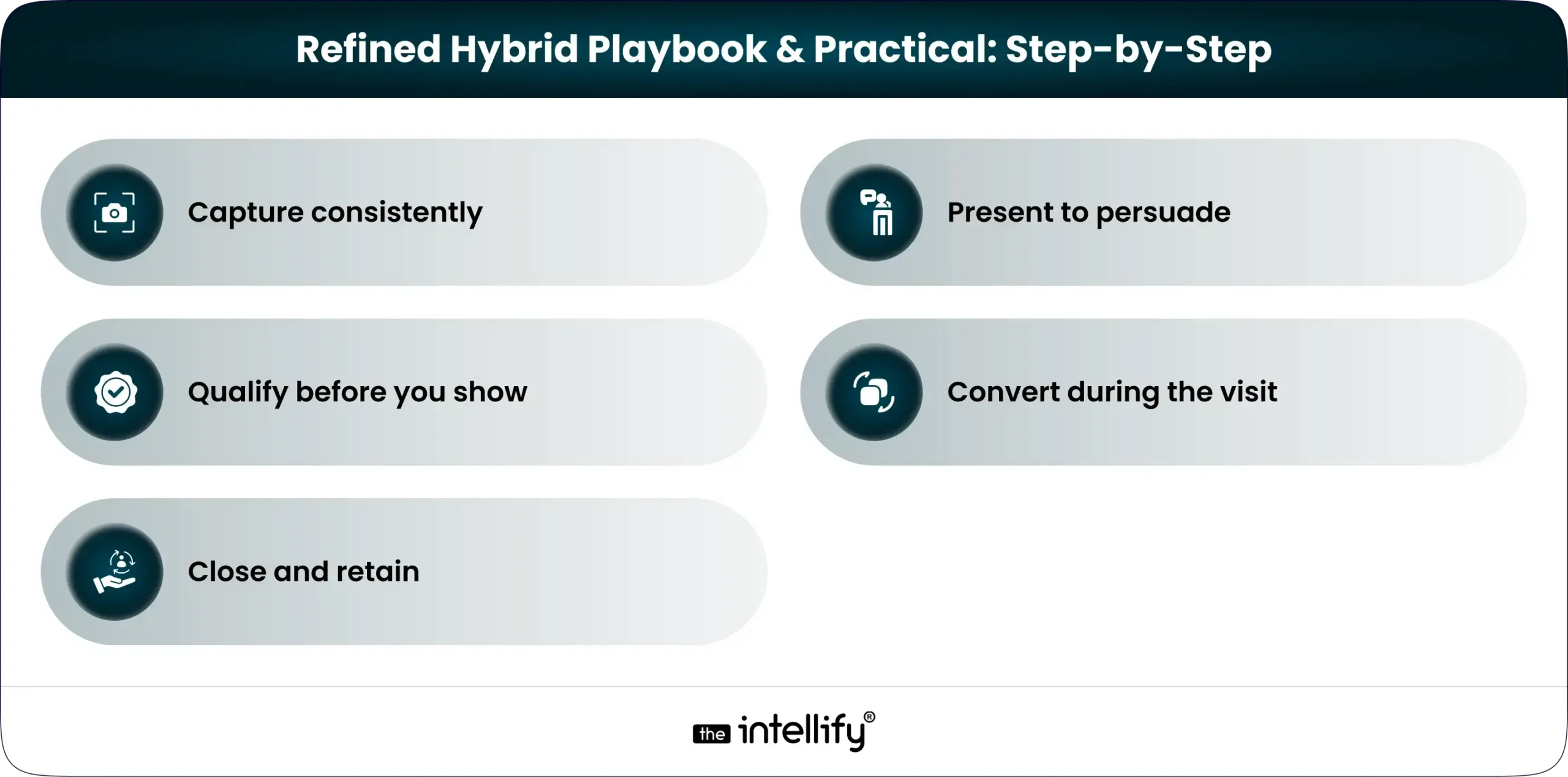
A Refined Hybrid Playbook & Practical: Step-by-Step

Refined Hybrid Playbook & Practical_ Step-by-Step

Phase 1: Capture consistently

  • Standard checklist: 3D scan (Matterport or equivalent) or high-quality 360° capture, a short hosted walkthrough video, accurate floor plans with measurements, high-resolution photography, and a downloadable dossier containing title, warranty, and finish schedules. Consistency signals professionalism.
  • Quality control: Use a capture checklist to ensure lighting, decluttered interiors, and consistent shot sequencing.
  • Speed to market: Publish virtual assets within 48–72 hours of capture to maintain listing momentum and enable timely promotion.

Phase 2: Present to persuade

  • Hero placement: Put the tour at the top of the property page and include a concise hosted video that highlights the five strongest selling points.
  • Contextual content: Provide neighborhood map, commute times, schools, and recent comparable sales to reduce common objections.
  • Clear booking options: Offer two frictionless CTAs: “Book a 15-minute Guided Virtual Tour” and “Schedule a Private In-Person Visit.”

Phase 3: Qualify before you show.

  • Smart booking form: Capture three essentials at booking, budget range, intended timeline, and investor vs occupant to triage visits.
  • Remote checks: Offer live guided video calls for overseas buyers to answer bespoke questions and reduce unnecessary travel.

Phase 4: Convert during the visit.

  • Prepare a physical packet: Provide warranty documents, finish samples, measurement sheets, and a short checklist matched to buyer concerns.
  • Focus on validation: Use in-person time to confirm remaining uncertainties rather than re-present basics already covered virtually.

Phase 5: Close and retain

  • Digital handover pack: After sale, deliver finalized scans, manuals, warranty documents, and a neighborhood welcome guide electronically.
  • Capture proof: Collect a short testimonial and permission to publish a concise metric (days to offer, % of virtual-origin leads).
  • Automated nurture: Use CRM automation to follow up on referrals, upgrades, and post-move support.


Strategies embedded in presentation and content

Integrate practical strategies into every listing and distribution channel to boost discoverability and trust without turning pages into sales brochures.

  • User-first headlines: Lead with buyer intent in one line. Example: “Explore this 2-bed Dubai Marina apartment full 3D tour available.”
  • 10-second summary: Ensure price, size, bedrooms, and the primary CTA are visible within a single screen without scrolling.
  • Short, shareable assets: Offer a two-page PDF (floorplan + key facts) for quick sharing rather than a long brochure.
  • Micro-case studies: Publish one-paragraph case studies showing a single metric to build credibility.
  • Mobile-first performance: Optimize tour embeds and media for fast mobile loading; speed is perceived as professionalism.

These approaches help listings get found, trusted, and shared.


What leading portals and brokers do and what to copy

Top regional players consistently apply three pillars you should emulate:

  1. Research-driven content: Publish market digests and repurpose them into short assets to earn backlinks and build authority.
  2. Hyperlocal pages: Create community landing pages and virtual-tour landing pages for key submarkets to capture search intent.
  3. Product integration: Surface “virtual tour available” badges, add live booking widgets, and offer promoted placements for tour-enabled listings.

Implement these systematically: standardize your asset library, localize copy, and make booking effortless.


Technology and vendor checklist: Practical selection criteria

Choose vendors and platforms with these capabilities:

  • Capture tech: Support for 3D scans, 360° capture, and guided video walkthroughs. For premium properties, consider LIDAR.
  • Embed and lead capture: The player must be mobile responsive, easily embeddable, and include lead capture.
  • CRM integration: Tour leads should flow automatically into CRM for instant follow-up and scoring.
  • Analytics: Platform should report tour completion rate, average watch time, and conversion to contact and in-person booking.
  • Support & SLAs: Prioritize vendors with quick processing and responsive support.

If analytics are limited at launch, at least capture completion and time-on-tour metrics for manual tracking.


Request a Private Inspection


Page layout and conversion copy that works

Structure property pages to answer buyer questions by priority and reduce friction.

  1. Hero: a single-line value proposition and immediate CTA (“View 3D Tour / Book Guided Tour”).
  2. Snapshot: price, bedrooms, size, completion status, and one immediate selling point.
  3. Virtual tour embed: prominent, with a short hosted highlight video.
  4. What you’ll love: three short lifestyle bullets (commute, schools, view).
  5. Practical facts: floorplan, measurements, parking, service charges.
  6. Neighborhood map: travel times and key amenities.
  7. Short FAQ: concise answers to inspection and offer questions.
  8. Booking CTAs: two clear CTAs for guided virtual viewing and in-person visit.
  9. Proof: a short case study or seller testimonial with a single metric.
  10. Final CTA: time-boxed incentive (“Private inspections available this week, book now”).

Keep copy short, factual, and benefit-focused; remove marketing fluff.


Operational details: Scripts, KPIs, and compliance

Sample agent script for a guided virtual tour

  1. Greeting (15–30s): “Hello, I’m [Name], your local property expert. I’ll guide you through the apartment and answer questions as we go.”
  2. Orientation (30s): State the building, floor level, and primary view orientation.
  3. Highlight loop (2–3 mins): Point out three selling features: layout flow, natural light, storage, and tie each to buyer benefits.
  4. CTA (30s): “If this looks suitable, we can schedule a private inspection this week, or I can send the full measurement sheet and warranty documents now.”

KPIs to monitor

  • Tour publish lead time: publish within 48–72 hours (target: 90% of listings).
  • Tour completion rate: % viewers who view at least 50% of the tour (target: 35–50%).
  • Contact after tour: % of tour viewers who contact the agent (target: 5–12%).
  • Conversion to in-person booking: % of contacts who schedule a visit (target: 30–40%).
  • Time to first offer: median days from listing to offer track and improve.

Sample capture checklist (detailed)

  • Exterior approach: entrance, lobby, amenities.
  • Living areas: multiple angles, balcony flow, and lighting.
  • Kitchen: cabinets, appliances, finishes.
  • Bedrooms: storage and sightlines.
  • Bathrooms: fixtures, tiling, ventilation.
  • Outdoor spaces: balcony depth, orientation, views.
  • Utility & parking: allocated spaces and access.
  • Documentation: brief capture of title page, service charge summary, warranty docs.

Common buyer objections and concise responses

  • “I can’t tell material quality from a video.” “I’ll send close-up photos and warranty details; we can schedule a private inspection for finishes you want to verify.”
  • “Is the view exactly like in the tour?” “The tour was captured on [date]; I’ll send a current photo, and we can do a live video at the time that shows the view you care about.”
  • “How fast can I inspect in person?” “Shortlisted buyers typically get inspection slots within 48–72 hours; I’ll prioritize your slot.”

Legal and compliance reminders

  • Ensure virtual representations are accurate and include a capture-date disclaimer and virtual-staging notes.
  • For off-plan sales, state assumptions used in visualizations and link to approved finish specifications.
  • Keep an audit trail of tour links and distribution for dispute resolution.


Distribution and amplification playbook

Treat distribution as part of the launch checklist:

  • Email: segmented blasts (investors, owner-occupiers, city lists) with a single CTA to view the tour.
  • Social: 15–30s highlight reels plus short fact cards for story formats.
  • Partner channels: syndicate to portals and proptech partners; use promoted placements for tour-enabled listings.
  • Paid tests: run small paid campaigns optimized for tour completion, not just clicks.


Example metrics report (one-pager)

  • Listings published with virtual tours this month: 24
  • Average time to publish tour: 62 hours
  • Average tour completion rate: 41%
  • Leads sourced from tours: 128 (≈10% of viewers)
  • In-person visits booked from tour leads: 42
  • Offers received from tour-origin leads: 11

Update this one-pager weekly during rollout to iterate on capture thresholds and promotional tactics.


Rollout timeline implemented in six weeks

Week 1: Create a capture checklist and run pilot captures.
Week 2: batch capture priority listings and publish landing pages.
Week 3: integrate tour analytics with CRM and launch social creative.
Week 4: A/B test CTAs and booking flows; refine copy.
Week 5: review performance metrics and optimize.
Week 6: publish a case study and scale capture.


Book a Live Guided Tour


Conclusion: What wins in 2026

In 2026, teams that treat virtual tours and in-person viewings as a single, coherent funnel will win. Virtual assets broaden reach and speed qualification; in-person visits close the trust gap. Execute consistent capture, present assets clearly, qualify before you show, and reserve in-person visits for validation and closing. The result: shorter sales cycles, stronger seller pitches, and higher conversion.


High Demand FAQs

  1. What is a virtual property tour, and how accurate is it?

    A virtual property tour is an interactive 3D or 360° walkthrough that shows layout, flow, and sightlines. It reliably represents space and orientation, but final tactile checks (materials, noise, odour) should be done in person for high-value purchases.


  2. Can I make an offer after viewing a property virtually?

    Yes, many buyers, especially overseas investors, make offers following a guided virtual tour. Best practice is to do a final in-person verification or live video inspection before completing legal closing steps.


  3. How soon can a virtual tour be created and published?

    For most apartments and standard homes, professional capture, processing, and publishing typically take 48–72 hours. Premium scanning (LIDAR or large villas) may take longer depending on vendor capacity.


  4. Do virtual tours show exact measurements and floor plans?

    Quality virtual tours include accurate floor plans and measurement overlays when produced with professional scanners. Always request the measurement sheet and, if required, a certified measurement before finalizing a purchase.


  5. Are virtual tours mobile-friendly and easy to share?

    Yes, top platforms deliver responsive embeds and lightweight players designed for mobile and desktop, and tours can be shared via direct links or included in short, downloadable PDFs for easy distribution.


  6. What types of properties work best for virtual tours?

    Virtual tours are effective for apartments, villas, off-plan show suites, and model homes. They are particularly useful for off-plan marketing and for buyers who are remote or time-constrained.


  7. What are the typical costs for producing a professional virtual tour?

    Costs vary by property size and capture method: basic 360° tours are economical, while high-fidelity 3D/LIDAR scans cost more. Consider ROI, faster sales, and higher-quality leads often justify professional capture.


  8. Will virtual staging mislead buyers?

    Virtual staging can help buyers visualise a space, but it must be disclosed clearly. Always show an option to view raw, unstaged imagery and include a disclosure when virtual furniture or finishes are applied.


  9. How does a hybrid virtual-first + in-person process speed up sales?

    Virtual-first screening reduces low-quality visits and shortlists motivated buyers. In-person visits are reserved for final validation, which shortens the sales cycle and improves agent efficiency.


  10. What legal or compliance considerations apply to virtual listings?

    Ensure all virtual representations are dated and accurate; include capture-date disclaimers and note any virtual staging or off-plan assumptions. For off-plan sales, link to approved finish schedules and developer documentation.

View
Case Study