The Rise of Voice-Driven AI: Opportunities for Businesses & Developers

Summary:
Voice-driven AI is changing how businesses and developers think about customer interactions and automation. This blog explains what Voice AI is, how AI voice agents work, and why they’re gaining traction across industries like customer support, healthcare, banking, and e-commerce. It also covers real-world use cases, business benefits, developer opportunities, and key considerations before adoption, helping readers understand where voice AI fits and why it matters today.

A few years ago, talking to a machine still felt… awkward. You’d say something simple like, “Check my order status,” and the system would respond with, “I did not understand that.” Cue mild irritation, maybe a sigh, maybe hanging up.

Fast forward to today, and things feel different. You can speak naturally, pause mid-sentence, even change your mind and the system keeps up. That shift is the quiet rise of voice-driven AI, and it’s changing how businesses work and how developers build.

This isn’t hype. It’s practical. It’s already happening. And if you’re building products or running a business, it’s worth paying attention.


What Is Voice-Driven AI?

What Is Voice-Driven AI

Voice-driven AI is technology that lets machines listen, understand, and respond using spoken language. You talk. The system listens. It figures out what you mean. Then it replies out loud.

That’s it. No complicated definition needed. At the core, it combines:

  • Speech recognition (turning voice into text)
  • AI understanding (figuring out intent)
  • Speech generation (talking back)

When people say AI Voice or Voice AI, they usually mean this full loop working smoothly together. What’s new is how natural it feels now. You don’t have to speak like a robot anymore. You can sound like… yourself. And that changes everything.


Evolution of Voice AI: From Assistants to AI Voice Agents

Early voice tools were basic. They followed scripts. Ask the wrong way, and they’d get confused. Anyone who has yelled “representative” into a phone menu knows the feeling.

Modern AI Voice Agents are different. They:

  • Handle back-and-forth conversations
  • Remember context within a call
  • Ask clarifying questions
  • Adapt their responses based on what you say

It’s the difference between a recorded menu and a capable assistant who doesn’t panic when things go slightly off-script. This evolution is why businesses are moving away from old IVR systems and toward smarter voice experiences.


Why Voice AI Is Growing So Fast

Voice AI didn’t explode overnight. It crept in quietly, then hit a tipping point.

One big reason is habit. People got used to talking to devices such as phones, cars, and smart speakers. Saying things out loud stopped feeling awkward. It became normal, almost automatic. You ask for directions while driving. You check the weather while making coffee. No typing, no thinking.

Another reason is pressure on businesses. Customer support teams are stretched thin. Call volumes are high. Hiring and training take time. Voice AI stepped in as a practical fix, not a flashy one. It handles repetitive questions, reduces wait times, and keeps things moving.

There’s also the technology itself. Speech recognition is more accurate now. AI understands context better. Systems don’t fall apart when users hesitate, interrupt, or phrase things differently. That reliability changed how businesses view voice from “nice to try” to “worth investing in.”


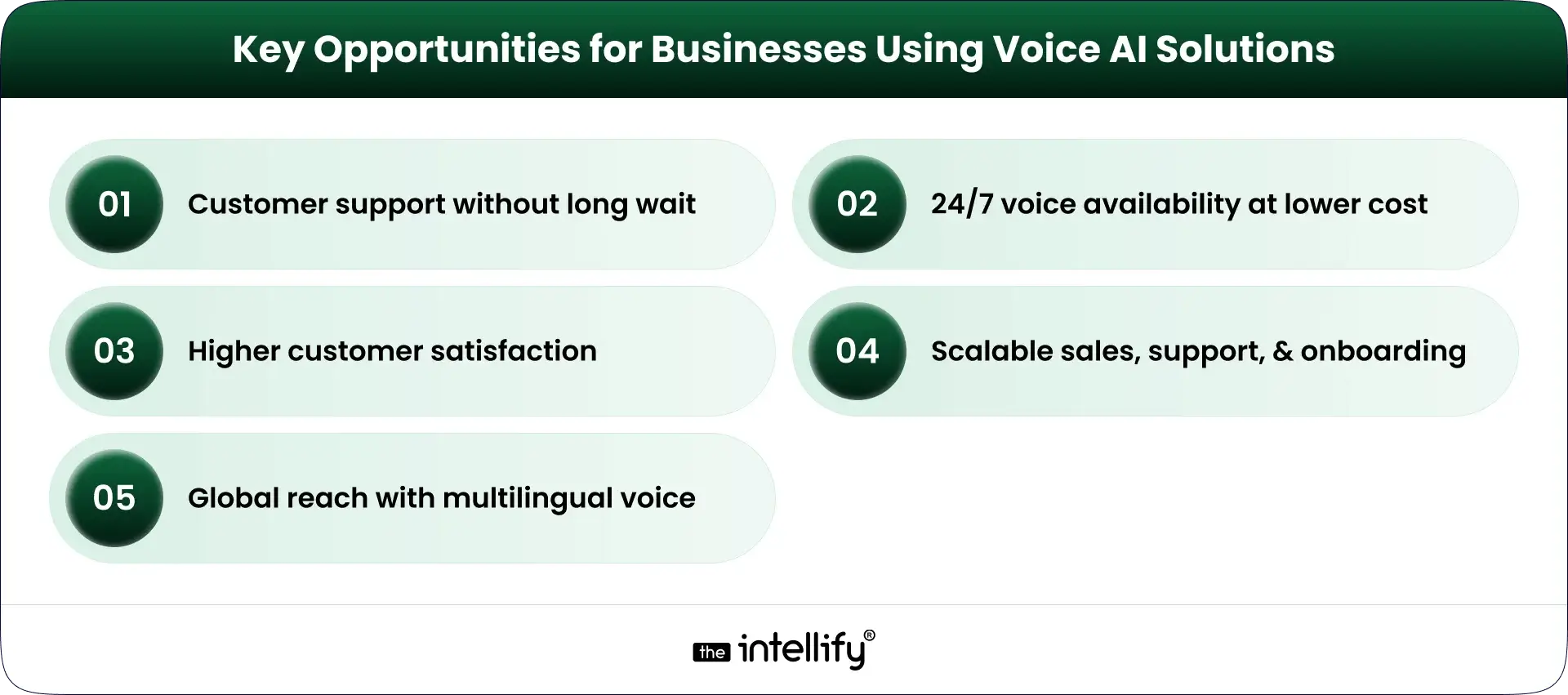
Key Opportunities for Businesses Using Voice AI Solutions
Opportunities for Businesses Using Voice AI Solutions

Let’s talk outcomes and business values:

Better Customer Support

Voice AI can handle routine questions without breaks, mood swings, or long wait times. Customers get help faster. Support teams focus on real problems.

Always-On Availability

People call at odd hours. Late nights. Early mornings. Voice AI doesn’t care. It’s there.

Lower Operating Costs

Once set up, AI Voice Agents handle high call volumes without scaling headcount at the same rate. That matters, especially in the US market where labor costs are high.

More Consistent Experiences
No bad days. No rushed calls. Every customer gets the same baseline level of service.

Global Reach

With multilingual voice support, businesses can serve users across regions without building separate teams everywhere.
None of this is flashy. It’s just… useful. And usefulness is what sticks.


Opportunities for Developers in the Voice AI Space

If you’re a developer, this space is wide open. Building voice systems isn’t just about code. It’s about understanding how people talk when they’re rushed, confused, or annoyed. That’s a different challenge than building forms or dashboards.

There’s strong demand for:

  • Custom AI Voice Agents tailored to specific industries
  • Integrations with CRMs, booking systems, and internal tools
  • Voice workflows that actually match how businesses operate
  • Ongoing improvement, tuning, and maintenance

Many companies don’t want generic solutions. They want voice systems that understand their customers, their data, and their processes.

That’s where AI Voice Agent Services come in. Not as off-the-shelf tools, but as carefully built systems that solve real problems. From a career and business standpoint, voice AI is less crowded than chatbots were a few years ago. There’s room to specialize. Room to experiment. Room to grow.


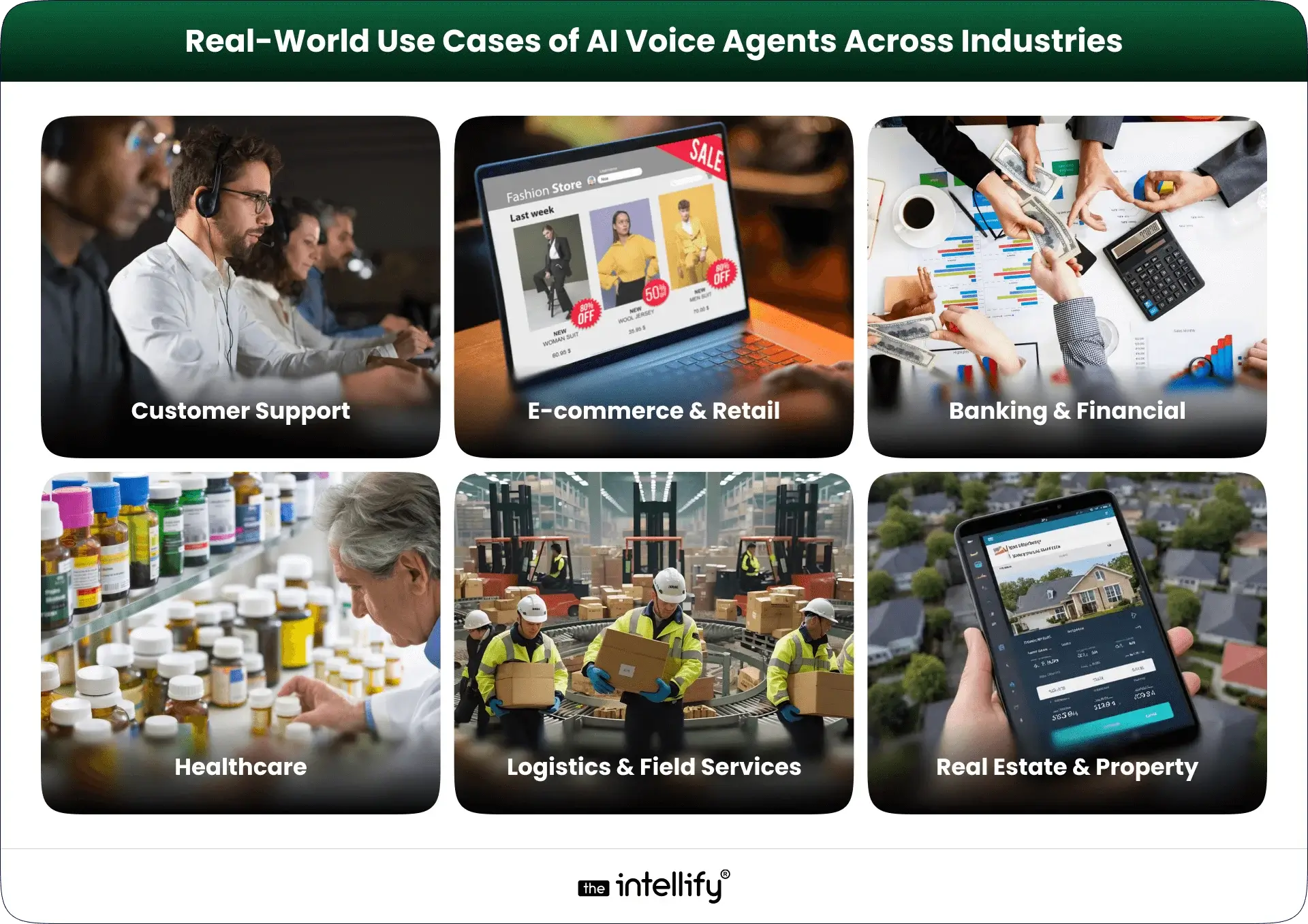
Real-World Use Cases of AI Voice Agents
Real-World Use Cases of AI Voice Agents

This is where things get tangible.

Customer Support & Call Centers

Voice AI handles common issues like order status, password resets, and appointment changes. Humans step in when things get complex.

Healthcare

Patients schedule appointments, receive reminders, or get basic information without waiting on hold. Simple, calm, efficient.

Banking & Financial Services

Account inquiries, transaction confirmations, and basic support are handled securely through voice, with humans for sensitive cases.

E-commerce & Retail

Customers track deliveries, initiate returns, or ask product questions without digging through emails.

Logistics & Field Services

Drivers confirm deliveries. Technicians get updates. Everything moves faster.

Real Estate & Property Management

Property inquiries, viewing schedules, and maintenance requests are all handled through voice without constant back-and-forth.


AI Voice Agent Solutions vs Traditional Voice Systems

CriterionBuildBuy
CostHigher upfrontLower upfront
Time to MarketSlowerFaster
ScalabilityCustom, complexPlatform-led
Security & ComplianceFully internalVendor-dependent
CustomizationFullLimited
Long-Term FlexibilityHighRestricted


The difference isn’t subtle. Traditional systems expect users to adapt. AI voice agents adapt to users. And that shift changes how people feel during interactions, which matters more than most metrics.

 

Mid-CTA


How Businesses Can Get Started with Voice AI Agent Services

Getting started with voice AI works best when the focus is clear and practical. Businesses should begin small and expand gradually based on results.

Identifying the right use case

Review common customer calls and identify repetitive questions such as order status, appointment booking, or basic support. These are ideal starting points for voice AI.

Choosing between off-the-shelf vs custom Voice AI Solutions

Off-the-shelf solutions suit simple needs and faster setup, while custom voice AI solutions work better for complex workflows or industry-specific requirements.

Data, privacy & compliance basics

Voice AI systems must follow security and privacy standards. Encryption, access control, and regulatory compliance should be addressed from the start.

Importance of working with the right AI development partner

An experienced partner like The Intellify helps design reliable, secure, and business-aligned voice AI solutions that deliver real value.


Challenges & Things to Consider Before Adopting Voice AI

Voice AI isn’t magic. It has limits. Accuracy still depends on good data. Poor inputs lead to awkward conversations. Privacy matters. Especially in the US, compliance isn’t optional. Integration can get messy if systems are outdated. And yes, some users still prefer humans. That’s fine. Voice AI doesn’t replace people, it supports them. Being honest about these challenges builds trust. And trust matters more than perfect demos.


The Future of Voice-Driven AI

Voice as the primary interface for AI

Voice is becoming the most natural way people interact with AI. As screens become secondary in many situations, driving, working, and multitasking, voice offers faster, hands-free access to information and actions.

More natural, emotional, and context-aware agents

Future voice agents will better understand tone, pauses, and intent. This allows responses to feel calmer, more relevant, and less robotic, especially in sensitive or time-critical situations.

Voice + multimodal AI

Voice will increasingly work alongside text, visuals, and data. Users may speak a request, view details on a screen, and confirm actions by voice, creating smoother experiences.

Why early adopters will have a competitive edge

Businesses adopting voice AI early gain practical insights, improve faster, and deliver better customer experiences before competitors catch up.
 

CTA


Final Thoughts

Voice-driven AI isn’t about replacing humans. It’s about removing friction. About making everyday interactions smoother, faster, and less annoying.

For businesses, it’s a practical investment. For developers, it’s a growing field with room to specialize. And for customers? It’s one less reason to sigh when the phone rings. If you’re exploring AI Voice Agents or looking into Voice AI solutions for your business, now is a good time to start the conversation, ironically enough, by listening first.


Frequently Asked Questions (FAQs)

1. What is Voice-Driven AI, and how does it work?

Voice-driven AI enables systems to understand spoken language and respond intelligently. It converts speech into text, interprets user intent using AI, and replies with a natural voice response in real time.

2. How is Voice AI different from traditional IVR systems?

Unlike IVR, Voice AI doesn’t rely on fixed menus. It understands everyday language, manages follow-up questions, and keeps conversations flowing even when users speak casually or change topics.

3. What are AI Voice Agents used for in real businesses?

AI Voice Agents are used for customer support, appointment scheduling, order tracking, payment reminders, and lead qualification, especially in healthcare, banking, e-commerce, and real estate.

4. Are Voice AI solutions suitable for small and mid-sized businesses?

Yes. Many businesses start small by automating frequent calls. Voice AI solutions can grow gradually, making them practical and cost-effective for small and mid-sized teams.

5. How can businesses get started with AI Voice Agent services?

Businesses usually begin by identifying repetitive voice interactions, then working with providers like The Intellify to design and deploy custom AI voice agent solutions aligned with their goals.

6. Will AI Voice Agents replace human support teams?

No. AI voice agents handle routine tasks, while humans focus on complex or emotional cases. The goal is support, not replacement, and better experiences for both customers and teams.

7. Is Voice-Driven AI secure and compliant with data privacy laws?

When designed properly, voice-driven AI follows encryption, access controls, and compliance standards. Security depends on how the solution is built and managed from day one.
Build vs Buy AI Voice Agents: Strategic Guide for Enterprises in 2026

Summary:
In 2026, enterprises are increasingly adopting AI voice agents to improve customer interactions and automate voice-based workflows. This blog explains what AI voice agents are, how businesses are using them today, and the key differences between building a custom solution versus buying a ready-made platform. It also covers cost, scalability, compliance, and real-world enterprise use cases to help decision-makers choose the right AI voice strategy.

In 2026, AI voice agents aren’t just a tech experiment anymore. They’ve quietly made their way into boardroom discussions across industries. As customers expect conversations that feel fast, natural, and almost human, enterprises are facing a real decision: build AI voice agents in-house or buy a ready-made solution.

This choice affects more than just call handling. It shapes customer trust, internal efficiency, and long-term costs. Get it right, and voice AI becomes an advantage. Get it wrong, and it turns into an expensive headache. In this guide, we’ll break down what AI voice agents actually are, how enterprises are using them today, and how to think clearly about the build vs buy decision.


Why AI Voice Agents Are a Board-Level Topic in 2026

Customers today don’t have patience for robotic menus or endless “Press 1, Press 2” loops. Traditional IVR systems are showing their age. They’re rigid, frustrating, and often the reason people hang up.

AI voice agents change that. They listen, understand intent, and respond in a way that feels far more natural. That shift from scripted automation to real conversation is why leadership teams are paying attention. Choosing whether to build or buy these systems is no longer an IT decision. It’s a business one.


What Are AI Voice Agents?

What Are AI Voice Agents

AI voice agents are software systems that can talk with users, understand what they’re saying, and respond intelligently. Think of them as voice driven assistants that handle tasks, answer questions, or guide users through processes without needing a human on every call.
They’re not perfect. They still need training and tuning. But when done right, they can handle a surprising amount of real-world conversation.

How Voice AI works without technical jargon

At a simple level, voice AI listens, understands, decides, and responds. It converts speech into text, figures out what the person means, and replies with a relevant answer. Over time, it learns from interactions and improves.
You don’t need to know the algorithms behind it to see the value. What matters is that the system gets better with use and doesn’t sound like a machine stuck in 2010.

Difference between traditional call automation and modern Voice AI

Older systems follow strict scripts. Say the wrong word, and they break. Modern AI voice agents are flexible. They understand context, handle interruptions, and adapt the conversation as it goes. That difference alone changes how customers feel about calling a business.


How Enterprises Are Using AI Voice Agents Today

1) Customer support and inbound calls

Many enterprises now use AI voice agents as the first point of contact. They handle common questions, route calls correctly, and reduce wait times. Customers get answers faster, and support teams deal with fewer repetitive requests.

2) Sales qualification and outbound calling

Voice AI is also stepping into sales. Agents can make initial outreach calls, ask qualifying questions, and pass serious leads to human reps. It’s not about replacing salespeople it’s about giving them better leads to work with.

3) Appointment booking and reminders

From healthcare to professional services, AI voice agents are booking appointments and sending reminders. Missed appointments drop. Schedules stay full. It’s simple, but effective.

4) Internal helpdesk and HR automation

Inside the organization, voice agents answer employee questions about policies, IT issues, or HR processes. That means fewer tickets and faster responses, without adding headcount.


Why the Build vs Buy Decision Matters More in 2026

1) Rising customer expectations

As voice AI becomes common, expectations rise. Customers notice when a system feels clunky or slow. They also notice when it works smoothly. There’s very little tolerance for bad experiences now.

2) Cost of poor voice experiences

A frustrating voice interaction doesn’t just annoy people. It damages trust. Over time, that hits retention, reviews, and brand perception. Voice AI choices have real consequences.

3) Compliance, security, and scalability challenges

Enterprises operate under strict rules, especially in healthcare, finance, and global markets. Voice AI systems must handle data responsibly, scale reliably, and stay compliant as regulations evolve.

4) Long-term ROI vs short-term speed

Buying gets you live faster. Building gives you more control long-term. The tension between speed and ownership is at the heart of this decision.


Building AI Voice Agents In-House: What It Really Takes

What “Build” Means in 2026

Building in-house means designing voice workflows, training the AI on real conversations, and integrating it with CRMs, ticketing tools, and internal systems. It’s not a side project. It’s a long-term commitment.

Benefits of Building AI Voice Agents

  • Full control and customization: You decide how the agent behaves, what it says, and how it fits your processes.
  • Ownership of data and logic: Your data stays yours. Your rules stay yours. That matters for many enterprises.

Challenges of Building In-House

  • High development and ongoing costs: Engineering, training, testing, and maintenance add up fast.
  • Longer time to launch: Custom systems take time. Sometimes more than expected.
  • Dependency on specialized talent: Voice AI isn’t easy to maintain without experienced people, and those skills aren’t cheap.


Buying AI Voice Agent Platforms: The Faster Path

What “Buy” Means for Enterprises

Buying usually means using a SaaS platform that offers pre-built AI voice agents. You configure flows, connect systems, and go live faster.

Benefits of Buying AI Voice Agents

  • Faster deployment: You can be live in weeks, not months.
  • Lower upfront investment: Costs are predictable and easier to justify early on.
  • Proven stability: These platforms are already tested across many businesses.

Limitations of Buying

  • Customization boundaries: You work within the platform’s limits.
  • Vendor lock-in risks: Switching later can be painful.
  • Integration limitations: Not every system plays nicely with pre-built tools.


AI Voice Agents for Enterprises


Build vs Buy AI Voice Agents: Side-by-Side Comparison

CriterionBuildBuy
CostHigher upfrontLower upfront
Time to MarketSlowerFaster
ScalabilityCustom, complexPlatform-led
Security & ComplianceFully internalVendor-dependent
CustomizationFullLimited
Long-Term FlexibilityHighRestricted


What Leading Enterprises Are Choosing in 2026

Why Most Enterprises Prefer Hybrid Models

Many enterprises aren’t choosing one or the other. They’re blending both. Core workflows are built in-house. Standard interactions are handled by purchased platforms. It’s practical, not ideological.

Industry-wise patterns

  • Healthcare: Custom-built solutions for patient data and compliance-heavy workflows.
  • BFSI: Bought platforms for routine queries, custom agents for sensitive financial interactions.
  • Retail & E-commerce: Purchased tools for customer service, built logic for orders and inventory.
  • Logistics & Travels: Standard inquiries handled by platforms, routing and optimization handled internally.


Cost Breakdown: Build vs Buy AI Voice Agents

Estimated cost of building AI Voice Agents

Custom builds often range from $250,000 to over $1 million, depending on complexity and scale.

Subscription + implementation cost of buying

Bought solutions typically cost $5,000 to $100,000 per year, based on features and usage.

Hidden costs enterprises often miss

Training, tuning, updates, and ongoing improvements add costs on both paths. Ignoring these is a common mistake.


Mistakes Enterprises Make with AI Voice Agents


When Building Custom AI Voice Agents Makes Sense

  • Complex enterprise workflows: Custom solutions are vital for intricate operations.
  • High compliance requirements: Regulated industries may need tailor-made solutions.
  • Deep system integrations: Complex systems often benefit from customized agents.
  • Long-term competitive differentiation: Unique solutions can provide a strategic advantage.

If voice AI is core to how you compete, building may be worth it.


How to Choose the Right AI Voice Agent Development Partner

Choosing the right AI voice agent development partner can make or break your entire initiative. The technology matters, but the partner behind it matters even more. Many enterprises underestimate this part and pay for it later through delays, rework, or systems that never quite fit.

Here’s what to look for when evaluating a development partner.

  • Deep Understanding of Business Workflows
  • Experience Beyond Just Voice Technology
  • Focus on Customization, Not Templates
  • Strong Approach to Security and Compliance
  • Clear Ownership and Transparency
  • Long-Term Support and Evolution
  • Ability to Scale With Your Business
  • A Partner Mindset, Not a Vendor Mindset

Choosing the right AI voice agent development partner is less about who has the loudest pitch and more about who understands your reality. When the partnership is right, the technology feels natural. When it’s wrong, even the best tools struggle.

Take the time to evaluate carefully. It’s an investment that pays off long after launch.


Conclusion

AI voice agents are changing how enterprises talk to customers and employees alike. The build vs buy decision isn’t about what’s trendy. It’s about what fits your business today and where you want to be tomorrow. Take the time to evaluate both paths carefully. The right choice pays off for years.


Build Custom AI Voice Agents


Frequently Asked Questions (FAQs)

1. What are AI Voice Agents?

AI voice agents are intelligent systems that communicate with people through spoken conversation. They can understand what users say, respond naturally, and complete tasks like answering questions, booking appointments, or routing calls without needing a human agent for every interaction.

2. How do AI voice agents improve customer service?

They reduce wait times by responding instantly, handle multiple calls at once, and provide consistent answers. When designed well, AI voice agents also understand intent better than traditional systems, making conversations smoother and less frustrating for customers.

3. What should enterprises consider when deciding to build or buy AI voice agents?

Enterprises should look at how complex their workflows are, how sensitive their data is, how quickly they need to launch, and whether they plan to scale across regions. Long-term flexibility and compliance needs are also critical factors.

4. What are the benefits of buying AI voice agent platform?

Buying a platform allows enterprises to deploy faster, reduce initial costs, and rely on technology that has already been tested across multiple use cases. It’s often a good option for standard voice interactions and quick implementation.

5. What are common mistakes enterprises make when implementing AI voice agents?

Common issues include launching without a clear strategy, automating too much too soon, skipping regular optimization, and failing to provide a smooth handoff to human agents when conversations become complex.

6. When is it better to build a custom AI voice agent?

Building makes more sense when businesses need deep system integrations, strict compliance controls, or highly customized voice workflows that off-the-shelf platforms can’t support effectively.

7. How can The Intellify help with AI voice agent solutions?

The Intellify helps enterprises design, build, and scale custom AI voice agents based on their specific workflows, data needs, and long-term goals while also supporting integration, optimization, and ongoing improvements.

View
Case Study