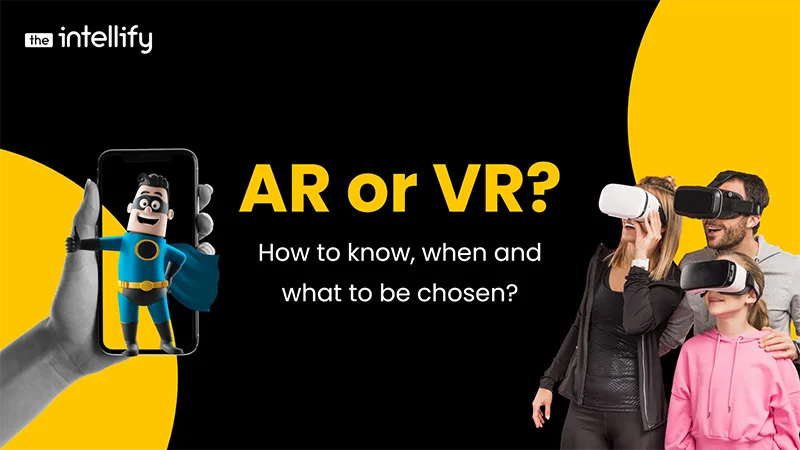
Augmented Reality vs Virtual Reality: Which One Suits Your Needs?
In today’s digital landscape, Augmented Reality (AR) and Virtual Reality App Development (VR) have emerged as revolutionary technologies, transforming how brands engage with customers. AR and VR offer immersive experiences, but they do so in distinct ways, each with capabilities, benefits, and limitations.
Let’s explore how these technologies can redefine customer service, product experience, and brand interaction.
Understanding Augmented Reality and Virtual Reality
Augmented Reality enhances the real-world environment with digital overlays such as images, videos, or interactive elements. It allows users to experience a blended reality where the physical world is augmented by digital enhancements. In contrast, Virtual Reality completely immerses the user in a simulated environment, cutting off physical surroundings for a fully virtual experience.
Example: In Virtual Reality, you can interact with a cow in a virtual field, fully immersed in the digital environment. Meanwhile, in Augmented Reality, you might see a digital cow pop out from a scanned image, blending seamlessly with the physical world.
Key Differences Between AR and VR
| Feature | Augmented Reality (AR) | Virtual Reality (VR) |
|---|---|---|
| Experience | Enhances real-world settings | Creates a fully simulated digital world |
| Physical Environment | Requires physical surroundings | Isolates from the physical environment |
| Hardware | Works on smartphones, tablets, AR glasses | Needs VR headsets and controllers |
| Use Cases | Retail, healthcare, navigation, gaming | Gaming, training, simulations, entertainment |
Both technologies aim to deliver immersive experiences, but their applications and use cases cater to different needs. While AR thrives in environments that require a connection to the real world, VR excels in scenarios where complete immersion is critical.
The Future of AR and VR
The future of AR and VR is incredibly promising, with rapid advancements and increasing commercial applications. Industries like retail, healthcare, education, and entertainment are already harnessing these technologies for enhanced engagement.
In the next few years, AR and VR are expected to become a one-stop solution for businesses, offering engaging and interactive digital solutions with minimal investment.
Why Choose AR or VR?
- Augmented Reality (AR) is the ideal choice if your project demands interaction with the physical environment.
- If your goal is to create a fully immersive digital experience free from real-world distractions, Virtual Reality (VR) is your go-to technology.
Let’s Explore AR and VR Solutions Together
At The Intellify, we deliver tailored AR and VR solutions that align with your conceptual ideas. Whether you’re looking to create an interactive augmented experience or a fully immersive virtual environment, our team guides you every step of the way.
Let’s discuss how these technologies can transform your business and create a unique customer experience. Together, we can identify the right solution—AR or VR—to bring your vision to life.
Conclusion
Augmented Reality (AR) and Virtual Reality (VR) offer incredible opportunities to transform user experiences and business solutions. Choosing the right technology depends on your project’s requirements—whether it’s enhancing the real world or creating an immersive virtual environment.
At The Intellify, we provide expert guidance to help you select and implement the best solution. Ready to innovate? Contact us to bring your vision to life with cutting-edge AR and VR technologies!