Virtual Reality in E-commerce: The Future of Immersive Online Shopping

By Darshak Doshi
April 16, 2026
Summary:
Virtual reality is making online shopping more engaging by helping customers explore products in a more real and interactive way. Instead of guessing from images, people can see details, try items virtually, and feel more confident before buying. This reduces confusion and returns while improving overall satisfaction. As technology grows, more businesses are using VR to create better shopping experiences and stand out in the competitive e-commerce market.
The Shift Toward Immersive Digital Commerce
E-commerce has moved far beyond simple product listings. Today, customers expect more than just images and descriptions they want to explore products, understand them clearly, and feel confident before making a purchase.
This shift is driven by changing user behavior. People are used to interactive digital experiences and expect the same when shopping online. The growing demand for “try-before-you-buy” has made traditional e-commerce feel limited in many cases.
Virtual Reality is emerging as a strong solution to bridge this gap. It brings interaction, clarity, and a more realistic feel to online shopping, making the overall experience more engaging and reliable.
Understanding VR in Ecommerce Landscape
Virtual Reality in e-commerce creates a digital environment where users can explore products more naturally and interactively. Instead of just scrolling through product pages, users can move through virtual spaces and interact with items.
It’s useful to understand the difference between similar technologies. VR offers a fully immersive experience, AR enhances the real world with digital elements, while basic 3D visualization only improves how a product looks on screen.
With the availability of both VR headsets and browser-based experiences, VR is becoming more accessible. Businesses are now using it to build virtual stores, showrooms, and interactive product demonstrations.
Where Traditional E-commerce Falls Short
Traditional e-commerce is convenient, but it often lacks depth in how products are presented. Customers rely on images and descriptions, which don’t always give a complete understanding of the product.
There is also a lack of interaction. Users cannot touch, try, or explore products in a meaningful way, which creates uncertainty during decision-making. This often leads to hesitation, abandoned carts, and higher return rates.
These limitations show why e-commerce needs a more interactive and confidence-driven approach, especially for products where visualization matters.
The Rise of Immersive Shopping Experiences
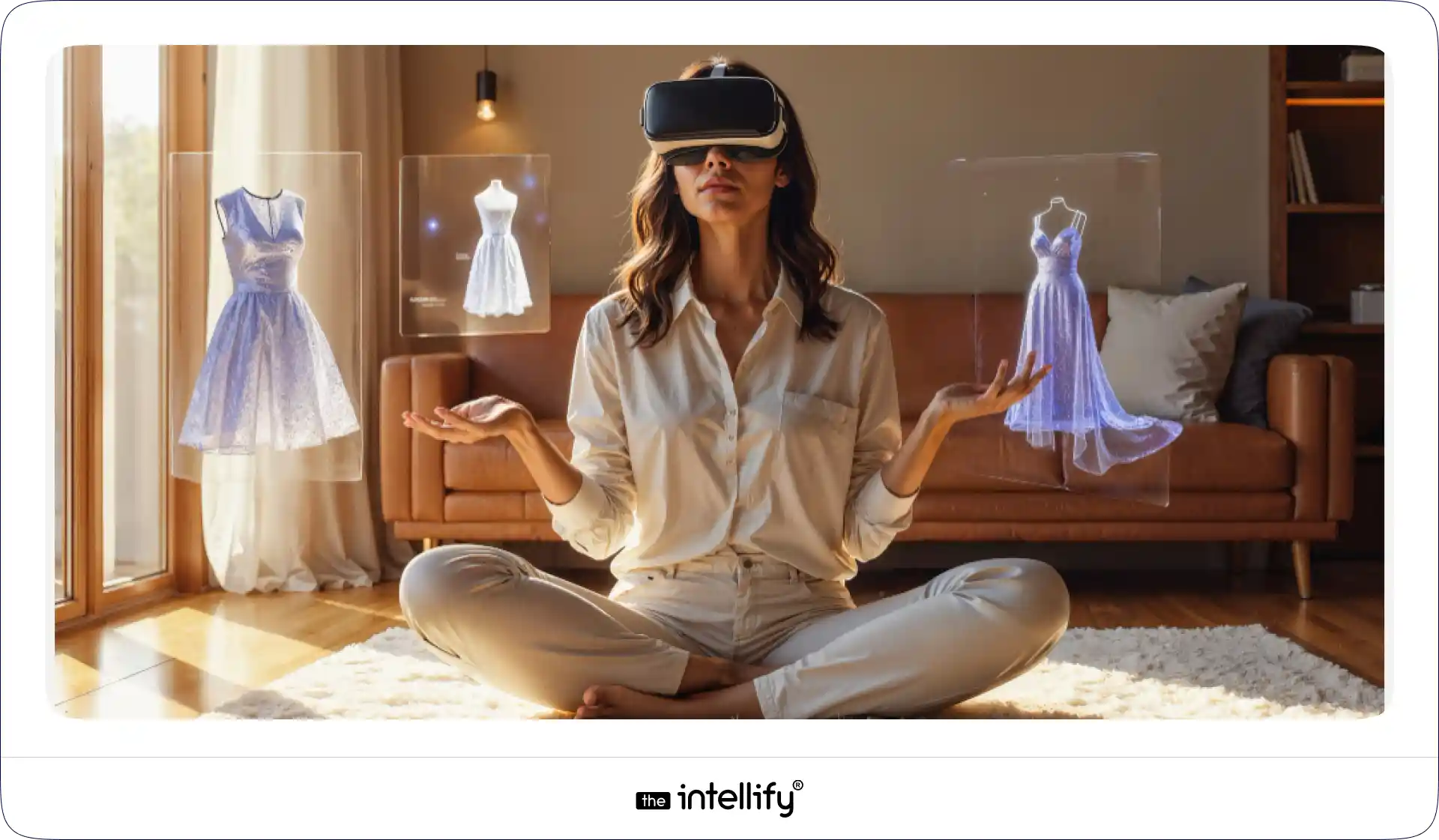
What immersive shopping looks like
Immersive shopping allows users to explore virtual stores, move through spaces, and interact with products in real time. This creates a more natural and engaging way to browse compared to static product pages.
Why it matters for users
When customers can explore products more deeply, they gain better clarity before buying. This reduces confusion and helps them make more confident decisions without second-guessing.
Practical Use Cases of Virtual Reality in E-commerce
Virtual try-ons
Customers can try products like clothing or eyewear virtually, helping them understand fit and appearance before buying. This reduces guesswork and improves satisfaction.
Product exploration
Users can view products from multiple angles and examine details closely. This gives a clearer understanding compared to static images.
Virtual showrooms
Industries like furniture, real estate, and automotive use VR to let users explore spaces or products in a realistic setting, even from a remote location.
Interactive demonstrations
Complex products can be explained visually through interaction, making it easier for customers to understand features without relying only on text.
Why Brands Are Investing in Virtual Reality Development
Improved engagement and conversions
Interactive experiences keep users engaged for longer, which increases the chances of conversion. As businesses invest in VR app development, it becomes easier for customers to explore products clearly and feel more confident about their choices.
Reduced returns
When expectations match reality, customers are less likely to return products. This helps businesses reduce operational costs.
Stronger brand positioning
Offering immersive experiences helps brands stand out and creates a more memorable impression compared to traditional e-commerce.
Virtual Reality Applications Across E-commerce & Retail Industry
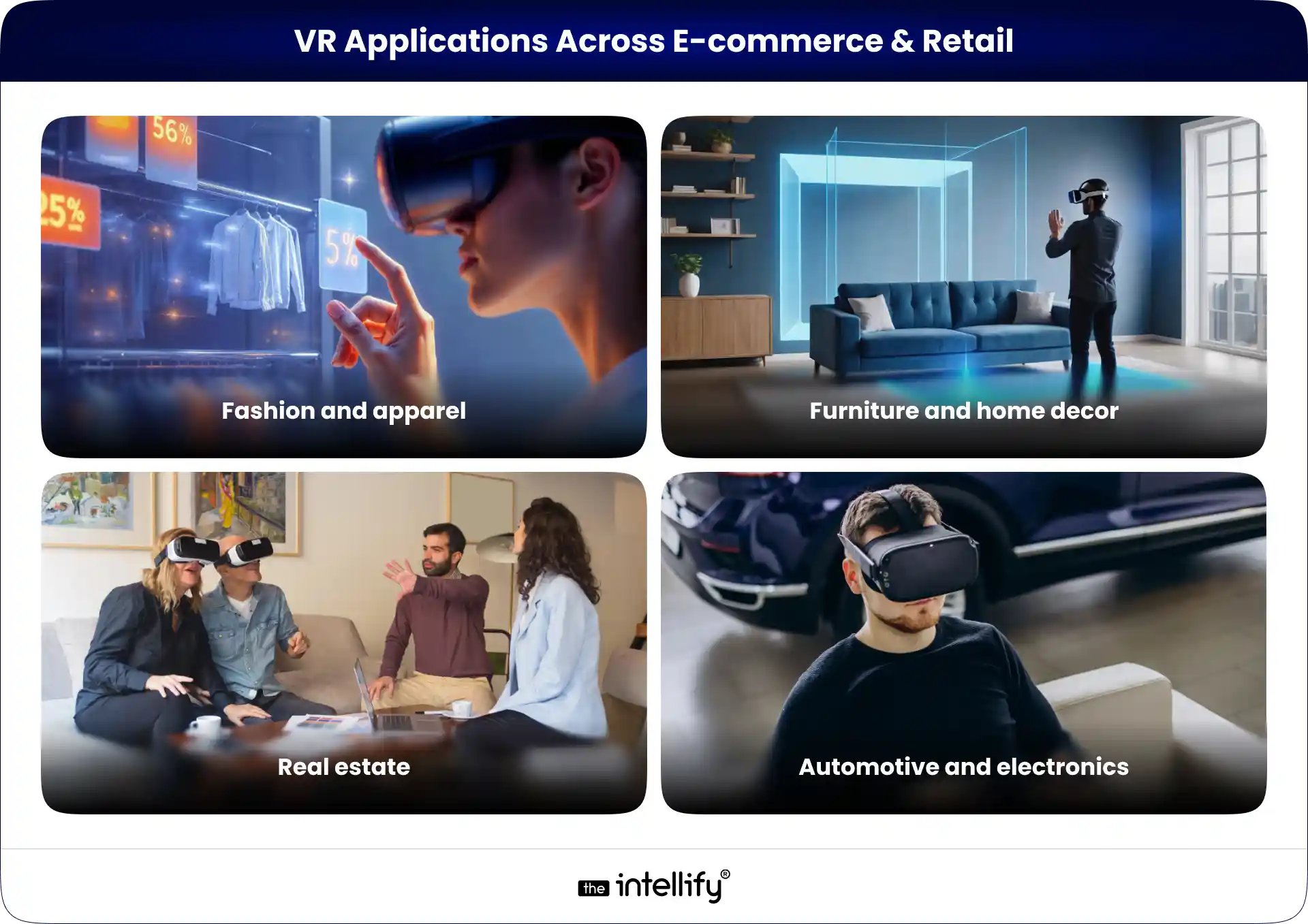
1. Fashion and apparel: Virtual fitting rooms allow users to try outfits digitally, helping them choose styles and sizes more confidently before making a purchase.
2. Furniture and home decor: Customers can visualize how products will look in their own space, making it easier to decide on size, placement, and design.
3. Real estate: Virtual tours allow users to explore properties remotely, saving time while still giving a realistic understanding of the space.
4. Automotive and electronics: Customers can explore product features, customization options, and details in an interactive way, improving their overall understanding.
Enhancing Customer Experience Through VR
- Better product understanding: Interactive exploration helps customers see products in detail, reducing confusion and improving clarity before buying.
- More confident decisions: When users feel sure about their choices, they are more likely to complete purchases without hesitation.
- Stronger engagement: Immersive experiences create a deeper connection with products, making the shopping journey more enjoyable and memorable.
Challenges in Adopting VR for Ecommerce
Adopting Virtual Reality in e-commerce comes with a few practical challenges. One of the main concerns is the cost involved in creating high-quality virtual environments and 3D assets. Businesses need to invest time and resources to build experiences that actually add value.
Another challenge is accessibility. While VR is growing, not all users have access to VR devices, and some may not be familiar with how to use them. This can limit adoption in the early stages.
There are also technical considerations, such as integrating VR with existing e-commerce platforms and maintaining performance across devices. Businesses need to ensure that the experience remains smooth and user-friendly.
Future Trends in Immersive Commerce
The future of e-commerce is clearly moving toward more immersive and interactive experiences. Virtual Reality is expected to play a major role, especially when combined with technologies like AI.
Personalized virtual shopping journeys will become more common, where users see products and experiences tailored to their preferences. At the same time, concepts like the metaverse are opening new possibilities for shared and social shopping environments.
As technology becomes more accessible and affordable, more businesses will start adopting VR. Over time, immersive commerce will become a natural part of how people shop online.
Getting Started: A Practical Approach for Businesses
- Start with focused use cases: Instead of building everything at once, businesses should begin with specific areas like product visualization or virtual demos where VR can add clear value.
- Choose the right approach: Depending on the audience and product type, businesses can adopt VR, AR, or a combination of both to create the best experience.
- Measure and improve: Tracking engagement, conversions, and customer behavior helps businesses understand what works and improve the experience over time.

Conclusion
Virtual Reality is reshaping how people experience online shopping by making it more interactive, clear, and engaging. Instead of relying only on images and descriptions, customers can now explore products in a way that feels closer to real life. This shift helps reduce uncertainty and allows users to make more confident decisions.
As e-commerce continues to evolve, the focus is shifting from convenience to creating meaningful experiences. Virtual Reality may not completely replace traditional e-commerce, but it will play a significant role in shaping its future. Businesses that start adapting to immersive technologies today will be better prepared to meet changing customer expectations tomorrow.
Frequently Asked Questions (FAQs)
1. How is virtual reality different from AR in e-commerce?
Virtual reality creates a fully immersive shopping environment where users can explore stores and products in a simulated space. AR, on the other hand, adds digital elements to the real world, like placing furniture in your room using a phone.
2. Do customers really use VR for online shopping today?
Yes, but it’s still growing. Some brands already offer virtual showrooms and try-on experiences, especially in fashion, furniture, and real estate. Adoption is increasing as technology becomes more accessible.
3. Can virtual reality actually improve conversion rates in e-commerce?
It can. When users can explore products in detail and feel more confident about what they’re buying, they’re more likely to complete a purchase and less likely to return it later.
4. What types of products benefit most from VR shopping experiences?
Products that require visualization or physical context work best like clothing, furniture, cars, and real estate. These are items where customers usually want to “see” before buying.
5. Is virtual reality only for big e-commerce brands?
Not anymore. While early adoption was mostly by large companies, smaller businesses can now start with focused VR features or hybrid experiences without a huge investment.
6. How does VR reduce product returns in e-commerce?
By giving customers a clearer understanding of size, design, and fit before buying. When expectations match reality, return rates naturally go down.


Written By, Darshak Doshi
With over a decade of experience, Darshak is a technopreneur specializing in cloud-based applications and product development in healthcare, insurance, and manufacturing. He excels in AWS Cloud, backend development, and immersive technologies like AR/VR to drive innovation and efficiency. Darshak has also explored AI/ML in insurance and healthcare, pushing the boundaries of technology to solve complex problems. His user-focused, results-driven approach ensures he builds scalable cloud solutions, cutting-edge AR/VR experiences, and AI-driven insights that meet today’s demands while anticipating future needs.

Augmented Reality in Retail: How It Improves the Shopping Experience
Summary: Shopping today is becoming more interactive and experience-driven, with technologies like augmented reality in retail helping customers make better decisions. By enabling virtual try-ons and real-world product visualization, AR reduces uncertainty and improves confidence before purchase. This blog explores how AR enhances customer experience, connects online and in-store journeys, and helps businesses achieve higher […]
Virtual Reality in Education: Applications, Benefits & Future of Learning
Summary: Virtual reality in education is changing how students learn by making lessons more interactive and practical. Instead of only reading or listening, learners can explore concepts through immersive experiences. This blog explains how VR is used across subjects, its key benefits, real-world applications, challenges, and future trends. It also covers how institutions can adopt […]
Indoor Navigation with AR: The Future of Smart Wayfinding Systems
Summary: AR-powered indoor navigation is helping businesses deliver smarter and more seamless wayfinding experiences. By guiding users with real-time visual directions, it eliminates confusion in complex environments like hospitals, malls, airports, and campuses. These solutions not only improve visitor satisfaction but also enhance operational efficiency and accessibility. As demand for smarter buildings grows, indoor navigation […]
Augmented Reality in Retail: How It Improves the Shopping Experience
Summary: Shopping today is becoming more interactive and experience-driven, with technologies like augmented reality in retail helping customers make better decisions. By enabling virtual try-ons and real-world product visualization, AR reduces uncertainty and improves confidence before purchase. This blog explores how AR enhances customer experience, connects online and in-store journeys, and helps businesses achieve higher […]
Virtual Reality in Education: Applications, Benefits & Future of Learning
Summary: Virtual reality in education is changing how students learn by making lessons more interactive and practical. Instead of only reading or listening, learners can explore concepts through immersive experiences. This blog explains how VR is used across subjects, its key benefits, real-world applications, challenges, and future trends. It also covers how institutions can adopt […]
Indoor Navigation with AR: The Future of Smart Wayfinding Systems
Summary: AR-powered indoor navigation is helping businesses deliver smarter and more seamless wayfinding experiences. By guiding users with real-time visual directions, it eliminates confusion in complex environments like hospitals, malls, airports, and campuses. These solutions not only improve visitor satisfaction but also enhance operational efficiency and accessibility. As demand for smarter buildings grows, indoor navigation […]
0
+0
+0
+0
+Committed Delivery Leads To Client Satisfaction
Client Testimonials that keep our expert's spirits highly motivated to deliver extraordinary solutions.

Christopher Seny
My experience working with The Intellify, has been a great experience. The team has a wealth of expertise in the tech space. Working with the intellify was a growing experience for me, I learned a lot. The team keeps great communication & responds fast to new ideas & suggestions. The team also provides great suggestions & solutions as well. I couldn’t imagine working with anybody else on this project & it has been a blessing working with, The Intellify.

Izandi Serdyn
The Intellify delivered a platform from scratch, involving the client at every stage. The team was communicative, responsive, and punctual throughout the engagement. Virtual meetings and emails ensured seamless project management. Customers can expect a team that can work fast.

Kya Johnson
The app serves as an effective introduction for users to the product and its characters. Responsive and faithful to initial requirements, The Intellify’s team exceeded initial expectations. Internal stakeholders were particularly pleased with their communication.

Stefan Wyk
Working with The Intellify to develop our website was an outstanding experience. Their team displayed exceptional professionalism, creativity, and technical expertise throughout the entire process. The final product exceeded our expectations, delivering a sleek, user-friendly, and highly functional website. We highly recommend The Intellify to anyone in need of top-tier web development services.

Steve Thorpe
The Intellify’s work has been met with high praise from internal and external stakeholders. The team is efficient, diligent, and reliable in their service. They go above and beyond in terms of communication and project management. The Intellify is a responsive vendor that gets the job done.

Tal Dotan
I’ve been working with The Intellify for the last 3 years. During this period of time we’ve planned and executed projects in both small and large scale. Working with The Intellify was and still is the best decision I’ve made when rising up Divo, I strongly recommend to work with them in any type of project.


 +1-302-803-4983