Summary:
Healthcare systems today are under pressure to deliver faster, more efficient care while managing growing workloads and fragmented processes. AI automation in healthcare is helping streamline workflows like patient onboarding, documentation, billing, and communication, improving both operations and care delivery. This blog explores how automation fits into healthcare, its real-world applications, key benefits, challenges, and how organizations can adopt it effectively to build more connected and patient-centered systems.
The Growing Pressure on Modern Healthcare Systems
Patients expect faster responses, smoother experiences, and fewer delays. Waiting weeks for reports or chasing updates? That doesn’t sit well anymore. People compare healthcare experiences to other industries now, like banking and e-commerce, where things just work. That expectation shift is real.
At the same time, hospitals are seeing more patients than ever. Ageing populations, chronic conditions, and increased awareness all contribute to higher demand. The system isn’t just busy, it’s constantly operating near its limits.
Then comes the administrative burden. Doctors and nurses spend a surprising amount of time on non-clinical work like documentation, scheduling, and coordination. It eats into time meant for patient care. Over time, that leads to frustration and burnout. You can feel it in conversations with healthcare professionals, they’re tired, not of helping patients, but of everything around it.
Another issue? Disconnected systems. A patient’s data might live in multiple platforms, EHRs, lab systems, and billing tools, and they don’t always sync properly. That leads to delays, repeated tests, or incomplete information during decision-making.
Traditional workflows weren’t designed for this level of complexity. They worked when volumes were lower and systems simpler. Today, they’re struggling to keep up.
Defining AI Automation in Healthcare Today
AI Automation in Healthcare isn’t just about speeding things up, it’s about making smarter decisions without constant manual effort.
Earlier, automation meant basic rules. If X happens, do Y. Simple, predictable, and a bit rigid. Now, with healthcare AI automation, systems can actually learn, adapt, and assist in decision-making.
Instead of manually reviewing patient records, AI can highlight patterns. Instead of scheduling everything by hand, systems can optimize appointments based on urgency, availability, and history. This shift from manual work to intelligent systems is changing how healthcare operates quietly but steadily.
In daily operations, AI automation shows up quietly:
- Suggesting next steps in patient care
- Flagging anomalies in reports
- Automating routine communication
- Prioritizing tasks based on real-time data
It’s not replacing healthcare professionals. It’s more like reducing the noise so they can focus on what matters. Across the care journey from patient onboarding to diagnosis to post-treatment follow-ups, this technology is already being used. Not everywhere, not perfectly, but enough to create visible improvements.
Gaps in Today’s Healthcare Workflow

If you step back and observe, the inefficiencies are hard to ignore.
Repetitive administrative tasks take a lot of time. Data entry, form filling, and insurance verification are necessary work, but not the best use of highly trained professionals.
Patient Communication delays are another pain point. Patients wait for confirmations. Staff wait for approvals. Small gaps, but they stack up.
Data fragmentation is another issue. Information is spread across systems and departments. Bringing it together takes effort, and sometimes important details slip through the cracks.
All of this impacts care quality in subtle but important ways:
- Slower decision-making
- Increased chances of human error
- Gaps in patient experience
- Added pressure on staff
Operational efficiency also suffers. Processes move, but not smoothly. There’s friction at multiple points and over time, that friction adds up.
How AI-Driven Automation Fits into Healthcare Workflows
AI-driven automation works by turning scattered data into meaningful action.
It starts with data capture, like patient records, lab results, clinical notes, and device data. This data is then processed using machine learning and natural language processing. These technologies help systems understand both structured and unstructured information.
For instance, clinical notes written in plain language can be analyzed automatically. Important insights can be extracted without manual review.
Integration plays a big role here. When connected with EHRs and hospital systems, automation becomes part of the workflow rather than an add-on.
There are two main approaches:
- Real-time automation: Immediate actions based on live data (like alerts or recommendations)
- Trigger-based workflows: Actions initiated when specific conditions are met (like sending reminders after discharge)
Both approaches serve different needs, and most healthcare systems use a mix of both.
The real shift? Faster, data-driven decisions. Instead of relying on delayed inputs or manual checks, teams can act on real-time insights.
Key Areas Where Healthcare Workflow Automation Creates Impact
AI in Healthcare workflow automation doesn’t focus on just one area, it improves multiple parts of the system at once.
- Patient onboarding becomes smoother. Forms are pre-filled, data is validated instantly, and appointments get scheduled without back-and-forth.
- Clinical documentation improves too. Notes can be captured and structured automatically, reducing manual effort.
- Billing and insurance processing see major benefits. Claims can be verified, errors flagged, and approvals processed faster. This alone can save a lot of time and reduce financial friction.
- Internal coordination improves as well. When systems are connected, departments don’t operate in isolation. Information flows more freely.
- Remote monitoring is another growing area. Devices continuously send patient data, and systems trigger alerts when something unusual is detected.
These changes may seem small individually, but together they create a smoother, more efficient workflow.
Real-World Applications of Workflow Automation in Healthcare
In practice, workflow automation is already shaping how healthcare operates.
- Hospitals use it to streamline daily tasks, from admissions to discharge. What used to take hours can now be done in minutes.
- Clinics and diagnostic centers rely on automation for managing patient flow, test scheduling, and report generation. It reduces chaos during peak hours. Telehealth platforms depend heavily on automation. Without it, managing virtual consultations, reminders, and follow-ups would be overwhelming.
- Patient communication has improved significantly. Automated reminders for appointments, medication schedules, and follow-ups keep patients informed without adding to staff workload.
- One noticeable benefit is workload reduction, not by cutting staff, but by reducing unnecessary tasks. Teams can focus more on patient care instead of administrative work.
- Billing, insurance verification, and claims processing have become faster and more accurate. Appointment scheduling is more organized. Follow-ups happen on time.
- Coordination between departments improves, too. Information doesn’t get stuck; it moves where it’s needed.
- For patients, the experience feels more connected. Fewer delays, clearer communication, and a more predictable journey across touchpoints.
Implementing Healthcare Automation Services the Right Way
Implementing healthcare automation services works best when you keep it simple and focused.
1. Start by identifying high-impact workflows tasks that are repetitive and time-consuming, like scheduling, onboarding, or billing. These areas usually deliver quick wins.
2. Make sure automation aligns with your existing systems. If it doesn’t integrate well, it can create more problems than it solves.
3. Staff adoption is just as important. Teams need to understand how it helps them, not just the process. A gradual rollout and basic training can make a big difference.
4. Avoid adding too much complexity early on. Start small, test what works, and expand slowly.
5. If your processes feel slow, repetitive, or hard to scale, that’s a clear sign you’re ready for automation.
Measurable Benefits for Care Delivery and Operations
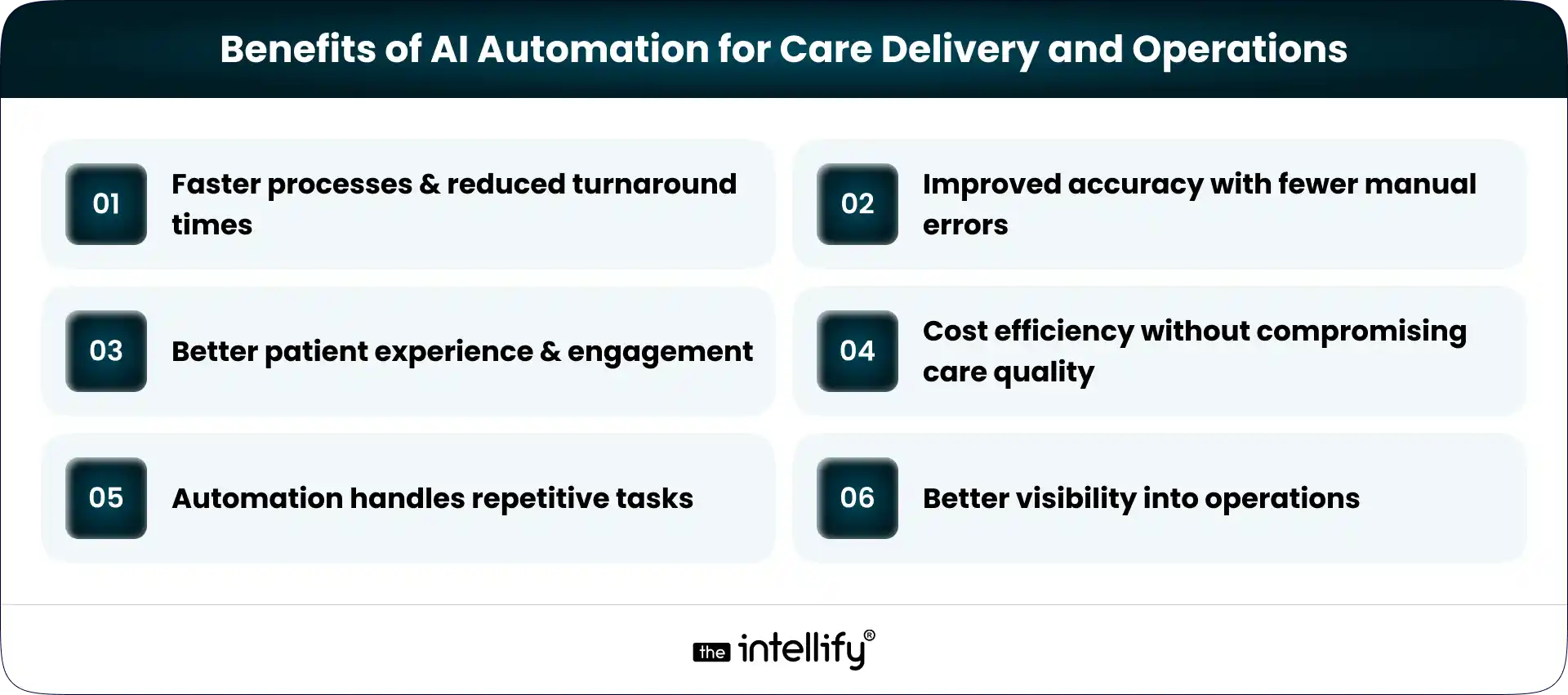
The impact of automation shows up in both numbers and day-to-day experience.
1. Processes become faster. Turnaround times for reports, approvals, and communication decrease.
2. Accuracy improves. Automated systems reduce manual errors, especially in data entry and documentation.
3. Patients experience smoother interactions. Shorter wait times, timely updates, and better overall communication.
4. Cost efficiency improves gradually. Not through drastic cuts, but by optimizing existing resources.
5. Healthcare teams benefit too. Automation handles repetitive tasks, allowing professionals to focus on more meaningful work.
There’s also better visibility into operations. Leaders can track performance, identify bottlenecks, and make informed decisions based on real data.
Common Challenges in Healthcare AI Automation
Despite its benefits, healthcare AI automation comes with challenges.
- Resistance to change within healthcare teams: Healthcare professionals are careful, and they should be. New systems need to prove reliability before gaining trust.
- Data privacy, compliance, and security concerns: Patient data must be handled securely, with strict adherence to regulations.
- Integration with legacy systems: It can make integration difficult. Many healthcare organizations still rely on older infrastructure that isn’t built for modern automation.
- Maintaining balance is another challenge. Automation should support decision-making, not replace human judgment, especially in clinical scenarios.
These challenges require planning, but they’re manageable with the right approach.
How Automation is Reshaping Hospitals and Healthcare Systems
Automation is gradually changing how hospitals operate, less fragmented, more connected.
There’s a clear shift toward data-driven environments. Information flows more easily across systems, so teams aren’t working in silos anymore. Decisions are based on real-time data, not delayed reports.
AI is also playing a bigger role, both in clinical and operational decisions. It helps surface insights, flag risks, and support faster actions without replacing human judgment.
Automation is no longer limited to one department. What starts in areas like billing or scheduling often expands across the organization once results become visible.
All of this leads to more coordinated care delivery. Departments stay aligned, communication improves, and the overall patient experience feels more consistent.
How Healthcare Automation Is Evolving
Rise of predictive and preventive care models
Healthcare is moving from reacting to problems → predicting them early. Systems can flag risks before they become serious issues.
More personalized patient journeys
Care plans are becoming more tailored, based on patient history, behavior, and real-time data not just standard protocols.
Real-time insights guiding decisions
Decisions are no longer delayed. Doctors and staff can act on live data, improving the speed and accuracy of care.
Expansion into remote and home-based care
Automation is enabling continuous monitoring outside hospitals, making care more accessible and less dependent on physical visits.

Conclusion
AI automation in healthcare is steadily improving how care is delivered and how operations are managed, helping reduce delays, minimize manual effort, and support better decision-making across the system. From streamlining workflows to enhancing patient experiences, the impact is visible, even if it’s happening gradually.
The key, though, is not rushing into it. A thoughtful, phased approach works better starting with the right use cases, aligning with existing systems, and ensuring teams are comfortable with the change. In the long run, it’s less about automation itself and more about building a healthcare system that is efficient, responsive, and truly centered around patient needs.
Frequently Asked Questions (FAQs)
1. Where does AI automation create the most impact in healthcare today?
It usually starts with operational areas like scheduling, billing, and patient communication. These are repetitive and time-consuming, so automation quickly improves efficiency and reduces delays.
2. How does AI automation improve the patient experience in practical terms?
Patients notice faster responses, fewer delays, and smoother coordination. Things like timely updates and easy communication make the overall care journey feel more organized.
3. What’s the difference between basic automation and AI-driven automation in healthcare?
Basic automation follows fixed rules, while AI-driven systems can learn from data and adapt over time. This helps improve accuracy and supports better decision-making.
4. How does automation change the day-to-day work of healthcare teams?
It reduces repetitive tasks like data entry and follow-ups, allowing staff to focus more on patient care and important decisions rather than routine work.
5. Can AI automation work with existing hospital systems, or does everything need to change?
Most solutions are designed to integrate with existing systems like EHRs, so organizations can improve workflows without replacing everything.
6. What are the early signs that a healthcare organization is ready for automation?
Frequent delays, high manual workload, and coordination issues are clear indicators. If teams are spending too much time on repetitive tasks, automation can help.
7. What’s the best place to start with AI automation in healthcare?
Start with workflows that are repetitive and time-consuming, like scheduling, billing, or patient communication. These areas usually deliver quick and measurable improvements.



Written By, Jalaj Shah
The COO and Co-Founder of The Intellify. Jalaj enjoys experimenting with new strategies. His posts are fantastic for businesses seeking innovative development ideas. Discover practical insights from his engaging content.

How to Automate Patient Onboarding in a Direct Primary Care Practice
Summary: Patient onboarding automation helps Direct Primary Care (DPC) practices simplify registration, digital intake forms, membership agreements, payment setup, and patient communication. This blog explains how to automate key onboarding workflows, integrate existing healthcare systems, protect patient information, and measure operational improvements. It also covers implementation best practices to help DPC practices reduce administrative work […]
How to Integrate AI Into an Existing DPC Platform Without Rebuilding It
Summary: This blog explains how to integrate AI into an existing Direct Primary Care (DPC) platform without rebuilding the entire system. It covers AI use cases, API integrations, implementation steps, HIPAA compliance, security considerations, common challenges, and costs. DPC practices can use these insights to modernize existing software, streamline administrative workflows, and improve operational efficiency. […]
How to Scale a Direct Primary Care Practice With Technology
Summary: This guide explains how technology can help Direct Primary Care practices scale without increasing administrative workload at the same pace. It covers DPC software, membership management, scheduling, billing, patient communication, automation, AI, and healthcare platform modernization, while outlining practical ways practices can build a more connected and scalable technology infrastructure. Running a Direct […]
How to Automate Patient Onboarding in a Direct Primary Care Practice
Summary: Patient onboarding automation helps Direct Primary Care (DPC) practices simplify registration, digital intake forms, membership agreements, payment setup, and patient communication. This blog explains how to automate key onboarding workflows, integrate existing healthcare systems, protect patient information, and measure operational improvements. It also covers implementation best practices to help DPC practices reduce administrative work […]
How to Integrate AI Into an Existing DPC Platform Without Rebuilding It
Summary: This blog explains how to integrate AI into an existing Direct Primary Care (DPC) platform without rebuilding the entire system. It covers AI use cases, API integrations, implementation steps, HIPAA compliance, security considerations, common challenges, and costs. DPC practices can use these insights to modernize existing software, streamline administrative workflows, and improve operational efficiency. […]
How to Scale a Direct Primary Care Practice With Technology
Summary: This guide explains how technology can help Direct Primary Care practices scale without increasing administrative workload at the same pace. It covers DPC software, membership management, scheduling, billing, patient communication, automation, AI, and healthcare platform modernization, while outlining practical ways practices can build a more connected and scalable technology infrastructure. Running a Direct […]
0
+0
+0
+0
+Committed Delivery Leads To Client Satisfaction
Client Testimonials that keep our expert's spirits highly motivated to deliver extraordinary solutions.

Christopher Seny
My experience working with The Intellify, has been a great experience. The team has a wealth of expertise in the tech space. Working with the intellify was a growing experience for me, I learned a lot. The team keeps great communication & responds fast to new ideas & suggestions. The team also provides great suggestions & solutions as well. I couldn’t imagine working with anybody else on this project & it has been a blessing working with, The Intellify.

Izandi Serdyn
The Intellify delivered a platform from scratch, involving the client at every stage. The team was communicative, responsive, and punctual throughout the engagement. Virtual meetings and emails ensured seamless project management. Customers can expect a team that can work fast.

Kya Johnson
The app serves as an effective introduction for users to the product and its characters. Responsive and faithful to initial requirements, The Intellify’s team exceeded initial expectations. Internal stakeholders were particularly pleased with their communication.

Stefan Wyk
Working with The Intellify to develop our website was an outstanding experience. Their team displayed exceptional professionalism, creativity, and technical expertise throughout the entire process. The final product exceeded our expectations, delivering a sleek, user-friendly, and highly functional website. We highly recommend The Intellify to anyone in need of top-tier web development services.

Steve Thorpe
The Intellify’s work has been met with high praise from internal and external stakeholders. The team is efficient, diligent, and reliable in their service. They go above and beyond in terms of communication and project management. The Intellify is a responsive vendor that gets the job done.

Tal Dotan
I’ve been working with The Intellify for the last 3 years. During this period of time we’ve planned and executed projects in both small and large scale. Working with The Intellify was and still is the best decision I’ve made when rising up Divo, I strongly recommend to work with them in any type of project.


 +1-302-803-4983