AI Solutions for Enterprises: Implementation Guide with ROI Insights

By Shravan Rajpurohit
May 8, 2026
Summary:
AI is changing how enterprises work, helping them improve efficiency and make better decisions. It’s no longer just about new technology, but about using it in the right way to solve real business problems. From getting started to scaling across teams, each step matters in making AI work effectively. This guide gives a clear view of how enterprises can use AI in a practical and meaningful way.
Businesses today are evolving faster than ever, and AI is becoming a key part of that change. It’s no longer just something new to explore; companies are now using AI to improve how they work, make better decisions, and handle everyday tasks more efficiently. This shift is opening up new possibilities across different teams and industries.
In this guide, we’ll look at how AI is being used in enterprises, where it creates the most value, and how businesses can get started practically. We’ll also cover simple implementation steps and how to measure impact over time.
Why AI Is Becoming a Core Business Priority for Enterprises
Businesses today are moving beyond digital tools and increasingly relying on AI to make everyday decisions. With so much data coming in from different sources, it’s becoming harder to manage things manually. AI helps simplify this by turning data into useful insights that teams can actually act on.
At the same time, AI is no longer just about trying something new; it’s becoming a key part of staying competitive. Many companies are shifting from small experiments to more serious, long-term use. While some are still exploring, others are already starting to scale AI across their operations.
How AI Is Being Applied Across Enterprise Functions
AI solutions aren’t confined to one department they can reshape various aspects of an organization. AI is being used across different parts of the business, from customer support and operations to finance and HR. It helps automate routine work, improve accuracy, and support better decision-making without adding extra effort to teams.
Instead of using separate tools, many enterprises are now connecting AI across systems to make processes smoother. Different industries are using it in their own way, but the idea is the same. AI works best when it becomes part of the overall business, not just one function.
Understanding the Scope of AI for Enterprises
What does “AI for enterprises” really entail?
- Core Components: It consists of systems, models, and decision-making layers that work together harmoniously.
- Types of Technology: Machine learning (ML), natural language processing (NLP), generative AI, and computer vision are all key players.
- Distinguishing AI: It’s crucial to differentiate between straightforward automation, analytics, and true AI-driven intelligence.
- Enterprise requirements: To build a successful AI strategy, scalability, security, and interoperability are essential.
- Structured Adoption: Implementing AI systematically is far more effective than ad-hoc solutions, which can lead to disappointing results.
Key Use Cases That Drive Value for Enterprise
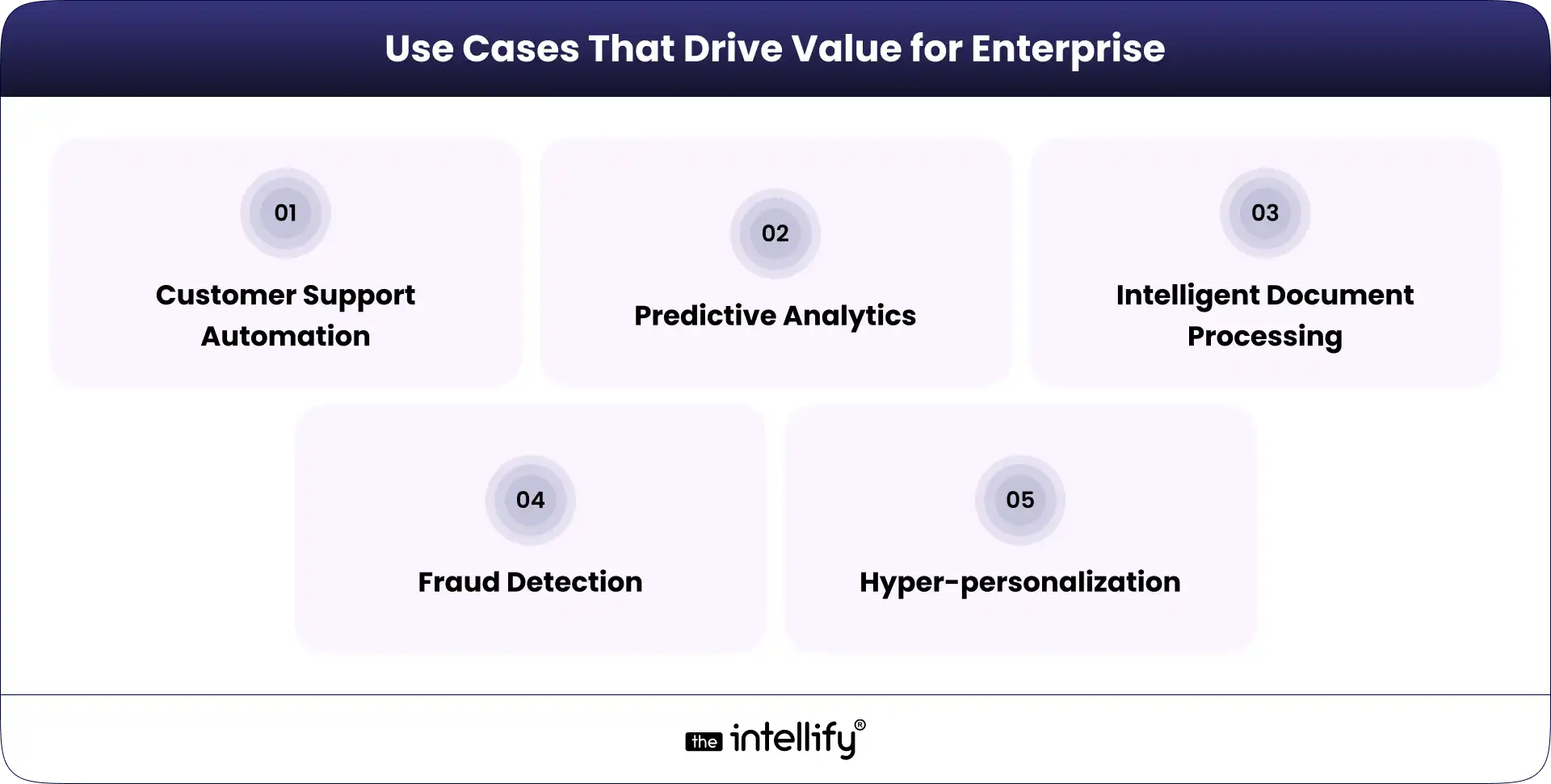
Identifying use cases that deliver the most value is key to successful AI deployment. Here are a few impactful applications:
1. Customer Support Automation: Chatbots and voice AI help handle customer queries instantly and reduce response time. They also support teams by managing routine questions, allowing staff to focus on more complex issues.
2. Predictive Analytics: Using data to forecast trends helps businesses plan better and make informed decisions. It improves demand forecasting, resource allocation, and reduces the chances of unexpected issues.
3. Intelligent Document Processing: AI can quickly process and organize large volumes of documents, reducing manual work. This helps improve accuracy and speeds up workflows across departments.
4. Fraud Detection: Real-time monitoring helps identify unusual activities and prevent potential threats. This makes systems more secure and reduces financial and operational risks.
5. Hyper-personalization: Recommendation systems analyze user behavior to offer more relevant products or services. This improves customer experience and helps increase engagement and conversions.
When choosing use cases, weigh the potential business impact against complexity to ensure a successful rollout.
Key Barriers That Slow Down Enterprise AI Adoption
Even with all its promise, several challenges can impede successful AI adoption:
- Data silos: When data is scattered across systems or not consistent, it becomes difficult to get accurate insights. This limits how effectively AI models can perform.
- Legacy infrastructure: Older systems are often not designed to support modern AI tools, making integration more complex and time-consuming.
- Budget constraints: Many organizations struggle to balance the cost of AI implementation with uncertain ROI, especially in the early stages.
- Skill gaps: Lack of in-house expertise can slow down progress, and heavy reliance on external partners may delay execution and scaling.
Overcoming these barriers requires commitment and strategic planning.
How to Identify the Right Starting Point for AI in Your Enterprise
Getting Started with AI: Readiness and First Steps
- Signs your business is ready for AI: Spot areas where AI can genuinely make a difference, like customer support or supply chain operations.
- Evaluating Readiness: Analyze your data maturity, current infrastructure, and team capabilities.
- Identifying quick-win opportunities: Focus on use cases that promise both feasibility and high ROI potential.
- When AI May Not Be Right: Be mindful of situations where diving into AI might not be the smartest choice, such as unclear data or organizational goals.
AI for Enterprises: From Strategy to Execution
Laying the groundwork for successful AI solutions involves several key steps:
Defining Objectives
Start by clearly identifying what you want to achieve with AI, such as improving efficiency or reducing costs. Setting clear goals and success metrics helps keep the implementation focused.
Mapping Use Cases
Identify and prioritize use cases that can deliver the most value. Focus on areas where AI can solve real problems or improve existing processes.
Preparing Data Pipelines
Ensure your data is clean, organized, and accessible. Strong data pipelines and governance are essential for AI systems to work effectively.
Choosing the Right Tools
Select tools, platforms, or partners that fit your business needs and existing systems. The right choice makes implementation smoother and more scalable.
Building Pilots
Start with a small pilot or proof of concept to test how the solution works. This helps validate results before scaling it across the organization.
Testing and Scaling
Testing is vital to ensure your AI solutions yield the expected results. Once validated, successful projects can be expanded throughout the organization.
Building an Enterprise AI Strategy That Aligns with Business Goals
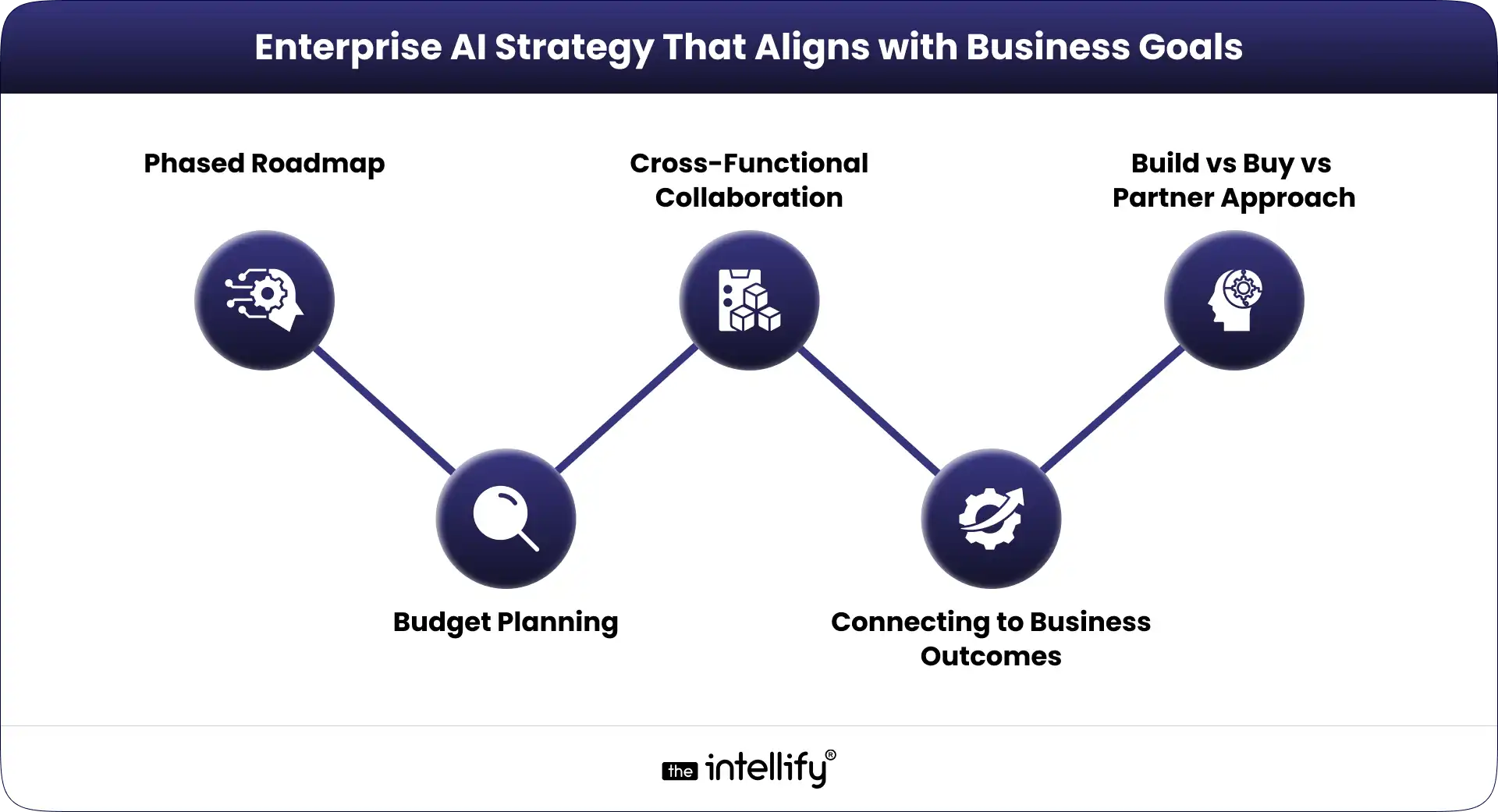
A successful AI strategy should align seamlessly with your broader business objectives:
- Phased Roadmap: Plan a clear timeline with a mix of quick wins and long-term initiatives. This helps show early results while building toward bigger goals.
- Budget Planning: Allocate your budget carefully by focusing on initiatives that deliver the most value. It’s important to balance costs with expected outcomes.
- Cross-Functional Collaboration: Ensure teams across departments work together. This improves coordination and helps AI initiatives run more smoothly.
- Connecting to Business Outcomes: Link every AI effort to clear business goals, such as improving efficiency, increasing revenue, or enhancing customer experience.
- Build vs Buy vs Partner Approach: Decide whether to build in-house, use existing tools, or work with partners based on your resources and long-term plans.
Measuring ROI of AI in Enterprises
To grasp the true value of your AI investments, keep the following in mind:
- Key Performance Indicators (KPIs): Establish measurable metrics covering efficiency, cost savings, and revenue growth.
- Understanding Time-to-Value: Differentiate between immediate and long-term ROI.
- Real-World Examples: Use benchmarks from organizations that have effectively measured their AI success.
- Linking AI to Business Performance: Connect AI outcomes directly to business results, such as improved productivity, better decision-making, or increased customer satisfaction.
- Avoiding Common Mistakes: Don’t rely only on short-term results or unclear metrics focus on consistent tracking and realistic expectations to measure true success
Governance, Security, and Responsible AI in Enterprise Environments
Effective governance is key to ensuring responsible AI use:
- Data Privacy: Ensure compliance with regulations while handling sensitive data carefully and securely.
- Bias Management: Put checks in place to reduce bias and maintain fairness in AI-driven decisions.
- Transparency: Keep AI processes clear and explainable so decisions can be understood and trusted.
- Governance Frameworks: Set clear internal rules for how AI is used across the business. This helps maintain consistency and alignment with company policies.
- Risk Management and Monitoring: Regularly monitor AI systems to identify issues early. This keeps systems reliable and reduces potential risks over time.
Scaling AI Across the Enterprise
Moving from pilot projects to full-scale implementations is a crucial phase:
- Standardizing Processes: Create a common framework for AI initiatives so teams can follow a consistent approach across the organization.
- Upskilling Teams: Invest in training so employees can understand and work effectively with AI tools in their daily tasks.
- Continuous Optimization: Regularly review performance and make improvements to keep AI systems efficient and relevant over time.
- Transitioning from PoC to Deployment: Turn successful pilot projects into practical solutions used across teams. This requires proper planning and smooth integration with existing systems.
- Change Management and Leadership Support: Strong leadership helps guide teams through change. Clear communication and training make adoption easier and reduce resistance.
The Future of AI in Enterprises
AI in enterprises is growing fast, with trends like generative AI helping automate content and tasks. Hyper-automation is also making processes more efficient by combining AI with automation. Many businesses are now using AI to support better and faster decision-making.
Industry-specific solutions are also becoming more common, making AI more practical. To stay ahead, enterprises need to stay flexible and keep adapting as technology evolves.
Conclusion
AI isn’t just a one-off project; it’s a long-term journey. Organizations should begin with targeted use cases and scale strategically, balancing technology, human resources, and processes. With a solid roadmap and the right mindset, enterprises can turn AI into a sustainable advantage.
The key is to focus on real business value rather than just adopting new technology. Start small, learn from early results, and build step by step. Over time, this approach helps create a strong foundation where AI becomes a natural part of everyday operations.
Frequently asked questions (FAQs)
1. How can a business start using AI without making it too complex?
Start with one clear problem where AI can help, like saving time or improving support. Test a small solution first, then scale once it shows results.
2. How long does it take to implement AI in an enterprise?
Small AI projects can take a few weeks to a couple of months. Larger implementations take longer depending on data and system complexity.
3. How can we measure if AI is actually working?
Track simple results like time saved, cost reduced, or faster processes. If these improve, your AI solution is delivering real value.
4. Can small or growing businesses also benefit from AI?
Yes, AI is useful for businesses of all sizes, not just large enterprises. Smaller companies can start small and scale as they grow.
5. What are the common challenges when starting with AI?
Unclear goals, poor data quality, and trying too much at once are common issues. Starting with a focused approach helps avoid these problems.
6. Will AI work with our existing systems, like CRM or ERP?
Yes, most AI solutions can integrate with tools like CRM and ERP systems. The key is having clean and accessible data for better results.
7. Is AI implementation very expensive to start with?
It depends on the use case, but you don’t need a huge budget to begin. Many businesses start small and invest more after seeing results.


Written By, Shravan Rajpurohit
Shravan Rajpurohit is the Co-Founder & CEO of The Intellify, a leading Custom Software Development company that empowers startups, product development teams, and Fortune 500 companies. With over 10 years of experience in marketing, sales, and customer success, Shravan has been driving digital innovation since 2018, leading a team of 50+ creative professionals. His mission is to bridge the gap between business ideas and reality through advanced tech solutions, aiming to make The Intellify a global leader. He focuses on delivering excellence, solving real-world problems, and pushing the limits of digital transformation.

Where AI Voice Agents Fit Into a Modern DPC Platform
Summary: AI voice agents can become a practical part of a modern Direct Primary Care (DPC) platform by handling routine phone interactions, appointment scheduling, membership questions, reminders, and call routing. This guide explains where voice AI fits within the DPC technology stack, what tasks it should and shouldn’t handle, HIPAA considerations, integration requirements, and how […]
AI Appointment Scheduling in Healthcare: How It Works, Key Benefits & Costs in 2026
Summary: AI appointment scheduling helps healthcare organizations automate booking, reduce no-shows, optimize provider schedules, and improve patient access to care. This guide explains how AI scheduling works, its key benefits, essential features, implementation costs, EHR integration requirements, and future trends shaping healthcare operations in 2026. A missed appointment doesn’t just create an empty slot in […]
How to Build AI for Real Estate Investment and Market Analysis
Summary: AI for real estate investment is helping investors and property businesses make smarter, faster, and more data-driven decisions. This guide explains how to build an AI-powered real estate investment platform, covering essential features, data sources, AI technologies, market analysis capabilities, development steps, business benefits, and future trends shaping the real estate industry. Real […]
Where AI Voice Agents Fit Into a Modern DPC Platform
Summary: AI voice agents can become a practical part of a modern Direct Primary Care (DPC) platform by handling routine phone interactions, appointment scheduling, membership questions, reminders, and call routing. This guide explains where voice AI fits within the DPC technology stack, what tasks it should and shouldn’t handle, HIPAA considerations, integration requirements, and how […]
AI Appointment Scheduling in Healthcare: How It Works, Key Benefits & Costs in 2026
Summary: AI appointment scheduling helps healthcare organizations automate booking, reduce no-shows, optimize provider schedules, and improve patient access to care. This guide explains how AI scheduling works, its key benefits, essential features, implementation costs, EHR integration requirements, and future trends shaping healthcare operations in 2026. A missed appointment doesn’t just create an empty slot in […]
How to Build AI for Real Estate Investment and Market Analysis
Summary: AI for real estate investment is helping investors and property businesses make smarter, faster, and more data-driven decisions. This guide explains how to build an AI-powered real estate investment platform, covering essential features, data sources, AI technologies, market analysis capabilities, development steps, business benefits, and future trends shaping the real estate industry. Real […]
0
+0
+0
+0
+Committed Delivery Leads To Client Satisfaction
Client Testimonials that keep our expert's spirits highly motivated to deliver extraordinary solutions.

Christopher Seny
My experience working with The Intellify, has been a great experience. The team has a wealth of expertise in the tech space. Working with the intellify was a growing experience for me, I learned a lot. The team keeps great communication & responds fast to new ideas & suggestions. The team also provides great suggestions & solutions as well. I couldn’t imagine working with anybody else on this project & it has been a blessing working with, The Intellify.

Izandi Serdyn
The Intellify delivered a platform from scratch, involving the client at every stage. The team was communicative, responsive, and punctual throughout the engagement. Virtual meetings and emails ensured seamless project management. Customers can expect a team that can work fast.

Kya Johnson
The app serves as an effective introduction for users to the product and its characters. Responsive and faithful to initial requirements, The Intellify’s team exceeded initial expectations. Internal stakeholders were particularly pleased with their communication.

Stefan Wyk
Working with The Intellify to develop our website was an outstanding experience. Their team displayed exceptional professionalism, creativity, and technical expertise throughout the entire process. The final product exceeded our expectations, delivering a sleek, user-friendly, and highly functional website. We highly recommend The Intellify to anyone in need of top-tier web development services.

Steve Thorpe
The Intellify’s work has been met with high praise from internal and external stakeholders. The team is efficient, diligent, and reliable in their service. They go above and beyond in terms of communication and project management. The Intellify is a responsive vendor that gets the job done.

Tal Dotan
I’ve been working with The Intellify for the last 3 years. During this period of time we’ve planned and executed projects in both small and large scale. Working with The Intellify was and still is the best decision I’ve made when rising up Divo, I strongly recommend to work with them in any type of project.


 +1-302-803-4983