AI Agents vs Traditional Automation: Business Use Cases, Costs & ROI

Summary:
Confused about whether AI agents or traditional automation are right for your business? You’re not alone. This blog breaks it down in plain terms, like what each approach does well, where it falls short, and how they compare on cost and ROI. It also highlights real-world use cases, common mistakes, and practical steps to choose the right automation approach for your business.

Automation used to be simple. You mapped a process, you wrote rules, you let software repeat the same steps again and again. It worked for a while, but businesses today don’t run on fixed rules anymore. Customers behave differently, markets shift fast, and data changes by the hour, and suddenly old-school automation begins to feel… narrow, useful, yes, but limited.

That’s where AI agents enter the picture. They aren’t here to replace automation. They appeared because businesses needed systems that could handle uncertainty without breaking.

This blog walks through AI agents vs traditional automation not as a trend comparison, but as a business decision. We’ll talk about real use cases, realistic costs, and the kind of ROI leaders actually care about when budgets are on the line.


What Is Traditional Automation?

Traditional automation is built on instructions. “If X happens, do Y.” That’s it. These systems don’t think. They don’t adapt. They don’t guess. They just execute steps you’ve already defined.

You’ll see traditional automation in things like:

  • Invoice processing
  • Payroll workflows
  • Employee onboarding checklists
  • Scheduled reports
  • Data moving from one system to another

It’s reliable. Predictable. And honestly, kind of comforting.

If your process is stable and rarely changes, traditional automation does its work quietly in the background. But the moment something unexpected happens, like missing data, a new customer behavior, or a process tweak, it freezes or fails or sends the task to a human. That’s the limit.


What Are AI Agents? How Are They Different?

AI agents don’t just follow rules. They make decisions. They behave less like scripts and more like junior team members. They look at data, understand context, and choose what to do next without being told every single step.

Think of an AI agent as a digital worker that:

  • Knows the goal
  • Understands the environment
  • Takes action
  • Learns from outcomes

Not perfectly, not magically. But enough to handle real-world messiness.

An AI agent can:

  • Decide which customer query needs escalation
  • Adjust responses based on past conversations
  • Route tasks dynamically
  • Handle incomplete or noisy data

This doesn’t mean it’s always right. Sometimes it hesitates. Sometimes it needs guardrails. Sometimes a human steps in. But unlike traditional automation, it improves over time. The more it works, the more patterns it learns. That learning curve is the difference.


AI Agents vs Traditional Automation: Core Differences

AI Agents vs Traditional Automation

Let’s keep this practical.

  • Decision-making: Traditional automation executes fixed steps. AI agents choose between options.
  • Learning: Traditional systems don’t learn. AI agents improve with data and feedback.
  • Flexibility: Rule-based automation breaks when inputs change. AI agents adapt.
  • Maintenance: Traditional automation needs constant rule updates. AI agents need monitoring and training, not endless rewrites.
  • Human involvement: Traditional automation depends on humans for exceptions. AI agents reduce exceptions over time.

One isn’t better by default. They solve different problems.


Business Use Cases: Where Each Approach Makes Sense

This is where theory meets the real world.

Traditional Automation Use Cases

Traditional automation still shines when processes are:

  • Rarely change
  • Have clear inputs and outputs
  • Are compliance-heavy

Common examples include:

  • Invoice and expense approvals
  • Employee onboarding tasks
  • Contract document routing
  • Regulatory reporting
  • Internal system syncing

These processes don’t need intelligence. They need consistency. Trying to add AI here often adds cost without adding value.

AI Agent Use Cases

AI agents work best when humans used to rely on judgment. They’re better suited for:

  • Customer support conversations that don’t follow scripts
  • Sales qualification across multiple channels
  • Demand forecasting when conditions shift weekly
  • Supply chain decisions with incomplete data
  • Internal IT or HR help desks

Anywhere humans used to “just figure it out,” AI agents can assist. Not replace. Assist.


Cost Comparison: AI Agents vs Traditional Automation

Let’s talk about money. Carefully.

Traditional Automation Costs

  • Lower initial setup
  • Faster deployment
  • Cheaper tools
  • Predictable maintenance

But there’s a catch. As processes grow, rule management becomes expensive. Every change needs rework. Every edge case adds complexity.

AI Agent Costs

  • Higher upfront investment
  • Data preparation costs
  • Model training and testing
  • Ongoing monitoring

But over time? Fewer manual interventions. Less rule maintenance. Better scalability.

Traditional automation is cheaper to start. AI agents are cheaper to grow with.


ROI Comparison: Which Delivers Better Business Value?
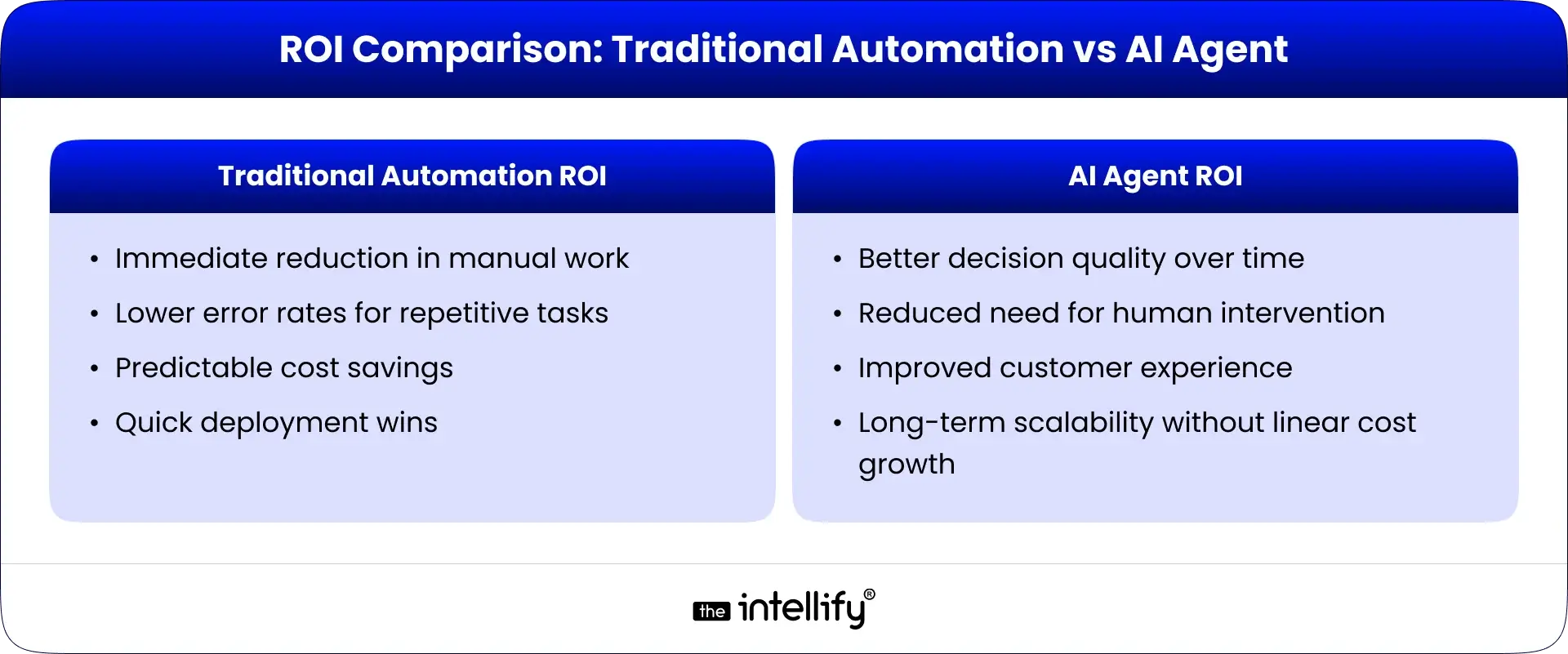
ROI Comparison table

ROI is often treated like a math problem. In reality, it’s more of a feeling backed by numbers.

Traditional automation delivers value fast. You automate a task, reduce manual effort, and see immediate savings. It’s satisfying. Especially when teams are stretched, and leadership wants results this quarter, not next year.

AI agents work differently. Their value builds over time. Early results may look modest, but as the system learns and adapts, the impact becomes broader and harder to ignore.

Here’s how ROI typically shows up:

Traditional Automation ROI

  • Immediate reduction in manual work
  • Lower error rates for repetitive tasks
  • Predictable cost savings
  • Quick deployment wins

AI Agent ROI

  • Better decision quality over time
  • Reduced need for human intervention
  • Improved customer experience
  • Long-term scalability without linear cost growth

Traditional automation saves hours. AI agents change outcomes.


When Traditional Automation Is Still the Right Choice

Despite the excitement around AI, traditional automation still deserves its place. It’s the right choice when processes are well-defined and unlikely to change. In these cases, adding intelligence doesn’t improve results; it just adds cost and complexity.

  • Steps are fixed and repeatable
  • Rules are clear and rarely updated
  • Compliance and audits matter
  • Errors must be minimized at all costs
  • Budgets are tightly controlled

Examples include finance operations, regulatory reporting, internal approvals, and backend system syncing. These processes don’t benefit from “thinking.” They benefit from consistency.

Sometimes, boring systems are the most valuable ones.


When AI Agents Become a Competitive Advantage

AI agents start to matter when businesses operate in uncertainty. They shine in environments where:

  • Customer behavior shifts frequently
  • Data arrives incomplete or late
  • Decisions affect revenue or retention
  • Human teams struggle to keep up

Instead of reacting to every exception, AI agents handle variation naturally. They prioritize, adapt, and escalate only when needed.

Over time, this creates advantages:

  • Faster responses without hiring more staff
  • Smarter decisions at scale
  • Reduced operational friction
  • Teams focused on strategy, not triage

This isn’t about replacing people. It’s about removing constant interruptions that drain momentum.


Common Mistakes Businesses Make While Choosing Automation

Most automation failures don’t come from bad tools. They come from bad assumptions. Some common mistakes include:

  • Automating broken or unclear processes
  • Expecting AI to fix poor data quality
  • Choosing software before defining goals
  • Underestimating change management
  • Ignoring security and compliance early

Another quiet mistake is expecting instant perfection. AI agents need time, feedback, and oversight. Treating them like plug-and-play software often leads to disappointment.

Automation amplifies design. If the design is flawed, the system will be too.
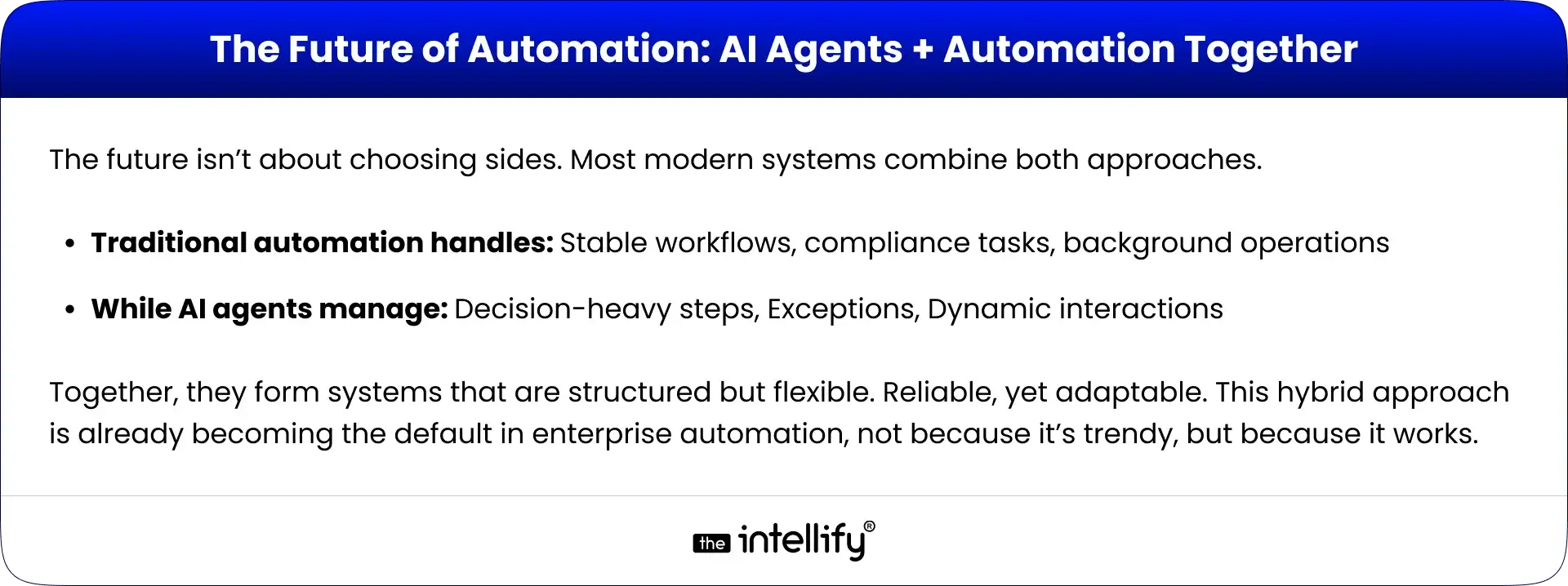
 

Future of Automation


How to Choose Between AI Agents and Traditional Automation

The decision doesn’t need to be complicated. Start with a few honest questions:

  • Does this process change often?
  • Does it require judgment or interpretation?
  • Are exceptions common?
  • Will scale increase complexity?

If most answers are “no,” traditional automation is usually enough.

If most answers are “yes,” AI agents are worth exploring.

The goal isn’t to adopt new technology. It’s to reduce friction without creating new problems.


How Businesses Can Get Started with AI Agents

Getting started with AI agents doesn’t begin with tools. It begins with clarity.

Most businesses don’t fail at AI because the technology doesn’t work. They fail because they start too big, too fast, or without a clear problem to solve. The smartest teams take a slower, more deliberate approach.

A practical starting point usually looks like this:

  • Identify one process that feels painful or inefficient
  • Focus on tasks that require judgment, not just repetition
  • Look for areas where teams are overwhelmed by volume or variation
  • Choose outcomes, not features, as success metrics

This is where an experienced AI agent development company makes a difference.

At The Intellify, the approach typically starts with understanding how your business actually runs, where decisions slow things down, where humans step in too often, and where intelligent agents could reduce friction without disrupting operations.

 

Build Intelligent Automation


Final Thoughts: Choosing the Right Automation Strategy

Choosing between AI agents and traditional automation is less about technology and more about fit. Some processes need structure and certainty. Others need flexibility and judgment. Forcing one approach everywhere usually creates more friction than value.

Traditional automation works best when rules are clear, and change is rare. AI agents add value when conditions shift, decisions matter, and scale makes manual work painful. Most businesses benefit from using both, each where it makes sense.

The goal isn’t to automate everything. It’s to automate the right things, in the right way, so teams can focus on work that actually moves the business forward. That’s what a good automation strategy looks like.


Frequently Asked Questions (FAQs)

1) What is the main difference between AI agents and traditional automation?

Traditional automation follows fixed rules and workflows. AI agents go a step further by understanding context, making decisions, and adapting when situations change. One repeats tasks; the other responds to situations.

2) Are AI agents better than traditional automation?

Not always. AI agents are better for processes that change often or require judgment. Traditional automation works best for stable, repeatable tasks. Most businesses use a mix of both rather than choosing just one.

3) Which is more cost-effective: AI agents or traditional automation?

Traditional automation is usually cheaper to set up. AI agents cost more upfront but often deliver better long-term value by reducing manual effort and scaling without constant rule updates.

4) Can AI agents replace RPA or workflow automation?

No. AI agents don’t replace RPA; they enhance it. RPA handles structured tasks, while AI agents manage decisions and exceptions. Together, they create more flexible and reliable systems.

5) When should a business switch from automation to AI agents?

If automation breaks frequently, needs constant rule changes, or depends heavily on human judgment, it may be time to introduce AI agents to handle complexity more smoothly.

6) Are AI agents safe for enterprise use?

Yes, when designed properly. Enterprise-grade AI agents include security controls, audit trails, and human oversight. This is why many organizations work with experienced teams like The Intellify to build them responsibly.

7) How do I decide what automation approach is right for my business?

Look at your process. If it’s predictable and rule-based, traditional automation fits. If it’s dynamic and decision-heavy, AI agents make more sense. A structured assessment helps avoid overengineering

Digital Transformation in Berlin: Fueling Innovation for Startups and Enterprises

Summary
Berlin stands at the forefront of digital transformation in Europe. In the city where creativity meets technology, innovative startups and well‑established enterprises join forces to redefine industries, streamline operations, and create new business models. Often leveraging the power of Generative AI Development to drive breakthrough innovations.
This blog explores how Berlin’s dynamic ecosystem drives digital transformation across sectors, the key strategies companies implement to stay competitive, and the challenges they overcome on their journey toward a digitally enabled future.

Introduction: Berlin – A Hub for Digital Transformation

Berlin has long been celebrated for its creative culture, vibrant arts scene, and rich history. Over the past decade, however, the city has also emerged as a powerhouse for digital innovation. Digital transformation in Berlin is not just a trend but a fundamental shift that touches every aspect of the economy.

Today, startups and large enterprises use technology to improve operations, create innovative products, and redefine customer experiences.

Berlin attracts entrepreneurs with its lower cost of living, diverse talent pool, and thriving startup ecosystem. At the same time, established regional enterprises increasingly invest in digital technologies to remain competitive. This blog explores how Berlin’s unique landscape fosters digital transformation and what this means for various industries.

Statistics on Digital Transformation in Industries and Technology Adoption

Berlin’s digital transformation is reshaping entire industries and driving widespread technology adoption. Digital companies employ over 88,000 people in the capital and generate annual sales exceeding EUR 10 billion, making the city a leader in Germany’s digital economy.

Since 2008, the sector has experienced an average annual employment growth of nearly 9%, with one in every seven new jobs created in Berlin belonging to the digital economy.

In the core areas, software development and data services, employment in Berlin is growing at an average annual rate of 10.8%, more than twice the national rate.

Additionally, industry reports forecast that Germany’s digital transformation market will reach USD 46 billion by 2025 and is projected to grow at a compound annual growth rate (CAGR) of 15.21% to hit USD 94 billion by 2030.

However, challenges remain. A Vodafone study indicates that by 2030, only about 45% of German companies will fully digitalize, below the expected 55% global benchmark. These statistics underscore both the immense potential of digital transformation and the significant work still required for businesses in Berlin to harness its full benefits.

The Berlin Digital Ecosystem: Startups Meet Enterprises

Berlin’s digital ecosystem is a vibrant mix of young, agile startups and seasoned enterprises. The city is an innovation hub where creativity and technology intersect, fostering dynamic collaborations that drive progress.

A Collaborative Environment

Berlin hosts numerous co‑working spaces, incubators, accelerators, and tech hubs, such as Factory Berlin and the hub. Berlin to CODE_n and Tech Open Air, these spaces provide startups with an environment to network, learn, and collaborate with peers.

Meanwhile, established enterprises partner with startups, invest in digital projects, and even create in‑house innovation labs to leverage fresh ideas.

Startups: The Digital Pioneers

Berlin startups break new ground by experimenting with disruptive technologies and innovative business models. With agile methodologies, rapid prototyping, and lean development practices, these companies quickly pivot in response to market demands.

Many develop breakthrough solutions in fintech, e‑commerce, healthcare, logistics, and AI.

Enterprises: The Digital Adopters

Large companies in Berlin are also actively engaging in digital transformation. They invest in cloud computing, big data analytics, and IoT to optimize processes and enhance decision‑making.

By partnering with startups, these enterprises integrate cutting‑edge digital tools into their operations, ensuring competitiveness in an ever‑changing market.

Networking and Ecosystem Events

Berlin’s vibrant networking events, meetups, conferences, and hackathons encourage the exchange of ideas between startups and enterprises. Events like Tech Open Air enable entrepreneurs to pitch innovative ideas, connect with investors, and learn from industry experts, fostering synergy across the ecosystem.

Key Drivers of Digital Transformation in Berlin

Several key factors drive the rapid pace of digital transformation in Berlin:

1. Entrepreneurial Spirit and Innovation Culture

Berlin’s entrepreneurial mindset encourages risk‑taking and experimentation. The city’s cultural diversity and openness to new ideas create a fertile ground for innovation, enabling entrepreneurs to develop unconventional solutions.

2. Access to Talent and Skills

Berlin attracts top talent from Europe and beyond, forming a highly skilled workforce proficient in digital technologies. Local universities, coding boot camps, and training programs build a robust talent pool that fuels digital transformation.

3. Lower Operational Costs

Compared to global tech hubs like Silicon Valley, Berlin offers a lower cost of living and affordable office space, allowing startups to launch with minimal overhead and enterprises to allocate more resources to R&D.

4. Government Support and Public Initiatives

The Berlin and German governments actively promote digital transformation through funding programs, grants, and advisory services. These initiatives streamline digital adoption and encourage innovation.

5. International Connectivity and Market Access

Berlin’s central location in Europe provides companies with access to a vast market. This connectivity allows startups and enterprises to expand rapidly without the heavy initial investment required for international expansion.

Digital Transformation Trends and Technologies

The digital landscape in Berlin is evolving rapidly, with several trends and technologies serving as catalysts for change:

Digital Transformation and Trends 2025

  1. Cloud Computing and Big Data

    Many companies in Berlin leverage cloud computing for scalable data storage and application hosting, integrating big data analytics to drive more intelligent decision‑making.

  2. Internet of Things (IoT)

    IoT technologies enable real‑time data exchange and automation, transforming industries from manufacturing to urban living by connecting devices and optimizing processes.

  3. Artificial Intelligence and Machine Learning

    AI and ML drive innovation across sectors in Berlin, powering customer service improvements, personalized marketing, and process automation to give companies a competitive edge.

  4. Cybersecurity Solutions

    As digital transformation deepens, robust cybersecurity solutions & measures become critical. Berlin’s tech ecosystem invests heavily in solutions to safeguard data and ensure regulatory compliance.

  5. Digital Platforms and Ecosystem Integration

    Successful digital transformation hinges on integrating diverse systems. Berlin companies create digital ecosystems where various platforms work together seamlessly, enhancing operational efficiency and customer experience.

  6. Automation and Robotics

    Automation technologies and robotics streamline repetitive manufacturing, logistics, and service tasks, improving efficiency and reducing operational costs.

  7. Sustainable Digital Solutions

    Sustainability is key. Berlin companies prioritize green technologies and digital solutions that reduce waste and promote energy efficiency, aligning with broader environmental goals.

Success Stories: How Berlin Startups and Enterprises Innovate

Berlin’s success in digital transformation is best illustrated through its innovative startups and enterprises:

Case Study 1: A Startup Revolutionizing Fintech

A Berlin fintech startup developed an AI‑powered platform that streamlines payment processes for SMEs. By leveraging advanced analytics, the platform optimizes cash flow and reduces errors. Collaborations with established banks helped the startup rapidly scale its operations across Europe.

Case Study 2: An Enterprise Embracing Industry 4.0

A leading manufacturing enterprise in Berlin transformed its operations with an Industry 4.0 digital transformation. By integrating IoT sensors, cloud computing, and AI‑driven analytics, the company improved efficiency, reduced downtime, and cut energy consumption, while enabling predictive maintenance.

Case Study 3: Digital Healthcare Innovations

A Berlin‑based healthcare startup created a telemedicine platform that connects patients with doctors via video consultations, digital diagnostics, and remote monitoring. AI‑driven tools provide personalized treatment recommendations, significantly enhancing patient care.

Case Study 4: Urban Mobility Transformation

An innovative mobility startup in Berlin introduced a smart ride‑sharing app that uses real‑time data and AI to optimize routes, reduce wait times, and lower carbon emissions, revolutionizing urban transportation.

Case Study 5: Evolving Retail with Digital Platforms

A traditional retail enterprise reinvented itself by launching an omnichannel digital platform that integrated online and offline sales channels. AI‑driven personalization and big data analytics boosted revenue and customer loyalty, showcasing how digital transformation can revitalize even long‑established sectors.

Challenges in Digital Transformation

Despite Berlin’s thriving ecosystem, companies face several challenges in digital transformation:

  • Cultural Resistance to Change

    Traditional organizational cultures can resist new technologies and processes. Overcoming this requires strong leadership, continuous training, and a clear vision for change.

  • Skills Gap and Talent Shortage

    Despite a robust talent pool, many companies struggle to find professionals skilled in emerging technologies like AI, IoT, and cybersecurity. Partnerships with educational institutions and specialized training programs are essential.

  • Cybersecurity Risks

    As companies digitize operations, they become more vulnerable to cyberattacks. Robust cybersecurity measures, regular audits, and proactive threat mitigation are vital.

  • Integration of Legacy Systems

    Many enterprises still rely on outdated legacy systems. Gradual integration and migration to modern platforms ensure continuity while unlocking digital potential.

  • Regulatory and Compliance Issues

    Navigating complex regulatory landscapes, such as GDPR, adds complexity to digital transformation efforts. Companies must invest in compliance and legal expertise.

  • Funding and Investment Challenges

    Access to venture capital and government grants is crucial, yet risk‑averse attitudes and high costs can limit funding opportunities for startups and SMEs.

Strategies for Startups: Scaling with Digital Tools

Berlin startups embrace digital transformation by adopting agile and innovative strategies:

Strategies for Startups: Scaling with Digital Tools

Strategies for Enterprises: Embracing Digital Change

For established enterprises, digital transformation is a holistic process that involves culture, processes, and business models:

  • Develop a Clear Digital Strategy

    Define a digital roadmap that aligns with business goals and appoint dedicated digital transformation teams or Chief Digital Officers (CDOs).

  • Invest in Employee Training

    Upskill your workforce through continuous training programs and partnerships with educational institutions to bridge the digital skills gap.

  • Modernize Legacy Systems Gradually

    Adopt a phased approach to integrate new technologies with existing systems, ensuring minimal disruption during the transition.

  • Foster a Culture of Innovation

    Encourage cross‑departmental collaboration, incentivize creative ideas, and create internal innovation labs to drive transformation.

  • Collaborate with Startups

    Partner with agile startups to access fresh ideas, cutting‑edge technologies, and flexible solutions that can accelerate digital transformation.

  • Leverage Data as a Strategic Asset

    Invest in data analytics platforms and employ data scientists to harness the full potential of your data for improved decision‑making.

  • Automate and Streamline Operations

    Invest in automation technologies, including robotic process automation (RPA), to reduce costs and improve operational efficiency.

Government Initiatives and Support Networks

Government support plays a crucial role in fostering digital transformation in Berlin:

  • Funding Programs and Grants

    The German government and Berlin Senate provide numerous funding programs and grants to support innovation and digital transformation projects.

  • Digital Innovation Hubs and Incubators

    Innovation hubs such as Factory Berlin, hub.berlin, and CODE_n offer essential resources, mentorship, and networking opportunities to bridge the gap between startups and established enterprises.

  • Regulatory Reforms and Advisory Services

    Streamlined bureaucratic processes, simplified data protection laws, and improved digital infrastructure help companies adopt new technologies more efficiently.

  • Collaboration with Academic Institutions

    Berlin’s universities and research institutes collaborate with industry players, resulting in joint research projects, technology transfer programs, and specialized training that equips the workforce with cutting‑edge digital skills.

  • Public‑Private Partnerships

    PPPs unite government, private enterprises, startups, and investors to create scalable solutions that drive innovation and support economic growth.

Spotlight: The Intellify – Your AI‑Enabled Software Development Partner

The Intellify is an innovative AI‑enabled software development company dedicated to driving digital transformation for businesses. It is a trusted software development partner in Berlin.

The Intellify leverages cutting‑edge technologies to help companies streamline processes, enhance customer experiences, and accelerate growth.

Why Choose The Intellify?

  • AI‑Enabled Solutions: Our expert team uses advanced artificial intelligence and machine learning to create robust software solutions that power digital transformation.
  • Cloud Consulting: We offer tailored and top-notch cloud consulting services to help your business migrate, integrate, and optimize cloud infrastructures.
  • Industry 4.0 Expertise: We enable digital transformation in production processes from smart manufacturing to predictive maintenance.
  • AR/VR Solutions: Our immersive augmented and virtual reality solutions enhance training, marketing, and customer engagement.
  • Legacy Application Modernization: We modernize your legacy systems to integrate with modern digital solutions, ensuring continuity and improved performance.

Step into the future with The Intellify at GITEX Berlin. Transform challenges into scalable, intelligent solutions.

Future Outlook: Berlin’s Role in Shaping the Digital Economy

Future Outlook: Berlin’s Role in Shaping the Digital Economy

  • Increasing Global Competitiveness

    Berlin’s startups and enterprises are becoming increasingly competitive globally. As more companies embrace digital transformation, Berlin’s tech scene will attract further international investment and talent, setting new benchmarks for innovation.

  • Emerging Technologies and Disruptive Innovation

    Emerging technologies like 5G, blockchain, augmented reality (AR), and virtual reality (VR) will further shape Berlin’s digital landscape. Berlin companies are well‑positioned to integrate these advancements into their business models, unlocking new opportunities and operational efficiencies.

  • Sustainable and Inclusive Digital Transformation

    Sustainability and social inclusion are critical drivers. Berlin’s companies integrate green technologies and digital solutions to reduce waste and promote energy efficiency, ensuring that innovation benefits society.

  • Enhancing Cross‑Sector Collaboration

    Greater collaboration between startups, enterprises, academia, and government will define the future of digital transformation in Berlin. This synergy will foster comprehensive solutions that drive innovation across healthcare, manufacturing, urban mobility, and energy sectors.

  • Preparing for a Rapidly Changing World

    Berlin’s ecosystem is built on resilience, creativity, and a willingness to experiment. As technological change accelerates, companies must invest more in research, development, and innovation to stay ahead.

    This proactive mindset will be crucial for navigating future disruptions and maintaining Berlin’s digital leadership.

Conclusion: Embracing the Digital Future

Berlin is a beacon of digital transformation, where startups and enterprises work together to forge innovative solutions and reshape industries. The city’s supportive ecosystem, bolstered by government initiatives, international connectivity, and a vibrant culture of innovation, creates an ideal environment for digital success.

Whether you’re a startup looking to scale quickly or an established enterprise aiming to reinvent your business model, Berlin offers the resources, talent, and network necessary to thrive.

By embracing digital transformation, Berlin’s businesses can enhance operational efficiency, improve customer experiences, and drive sustainable growth.

The Intellify is proud to be at the forefront of this revolution. As your trusted partner, we empower startups and enterprises with AI‑enabled solutions, cloud consulting, Industry 4.0 expertise, top AR/VR solutions, digital transformation strategies, and legacy application modernization.

Our mission is to help you unlock the full potential of digital technologies and secure a competitive edge in today’s rapidly evolving market.

Take Action Today:

Elevate your enterprise by embracing digital innovation in Berlin.Now is the time to embrace change, invest in digital transformation, partner with innovators like The Intellify, and build a future that is not only profitable but also innovative, sustainable, and inclusive.

Thank you for reading! For more insights into digital transformation, startups, and innovative enterprise strategies in Germany, please visit our latest blog, Top Mobile App Development Companies in Germany.

View
Case Study