Top AI Development Company for Custom AI Solutions & Services

Summary:
Businesses are increasingly adopting AI to improve efficiency, automate workflows, enhance customer experiences, and make smarter decisions. This blog explains how an AI development company helps organizations build custom AI solutions, intelligent applications, and AI automation systems tailored to their needs. It also explores industry use cases, implementation best practices, emerging AI trends, and the key factors to consider when selecting the right AI development partner for long-term success.


Artificial Intelligence is no longer something businesses talk about as a future possibility. It’s already reshaping how companies operate, serve customers, and make decisions every day. A few years ago, businesses relied heavily on traditional software to manage operations. While those systems still play an important role, they often struggle when dealing with large volumes of data, changing customer expectations, or complex decision-making processes. That’s where AI comes in.

Organizations across healthcare, retail, finance, manufacturing, logistics, and many other industries are investing in intelligent systems that can learn from data, automate repetitive work, and deliver insights in real time. Instead of spending hours on manual tasks, teams can focus on strategic work that drives growth. From predicting customer behavior and automating workflows to creating personalized experiences and improving operational efficiency, AI is helping businesses solve challenges that traditional software simply wasn’t designed to handle.

However, building successful AI solutions requires much more than writing code. It demands expertise in machine learning, data engineering, automation, cloud infrastructure, and business strategy. This is why many organizations choose to work with an experienced AI development company that can design, build, and scale AI-powered systems aligned with their business goals.


What Is an AI Development Company and Why Does It Matter?

An AI development company specializes in creating software solutions powered by artificial intelligence technologies such as machine learning, natural language processing, computer vision, predictive analytics, and generative AI.
Unlike traditional software development, where applications follow predefined rules and instructions, AI systems are designed to learn from data, identify patterns, and continuously improve their performance over time.
For example, a traditional customer support platform may follow scripted workflows. An AI-powered platform, on the other hand, can understand customer intent, answer questions intelligently, and improve responses based on previous interactions.
Developing such systems requires specialized expertise in areas including:

  • Machine learning engineering
  • Data science
  • AI model training
  • Data architecture
  • Cloud computing
  • Automation technologies
  • AI governance and compliance

Many businesses initially assume that any software development team can build AI solutions. In reality, successful AI projects require unique skills, tools, and methodologies that differ significantly from conventional software development.
Partnering with a specialized AI development company provides access to experienced professionals who understand how to turn business challenges into scalable AI-driven solutions.


How Custom AI Solutions Help Businesses Solve Real Challenges
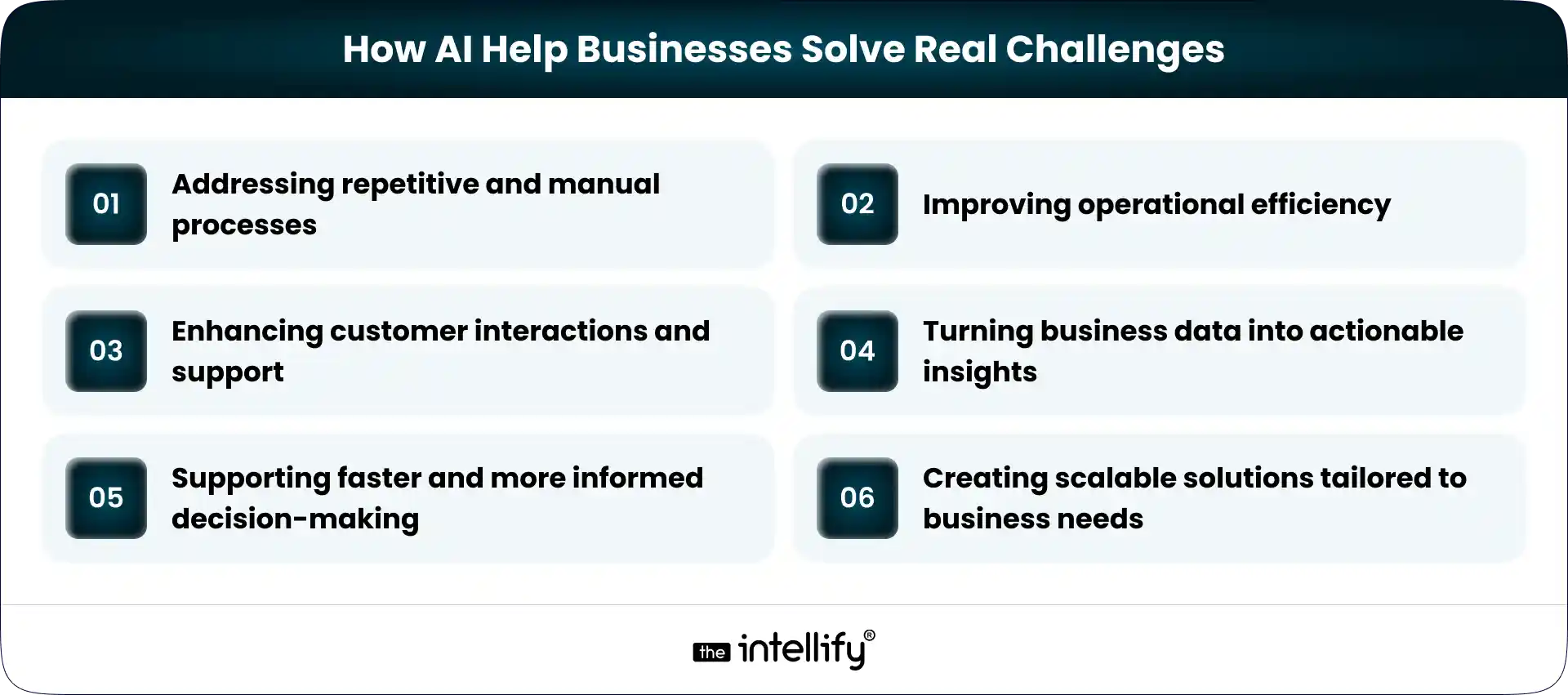
How AI Help Businesses Solve Real Challenges

Every business has unique processes, workflows, and operational challenges. Off-the-shelf software often forces organizations to adapt their operations around the software itself.
Custom AI solutions work differently. They are designed around specific business objectives, allowing companies to solve problems more effectively while maintaining flexibility as they grow.

Addressing Repetitive and Manual Processes

Many organizations still rely on employees to perform routine tasks such as data entry, document verification, scheduling, and report generation. AI can automate these activities, reducing workload and minimizing human error.

Improving Operational Efficiency

Intelligent systems help businesses complete tasks faster, streamline workflows, and eliminate bottlenecks across departments.

Enhancing Customer Interactions and Support

AI-powered chatbots, virtual assistants, and recommendation engines can provide instant responses, personalized experiences, and 24/7 customer support.

Turning Business Data Into Actionable Insights

Most companies collect massive amounts of data but struggle to use it effectively. AI solutions analyze data in real time and identify trends, risks, and opportunities that might otherwise go unnoticed.

Supporting Faster and More Informed Decision-Making

Executives and managers can use AI-generated insights to make smarter decisions based on facts rather than assumptions.

Creating Scalable Solutions Tailored to Business Needs

As organizations grow, AI systems can scale alongside operations, handling larger datasets and more complex workflows without significant increases in manual effort.


Core AI Development Services Businesses Should Look For

Choosing the right AI development partner starts with understanding the services they offer.

AI Consulting and Strategy Development

Before implementation begins, businesses need a clear AI roadmap. AI Consulting services help identify opportunities, define objectives, assess feasibility, and create implementation strategies.

Machine Learning Model Development

Machine learning models enable systems to recognize patterns, make predictions, and continuously improve through data analysis.

Natural Language Processing Solutions

Natural Language Processing (NLP) helps machines understand, interpret, and generate human language.

Common applications include:

  • Chatbots
  • Virtual assistants
  • Sentiment analysis
  • Document processing
  • Language translation

Computer Vision Applications

Computer vision enables systems to analyze images and videos for tasks such as:

  • Quality inspection
  • Facial recognition
  • Medical imaging analysis
  • Security monitoring

Generative AI Development

Generative AI solutions can create text, images, code, reports, and business content, helping organizations improve productivity and innovation.

Predictive Analytics Solutions

Predictive models help businesses forecast future outcomes, customer behavior, demand patterns, and operational risks.

AI Integration With Existing Business Systems

Successful AI projects must work seamlessly with CRM, ERP, HRM, and other enterprise systems.

AI Maintenance, Monitoring, and Optimization

AI systems require continuous monitoring, retraining, and optimization to maintain performance and accuracy over time.


AI App Development Services for Intelligent Digital Experiences

Modern users expect digital experiences that are personalized, responsive, and intelligent. This demand has fueled rapid growth in AI app development services across industries.

AI-Powered Mobile Application Development

Mobile apps can leverage AI to provide recommendations, automate tasks, and improve user engagement.

AI-Enabled Web Platforms

AI-powered web applications can personalize content, optimize user journeys, and deliver intelligent interactions.

Smart Business Applications

Organizations are increasingly building internal AI-powered tools that support operations, analytics, and decision-making.

Personalized User Experiences Through AI

AI can analyze user behavior and tailor experiences based on preferences, interests, and previous interactions.

Recommendation and Prediction Engines

Popular examples include:

  • Product recommendations
  • Content suggestions
  • Personalized marketing campaigns
  • Demand forecasting

Conversational AI and Virtual Assistants

Conversational AI solutions help businesses engage users through natural and intuitive interactions.

Benefits of Integrating AI Into Modern Applications

Key benefits include:

  • Higher customer engagement
  • Better user retention
  • Faster service delivery
  • Personalized experiences
  • Improved business intelligence
  • Increased operational efficiency


AI Automation Services That Drive Productivity and Growth

Automation has always been a business priority. AI takes automation several steps further by enabling systems to learn, adapt, and make decisions.

Business Process Automation

AI automates repetitive workflows that traditionally require manual intervention.

Intelligent Workflow Management

AI helps coordinate tasks, prioritize activities, and optimize process execution.

Document Processing and Data Extraction

Organizations can automate invoice processing, contract reviews, claims handling, and document classification.

Customer Service Automation

AI-powered assistants can resolve inquiries instantly while escalating complex issues when necessary.

Automated Reporting and Analytics

Instead of manually compiling reports, AI can generate insights automatically from multiple data sources.

Internal Operations Optimization

Departments such as HR, finance, procurement, and operations can benefit significantly from intelligent automation.

Key Business Benefits

  • Reduced Manual Effort: Employees spend less time on repetitive work and more time on strategic initiatives.
  • Faster Execution of Tasks: Processes that once took hours can often be completed within minutes.
  • Improved Accuracy: Automation reduces errors caused by manual processing.
  • Lower Operational Costs: Organizations can achieve significant cost savings through improved efficiency.
  • Better Resource Utilization: Teams can focus on higher-value activities while AI handles routine operations.
 

AI Development Services Solutions


Where AI Workflow Automation Creates the Most Impact

AI workflow automation is delivering measurable results across nearly every department.

Sales and Lead Management

  • Lead scoring
  • Opportunity prioritization
  • Sales forecasting
  • Automated follow-ups

Marketing and Campaign Optimization

  • Audience segmentation
  • Campaign personalization
  • Content recommendations
  • Performance analysis

Customer Support Operations

  • AI chatbots
  • Ticket routing
  • Customer sentiment analysis
  • Automated responses

Human Resources Processes

  • Resume screening
  • Candidate matching
  • Employee onboarding
  • Workforce analytics

Finance and Accounting Workflows

  • Invoice processing
  • Expense management
  • Financial forecasting
  • Compliance monitoring

Supply Chain and Logistics Management

  • Inventory optimization
  • Route planning
  • Demand forecasting
  • Vendor management

Project and Operations Management

  • Resource allocation
  • Project monitoring
  • Risk identification
  • Performance tracking


Industry Applications of AI Solutions

Healthcare

Healthcare organizations are using AI to improve patient care and operational efficiency.

  • Patient Engagement: AI assistants help patients schedule appointments and receive support.
  • Medical Data Analysis: AI can identify patterns across large medical datasets.
  • Diagnostic Support: Advanced algorithms assist clinicians in detecting conditions earlier and more accurately.

Retail and eCommerce

  • Product Recommendations: AI delivers personalized shopping experiences.
  • Demand Forecasting: Retailers can predict inventory requirements more accurately.
  • Customer Personalization: Businesses tailor promotions and experiences based on customer behavior.

Banking and Financial Services

  • Fraud Detection: AI identifies suspicious transactions in real time.
  • Risk Assessment: Financial institutions improve lending and investment decisions.
  • Customer Support Automation: Virtual assistants provide faster service and lower support costs.

Manufacturing

  • Predictive Maintenance: AI predicts equipment failures before they occur.
  • Quality Control: Computer vision systems identify defects during production.
  • Production Optimization: Manufacturers improve efficiency and reduce waste.

Insurance

  • Claims Processing: AI accelerates claim reviews and approvals.
  • Risk Analysis: Insurers can assess policy risk more accurately.
  • Customer Service Automation: Virtual agents provide policyholder support around the clock.
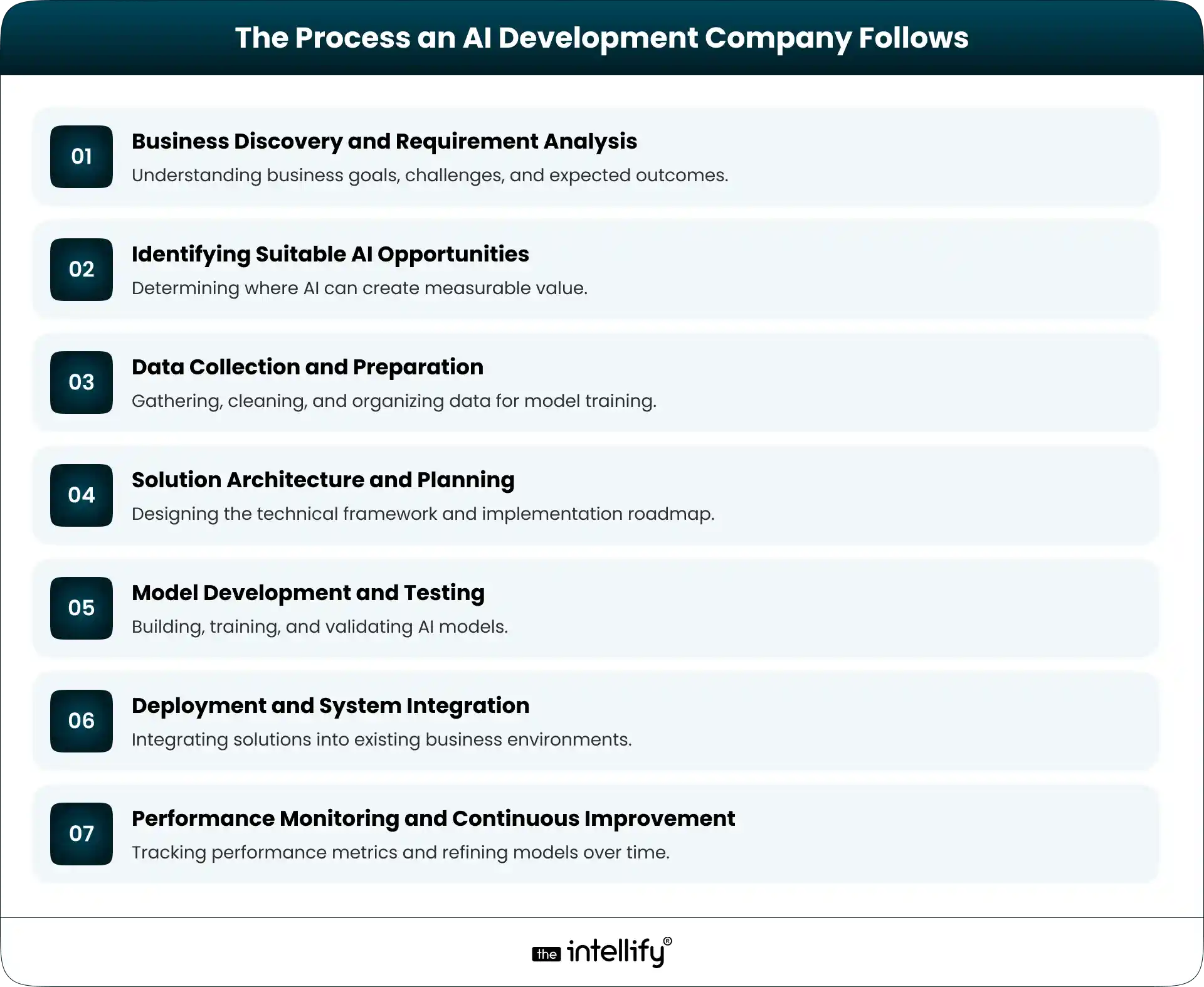
 

Process of AI Development Company


Key Factors That Determine the Success of AI Development Solutions

Several factors influence whether an AI initiative succeeds or struggles.

  1. Clearly Defined Business Objectives: AI should solve real business problems, not exist simply because it’s trendy.
  2. Availability of Quality Data: Even the best algorithms cannot compensate for poor-quality data.
  3. Scalability Considerations: Solutions should support future growth and evolving business needs.
  4. Integration With Existing Systems: Seamless connectivity improves adoption and usability.
  5. User Adoption and Change Management: Employees must understand and trust AI-driven processes.
  6. Ongoing Optimization and Support: AI requires continuous improvements to remain effective.
  7. Security, Compliance, and Governance Requirements: Strong governance ensures data privacy, compliance, and responsible AI usage.


How to Choose the Right AI Development Company

Selecting the right partner can significantly influence project outcomes.

Technical Expertise and AI Capabilities: Evaluate experience across machine learning, NLP, computer vision, and automation technologies.
Industry-Specific Experience: Industry knowledge often leads to faster implementation and better results.
Portfolio and Case Studies: Review previous projects and measurable outcomes.
Development Methodology and Transparency: Look for structured processes and open communication.
Security and Compliance Standards: Ensure the company follows recognized security frameworks and compliance requirements.
Scalability and Future Support: Choose a partner capable of supporting long-term growth.
Communication and Collaboration Approach: Strong collaboration often determines project success more than technology alone.

Questions to Ask Before Selecting a Partner

  • What industries have they worked with?
  • How do they measure project success?
  • What support is provided after deployment?
  • How do they ensure data security and compliance?


Emerging Trends Shaping the Future of AI Development

The AI landscape continues to evolve rapidly.

  • Generative AI Adoption Across Industries: Organizations are increasingly integrating generative AI into daily operations.
  • AI Agents and Autonomous Workflows: AI agents are beginning to manage tasks with minimal human intervention.
  • Hyperautomation Strategies: Businesses are combining AI, automation, and analytics to streamline operations end-to-end.
  • Industry-Specific AI Platforms: Purpose-built AI solutions are becoming more common across sectors.
  • Responsible and Ethical AI Practices: Organizations are prioritizing transparency, fairness, and accountability.
  • AI-Powered Decision Intelligence: AI is moving beyond predictions and supporting strategic decision-making.
  • The Growing Role of Human-AI Collaboration: The future isn’t humans versus AI. It’s humans working alongside AI to achieve better outcomes.


Why Businesses Are Partnering With AI Development Companies for Long-Term Innovation

Businesses aren’t adopting AI simply to follow a trend. They’re investing because it delivers measurable advantages.

  • Accelerating Digital Transformation Initiatives: AI helps organizations modernize processes faster.
  • Building Competitive Advantages Through AI: Companies that effectively use AI often outperform slower-moving competitors.
  • Scaling Operations More Efficiently: Growth becomes easier when repetitive work is automated.
  • Improving Customer Experiences: Personalized and intelligent interactions increase satisfaction and loyalty.
  • Unlocking New Revenue Opportunities: AI can create entirely new products, services, and business models.
  • Future-Proofing Business Growth: Organizations that embrace AI today are better positioned for tomorrow’s challenges.

 

Custom AI Solutions


Conclusion

Artificial intelligence is quickly becoming a core part of modern business strategy. From improving operational efficiency and automating repetitive tasks to enhancing customer experiences and supporting smarter decision-making, AI is transforming how organizations compete and grow.

Custom AI solutions, intelligent applications, and AI automation services enable businesses to address unique challenges while creating scalable systems that evolve alongside their needs. Whether it’s predictive analytics, workflow automation, generative AI, or conversational experiences, the opportunities continue to expand across every major industry.

The success of any AI initiative, however, depends heavily on choosing the right AI development company. An experienced partner like The Intellify can help identify opportunities, build tailored solutions, integrate AI into existing systems, and ensure long-term optimization. As AI adoption accelerates worldwide, businesses that invest strategically today will be better equipped to innovate, adapt, and achieve sustainable growth in the years ahead.


Frequently Asked Questions

Q1. How do I know if my business is ready for AI development?

If your business relies on repetitive processes, manual decision-making, or large amounts of data, AI can help improve efficiency, automate workflows, and generate valuable insights. An AI development company can assess your operations and identify the most impactful opportunities for AI adoption.

Q2. What are the benefits of choosing custom AI solutions over ready-made tools?

Custom AI solutions are designed specifically for your business goals, workflows, and data. Unlike off-the-shelf software, they offer greater flexibility, scalability, and long-term value while addressing unique operational challenges.

Q3. Can an AI development company integrate AI into existing business systems?

Yes. Most AI solutions can be integrated with existing platforms such as CRM, ERP, HR, and customer support systems. This allows businesses to enhance current processes without replacing their existing technology infrastructure.

Q4. What should I look for when selecting an AI development company?

Look for technical expertise, industry experience, successful project delivery, security standards, transparent communication, and ongoing support capabilities. Reviewing case studies and client success stories can also help evaluate a company’s capabilities.

Q5. How can businesses measure the return on investment from AI solutions?

Businesses can measure AI ROI through improvements in operational efficiency, productivity, customer satisfaction, cost savings, revenue growth, and process automation. Establishing clear KPIs before implementation helps track success more effectively.
AI Solutions for Enterprises: Implementation Guide with ROI Insights

Summary:
AI is changing how enterprises work, helping them improve efficiency and make better decisions. It’s no longer just about new technology, but about using it in the right way to solve real business problems. From getting started to scaling across teams, each step matters in making AI work effectively. This guide gives a clear view of how enterprises can use AI in a practical and meaningful way.

Businesses today are evolving faster than ever, and AI is becoming a key part of that change. It’s no longer just something new to explore; companies are now using AI to improve how they work, make better decisions, and handle everyday tasks more efficiently. This shift is opening up new possibilities across different teams and industries.

In this guide, we’ll look at how AI is being used in enterprises, where it creates the most value, and how businesses can get started practically. We’ll also cover simple implementation steps and how to measure impact over time.


Why AI Is Becoming a Core Business Priority for Enterprises

Businesses today are moving beyond digital tools and increasingly relying on AI to make everyday decisions. With so much data coming in from different sources, it’s becoming harder to manage things manually. AI helps simplify this by turning data into useful insights that teams can actually act on.

At the same time, AI is no longer just about trying something new; it’s becoming a key part of staying competitive. Many companies are shifting from small experiments to more serious, long-term use. While some are still exploring, others are already starting to scale AI across their operations.


How AI Is Being Applied Across Enterprise Functions

AI solutions aren’t confined to one department they can reshape various aspects of an organization. AI is being used across different parts of the business, from customer support and operations to finance and HR. It helps automate routine work, improve accuracy, and support better decision-making without adding extra effort to teams.

Instead of using separate tools, many enterprises are now connecting AI across systems to make processes smoother. Different industries are using it in their own way, but the idea is the same. AI works best when it becomes part of the overall business, not just one function.


Understanding the Scope of AI for Enterprises

What does “AI for enterprises” really entail?

  • Core Components: It consists of systems, models, and decision-making layers that work together harmoniously.
  • Types of Technology: Machine learning (ML), natural language processing (NLP), generative AI, and computer vision are all key players.
  • Distinguishing AI: It’s crucial to differentiate between straightforward automation, analytics, and true AI-driven intelligence.
  • Enterprise requirements: To build a successful AI strategy, scalability, security, and interoperability are essential.
  • Structured Adoption: Implementing AI systematically is far more effective than ad-hoc solutions, which can lead to disappointing results.


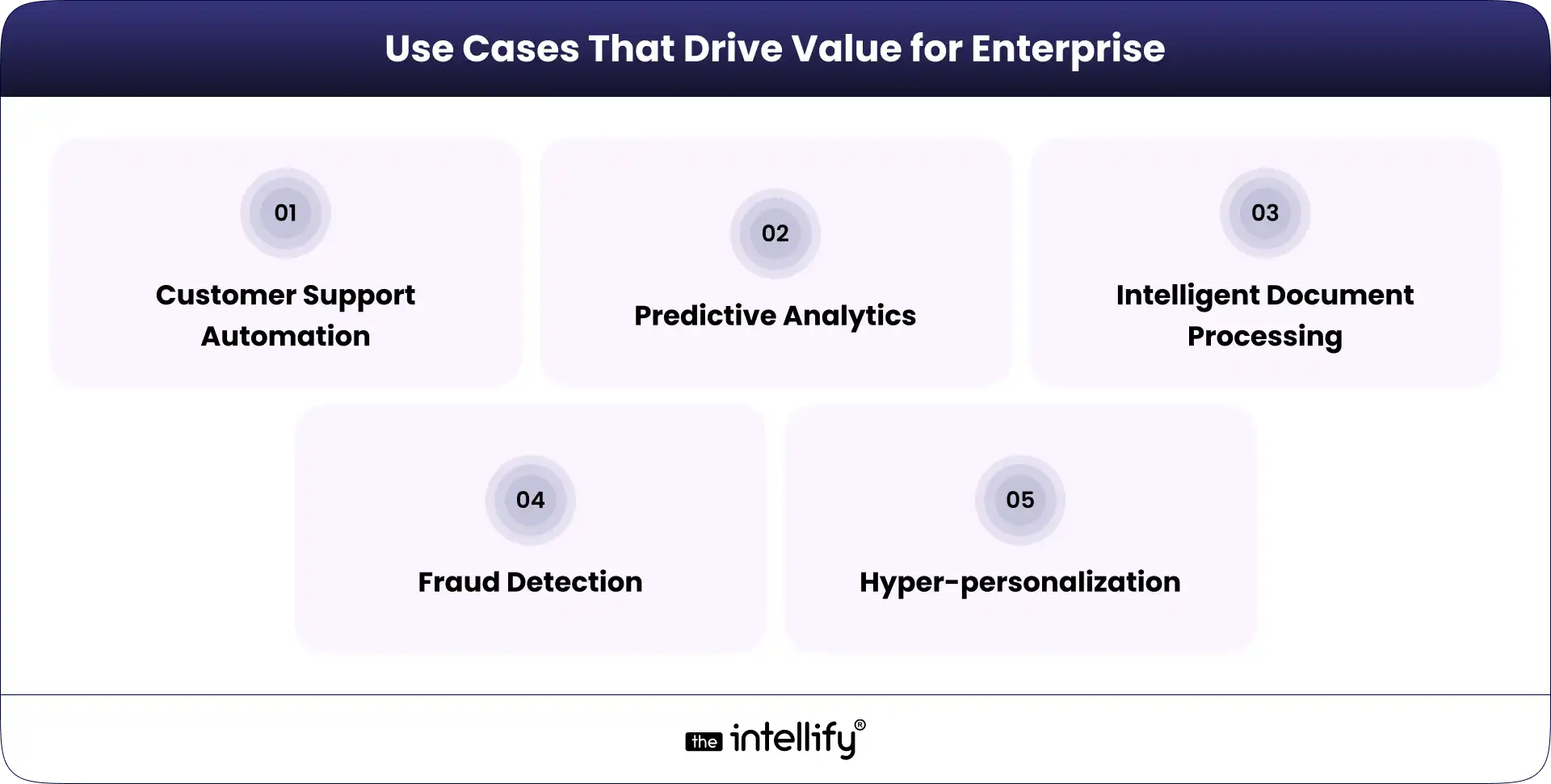
Key Use Cases That Drive Value for Enterprise

Use Cases That Drive Value for Enterprise

Identifying use cases that deliver the most value is key to successful AI deployment. Here are a few impactful applications:

1. Customer Support Automation: Chatbots and voice AI help handle customer queries instantly and reduce response time. They also support teams by managing routine questions, allowing staff to focus on more complex issues.

2. Predictive Analytics: Using data to forecast trends helps businesses plan better and make informed decisions. It improves demand forecasting, resource allocation, and reduces the chances of unexpected issues.

3. Intelligent Document Processing: AI can quickly process and organize large volumes of documents, reducing manual work. This helps improve accuracy and speeds up workflows across departments.

4. Fraud Detection: Real-time monitoring helps identify unusual activities and prevent potential threats. This makes systems more secure and reduces financial and operational risks.

5. Hyper-personalization: Recommendation systems analyze user behavior to offer more relevant products or services. This improves customer experience and helps increase engagement and conversions.

When choosing use cases, weigh the potential business impact against complexity to ensure a successful rollout.


Key Barriers That Slow Down Enterprise AI Adoption

Even with all its promise, several challenges can impede successful AI adoption:

  • Data silos: When data is scattered across systems or not consistent, it becomes difficult to get accurate insights. This limits how effectively AI models can perform.
  • Legacy infrastructure: Older systems are often not designed to support modern AI tools, making integration more complex and time-consuming.
  • Budget constraints: Many organizations struggle to balance the cost of AI implementation with uncertain ROI, especially in the early stages.
  • Skill gaps: Lack of in-house expertise can slow down progress, and heavy reliance on external partners may delay execution and scaling.

Overcoming these barriers requires commitment and strategic planning.


How to Identify the Right Starting Point for AI in Your Enterprise

Getting Started with AI: Readiness and First Steps

  • Signs your business is ready for AI: Spot areas where AI can genuinely make a difference, like customer support or supply chain operations.
  • Evaluating Readiness: Analyze your data maturity, current infrastructure, and team capabilities.
  • Identifying quick-win opportunities: Focus on use cases that promise both feasibility and high ROI potential.
  • When AI May Not Be Right: Be mindful of situations where diving into AI might not be the smartest choice, such as unclear data or organizational goals.


AI solutions for enterprises


AI for Enterprises: From Strategy to Execution

Laying the groundwork for successful AI solutions involves several key steps:

Defining Objectives

Start by clearly identifying what you want to achieve with AI, such as improving efficiency or reducing costs. Setting clear goals and success metrics helps keep the implementation focused.

Mapping Use Cases

Identify and prioritize use cases that can deliver the most value. Focus on areas where AI can solve real problems or improve existing processes.

Preparing Data Pipelines

Ensure your data is clean, organized, and accessible. Strong data pipelines and governance are essential for AI systems to work effectively.

Choosing the Right Tools

Select tools, platforms, or partners that fit your business needs and existing systems. The right choice makes implementation smoother and more scalable.

Building Pilots

Start with a small pilot or proof of concept to test how the solution works. This helps validate results before scaling it across the organization.

Testing and Scaling

Testing is vital to ensure your AI solutions yield the expected results. Once validated, successful projects can be expanded throughout the organization.


Building an Enterprise AI Strategy That Aligns with Business Goals

Enterprise AI Strategy for Business Goals

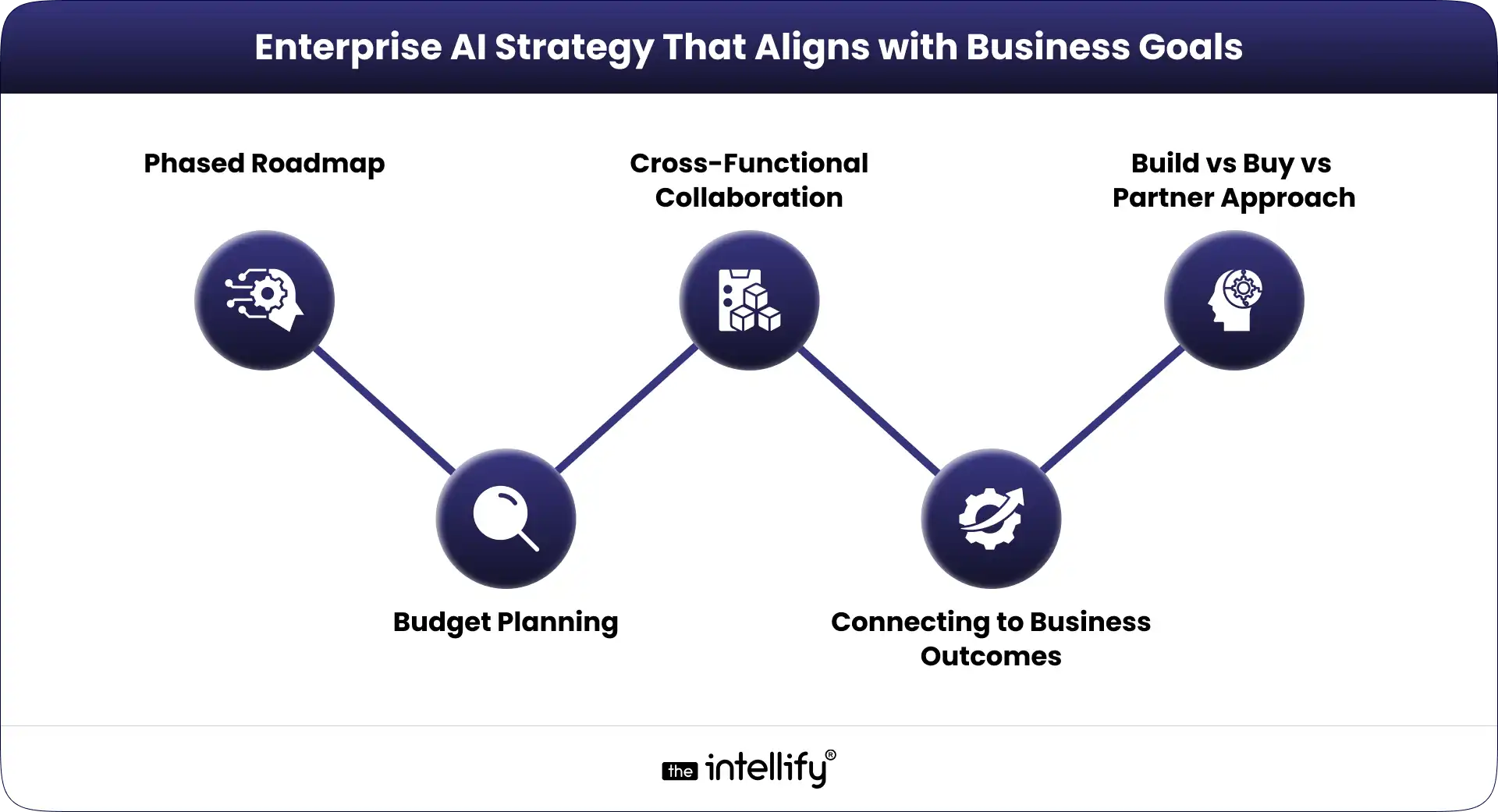
A successful AI strategy should align seamlessly with your broader business objectives:

  • Phased Roadmap: Plan a clear timeline with a mix of quick wins and long-term initiatives. This helps show early results while building toward bigger goals.
  • Budget Planning: Allocate your budget carefully by focusing on initiatives that deliver the most value. It’s important to balance costs with expected outcomes.
  • Cross-Functional Collaboration: Ensure teams across departments work together. This improves coordination and helps AI initiatives run more smoothly.
  • Connecting to Business Outcomes: Link every AI effort to clear business goals, such as improving efficiency, increasing revenue, or enhancing customer experience.
  • Build vs Buy vs Partner Approach: Decide whether to build in-house, use existing tools, or work with partners based on your resources and long-term plans.


Measuring ROI of AI in Enterprises

To grasp the true value of your AI investments, keep the following in mind:

  • Key Performance Indicators (KPIs): Establish measurable metrics covering efficiency, cost savings, and revenue growth.
  • Understanding Time-to-Value: Differentiate between immediate and long-term ROI.
  • Real-World Examples: Use benchmarks from organizations that have effectively measured their AI success.
  • Linking AI to Business Performance: Connect AI outcomes directly to business results, such as improved productivity, better decision-making, or increased customer satisfaction.
  • Avoiding Common Mistakes: Don’t rely only on short-term results or unclear metrics focus on consistent tracking and realistic expectations to measure true success


Governance, Security, and Responsible AI in Enterprise Environments

Effective governance is key to ensuring responsible AI use:

  • Data Privacy: Ensure compliance with regulations while handling sensitive data carefully and securely.
  • Bias Management: Put checks in place to reduce bias and maintain fairness in AI-driven decisions.
  • Transparency: Keep AI processes clear and explainable so decisions can be understood and trusted.
  • Governance Frameworks: Set clear internal rules for how AI is used across the business. This helps maintain consistency and alignment with company policies.
  • Risk Management and Monitoring: Regularly monitor AI systems to identify issues early. This keeps systems reliable and reduces potential risks over time.


Scaling AI Across the Enterprise

Moving from pilot projects to full-scale implementations is a crucial phase:

  • Standardizing Processes: Create a common framework for AI initiatives so teams can follow a consistent approach across the organization.
  • Upskilling Teams: Invest in training so employees can understand and work effectively with AI tools in their daily tasks.
  • Continuous Optimization: Regularly review performance and make improvements to keep AI systems efficient and relevant over time.
  • Transitioning from PoC to Deployment: Turn successful pilot projects into practical solutions used across teams. This requires proper planning and smooth integration with existing systems.
  • Change Management and Leadership Support: Strong leadership helps guide teams through change. Clear communication and training make adoption easier and reduce resistance.


The Future of AI in Enterprises

AI in enterprises is growing fast, with trends like generative AI helping automate content and tasks. Hyper-automation is also making processes more efficient by combining AI with automation. Many businesses are now using AI to support better and faster decision-making.

Industry-specific solutions are also becoming more common, making AI more practical. To stay ahead, enterprises need to stay flexible and keep adapting as technology evolves.


Build Enterprise AI Solutions


Conclusion

AI isn’t just a one-off project; it’s a long-term journey. Organizations should begin with targeted use cases and scale strategically, balancing technology, human resources, and processes. With a solid roadmap and the right mindset, enterprises can turn AI into a sustainable advantage.

The key is to focus on real business value rather than just adopting new technology. Start small, learn from early results, and build step by step. Over time, this approach helps create a strong foundation where AI becomes a natural part of everyday operations.


Frequently asked questions (FAQs)

1. How can a business start using AI without making it too complex?

Start with one clear problem where AI can help, like saving time or improving support. Test a small solution first, then scale once it shows results.

2. How long does it take to implement AI in an enterprise?

Small AI projects can take a few weeks to a couple of months. Larger implementations take longer depending on data and system complexity.

3. How can we measure if AI is actually working?

Track simple results like time saved, cost reduced, or faster processes. If these improve, your AI solution is delivering real value.

4. Can small or growing businesses also benefit from AI?

Yes, AI is useful for businesses of all sizes, not just large enterprises. Smaller companies can start small and scale as they grow.

5. What are the common challenges when starting with AI?

Unclear goals, poor data quality, and trying too much at once are common issues. Starting with a focused approach helps avoid these problems.

6. Will AI work with our existing systems, like CRM or ERP?

Yes, most AI solutions can integrate with tools like CRM and ERP systems. The key is having clean and accessible data for better results.

7. Is AI implementation very expensive to start with?

It depends on the use case, but you don’t need a huge budget to begin. Many businesses start small and invest more after seeing results.

Digital Transformation in Insurance Industry: Key Benefits, Use Cases & Future Trends

Summary:
Digital transformation is helping insurance companies move away from slow, manual processes and adopt faster, more efficient ways of working. By using technologies like automation, data, and digital platforms, insurers can improve how they manage operations and interact with customers. It makes services quicker, more accurate, and more personalized, while also helping businesses reduce costs and make better decisions. As the industry continues to evolve, adopting digital approaches is becoming key to staying competitive and meeting modern customer expectations.


Why Insurance Businesses Are Going Digital

In today’s fast-moving world, insurance companies feel the pressure to keep up and evolve. Digital transformation in insurance isn’t just a trending topic; it’s become essential for staying relevant and ahead of the competition. As customer preferences shift toward quicker, digital-first experiences, traditional methods often slow, manual, and fragmented are simply not cutting it anymore. The emergence of digital-first insurers and insurtech players is ramping up competition, urging established companies to innovate. Plus, the urgency for efficiency which is vital for managing costs and improving turnaround times, can’t be ignored.

Technology is at the heart of this evolution, particularly with data, automation, and interconnected systems driving change. In this blog, we’ll dive into the benefits of digital transformation, key use cases, and the trends that are shaping the future of the insurance landscape.


What Is Digital Transformation in the Insurance Industry?

At its essence, digital transformation in the insurance industry involves reimagining operations through innovative technologies. It encompasses much more than merely digitizing processes; it represents a comprehensive business overhaul. Here’s what you need to know:

Definition

Digital transformation means investing in technology to redefine how insurance companies interact with customers and manage their internal operations.

Digitization vs transformation

While digitization focuses on converting manual tasks into digital formats, transformation involves a holistic change in business strategies and operational practices.

Key Areas for Transformation

Important areas for transformation include:

  • Operations: Streamlining workflows to boost efficiency.
  • Customer Experience: Providing seamless, personalized services.
  • Data Management: Utilizing data for instant insights.
  • Distribution Channels: Enhancing points of contact with customers.

Process changes

Incorporating automation, integration, and real-time workflows can greatly improve service delivery and responsiveness.

Customer impact

The aim is to create smooth journeys where insurance offerings are aligned with individual customer needs.

Business impact

Implementing these changes fosters efficiency, agility, and growth, allowing firms to quickly adapt to market changes.


What Is Driving Digital Transformation in Insurance Services

Several factors are prompting insurance firms to embrace digital transformation:

  • Demand for Faster Experiences: Customers want quick, self-service options when dealing with their insurers.
  • Competition from Digital Players: The rise of digital-first insurers is pushing traditional companies to upgrade their systems.
  • Cost Efficiency Pressures: With increasing costs, efficient operations are critical for maintaining profitability.
  • Data and Analytics: More data leads to deeper insights, enabling personalized offerings and better decision-making.
  • Regulatory Compliance: Digital solutions can help ease the challenges of meeting compliance requirements.


How Digital Transformation Works in the Insurance Industry

Successfully implementing digital transformation relies on several operational components:

1. Unified Data Access: Having a centralized source of truth across various systems is vital for consistency.
2. Workflow Automation: Streamlining processes like claims management and underwriting accelerates response times.
3. Digital Platforms: Apps, portals, and dashboards improve customer engagement and support.
4. Real-Time Data Usage: Ongoing access to insights leads to quicker, data-informed decisions.
5. Continuous Improvement: Leveraging analytics creates a culture of ongoing growth and adaptation.
6. Third- Party Integrations: APIs and partnerships expand capabilities and foster innovation.


Technologies Behind Modern Insurance Transformation

Technologies Behind Insurance Transformation

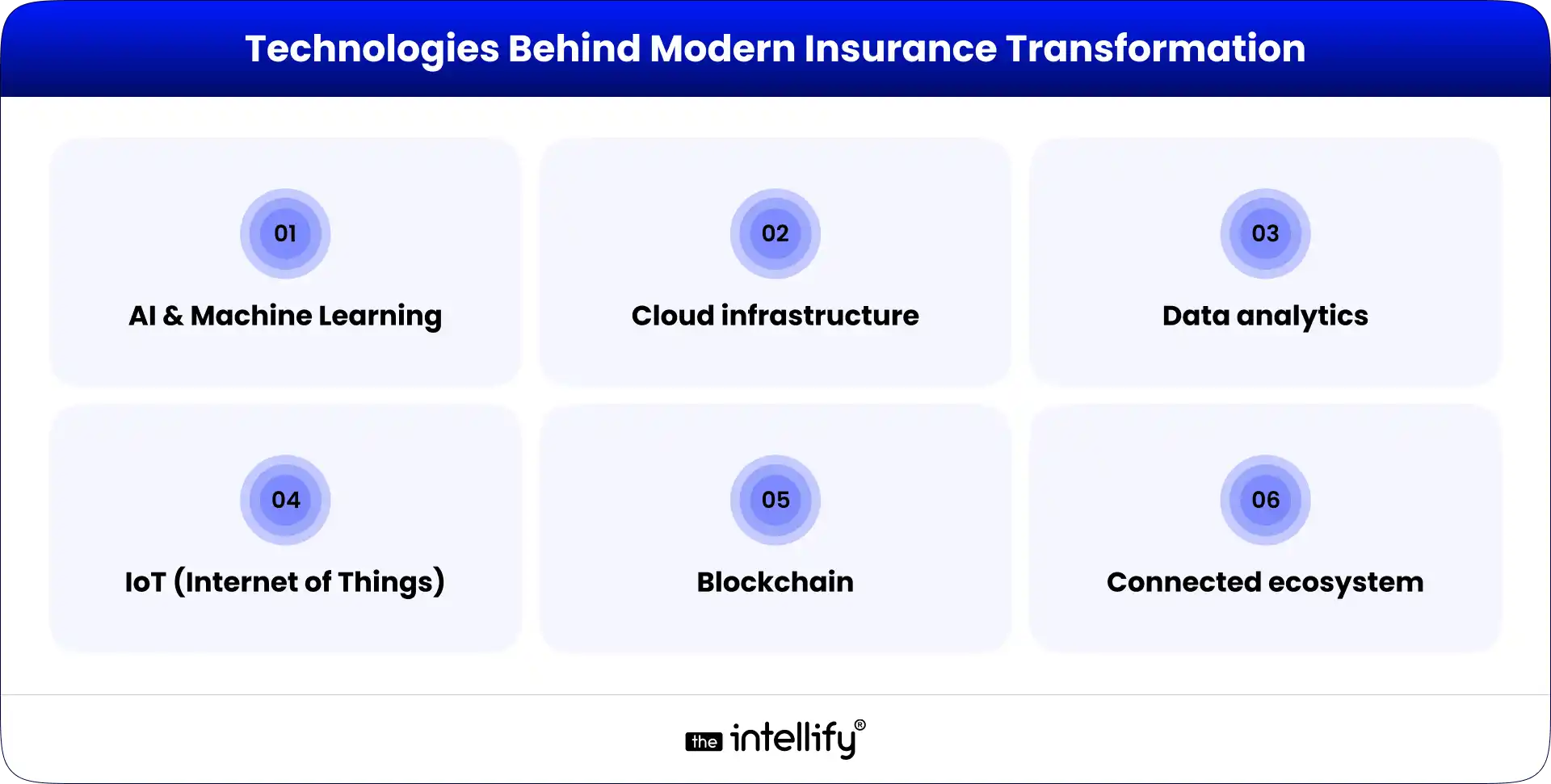
A few key technologies are paving the way for digital change in insurance:

  • AI & Machine Learning: Enhancing operations, improving risk assessments, and spotting fraud.
  • Cloud infrastructure: Providing scalability and flexibility for a variety of applications.
  • Data analytics: Offering actionable insights for improved personalization and customer experiences.
  • IoT(Internet of Things): Supporting real-time and usage-based insurance models.
  • Blockchain: Ensuring secure and transparent transactions.


Key Benefits of Digital Transformation in Insurance Sector

Digital transformation offers numerous advantages, such as:

  • Faster processes: Reducing manual tasks speeds up operational efficiency.
  • Improved customer experience: Personalized interactions and quicker service boost satisfaction.
  • Better Risk Assessment: Reliable data allows for more informed underwriting decisions.
  • Cost efficiency: Streamlined processes yield significant operational savings.
  • Enhanced Fraud Detection: Advanced algorithms improve monitoring and compliance.
  • Accelerated Product Development: Integrated systems facilitate rapid innovation.


Modernize Your Insurance Operations


Where Digital Transformation Delivers Value

Digital transformation has a direct impact on various stages of the insurance value chain:

  • Customer Onboarding: Simplifying policy purchases creates a seamless entry for customers.
  • Claims processing: Automation expedites claims handling and resolution.
  • Customer support: Digital channels enhance engagement and quicken responsiveness.
  • Underwriting and pricing: Efficient data analysis provides the ability for real-time decision-making.
  • Agent and Broker Enablement: Empowered agents can offer better service with enhanced tools.


Real-World Use Cases Across the Insurance Value Chain

Let’s explore some compelling examples that highlight the effectiveness of digital transformation:

Claims & Operations

Automated claims processing: Reduces processing times while improving accuracy.
Fraud detection systems: Utilizing machine learning to identify irregularities.
Document verification: Streamlining the submission process for users.

Customer Experience

Chatbots and virtual assistants: Offering 24/7 support for customer questions.
Self-service portals: Allowing customers to manage their policies and claims independently.
Faster onboarding journeys: Minimizing wait times and simplifying the policy initiation process.

Product Innovation

Telematics-based insurance: Implementing usage-based pricing models based on driving behavior.
Personalized policy recommendations: Crafting options tailored to individual profiles.
Usage-based insurance models: Setting premiums based on actual usage rather than generalized estimates.


Business Impact of Digital Transformation for Insurance Companies

The outcomes of digital transformation are notable:

  • Reduced operational costs: Greater efficiency leads to lower expenses.
  • Faster turnaround times: Quick service enhances customer satisfaction.
  • Higher customer retention: Happy customers are more likely to remain loyal.
  • New revenue opportunities: Innovations can pave the way for fresh business models and offerings.
  • Data-driven decision-making: Leveraging data facilitates informed planning and strategies.


Challenges Insurance Companies Face During Digital Adoption

Challenges Insurance Companies While Digital Adoption

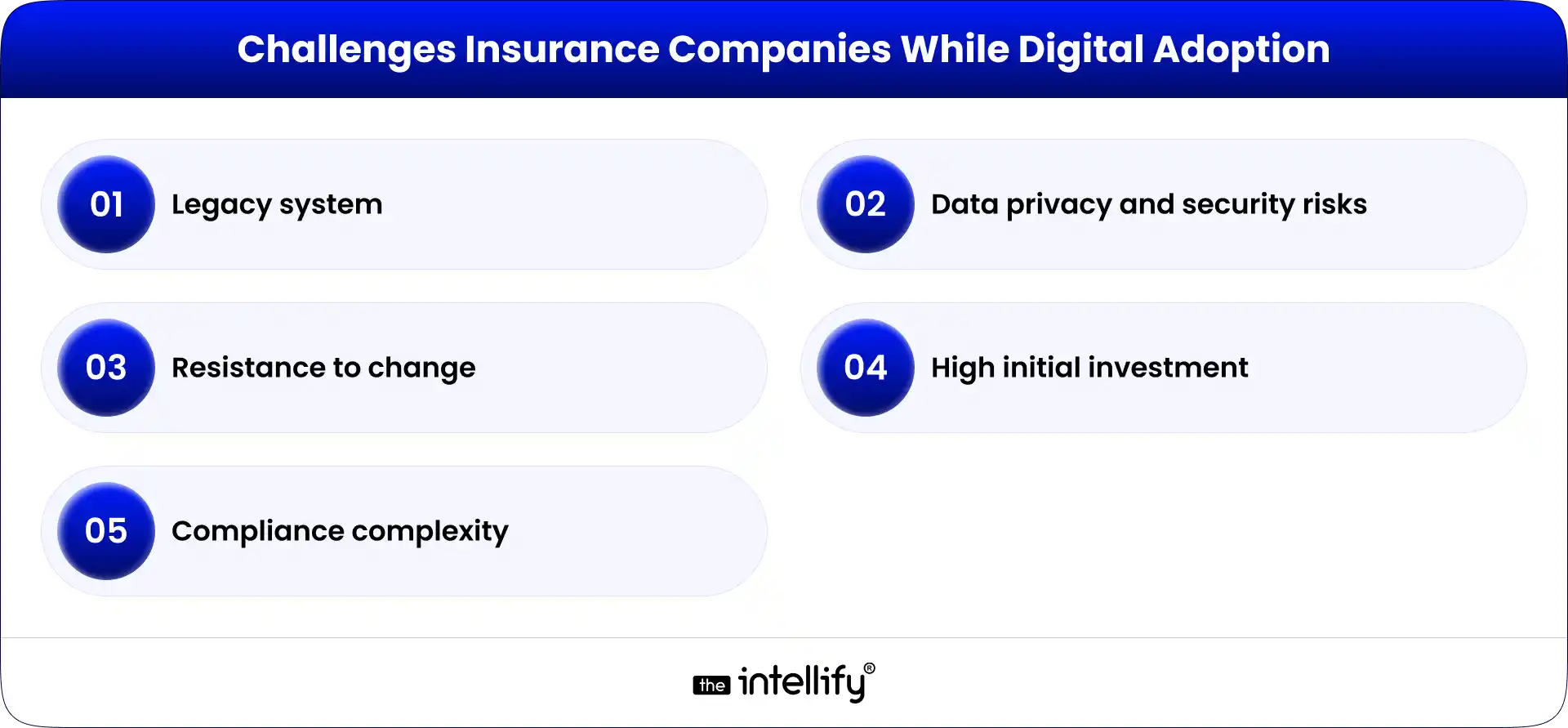
Even with the many benefits, insurance companies face a range of challenges during their digital journey:

  • Legacy system: Older technology can resist integration, complicating progress.
  • Data privacy and security risks: Safeguarding customer data is paramount.
  • Resistance to change: Some employees might be hesitant to adapt, slowing transformation efforts.
  • High initial investment: The upfront costs of new technologies can feel overwhelming.
  • Compliance complexity: Navigating regulatory requirements can be daunting.


How to Implement Digital Transformation in Insurance

Implementing a successful digital transformation strategy involves more than just adopting new tools. Insurance companies need the right partner with expertise in digital transformation and insurance development services to ensure smooth implementation and long-term success. Key factors to consider include:

  • Clear roadmap and priorities: Setting a structured approach to your transformation journey.
  • Customer-first approach: Keeping customer needs and expectations at the forefront throughout the process.
  • Scalable technology: Opting for solutions that can grow alongside your business.
  • Team upskilling: Equipping staff with the necessary skills for thriving in a digital world.
  • Strategic partnerships: Collaborating with tech providers for expertise and innovative solutions.


Emerging Trends Shaping the Future of Insurance

The insurance industry is moving toward thrilling opportunities:

1. AI-driven Predictive Insurance: Using data to anticipate and prepare for future claims.
2. Hyper-personalized policies: Custom offerings grounded in thorough customer insights.
3. Embedded insurance models: Seamlessly integrating insurance into established customer journeys.
4. Fully digital insurance platforms: Facilitating all interactions online for maximum convenience.
5. Real-time data usage: Utilizing data from IoT devices to dynamically adjust policies.


Conclusion:

To sum it up, digital transformation in the insurance industry isn’t just about technology, it’s about rethinking how businesses connect with customers while optimizing operations. Early adaptation is vital to capitalizing on digital opportunities, as it dramatically affects long-term success and competitiveness.

By embracing digital transformation, insurance companies can elevate customer satisfaction, streamline workflows, and position themselves for future growth. The path to innovation starts now let’s seize the opportunities that lie ahead!


Insurance Digital Transformation Services


Frequently asked questions

1. Why are insurance companies focusing more on digital transformation now?

Customers today expect quick responses, online access, and smooth experiences. Traditional systems struggle to keep up with this, so insurers are moving towards digital solutions to stay competitive and meet these expectations.

2. How does digital transformation make insurance processes faster?

It reduces manual work by automating tasks like claims handling, underwriting, and approvals. This not only speeds up operations but also reduces delays and improves overall efficiency.

3. Can digital transformation improve the claims process?

Yes, it makes claims faster and more transparent. Customers can submit and track claims online, while automation helps insurers process them quickly with fewer errors.

4. What role do mobile apps play in digital transformation in insurance?

Mobile apps give customers easy access to services like buying policies, renewing plans, or filing claims. They make the entire experience more convenient and accessible anytime, anywhere.

5. Can traditional insurance companies adapt to digital transformation?

Yes, many companies start small by digitizing specific processes like claims or customer support. Over time, they gradually expand and build a more complete digital system.

6. Does digital transformation help in reducing fraud in insurance?

Yes, advanced technologies can detect unusual patterns and flag suspicious activities early. This helps insurers prevent fraud and improve security.

7. How does digital transformation improve customer experience in insurance?

It makes services faster, simpler, and more personalized. Customers can interact easily, get quick responses, and access everything online without unnecessary delays.

Top AI Trends in Healthcare: Transforming Digital Health in 2026

Summary:
AI trends in healthcare are helping systems become smarter and more data-driven instead of just digital. They support early disease detection, personalized treatments, and remote patient monitoring. This is improving how care is delivered while making hospital operations more efficient. AI also helps reduce the workload on healthcare providers and improves overall patient experience. Despite some challenges, it is becoming an important part of modern, connected healthcare systems.


Why AI is Becoming the Driving Force Behind Digital Health

Healthcare isn’t just going digital anymore; it’s becoming smarter. As technology keeps advancing, artificial intelligence (AI) is reshaping the healthcare landscape in ways we never imagined. With hospitals facing increasing demands to enhance speed, accuracy, and overall patient care, AI is proving to be a crucial ally in bridging the gap between vast amounts of data and actionable decision-making.

In this blog, we’ll delve into AI trends in healthcare that are actively revolutionising digital health. From predictive analytics to personalised treatment plans, these trends are dramatically transforming our approach to healthcare.


Digital Health Transformation in Modern Healthcare Systems

So what does “digital health” really mean today? It goes beyond just having software and applications; it’s about establishing a connected, data-driven healthcare system that genuinely meets patient needs. Modern healthcare systems aren’t just digitizing existing processes; they’re harnessing technology to create a more responsive, integrated, and efficient environment.

Patients today have higher expectations regarding speed, access, and personalized care. They want more than just scheduled visits; they’re looking for tailored health experiences. Digital transformation alone isn’t sufficient adding a robust AI layer is essential to fully leverage the potential of this shift.


The Growing Role of AI in Healthcare Industry

The surge of data in healthcare from electronic health records (EHRs) to wearables and diagnostic tools is monumental. Yet, traditional human-led systems can no longer manage this volume alone. AI isn’t here to replace healthcare professionals; it’s designed to support them. It serves as the backbone of modern healthcare systems, delivering insights and analytics that lead to better patient outcomes.

Today, AI is being used across multiple touchpoints in healthcare, from analyzing patient records to assisting in diagnosis and treatment planning. This shift is helping healthcare professionals rely more on data-backed insights rather than assumptions.


Key AI Trends in Healthcare Driving Digital Health Transformation

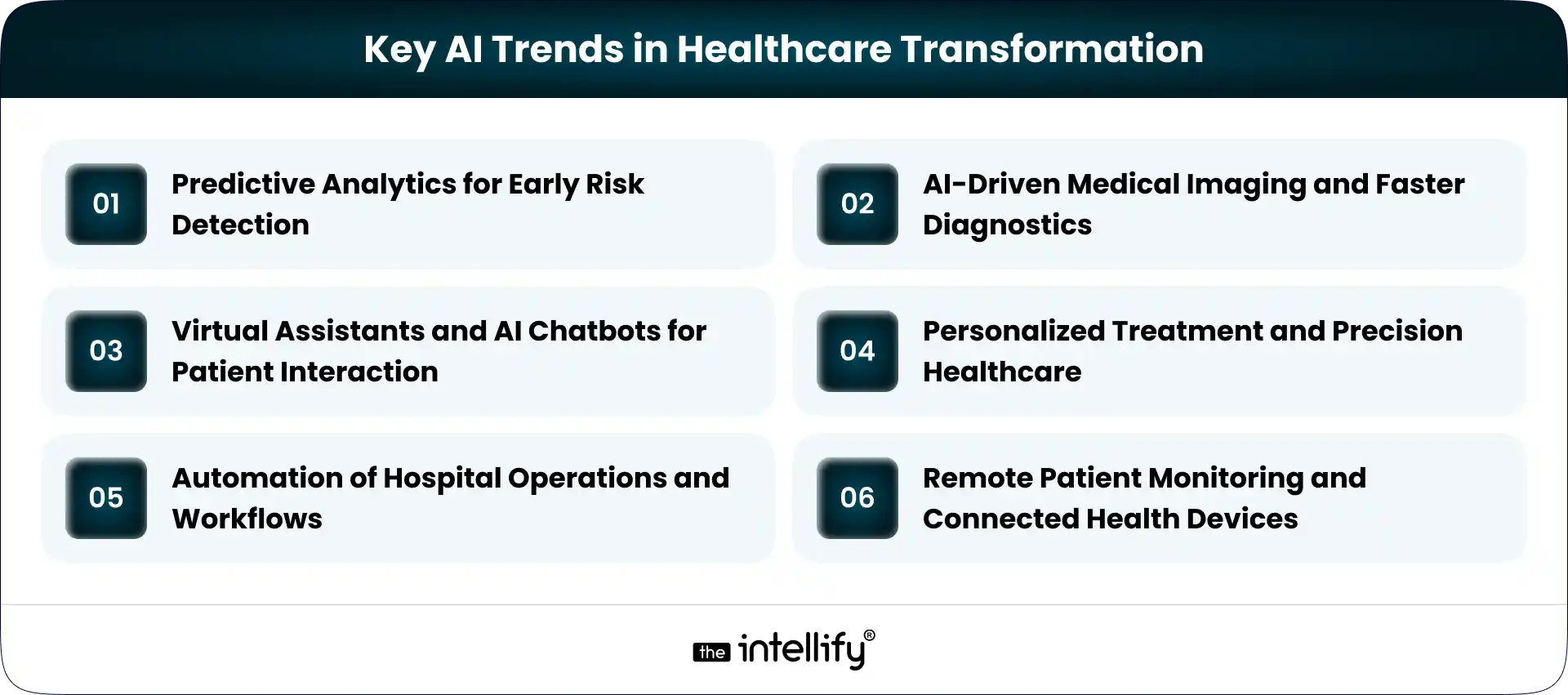
Key AI Trends in Healthcare Transformation

Predictive Analytics for Early Risk Detection

AI’s knack for identifying health risks before symptoms escalate is truly transformative. By analyzing patterns in patient data, healthcare providers can implement preventive measures rather than waiting for issues to arise. This proactive approach is significantly beneficial in chronic disease management and helps alleviate the burden on hospitals.

For example, AI can flag early signs of conditions like heart disease or diabetes based on patient history and lifestyle patterns. This helps hospitals reduce emergency cases and manage patient care more effectively.

AI-Driven Medical Imaging and Faster Diagnostics

AI is stepping up medical imaging, enhancing accuracy in scans like X-rays and MRIs while cutting down on diagnosis time and reducing human error. This assists specialists, offering faster insights that empower them to make well-informed decisions.

This not only improves accuracy but also reduces the workload on radiologists, allowing them to focus on complex cases. Faster diagnosis also means quicker treatment decisions for patients.

Virtual Assistants and AI Chatbots for Patient Interaction

AI chatbots are stepping in to boost patient engagement by delivering round-the-clock support without adding to staff workloads. From scheduling appointments to providing basic consultations, these tools enhance access to healthcare services and allow healthcare professionals to concentrate on critical tasks.

This improves patient convenience by reducing waiting times and makes basic healthcare support available anytime. It also reduces the pressure on hospital front desks and support teams.

Personalized Treatment and Precision Healthcare

AI dives into patient history, genetics, and lifestyle to create tailored treatment plans. This results in better outcomes with fewer unnecessary treatments, ushering in a more efficient, patient-centered healthcare experience.

Automation of Hospital Operations and Workflows

Thanks to AI, hospitals can automate mundane manual tasks like paperwork and administrative duties, substantially reducing the administrative load. This allows healthcare staff to dedicate more time to patient care, ultimately boosting the quality of service.

Automation also reduces the chances of manual errors in billing and records, while helping hospitals manage costs more efficiently over time.

Remote Patient Monitoring and Connected Health Devices

Wearables and IoT devices enable constant health monitoring, providing healthcare professionals with real-time alerts and updates about patients’ conditions. This capability leads to better management of long-term patients and those recovering post-treatment.

This is especially helpful for elderly patients and those with chronic conditions who need regular monitoring without frequent hospital visits.


AI for Healthcare operations


Real-World Applications of AI in Digital Healthcare

Several real-world applications are illustrating AI’s profound impact on digital healthcare:

  • AI Powered Telehealth Platform: These systems are making remote consultations more efficient and accessible. These platforms allow patients to consult doctors remotely, improving access to care.
  • Smart diagnostic systems used in hospitals: Hospitals are increasingly relying on AI for accurate diagnostic assistance. AI in healthcare helps doctors detect diseases faster and with better accuracy.
  • AI in drug discovery and clinical research: AI can shift through vast datasets, accelerating the drug discovery process. AI speeds up research by analyzing large datasets in less time.
  • Intelligent ICU systems: Utilizing AI, these systems monitor patients and enhance emergency response times. These systems monitor patients continuously and alert staff instantly in emergencies.


Impact of AI on Healthcare Businesses and Providers

Incorporating AI is enabling better resource management while alleviating operational pressures on healthcare providers. This allows them to scale services without significantly increasing costs, maintaining a competitive edge in the ever-evolving digital healthcare landscape. Higher patient satisfaction translates to increased trust and retention rates.

AI also helps healthcare organizations make better strategic decisions based on data insights and supports long-term scalability as patient demand grows.


Challenges in Adopting AI for Digital Health Transformation

While the advantages are evident, various challenges still need addressing:

1. Data Privacy and Security Concerns: Safeguarding patient data is critical, and concerns over data security can complicate AI adoption.
2. Integration Issues: Existing legacy systems might clash with new AI solutions, leading to compatibility challenges.
3. High Intial Cost and Technical Complexity: The upfront costs for AI can be quite significant, which can deter some organizations.
4. Resistance to Change: Staff who are accustomed to traditional workflows might resist adopting new processes.


How to Successfully Implement AI in Healthcare Systems

To achieve successful AI integration, consider these strategic steps:

1. Start with clear, Pratical Use Cases: Target specific areas rather than trying to implement everything all at once.
2. Ensure Clean and Accessible Data: High-quality data is vital for the effectiveness of AI.
3. Choose Scalable and Flexible AI Solutions: Invest in technology that can adapt and grow with your organization.
4. Collaborate with Experienced Technology Partners: Working with experts will help ensure a smoother implementation process.
5. Train Teams for Digital Workflows: Proper training ensures that staff can effectively utilize new systems.


What’s Next for AI in Healthcare

We can anticipate an increasing use of predictive and preventive healthcare models that will further connect ecosystems involving hospitals, patients, and devices. As accuracy, speed, and personalization continue to improve, AI will undoubtedly become an integral part of every healthcare system.

As AI continues to evolve, we can expect more advanced and seamless integration into everyday healthcare processes, making it a standard part of modern healthcare systems.


AI solutions for Healthcare


Conclusion:

AI in healthcare is not just a supporting player in digital transformation; it’s at the forefront of driving it. Healthcare is evolving to be smarter, faster, and more patient-centric. Organizations that adapt early will help shape the future of healthcare, providing high-quality care while streamlining operations. Embracing AI isn’t just a choice anymore; It’s a necessity for any healthcare provider aiming for success.


Frequently asked questions (FAQs)

1. What makes AI a key driver behind digital health transformation today?

Digital systems alone manage data, but AI turns that data into useful insights. This ability to predict risks and support decisions is what makes AI central to real transformation in healthcare.

2. How is AI improving decision-making in modern healthcare systems?

AI analyzes large volumes of patient data in seconds, helping doctors make faster and more informed decisions. It reduces guesswork and supports better clinical outcomes without replacing human expertise.

3. In what ways are AI-driven healthcare solutions improving operational efficiency?

AI automates routine tasks like scheduling, billing, and data entry, reducing administrative workload. This allows healthcare teams to focus more on patient care while improving system efficiency.

4. How do AI trends support the shift toward personalized healthcare?

AI studies patient history, behavior, and medical data to suggest tailored treatments. This leads to more effective care plans and reduces the chances of unnecessary or ineffective treatments.

5. Why is integrating AI into existing healthcare systems still a challenge?

Many healthcare systems rely on outdated infrastructure, making integration complex. Along with that, concerns around data security and cost slow down adoption despite clear benefits.

6. How can healthcare organizations scale AI adoption without disrupting operations?

They can start with focused use cases like diagnostics or workflow automation and expand gradually. This step-by-step approach reduces risk and helps teams adapt more smoothly.

7. How are AI trends shaping the next phase of digital health transformation?

AI is pushing healthcare toward more connected, predictive, and patient-focused systems. Over time, it will become a standard layer across all digital healthcare solutions

How Digital Transformation in Healthcare Is Shaping the Industry’s Future

Summary:
Digital transformation in healthcare is changing how systems, data, and processes work together. It is helping improve coordination, reduce delays, and make operations more efficient. Healthcare organizations are using connected technologies and data to manage services better and respond faster. While there are challenges, many are moving forward step by step to improve their systems. Overall, it is shaping a more connected and efficient future for the healthcare industry.

Digital transformation in healthcare is changing how systems, data, and processes work together. It is helping improve coordination, reduce delays, and make operations more efficient. Healthcare organizations are using connected technologies and data to manage services better and respond faster. While there are challenges, many are moving forward step by step to improve their systems. Overall, it is shaping a more connected and efficient future for the healthcare industry.

It is not just improving how healthcare works today, but also shaping how systems will function in the coming years. As the industry evolves, digital transformation is becoming a key part of long-term healthcare growth.


How Healthcare Systems Are Becoming More Connected

In the past, healthcare often relied on outdated manual processes and isolated systems. Departments worked in silos, resulting in gaps in coordination and efficiency. As a consequence, managing the ever-growing sea of patient and operational data could feel like an uphill battle, leading to frustration for both providers and patients alike.

Nowadays, the demand for interconnected systems is surging. Healthcare providers are starting to understand that the secret to enhancing service delivery lies in building systems that foster communication and collaboration.

This level of connectivity reduces repeated work and improves the overall flow of services. It also helps different parts of the system work together more smoothly.


Digital Transformation in Healthcare as the New Foundation

Healthcare Digital Transformation

Digital transformation in healthcare isn’t just about switching to digital formats; it represents a fundamental change in how healthcare systems operate. This transformation aims to connect people, processes, and data into a smooth, cohesive flow.

  • Reducing operational gaps: Automation of workflows and system integration helps minimize delays and miscommunications, enabling better care delivery.
  • Modern foundation: This transformation forms the solid groundwork on which today’s healthcare systems are built, enhancing patient experiences and operational efficiencies.


What makes Digital Transformation Essential in Healthcare

The rapid pace of change in healthcare brings several challenges:

  • Managing Data: The amount of patient and operational data continues to grow. Digital transformation enables healthcare organizations to manage and harness this data for improved decision-making.
  • Faster Coordination: As healthcare teams expand, quick coordination across various systems becomes crucial. Digital tools offer real-time data sharing, ensuring everyone stays aligned.
  • Meeting Expectations: Today’s patients expect smooth, accessible services. Digital transformation equips healthcare providers to meet these rising expectations.

It also helps bring more consistency in how services are delivered across different systems. As operations grow, managing complexity without digital support becomes difficult.


Where Digital Healthcare Transformation Is Creating Real Impact

Digital healthcare transformation is delivering tangible benefits across the industry:

  • Improved coordination: Departments and teams can now communicate effectively, fostering trust and collaboration.
  • Faster Communication: Instant messaging systems and data-sharing platforms cut down on waiting times and speed up decision-making.
  • Efficient Workflows: Routine processes are now more structured, giving healthcare professionals more time to focus on what matters patient care.

It also improves visibility across systems, helping teams make quicker and more informed decisions.


Technologies Behind Digital Transformation in Healthcare Solutions

Several cutting-edge technologies drive the digital transformation in healthcare solutions:

  • AI: This technology speeds up analysis and supports quicker decision-making.
  • Cloud Systems: These enable secure access to and sharing of data.
  • Connected Devices: They allow for continuous monitoring of patient health.
  • Data Platforms: These help organize and simplify vast amounts of information.
  • Integration Tools: They link multiple systems, facilitating smooth operations.

Together, these technologies form the backbone of a transformed healthcare landscape, paving the way for smarter, more efficient practices.


Digital transformation Solutions


How healthcare Operations Are Being Reshaped Internally

Internally, healthcare operations are prioritizing efficiency:

  • Reduction in manual work: Automation takes over routine tasks, freeing staff to focus on vital issues.
  • Faster process Handling: Fewer bottlenecks in workflows enable healthcare facilities to quickly respond to patient needs.
  • Better Use of Resources: By optimizing staff time and hospital resources, organizations can provide improved care.
  • Improved Accuracy: Less manual intervention means fewer mistakes, boosting overall service quality.

This allows healthcare organizations to respond faster to changing needs and improve overall service delivery.


The Expanding Role of Data in Healthcare

Gone are the days when data was merely stored away. Now, it plays a vital role in everyday operations:

  • Real Time Access: Quick access to data enhances decision-making and planning processes.
  • Better Resource Management: Data analytics empower organizations to allocate staff and materials more effectively.
  • Connected Systems: A solid data strategy fosters informed systems that can dynamically respond to patient needs.

Over time, this is helping healthcare systems move toward more planned and proactive decision-making.


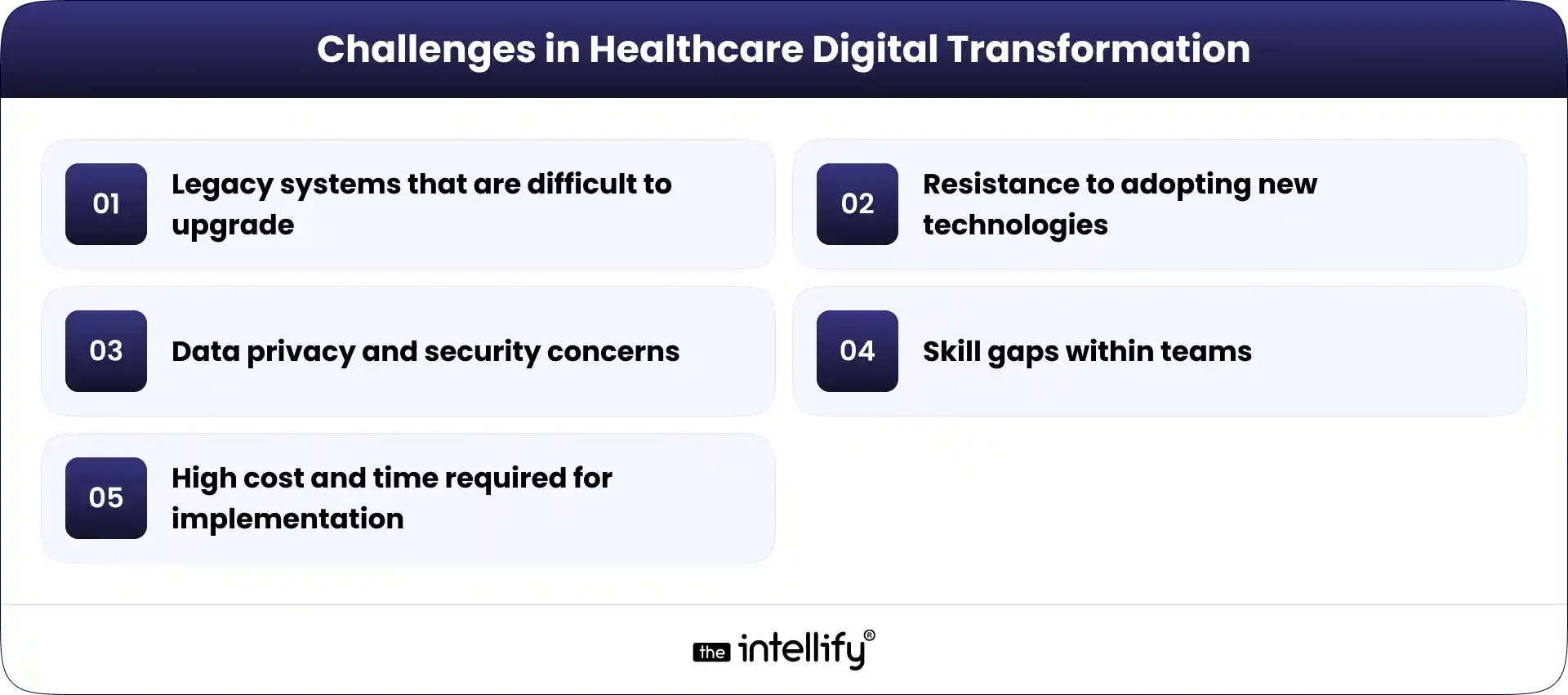
Challenges in Adopting Digital Transformation in Healthcare

Challenges in Healthcare Digital Transformation

Yet, the path to adopting digital transformation isn’t without its hurdles:

  • Legacy Systems: Many organizations struggle with outdated systems that aren’t easy to upgrade.
  • Privacy and Security Concerns: Safeguarding sensitive patient data is crucial and can slow technology adoption.
  • Resistance to Change: Some staff may be hesitant to embrace new technologies, which can stall progress.
  • Skill Gaps: Existing teams might lack the necessary skills for implementation, requiring additional training.
  • Implementation Costs: Upgrading systems can be costly and time-consuming, making many organizations hesitant to proceed.

These challenges can slow progress, but with the right approach, they can be managed over time.


How Healthcare Organizations Are Improving Their Systems

Healthcare organizations are cautiously progressing with strategies to enhance their frameworks:

  • Gradual adoption: Instead of a complete overhaul, many are choosing incremental improvements that minimize disruption.
  • Training Initiatives: Investing in staff training ensures teams are ready to tackle new systems effectively.
  • Scalable Solutions: Organizations focus on flexible technology that can adapt as their needs grow.
  • Partnerships with Tech Providers: Teaming up with experienced technology providers can lead to better outcomes.
  • Long Term Focus: Emphasizing ongoing improvements and results is crucial for sustainable transformation.

The focus is on making systems more stable, reliable, and easier to manage in the long run.


Real-World Applications in Healthcare Services

Digital transformation in healthcare services is already showing its worth in various areas:

  • Online Consultations: Telehealth is enhancing patient access to healthcare services.
  • Digital Health Records: Streamlined management of information reduces paperwork and makes care more efficient.
  • Remote Monitoring: Wearable tech supports continuous patient care, boosting health outcomes.
  • Automation: Routine tasks, from scheduling to billing, are increasingly automated to cut delays.
  • Better Coordination: Enhanced communication tools ensure smooth service across all touchpoints.

These applications are already changing how healthcare services are delivered and experienced.


How Healthcare Systems Are Changing for the Future

The future of healthcare is on a transformative path:

Connected Systems: Improved integration offers a more holistic view of patient care.

Faster Service Delivery: Automation and streamlined processes ensure prompt care.

Increased Automation: Smart tools and technologies are set to reshape daily operations further.

Improved Coordination: A more connected infrastructure will facilitate stronger relationships among providers.

Healthcare systems are expected to become more proactive rather than reactive in handling needs.


What Healthcare Organizations Need to Focus on Next

Looking ahead, healthcare organizations should concentrate on:

Scalability: Designing systems that can adapt to future challenges.

Digital Strategy: Making digital transformation a cornerstone of long-term planning.

Continuous Improvement: Prioritizing process refinement over merely implementing new tools.

Alignment of Teams: Ensuring that people, processes, and technology work in harmony.

Staying Adaptable: Keeping an open mind toward new technologies and changing patient expectations.

The goal is to build systems that can support continuous change and future growth.


Healthcare digital transformation solutions


Conclusion:

Digital transformation is no longer a choice; it’s central to how the healthcare industry operates. As organizations embrace these changes, they’re paving the way for more connected, efficient systems that ultimately benefit everyone from healthcare providers to patients.

The journey is just beginning, and healthcare organizations need to remain flexible and proactive to stay relevant in an ever-evolving landscape. By effectively implementing these changes, the future of healthcare looks bright, buoyed by innovation and progress.


Frequently Asked Questions

1. Why do traditional healthcare systems face limitations?

They depend on manual work and disconnected systems, which slows down processes. This makes it harder to manage data, coordinate teams, and deliver services efficiently.

2. How do connected systems improve healthcare services?

They allow information to move smoothly between departments and teams. This improves coordination, reduces errors, and helps deliver services faster.

3.. What changes do healthcare teams notice after going digital?

Teams experience faster workflows and less dependency on paperwork. They also see better accuracy and smoother coordination across different departments.

4. What are the common challenges in digital transformation for healthcare?

Many organizations struggle with outdated systems and data security concerns. They also need time and training to help teams adapt to new ways of working.

5. What should healthcare organizations focus on moving forward?

They should focus on building flexible systems that can adapt over time. Continuous improvement in processes and team readiness is also important for long-term success.

Indoor Navigation with AR: The Future of Smart Wayfinding Systems

Summary:
AR-powered indoor navigation is helping businesses deliver smarter and more seamless wayfinding experiences. By guiding users with real-time visual directions, it eliminates confusion in complex environments like hospitals, malls, airports, and campuses. These solutions not only improve visitor satisfaction but also enhance operational efficiency and accessibility. As demand for smarter buildings grows, indoor navigation is becoming a key technology for organizations looking to modernize their spaces.


Lost Inside Big Buildings? You’re Not Alone

Walking into a large hospital, airport, or shopping mall can quickly become confusing, especially when you’re unfamiliar with the layout. Unlike outdoor travel, where GPS guides us almost everywhere, indoor environments block satellite signals. Thick walls, multiple floors, and complex structures make traditional navigation tools unreliable.

Modern facilities are also expanding rapidly. A single building may include dozens of departments, corridors, and entry points. Visitors often waste time wandering, asking for directions, or backtracking after taking a wrong turn. In stressful places like hospitals or transit hubs, this confusion can add unnecessary anxiety. Traditional signs and maps help to some extent, but they can’t adapt to real-time movement which is why smarter digital guidance is becoming increasingly important.


What Are Indoor Navigation Solutions?

Indoor navigation solutions are systems that help people move through buildings efficiently when GPS cannot function properly. Instead of satellites, they rely on local technologies such as Wi-Fi signals, Bluetooth beacons, sensors, and digital building maps to determine a user’s position.

As a person walks, the system continuously updates their location and provides step-by-step directions to the desired destination. Unlike outdoor navigation, indoor guidance must account for elevators, staircases, restricted areas, and multi-floor layouts. These solutions benefit visitors looking for quick directions, staff navigating large facilities daily, and organizations aiming to improve overall efficiency and user experience.


From Maps to AR: A Smarter Way to Find Your Way

Limitations of static maps and directories

Traditional maps show the layout but don’t guide you as you move, so users must remember directions on their own. In large buildings, this often leads to confusion, missed turns, or repeated stops to recheck the map.

Shift toward interactive and real-time guidance

Modern navigation tools provide step-by-step assistance that updates as you walk, similar to GPS outdoors. This makes the experience more dynamic and reduces the need for guesswork.

How AR overlays directions onto the real environment

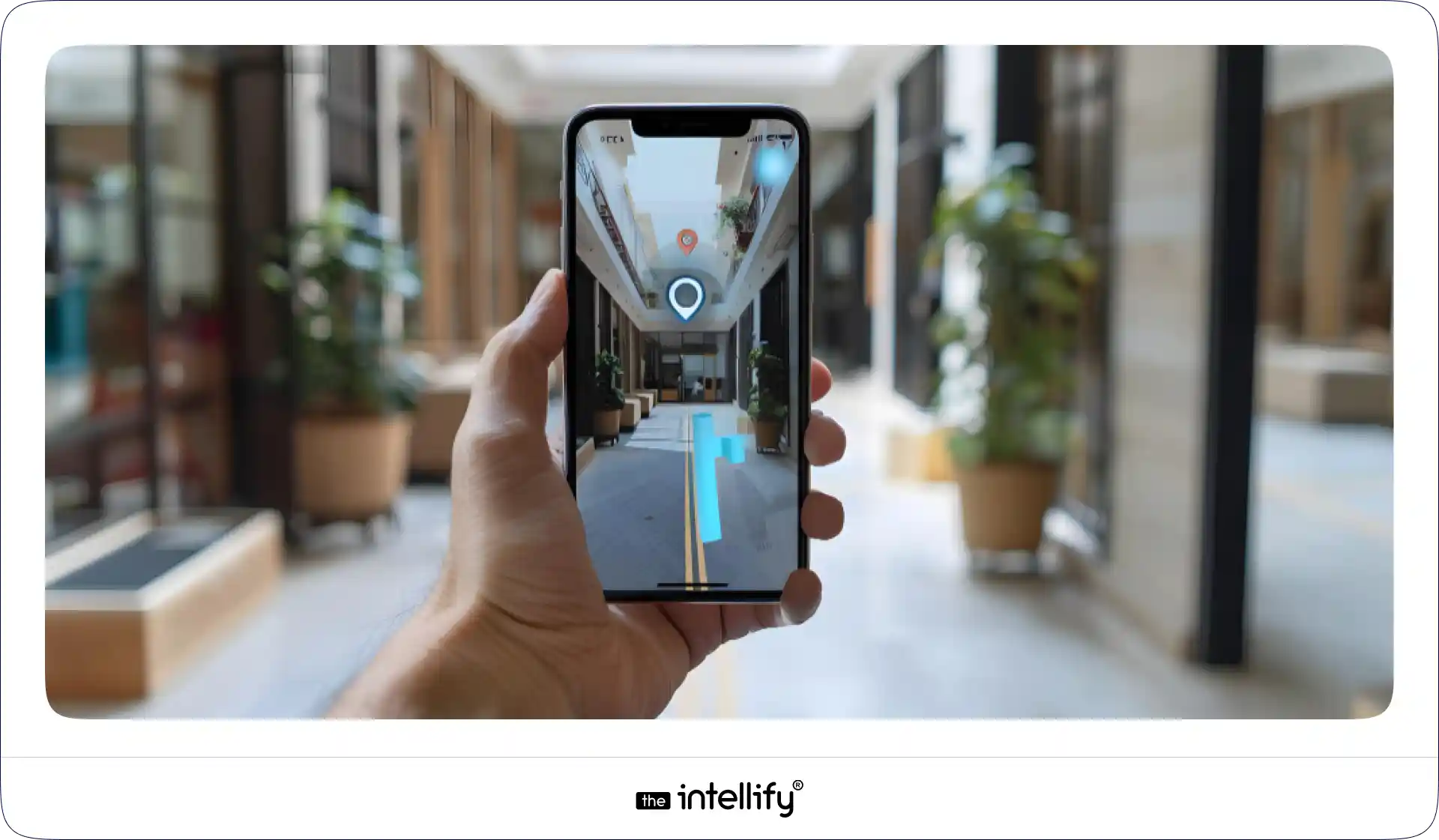
Augmented Reality displays arrows or paths directly on the live camera view of your surroundings. Instead of imagining the route, users can simply follow visual markers placed in their actual environment.

Why visual cues are easier to follow than 2D maps

People naturally understand visual directions faster than abstract diagrams or written instructions. Seeing where to go in real space removes the mental effort of translating a map into movement.

Real-time adjustments as users move

If a user takes a wrong turn or changes direction, the system recalculates instantly and shows a new route. This ensures users stay on track without needing to restart the navigation process.


How an AR Navigation App Guides You Step by Step

AR Navigation App Guides

How users start navigation on their device

The process begins by selecting a destination within the app, such as a store, department, or room. The system then determines the best route based on the user’s current position.

Environment scanning and position detection

The app scans nearby surroundings using the camera and sensors to understand orientation and location. This helps it align digital directions accurately with the physical space.

Camera-based arrows and turn-by-turn directions

Visual arrows appear on the screen, guiding users step by step through corridors and intersections. This removes uncertainty and makes navigation feel intuitive.

Multi-floor routing and destination search

For multi-level buildings, the app guides users to elevators or staircases and continues directions on the next floor. It can also help locate specific rooms or facilities within large complexes.

Compatibility with smartphones and wearables

Most solutions are designed to work on everyday smartphones and tablets, with some expanding to smart glasses or wearable devices. This makes the technology accessible without requiring special hardware.

Key features that improve usability

Features such as clear visuals, simple interfaces, and automatic rerouting make the app easy to use for people of all ages. Minimal interaction is needed once navigation begins.


Why Smart AR Indoor Navigation Is a Game Changer

For Visitors

Indoor navigation dramatically improves the visitor experience by removing uncertainty. People can reach their destinations faster without relying on staff or signage, which reduces stress in unfamiliar places. It also supports elderly users and individuals with mobility challenges by providing clear, step-by-step guidance.

For Businesses & Facilities

Organizations benefit from smoother operations and improved service perception. Staff spend less time giving directions, allowing them to focus on their primary responsibilities. Additionally, understanding how visitors move through a facility can help optimize layouts, reduce congestion, and enhance overall efficiency.


AR Navigation App Development


 Where This Technology Makes the Biggest Difference

Airports & Transportation Hubs

Large transit facilities can be overwhelming, especially for travelers under time pressure. Indoor navigation helps passengers quickly locate gates, baggage areas, security checkpoints, and services, reducing missed connections and confusion.

Hospitals & Healthcare Campuses

Hospitals often consist of multiple buildings and departments, making navigation stressful for patients and visitors. Clear guidance ensures people reach the right department on time, improving both experience and operational flow.

Shopping Malls & Retail Spaces

In large malls, customers frequently struggle to locate specific stores or amenities. Navigation tools help shoppers move efficiently, discover more outlets, and spend less time searching and more time engaging.

Universities & Corporate Offices

Expansive campuses can be difficult for new students, visitors, or job candidates to navigate. Guided routes simplify movement between buildings, lecture halls, or offices, especially during events or peak hours.

Museums, Exhibitions & Event Venues

Events and exhibitions often involve temporary layouts that change frequently. Navigation solutions help visitors explore spaces comfortably while preventing overcrowding in popular areas.

Industrial Facilities & Warehouses

Large industrial sites benefit from improved worker mobility and safety. Clear routing helps staff move efficiently across complex environments while reducing time spent searching for locations or equipment.


How Indoor Navigation Solutions Improve Safety Too

Emergency Guidance

During emergencies, clear directions to exits can significantly reduce panic and evacuation time. Real-time guidance ensures people move toward the safest available routes instead of relying on memory or unclear signage.

Support for Vulnerable Users

Navigation systems can highlight accessible paths for individuals with mobility limitations or visual impairments. This promotes independence and ensures safer movement throughout the facility.

Crowd Management

In high-traffic environments, directing people efficiently prevents bottlenecks and unsafe congestion. Balanced crowd flow improves both safety and comfort for everyone present.

Multilingual Assistance

For international locations, language barriers can make navigation difficult. Providing directions in multiple languages helps visitors move confidently without needing personal assistance.


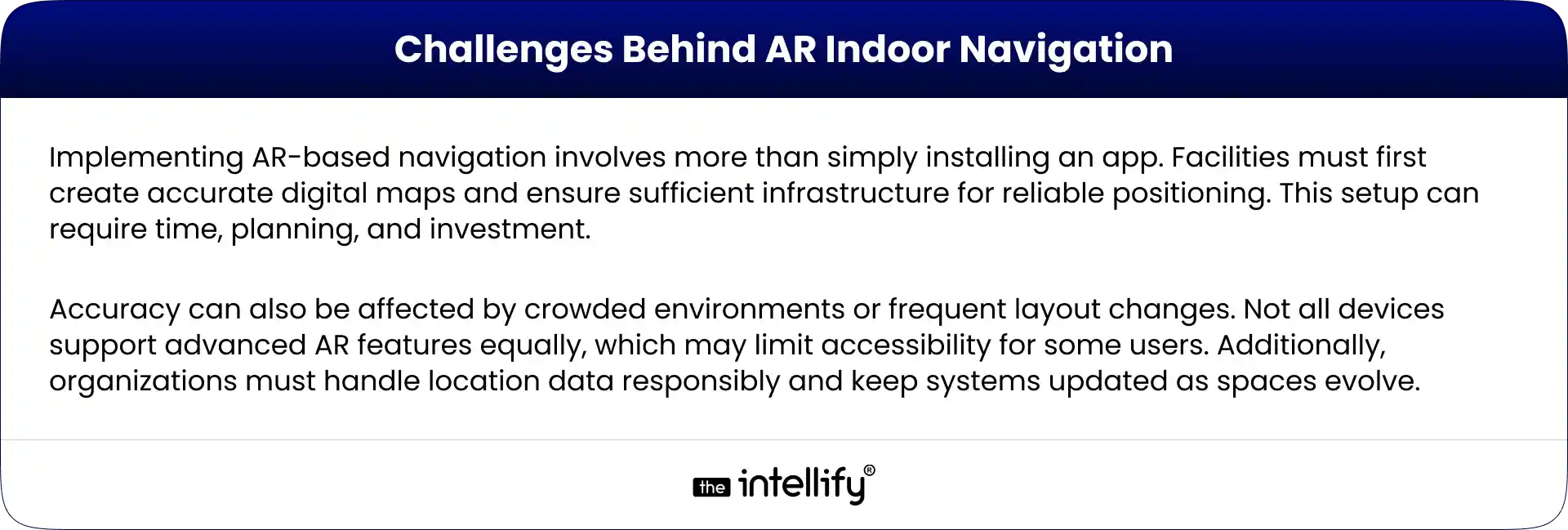
Challenges Behind AR Indoor Navigation


What’s Next for AR Wayfinding?

The future of AR wayfinding lies in smarter, more personalized experiences. Integration with artificial intelligence could allow systems to suggest optimal routes based on crowd levels, user preferences, or accessibility needs. Voice guidance may enable hands-free navigation, making the experience more convenient in busy situations.

As buildings become more connected through smart technologies, navigation systems may integrate with sensors and infrastructure to provide real-time updates about closures, maintenance, or hazards. Over time, indoor guidance is likely to become part of a broader digital ecosystem linking transportation, buildings, and services seamlessly.


The Future of Finding Your Way Indoors

Traditional navigation methods are struggling to keep up with the scale and complexity of modern spaces. Static signs and maps simply cannot provide the adaptability people expect today. Augmented reality bridges the gap between physical environments and digital intelligence, turning navigation into an intuitive experience.

As adoption spreads across industries, indoor navigation is moving from a convenience to a necessity. Organizations that implement these solutions are creating environments that feel easier, safer, and more welcoming. In the near future, getting lost indoors may become uncommon replaced by guidance that feels effortless and reliable.


AR Indoor Navigation App Solutions


Conclusion:

Indoor navigation is no longer just a convenience it is becoming an essential part of how people experience large and complex environments. As buildings continue to grow in size and functionality, relying on static signs alone is no longer enough to guide visitors efficiently.

Augmented reality brings a human-friendly approach to navigation by turning directions into a visual, intuitive, and easy-to-follow experience. Organizations that adopt these solutions are not only improving operational efficiency but also creating spaces that feel more welcoming, accessible, and future-ready for everyone who walks through their doors.


Frequently Asked Questions (FAQs)

1. How accurate is AR indoor navigation compared to GPS?

AR indoor navigation can be surprisingly precise because it relies on local signals and visual positioning instead of distant satellites. In well-mapped buildings, it can guide users to specific rooms or facilities with high accuracy. However, performance depends on infrastructure, layout complexity, and device quality.

2. Do users need special devices to use AR wayfinding?

No, most AR navigation solutions work on standard smartphones and tablets. As long as the device supports basic camera and sensor functions, users can access visual guidance without additional hardware. Some advanced setups may also support smart glasses, but they are not required.

3. Can indoor navigation work without internet connectivity?

Many systems need internet access for initial setup and map loading, but some can continue guiding users offline once the data is downloaded. The exact capability depends on how the solution is designed and the building’s infrastructure.

4. How long does it take to implement an indoor navigation system in a large facility?

Implementation timelines vary based on building size and complexity. Mapping, calibration, and testing can take weeks or months for very large spaces. However, once deployed, the system can be updated incrementally as layouts change.

5. How does indoor navigation improve customer experience in large venues?

By removing confusion and saving time, navigation tools make visits smoother and less stressful. Customers can focus on their purpose, shopping, traveling, or attending an event instead of worrying about getting lost. This often leads to higher satisfaction and repeat visits.

6. Is user privacy a concern with location-based indoor navigation?

Responsible solutions prioritize privacy by anonymizing data and avoiding unnecessary personal tracking. Most systems focus on movement patterns rather than individual identities, ensuring useful insights without compromising user trust.

7. Can these systems support accessibility needs?

Yes, many solutions are designed to highlight accessible routes, elevators, ramps, and barrier-free paths. This helps individuals with mobility challenges navigate complex environments independently and safely.

Digital Twin in Manufacturing & Industrial Operations: A Practical Guide

Summary:
Digital twin in manufacturing enables organizations to improve visibility, efficiency, and decision-making across industrial operations. Creating real-time digital replicas of physical assets, it supports predictive maintenance, process optimisation, and smarter planning. The guide covers how the technology works, key benefits, practical use cases, implementation challenges, and future trends, helping manufacturers understand how to adopt and scale digital twin solutions effectively.
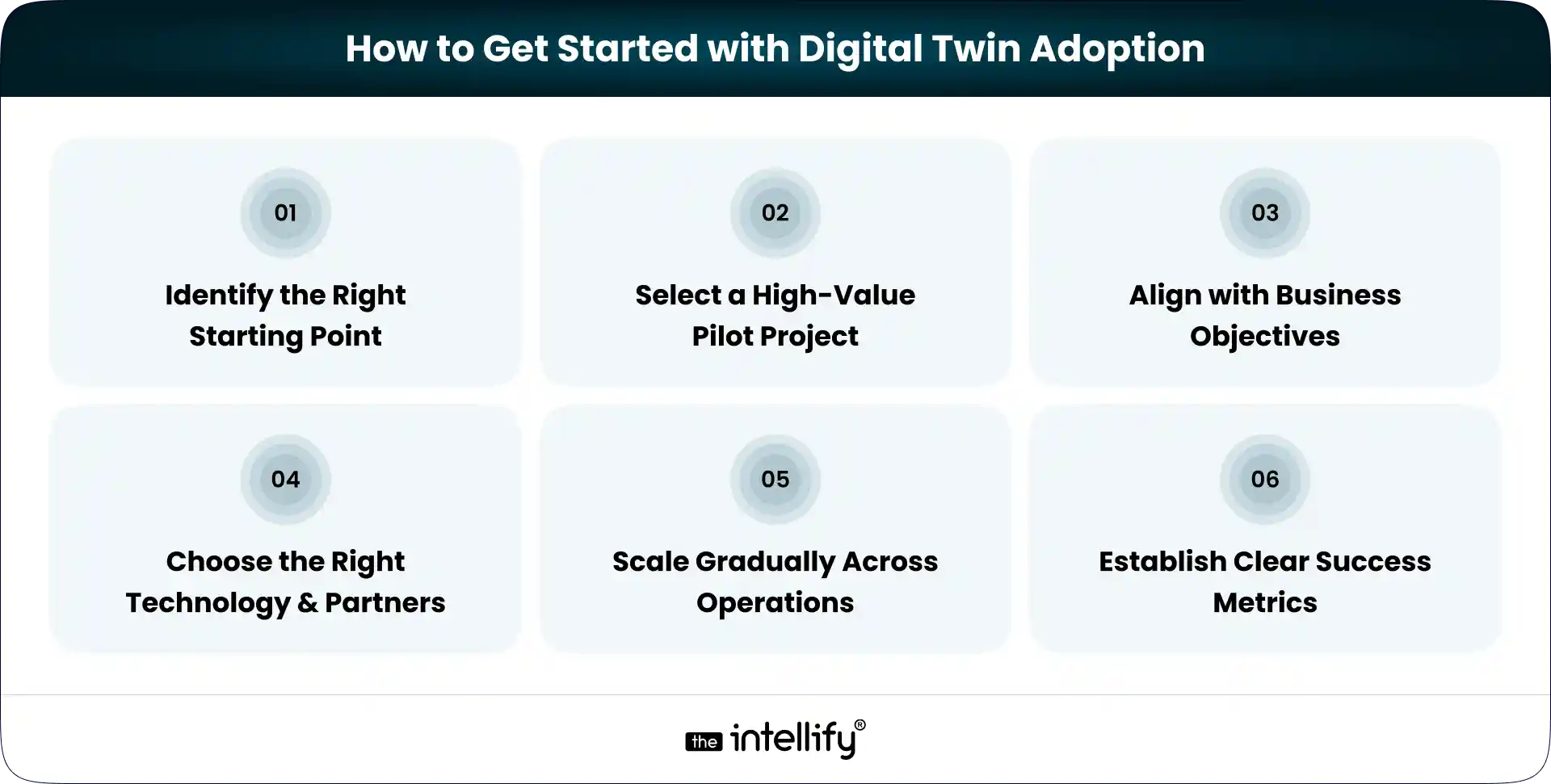
 

The Shift Toward Data-Driven Manufacturing

Walk into any modern factory today, and you’ll notice something right away: it’s no longer just machines and people. It’s screens, dashboards, alerts data everywhere. And honestly, it’s getting a bit overwhelming.

Manufacturing environments have become more complex than ever. Multiple production lines, global supply chains, fluctuating demand, it’s not simple anymore. A small delay in one area can quietly ripple across the entire operation. That’s where the real challenge kicks in.

Most manufacturers still rely on traditional monitoring methods. Reports. Periodic checks. Manual inspections. The problem? These methods are always a step behind. By the time you spot an issue, It’s already costing you. There’s a growing need for something better. Something real-time. Something that shows what’s happening right now, not what happened yesterday.

This is exactly where the digital twin in manufacturing starts to make sense. Digital technologies are quietly reshaping how factories operate. Instead of guessing, teams can now see, test, and predict outcomes before they happen. It’s less firefighting, more foresight.

In this guide, we’ll break down how digital twin technology actually works in manufacturing. No buzzwords. No overcomplicated explanations. Just a practical look at how it helps improve operations and where it fits in real-world industrial setups.


Digital Twin in Manufacturing and Industrial Environments

Digital Twin in Manufacturing

In an industrial setting, a digital twin in manufacturing goes beyond a single machine. It connects multiple systems, equipment, workflows, people, and processes into one unified digital environment. Think of it like a live control room but smarter. Again, to keep things clear:

  • A basic digital model shows how something looks
  • A simulation shows how something might behave
  • A real-time digital twin shows how something is behaving right now

That real-time connection is powered by data. Machines on the shop floor send continuous updates. These updates feed into a virtual system that mirrors operations as they happen. It’s like watching your factory run from inside a screen.

This applies across:

  • Assembly lines
  • Production equipment
  • Warehousing systems
  • Entire manufacturing plants

What’s interesting is how quickly this is expanding beyond manufacturing, into energy, logistics, and even infrastructure. The reason is simple. Industrial operations can’t afford blind spots anymore.


How Digital Twins Enhance Manufacturing & Industrial Operations

Here’s where it gets practical. With industrial digital twin solutions, manufacturers can actually improve operations, not just monitor them. Data flows continuously from the shop floor into digital platforms. This creates visibility that most factories never had before. You can see:

  • Which machines are underperforming
  • Where production is slowing down
  • How efficiently resources are being used

And instead of reacting to breakdowns, teams can act early. Predictive insights allow maintenance teams to fix issues before they become failures. That alone can save a surprising amount of time and cost. (Seriously, unplanned downtime is a silent killer.)

Another benefit is how easily this fits into existing systems. You don’t have to rip everything out and start from scratch. Digital twins can layer on top of your current infrastructure and gradually enhance it.


Key Benefits for Manufacturers

Let’s not overcomplicate this. The value comes down to a few clear outcomes.

  • Reduced unplanned downtime: Machines don’t just stop suddenly anymore. You see problems coming.
  • Improved productivity and throughout: When systems run smoothly, output naturally improves.
  • Better product quality and consistency: You catch variations early. That means fewer defects and less rework.
  • Enhanced worker safety: Monitoring conditions helps reduce risk, especially in high-risk environments.
  • Lower operational waste and energy use: You can actually see where resources are being wasted. And fix it.
  • Greater visibility across complex processes: When operations get complex, visibility becomes everything.


Practical Use Cases Across the Manufacturing Lifecycle

  • Predictive Maintenance of Critical Equipment: Machines are monitored continuously, helping teams fix issues before they lead to breakdowns.
  • Production Line Optimization and Balancing: Manufacturers can identify slow points and adjust workflows to keep production running smoothly.
  • Factory Layout Planning and Process Testing: Different layouts and process changes can be tested digitally before making physical changes.
  • Supply Chain Coordination and Inventory Planning: Better visibility helps align inventory with demand and avoid overstocking or shortages.
  • Remote Monitoring of Distributed Facilities: Teams can track performance across multiple locations without being physically present.
  • Energy and Resource Management: Usage patterns can be analyzed to reduce waste and improve overall efficiency.


Digital twin for manufacturing solutions


Enabling Smart Factories and Industry 4.0 Initiatives

Digital twins are a big part of the whole Industry 4.0 shift. Factories are becoming more connected. More automated. More flexible. Digital twins sit right in the middle of this. They connect with:

  • Robotics
  • Automation systems
  • AI-driven tools

This allows manufacturing systems to adapt faster. Instead of fixed processes, you get flexible production models that adjust based on real-time data. Over time, this leads to something bigger, self-optimizing operations. Not fully autonomous (yet), but getting close.


Using Real-Time Data to Improve Operations

Real-time data changes how decisions are made on the shop floor. Instead of relying on reports or past trends, teams can see what’s happening as it unfolds. This makes operations more responsive, a bit more predictable, and honestly… less stressful to manage.

1. Testing Scenarios Without Disrupting Production

Teams can simulate changes in a digital environment before applying them in real operations. This reduces risk and avoids unnecessary downtime.

2. Identifying Bottlenecks Early

Small delays or inefficiencies can be spotted early, before they turn into larger production issues.

3. Planning Capacity and Demand Changes

Manufacturers can adjust plans based on current data, making it easier to handle demand shifts without overloading systems.

4. Supporting Data-Driven Decisions

Managers have access to live insights, helping them make faster and more accurate decisions instead of relying on assumptions.

5. Faster Response to Disruptions or Failures

When something goes wrong, teams can react quickly, minimizing downtime and keeping operations on track.


Cost Considerations and Business Value

Let’s talk money. Because this is where most decisions get stuck. Digital twin implementation does require investment. There’s no way around that. But the returns usually show up in places like:

  • Reduced downtime
  • Lower maintenance costs
  • Improved efficiency
  • Less material waste

Some gains are immediate. Others take time. That’s why most manufacturers start small.

Instead of applying digital twins everywhere, they begin with high-impact assets like machines that are critical or prone to failure. Success is usually measured through operational metrics. Not vanity numbers. Real things like uptime, output, and cost savings.


Implementation Challenges and Practical Barriers

Digital twin adoption sounds straightforward on paper but in reality, there are a few bumps along the way. Most of them aren’t technical alone, they’re operational too.

Data Availability and Quality Issues

Digital twins rely heavily on data. If the data is incomplete, outdated, or just messy, the insights won’t be reliable. And that can create more confusion than clarity.

Integration with Legacy Systems

Many manufacturing setups still run on older systems. Connecting them with modern digital platforms isn’t always smooth, it takes effort, and sometimes a bit of workaround thinking.

Upfront Investment and Organizational Readiness

There’s an initial cost involved, both in technology and setup. Plus, not every organization is immediately ready to adopt something this data-driven.

Skills Gaps and Training Needs

Teams need to understand how to use and interpret digital twin systems. Without proper training, even the best tools can end up underused.

Cybersecurity and Data Governance Concerns

With more connected systems comes more risk. Protecting operational data and ensuring proper access control becomes critical.

Managing Change Across Teams

And then there’s the human side. Not everyone is quick to adopt new systems. Change takes time, and getting teams aligned can be… a bit of a process.


How to Get Started with Digital Twin Adoption

How to Get Started with Digital Twin Adoption

Getting started with a digital twin doesn’t have to be complicated. In fact, keeping it simple at the beginning usually works better.

1. Identify the Right Starting Point

Look for an area where problems show up often or where delays actually hurt operations. It could be a machine that breaks down too often or a process that slows everything else.

2. Select a High-Value Pilot Project

Don’t try to fix everything at once. Pick one use case that can show clear results, something measurable, not vague.

3. Align with Business Objectives

Make sure the effort connects to real goals. Reducing downtime, improving output, cutting waste, and keeping it tied to what matters.

4. Choose the Right Technology and Partners

Tools matter, but so do the people implementing them. A good partner can save a lot of trial and error (and frustration, honestly).

5. Scale Gradually Across Operations

Once the pilot works, expand step by step. No need to rush. Scaling slowly helps avoid unnecessary chaos.

6. Establish Clear Success Metrics

Define what success looks like early on. Track things like uptime, efficiency, or cost savings so you know what’s actually improving.


The Future of Digital Twin Technology in Manufacturing

The future of digital twins isn’t some far-off idea, it’s already starting to take shape. And honestly, it’s moving faster than most teams expect.

Rise of AI-Driven Insights and Automation

Digital twins are getting smarter. With AI layered in, they won’t just show what’s happening, they’ll suggest what to do next (and sometimes even act on it).

Expansion Beyond Individual Assets

What started with single machines is now scaling up. Manufacturers are beginning to create digital twins for entire production lines, factories, and even full value chains.

Stronger Focus on Sustainability and Resilience

There’s growing pressure to reduce waste and energy use. Digital twins help track and optimize resources, making operations more efficient and a bit more future-proof.

Move Toward Autonomous and Self-Adjusting Systems

We’re slowly heading toward factories that can adjust themselves. Not fully hands-off yet, but definitely less dependent on constant manual intervention.

Continuous Evolution in the Coming Years

This space isn’t standing still. As technology improves, digital twins will become more accessible, more accurate, and honestly… more expected than optional.


Manufacturing digital twin services


Conclusion

Digital twin in manufacturing is becoming a practical tool for improving visibility, efficiency, and decision-making across operations. It helps teams reduce downtime, optimize processes, and respond faster to issues. What once felt experimental is now moving into core operations. Manufacturers are adopting it not for innovation alone, but to stay competitive and efficient.

Early adoption gives organizations an edge, especially as digital capabilities become more common. Looking ahead, digital twins are likely to become a standard part of modern manufacturing, not just an added advantage.


Frequently Asked Questions (FAQs)

1. How is a digital twin different from a simulation in manufacturing?

A simulation tests scenarios based on assumptions, usually during planning. A digital twin stays connected to the real system using live data. It reflects actual performance in real time, which makes it more useful for monitoring, predicting issues, and improving day-to-day operations.

2. Do small or mid-sized manufacturers benefit from digital twins, or is it only for large enterprises?

Digital twins are not limited to large enterprises. Smaller manufacturers can start with one critical machine or process. Even a small setup can reduce downtime and improve maintenance planning without requiring a heavy upfront investment.

3. What kind of data is needed to create a digital twin?

Data typically comes from sensors, machines, production systems, and maintenance records. The focus is on understanding real performance. Clean and relevant data is more important than collecting large volumes of it.

4. How does a digital twin help reduce unexpected equipment failures?

It continuously tracks performance and detects early warning signs like unusual vibration, temperature changes, or drops in efficiency. This allows teams to fix issues before they turn into breakdowns.

5. Can digital twins improve production planning and scheduling?

Yes. They allow teams to test different production scenarios using real data. This helps identify bottlenecks, optimize workflows, and adjust schedules without interrupting actual production.

6. Is implementing a digital twin disruptive to ongoing operations?

Most companies start with a small pilot, such as a single machine or production line. This approach keeps disruption low and allows teams to learn before scaling.

How to Choose the Right Digital Transformation Partner for Healthcare Platforms

Summary:
Healthcare platforms can no longer rely on outdated systems. This blog explains why digital transformation in healthcare industry has become essential and how the right digital transformation partner can shape long-term success. It covers modernization challenges, AI automation in healthcare, operational improvements, and key factors to consider before choosing a partner. The goal is simple: help healthcare organizations make a strategic, informed decision that strengthens patient care and operational stability.


Why Healthcare Platforms Can No Longer Ignore Digital Change

Healthcare doesn’t work the way it used to. And honestly, it can’t. Patient expectations have changed. People now expect healthcare platforms to feel as smooth as booking a cab or ordering groceries. They want:

  • Online appointment booking
  • Easy access to digital medical records
  • Quick responses and reminders
  • Clear billing transparency

The shift toward online consultations and digital records has accelerated. Telehealth calls from living rooms. Reports shared through secure portals. Prescriptions delivered digitally. This isn’t futuristic anymore it’s normal.

At the same time, hospitals, clinics, and health startups are under operational pressure. Staff shortages. Rising compliance requirements. Increasing patient volumes. Limited budgets. This is why digital transformation in healthcare industry is no longer optional. It’s becoming a survival need.

Platforms that stay dependent on outdated systems face real risks:

  • Slow reporting cycles
  • Data stuck in disconnected tools
  • Higher chances of billing and documentation errors
  • Poor patient experience

In healthcare, delays and mistakes aren’t minor inconveniences. They affect real lives. That’s the reality.


What Digital Transformation Really Means for Healthcare Platforms

Many leaders think digital transformation solutions mean upgrading software. That’s only a small part of it.

True transformation connects systems instead of running isolated tools. Your scheduling system should sync with billing. Billing should integrate with patient records. Labs, pharmacies, and admin teams should work on shared data not separate spreadsheets.

It also means bringing AI and automation into daily workflows in practical ways. For example:

  • Automated appointment reminders
  • Real-time claim verification
  • Intelligent flagging of abnormal test results
  • Smart patient communication system

Another key element is data accessibility. Doctors shouldn’t waste time searching through multiple dashboards. Administrators shouldn’t manually compile reports just to understand performance.

Digital transformation is about smoother internal operations. Less confusion. Less duplication. More clarity. It’s not about flashy technology. It’s about systems working together quietly in the background.


How Healthcare Platforms Operated Before Modernization

Before modernization, most healthcare platforms relied heavily on manual processes. Paper files, Duplicate data entry, Sticky notes on desks, and Long Excel sheets emailed back and forth.

Common challenges included:

  • Manual patient registration
  • Scheduling conflicts and double bookings
  • Billing handled across disconnected systems
  • Delayed insurance claim processing
  • No real-time visibility into operations

Patient wait times often increased due to inefficient scheduling. Billing teams struggled with reconciliation because systems didn’t talk to each other. Leaders had to make decisions based on outdated monthly reports.

Care delivery was reactive. Issues were addressed after they surfaced. Predictive planning was rare. For many organizations, this still feels familiar. And exhausting.


Where Healthcare Platforms Are Adopting Digital Transformation Today

Healthcare platforms are now modernizing in focused areas.

Online appointment systems and patient portals allow patients to book visits, access reports, and manage records without calling reception desks.

Telehealth and remote consultations reduce travel time and improve accessibility. This is especially useful for follow-ups and chronic condition monitoring.

Automated billing and revenue cycle management tools reduce manual errors and accelerate payments. Claim validation becomes faster and more accurate.

AI-supported diagnostics and reporting are helping identify patterns in patient data. AI and digital transformation in healthcare are now working together to support clinicians, not replace them.

Operational dashboards provide real-time visibility into bed occupancy, patient flow, and staffing levels. This strengthens digital transformation in healthcare operations by enabling proactive planning.

The goal isn’t complexity. It’s clarity.


Digital transformation solution for healthcare


Why Choosing the Right Digital Transformation Partner Is a Strategic Decision

Technology alone cannot solve operational gaps.

A healthcare platform might invest in advanced systems, but without proper alignment and execution, results fall short. A wrong digital transformation partner can delay growth and introduce new inefficiencies.

Healthcare requires industry-specific understanding. Patient data is sensitive. Regulations are strict. Workflows are layered and interconnected.

Key considerations include:

  • Compliance with healthcare regulations
  • Secure data management practices
  • Deep understanding of healthcare workflows
  • Long-term scalability

Some vendors prioritize fast implementation. Quick launches sound attractive. But healthcare systems need stability and thoughtful integration. Selecting a digital transformation partner is not just an IT choice. It’s a strategic business decision.


What to Look for in a Healthcare Digital Transformation Partner

When evaluating a digital transformation partner, focus on practical factors.

1. Proven healthcare experience

Have they worked with hospitals, clinics, or health platforms before? Real industry exposure matters.

2. Integration capabilities

Healthcare systems rarely start from scratch. The partner must integrate with existing infrastructure rather than forcing complete replacement.

3. Regulatory understanding

Compliance standards cannot be an afterthought. The partner should demonstrate clear knowledge of healthcare data regulations.

4. Clear roadmap and milestones

A structured plan with measurable phases ensures transparency and accountability.

5. Post-launch support

Implementation is only the beginning. Continuous monitoring, updates, and optimization are necessary.

6. AI-powered expertise

Experience with AI automation in healthcare enables smarter scheduling, billing, and reporting systems.

A strong digital transformation partner combines healthcare knowledge with technical execution and long-term commitment.


The Role of AI in Modern Healthcare Operations

AI automation in healthcare is becoming increasingly practical.

Administrative tasks such as:

  • Appointment confirmations
  • Data validation
  • Claims pre-checks
  • Basic patient queries

can be handled through AI-powered solutions.

In clinical settings, AI supports diagnosis by analyzing large datasets and identifying unusual patterns. It assists doctors in making informed decisions. AI also helps predict patient demand by analyzing historical data.

This allows better staffing and resource allocation. Billing accuracy improves when AI systems flag inconsistencies before submission. Revenue leakage decreases. When AI and digital transformation strategies work together, healthcare platforms become more proactive instead of reactive.


Benefits Healthcare Platforms See After Modernization


Common Mistakes While Choosing a Healthcare Partner

Some common errors include:

  • Choosing solely based on cost
  • Ignoring long-term scalability
  • Underestimating integration complexity
  • Overlooking post-launch support
  • Selecting general IT providers without healthcare expertise

Low-cost solutions often lead to expensive corrections later. Systems that don’t scale create bottlenecks. Lack of support leaves teams struggling after deployment.

Healthcare platforms require specialized understanding. Generalized solutions rarely work smoothly.


Working With a Partner That Understands Healthcare Complexity

Healthcare operations are layered and interconnected. Clinical workflows, administrative processes, billing cycles, and compliance frameworks must function together.

A reliable digital transformation service partner understands this complexity. They assess existing workflows before recommending changes. They focus on measurable results rather than generic implementations.

Organizations like The Intellify combine healthcare domain knowledge with AI and digital transformation expertise to design customized digital transformation solutions. The focus remains on operational clarity, compliance, and long-term scalability.

A long-term partnership approach ensures that modernization evolves with the organization’s growth.


Healthcare Digital Transformation Solutions


Final Thoughts

Digital transformation in healthcare industry affects patient care, operational efficiency, and financial sustainability. Choosing the right digital transformation partner influences how smoothly this transition happens.

When AI-powered systems and structured digital transformation strategies align, healthcare platforms become more resilient and intelligent.
This decision should be strategic, carefully evaluated, and future-focused. In healthcare, every operational improvement eventually impacts patient outcomes, and that makes the choice significant.


Frequently Asked Questions (FAQ)

1. What does a digital transformation partner do for healthcare platforms?

A digital transformation partner reviews your current systems, identifies gaps, and implements connected digital transformation solutions. In healthcare, this includes integrating patient records, automating workflows, improving billing systems, and strengthening data security. The goal is smoother operations and better patient experience.

2. Why is choosing the right partner important for digital transformation in healthcare?

Healthcare platforms handle sensitive patient data and strict compliance requirements. The wrong partner can create delays, integration issues, or security risks. The right digital transformation partner like The Intellify understands healthcare workflows and builds scalable, secure systems that support long-term growth.

3. How do I start evaluating a potential digital transformation partner?

Begin by checking their healthcare experience, integration capability, and regulatory knowledge. Ask for a clear roadmap, measurable milestones, and post-launch support plans. A structured evaluation helps avoid costly mistakes later.

4. Can digital transformation work with existing hospital systems?

Yes. Digital transformation in healthcare industry usually focuses on integrating existing systems rather than replacing everything. Proper integration improves data flow, reduces manual work, and enhances overall efficiency without major operational disruption.

5. How long does digital transformation take in healthcare?

The timeline depends on the scope of modernization. Smaller improvements may take a few months, while full-scale transformation can take longer. A phased approach with defined milestones allows healthcare platforms to improve steadily without overwhelming staff.

6. What role does AI play in digital transformation for healthcare?

AI automation in healthcare helps reduce manual tasks, improve data analysis, flag billing errors, and support clinical decisions. When combined with connected systems, AI makes healthcare operations faster, more accurate, and more proactive.

7. How do I measure success after adopting digital transformation solutions?

Success can be measured through reduced patient wait times, fewer claim denials, improved operational efficiency, stronger compliance tracking, and better financial visibility. Clear KPIs should be defined before implementation to track real progress.

Emerging Digital Transformation Trends in AI, Cloud, & Intelligent Automation

Summary:
Digital transformation trends focus on how businesses use AI, intelligent automation, hybrid cloud, data analytics, and cybersecurity to improve efficiency and customer experience. These trends help organizations modernize systems, make better decisions, reduce operational costs, and stay competitive. The blog explains real industry use cases, key challenges, and future developments, offering practical guidance for companies planning long-term digital transformation strategies.

A few years ago, “going digital” mostly meant having a website and maybe a basic CRM system. Today, that sounds almost old-fashioned. Walk into any modern office, and you’ll see cloud dashboards on screens, automated workflows running in the background, and teams discussing data like it’s second nature.

This shift isn’t random. It’s driven by clear digital transformation trends that are reshaping how companies work, compete, and grow. From digital transformation with AI to intelligent automation, businesses are rethinking everything, sometimes with excitement, sometimes with doubt, and often with a bit of trial and error.

Let’s look at what’s really happening.


The Evolving Digital Business Landscape

Businesses are now operating in a digital-first economy. For many companies, digital systems are no longer “support tools.” They are the backbone of daily operations.

Technology investments are tied directly to growth and competitiveness. When leaders approve budgets today, they don’t just ask, “How much does this cost?” They ask, “Will this help us scale faster? Will customers notice the difference?”

Enterprises are modernizing systems to improve speed, efficiency, and customer experience. Old, slow platforms create friction. You can almost feel the slow reports, delayed approvals, and messy data. Over time, it drains energy from teams.

At the same time, AI, hybrid cloud, intelligent automation, and advanced analytics are emerging as key digital transformation trends across industries. These tools are not “nice to have” anymore. They are becoming standard.


What Are Digital Transformation Trends?

In simple terms, digital transformation trends are patterns in how businesses adopt and use technology over time. They are not about installing one new tool and calling it a day. That’s a digital upgrade. Real transformation is different. It’s about changing how work happens.

For example, switching from spreadsheets to a cloud ERP is an upgrade. Redesigning your planning process around real-time data is transformation.

Trends reflect deeper shifts in business strategy, customer behavior, and technology adoption. Customers expect faster responses. Employees want flexible tools. Leaders want clearer insights. Technology adapts to meet these needs.

Enterprises track these trends through market research, peer benchmarking, pilot projects, and sometimes plain old experimentation. Some ideas work. Some fail. That’s normal. Staying competitive means learning quickly and adjusting.

This foundation matters. Without understanding trends, transformation becomes random and expensive.


The Current Landscape of Enterprise Transformation

Most organizations today are under pressure to move faster. Markets change quickly. Customer loyalty is fragile. One bad digital experience can push someone away. This has created a growing demand for agility and speed. Teams want systems that respond in seconds, not days.

There is also a strong rise in data-driven operations. Decisions are no longer based only on gut feeling. Managers now ask for dashboards, forecasts, and evidence.

Legacy systems are slowly being replaced by cloud-based environments. Many companies still rely on old software, but maintaining it feels like fixing a leaking pipe every week.

Customer experience has become a real competitive differentiator. Smooth apps, fast support, and personalized offers matter more than flashy ads. All this creates the setting in which modern digital transformation trends are taking shape.


Core Digital Transformation Trends:

Core Digital Transformation Trends

1. Artificial Intelligence as a Leading Transformation Trend

Artificial Intelligence is no longer limited to research labs. It is quietly spreading across departments. In finance, AI helps analyze spending patterns. In HR, it screens resumes. In marketing, it predicts customer behavior. Over time, it becomes part of daily work.

Predictive analytics and forecasting allow companies to look ahead instead of reacting late. A retailer can forecast demand. A logistics firm can anticipate delays.

Intelligent customer engagement is another big area. Chatbots, voice assistants, and recommendation engines are improving service quality when done right. Poorly designed AI still frustrates users, honestly.

AI-driven decision support helps leaders compare scenarios and risks. It doesn’t replace humans. It supports them.

Industry examples

  • Retail demand planning: AI predicts which products will sell next month, reducing overstock.
  • Healthcare diagnostics: Algorithms help doctors spot patterns in medical images.
  • Financial fraud detection: Systems flag suspicious transactions in seconds.
  • Manufacturing performance analysis: Machines report early signs of failure.

When digital transformation with AI works well, it feels invisible. Things just run smoother.

2. Intelligent Automation Transforming Operational Efficiency

Intelligent automation means using software to handle repetitive work, supported by AI insights. It goes beyond simple rule-based automation. These systems can learn, adapt, and improve.

For example, instead of manually checking every invoice, software reads it, validates it, and sends it for approval. Humans step in only when something looks odd.
This combination of automation and AI streamlines workflows and reduces errors. Over time, teams trust the system more.

Common use cases

  • Invoice processing: Faster approvals, fewer mistakes.
  • HR onboarding: Automatic document collection and account setup.
  • IT service management: Ticket routing and issue prediction.
  • Supply chain coordination: Real-time order tracking.

The result is better speed, accuracy, and consistency. Employees spend less time on boring tasks. That matters more than many leaders realize.

3. Hybrid Cloud as a Core Infrastructure Trend

Hybrid cloud combines public cloud services with private infrastructure. It’s a mix, not a compromise. Many businesses avoid relying on a single provider. Vendor lock-in feels risky. Prices change. Policies shift.

Hybrid models support remote and distributed teams. Files, apps, and dashboards remain accessible from anywhere. They also enable scalable data and AI workloads. When processing demand rises, capacity can expand quickly.

Disaster recovery and system resilience improve as well. If one environment fails, another can take over. It brings peace of mind, especially after a few painful outages.


Additional Digital Transformation Trends:

4. Application Modernization and Smarter Systems

Many organizations still run on outdated software. It works, but barely.
Modernization means upgrading to flexible, cloud-based platforms. It also means connecting systems through APIs so data flows freely. Performance improves. Updates become easier. Scalability increases.
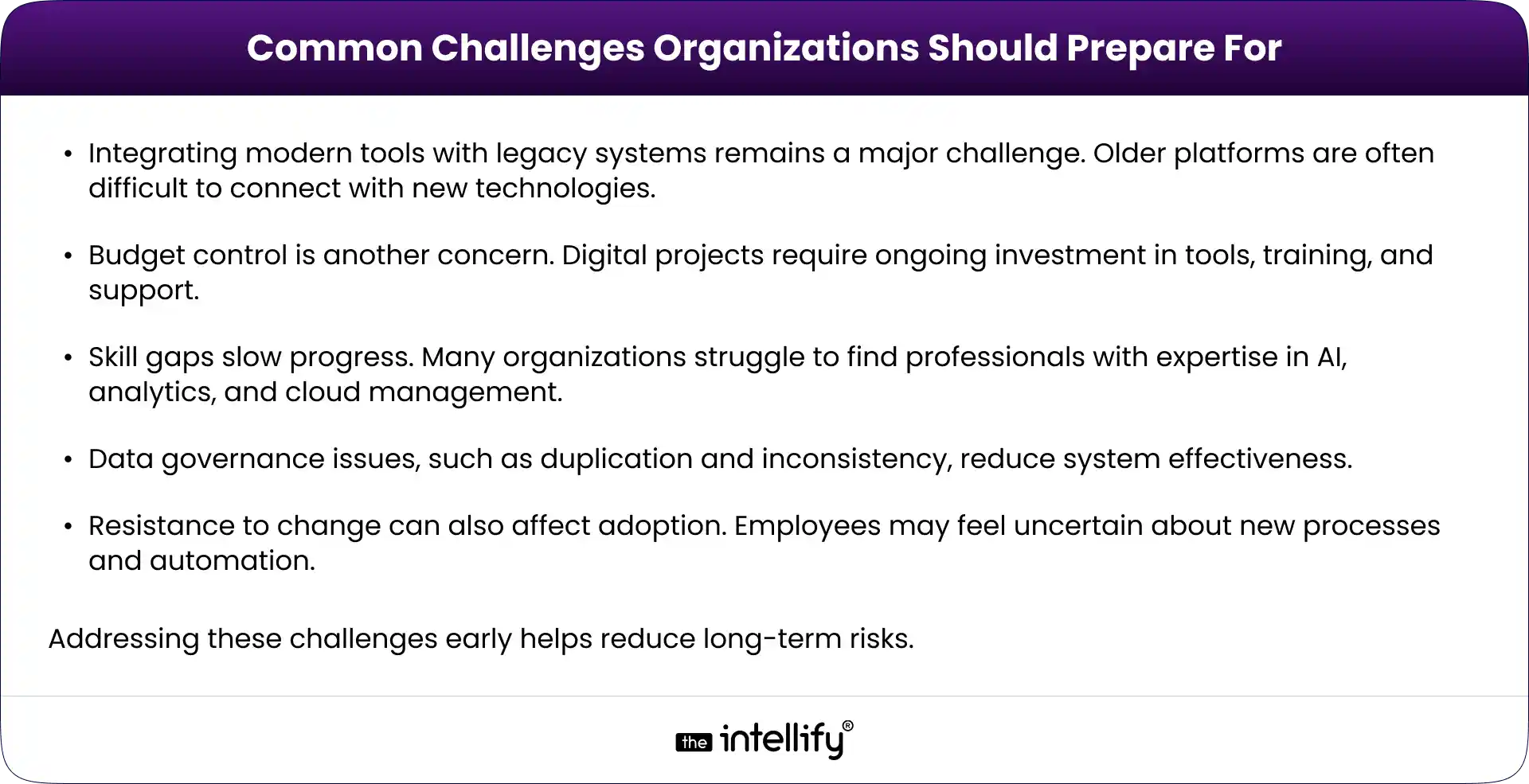
Why this matters: most digital transformation journeys begin here. If the foundation is weak, everything else struggles.

5. Low-Code Platforms Accelerating Innovation

Low-code tools allow teams to build applications with minimal coding. Business users can create dashboards, forms, and workflows themselves. IT teams become advisors instead of bottlenecks.

This speeds up development and reduces workload. Small and mid-sized companies benefit especially. They can digitize processes without massive budgets.
Why this matters: it lowers technical barriers and encourages innovation.

6. Edge Computing Supporting Real-Time Operations

Edge computing processes data close to where it is generated. This reduces delays. In factories, milliseconds matter. In hospitals, they can save lives.

It supports IoT devices and smart systems. Sensors, cameras, and machines all generate massive data. Operational visibility improves. Managers see issues as they happen.

Why this matters: industries like manufacturing, logistics, and healthcare depend on real-time decisions.

7. Sustainable and Responsible Digital Practices

Digital systems also consume energy. Servers run day and night. Companies are now focusing on energy-efficient cloud usage and reducing infrastructure waste.

Responsible AI is becoming important. Bias, transparency, and explain ability are no longer optional. Transparent data management builds trust.

Why this matters: sustainability is becoming part of digital strategy, not a side project.


Digital transformation services


Data-Driven Decision Making and Advanced Analytics

Many organizations now rely on data instead of intuition when making decisions. Centralized data systems help teams work with consistent and reliable information.
Real-time dashboards give leaders quick visibility into sales, operations, and performance. Instead of waiting for monthly reports, they can spot issues early and respond faster.

  • Predictive analytics supports future planning. Sales forecasts, demand predictions, and cost simulations help businesses prepare before problems appear.
  • Data centralization also reduces dependency on technical teams. Managers and team leads can access insights directly, improving speed and accountability.
  • However, strong data governance is essential. Without clean and well-managed data, even advanced analytics can produce misleading results.


Cybersecurity and Digital Trust as a Strategic Priority

  • As digital systems grow, security risks increase. More cloud platforms, devices, and integrations mean more potential vulnerabilities.
  • Cybersecurity is now a strategic priority, not just an IT task. Data breaches can damage reputation, disrupt operations, and lead to regulatory penalties.
  • Organizations are strengthening identity management, encryption, and monitoring systems to protect sensitive information. Secure cloud adoption is becoming standard practice.
  • Compliance with data protection laws is also critical. Proper documentation and audit processes help reduce legal and financial risks.
  • Digital trust depends on transparency. When customers feel their data is handled responsibly, they are more likely to stay loyal.


Customer-Centric Digital Experiences

Customer expectations continue to rise. People expect fast responses, simple interfaces, and consistent service across channels.

  • Omnichannel engagement connects websites, apps, stores, and support teams into one experience. Customers no longer want to repeat the same information multiple times.
  • Personalization uses data to recommend relevant products, content, and services. When done carefully, it improves engagement without feeling intrusive.
  • Faster service delivery through automation and self-service tools reduces frustration and improves satisfaction.
  • Customer-centric systems help businesses build long-term relationships, not just short-term transactions.


Industry Impact: How These Trends Are Applied in Real Business Scenarios

1. In healthcare, digital systems improve patient data access and coordination between departments. This leads to better treatment planning and fewer errors.

2. In retail, AI-powered forecasting helps optimize inventory and reduce waste. Stores can respond quickly to changing demand.

3. Manufacturing companies use predictive maintenance to reduce equipment breakdowns and downtime.

4. Financial institutions apply automation and analytics to strengthen compliance and fraud detection.

5. Logistics providers improve delivery efficiency through route optimization and real-time tracking.

Across industries, the focus remains on measurable results such as cost savings, faster processes, and improved reliability.


Challenges in digital transformation


The Future Direction of Digital Transformation Trends

AI will continue expanding into more business functions, from operations to finance and customer service.

Multi-cloud and hybrid environments will become more common as companies seek flexibility and reliability. Intelligent automation will handle more complex processes with limited human intervention.

Responsible AI and regulatory compliance will receive greater attention. Continuous improvement will become standard practice. Digital transformation will remain an ongoing process rather than a one-time project. Future-ready organizations will focus on adaptability instead of chasing every new technology.


Digital transformation solutions


Final Thoughts

Digital transformation trends continue to evolve. There is no fixed destination. AI, hybrid cloud, and intelligent automation are central, but they are part of a larger ecosystem that includes data, security, sustainability, and people.

Success depends on strategic alignment, not just buying new software. Organizations that adapt thoughtfully gain long-term advantage. They listen, test, learn, and adjust. Transformation is an ongoing journey, sometimes exciting, sometimes exhausting, always necessary.

At The Intellify, we work with businesses that are navigating this journey every day. From digital transformation with AI to intelligent automation and cloud modernization, our focus is on building practical, scalable solutions that fit real business needs, not just trends on paper.

If you’re planning your next step in digital transformation, the key is simple: start with purpose, move with clarity, and stay flexible.


Frequently Asked Questions (FAQs)

1. How are emerging digital transformation trends influencing business strategy today?

Emerging digital transformation trends are pushing companies to move beyond basic system upgrades. Businesses are now using AI, hybrid cloud, and intelligent automation to build flexible, data-driven operations. Strategy is focused on speed, better decisions, and long-term scalability instead of short-term fixes.

2. Why is AI becoming central to digital transformation initiatives?

AI enables predictive insights, smarter customer engagement, fraud detection, and operational forecasting. It helps companies shift from reactive decisions to proactive planning. Digital transformation with AI improves efficiency while supporting smarter, data-backed strategies across departments.

3. What role does hybrid cloud play in modern enterprise transformation?

A hybrid cloud combines private infrastructure with public cloud services. It provides scalability, cost flexibility, and better control over sensitive data. This approach supports remote teams, large data workloads, and secure digital growth without depending on a single provider.

4. How does intelligent automation improve operational performance?

Intelligent automation blends automation with AI-driven insights. It handles repetitive tasks, reduces manual errors, and speeds up workflows. Over time, it improves productivity, consistency, and operational visibility across finance, HR, IT, and supply chain functions.

5. Are digital transformation trends limited to large enterprises?

No. Small and mid-sized businesses are actively adopting cloud platforms, AI tools, and automation systems. Scalable technologies make digital transformation accessible without heavy upfront investment, allowing companies of all sizes to modernize operations efficiently.

6. Which industries are benefiting the most from these transformation trends?

Healthcare, retail, manufacturing, finance, and logistics are seeing a strong impact. From predictive maintenance and fraud detection to personalized customer experiences and real-time tracking, digital transformation trends are improving both operational efficiency and service quality.

Transforming Legacy Application Modernization with AI and Automation

Summary:
Legacy Application Modernization helps businesses upgrade outdated systems while maintaining operational stability. Many enterprises face technical debt, scalability challenges, and security risks that limit growth. By combining AI-driven automation with structured modernization strategies, organizations can improve performance, strengthen compliance, and enhance user experience. The blog also covers legacy mobile app modernization, industry use cases, and a practical roadmap to support long-term digital transformation in mobile apps and enterprise systems

Most companies didn’t wake up one day and decide to run on outdated systems. It happened slowly. A quick fix during a tight deadline. A patch before an audit. A workaround that was supposed to be temporary but never really left.

Years later, that “temporary” solution is still there. That’s why Legacy Application Modernization has become a serious conversation in boardrooms. Not because it sounds impressive, but because the pressure is real. Systems feel heavy. Changes feel risky. Teams move carefully instead of confidently.

Modernization today is not about replacing everything in one dramatic move. It’s about improving what slows you down while keeping the business steady. AI-driven automation makes that process more predictable and less chaotic, and honestly, predictability matters.


Why Legacy Application Modernization Is Now a Business Imperative

Many enterprises still rely on legacy applications built a decade or more ago. Payroll engines, claims systems, and inventory dashboards have been doing their job for years. The problem is, the world around them changed.

Customers expect instant responses. Internal teams expect systems to integrate without friction. Leadership expects insights in real time, not at the end of the quarter.

Older systems struggle to scale. Integrations require workarounds. Security updates feel risky. Even adding a small feature can turn into a three-week exercise. Now, Businesses need systems that adapt quickly to market changes. If technology slows decision-making, it slows growth.

Legacy application modernization, supported by AI and automation, allows companies to upgrade without disrupting daily operations. It protects the foundation while strengthening the structure. That balance is what makes it essential now, not optional later.


Understanding the Challenges of a Legacy Application in Today’s Market

Accumulated Technical Debt

Technical debt builds quietly. A small patch today seems harmless. Another quick fix next month. Over time, those fixes overlap and increase complexity. Documentation becomes outdated. The original developers move on. New team members hesitate to touch certain modules because no one fully understands them.

Even minor updates require deep testing. Maintenance slows down. Costs increase. At some point, teams stop improving and start avoiding. That’s usually the signal that something needs to change.

Scalability and Performance Constraints

Growth exposes limitations. More users. More transactions. More data. The architecture that once handled everything smoothly begins to struggle under peak demand.

Performance bottlenecks appear. Dashboards load slowly. Transactions lag. During heavy traffic, systems may even crash. These issues affect customer perception quickly. People rarely complain about slow systems. They simply leave. When growth is restricted by outdated architecture, modernization becomes urgent.

Security and Compliance Risks

Security standards evolve constantly, but legacy platforms often lag behind. Older encryption methods become insufficient. Manual monitoring increases risk. Compliance reporting becomes more complex each year.

Applying security patches can destabilize fragile systems, so updates get delayed. That hesitation increases exposure. It’s not just a technical concern. It affects trust, brand reputation, and regulatory standing.


What Legacy Application Modernization Truly Means

Modernization is not about making a dashboard look modern. It involves rethinking architecture, workflows, and data management. It may include refactoring code, re-platforming infrastructure, or rebuilding specific components that no longer serve the business.

The goal is alignment. Technology should support business strategy, not block it. A well-planned legacy modernization initiative creates systems that are adaptable and easier to maintain. It reduces stress for development teams and improves reliability for users. It sets the business up for long-term flexibility.


The Role of AI in Transforming Legacy Systems

AI adds intelligence to modernization efforts. When used thoughtfully, it improves visibility, decision-making, and system performance.

Intelligent Data Utilization

Legacy systems store years of operational data. Often, that data is underused.

AI analyzes historical and real-time information to identify patterns and trends. Predictive models improve forecasting accuracy. Teams can respond proactively instead of reacting to problems after they occur. Data begins to inform strategy in a meaningful way.

Enhancing User Experience

User expectations are higher now. AI solutions supports personalized experiences by analyzing behavior and preferences. Adaptive interfaces adjust to usage patterns. Intelligent notifications guide users without overwhelming them.

Conversational tools simplify interaction. Instead of navigating complex menus, users can ask direct questions. Smart workflows reduce friction. That alone can improve engagement significantly.

AI-Assisted Code and Architecture Optimization

Large legacy codebases are difficult to evaluate manually. AI tools can scan and analyze these systems efficiently.

They identify redundant logic, performance gaps, and risky dependencies. Automated testing improves accuracy. Migration decisions become data-driven. This reduces uncertainty and shortens planning cycles.


How Automation Strengthens Modernization Efforts

How Automation Strengthens Modernization Efforts

Automation brings structure and consistency. It reduces repetitive tasks and minimizes human error.

Development and Deployment Automation

Continuous integration supports stability. Automated testing catches issues early, which reduces last-minute surprises.

Release cycles become shorter and more predictable. Collaboration improves through structured version control practices. Updates feel controlled instead of stressful.

Business Process Automation

Many enterprise workflows still rely heavily on manual steps. Automation converts repetitive processes into rule-based systems:

  • Claims move through structured workflows
  • Onboarding becomes standardized
  • Approvals follow clear logic
  • Data entry errors decrease
  • Teams focus on strategic tasks

Over time, productivity improves and operational costs decline.

Infrastructure and Environment Automation

Cloud provisioning becomes repeatable and reliable. Environments can be replicated consistently across teams. Auto-scaling adjusts to traffic changes automatically. Configuration management reduces inconsistencies.

Monitoring systems detect issues early, and recovery processes become more predictable. This stability supports growth without increasing complexity.

Security and Compliance Automation

Automated vulnerability scans strengthen protection. Compliance checks integrate into development pipelines.

Real-time monitoring improves threat detection. Audit readiness becomes easier because reporting is structured. Security shifts from reactive to proactive.


Legacy Application Modernization Services


Legacy Mobile App Modernization in a Multi-Device Ecosystem

Many enterprises operate older mobile applications alongside web platforms. The experience often feels disconnected. Legacy mobile app modernization focuses on performance, responsiveness, and integration. Cloud connectivity improves synchronization across devices. AI enables personalization and predictive engagement.

Automation ensures updates are rolled out consistently. Digital transformation in mobile apps matters because users switch between devices constantly. If the experience feels inconsistent, trust erodes quickly.


A Strategic Roadmap for Legacy Modernization Mobile App Initiatives

Modernization works best when it follows a clear structure.

Step 1: Assessment and Discovery

Evaluate architecture, dependencies, and integrations carefully. Identify performance bottlenecks and security gaps. Align findings with business priorities. Not every system requires full rebuilding. Clear visibility reduces unnecessary investment.

Step 2: Selecting the Right Modernization Approach

  • Several approaches are available:
  • Rehost for quick migration
  • Refactor to improve specific components
  • Re-platform for gradual upgrades
  • Rebuild for complete transformation

Each option involves trade-offs in cost, time, and risk. Evaluate ROI before committing.

Step 3: Architecture Redesign and Cloud Enablement

Shift toward modular or service-based architecture where possible. Strengthen API integrations. Improve data flexibility. Enable scalable cloud-native deployment. Design for adaptability, not just immediate functionality.

Step 4: Integrating AI and Automation Strategically

Identify high-impact areas first. Introduce automation gradually across development and operations. Implement AI capabilities in phases. Measure results and refine continuously. Intentional adoption prevents unnecessary complexity.

Step 5: Continuous Monitoring and Optimization

Track performance metrics consistently. Refine AI models over time. Improve workflows using analytics. Optimize infrastructure usage based on demand. Modernization is ongoing. It evolves with the business.


Industry Use Cases Driving Modernization

1. Healthcare Providers

Healthcare organizations use modernization to improve patient engagement, automate scheduling and billing, apply predictive analytics for operations, strengthen data security, and improve coordination. Efficiency improves, but so does reliability.

2. Insurance Companies

Insurance firms modernize to automate claims management, detect fraud through predictive models, improve risk assessment, process documents intelligently, and reduce response times. Operational friction decreases significantly.

3. Financial Services Institutions

Financial institutions apply AI-enabled onboarding, anomaly detection in transactions, automated compliance reporting, personalized product recommendations, and scalable digital platforms. In this industry, speed and trust must coexist.


Measuring Success After Modernization

Modernization success should be measurable. Improved uptime and faster response times are clear indicators. Reduced maintenance costs reflect operational efficiency. Faster deployment cycles show architectural improvement.

Customer satisfaction and scalability readiness confirm long-term impact. When teams spend less time fixing issues and more time building improvements, progress becomes visible.


Common Implementation Challenges and How to Address Them

Data migration requires careful planning and testing. Avoid rushing transitions. Balance innovation with operational stability through phased rollouts. Invest in team training for AI adoption.

Maintain compliance documentation throughout the transformation. Protect business continuity during upgrades. Structured planning reduces uncertainty and prevents setbacks.


The Future of Intelligent Application Transformation

Generative AI will increasingly assist with code refactoring and architectural decisions. Hyper-automation will connect enterprise systems more tightly. Predictive monitoring will detect issues earlier and enable faster recovery.

Cloud-native architecture will continue expanding. Continuous modernization will replace large, infrequent overhauls. Organizations that treat modernization as an ongoing discipline will remain adaptable.


legacy app modernization solutions


Final Thought

Legacy Application Modernization is a strategic decision, not a technical trend. AI-driven automation accelerates transformation while maintaining control. A structured roadmap reduces risk and supports steady progress.

Intelligent systems improve performance, strengthen scalability, and enable sustainable growth. Organizations that modernize proactively move forward with confidence instead of hesitation.


Frequently Asked Questions (FAQs)

1. Why should businesses modernize legacy systems now?

Legacy systems often limit growth due to technical debt, slow performance, and rising maintenance costs. Modernization helps organizations improve agility, support AI-driven automation, and align with ongoing digital transformation initiatives.

2. Can modernization be done without replacing the whole system?

Yes. Companies can modernize specific components through approaches like rehosting, refactoring, or re-platforming. This reduces risk and cost while improving performance step by step instead of rebuilding everything at once.

3. What role does AI play in modernization?

AI supports code analysis, predictive insights, automated testing, and performance optimization. It helps teams identify inefficiencies, reduce errors, and make data-driven decisions during modernization projects.

4. What is Legacy Mobile App Modernization?

Legacy mobile app modernization focuses on improving older mobile applications by enhancing performance, cloud integration, security, and user experience across multiple devices.

5. How do organizations measure success after modernization?

Success is measured through improved uptime, faster feature deployment, reduced maintenance costs, and better user satisfaction. Many organizations work with experienced partners like The Intellify to define clear KPIs and ensure measurable modernization outcomes.

View
Case Study