AI in AR & VR: Redefining Intelligent Immersive Experiences

Summary:
AI is making AR and VR smarter, turning static experiences into adaptive, personalized environments. From training and healthcare to retail and gaming, intelligent immersive systems are improving engagement, learning, and decision-making. This blog explores how AI is shaping the future of immersive technology across industries.


In a world where technology is changing faster than ever, AI in AR and VR is reimagining how we engage with digital environments. Augmented Reality (AR) and Virtual Reality (VR) started as platforms that focused purely on immersive visuals. However, today’s users are looking for interactions that are not just immersive but smarter and more intuitive as well. This evolving expectation has set the stage for artificial intelligence to become a fundamental component in shaping these immersive systems.

What this shift means is that digital experiences are no longer static displays; they’re transforming into intelligent ecosystems that can learn from us, adapt in real time, and provide personalized interactions. In this blog, we’ll delve into how AI is reshaping AR and VR, the key technologies driving this transformation, and the real-world applications that are making an impact across various industries.


How Artificial Intelligence Transforms AR and VR

How AI Transforms AR and VR

From Static Environments to Adaptive Systems

The days of AR and VR experiences being merely static presentations are behind us. With AI integration in AR and VR, these environments can now adjust based on real-time user interactions, creating a responsive landscape. This adaptability not only enhances user engagement but also makes the experience feel immersive and personalized.

Learning from User Behavior

AI allows AR and VR systems to learn from user behaviors and preferences. By analyzing how people interact, these systems can tailor experiences specifically to what users enjoy. This kind of responsiveness is crucial for keeping users engaged and satisfied.

Context-Aware Interaction

Thanks to advancements in AI, AR, and VR can now understand the context of interactions. This means users can expect systems to respond not only to their immediate actions but also to surrounding environmental cues. For instance, in a VR game, the difficulty level might automatically adjust based on a player’s skill, making for a more enjoyable experience.


Core Technologies Powering Intelligent Immersion

Generative AI for Dynamic Content

Generative AI is vital in creating content that can evolve. Instead of relying solely on pre-loaded graphics, immersive experiences can now generate environments, characters, and scenarios on the fly, dramatically enriching user engagement.

Computer Vision and Spatial Awareness

Computer vision enhances spatial awareness in immersive experiences. It equips AR systems to recognize real-world objects and overlay relevant info seamlessly, crafting a blended reality that heightens the user’s understanding of their surroundings.

Conversational Interfaces and Smart Avatars

Integrating conversational interfaces such as smart avatars facilitates natural conversations within AR and VR. Users can interact using their voices, adding layers of realism and making the experience feel more relatable and engaging.

Predictive and Behavioral Systems

These systems can anticipate user needs and preferences. By analyzing behavioral data, they can suggest actions or content, leading to a more intuitive experience that feels custom-made.


AI Personalization in Immersive AR/VR Experiences

Adaptive Learning and Training

In educational settings, AR and VR combined with AI can adapt to each learner’s pace. This means students receive personalized feedback and tailored educational journeys, which significantly improve learning outcomes.

Interactive Entertainment

The gaming and entertainment industries are undergoing a transformation. AI-driven avatars and dynamic narratives create unique experiences for each user, ensuring that no two gaming sessions feel the same.

Immersive Commerce

AR is reshaping the online shopping landscape by allowing users to virtually try on products before making a purchase. Imagine seeing how a new sofa fits into your living room through your smartphone while AI suggests additional furniture based on your personal style.

Enterprise and Workplace Applications

In corporate training and simulations, AR and VR are providing hands-on learning experiences by creating realistic, immersive environments. AI enhances these experiences, ensuring they are both relevant and impactful.


Mid-CTA


Real-World Applications of AI in AR/VR Across Industries

Healthcare

AI in AR and VR stands to revolutionize training for medical professionals. By simulating surgeries and complex procedures, practitioners can gain vital experience without any risk to patients. Plus, AR can support surgeons during operations by overlaying essential information onto their field of view.

Education and Workforce Development

In both schools and workplaces, immersive learning driven by AI is equipping students and employees for the future job market. Engaging environments not only enhance information retention but also skill development.

Manufacturing and Operations

AI-powered VR simulations can aid in training operators on complex machinery, minimizing risks and boosting efficiency. Workers can practice scenarios and gain insights into operations without physical trials.

Retail and Real Estate

In retail, brands are leveraging AR to give customers a feel for how products might fit in their lives. In real estate, AI-enhanced virtual tours allow potential buyers to explore properties more interactively, facilitating informed decision-making.


Business Value of Intelligent Immersive Systems

• Higher engagement and retention: Users are more likely to return when their experiences are tailored to their preferences.

• Improved learning outcomes: Personalized training leads to quicker skill acquisition and better knowledge retention.

• Operational efficiency: Companies can reduce costs by optimizing training and cutting down on errors through immersive learning solutions.

• Better customer insights: Collecting data on user interactions helps brands understand customer needs, leading to better product offerings.

• Scalable personalization: AI empowers businesses to efficiently scale personalized experiences as they grow.


Implementation and Key Challenges

Infrastructure and Performance

For organizations to effectively harness AI in AR and VR, robust infrastructure is crucial. It’s essential that systems can support high-performance demands.

Data Responsibility

With powerful tools come great responsibilities. It’s vital to handle user data ethically and transparently to build trust.

Clear Strategic Alignment

Aligning AI initiatives with broader business goals ensures that investments yield tangible benefits. Companies need a clear vision of how AI will influence their operations and customer interactions.


The Future of AI in AR/VR beyond 2026

Looking ahead, several trends are starting to emerge:

• More natural human-machine interaction: We can expect AI to streamline interactions, bridging the gap between users and technology.

• Emotion-aware virtual systems: AI could help design environments that adapt according to users’ emotional states, making interactions even more personalized.

• Persistent immersive environments: Users might soon have the ability to seamlessly leave and re-enter the same AR/VR spaces without losing any progress.

• Faster, seamless real-time experiences: As technology continues to evolve, the speed and fluidity of immersive experiences are set to improve significantly.


Bottom CTA


Conclusion

AI isn’t just enhancing AR and VR; it’s transforming how we engage with digital content. As businesses adopt these intelligent immersive systems, they uncover new opportunities for engagement, learning, and interaction. Embracing this revolution means staying ahead of the curve, offering futuristic experiences today, and laying the groundwork for tomorrow’s innovations. Curious about how AI can reshape your business? Get in touch with us at The Intellify today!


Frequently asked questions (FAQs)

1. What is AI in AR and VR?

AI in AR and VR uses advanced algorithms to create immersive experiences that adapt to user preferences and behaviors, resulting in greater engagement.

2. How does AI enhance the user experience in AR and VR?

AI personalizes interactions, learns from behaviors, and crafts context-aware environments, making experiences more immersive and enjoyable.

3. What industries benefit most from AI in AR and VR?

Industries like healthcare, education, retail, and manufacturing have seen significant strides in training, customer engagement, and operational efficiency through AI-driven AR and VR solutions.

4. What technologies power intelligent immersive experiences?

Core technologies include generative AI for content creation, computer vision for spatial awareness, and smart avatars for conversational interfaces.

5. What challenges come with implementing AI in AR and VR?

Key challenges include ensuring infrastructure meets performance needs, managing user data responsibly, and aligning AI efforts with strategic business objectives.

6. What does the future hold for AI in AR and VR?

Trends indicate advancements in emotional awareness, natural interactions, and persistent environments, paving the way for richer, more engaging experiences.

7. How can The Intellify assist in integrating AI into AR/VR Solutions?

The Intellify offers tailored solutions to optimize immersive systems, ensuring businesses leverage AI effectively for maximum engagement and efficiency.

The Future of AI in Customer Service: Transforming Experiences

New Era for Customer Service
Customer service is changing greatly. Smart, AI-driven systems that operate 24/7, better understand consumers, and handle problems faster are replacing traditional contact centers and support requests. Companies now ask, “How can AI help us serve customers better, faster, and smarter?” rather than merely “How can we serve customers?”
In this blog, we’ll explore the future of Ai in customer service, focusing on three main technologies: Conversational AI, Generative AI, and Agentic AI. We will also discuss the advantages of artificial intelligence as it is being applied across several sectors.


What Is the Future of AI in Customer Service?

The future of customer service will be sophisticated, predictive, and quite individual. It’s about enabling support teams and smoothing out customer interactions, not about substituting people.
Imagine a time when artificial intelligence forecasts a customer’s problem before they ever interact, provides self-service solutions, and only escalates to a human when absolutely necessary. With artificial intelligence increasingly driving customer care automation, proactive issue resolution, and 24/7 worldwide support, we are headed toward that future.


The Three Game-Changers in AI Customer Service

A. Conversational AI: Human-like interactions at scale

Virtual agents and chatbots powered by conversational AI mimic actual human interactions. Unlike earlier written bots, these systems grow with every contact.

  • Natural language processing (NLP) helps one to grasp user intent.
  • React right away using text or voice.
  • Address questions, order status, returns, and more.

This lets companies give continuous support over websites, WhatsApp, Messenger, and mobile apps.

Example:

  • Bank of America’s Erica is a well-known AI customer service assistant that helps customers manage finances, check balances, and even suggest money-saving tips.
  • Camping World used Conversational AI to cut customer wait times in half during high-demand seasons.

Why it matters: Conversational artificial intelligence responds swiftly, consistently, and helpfully to thousands of people at once.


B. Generative AI: Contextual-aware, tailored assistance

Using cutting-edge models like GPT, generative AI generates human-like responses, draft emails, summarizes data, and even forecasts user demands moving forward.

Applications of use:

  • email responses automatically generated
  • Compiling center article summaries
  • Offering tailored advice on personal support

Without sacrificing accuracy, it gives routine customer service chores originality and inventiveness.

Example:
United Airlines uses Generative AI to power its virtual assistant, helping customers with real-time flight updates, baggage issues, and more, without a human agent.

Why it matters: It provides deeper, context-aware conversations and reduces the burden on human agents.


C. Agentic AI: Wise decision-makers for consumer experience

Agentic AI advances still another level. It does not only speaks. These systems can even manage complete processes without human involvement, make judgments, and automate chores.

Applications of use:

  • Directing tickets to the correct division
  • Order cancelling or modification
  • Solving recognized problems ahead of time

Example:

Verizon handles approximately 40% of its support inquiries with Agentic AI without human intervention. These artificial intelligence assistants can reject calls, provide intelligent recommendations, and even start refund or troubleshooting processes.

Why it matters: Agentic AI boosts efficiency and customer satisfaction by taking immediate action.


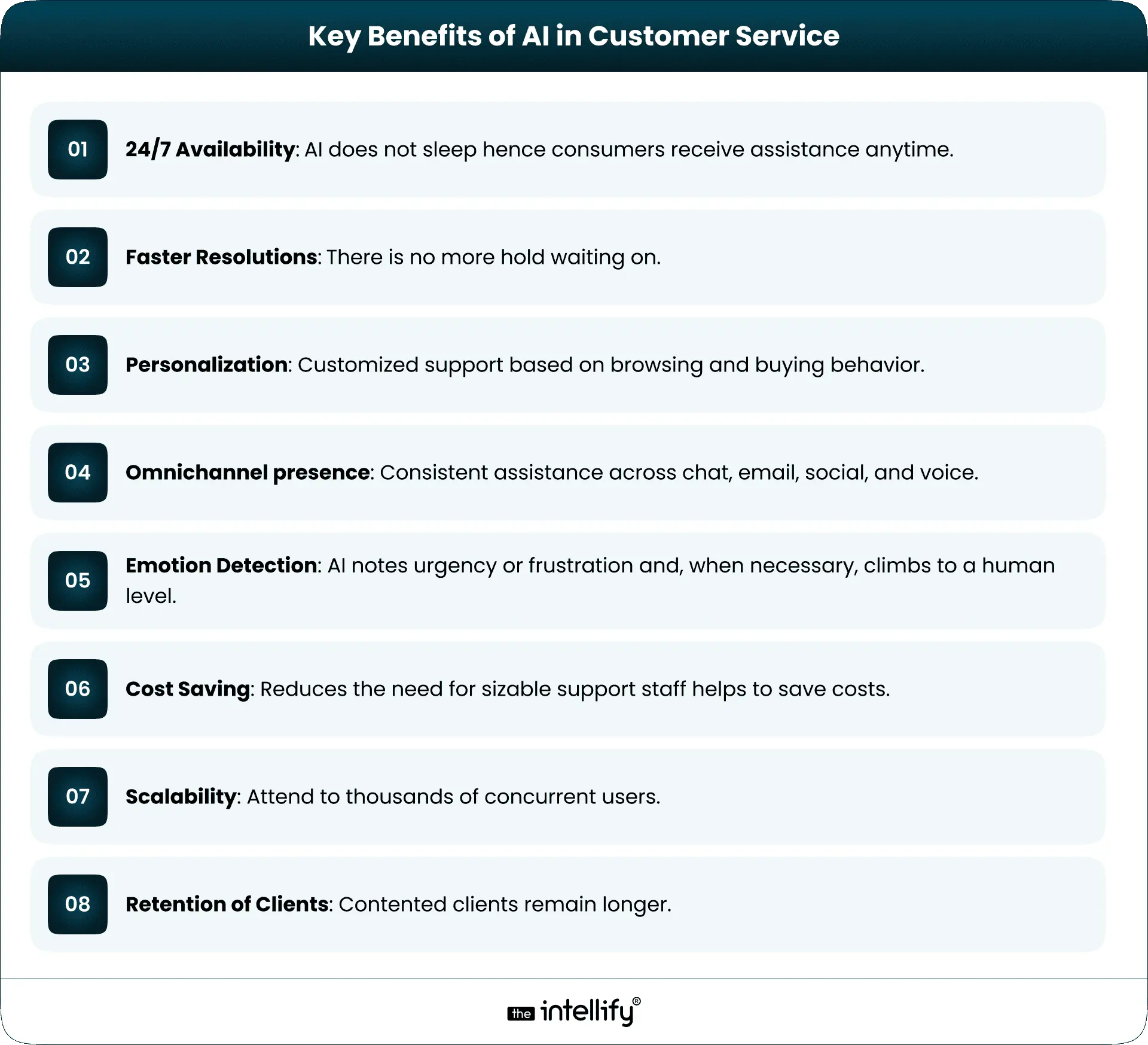
Benefits of AI in Customer Service


Actual Case Studies of AI-Driven Customer Service

1. Verizon: Smart Call Deflection

Through self-service channels, Verizon routes and fixes problems using artificial intelligence in customer care. Their virtual assistant can now manage over 20 million interactions a month without human intervention, therefore dramatically lowering call centre volume.

2. In-house Bank: Using artificial intelligence to raise NPS

Using bots driven by artificial intelligence, ING customized communications and shortened email response times. As so? Customer satisfaction and Net Promoter Score (NPS) clearly have increased.

3. United Airlines: Real-Time Travel Support

To make air travel more predictable and less stressful, United Airlines developed an artificial intelligence-powered virtual assistant to assist consumers with flight modifications, baggage updates, and airport directions.

4. Improving Digital Engagement: Camping World

After including artificial intelligence chatbots that quickly assist guests with product information, store locations, and service appointments, Camping World cut chat abandonment by 40%.

These illustrations explain how customer service and artificial intelligence working together produce savings as well as satisfaction.


Infographic: Comparing AI Types in Customer Service

AI Type Strengths Use Cases
Conversational AI Fast, Natural Conversations Chatbots, Voice Bots
Generative AI Context-Aware, Personalized Texts Smart Replies, Summaries, Support Content
Agentic AI Action-Oriented, Autonomous Tasks Ticket Routing, Issue Resolution, Automation


Use Cases: AI Across Industries

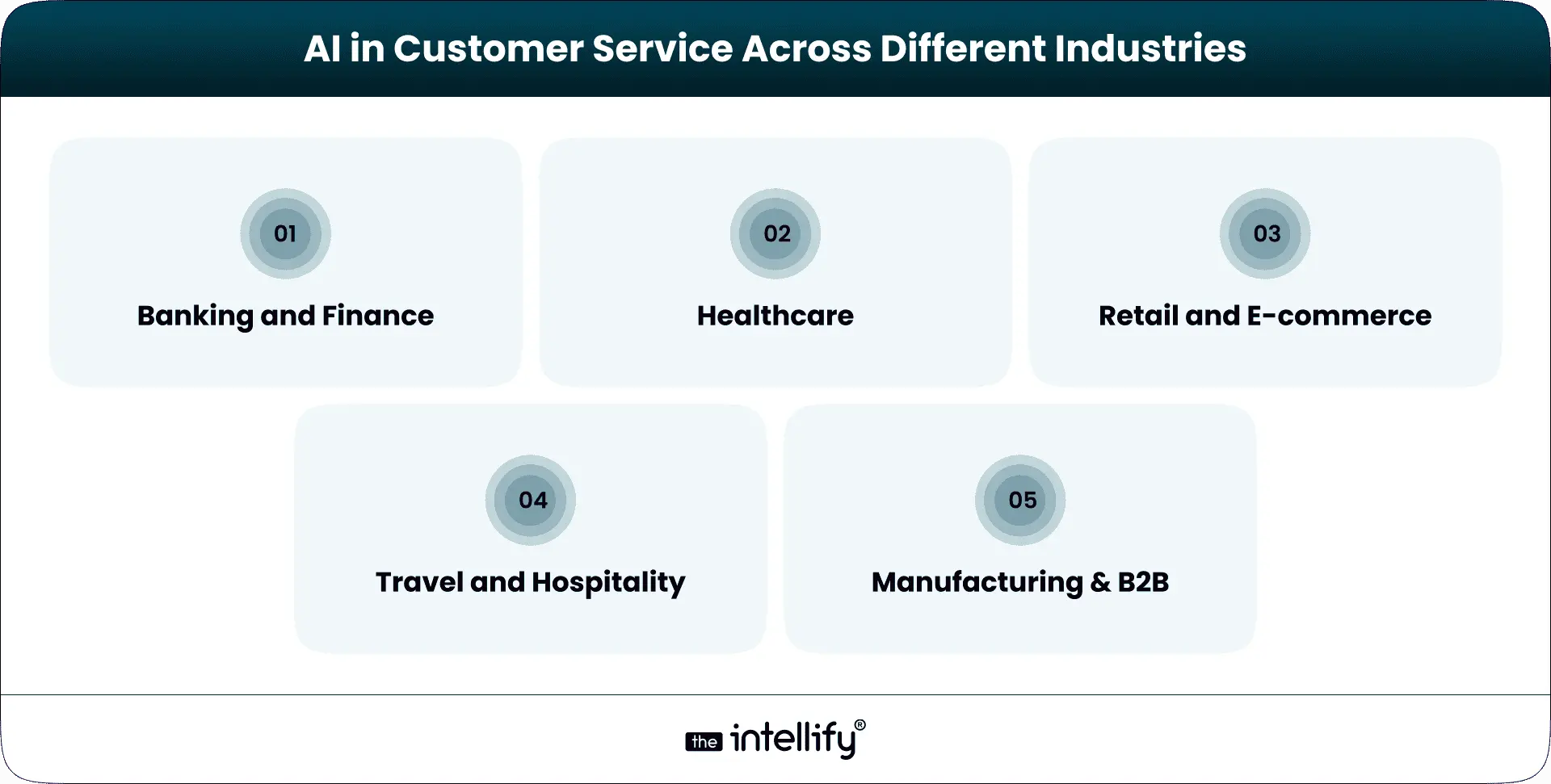
Customer service artificial intelligence goes beyond retail or technology. It’s altering the way support functions in many spheres:

AI in customer service use cases

1. Banking and Financial Services

  • Use case: Instant KYC verification, fraud detection, AI-powered chatbots enabling users to check accounts, make payments, or seek loans.
  • Result: Less wait times, more trust, and better onboarding follow from this.

2. Healthcare

  • Use case: Appointment scheduling, symptom checking via chatbots, and post-discharge virtual assistants.
  • Result: Improved patient experience and less strain on human staff follow from this.

3. Retail and E-Commerce

  • Use case: Real-time inventory checks, tailored shopping help, AI-driven product recommendations.
  • Result: Higher conversions and improved loyalty.

4. Hospitality and Travel

  • Use case: real-time flight updates, Loyalty point management, booking changes, and multilingual help.
  • Result: Reduced call center volume and better traveler experiences.

5. Manufacturing & B2B

  • Supplier queries and support tickets handled via AI
  • Self-service for equipment manuals and troubleshooting

Faster resolutions, reduced costs, and happier consumers, all of which are apparent advantages of AI in customer service across all three sectors.

You Can Also Read This Blog – How Voice AI Agents Are Changing Customer Service in 2025

Challenges & Considerations

While the future of AI in customer service is promising, businesses must keep a few things in mind:

  • Data Security & Compliance: Especially important in healthcare, finance, and government sectors.
  • Over-automation: Customers can get frustrated if they’re unable to reach a human when needed.
  • Bias in AI models: If trained on poor data, AI can misunderstand or misrepresent customers.
  • Integration Issues: AI systems must connect seamlessly with existing CRMs and backend tools.
  • Training & Accuracy: Poorly trained AI can harm the experience.
  • Cultural Sensitivity: AI should understand local language and tone.


The Future of AI in Customer Service: What’s Next?

Future of AI in Customer Service

The future of AI in customer service will see AI doing more than reacting, it will become proactive and predictive.

  • consumer requirements before they become apparent.
  • Integrate deeply with CRM systems.
  • voice-first interactions
  • Automate complex workflows
  • Improve through continuous learning
  • Get more emotionally intelligent.

The aim of artificial intelligence is not to replace humans but rather to enable them to perform their jobs better and let them concentrate on what counts most: empathy and sophisticated thought.


Choosing the Right AI for Your Business

Every company needs a different kind of artificial intelligence. Here is how one should decide:

  • Conversational AI If your clients need fast responses, consider.
  • Generative AI for dynamic FAQs or material-heavy help.
  • Agentic AI for judgments and action automation.

Brief checklist:

  • List three of your main support difficulties.
  • Select the AI type that addresses those first
  • Start small, then scale progressively.
  • Partner with an experienced AI service provider


Transform your customer service with AI


Why Choose The Intellify for AI-Powered Customer Service?

Here at The Intellify, we enable companies to fully use AI across customer support and experience.
From creating conversational AI chatbots to implementing agentic AI systems for automation, we provide scalable, safe, and simple-to-interface unique solutions.
We ensure:

  • Perfect interaction with your current systems
  • artificial intelligence acquired from actual interactions
  • Constant development and real-time statistics


Conclusion: The Time to Embrace AI Is Now

The days of scripted support calls and protracted waiting lines are vanishing. Faster, smarter, more personal approaches to help consumers are being produced by artificial intelligence. The change is the new benchmark rather than a trend.
Whether your industry is retail, finance, travel, or healthcare, adopting the future of artificial intelligence in customer service will change your interaction with consumers.

View
Case Study