AI in AR & VR: Redefining Intelligent Immersive Experiences

Summary:
AI is making AR and VR smarter, turning static experiences into adaptive, personalized environments. From training and healthcare to retail and gaming, intelligent immersive systems are improving engagement, learning, and decision-making. This blog explores how AI is shaping the future of immersive technology across industries.

In a world where technology is changing faster than ever, AI in AR and VR is reimagining how we engage with digital environments. Augmented Reality (AR) and Virtual Reality (VR) started as platforms that focused purely on immersive visuals. However, today’s users are looking for interactions that are not just immersive but smarter and more intuitive as well. This evolving expectation has set the stage for artificial intelligence to become a fundamental component in shaping these immersive systems.

What this shift means is that digital experiences are no longer static displays; they’re transforming into intelligent ecosystems that can learn from us, adapt in real time, and provide personalized interactions. In this blog, we’ll delve into how AI is reshaping AR and VR, the key technologies driving this transformation, and the real-world applications that are making an impact across various industries.


How Artificial Intelligence Transforms AR and VR

How AI Transforms AR and VR

From Static Environments to Adaptive Systems

The days of AR and VR experiences being merely static presentations are behind us. With AI integration in AR and VR, these environments can now adjust based on real-time user interactions, creating a responsive landscape. This adaptability not only enhances user engagement but also makes the experience feel immersive and personalized.

Learning from User Behavior

AI allows AR and VR systems to learn from user behaviors and preferences. By analyzing how people interact, these systems can tailor experiences specifically to what users enjoy. This kind of responsiveness is crucial for keeping users engaged and satisfied.

Context-Aware Interaction

Thanks to advancements in AI, AR, and VR can now understand the context of interactions. This means users can expect systems to respond not only to their immediate actions but also to surrounding environmental cues. For instance, in a VR game, the difficulty level might automatically adjust based on a player’s skill, making for a more enjoyable experience.


Core Technologies Powering Intelligent Immersion

Generative AI for Dynamic Content

Generative AI is vital in creating content that can evolve. Instead of relying solely on pre-loaded graphics, immersive experiences can now generate environments, characters, and scenarios on the fly, dramatically enriching user engagement.

Computer Vision and Spatial Awareness

Computer vision enhances spatial awareness in immersive experiences. It equips AR systems to recognize real-world objects and overlay relevant info seamlessly, crafting a blended reality that heightens the user’s understanding of their surroundings.

Conversational Interfaces and Smart Avatars

Integrating conversational interfaces such as smart avatars facilitates natural conversations within AR and VR. Users can interact using their voices, adding layers of realism and making the experience feel more relatable and engaging.

Predictive and Behavioral Systems

These systems can anticipate user needs and preferences. By analyzing behavioral data, they can suggest actions or content, leading to a more intuitive experience that feels custom-made.


AI Personalization in Immersive AR/VR Experiences

Adaptive Learning and Training

In educational settings, AR and VR combined with AI can adapt to each learner’s pace. This means students receive personalized feedback and tailored educational journeys, which significantly improve learning outcomes.

Interactive Entertainment

The gaming and entertainment industries are undergoing a transformation. AI-driven avatars and dynamic narratives create unique experiences for each user, ensuring that no two gaming sessions feel the same.

Immersive Commerce

AR is reshaping the online shopping landscape by allowing users to virtually try on products before making a purchase. Imagine seeing how a new sofa fits into your living room through your smartphone while AI suggests additional furniture based on your personal style.

Enterprise and Workplace Applications

In corporate training and simulations, AR and VR are providing hands-on learning experiences by creating realistic, immersive environments. AI enhances these experiences, ensuring they are both relevant and impactful.


Mid-CTA


Real-World Applications of AI in AR/VR Across Industries

Healthcare

AI in AR and VR stands to revolutionize training for medical professionals. By simulating surgeries and complex procedures, practitioners can gain vital experience without any risk to patients. Plus, AR can support surgeons during operations by overlaying essential information onto their field of view.

Education and Workforce Development

In both schools and workplaces, immersive learning driven by AI is equipping students and employees for the future job market. Engaging environments not only enhance information retention but also skill development.

Manufacturing and Operations

AI-powered VR simulations can aid in training operators on complex machinery, minimizing risks and boosting efficiency. Workers can practice scenarios and gain insights into operations without physical trials.

Retail and Real Estate

In retail, brands are leveraging AR to give customers a feel for how products might fit in their lives. In real estate, AI-enhanced virtual tours allow potential buyers to explore properties more interactively, facilitating informed decision-making.


Business Value of Intelligent Immersive Systems

• Higher engagement and retention: Users are more likely to return when their experiences are tailored to their preferences.

• Improved learning outcomes: Personalized training leads to quicker skill acquisition and better knowledge retention.

• Operational efficiency: Companies can reduce costs by optimizing training and cutting down on errors through immersive learning solutions.

• Better customer insights: Collecting data on user interactions helps brands understand customer needs, leading to better product offerings.

• Scalable personalization: AI empowers businesses to efficiently scale personalized experiences as they grow.


Implementation and Key Challenges

Infrastructure and Performance

For organizations to effectively harness AI in AR and VR, robust infrastructure is crucial. It’s essential that systems can support high-performance demands.

Data Responsibility

With powerful tools come great responsibilities. It’s vital to handle user data ethically and transparently to build trust.

Clear Strategic Alignment

Aligning AI initiatives with broader business goals ensures that investments yield tangible benefits. Companies need a clear vision of how AI will influence their operations and customer interactions.


The Future of AI in AR/VR beyond 2026

Looking ahead, several trends are starting to emerge:

• More natural human-machine interaction: We can expect AI to streamline interactions, bridging the gap between users and technology.

• Emotion-aware virtual systems: AI could help design environments that adapt according to users’ emotional states, making interactions even more personalized.

• Persistent immersive environments: Users might soon have the ability to seamlessly leave and re-enter the same AR/VR spaces without losing any progress.

• Faster, seamless real-time experiences: As technology continues to evolve, the speed and fluidity of immersive experiences are set to improve significantly.


Bottom CTA


Conclusion

AI isn’t just enhancing AR and VR; it’s transforming how we engage with digital content. As businesses adopt these intelligent immersive systems, they uncover new opportunities for engagement, learning, and interaction. Embracing this revolution means staying ahead of the curve, offering futuristic experiences today, and laying the groundwork for tomorrow’s innovations. Curious about how AI can reshape your business? Get in touch with us at The Intellify today!


Frequently asked questions (FAQs)

1. What is AI in AR and VR?

AI in AR and VR uses advanced algorithms to create immersive experiences that adapt to user preferences and behaviors, resulting in greater engagement.

2. How does AI enhance the user experience in AR and VR?

AI personalizes interactions, learns from behaviors, and crafts context-aware environments, making experiences more immersive and enjoyable.

3. What industries benefit most from AI in AR and VR?

Industries like healthcare, education, retail, and manufacturing have seen significant strides in training, customer engagement, and operational efficiency through AI-driven AR and VR solutions.

4. What technologies power intelligent immersive experiences?

Core technologies include generative AI for content creation, computer vision for spatial awareness, and smart avatars for conversational interfaces.

5. What challenges come with implementing AI in AR and VR?

Key challenges include ensuring infrastructure meets performance needs, managing user data responsibly, and aligning AI efforts with strategic business objectives.

6. What does the future hold for AI in AR and VR?

Trends indicate advancements in emotional awareness, natural interactions, and persistent environments, paving the way for richer, more engaging experiences.

7. How can The Intellify assist in integrating AI into AR/VR Solutions?

The Intellify offers tailored solutions to optimize immersive systems, ensuring businesses leverage AI effectively for maximum engagement and efficiency.
Augmented Reality Storytelling: Turning Brand Stories into Immersive Experiences

Summary:
This blog explores how Augmented Reality Storytelling helps brands create deeper engagement through immersive, interactive experiences. It explains what AR storytelling is, how it works, real-world brand examples, key benefits, and common use cases across industries. The article also covers essential features of an AR storytelling app, how to choose the right AR app development company, and what the future holds for AR-enhanced storytelling in brand communication.

Storytelling used to be simple. A picture. A headline. Maybe a video if the budget allowed. People watched, nodded, and scrolled on. These days, though, attention is hard to earn and even harder to keep. Most users decide in seconds whether something is worth their time.
That’s where Augmented Reality Storytelling quietly steps in. Not loud. Not flashy. Just… more real. It doesn’t shout at people. It invites them in. And when done right, it feels less like marketing and more like an experience someone remembers later while waiting for coffee, or telling a friend, or thinking, “That was actually kind of cool.”


What Is Augmented Reality Storytelling?

At its core, Augmented Reality Storytelling is simple. It blends a story with digital elements like 3D visuals, animations, and sounds layered onto the real world through a phone, tablet, or wearable device. The story doesn’t live on a flat screen anymore. It exists around the user.

Unlike traditional storytelling, AR Storytelling lets people interact. They don’t just watch. They move, tap, and explore. Sometimes they even shape how the story unfolds.

Think of it as reading a book where the characters step off the page and stand right in front of you. Slightly surreal. Very engaging.


Why Brands Are Investing in AR Storytelling

Most brands aren’t struggling with ideas. They’re struggling with attention. People skip ads. They ignore banners. They mute videos. And honestly, you can’t blame them. We’ve all done it.

Augmented Reality Storytelling works because it changes the dynamic. Instead of asking for attention, it earns it. Here’s why brands are leaning in:

  • People spend more time with interactive content
  • Experiences are remembered longer than messages
  • Users feel involved, not sold to

There’s also emotion involved. Curiosity. A small spark of surprise. Sometimes even joy. Those feelings matter more than click-through rates ever will.


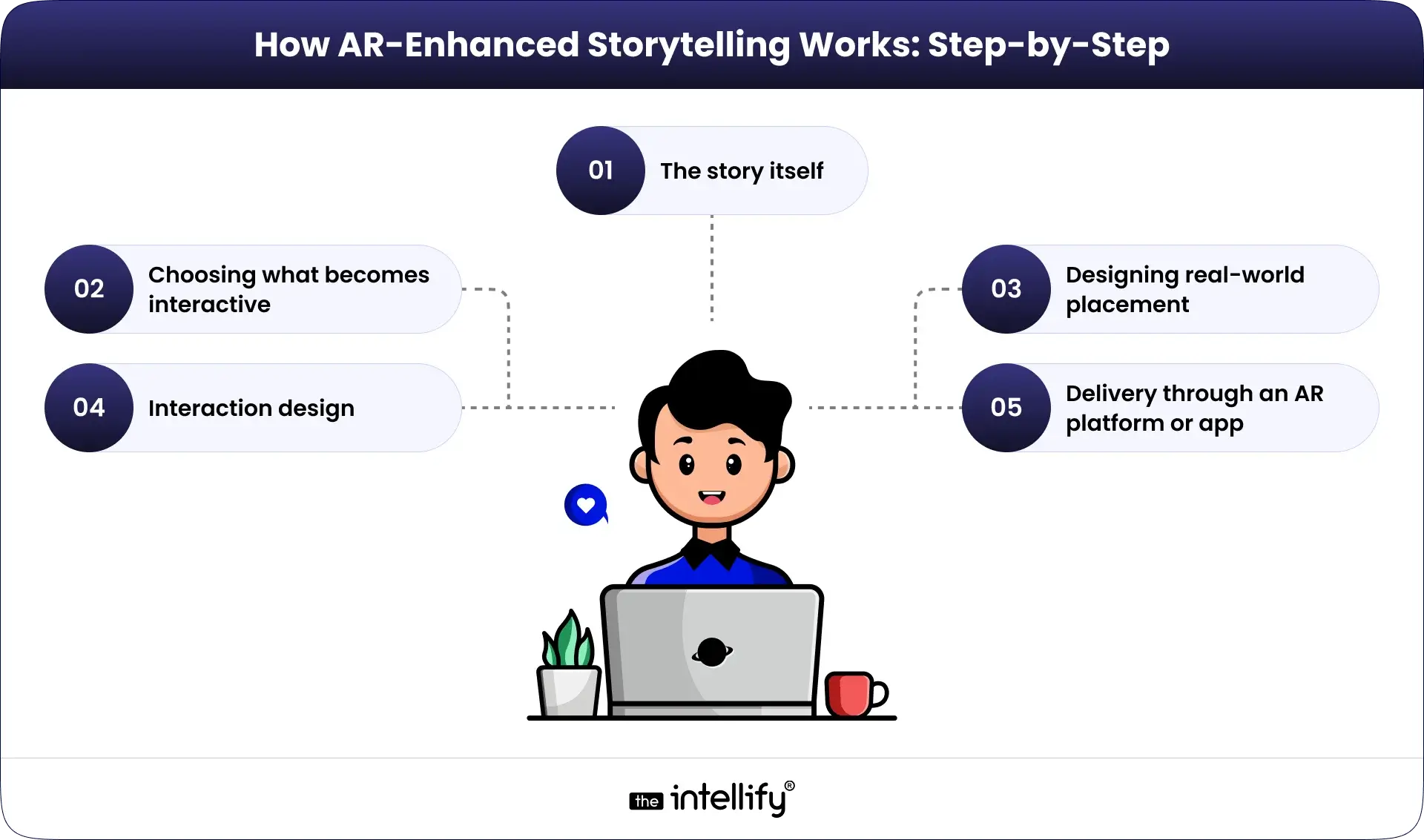
How AR-Enhanced Storytelling Works (Step-by-Step)

How AR-Enhanced Storytelling Works

AR-enhanced storytelling doesn’t begin with code or 3D models. It starts much earlier, often with a simple question: what do we want people to feel?

Step 1: The story itself.

This is the part many brands rush. A good AR experience doesn’t exist just to look impressive. It needs a clear narrative, something with a beginning, a middle, and a reason to care. It could be a product journey, a brand origin, or even a small moment that reflects a value.

Step 2: Choosing what becomes interactive.

Not everything needs to move. Some elements stay subtle. A floating object here. A character appears there. The best AR storytelling feels intentional, not crowded.

Step 3: Designing real-world placement.

This is where AR becomes different from video. Objects must feel like they belong in the user’s space. A table. A wall. A street corner. If placement feels off, users notice instantly.

Step 4: Interaction design.

Taps, swipes, movement, distance. These actions guide the story forward. Nothing should feel confusing. If users hesitate, the story breaks.

Step 5: Delivery through an AR platform or app.

Often this happens through a dedicated AR Storytelling App, built to handle performance, visuals, and analytics without friction.

When all steps align, the tech disappears, and the story stays.


Real-World Examples of AR Storytelling by Brands

AR storytelling shows up in everyday places now, even if people don’t label it as such.

  • Retail: Customers scan packaging and unlock stories about how a product was made, who designed it, or how it fits into real life. It feels personal. Almost quiet.
  • Entertainment: AR lets fans step inside scenes, explore characters, or unlock short narratives tied to shows or films. Not trailers, extensions of the story.
  • Education and museums: AR overlays bring history back into physical spaces. Old photographs turn into moving scenes. Voices return. People linger longer than planned.
  • Tourism: Cities use AR to recreate lost buildings or events right where they once stood. Standing there, phone raised, people pause. You can almost see it in their faces.

These experiences work because they don’t feel like campaigns. They feel discovered.


AR Storytelling Case Study: RainbowMe by The Intellify
To see how AR storytelling works in real life, take a look at RainbowMe, an AR storytelling application developed by The Intellify.
The app brings stories to life by letting users see and interact with characters in their own space. Instead of passively reading or watching, users explore the story through simple AR interactions. The focus stayed on smooth performance, child-friendly design, and clear storytelling. This project shows how AR storytelling apps can create meaningful engagement when the story comes first.

👉 View the full case study here:

RainbowME


Benefits of Augmented Reality Storytelling for Brands

This isn’t about trends. It’s about results that feel human. Some clear benefits brands notice:

  • Longer attention spans: When people interact, they slow down. AR experiences naturally extend time spent with a brand.
  • Stronger emotional memory: Stories layered into real space trigger emotion differently. Users remember the feeling, not just the message.
  • Higher brand trust: Interactive storytelling feels transparent. Brands aren’t talking at people, they’re inviting them in.
  • Organic sharing: People share AR experiences because they’re unexpected. Not because they’re told to.
  • Better insight: Behind the scenes, brands learn how users move, pause, interact, or drop off valuable data without intrusive tactics.
    It’s not perfect every time. Some experiences flop. But when it works, it works quietly and deeply.


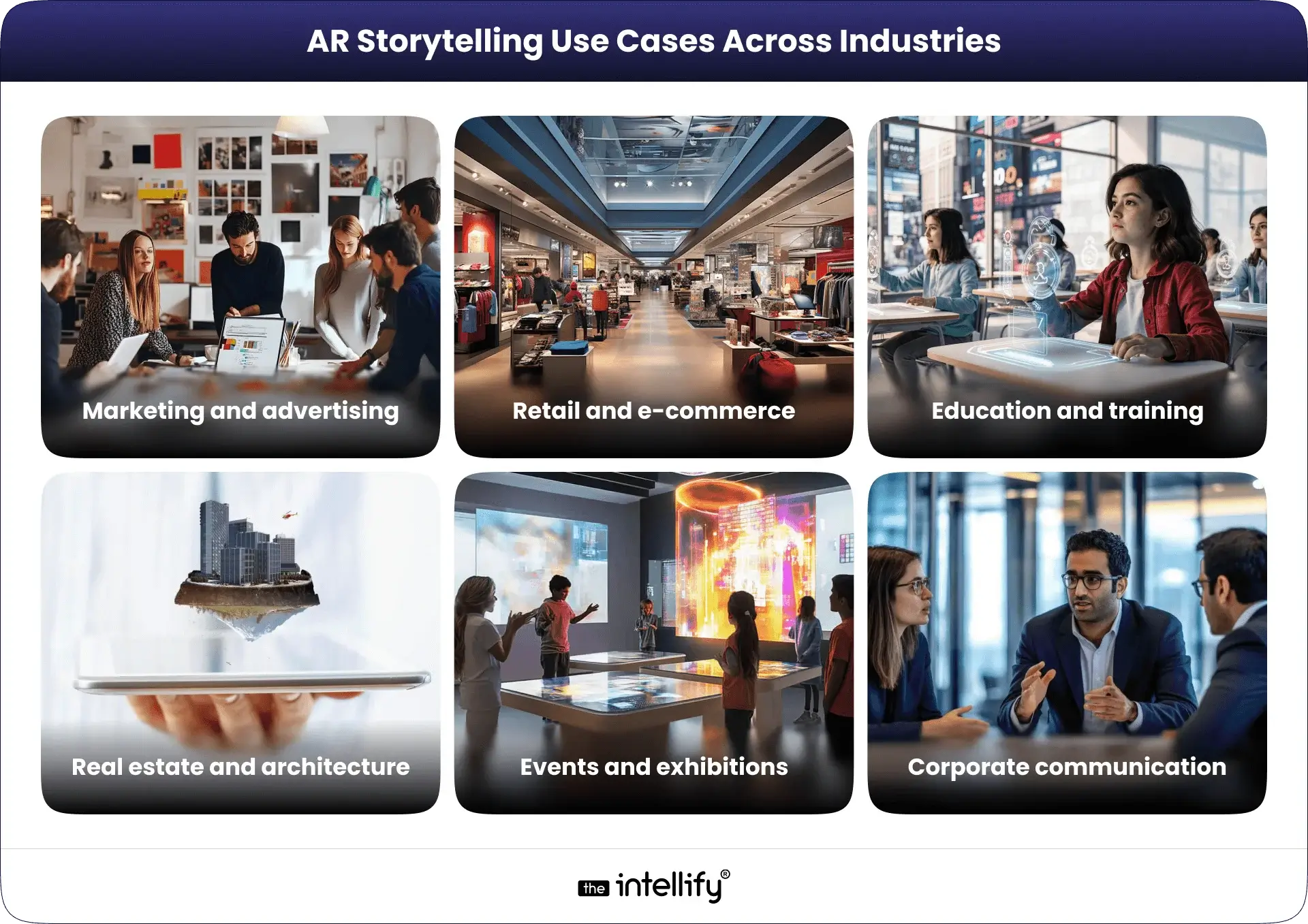
Use Cases of AR Storytelling Across Industries

Use Cases of AR Storytelling

1) Marketing and advertising: Campaigns become experiences people choose to engage with, not skip.

2) Retail and eCommerce: Products come with context. Stories replace static descriptions.

3) Education and training: Lessons feel lived-in. Learning sticks longer when people explore instead of memorize.

4) Real estate and architecture: Spaces tell their own stories before they exist physically.

5) Events and exhibitions: Booths stop being booths. They become narrative environments.

6) Corporate communication: Onboarding, values, and culture feel human instead of procedural.

Different industries. Same outcome: deeper connection.


Key Features of a Successful AR Storytelling App

A good AR Storytelling App doesn’t feel complicated. If it does, something went wrong. Strong apps usually include:

1) Ease of use: If someone needs instructions, the experience has already lost momentum.

2) Smooth performance: Lag breaks immersion instantly. Stability matters more than effects.

3) Thoughtful interaction design: Every tap or movement should feel purposeful, not gimmicky.

4) Cross-device compatibility: Users shouldn’t worry about what phone they’re holding.

5) Scalable architecture: Stories evolve. The app should grow with them.

6) Analytics without intrusion: Understanding engagement without disrupting the experience is key.

People notice when an app stutters or feels clunky. And they leave fast. Performance matters more than fancy tricks.


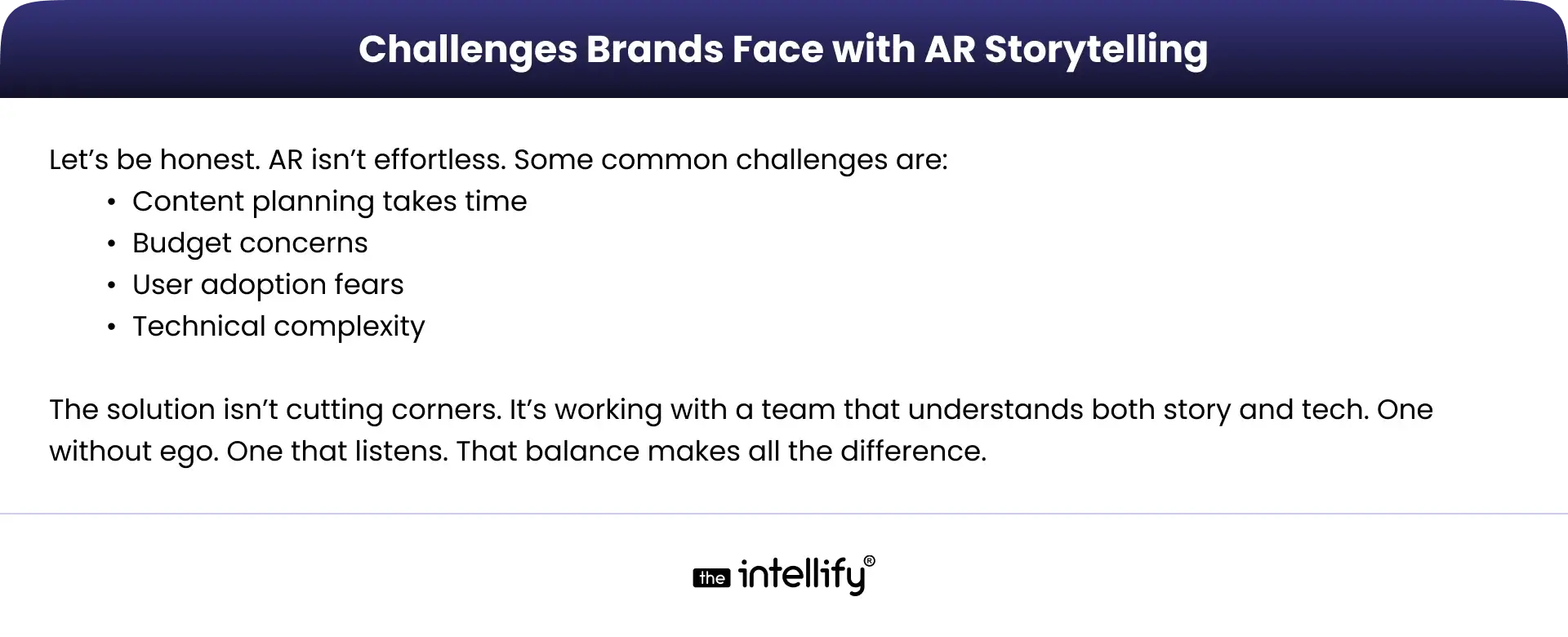
Challenges Brands Face with AR Storytelling


How to Choose the Right AR Storytelling App Development Partner

This decision shapes everything. Choosing an AR development partner isn’t just a technical decision. It’s a creative one. And honestly, this is where many AR storytelling projects either come together or quietly fall apart.

A good partner won’t start by talking about tools or frameworks. They’ll start by asking why you want to tell this story in the first place. A reliable partner should:

  • Understand storytelling, not just code
  • Have real AR project experience
  • Build custom solutions, not templates
  • Offer post-launch support
  • Think about scale from day one

If they jump straight into features without asking about your story, pause. That’s usually a red flag.


Future of Augmented Reality Storytelling

The future of AR storytelling isn’t about louder visuals or bigger effects. It’s moving in the opposite direction toward subtle, everyday experiences that blend naturally into real life.

We’re seeing:

  • AI-driven story personalization
  • Growth of WebAR experiences
  • AR Blending with AI and Spatial Computing
  • From Campaigns to Long-Term Experiences
  • Faster adoption in everyday marketing

It won’t replace traditional storytelling. It will sit beside it. Like another tool. A powerful one.


Build an AR Storytelling


Conclusion: Why AR Storytelling Is the Future of Brand Engagement

People don’t remember slogans. They remember how something made them feel. Augmented Reality Storytelling works because it turns stories into moments users can explore, not just watch. When a story exists in the real world, even briefly, it feels more personal and easier to remember.

This isn’t about using AR for the sake of it. It’s about giving people space to engage on their own terms. Brands that focus on meaning, not spectacle, tend to get it right. As immersive tech becomes more common, thoughtful storytelling will matter more than novelty. The brands that start building those experiences now will be the ones people remember later.


Frequently Asked Questions (FAQs)

1. What is Augmented Reality Storytelling, and how is it different from normal ads?

Augmented Reality Storytelling places a brand’s story into the real world using interactive digital elements. Unlike normal ads, users don’t just watch, they explore, move, and engage at their own pace. This makes the experience feel less promotional and more personal, which helps people remember the message longer.

2. What practical benefits can brands expect from AR storytelling?

Brands usually see longer engagement time, better brand recall, and stronger emotional connection. Because users interact with the story instead of scrolling past it, AR storytelling often leads to higher trust and more meaningful interest compared to traditional digital content.

3. Do I need a native app to run AR storytelling, or can I use WebAR?

Both options work. WebAR is faster to launch and doesn’t require downloads, making it ideal for quick campaigns. A native AR storytelling app offers deeper interaction, better performance, and long-term use. The right choice depends on your goals, audience, and how often you plan to use AR.

4. How long and how much does it take to build an AR storytelling app?

Timelines depend on complexity. A basic AR experience can take a few weeks, while a full AR storytelling app may take several months. Cost varies based on design depth, 3D content, and features. Clear planning early on helps control both time and budget.

5. Which industries benefit most from AR storytelling?

Retail, e-commerce, education, entertainment, real estate, tourism, and events benefit the most. Any industry where seeing, exploring, or understanding something in a real-world context improves decision-making can gain value from AR storytelling.

6. How do I pick the right AR storytelling app development partner?

Look for a partner who understands storytelling, not just AR technology. They should have real project experience, a clear development process, and post-launch support. Teams like The Intellify focus on story-first AR development, helping brands build scalable, meaningful AR storytelling experiences from concept to launch.

7. What does The Intellify specifically help with on AR storytelling projects?

The Intellify helps brands design the story, build AR experiences (WebAR or app-based), create optimized 3D content, and track engagement after launch. Their approach combines practical AR development with clear storytelling, ensuring the experience feels natural and delivers real business value.

View
Case Study