Emerging Digital Transformation Trends in AI, Cloud, & Intelligent Automation

Summary:
Digital transformation trends focus on how businesses use AI, intelligent automation, hybrid cloud, data analytics, and cybersecurity to improve efficiency and customer experience. These trends help organizations modernize systems, make better decisions, reduce operational costs, and stay competitive. The blog explains real industry use cases, key challenges, and future developments, offering practical guidance for companies planning long-term digital transformation strategies.

A few years ago, “going digital” mostly meant having a website and maybe a basic CRM system. Today, that sounds almost old-fashioned. Walk into any modern office, and you’ll see cloud dashboards on screens, automated workflows running in the background, and teams discussing data like it’s second nature.

This shift isn’t random. It’s driven by clear digital transformation trends that are reshaping how companies work, compete, and grow. From digital transformation with AI to intelligent automation, businesses are rethinking everything, sometimes with excitement, sometimes with doubt, and often with a bit of trial and error.

Let’s look at what’s really happening.


The Evolving Digital Business Landscape

Businesses are now operating in a digital-first economy. For many companies, digital systems are no longer “support tools.” They are the backbone of daily operations.

Technology investments are tied directly to growth and competitiveness. When leaders approve budgets today, they don’t just ask, “How much does this cost?” They ask, “Will this help us scale faster? Will customers notice the difference?”

Enterprises are modernizing systems to improve speed, efficiency, and customer experience. Old, slow platforms create friction. You can almost feel the slow reports, delayed approvals, and messy data. Over time, it drains energy from teams.

At the same time, AI, hybrid cloud, intelligent automation, and advanced analytics are emerging as key digital transformation trends across industries. These tools are not “nice to have” anymore. They are becoming standard.


What Are Digital Transformation Trends?

In simple terms, digital transformation trends are patterns in how businesses adopt and use technology over time. They are not about installing one new tool and calling it a day. That’s a digital upgrade. Real transformation is different. It’s about changing how work happens.

For example, switching from spreadsheets to a cloud ERP is an upgrade. Redesigning your planning process around real-time data is transformation.

Trends reflect deeper shifts in business strategy, customer behavior, and technology adoption. Customers expect faster responses. Employees want flexible tools. Leaders want clearer insights. Technology adapts to meet these needs.

Enterprises track these trends through market research, peer benchmarking, pilot projects, and sometimes plain old experimentation. Some ideas work. Some fail. That’s normal. Staying competitive means learning quickly and adjusting.

This foundation matters. Without understanding trends, transformation becomes random and expensive.


The Current Landscape of Enterprise Transformation

Most organizations today are under pressure to move faster. Markets change quickly. Customer loyalty is fragile. One bad digital experience can push someone away. This has created a growing demand for agility and speed. Teams want systems that respond in seconds, not days.

There is also a strong rise in data-driven operations. Decisions are no longer based only on gut feeling. Managers now ask for dashboards, forecasts, and evidence.

Legacy systems are slowly being replaced by cloud-based environments. Many companies still rely on old software, but maintaining it feels like fixing a leaking pipe every week.

Customer experience has become a real competitive differentiator. Smooth apps, fast support, and personalized offers matter more than flashy ads. All this creates the setting in which modern digital transformation trends are taking shape.


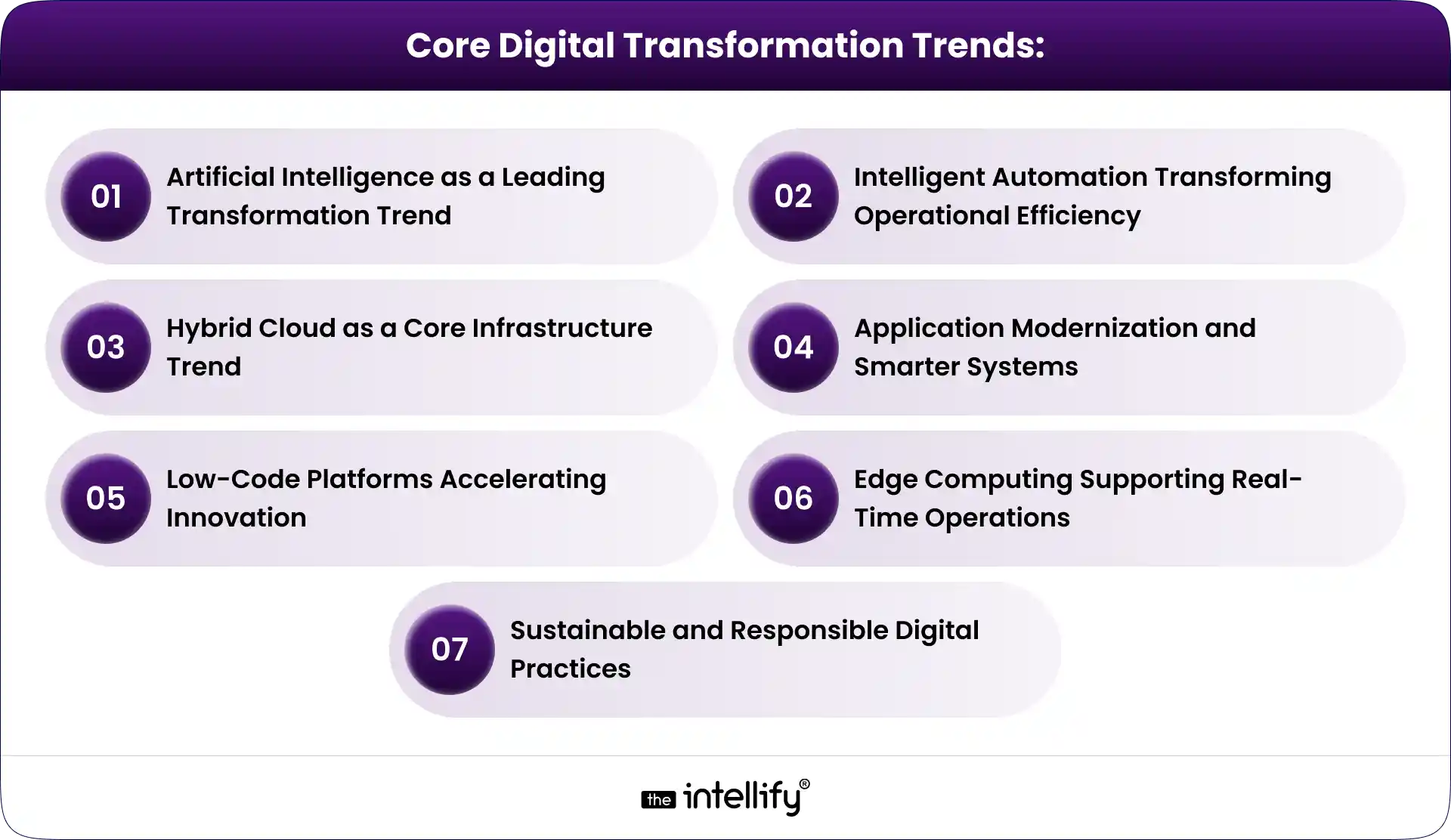
Core Digital Transformation Trends:
Core Digital Transformation Trends

1. Artificial Intelligence as a Leading Transformation Trend

Artificial Intelligence is no longer limited to research labs. It is quietly spreading across departments. In finance, AI helps analyze spending patterns. In HR, it screens resumes. In marketing, it predicts customer behavior. Over time, it becomes part of daily work.

Predictive analytics and forecasting allow companies to look ahead instead of reacting late. A retailer can forecast demand. A logistics firm can anticipate delays.

Intelligent customer engagement is another big area. Chatbots, voice assistants, and recommendation engines are improving service quality when done right. Poorly designed AI still frustrates users, honestly.

AI-driven decision support helps leaders compare scenarios and risks. It doesn’t replace humans. It supports them.

Industry examples

  • Retail demand planning: AI predicts which products will sell next month, reducing overstock.
  • Healthcare diagnostics: Algorithms help doctors spot patterns in medical images.
  • Financial fraud detection: Systems flag suspicious transactions in seconds.
  • Manufacturing performance analysis: Machines report early signs of failure.

When digital transformation with AI works well, it feels invisible. Things just run smoother.

2. Intelligent Automation Transforming Operational Efficiency

Intelligent automation means using software to handle repetitive work, supported by AI insights. It goes beyond simple rule-based automation. These systems can learn, adapt, and improve.

For example, instead of manually checking every invoice, software reads it, validates it, and sends it for approval. Humans step in only when something looks odd.
This combination of automation and AI streamlines workflows and reduces errors. Over time, teams trust the system more.

Common use cases

  • Invoice processing: Faster approvals, fewer mistakes.
  • HR onboarding: Automatic document collection and account setup.
  • IT service management: Ticket routing and issue prediction.
  • Supply chain coordination: Real-time order tracking.

The result is better speed, accuracy, and consistency. Employees spend less time on boring tasks. That matters more than many leaders realize.

3. Hybrid Cloud as a Core Infrastructure Trend

Hybrid cloud combines public cloud services with private infrastructure. It’s a mix, not a compromise. Many businesses avoid relying on a single provider. Vendor lock-in feels risky. Prices change. Policies shift.

Hybrid models support remote and distributed teams. Files, apps, and dashboards remain accessible from anywhere. They also enable scalable data and AI workloads. When processing demand rises, capacity can expand quickly.

Disaster recovery and system resilience improve as well. If one environment fails, another can take over. It brings peace of mind, especially after a few painful outages.


Additional Digital Transformation Trends:

4. Application Modernization and Smarter Systems

Many organizations still run on outdated software. It works, but barely.

Modernization means upgrading to flexible, cloud-based platforms. It also means connecting systems through APIs so data flows freely. Performance improves. Updates become easier. Scalability increases.

Why this matters: most digital transformation journeys begin here. If the foundation is weak, everything else struggles.

5. Low-Code Platforms Accelerating Innovation

Low-code tools allow teams to build applications with minimal coding. Business users can create dashboards, forms, and workflows themselves. IT teams become advisors instead of bottlenecks.

This speeds up development and reduces workload. Small and mid-sized companies benefit especially. They can digitize processes without massive budgets.

Why this matters: it lowers technical barriers and encourages innovation.

6. Edge Computing Supporting Real-Time Operations

Edge computing processes data close to where it is generated. This reduces delays. In factories, milliseconds matter. In hospitals, they can save lives.

It supports IoT devices and smart systems. Sensors, cameras, and machines all generate massive data. Operational visibility improves. Managers see issues as they happen.

Why this matters: industries like manufacturing, logistics, and healthcare depend on real-time decisions.

7. Sustainable and Responsible Digital Practices

Digital systems also consume energy. Servers run day and night. Companies are now focusing on energy-efficient cloud usage and reducing infrastructure waste.

Responsible AI is becoming important. Bias, transparency, and explain ability are no longer optional. Transparent data management builds trust.

Why this matters: sustainability is becoming part of digital strategy, not a side project.
 

Digital transformation services


Data-Driven Decision Making and Advanced Analytics

Many organizations now rely on data instead of intuition when making decisions. Centralized data systems help teams work with consistent and reliable information.
Real-time dashboards give leaders quick visibility into sales, operations, and performance. Instead of waiting for monthly reports, they can spot issues early and respond faster.

  • Predictive analytics supports future planning. Sales forecasts, demand predictions, and cost simulations help businesses prepare before problems appear.
  • Data centralization also reduces dependency on technical teams. Managers and team leads can access insights directly, improving speed and accountability.
  • However, strong data governance is essential. Without clean and well-managed data, even advanced analytics can produce misleading results.


Cybersecurity and Digital Trust as a Strategic Priority

  • As digital systems grow, security risks increase. More cloud platforms, devices, and integrations mean more potential vulnerabilities.
  • Cybersecurity is now a strategic priority, not just an IT task. Data breaches can damage reputation, disrupt operations, and lead to regulatory penalties.
  • Organizations are strengthening identity management, encryption, and monitoring systems to protect sensitive information. Secure cloud adoption is becoming standard practice.
  • Compliance with data protection laws is also critical. Proper documentation and audit processes help reduce legal and financial risks.
  • Digital trust depends on transparency. When customers feel their data is handled responsibly, they are more likely to stay loyal.


Customer-Centric Digital Experiences

Customer expectations continue to rise. People expect fast responses, simple interfaces, and consistent service across channels.

  • Omnichannel engagement connects websites, apps, stores, and support teams into one experience. Customers no longer want to repeat the same information multiple times.
  • Personalization uses data to recommend relevant products, content, and services. When done carefully, it improves engagement without feeling intrusive.
  • Faster service delivery through automation and self-service tools reduces frustration and improves satisfaction.
  • Customer-centric systems help businesses build long-term relationships, not just short-term transactions.


Industry Impact: How These Trends Are Applied in Real Business Scenarios

1. In healthcare, digital systems improve patient data access and coordination between departments. This leads to better treatment planning and fewer errors.

2. In retail, AI-powered forecasting helps optimize inventory and reduce waste. Stores can respond quickly to changing demand.

3. Manufacturing companies use predictive maintenance to reduce equipment breakdowns and downtime.

4. Financial institutions apply automation and analytics to strengthen compliance and fraud detection.

5. Logistics providers improve delivery efficiency through route optimization and real-time tracking.

Across industries, the focus remains on measurable results such as cost savings, faster processes, and improved reliability.
 

Challenges in digital transformation


The Future Direction of Digital Transformation Trends

AI will continue expanding into more business functions, from operations to finance and customer service.

Multi-cloud and hybrid environments will become more common as companies seek flexibility and reliability. Intelligent automation will handle more complex processes with limited human intervention.

Responsible AI and regulatory compliance will receive greater attention. Continuous improvement will become standard practice. Digital transformation will remain an ongoing process rather than a one-time project. Future-ready organizations will focus on adaptability instead of chasing every new technology.
 

Digital transformation solutions


Final Thoughts

Digital transformation trends continue to evolve. There is no fixed destination. AI, hybrid cloud, and intelligent automation are central, but they are part of a larger ecosystem that includes data, security, sustainability, and people.

Success depends on strategic alignment, not just buying new software. Organizations that adapt thoughtfully gain long-term advantage. They listen, test, learn, and adjust. Transformation is an ongoing journey, sometimes exciting, sometimes exhausting, always necessary.

At The Intellify, we work with businesses that are navigating this journey every day. From digital transformation with AI to intelligent automation and cloud modernization, our focus is on building practical, scalable solutions that fit real business needs, not just trends on paper.

If you’re planning your next step in digital transformation, the key is simple: start with purpose, move with clarity, and stay flexible.


Frequently Asked Questions (FAQs)

1. How are emerging digital transformation trends influencing business strategy today?

Emerging digital transformation trends are pushing companies to move beyond basic system upgrades. Businesses are now using AI, hybrid cloud, and intelligent automation to build flexible, data-driven operations. Strategy is focused on speed, better decisions, and long-term scalability instead of short-term fixes.

2. Why is AI becoming central to digital transformation initiatives?

AI enables predictive insights, smarter customer engagement, fraud detection, and operational forecasting. It helps companies shift from reactive decisions to proactive planning. Digital transformation with AI improves efficiency while supporting smarter, data-backed strategies across departments.

3. What role does hybrid cloud play in modern enterprise transformation?

A hybrid cloud combines private infrastructure with public cloud services. It provides scalability, cost flexibility, and better control over sensitive data. This approach supports remote teams, large data workloads, and secure digital growth without depending on a single provider.

4. How does intelligent automation improve operational performance?

Intelligent automation blends automation with AI-driven insights. It handles repetitive tasks, reduces manual errors, and speeds up workflows. Over time, it improves productivity, consistency, and operational visibility across finance, HR, IT, and supply chain functions.

5. Are digital transformation trends limited to large enterprises?

No. Small and mid-sized businesses are actively adopting cloud platforms, AI tools, and automation systems. Scalable technologies make digital transformation accessible without heavy upfront investment, allowing companies of all sizes to modernize operations efficiently.

6. Which industries are benefiting the most from these transformation trends?

Healthcare, retail, manufacturing, finance, and logistics are seeing a strong impact. From predictive maintenance and fraud detection to personalized customer experiences and real-time tracking, digital transformation trends are improving both operational efficiency and service quality.
Transforming Legacy Application Modernization with AI and Automation

Summary:
Legacy Application Modernization helps businesses upgrade outdated systems while maintaining operational stability. Many enterprises face technical debt, scalability challenges, and security risks that limit growth. By combining AI-driven automation with structured modernization strategies, organizations can improve performance, strengthen compliance, and enhance user experience. The blog also covers legacy mobile app modernization, industry use cases, and a practical roadmap to support long-term digital transformation in mobile apps and enterprise systems

Most companies didn’t wake up one day and decide to run on outdated systems. It happened slowly. A quick fix during a tight deadline. A patch before an audit. A workaround that was supposed to be temporary but never really left.

Years later, that “temporary” solution is still there. That’s why Legacy Application Modernization has become a serious conversation in boardrooms. Not because it sounds impressive, but because the pressure is real. Systems feel heavy. Changes feel risky. Teams move carefully instead of confidently.

Modernization today is not about replacing everything in one dramatic move. It’s about improving what slows you down while keeping the business steady. AI-driven automation makes that process more predictable and less chaotic, and honestly, predictability matters.


Why Legacy Application Modernization Is Now a Business Imperative

Many enterprises still rely on legacy applications built a decade or more ago. Payroll engines, claims systems, and inventory dashboards have been doing their job for years. The problem is, the world around them changed.

Customers expect instant responses. Internal teams expect systems to integrate without friction. Leadership expects insights in real time, not at the end of the quarter.

Older systems struggle to scale. Integrations require workarounds. Security updates feel risky. Even adding a small feature can turn into a three-week exercise. Now, Businesses need systems that adapt quickly to market changes. If technology slows decision-making, it slows growth.

Legacy application modernization, supported by AI and automation, allows companies to upgrade without disrupting daily operations. It protects the foundation while strengthening the structure. That balance is what makes it essential now, not optional later.


Understanding the Challenges of a Legacy Application in Today’s Market

Accumulated Technical Debt

Technical debt builds quietly. A small patch today seems harmless. Another quick fix next month. Over time, those fixes overlap and increase complexity. Documentation becomes outdated. The original developers move on. New team members hesitate to touch certain modules because no one fully understands them.

Even minor updates require deep testing. Maintenance slows down. Costs increase. At some point, teams stop improving and start avoiding. That’s usually the signal that something needs to change.

Scalability and Performance Constraints

Growth exposes limitations. More users. More transactions. More data. The architecture that once handled everything smoothly begins to struggle under peak demand.

Performance bottlenecks appear. Dashboards load slowly. Transactions lag. During heavy traffic, systems may even crash. These issues affect customer perception quickly. People rarely complain about slow systems. They simply leave. When growth is restricted by outdated architecture, modernization becomes urgent.

Security and Compliance Risks

Security standards evolve constantly, but legacy platforms often lag behind. Older encryption methods become insufficient. Manual monitoring increases risk. Compliance reporting becomes more complex each year.

Applying security patches can destabilize fragile systems, so updates get delayed. That hesitation increases exposure. It’s not just a technical concern. It affects trust, brand reputation, and regulatory standing.


What Legacy Application Modernization Truly Means

Modernization is not about making a dashboard look modern. It involves rethinking architecture, workflows, and data management. It may include refactoring code, re-platforming infrastructure, or rebuilding specific components that no longer serve the business.

The goal is alignment. Technology should support business strategy, not block it. A well-planned legacy modernization initiative creates systems that are adaptable and easier to maintain. It reduces stress for development teams and improves reliability for users. It sets the business up for long-term flexibility.


The Role of AI in Transforming Legacy Systems

AI adds intelligence to modernization efforts. When used thoughtfully, it improves visibility, decision-making, and system performance.

Intelligent Data Utilization

Legacy systems store years of operational data. Often, that data is underused.

AI analyzes historical and real-time information to identify patterns and trends. Predictive models improve forecasting accuracy. Teams can respond proactively instead of reacting to problems after they occur. Data begins to inform strategy in a meaningful way.

Enhancing User Experience

User expectations are higher now. AI solutions supports personalized experiences by analyzing behavior and preferences. Adaptive interfaces adjust to usage patterns. Intelligent notifications guide users without overwhelming them.

Conversational tools simplify interaction. Instead of navigating complex menus, users can ask direct questions. Smart workflows reduce friction. That alone can improve engagement significantly.

AI-Assisted Code and Architecture Optimization

Large legacy codebases are difficult to evaluate manually. AI tools can scan and analyze these systems efficiently.

They identify redundant logic, performance gaps, and risky dependencies. Automated testing improves accuracy. Migration decisions become data-driven. This reduces uncertainty and shortens planning cycles.


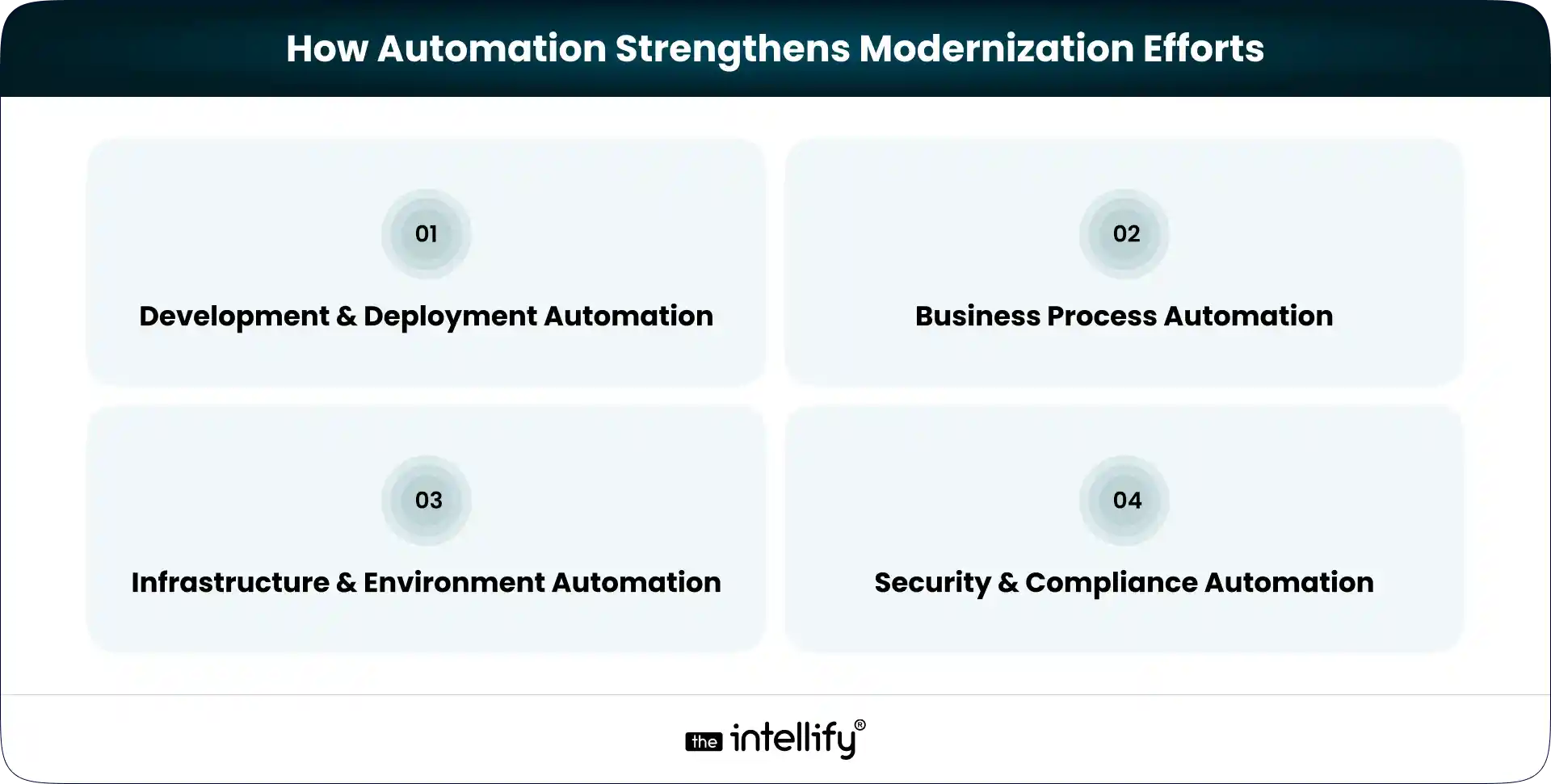
How Automation Strengthens Modernization Efforts

How Automation Strengthens Modernization Efforts

Automation brings structure and consistency. It reduces repetitive tasks and minimizes human error.

Development and Deployment Automation

Continuous integration supports stability. Automated testing catches issues early, which reduces last-minute surprises.

Release cycles become shorter and more predictable. Collaboration improves through structured version control practices. Updates feel controlled instead of stressful.

Business Process Automation

Many enterprise workflows still rely heavily on manual steps. Automation converts repetitive processes into rule-based systems:

  • Claims move through structured workflows
  • Onboarding becomes standardized
  • Approvals follow clear logic
  • Data entry errors decrease
  • Teams focus on strategic tasks

Over time, productivity improves and operational costs decline.

Infrastructure and Environment Automation

Cloud provisioning becomes repeatable and reliable. Environments can be replicated consistently across teams. Auto-scaling adjusts to traffic changes automatically. Configuration management reduces inconsistencies.

Monitoring systems detect issues early, and recovery processes become more predictable. This stability supports growth without increasing complexity.

Security and Compliance Automation

Automated vulnerability scans strengthen protection. Compliance checks integrate into development pipelines.

Real-time monitoring improves threat detection. Audit readiness becomes easier because reporting is structured. Security shifts from reactive to proactive.


Legacy Application Modernization Services


Legacy Mobile App Modernization in a Multi-Device Ecosystem

Many enterprises operate older mobile applications alongside web platforms. The experience often feels disconnected. Legacy mobile app modernization focuses on performance, responsiveness, and integration. Cloud connectivity improves synchronization across devices. AI enables personalization and predictive engagement.

Automation ensures updates are rolled out consistently. Digital transformation in mobile apps matters because users switch between devices constantly. If the experience feels inconsistent, trust erodes quickly.


A Strategic Roadmap for Legacy Modernization Mobile App Initiatives

Modernization works best when it follows a clear structure.

Step 1: Assessment and Discovery

Evaluate architecture, dependencies, and integrations carefully. Identify performance bottlenecks and security gaps. Align findings with business priorities. Not every system requires full rebuilding. Clear visibility reduces unnecessary investment.

Step 2: Selecting the Right Modernization Approach

  • Several approaches are available:
  • Rehost for quick migration
  • Refactor to improve specific components
  • Re-platform for gradual upgrades
  • Rebuild for complete transformation

Each option involves trade-offs in cost, time, and risk. Evaluate ROI before committing.

Step 3: Architecture Redesign and Cloud Enablement

Shift toward modular or service-based architecture where possible. Strengthen API integrations. Improve data flexibility. Enable scalable cloud-native deployment. Design for adaptability, not just immediate functionality.

Step 4: Integrating AI and Automation Strategically

Identify high-impact areas first. Introduce automation gradually across development and operations. Implement AI capabilities in phases. Measure results and refine continuously. Intentional adoption prevents unnecessary complexity.

Step 5: Continuous Monitoring and Optimization

Track performance metrics consistently. Refine AI models over time. Improve workflows using analytics. Optimize infrastructure usage based on demand. Modernization is ongoing. It evolves with the business.


Industry Use Cases Driving Modernization

1. Healthcare Providers

Healthcare organizations use modernization to improve patient engagement, automate scheduling and billing, apply predictive analytics for operations, strengthen data security, and improve coordination. Efficiency improves, but so does reliability.

2. Insurance Companies

Insurance firms modernize to automate claims management, detect fraud through predictive models, improve risk assessment, process documents intelligently, and reduce response times. Operational friction decreases significantly.

3. Financial Services Institutions

Financial institutions apply AI-enabled onboarding, anomaly detection in transactions, automated compliance reporting, personalized product recommendations, and scalable digital platforms. In this industry, speed and trust must coexist.


Measuring Success After Modernization

Modernization success should be measurable. Improved uptime and faster response times are clear indicators. Reduced maintenance costs reflect operational efficiency. Faster deployment cycles show architectural improvement.

Customer satisfaction and scalability readiness confirm long-term impact. When teams spend less time fixing issues and more time building improvements, progress becomes visible.


Common Implementation Challenges and How to Address Them

Data migration requires careful planning and testing. Avoid rushing transitions. Balance innovation with operational stability through phased rollouts. Invest in team training for AI adoption.

Maintain compliance documentation throughout the transformation. Protect business continuity during upgrades. Structured planning reduces uncertainty and prevents setbacks.


The Future of Intelligent Application Transformation

Generative AI will increasingly assist with code refactoring and architectural decisions. Hyper-automation will connect enterprise systems more tightly. Predictive monitoring will detect issues earlier and enable faster recovery.

Cloud-native architecture will continue expanding. Continuous modernization will replace large, infrequent overhauls. Organizations that treat modernization as an ongoing discipline will remain adaptable.


legacy app modernization solutions


Final Thought

Legacy Application Modernization is a strategic decision, not a technical trend. AI-driven automation accelerates transformation while maintaining control. A structured roadmap reduces risk and supports steady progress.

Intelligent systems improve performance, strengthen scalability, and enable sustainable growth. Organizations that modernize proactively move forward with confidence instead of hesitation.


Frequently Asked Questions (FAQs)

1. Why should businesses modernize legacy systems now?

Legacy systems often limit growth due to technical debt, slow performance, and rising maintenance costs. Modernization helps organizations improve agility, support AI-driven automation, and align with ongoing digital transformation initiatives.

2. Can modernization be done without replacing the whole system?

Yes. Companies can modernize specific components through approaches like rehosting, refactoring, or re-platforming. This reduces risk and cost while improving performance step by step instead of rebuilding everything at once.

3. What role does AI play in modernization?

AI supports code analysis, predictive insights, automated testing, and performance optimization. It helps teams identify inefficiencies, reduce errors, and make data-driven decisions during modernization projects.

4. What is Legacy Mobile App Modernization?

Legacy mobile app modernization focuses on improving older mobile applications by enhancing performance, cloud integration, security, and user experience across multiple devices.

5. How do organizations measure success after modernization?

Success is measured through improved uptime, faster feature deployment, reduced maintenance costs, and better user satisfaction. Many organizations work with experienced partners like The Intellify to define clear KPIs and ensure measurable modernization outcomes.

AI Agents vs Traditional Automation: Business Use Cases, Costs & ROI

Summary:
Confused about whether AI agents or traditional automation are right for your business? You’re not alone. This blog breaks it down in plain terms, like what each approach does well, where it falls short, and how they compare on cost and ROI. It also highlights real-world use cases, common mistakes, and practical steps to choose the right automation approach for your business.

Automation used to be simple. You mapped a process, you wrote rules, you let software repeat the same steps again and again. It worked for a while, but businesses today don’t run on fixed rules anymore. Customers behave differently, markets shift fast, and data changes by the hour, and suddenly old-school automation begins to feel… narrow, useful, yes, but limited.

That’s where AI agents enter the picture. They aren’t here to replace automation. They appeared because businesses needed systems that could handle uncertainty without breaking.

This blog walks through AI agents vs traditional automation not as a trend comparison, but as a business decision. We’ll talk about real use cases, realistic costs, and the kind of ROI leaders actually care about when budgets are on the line.


What Is Traditional Automation?

Traditional automation is built on instructions. “If X happens, do Y.” That’s it. These systems don’t think. They don’t adapt. They don’t guess. They just execute steps you’ve already defined.

You’ll see traditional automation in things like:

  • Invoice processing
  • Payroll workflows
  • Employee onboarding checklists
  • Scheduled reports
  • Data moving from one system to another

It’s reliable. Predictable. And honestly, kind of comforting.

If your process is stable and rarely changes, traditional automation does its work quietly in the background. But the moment something unexpected happens, like missing data, a new customer behavior, or a process tweak, it freezes or fails or sends the task to a human. That’s the limit.


What Are AI Agents? How Are They Different?

AI agents don’t just follow rules. They make decisions. They behave less like scripts and more like junior team members. They look at data, understand context, and choose what to do next without being told every single step.

Think of an AI agent as a digital worker that:

  • Knows the goal
  • Understands the environment
  • Takes action
  • Learns from outcomes

Not perfectly, not magically. But enough to handle real-world messiness.

An AI agent can:

  • Decide which customer query needs escalation
  • Adjust responses based on past conversations
  • Route tasks dynamically
  • Handle incomplete or noisy data

This doesn’t mean it’s always right. Sometimes it hesitates. Sometimes it needs guardrails. Sometimes a human steps in. But unlike traditional automation, it improves over time. The more it works, the more patterns it learns. That learning curve is the difference.


AI Agents vs Traditional Automation: Core Differences

AI Agents vs Traditional Automation

Let’s keep this practical.

  • Decision-making: Traditional automation executes fixed steps. AI agents choose between options.
  • Learning: Traditional systems don’t learn. AI agents improve with data and feedback.
  • Flexibility: Rule-based automation breaks when inputs change. AI agents adapt.
  • Maintenance: Traditional automation needs constant rule updates. AI agents need monitoring and training, not endless rewrites.
  • Human involvement: Traditional automation depends on humans for exceptions. AI agents reduce exceptions over time.

One isn’t better by default. They solve different problems.


Business Use Cases: Where Each Approach Makes Sense

This is where theory meets the real world.

Traditional Automation Use Cases

Traditional automation still shines when processes are:

  • Rarely change
  • Have clear inputs and outputs
  • Are compliance-heavy

Common examples include:

  • Invoice and expense approvals
  • Employee onboarding tasks
  • Contract document routing
  • Regulatory reporting
  • Internal system syncing

These processes don’t need intelligence. They need consistency. Trying to add AI here often adds cost without adding value.

AI Agent Use Cases

AI agents work best when humans used to rely on judgment. They’re better suited for:

  • Customer support conversations that don’t follow scripts
  • Sales qualification across multiple channels
  • Demand forecasting when conditions shift weekly
  • Supply chain decisions with incomplete data
  • Internal IT or HR help desks

Anywhere humans used to “just figure it out,” AI agents can assist. Not replace. Assist.


Cost Comparison: AI Agents vs Traditional Automation

Let’s talk about money. Carefully.

Traditional Automation Costs

  • Lower initial setup
  • Faster deployment
  • Cheaper tools
  • Predictable maintenance

But there’s a catch. As processes grow, rule management becomes expensive. Every change needs rework. Every edge case adds complexity.

AI Agent Costs

  • Higher upfront investment
  • Data preparation costs
  • Model training and testing
  • Ongoing monitoring

But over time? Fewer manual interventions. Less rule maintenance. Better scalability.

Traditional automation is cheaper to start. AI agents are cheaper to grow with.


ROI Comparison: Which Delivers Better Business Value?

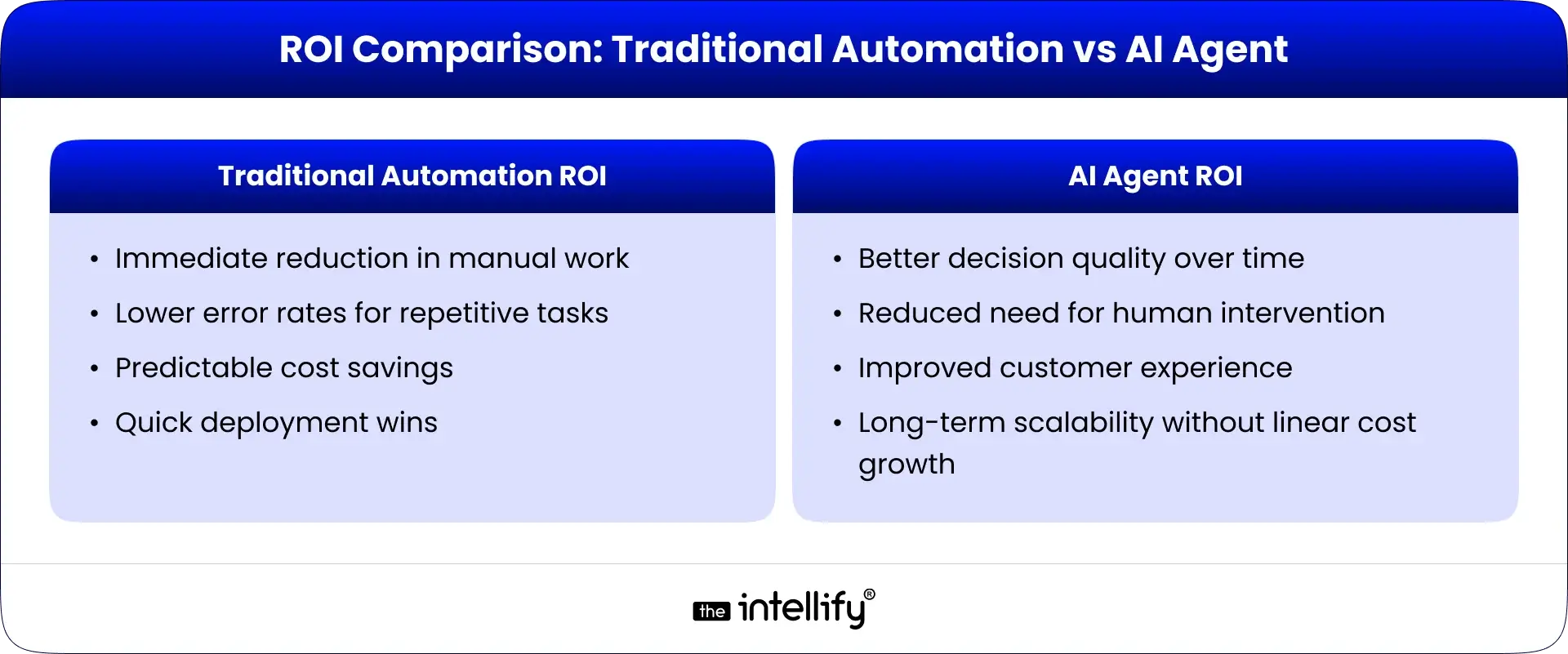
ROI Comparison table

ROI is often treated like a math problem. In reality, it’s more of a feeling backed by numbers.

Traditional automation delivers value fast. You automate a task, reduce manual effort, and see immediate savings. It’s satisfying. Especially when teams are stretched, and leadership wants results this quarter, not next year.

AI agents work differently. Their value builds over time. Early results may look modest, but as the system learns and adapts, the impact becomes broader and harder to ignore.

Here’s how ROI typically shows up:

Traditional Automation ROI

  • Immediate reduction in manual work
  • Lower error rates for repetitive tasks
  • Predictable cost savings
  • Quick deployment wins

AI Agent ROI

  • Better decision quality over time
  • Reduced need for human intervention
  • Improved customer experience
  • Long-term scalability without linear cost growth

Traditional automation saves hours. AI agents change outcomes.


When Traditional Automation Is Still the Right Choice

Despite the excitement around AI, traditional automation still deserves its place. It’s the right choice when processes are well-defined and unlikely to change. In these cases, adding intelligence doesn’t improve results; it just adds cost and complexity.

  • Steps are fixed and repeatable
  • Rules are clear and rarely updated
  • Compliance and audits matter
  • Errors must be minimized at all costs
  • Budgets are tightly controlled

Examples include finance operations, regulatory reporting, internal approvals, and backend system syncing. These processes don’t benefit from “thinking.” They benefit from consistency.

Sometimes, boring systems are the most valuable ones.


When AI Agents Become a Competitive Advantage

AI agents start to matter when businesses operate in uncertainty. They shine in environments where:

  • Customer behavior shifts frequently
  • Data arrives incomplete or late
  • Decisions affect revenue or retention
  • Human teams struggle to keep up

Instead of reacting to every exception, AI agents handle variation naturally. They prioritize, adapt, and escalate only when needed.

Over time, this creates advantages:

  • Faster responses without hiring more staff
  • Smarter decisions at scale
  • Reduced operational friction
  • Teams focused on strategy, not triage

This isn’t about replacing people. It’s about removing constant interruptions that drain momentum.


Common Mistakes Businesses Make While Choosing Automation

Most automation failures don’t come from bad tools. They come from bad assumptions. Some common mistakes include:

  • Automating broken or unclear processes
  • Expecting AI to fix poor data quality
  • Choosing software before defining goals
  • Underestimating change management
  • Ignoring security and compliance early

Another quiet mistake is expecting instant perfection. AI agents need time, feedback, and oversight. Treating them like plug-and-play software often leads to disappointment.

Automation amplifies design. If the design is flawed, the system will be too.


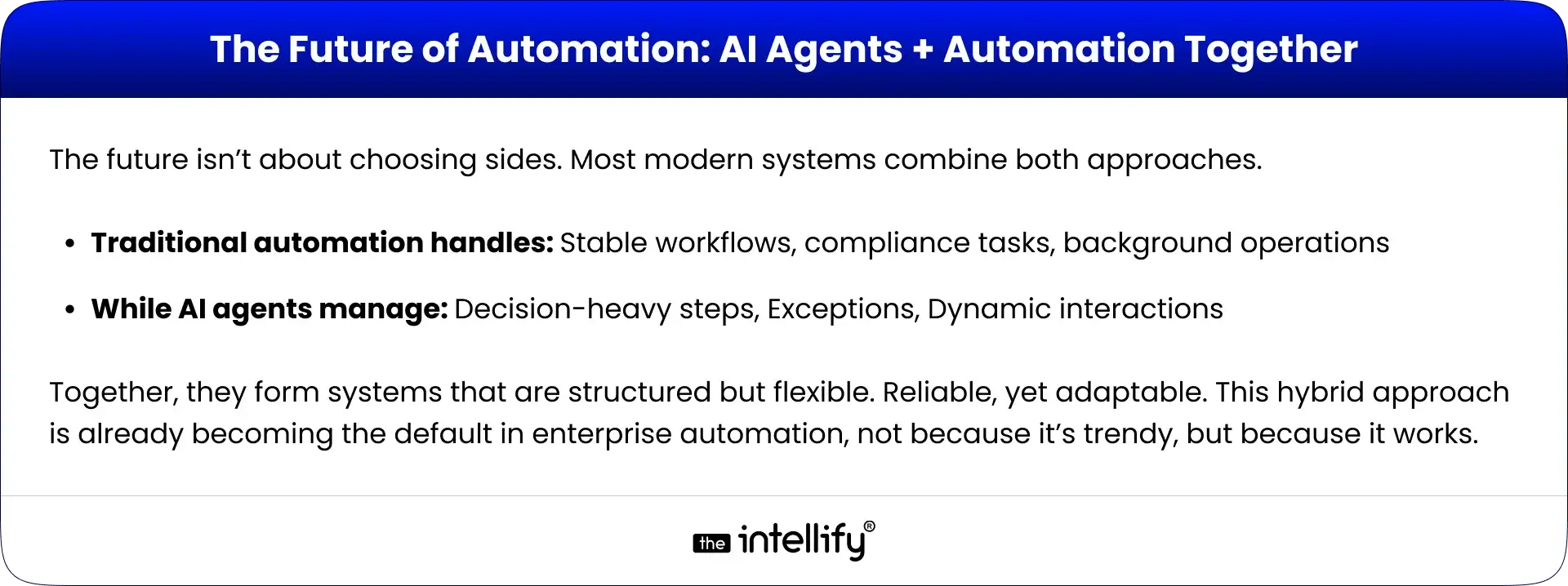
Future of Automation


How to Choose Between AI Agents and Traditional Automation

The decision doesn’t need to be complicated. Start with a few honest questions:

  • Does this process change often?
  • Does it require judgment or interpretation?
  • Are exceptions common?
  • Will scale increase complexity?

If most answers are “no,” traditional automation is usually enough.

If most answers are “yes,” AI agents are worth exploring.

The goal isn’t to adopt new technology. It’s to reduce friction without creating new problems.


How Businesses Can Get Started with AI Agents

Getting started with AI agents doesn’t begin with tools. It begins with clarity.

Most businesses don’t fail at AI because the technology doesn’t work. They fail because they start too big, too fast, or without a clear problem to solve. The smartest teams take a slower, more deliberate approach.

A practical starting point usually looks like this:

  • Identify one process that feels painful or inefficient
  • Focus on tasks that require judgment, not just repetition
  • Look for areas where teams are overwhelmed by volume or variation
  • Choose outcomes, not features, as success metrics

This is where an experienced AI agent development company makes a difference.

At The Intellify, the approach typically starts with understanding how your business actually runs, where decisions slow things down, where humans step in too often, and where intelligent agents could reduce friction without disrupting operations.


Build Intelligent Automation


Final Thoughts: Choosing the Right Automation Strategy

Choosing between AI agents and traditional automation is less about technology and more about fit. Some processes need structure and certainty. Others need flexibility and judgment. Forcing one approach everywhere usually creates more friction than value.

Traditional automation works best when rules are clear, and change is rare. AI agents add value when conditions shift, decisions matter, and scale makes manual work painful. Most businesses benefit from using both, each where it makes sense.

The goal isn’t to automate everything. It’s to automate the right things, in the right way, so teams can focus on work that actually moves the business forward. That’s what a good automation strategy looks like.


Frequently Asked Questions (FAQs)

1) What is the main difference between AI agents and traditional automation?

Traditional automation follows fixed rules and workflows. AI agents go a step further by understanding context, making decisions, and adapting when situations change. One repeats tasks; the other responds to situations.

2) Are AI agents better than traditional automation?

Not always. AI agents are better for processes that change often or require judgment. Traditional automation works best for stable, repeatable tasks. Most businesses use a mix of both rather than choosing just one.

3) Which is more cost-effective: AI agents or traditional automation?

Traditional automation is usually cheaper to set up. AI agents cost more upfront but often deliver better long-term value by reducing manual effort and scaling without constant rule updates.

4) Can AI agents replace RPA or workflow automation?

No. AI agents don’t replace RPA; they enhance it. RPA handles structured tasks, while AI agents manage decisions and exceptions. Together, they create more flexible and reliable systems.

5) When should a business switch from automation to AI agents?

If automation breaks frequently, needs constant rule changes, or depends heavily on human judgment, it may be time to introduce AI agents to handle complexity more smoothly.

6) Are AI agents safe for enterprise use?

Yes, when designed properly. Enterprise-grade AI agents include security controls, audit trails, and human oversight. This is why many organizations work with experienced teams like The Intellify to build them responsibly.

7) How do I decide what automation approach is right for my business?

Look at your process. If it’s predictable and rule-based, traditional automation fits. If it’s dynamic and decision-heavy, AI agents make more sense. A structured assessment helps avoid overengineering

View
Case Study