AI Workflow Automation Explained: Benefits, Use Cases, and ROI for Businesses

Summary:
AI workflow automation helps businesses achieve faster ROI by optimizing repetitive and time-consuming processes. It improves efficiency, reduces costs, and enhances decision-making by leveraging data and intelligent systems. From customer service to internal operations, organizations can streamline workflows and scale effectively. By starting with high-impact use cases and tracking performance metrics, businesses can unlock immediate value while building a strong foundation for future automation initiatives.


Why Businesses Are Turning to Intelligent Automation Now

In today’s business world, companies are grappling with rising operational costs, talent shortages, and the relentless drive to speed things up without sacrificing quality. As manual and rule-based processes start to show their limits, more organizations are looking to AI workflow automation as a viable solution.

So, what does “seeing ROI first” mean for decision-makers? It’s about capturing quick wins through strategic implementations that boost efficiency while cutting costs. In this blog, we’ll explore what AI workflow automation is all about, its benefits, specific use cases across different industries, and how businesses can effectively measure ROI.


What Is AI Workflow Automation?

AI workflow automation is all about merging artificial intelligence with the automation of routine tasks. Unlike traditional automation tools that just tackle repetitive tasks, AI workflow automation takes it a step further by analyzing data and understanding context and patterns.

Key features :

  • Context understanding: AI can sift through both structured and unstructured data, allowing for smarter decision-making.
  • Decision-making Capability: When faced with choices, AI evaluates various factors to suggest or execute the best action.
  • Real-world examples: Consider automated email sorting, intelligent customer support via chatbots, and streamlined supply chain processes all areas where AI bolsters productivity.

AI workflow automation really shines across departments be it finance, HR, or marketing by smoothing out operations and enhancing overall effectiveness.


Why Traditional Automation Often Falls Short

While traditional automation has brought some benefits, it often falls short in key areas:

  • Limited to structured Tasks: These systems only perform well with predictable processes, missing the complexities of real-world situations.
  • Requires Constant Updates: They often need manual tweaks to keep up, adding extra workload instead of alleviating it.
  • New Bottlenecks: Sometimes, traditional automation introduces new delays rather than solving existing ones, leaving organizations hungry for smarter options.

As the demand for more flexible solutions grows, so does the interest in AI-driven processes.


How AI-Driven Processes Improve Efficiency Across Teams
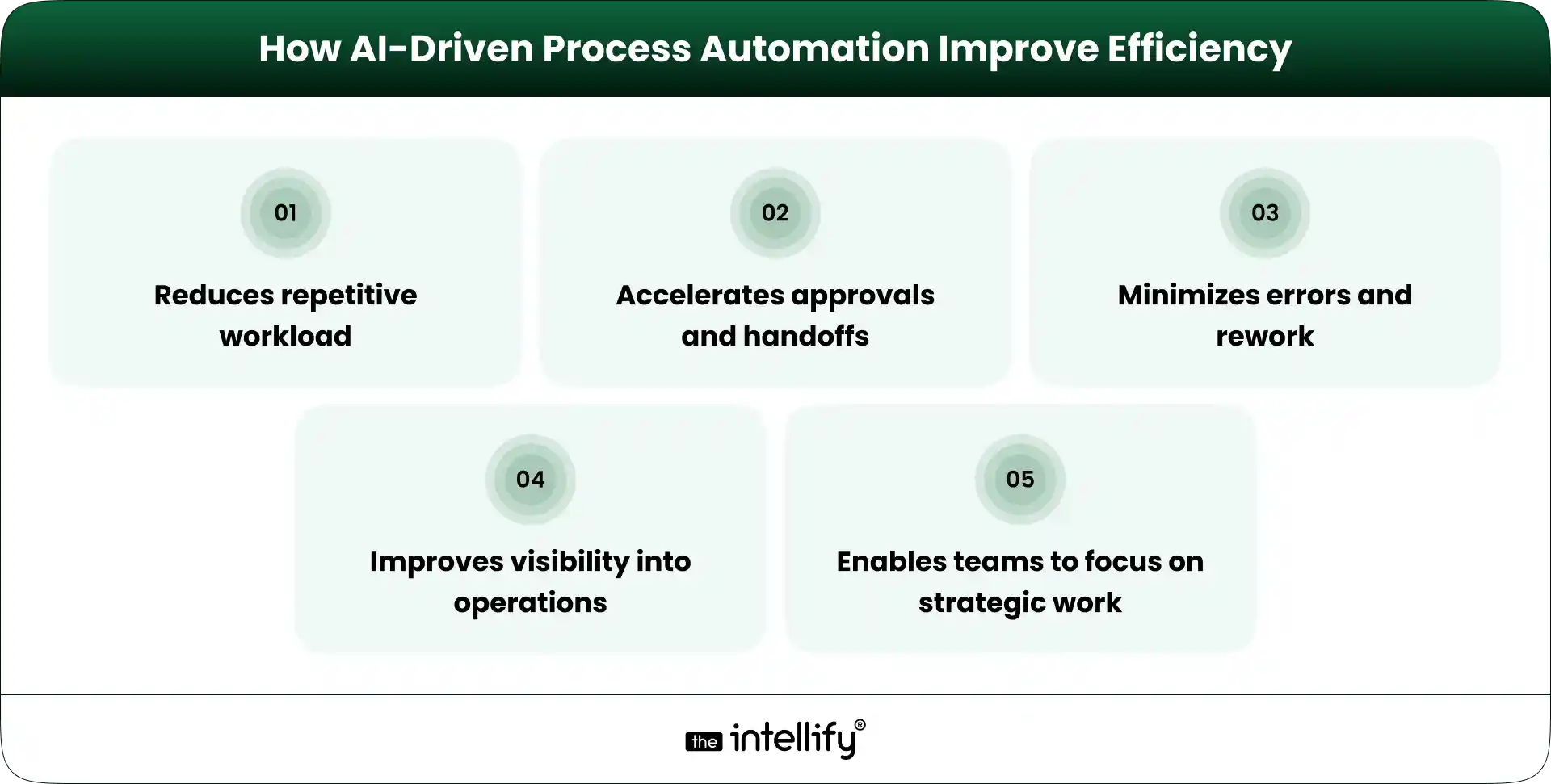
Benefit of AI-driven Process Automation

AI workflow automation brings a host of efficiency improvements that resonate across teams:

1. Reduces repetitive workload: By automating tedious tasks, employees can dedicate their time to more strategic projects.
2. Accelerates approvals and handoffs: AI speeds up decision-making, cutting down long waits for task approvals.
3. Minimizes errors and rework: Fewer manual inputs mean fewer chances for mistakes that require rework.
4. Improves visibility into operations: Real-time data and intelligent insights keep teams informed about project statuses and results.

These gains in efficiency enable departments to run more smoothly and adapt quickly to changing demands.


Why Businesses See Faster ROI Compared to Other Digital Investments

Many companies notice a quicker ROI from AI workflow automation compared to broader digital transformation initiatives, and here’s why:

  • Lower implementation effort: Getting AI solutions off the ground typically takes less time and fewer resources than larger digital projects.
  • Immediate Savings: Reducing manual labor leads to immediate cuts in operating costs.
  • Increased Throughout: Businesses can handle more work without hiring additional staff, allowing for efficient scaling.
  • Better Resource Utilization: AI optimizes the use of existing resources, making operational improvements sustainable over time.

These advantages stack up, leading to a faster return on investment.
 

AI workflow Automation solutions


Where AI Workflow Automation Delivers the Most ROI

AI workflow automation can provide significant returns in particular business areas:

1. Customer Service Operations

  • Automated handling and routing of requests
  • Quicker response times, boosting customer satisfaction
  • Reduced support costs without sacrificing quality

2. Finance & Accounting

  • Streamlined invoice processing and reconciliation
  • Quick expense validation with minimal manual review
  • Automatic compliance checks

3. Human Resources

  • Effective candidate screening and onboarding
  • Timely management of employee requests
  • Decreased administrative workloads

4. Sales & Marketing Operations

  • Lead qualification and routing
  • Automated campaign execution workflows
  • Prompt CRM updates and follow-ups

5. IT & Internal Operations

  • Efficient incident resolution workflows
  • Automated access provisioning
  • Routine maintenance processes

These areas offer prime opportunities for businesses looking to establish AI workflow automation that has a direct impact on their bottom line.


Real-World Industry Use Cases Showing Early Returns

Several industries are already reaping the rewards of AI workflow automation. Here are some notable examples:

1. Healthcare:  AI streamlines patient intake and automates documentation processes, ultimately leading to better patient care.

2. Manufacturing:  AI improves supply chain coordination, ensuring that materials are in the right place at the right time.

3. Retail:  Automated order management and returns processing enhance operational efficiency in stores.

4. Banking & Insurance:  AI implementations expedite claims and risk processes, reducing turnaround times.

Professional services: Firms with documentation-heavy workflows benefit from automated processing, allowing more focus on client interaction.

These examples demonstrate how AI significantly contributes to operational efficiencies.


How to Identify High-ROI Opportunities in Your Organization

To effectively implement AI workflow automation, organizations should pinpoint processes that show high potential for returns:

  • High Volume and Repetition: Tasks that happen frequently and in large quantities are prime for automation.
  • Multiple Approvals Needed: Processes requiring numerous approvals can often be streamlined for quicker results.
  • Frequent Delays or Errors: Identify areas prone to slowdowns or inefficiencies that could benefit from automation.
  • Data Extraction Work : Tasks that involve pulling data from documents provide excellent opportunities for automation.
  • Customer- Facing Operations: In scenarios where speed is critical, AI can help ensure timely services.

By identifying these opportunities, organizations can make informed decisions about where to allocate their automation efforts.


How to Implement AI Workflow Automation Successfully

AI workflow automation can be integrated successfully with a few strategic steps:

1. Start Small:- Begin with one high-impact process to kick off your journey.

2. Map Current Workflows:- Pinpoint pain points and areas where efficiency can improve.

3. Choose Compatible Tools:- Look for AI agent solutions that work well with your existing systems.

4. Run Pilot Projects:- Test potential value through small-scale trials.

5. Train Teams:- Ensure your staff is equipped with the skills they need to navigate the new systems effectively.

A gradual scaling approach based on measured results leads to thoughtful and impactful implementation.


Common Challenges and How Businesses Overcome Them

Integrating AI workflow automation isn’t without its challenges. Here are some typical obstacles and strategies for navigating them:

  • Legacy System Integration: Ensure new solutions can integrate smoothly with older systems to minimize disruption.
  • Data Readiness Issues: Prepare and clean your data before diving into AI systems to dodge inaccuracies.
  • Employee Resistance: Communicate openly about changes and how they benefit employees to ease any concerns.
  • Security and Compliance: Be vigilant in addressing potential security issues and ensuring regulatory compliance.
  • Setting Realistic Expectations: Understand that while ROI is attainable, it requires time and effort.

By proactively tackling these challenges, organizations can improve their chances of successful automation.


Measuring ROI: How to Track the Real Business Impact

To understand the benefits of AI workflow automation, it’s essential to monitor key performance indicators (KPIs):

  • Cost savings vs productivity gains: Look at financial savings against gains in efficiency.
  • Cycle time reduction: Track how long it takes to complete tasks before and after automation.
  • Error rate improvements: Measure the frequency of errors to evaluate process consistency.
  • Customer satisfaction impact: Gather customer feedback and analyze service levels.
  • Long-term value vs short-term wins: Beyond immediate benefits, assess long-term performance improvements.

Keeping tabs on these metrics helps in understanding the tangible effects of AI workflow automation on business operations.


The Future of AI-Enabled Workflow Transformation

Looking ahead, AI-enabled workflow transformation is set to evolve even further:

1. Move toward autonomous operations:- Future systems might handle more tasks independently, requiring minimal human oversight.

2. Human + AI collaboration models:- Businesses will increasingly see AI as supportive partners in workflow tasks.

3. Predictive and self-optimizing workflows:- AI could evolve to anticipate challenges and continually optimize processes.

4. Competitive advantage for early adopters:- Organizations embracing these innovations sooner are likely to lead in their sectors.

Being prepared for these developments will position businesses favorably as they adapt to a rapidly changing landscape.


Conclusion

Big gains come when businesses focus on the right processes for automation. Quick ROI is achievable through targeted implementation, starting small and scaling thoughtfully. Organizations that act swiftly won’t just keep pace; they’ll lead in efficiency and agility.

Incorporating AI workflow automation can revolutionize operations, creating significant value and gearing businesses up for future growth.

 

AI workflow automation services


Frequently Asked Questions (FAQs)

1) How quickly can businesses see ROI from AI workflow automation?

Many companies notice improvements within a few months, especially after automating repetitive tasks like customer queries or document handling. Faster processes and reduced manual work quickly translate into cost and time savings.

2) Which departments usually benefit first from AI-driven automation?

Customer support, finance, HR, sales operations, and IT often see the earliest gains. These areas handle large volumes of routine work that can be streamlined easily.

3) Is AI workflow automation suitable for small and mid-sized businesses?

Yes, it helps smaller companies scale without hiring large teams. Modern tools are affordable and easier to implement than traditional enterprise systems.

4) How is AI automation different from traditional workflow automation?

Traditional automation follows fixed rules and struggles with unexpected inputs. AI can handle unstructured data, learn patterns, and adapt to changing situations.

5) What types of tasks are best suited for AI workflow automation?

Repetitive, time-consuming tasks like data entry, document processing, approvals, and request handling are ideal. These processes consume effort but add little strategic value.

6) How should a business decide what to automate first?

Start with processes that are slow, error-prone, or involve heavy manual effort. Choosing one high-impact workflow helps demonstrate value quickly.

7) How can businesses measure the success of automation initiatives?

Key indicators include time saved, lower operating costs, reduced errors, and faster service delivery. Comparing performance before and after implementation shows the real impact.

AI Agents vs Traditional Automation: Business Use Cases, Costs & ROI

Summary:
Confused about whether AI agents or traditional automation are right for your business? You’re not alone. This blog breaks it down in plain terms, like what each approach does well, where it falls short, and how they compare on cost and ROI. It also highlights real-world use cases, common mistakes, and practical steps to choose the right automation approach for your business.

Automation used to be simple. You mapped a process, you wrote rules, you let software repeat the same steps again and again. It worked for a while, but businesses today don’t run on fixed rules anymore. Customers behave differently, markets shift fast, and data changes by the hour, and suddenly old-school automation begins to feel… narrow, useful, yes, but limited.

That’s where AI agents enter the picture. They aren’t here to replace automation. They appeared because businesses needed systems that could handle uncertainty without breaking.

This blog walks through AI agents vs traditional automation not as a trend comparison, but as a business decision. We’ll talk about real use cases, realistic costs, and the kind of ROI leaders actually care about when budgets are on the line.


What Is Traditional Automation?

Traditional automation is built on instructions. “If X happens, do Y.” That’s it. These systems don’t think. They don’t adapt. They don’t guess. They just execute steps you’ve already defined.

You’ll see traditional automation in things like:

  • Invoice processing
  • Payroll workflows
  • Employee onboarding checklists
  • Scheduled reports
  • Data moving from one system to another

It’s reliable. Predictable. And honestly, kind of comforting.

If your process is stable and rarely changes, traditional automation does its work quietly in the background. But the moment something unexpected happens, like missing data, a new customer behavior, or a process tweak, it freezes or fails or sends the task to a human. That’s the limit.


What Are AI Agents? How Are They Different?

AI agents don’t just follow rules. They make decisions. They behave less like scripts and more like junior team members. They look at data, understand context, and choose what to do next without being told every single step.

Think of an AI agent as a digital worker that:

  • Knows the goal
  • Understands the environment
  • Takes action
  • Learns from outcomes

Not perfectly, not magically. But enough to handle real-world messiness.

An AI agent can:

  • Decide which customer query needs escalation
  • Adjust responses based on past conversations
  • Route tasks dynamically
  • Handle incomplete or noisy data

This doesn’t mean it’s always right. Sometimes it hesitates. Sometimes it needs guardrails. Sometimes a human steps in. But unlike traditional automation, it improves over time. The more it works, the more patterns it learns. That learning curve is the difference.


AI Agents vs Traditional Automation: Core Differences

AI Agents vs Traditional Automation

Let’s keep this practical.

  • Decision-making: Traditional automation executes fixed steps. AI agents choose between options.
  • Learning: Traditional systems don’t learn. AI agents improve with data and feedback.
  • Flexibility: Rule-based automation breaks when inputs change. AI agents adapt.
  • Maintenance: Traditional automation needs constant rule updates. AI agents need monitoring and training, not endless rewrites.
  • Human involvement: Traditional automation depends on humans for exceptions. AI agents reduce exceptions over time.

One isn’t better by default. They solve different problems.


Business Use Cases: Where Each Approach Makes Sense

This is where theory meets the real world.

Traditional Automation Use Cases

Traditional automation still shines when processes are:

  • Rarely change
  • Have clear inputs and outputs
  • Are compliance-heavy

Common examples include:

  • Invoice and expense approvals
  • Employee onboarding tasks
  • Contract document routing
  • Regulatory reporting
  • Internal system syncing

These processes don’t need intelligence. They need consistency. Trying to add AI here often adds cost without adding value.

AI Agent Use Cases

AI agents work best when humans used to rely on judgment. They’re better suited for:

  • Customer support conversations that don’t follow scripts
  • Sales qualification across multiple channels
  • Demand forecasting when conditions shift weekly
  • Supply chain decisions with incomplete data
  • Internal IT or HR help desks

Anywhere humans used to “just figure it out,” AI agents can assist. Not replace. Assist.


Cost Comparison: AI Agents vs Traditional Automation

Let’s talk about money. Carefully.

Traditional Automation Costs

  • Lower initial setup
  • Faster deployment
  • Cheaper tools
  • Predictable maintenance

But there’s a catch. As processes grow, rule management becomes expensive. Every change needs rework. Every edge case adds complexity.

AI Agent Costs

  • Higher upfront investment
  • Data preparation costs
  • Model training and testing
  • Ongoing monitoring

But over time? Fewer manual interventions. Less rule maintenance. Better scalability.

Traditional automation is cheaper to start. AI agents are cheaper to grow with.


ROI Comparison: Which Delivers Better Business Value?

ROI Comparison table

ROI is often treated like a math problem. In reality, it’s more of a feeling backed by numbers.

Traditional automation delivers value fast. You automate a task, reduce manual effort, and see immediate savings. It’s satisfying. Especially when teams are stretched, and leadership wants results this quarter, not next year.

AI agents work differently. Their value builds over time. Early results may look modest, but as the system learns and adapts, the impact becomes broader and harder to ignore.

Here’s how ROI typically shows up:

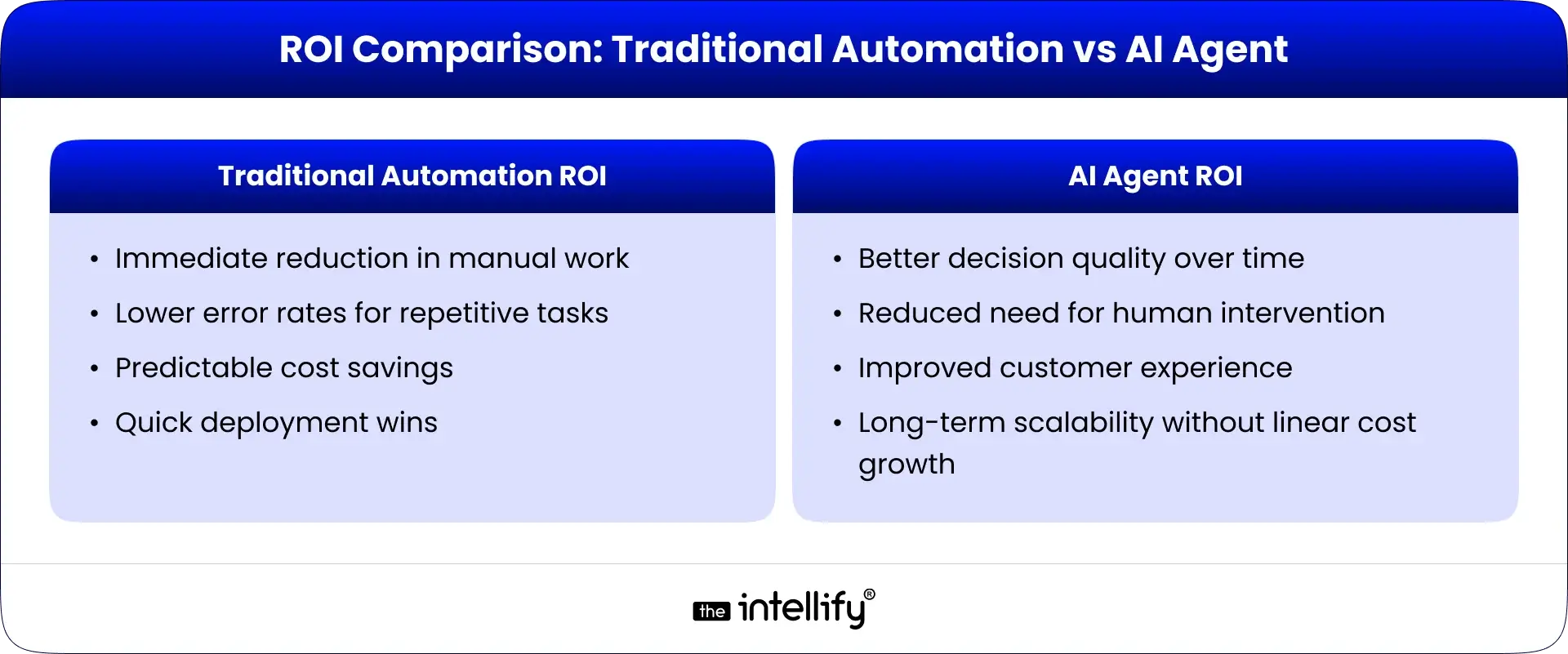
Traditional Automation ROI

  • Immediate reduction in manual work
  • Lower error rates for repetitive tasks
  • Predictable cost savings
  • Quick deployment wins

AI Agent ROI

  • Better decision quality over time
  • Reduced need for human intervention
  • Improved customer experience
  • Long-term scalability without linear cost growth

Traditional automation saves hours. AI agents change outcomes.


When Traditional Automation Is Still the Right Choice

Despite the excitement around AI, traditional automation still deserves its place. It’s the right choice when processes are well-defined and unlikely to change. In these cases, adding intelligence doesn’t improve results; it just adds cost and complexity.

  • Steps are fixed and repeatable
  • Rules are clear and rarely updated
  • Compliance and audits matter
  • Errors must be minimized at all costs
  • Budgets are tightly controlled

Examples include finance operations, regulatory reporting, internal approvals, and backend system syncing. These processes don’t benefit from “thinking.” They benefit from consistency.

Sometimes, boring systems are the most valuable ones.


When AI Agents Become a Competitive Advantage

AI agents start to matter when businesses operate in uncertainty. They shine in environments where:

  • Customer behavior shifts frequently
  • Data arrives incomplete or late
  • Decisions affect revenue or retention
  • Human teams struggle to keep up

Instead of reacting to every exception, AI agents handle variation naturally. They prioritize, adapt, and escalate only when needed.

Over time, this creates advantages:

  • Faster responses without hiring more staff
  • Smarter decisions at scale
  • Reduced operational friction
  • Teams focused on strategy, not triage

This isn’t about replacing people. It’s about removing constant interruptions that drain momentum.


Common Mistakes Businesses Make While Choosing Automation

Most automation failures don’t come from bad tools. They come from bad assumptions. Some common mistakes include:

  • Automating broken or unclear processes
  • Expecting AI to fix poor data quality
  • Choosing software before defining goals
  • Underestimating change management
  • Ignoring security and compliance early

Another quiet mistake is expecting instant perfection. AI agents need time, feedback, and oversight. Treating them like plug-and-play software often leads to disappointment.

Automation amplifies design. If the design is flawed, the system will be too.


Future of Automation


How to Choose Between AI Agents and Traditional Automation

The decision doesn’t need to be complicated. Start with a few honest questions:

  • Does this process change often?
  • Does it require judgment or interpretation?
  • Are exceptions common?
  • Will scale increase complexity?

If most answers are “no,” traditional automation is usually enough.

If most answers are “yes,” AI agents are worth exploring.

The goal isn’t to adopt new technology. It’s to reduce friction without creating new problems.


How Businesses Can Get Started with AI Agents

Getting started with AI agents doesn’t begin with tools. It begins with clarity.

Most businesses don’t fail at AI because the technology doesn’t work. They fail because they start too big, too fast, or without a clear problem to solve. The smartest teams take a slower, more deliberate approach.

A practical starting point usually looks like this:

  • Identify one process that feels painful or inefficient
  • Focus on tasks that require judgment, not just repetition
  • Look for areas where teams are overwhelmed by volume or variation
  • Choose outcomes, not features, as success metrics

This is where an experienced AI agent development company makes a difference.

At The Intellify, the approach typically starts with understanding how your business actually runs, where decisions slow things down, where humans step in too often, and where intelligent agents could reduce friction without disrupting operations.


Build Intelligent Automation


Final Thoughts: Choosing the Right Automation Strategy

Choosing between AI agents and traditional automation is less about technology and more about fit. Some processes need structure and certainty. Others need flexibility and judgment. Forcing one approach everywhere usually creates more friction than value.

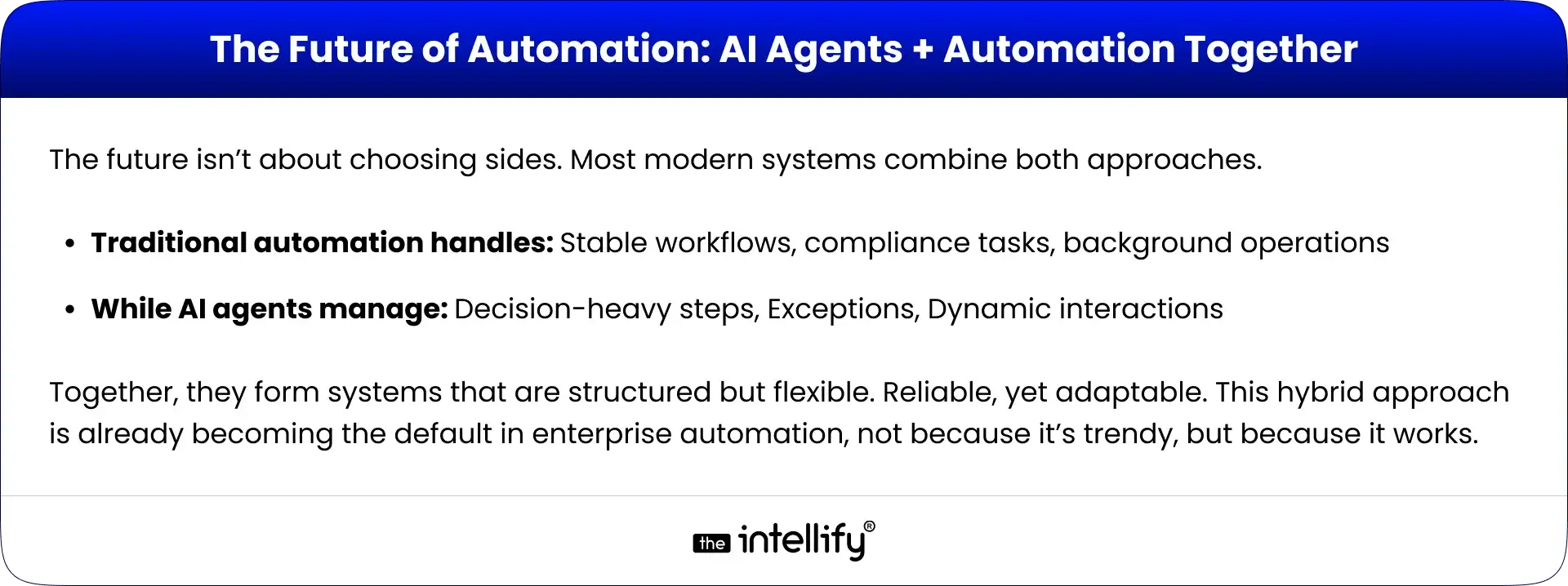
Traditional automation works best when rules are clear, and change is rare. AI agents add value when conditions shift, decisions matter, and scale makes manual work painful. Most businesses benefit from using both, each where it makes sense.

The goal isn’t to automate everything. It’s to automate the right things, in the right way, so teams can focus on work that actually moves the business forward. That’s what a good automation strategy looks like.


Frequently Asked Questions (FAQs)

1) What is the main difference between AI agents and traditional automation?

Traditional automation follows fixed rules and workflows. AI agents go a step further by understanding context, making decisions, and adapting when situations change. One repeats tasks; the other responds to situations.

2) Are AI agents better than traditional automation?

Not always. AI agents are better for processes that change often or require judgment. Traditional automation works best for stable, repeatable tasks. Most businesses use a mix of both rather than choosing just one.

3) Which is more cost-effective: AI agents or traditional automation?

Traditional automation is usually cheaper to set up. AI agents cost more upfront but often deliver better long-term value by reducing manual effort and scaling without constant rule updates.

4) Can AI agents replace RPA or workflow automation?

No. AI agents don’t replace RPA; they enhance it. RPA handles structured tasks, while AI agents manage decisions and exceptions. Together, they create more flexible and reliable systems.

5) When should a business switch from automation to AI agents?

If automation breaks frequently, needs constant rule changes, or depends heavily on human judgment, it may be time to introduce AI agents to handle complexity more smoothly.

6) Are AI agents safe for enterprise use?

Yes, when designed properly. Enterprise-grade AI agents include security controls, audit trails, and human oversight. This is why many organizations work with experienced teams like The Intellify to build them responsibly.

7) How do I decide what automation approach is right for my business?

Look at your process. If it’s predictable and rule-based, traditional automation fits. If it’s dynamic and decision-heavy, AI agents make more sense. A structured assessment helps avoid overengineering

View
Case Study