Summary:
AI revenue cycle management is helping healthcare providers handle billing and financial processes with better accuracy and less manual effort. By using technologies like AI medical coding and healthcare claims automation, organizations can reduce claim denials, speed up reimbursements, and improve overall efficiency. From patient registration to final payment, AI supports every stage of the revenue cycle, making operations smoother and more predictable while allowing teams to focus on higher-value work.
Revenue cycle management sits quietly in the background of every healthcare organization, but honestly it’s what keeps the lights on. From patient registration to final payment, every step affects cash flow. And when something breaks coding errors, denied claims, delays in reimbursement it doesn’t just slow things down, it hits revenue directly.
Most teams are still dealing with a mix of manual work, outdated tools, and constant back-and-forth with payers. It gets tiring. Small mistakes pile up, claims get rejected, and suddenly you’re chasing payments that should’ve been settled weeks ago.
This is where AI revenue cycle management starts to make a real difference. Not in a flashy, overhyped way but in a practical, day-to-day sense. It helps reduce errors, speed things up, and take some pressure off already stretched teams.
In this blog, we’ll walk through how AI fits into healthcare revenue cycle management, especially in areas like AI medical coding and healthcare claims automation, along with the benefits, challenges, and what’s coming next.
The Growing Challenges in Healthcare Revenue Cycle Management
If you talk to anyone working in billing or coding, you’ll hear the same frustration things are getting more complex, not simpler.
- Claim volumes are rising, and payer rules keep changing (sometimes without much notice yeah, that part’s annoying).
- There’s a real shortage of skilled coders and billing professionals. Teams are stretched thin.
- Revenue leakage is common denials, undercoding, missed charges it all adds up.
- Administrative work eats up time that could be spent on more critical tasks.
- Reimbursements take longer than they should. Cash flow becomes unpredictable.
Because of all this, healthcare organizations are starting to look beyond traditional automation. They need something smarter. Something that doesn’t just follow rules but learns and improves over time.
What Is AI Revenue Cycle Management in Healthcare?
At its core, AI revenue cycle management means using artificial intelligence to handle and improve financial processes in healthcare.
It brings together:
- Machine learning (to learn from historical data)
- Natural language processing (to understand clinical notes)
- Predictive analytics (to forecast outcomes like denials or payment delays)
Traditional automation follows fixed rules. AI goes a step further it adapts. It identifies patterns, flags risks, and even suggests actions before problems occur.
Instead of just processing data, AI helps teams make better decisions across the entire revenue cycle.
How AI Revenue Cycle Management Works Across the Entire Revenue Cycle
AI doesn’t just sit in one part of the process. It touches almost every stage, quietly improving things in the background.
- Patient scheduling and insurance verification: AI checks eligibility in real time and flags missing or incorrect details early.
- Prior authorization and documentation checks: It reviews requirements and ensures everything is in place before submission.
- Charge capture and clinical documentation analysis: AI scans clinical notes to detect missed charges or inconsistencies.
- AI medical coding and recommendations: Suggests accurate codes based on documentation.
- Healthcare claims automation and validation: Claims are scrubbed automatically before submission.
- Denial prediction and prevention: AI identifies high-risk claims and suggests fixes before they’re sent.
- Payment posting and reconciliation: Faster matching of payments with claims.
- Patient billing and collections optimization: Smarter billing cycles and personalized payment plans.
It’s not magic. But when all these small improvements stack up, the impact is pretty noticeable.

AI Medical Coding: Improving Coding Accuracy and Productivity
Medical coding is one of those areas where even small errors can cause big problems. A wrong code, a missing detail, and the claim gets denied.
AI helps by reading and interpreting clinical documentation (yes, even messy notes sometimes) and suggesting the right codes.
- Recommends ICD-10, CPT, and HCPCS codes automatically
- Reduces manual errors and missed revenue opportunities
- Maintains consistency across coding practices
- Supports compliance and audit readiness
What’s interesting is that AI doesn’t replace coders it supports them. It handles repetitive tasks so they can focus on edge cases and complex scenarios.
Healthcare Claims Automation: Streamlining Claims From Submission to Payment
Claims processing is where delays usually happen. And honestly, it’s often because of small, preventable issues. With healthcare claims automation, AI steps in before claims are even submitted.
- Automatically checks claims for errors or missing data
- Applies payer-specific rules and edits
- Flags potential rejection risks early
- Speeds up approvals and reduces back-and-forth
The result? Fewer denials, faster payments, and way less manual follow-up.
Key Benefits of AI Revenue Cycle Management
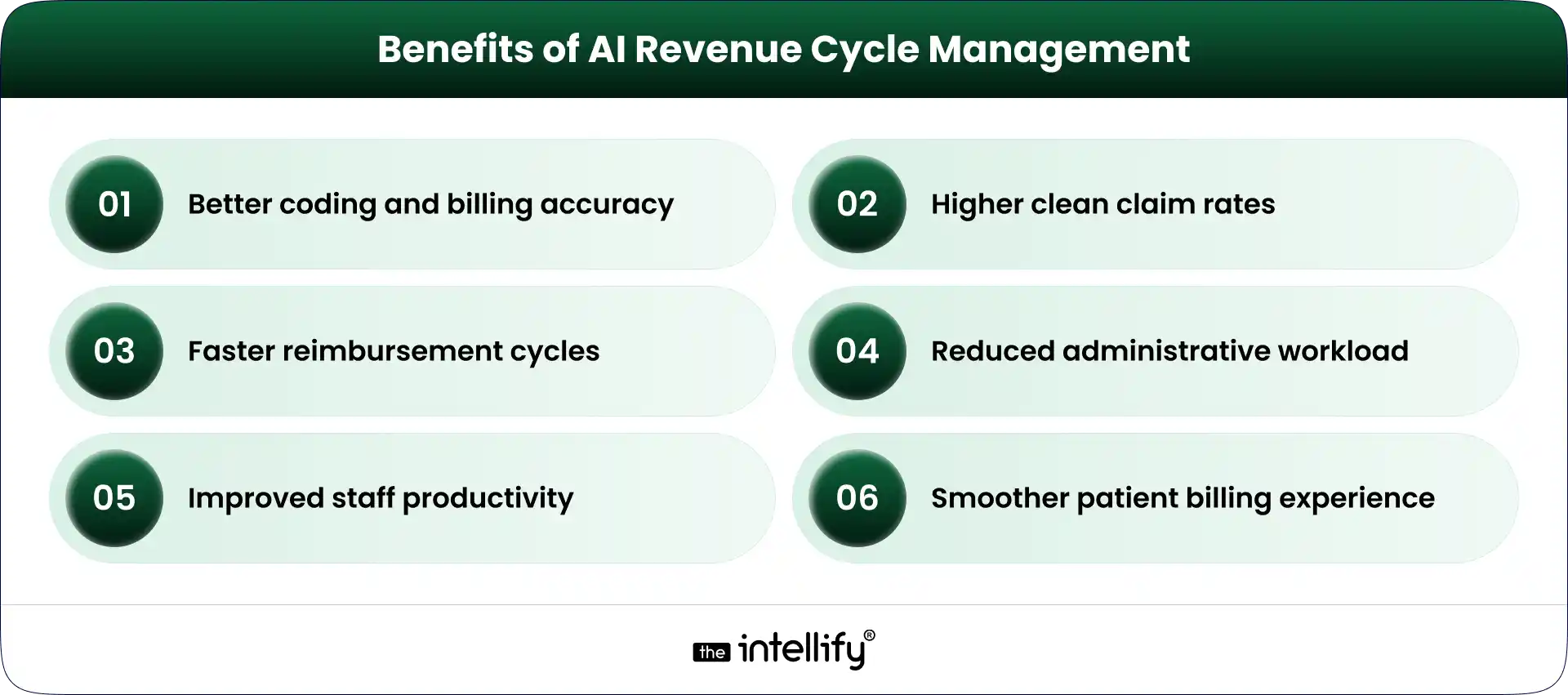
When implemented well, the benefits are hard to ignore. And not just on paper you actually start seeing the difference in daily operations. Things move faster, fewer issues pop up, and teams aren’t constantly firefighting small errors.
Better coding and billing accuracy
AI reviews clinical documentation in detail and suggests the most appropriate codes. This reduces common errors, avoids undercoding or overcoding, and helps capture revenue that might otherwise slip through.
Higher clean claim rates
With automated checks and validations before submission, claims go out more accurate the first time. This means fewer rejections and less rework for the team.
Faster reimbursement cycles
Clean claims get processed quicker. Payments come in faster, and there’s less time spent chasing pending or denied claims which, honestly, can be exhausting.
Reduced administrative workload
Routine tasks like data entry, claim scrubbing, and follow-ups are handled by AI. This frees up staff to focus on more important work instead of repetitive processes.
Improved staff productivity (less burnout too, honestly)
When the pressure of manual work reduces, teams can work more efficiently. There’s less stress, fewer bottlenecks, and overall better output without constantly feeling overwhelmed.
Stronger cash flow and financial predictability
With fewer denials and quicker reimbursements, revenue becomes more consistent. It’s easier to forecast and plan, instead of dealing with unexpected gaps.
Smoother patient billing experience
Patients receive clearer, more accurate bills. Fewer errors mean fewer disputes, and the overall experience feels more transparent and manageable for them.
Real-World Use Cases Across Healthcare Operations
Different types of organizations are already seeing results, not in a “future potential” kind of way, but in real, everyday workflows where things used to slow down or break.
Hospitals managing large volumes of claims
Large hospitals deal with thousands of claims daily. AI in healthcare helps prioritize, validate, and process these claims faster, reducing backlogs and keeping cash flow steady.
Specialty practices handling complex procedures
Specialties like cardiology or oncology often involve detailed coding requirements. AI supports accurate documentation and coding, reducing the risk of costly errors or denials.
Medical billing companies reducing turnaround times
Billing firms use AI to speed up claim processing, automate repetitive checks, and handle higher volumes without increasing staff. This improves both efficiency and client satisfaction.
Multi-location providers standardizing workflows
Organizations with multiple clinics or branches often struggle with consistency. AI brings uniform processes across locations, ensuring coding, billing, and reporting follow the same standards everywhere.
Revenue cycle teams using predictive denial analytics
Instead of reacting to denials after they happen, teams can now identify high-risk claims early. AI highlights potential issues, allowing corrections before submission saving time and effort later.
The common theme? Less guesswork, more control. And honestly, that shift alone makes a big difference in how smoothly operations run.
Measuring ROI and Operational Performance
Adopting AI sounds good, but teams still need to justify the investment. Fair enough no one’s signing off on new tech without seeing real impact. Here’s how performance is typically measured:
- Lower denial rates:- AI helps catch errors early, so fewer claims get rejected. Over time, even a small drop in denials can make a noticeable financial difference.
- Higher clean claim percentages:- More claims get approved on the first submission. This reduces rework and speeds up the entire revenue cycle.
- Reduced days in accounts receivable:- Payments come in faster, which means less money stuck in the pipeline. This directly improves cash flow.
- Increased net collections:- With better accuracy and fewer missed charges, organizations are able to collect more of what they’re actually owed.
- Time saved in coding and billing tasks:- Automation cuts down hours spent on repetitive work. Teams can handle more volume without feeling constantly overloaded.
- Improved visibility into revenue cycle performance:- AI-driven dashboards and analytics give clearer insights into where delays or issues are happening, making it easier to fix them quickly.
When these metrics improve, ROI becomes pretty clear. It’s not just about cost savings it’s about running a smoother, more predictable operation overall.
How to Choose the Right AI Revenue Cycle Management Solution
Not every solution fits every organization. Choosing the right one just needs a bit of clarity upfront.
- Start by identifying your biggest pain points: Focus on where things are breaking denials, coding errors, or delays so you solve the right problem.
- Look closely at AI medical coding and claims automation features: Make sure it handles accurate coding, claim validation, and denial prevention not just basic tasks.
- Check if it integrates with your current systems: Smooth integration with EHR and billing systems is essential to avoid workflow issues.
- Evaluate reporting and analytics capabilities: Clear dashboards help track performance and spot issues quickly.
- Review the vendor’s healthcare experience: Industry knowledge matters for compliance and real-world workflows.
- Run a pilot before scaling: Test in one area first, then expand based on results.
A rushed decision here usually doesn’t end well. Taking a little extra time upfront can save a lot of headaches later.
Best Practices for Successful Implementation
Even the best tools won’t help if implementation is rushed or unclear. Getting the basics right makes a big difference.
- Start with one area (coding or denials works well): Don’t try to fix everything at once. Focus on one high-impact area first.
- Define clear KPIs from the beginning: Set simple metrics like denial rates or claim accuracy so you know what success looks like.
- Involve all key teams early coding, billing, IT: Early collaboration avoids confusion later and keeps everyone aligned.
- Track results and adjust workflows: Monitor performance regularly and tweak processes where needed.
- Scale gradually based on what works: Expand only after you see consistent results in the initial phase.

Conclusion
AI revenue cycle management is steadily changing how healthcare organizations handle their financial operations. Not overnight but in meaningful steps.
From AI medical coding to healthcare claims automation, the improvements in accuracy, speed, and efficiency are already visible. And for organizations dealing with constant denials, delays, and admin overload, that matters a lot.
The real value lies in balance using AI to handle repetitive, error-prone tasks while teams focus on higher-value work.
Looking ahead, it’s clear that AI will continue shaping a more efficient and scalable future for healthcare revenue cycle management. And honestly for many organizations, that shift can’t come soon enough.
Frequently asked questions
1. How does AI revenue cycle management help reduce claim denials?
AI reviews claims before they are submitted and catches missing details, coding issues, or payer-specific errors. This helps healthcare organizations send cleaner claims and reduces the chances of denials.
2. Can AI medical coding really improve coding accuracy?
Yes, AI can analyze clinical notes and suggest the most appropriate medical codes. This helps coders work faster, reduces manual mistakes, and improves overall coding consistency.
3. Which parts of the revenue cycle can AI automate?
AI can support many steps in the revenue cycle, including insurance verification, prior authorization, medical coding, claims submission, denial management, payment posting, and patient billing.
4. How is AI different from traditional claims automation?
Traditional automation follows fixed rules, while AI learns from past data and patterns. This allows it to predict problems, recommend corrections, and adapt as payer requirements change.
5. Will AI replace medical coders and billing teams?
No, AI is meant to assist healthcare professionals, not replace them. It handles repetitive tasks so coders and billing teams can focus on reviewing complex cases and improving accuracy.
6. What is the future of AI in healthcare revenue cycle management?
AI is expected to make revenue cycle processes more proactive and efficient. It will help healthcare organizations predict issues earlier, reduce manual work, and improve financial performance over time.