Digital Transformation in Insurance Industry: Key Benefits, Use Cases & Future Trends

Summary:
Digital transformation is helping insurance companies move away from slow, manual processes and adopt faster, more efficient ways of working. By using technologies like automation, data, and digital platforms, insurers can improve how they manage operations and interact with customers. It makes services quicker, more accurate, and more personalized, while also helping businesses reduce costs and make better decisions. As the industry continues to evolve, adopting digital approaches is becoming key to staying competitive and meeting modern customer expectations.


Why Insurance Businesses Are Going Digital

In today’s fast-moving world, insurance companies feel the pressure to keep up and evolve. Digital transformation in insurance isn’t just a trending topic; it’s become essential for staying relevant and ahead of the competition. As customer preferences shift toward quicker, digital-first experiences, traditional methods often slow, manual, and fragmented are simply not cutting it anymore. The emergence of digital-first insurers and insurtech players is ramping up competition, urging established companies to innovate. Plus, the urgency for efficiency which is vital for managing costs and improving turnaround times, can’t be ignored.

Technology is at the heart of this evolution, particularly with data, automation, and interconnected systems driving change. In this blog, we’ll dive into the benefits of digital transformation, key use cases, and the trends that are shaping the future of the insurance landscape.


What Is Digital Transformation in the Insurance Industry?

At its essence, digital transformation in the insurance industry involves reimagining operations through innovative technologies. It encompasses much more than merely digitizing processes; it represents a comprehensive business overhaul. Here’s what you need to know:

Definition

Digital transformation means investing in technology to redefine how insurance companies interact with customers and manage their internal operations.

Digitization vs transformation

While digitization focuses on converting manual tasks into digital formats, transformation involves a holistic change in business strategies and operational practices.

Key Areas for Transformation

Important areas for transformation include:

  • Operations: Streamlining workflows to boost efficiency.
  • Customer Experience: Providing seamless, personalized services.
  • Data Management: Utilizing data for instant insights.
  • Distribution Channels: Enhancing points of contact with customers.

Process changes

Incorporating automation, integration, and real-time workflows can greatly improve service delivery and responsiveness.

Customer impact

The aim is to create smooth journeys where insurance offerings are aligned with individual customer needs.

Business impact

Implementing these changes fosters efficiency, agility, and growth, allowing firms to quickly adapt to market changes.


What Is Driving Digital Transformation in Insurance Services

Several factors are prompting insurance firms to embrace digital transformation:

  • Demand for Faster Experiences: Customers want quick, self-service options when dealing with their insurers.
  • Competition from Digital Players: The rise of digital-first insurers is pushing traditional companies to upgrade their systems.
  • Cost Efficiency Pressures: With increasing costs, efficient operations are critical for maintaining profitability.
  • Data and Analytics: More data leads to deeper insights, enabling personalized offerings and better decision-making.
  • Regulatory Compliance: Digital solutions can help ease the challenges of meeting compliance requirements.


How Digital Transformation Works in the Insurance Industry

Successfully implementing digital transformation relies on several operational components:

1. Unified Data Access: Having a centralized source of truth across various systems is vital for consistency.
2. Workflow Automation: Streamlining processes like claims management and underwriting accelerates response times.
3. Digital Platforms: Apps, portals, and dashboards improve customer engagement and support.
4. Real-Time Data Usage: Ongoing access to insights leads to quicker, data-informed decisions.
5. Continuous Improvement: Leveraging analytics creates a culture of ongoing growth and adaptation.
6. Third- Party Integrations: APIs and partnerships expand capabilities and foster innovation.


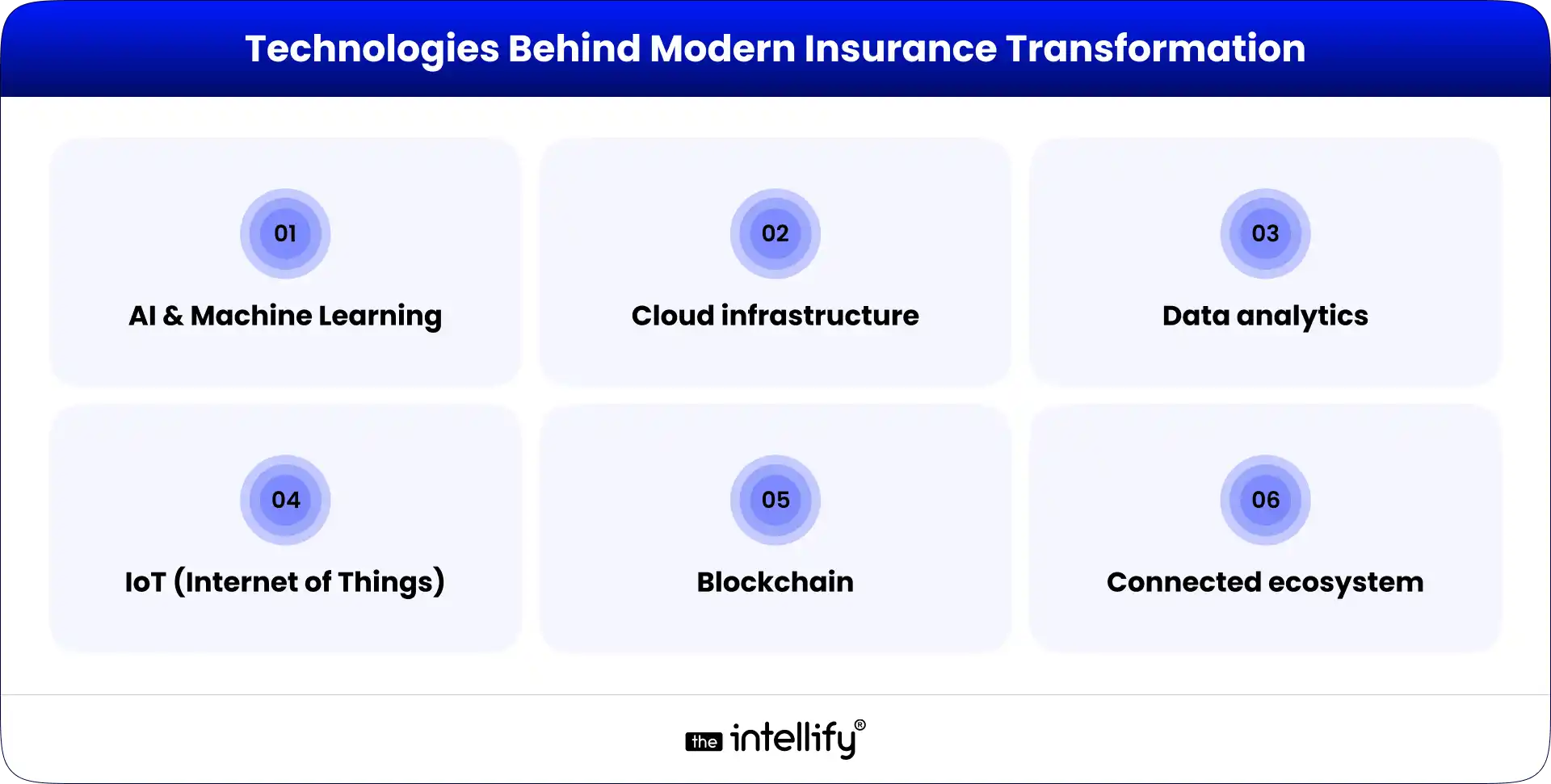
Technologies Behind Modern Insurance Transformation

Technologies Behind Insurance Transformation

A few key technologies are paving the way for digital change in insurance:

  • AI & Machine Learning: Enhancing operations, improving risk assessments, and spotting fraud.
  • Cloud infrastructure: Providing scalability and flexibility for a variety of applications.
  • Data analytics: Offering actionable insights for improved personalization and customer experiences.
  • IoT(Internet of Things): Supporting real-time and usage-based insurance models.
  • Blockchain: Ensuring secure and transparent transactions.


Key Benefits of Digital Transformation in Insurance Sector

Digital transformation offers numerous advantages, such as:

  • Faster processes: Reducing manual tasks speeds up operational efficiency.
  • Improved customer experience: Personalized interactions and quicker service boost satisfaction.
  • Better Risk Assessment: Reliable data allows for more informed underwriting decisions.
  • Cost efficiency: Streamlined processes yield significant operational savings.
  • Enhanced Fraud Detection: Advanced algorithms improve monitoring and compliance.
  • Accelerated Product Development: Integrated systems facilitate rapid innovation.


Modernize Your Insurance Operations


Where Digital Transformation Delivers Value

Digital transformation has a direct impact on various stages of the insurance value chain:

  • Customer Onboarding: Simplifying policy purchases creates a seamless entry for customers.
  • Claims processing: Automation expedites claims handling and resolution.
  • Customer support: Digital channels enhance engagement and quicken responsiveness.
  • Underwriting and pricing: Efficient data analysis provides the ability for real-time decision-making.
  • Agent and Broker Enablement: Empowered agents can offer better service with enhanced tools.


Real-World Use Cases Across the Insurance Value Chain

Let’s explore some compelling examples that highlight the effectiveness of digital transformation:

Claims & Operations

Automated claims processing: Reduces processing times while improving accuracy.
Fraud detection systems: Utilizing machine learning to identify irregularities.
Document verification: Streamlining the submission process for users.

Customer Experience

Chatbots and virtual assistants: Offering 24/7 support for customer questions.
Self-service portals: Allowing customers to manage their policies and claims independently.
Faster onboarding journeys: Minimizing wait times and simplifying the policy initiation process.

Product Innovation

Telematics-based insurance: Implementing usage-based pricing models based on driving behavior.
Personalized policy recommendations: Crafting options tailored to individual profiles.
Usage-based insurance models: Setting premiums based on actual usage rather than generalized estimates.


Business Impact of Digital Transformation for Insurance Companies

The outcomes of digital transformation are notable:

  • Reduced operational costs: Greater efficiency leads to lower expenses.
  • Faster turnaround times: Quick service enhances customer satisfaction.
  • Higher customer retention: Happy customers are more likely to remain loyal.
  • New revenue opportunities: Innovations can pave the way for fresh business models and offerings.
  • Data-driven decision-making: Leveraging data facilitates informed planning and strategies.


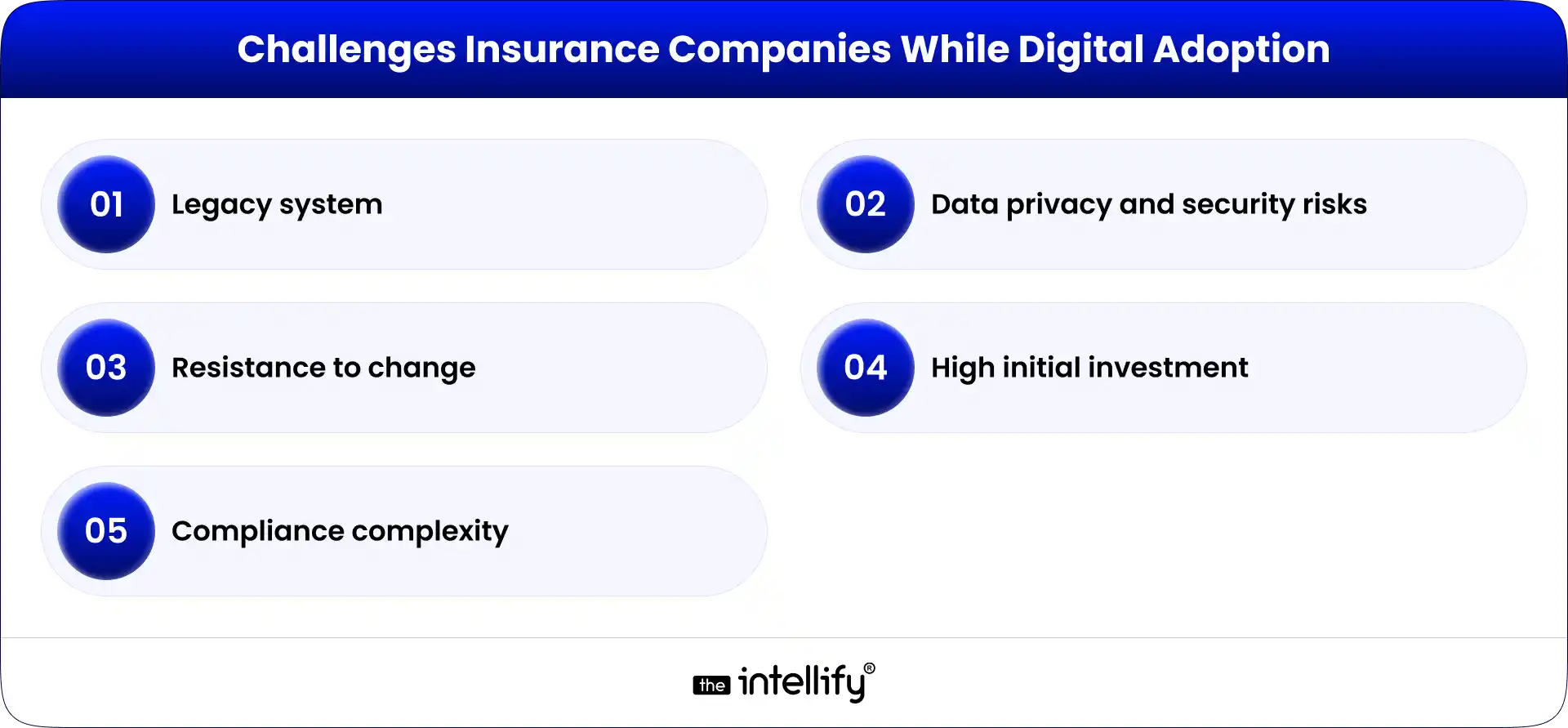
Challenges Insurance Companies Face During Digital Adoption

Challenges Insurance Companies While Digital Adoption

Even with the many benefits, insurance companies face a range of challenges during their digital journey:

  • Legacy system: Older technology can resist integration, complicating progress.
  • Data privacy and security risks: Safeguarding customer data is paramount.
  • Resistance to change: Some employees might be hesitant to adapt, slowing transformation efforts.
  • High initial investment: The upfront costs of new technologies can feel overwhelming.
  • Compliance complexity: Navigating regulatory requirements can be daunting.


How to Implement Digital Transformation in Insurance

Implementing a successful digital transformation strategy involves more than just adopting new tools. Insurance companies need the right partner with expertise in digital transformation and insurance development services to ensure smooth implementation and long-term success. Key factors to consider include:

  • Clear roadmap and priorities: Setting a structured approach to your transformation journey.
  • Customer-first approach: Keeping customer needs and expectations at the forefront throughout the process.
  • Scalable technology: Opting for solutions that can grow alongside your business.
  • Team upskilling: Equipping staff with the necessary skills for thriving in a digital world.
  • Strategic partnerships: Collaborating with tech providers for expertise and innovative solutions.


Emerging Trends Shaping the Future of Insurance

The insurance industry is moving toward thrilling opportunities:

1. AI-driven Predictive Insurance: Using data to anticipate and prepare for future claims.
2. Hyper-personalized policies: Custom offerings grounded in thorough customer insights.
3. Embedded insurance models: Seamlessly integrating insurance into established customer journeys.
4. Fully digital insurance platforms: Facilitating all interactions online for maximum convenience.
5. Real-time data usage: Utilizing data from IoT devices to dynamically adjust policies.


Conclusion:

To sum it up, digital transformation in the insurance industry isn’t just about technology, it’s about rethinking how businesses connect with customers while optimizing operations. Early adaptation is vital to capitalizing on digital opportunities, as it dramatically affects long-term success and competitiveness.

By embracing digital transformation, insurance companies can elevate customer satisfaction, streamline workflows, and position themselves for future growth. The path to innovation starts now let’s seize the opportunities that lie ahead!


Insurance Digital Transformation Services


Frequently asked questions

1. Why are insurance companies focusing more on digital transformation now?

Customers today expect quick responses, online access, and smooth experiences. Traditional systems struggle to keep up with this, so insurers are moving towards digital solutions to stay competitive and meet these expectations.

2. How does digital transformation make insurance processes faster?

It reduces manual work by automating tasks like claims handling, underwriting, and approvals. This not only speeds up operations but also reduces delays and improves overall efficiency.

3. Can digital transformation improve the claims process?

Yes, it makes claims faster and more transparent. Customers can submit and track claims online, while automation helps insurers process them quickly with fewer errors.

4. What role do mobile apps play in digital transformation in insurance?

Mobile apps give customers easy access to services like buying policies, renewing plans, or filing claims. They make the entire experience more convenient and accessible anytime, anywhere.

5. Can traditional insurance companies adapt to digital transformation?

Yes, many companies start small by digitizing specific processes like claims or customer support. Over time, they gradually expand and build a more complete digital system.

6. Does digital transformation help in reducing fraud in insurance?

Yes, advanced technologies can detect unusual patterns and flag suspicious activities early. This helps insurers prevent fraud and improve security.

7. How does digital transformation improve customer experience in insurance?

It makes services faster, simpler, and more personalized. Customers can interact easily, get quick responses, and access everything online without unnecessary delays.

Top AI Trends in Healthcare: Transforming Digital Health in 2026

Summary:
AI trends in healthcare are helping systems become smarter and more data-driven instead of just digital. They support early disease detection, personalized treatments, and remote patient monitoring. This is improving how care is delivered while making hospital operations more efficient. AI also helps reduce the workload on healthcare providers and improves overall patient experience. Despite some challenges, it is becoming an important part of modern, connected healthcare systems.


Why AI is Becoming the Driving Force Behind Digital Health

Healthcare isn’t just going digital anymore; it’s becoming smarter. As technology keeps advancing, artificial intelligence (AI) is reshaping the healthcare landscape in ways we never imagined. With hospitals facing increasing demands to enhance speed, accuracy, and overall patient care, AI is proving to be a crucial ally in bridging the gap between vast amounts of data and actionable decision-making.

In this blog, we’ll delve into AI trends in healthcare that are actively revolutionising digital health. From predictive analytics to personalised treatment plans, these trends are dramatically transforming our approach to healthcare.


Digital Health Transformation in Modern Healthcare Systems

So what does “digital health” really mean today? It goes beyond just having software and applications; it’s about establishing a connected, data-driven healthcare system that genuinely meets patient needs. Modern healthcare systems aren’t just digitizing existing processes; they’re harnessing technology to create a more responsive, integrated, and efficient environment.

Patients today have higher expectations regarding speed, access, and personalized care. They want more than just scheduled visits; they’re looking for tailored health experiences. Digital transformation alone isn’t sufficient adding a robust AI layer is essential to fully leverage the potential of this shift.


The Growing Role of AI in Healthcare Industry

The surge of data in healthcare from electronic health records (EHRs) to wearables and diagnostic tools is monumental. Yet, traditional human-led systems can no longer manage this volume alone. AI isn’t here to replace healthcare professionals; it’s designed to support them. It serves as the backbone of modern healthcare systems, delivering insights and analytics that lead to better patient outcomes.

Today, AI is being used across multiple touchpoints in healthcare, from analyzing patient records to assisting in diagnosis and treatment planning. This shift is helping healthcare professionals rely more on data-backed insights rather than assumptions.


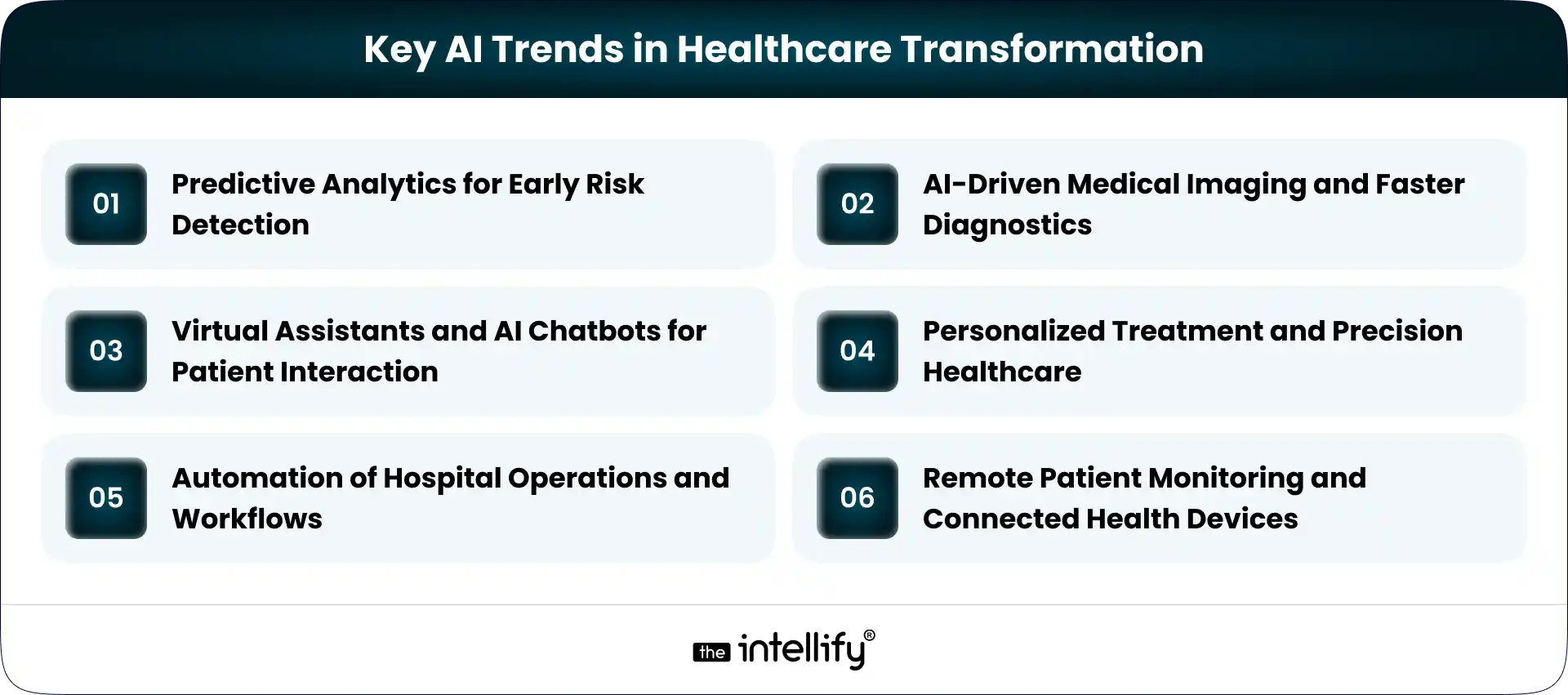
Key AI Trends in Healthcare Driving Digital Health Transformation

Key AI Trends in Healthcare Transformation

Predictive Analytics for Early Risk Detection

AI’s knack for identifying health risks before symptoms escalate is truly transformative. By analyzing patterns in patient data, healthcare providers can implement preventive measures rather than waiting for issues to arise. This proactive approach is significantly beneficial in chronic disease management and helps alleviate the burden on hospitals.

For example, AI can flag early signs of conditions like heart disease or diabetes based on patient history and lifestyle patterns. This helps hospitals reduce emergency cases and manage patient care more effectively.

AI-Driven Medical Imaging and Faster Diagnostics

AI is stepping up medical imaging, enhancing accuracy in scans like X-rays and MRIs while cutting down on diagnosis time and reducing human error. This assists specialists, offering faster insights that empower them to make well-informed decisions.

This not only improves accuracy but also reduces the workload on radiologists, allowing them to focus on complex cases. Faster diagnosis also means quicker treatment decisions for patients.

Virtual Assistants and AI Chatbots for Patient Interaction

AI chatbots are stepping in to boost patient engagement by delivering round-the-clock support without adding to staff workloads. From scheduling appointments to providing basic consultations, these tools enhance access to healthcare services and allow healthcare professionals to concentrate on critical tasks.

This improves patient convenience by reducing waiting times and makes basic healthcare support available anytime. It also reduces the pressure on hospital front desks and support teams.

Personalized Treatment and Precision Healthcare

AI dives into patient history, genetics, and lifestyle to create tailored treatment plans. This results in better outcomes with fewer unnecessary treatments, ushering in a more efficient, patient-centered healthcare experience.

Automation of Hospital Operations and Workflows

Thanks to AI, hospitals can automate mundane manual tasks like paperwork and administrative duties, substantially reducing the administrative load. This allows healthcare staff to dedicate more time to patient care, ultimately boosting the quality of service.

Automation also reduces the chances of manual errors in billing and records, while helping hospitals manage costs more efficiently over time.

Remote Patient Monitoring and Connected Health Devices

Wearables and IoT devices enable constant health monitoring, providing healthcare professionals with real-time alerts and updates about patients’ conditions. This capability leads to better management of long-term patients and those recovering post-treatment.

This is especially helpful for elderly patients and those with chronic conditions who need regular monitoring without frequent hospital visits.


AI for Healthcare operations


Real-World Applications of AI in Digital Healthcare

Several real-world applications are illustrating AI’s profound impact on digital healthcare:

  • AI Powered Telehealth Platform: These systems are making remote consultations more efficient and accessible. These platforms allow patients to consult doctors remotely, improving access to care.
  • Smart diagnostic systems used in hospitals: Hospitals are increasingly relying on AI for accurate diagnostic assistance. AI in healthcare helps doctors detect diseases faster and with better accuracy.
  • AI in drug discovery and clinical research: AI can shift through vast datasets, accelerating the drug discovery process. AI speeds up research by analyzing large datasets in less time.
  • Intelligent ICU systems: Utilizing AI, these systems monitor patients and enhance emergency response times. These systems monitor patients continuously and alert staff instantly in emergencies.


Impact of AI on Healthcare Businesses and Providers

Incorporating AI is enabling better resource management while alleviating operational pressures on healthcare providers. This allows them to scale services without significantly increasing costs, maintaining a competitive edge in the ever-evolving digital healthcare landscape. Higher patient satisfaction translates to increased trust and retention rates.

AI also helps healthcare organizations make better strategic decisions based on data insights and supports long-term scalability as patient demand grows.


Challenges in Adopting AI for Digital Health Transformation

While the advantages are evident, various challenges still need addressing:

1. Data Privacy and Security Concerns: Safeguarding patient data is critical, and concerns over data security can complicate AI adoption.
2. Integration Issues: Existing legacy systems might clash with new AI solutions, leading to compatibility challenges.
3. High Intial Cost and Technical Complexity: The upfront costs for AI can be quite significant, which can deter some organizations.
4. Resistance to Change: Staff who are accustomed to traditional workflows might resist adopting new processes.


How to Successfully Implement AI in Healthcare Systems

To achieve successful AI integration, consider these strategic steps:

1. Start with clear, Pratical Use Cases: Target specific areas rather than trying to implement everything all at once.
2. Ensure Clean and Accessible Data: High-quality data is vital for the effectiveness of AI.
3. Choose Scalable and Flexible AI Solutions: Invest in technology that can adapt and grow with your organization.
4. Collaborate with Experienced Technology Partners: Working with experts will help ensure a smoother implementation process.
5. Train Teams for Digital Workflows: Proper training ensures that staff can effectively utilize new systems.


What’s Next for AI in Healthcare

We can anticipate an increasing use of predictive and preventive healthcare models that will further connect ecosystems involving hospitals, patients, and devices. As accuracy, speed, and personalization continue to improve, AI will undoubtedly become an integral part of every healthcare system.

As AI continues to evolve, we can expect more advanced and seamless integration into everyday healthcare processes, making it a standard part of modern healthcare systems.


AI solutions for Healthcare


Conclusion:

AI in healthcare is not just a supporting player in digital transformation; it’s at the forefront of driving it. Healthcare is evolving to be smarter, faster, and more patient-centric. Organizations that adapt early will help shape the future of healthcare, providing high-quality care while streamlining operations. Embracing AI isn’t just a choice anymore; It’s a necessity for any healthcare provider aiming for success.


Frequently asked questions (FAQs)

1. What makes AI a key driver behind digital health transformation today?

Digital systems alone manage data, but AI turns that data into useful insights. This ability to predict risks and support decisions is what makes AI central to real transformation in healthcare.

2. How is AI improving decision-making in modern healthcare systems?

AI analyzes large volumes of patient data in seconds, helping doctors make faster and more informed decisions. It reduces guesswork and supports better clinical outcomes without replacing human expertise.

3. In what ways are AI-driven healthcare solutions improving operational efficiency?

AI automates routine tasks like scheduling, billing, and data entry, reducing administrative workload. This allows healthcare teams to focus more on patient care while improving system efficiency.

4. How do AI trends support the shift toward personalized healthcare?

AI studies patient history, behavior, and medical data to suggest tailored treatments. This leads to more effective care plans and reduces the chances of unnecessary or ineffective treatments.

5. Why is integrating AI into existing healthcare systems still a challenge?

Many healthcare systems rely on outdated infrastructure, making integration complex. Along with that, concerns around data security and cost slow down adoption despite clear benefits.

6. How can healthcare organizations scale AI adoption without disrupting operations?

They can start with focused use cases like diagnostics or workflow automation and expand gradually. This step-by-step approach reduces risk and helps teams adapt more smoothly.

7. How are AI trends shaping the next phase of digital health transformation?

AI is pushing healthcare toward more connected, predictive, and patient-focused systems. Over time, it will become a standard layer across all digital healthcare solutions

How Digital Transformation in Healthcare Is Shaping the Industry’s Future

Summary:
Digital transformation in healthcare is changing how systems, data, and processes work together. It is helping improve coordination, reduce delays, and make operations more efficient. Healthcare organizations are using connected technologies and data to manage services better and respond faster. While there are challenges, many are moving forward step by step to improve their systems. Overall, it is shaping a more connected and efficient future for the healthcare industry.

Digital transformation in healthcare is changing how systems, data, and processes work together. It is helping improve coordination, reduce delays, and make operations more efficient. Healthcare organizations are using connected technologies and data to manage services better and respond faster. While there are challenges, many are moving forward step by step to improve their systems. Overall, it is shaping a more connected and efficient future for the healthcare industry.

It is not just improving how healthcare works today, but also shaping how systems will function in the coming years. As the industry evolves, digital transformation is becoming a key part of long-term healthcare growth.


How Healthcare Systems Are Becoming More Connected

In the past, healthcare often relied on outdated manual processes and isolated systems. Departments worked in silos, resulting in gaps in coordination and efficiency. As a consequence, managing the ever-growing sea of patient and operational data could feel like an uphill battle, leading to frustration for both providers and patients alike.

Nowadays, the demand for interconnected systems is surging. Healthcare providers are starting to understand that the secret to enhancing service delivery lies in building systems that foster communication and collaboration.

This level of connectivity reduces repeated work and improves the overall flow of services. It also helps different parts of the system work together more smoothly.


Digital Transformation in Healthcare as the New Foundation

Healthcare Digital Transformation

Digital transformation in healthcare isn’t just about switching to digital formats; it represents a fundamental change in how healthcare systems operate. This transformation aims to connect people, processes, and data into a smooth, cohesive flow.

  • Reducing operational gaps: Automation of workflows and system integration helps minimize delays and miscommunications, enabling better care delivery.
  • Modern foundation: This transformation forms the solid groundwork on which today’s healthcare systems are built, enhancing patient experiences and operational efficiencies.


What makes Digital Transformation Essential in Healthcare

The rapid pace of change in healthcare brings several challenges:

  • Managing Data: The amount of patient and operational data continues to grow. Digital transformation enables healthcare organizations to manage and harness this data for improved decision-making.
  • Faster Coordination: As healthcare teams expand, quick coordination across various systems becomes crucial. Digital tools offer real-time data sharing, ensuring everyone stays aligned.
  • Meeting Expectations: Today’s patients expect smooth, accessible services. Digital transformation equips healthcare providers to meet these rising expectations.

It also helps bring more consistency in how services are delivered across different systems. As operations grow, managing complexity without digital support becomes difficult.


Where Digital Healthcare Transformation Is Creating Real Impact

Digital healthcare transformation is delivering tangible benefits across the industry:

  • Improved coordination: Departments and teams can now communicate effectively, fostering trust and collaboration.
  • Faster Communication: Instant messaging systems and data-sharing platforms cut down on waiting times and speed up decision-making.
  • Efficient Workflows: Routine processes are now more structured, giving healthcare professionals more time to focus on what matters patient care.

It also improves visibility across systems, helping teams make quicker and more informed decisions.


Technologies Behind Digital Transformation in Healthcare Solutions

Several cutting-edge technologies drive the digital transformation in healthcare solutions:

  • AI: This technology speeds up analysis and supports quicker decision-making.
  • Cloud Systems: These enable secure access to and sharing of data.
  • Connected Devices: They allow for continuous monitoring of patient health.
  • Data Platforms: These help organize and simplify vast amounts of information.
  • Integration Tools: They link multiple systems, facilitating smooth operations.

Together, these technologies form the backbone of a transformed healthcare landscape, paving the way for smarter, more efficient practices.


Digital transformation Solutions


How healthcare Operations Are Being Reshaped Internally

Internally, healthcare operations are prioritizing efficiency:

  • Reduction in manual work: Automation takes over routine tasks, freeing staff to focus on vital issues.
  • Faster process Handling: Fewer bottlenecks in workflows enable healthcare facilities to quickly respond to patient needs.
  • Better Use of Resources: By optimizing staff time and hospital resources, organizations can provide improved care.
  • Improved Accuracy: Less manual intervention means fewer mistakes, boosting overall service quality.

This allows healthcare organizations to respond faster to changing needs and improve overall service delivery.


The Expanding Role of Data in Healthcare

Gone are the days when data was merely stored away. Now, it plays a vital role in everyday operations:

  • Real Time Access: Quick access to data enhances decision-making and planning processes.
  • Better Resource Management: Data analytics empower organizations to allocate staff and materials more effectively.
  • Connected Systems: A solid data strategy fosters informed systems that can dynamically respond to patient needs.

Over time, this is helping healthcare systems move toward more planned and proactive decision-making.


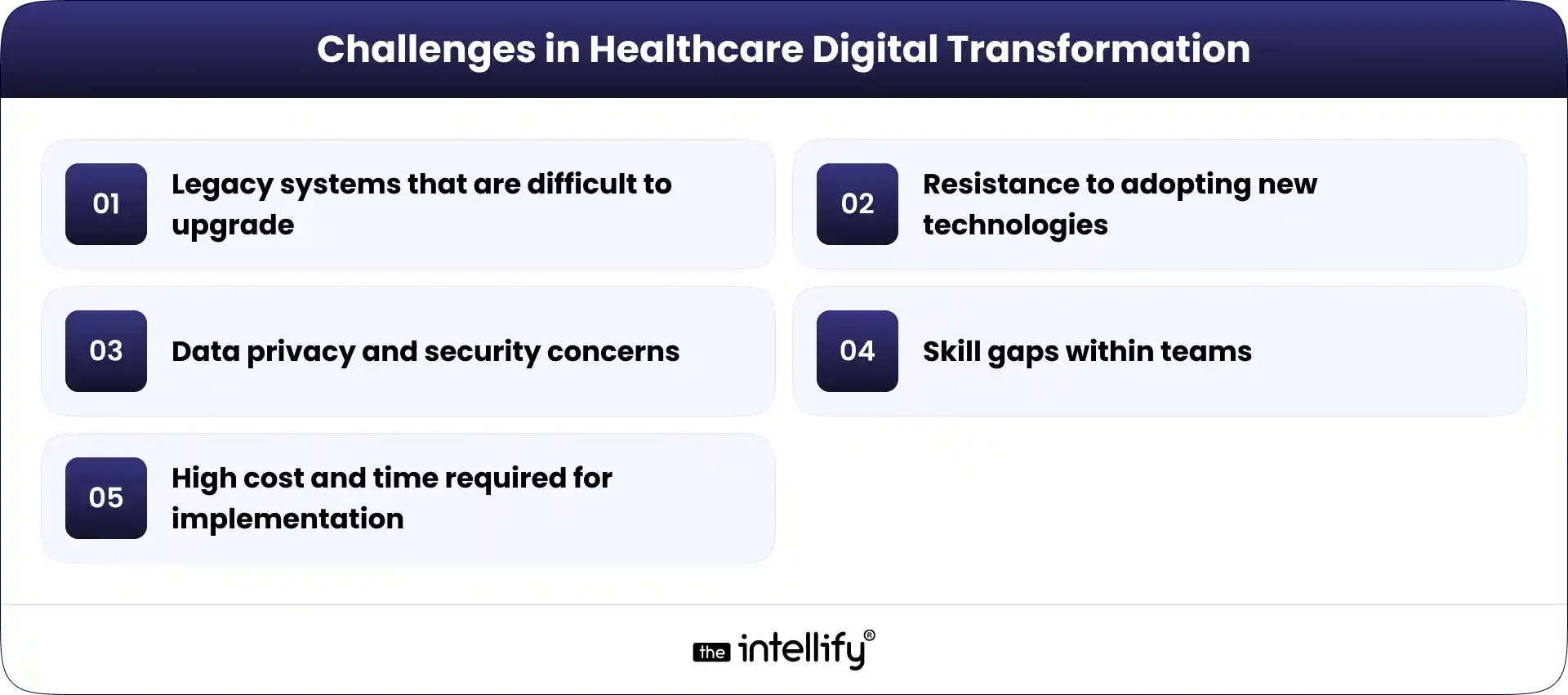
Challenges in Adopting Digital Transformation in Healthcare

Challenges in Healthcare Digital Transformation

Yet, the path to adopting digital transformation isn’t without its hurdles:

  • Legacy Systems: Many organizations struggle with outdated systems that aren’t easy to upgrade.
  • Privacy and Security Concerns: Safeguarding sensitive patient data is crucial and can slow technology adoption.
  • Resistance to Change: Some staff may be hesitant to embrace new technologies, which can stall progress.
  • Skill Gaps: Existing teams might lack the necessary skills for implementation, requiring additional training.
  • Implementation Costs: Upgrading systems can be costly and time-consuming, making many organizations hesitant to proceed.

These challenges can slow progress, but with the right approach, they can be managed over time.


How Healthcare Organizations Are Improving Their Systems

Healthcare organizations are cautiously progressing with strategies to enhance their frameworks:

  • Gradual adoption: Instead of a complete overhaul, many are choosing incremental improvements that minimize disruption.
  • Training Initiatives: Investing in staff training ensures teams are ready to tackle new systems effectively.
  • Scalable Solutions: Organizations focus on flexible technology that can adapt as their needs grow.
  • Partnerships with Tech Providers: Teaming up with experienced technology providers can lead to better outcomes.
  • Long Term Focus: Emphasizing ongoing improvements and results is crucial for sustainable transformation.

The focus is on making systems more stable, reliable, and easier to manage in the long run.


Real-World Applications in Healthcare Services

Digital transformation in healthcare services is already showing its worth in various areas:

  • Online Consultations: Telehealth is enhancing patient access to healthcare services.
  • Digital Health Records: Streamlined management of information reduces paperwork and makes care more efficient.
  • Remote Monitoring: Wearable tech supports continuous patient care, boosting health outcomes.
  • Automation: Routine tasks, from scheduling to billing, are increasingly automated to cut delays.
  • Better Coordination: Enhanced communication tools ensure smooth service across all touchpoints.

These applications are already changing how healthcare services are delivered and experienced.


How Healthcare Systems Are Changing for the Future

The future of healthcare is on a transformative path:

Connected Systems: Improved integration offers a more holistic view of patient care.

Faster Service Delivery: Automation and streamlined processes ensure prompt care.

Increased Automation: Smart tools and technologies are set to reshape daily operations further.

Improved Coordination: A more connected infrastructure will facilitate stronger relationships among providers.

Healthcare systems are expected to become more proactive rather than reactive in handling needs.


What Healthcare Organizations Need to Focus on Next

Looking ahead, healthcare organizations should concentrate on:

Scalability: Designing systems that can adapt to future challenges.

Digital Strategy: Making digital transformation a cornerstone of long-term planning.

Continuous Improvement: Prioritizing process refinement over merely implementing new tools.

Alignment of Teams: Ensuring that people, processes, and technology work in harmony.

Staying Adaptable: Keeping an open mind toward new technologies and changing patient expectations.

The goal is to build systems that can support continuous change and future growth.


Healthcare digital transformation solutions


Conclusion:

Digital transformation is no longer a choice; it’s central to how the healthcare industry operates. As organizations embrace these changes, they’re paving the way for more connected, efficient systems that ultimately benefit everyone from healthcare providers to patients.

The journey is just beginning, and healthcare organizations need to remain flexible and proactive to stay relevant in an ever-evolving landscape. By effectively implementing these changes, the future of healthcare looks bright, buoyed by innovation and progress.


Frequently Asked Questions

1. Why do traditional healthcare systems face limitations?

They depend on manual work and disconnected systems, which slows down processes. This makes it harder to manage data, coordinate teams, and deliver services efficiently.

2. How do connected systems improve healthcare services?

They allow information to move smoothly between departments and teams. This improves coordination, reduces errors, and helps deliver services faster.

3.. What changes do healthcare teams notice after going digital?

Teams experience faster workflows and less dependency on paperwork. They also see better accuracy and smoother coordination across different departments.

4. What are the common challenges in digital transformation for healthcare?

Many organizations struggle with outdated systems and data security concerns. They also need time and training to help teams adapt to new ways of working.

5. What should healthcare organizations focus on moving forward?

They should focus on building flexible systems that can adapt over time. Continuous improvement in processes and team readiness is also important for long-term success.

Virtual Reality in E-commerce: The Future of Immersive Online Shopping

Summary:
Virtual reality is making online shopping more engaging by helping customers explore products in a more real and interactive way. Instead of guessing from images, people can see details, try items virtually, and feel more confident before buying. This reduces confusion and returns while improving overall satisfaction. As technology grows, more businesses are using VR to create better shopping experiences and stand out in the competitive e-commerce market.


The Shift Toward Immersive Digital Commerce

E-commerce has moved far beyond simple product listings. Today, customers expect more than just images and descriptions they want to explore products, understand them clearly, and feel confident before making a purchase.

This shift is driven by changing user behavior. People are used to interactive digital experiences and expect the same when shopping online. The growing demand for “try-before-you-buy” has made traditional e-commerce feel limited in many cases.

Virtual Reality is emerging as a strong solution to bridge this gap. It brings interaction, clarity, and a more realistic feel to online shopping, making the overall experience more engaging and reliable.


Understanding VR in Ecommerce Landscape

Virtual Reality in e-commerce creates a digital environment where users can explore products more naturally and interactively. Instead of just scrolling through product pages, users can move through virtual spaces and interact with items.

It’s useful to understand the difference between similar technologies. VR offers a fully immersive experience, AR enhances the real world with digital elements, while basic 3D visualization only improves how a product looks on screen.

With the availability of both VR headsets and browser-based experiences, VR is becoming more accessible. Businesses are now using it to build virtual stores, showrooms, and interactive product demonstrations.


Where Traditional E-commerce Falls Short

Traditional e-commerce is convenient, but it often lacks depth in how products are presented. Customers rely on images and descriptions, which don’t always give a complete understanding of the product.

There is also a lack of interaction. Users cannot touch, try, or explore products in a meaningful way, which creates uncertainty during decision-making. This often leads to hesitation, abandoned carts, and higher return rates.

These limitations show why e-commerce needs a more interactive and confidence-driven approach, especially for products where visualization matters.


The Rise of Immersive Shopping Experiences

VR in online shopping

What immersive shopping looks like

Immersive shopping allows users to explore virtual stores, move through spaces, and interact with products in real time. This creates a more natural and engaging way to browse compared to static product pages.

Why it matters for users

When customers can explore products more deeply, they gain better clarity before buying. This reduces confusion and helps them make more confident decisions without second-guessing.


Practical Use Cases of Virtual Reality in E-commerce

Virtual try-ons

Customers can try products like clothing or eyewear virtually, helping them understand fit and appearance before buying. This reduces guesswork and improves satisfaction.

Product exploration

Users can view products from multiple angles and examine details closely. This gives a clearer understanding compared to static images.

Virtual showrooms

Industries like furniture, real estate, and automotive use VR to let users explore spaces or products in a realistic setting, even from a remote location.

Interactive demonstrations

Complex products can be explained visually through interaction, making it easier for customers to understand features without relying only on text.


Custom VR App Development


Why Brands Are Investing in Virtual Reality Development

Improved engagement and conversions

Interactive experiences keep users engaged for longer, which increases the chances of conversion. As businesses invest in VR app development, it becomes easier for customers to explore products clearly and feel more confident about their choices.

Reduced returns

When expectations match reality, customers are less likely to return products. This helps businesses reduce operational costs.

Stronger brand positioning

Offering immersive experiences helps brands stand out and creates a more memorable impression compared to traditional e-commerce.


Virtual Reality Applications Across E-commerce & Retail Industry

VR Applications Across Retail Industry

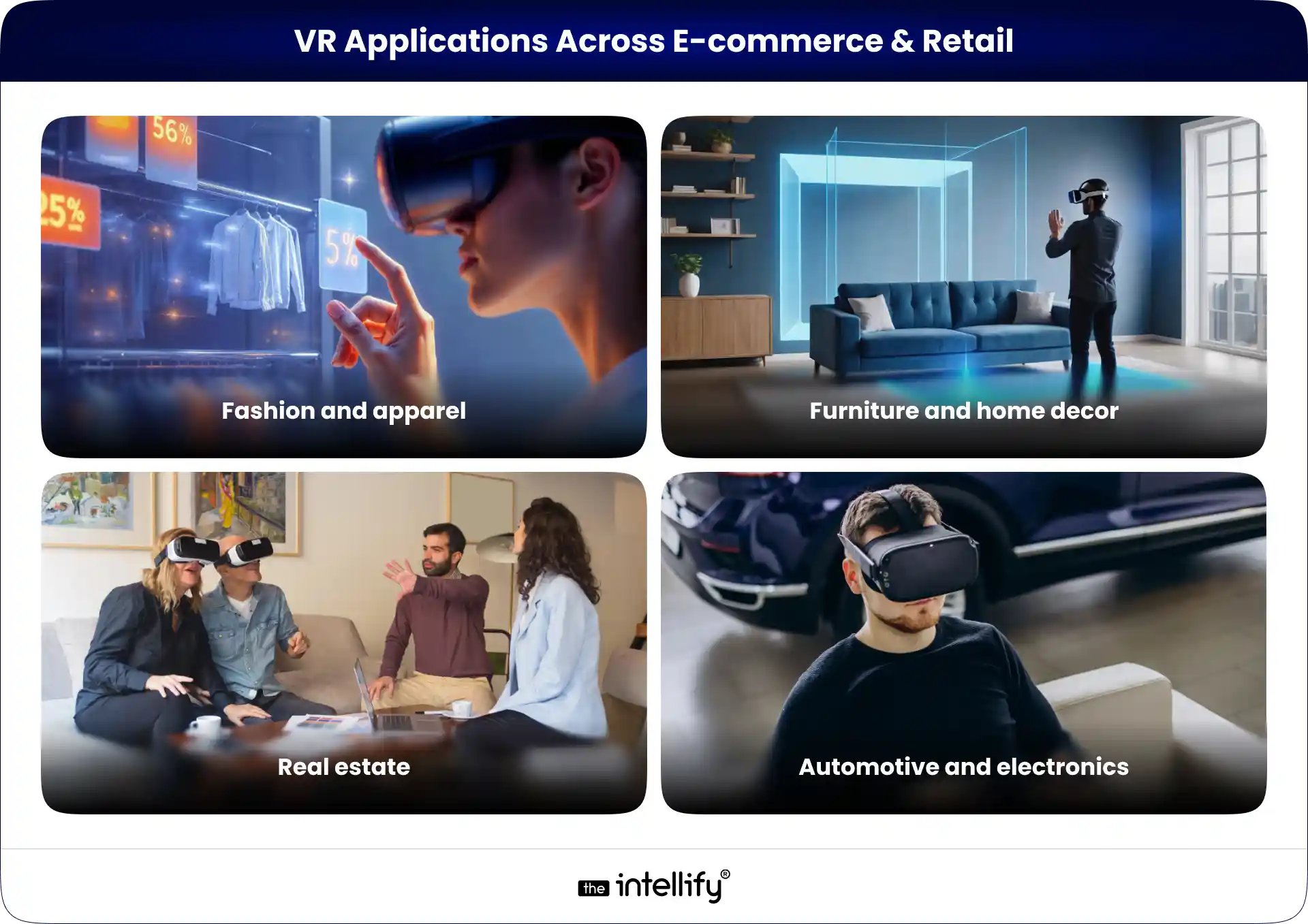
1. Fashion and apparel: Virtual fitting rooms allow users to try outfits digitally, helping them choose styles and sizes more confidently before making a purchase.

2. Furniture and home decor: Customers can visualize how products will look in their own space, making it easier to decide on size, placement, and design.

3. Real estate: Virtual tours allow users to explore properties remotely, saving time while still giving a realistic understanding of the space.

4. Automotive and electronics: Customers can explore product features, customization options, and details in an interactive way, improving their overall understanding.


Enhancing Customer Experience Through VR

  • Better product understanding: Interactive exploration helps customers see products in detail, reducing confusion and improving clarity before buying.
  • More confident decisions: When users feel sure about their choices, they are more likely to complete purchases without hesitation.
  • Stronger engagement: Immersive experiences create a deeper connection with products, making the shopping journey more enjoyable and memorable.


Challenges in Adopting VR for Ecommerce

Adopting Virtual Reality in e-commerce comes with a few practical challenges. One of the main concerns is the cost involved in creating high-quality virtual environments and 3D assets. Businesses need to invest time and resources to build experiences that actually add value.

Another challenge is accessibility. While VR is growing, not all users have access to VR devices, and some may not be familiar with how to use them. This can limit adoption in the early stages.

There are also technical considerations, such as integrating VR with existing e-commerce platforms and maintaining performance across devices. Businesses need to ensure that the experience remains smooth and user-friendly.


Future Trends in Immersive Commerce

The future of e-commerce is clearly moving toward more immersive and interactive experiences. Virtual Reality is expected to play a major role, especially when combined with technologies like AI.

Personalized virtual shopping journeys will become more common, where users see products and experiences tailored to their preferences. At the same time, concepts like the metaverse are opening new possibilities for shared and social shopping environments.

As technology becomes more accessible and affordable, more businesses will start adopting VR. Over time, immersive commerce will become a natural part of how people shop online.


Getting Started: A Practical Approach for Businesses

  • Start with focused use cases: Instead of building everything at once, businesses should begin with specific areas like product visualization or virtual demos where VR can add clear value.
  • Choose the right approach: Depending on the audience and product type, businesses can adopt VR, AR, or a combination of both to create the best experience.
  • Measure and improve: Tracking engagement, conversions, and customer behavior helps businesses understand what works and improve the experience over time.


VR App Development Solutions


Conclusion

Virtual Reality is reshaping how people experience online shopping by making it more interactive, clear, and engaging. Instead of relying only on images and descriptions, customers can now explore products in a way that feels closer to real life. This shift helps reduce uncertainty and allows users to make more confident decisions.

As e-commerce continues to evolve, the focus is shifting from convenience to creating meaningful experiences. Virtual Reality may not completely replace traditional e-commerce, but it will play a significant role in shaping its future. Businesses that start adapting to immersive technologies today will be better prepared to meet changing customer expectations tomorrow.


Frequently Asked Questions (FAQs)

1. How is virtual reality different from AR in e-commerce?

Virtual reality creates a fully immersive shopping environment where users can explore stores and products in a simulated space. AR, on the other hand, adds digital elements to the real world, like placing furniture in your room using a phone.

2. Do customers really use VR for online shopping today?

Yes, but it’s still growing. Some brands already offer virtual showrooms and try-on experiences, especially in fashion, furniture, and real estate. Adoption is increasing as technology becomes more accessible.

3. Can virtual reality actually improve conversion rates in e-commerce?

It can. When users can explore products in detail and feel more confident about what they’re buying, they’re more likely to complete a purchase and less likely to return it later.

4. What types of products benefit most from VR shopping experiences?

Products that require visualization or physical context work best like clothing, furniture, cars, and real estate. These are items where customers usually want to “see” before buying.

5. Is virtual reality only for big e-commerce brands?

Not anymore. While early adoption was mostly by large companies, smaller businesses can now start with focused VR features or hybrid experiences without a huge investment.

6. How does VR reduce product returns in e-commerce?

By giving customers a clearer understanding of size, design, and fit before buying. When expectations match reality, return rates naturally go down.

Customer Experience Automation Platform: Automate Work & Accelerate Experience

Summary:
Customer Experience Automation helps businesses handle customer interactions faster and more efficiently by combining AI and workflow automation. This blog explains how automation works across support, engagement, and service processes, along with its key capabilities, real-world use cases, and business impact. It also covers implementation steps, platform selection criteria, and emerging trends, helping businesses build scalable and consistent customer experience systems without increasing operational complexity.


Customer Experience Automation: A Practical Overview for Modern Businesses

Customer experience automation isn’t as complex as it sounds. In practical terms, it’s about making customer interactions faster and smoother without depending entirely on manual effort.

When a customer reaches out, the system understands the request and either responds instantly or triggers the next step. That’s the foundation.

Automating tasks vs automating experiences

There’s a clear difference here. Automating tasks means handling individual actions like sending emails or updating tickets. Automating experiences connects those actions into a complete journey from the first interaction to resolution and follow-ups.

That shift is where real value comes in.

Instead of disconnected tools, businesses start linking support systems, communication channels, and backend operations. Everything works together, even if the customer doesn’t notice it directly.

Role across the customer journey

Automation supports different stages without breaking the flow. Before a purchase, it answers questions quickly. During usage, it guides and assists. After interactions, it resolves issues and collects feedback.

It’s less about speed alone and more about removing friction completely.


Why Customer Experience Automation Is Becoming a Business Priority

This shift has been building for a while.

Customers expect quick responses and consistent experiences. They don’t want to repeat themselves or wait across channels. Whether it’s chat, email, or apps everything should just work.

On the business side, the pressure looks different.

  • Rising customer expectations: Customers now expect instant, accurate, and consistent replies across all touchpoints. Delays or mismatched responses quickly lead to frustration.
  • Increasing interaction volume: The number of customer queries has grown significantly, especially with multiple communication channels in play.
  • Limitations of manual processes: Support teams often get stuck handling repetitive queries. Over time, response times slow down and service quality becomes inconsistent.
  • Scaling challenges without increasing cost: Hiring more people isn’t always sustainable. Businesses need ways to scale without increasing operational costs.
  • Competitive pressure: Companies that offer faster and smoother experiences naturally gain an advantage.
    At some point, it becomes clear manual systems alone can’t keep up anymore.


How Customer Experience Automation Works

Customer Experience Automation Process

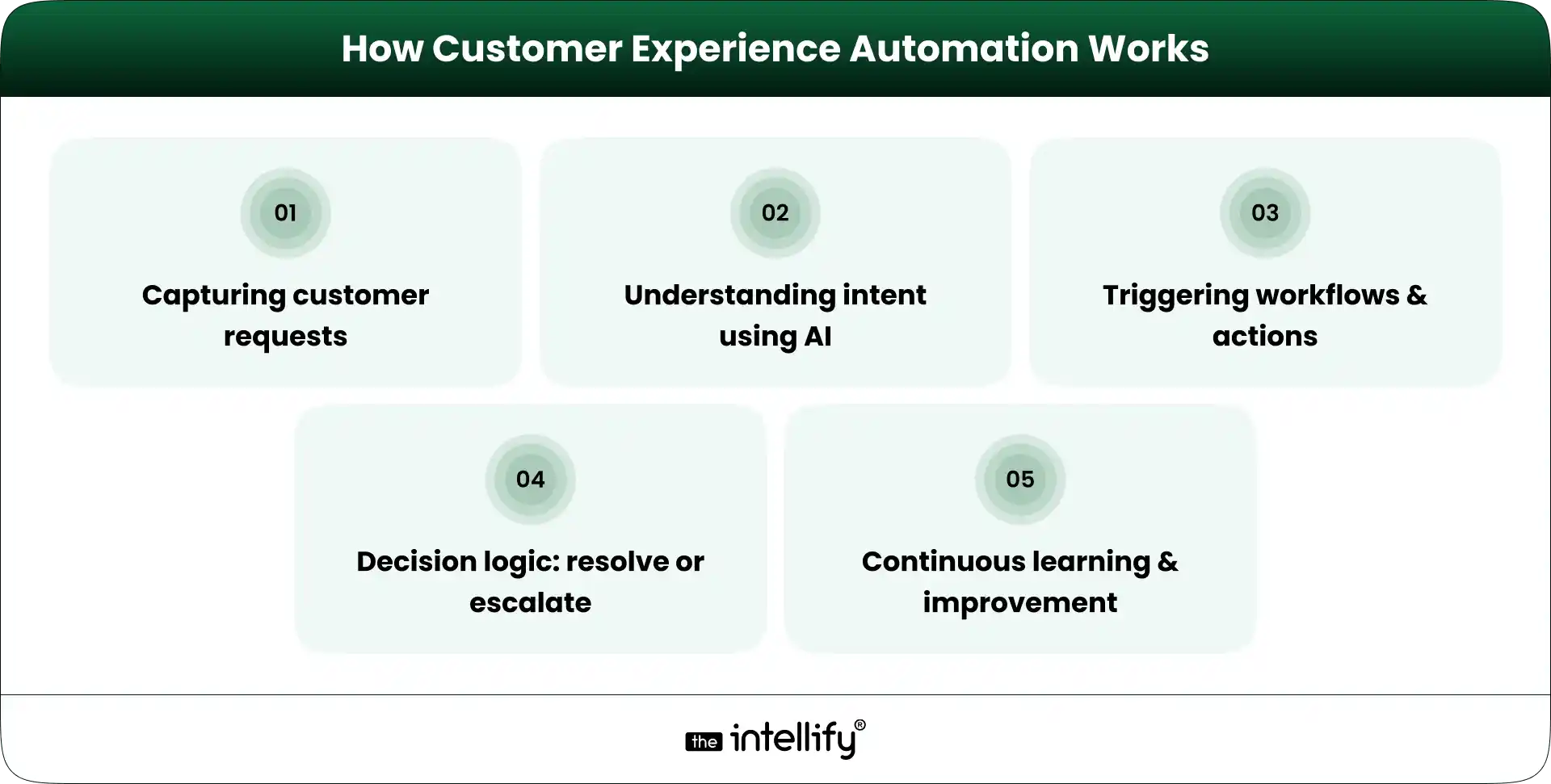
The process behind customer experience automation is structured and logical.

Capturing customer requests

Customer queries come in through channels like chat, email, apps, or support portals. The system collects and centralizes them.

Understanding intent using AI

AI analyzes the request and identifies what the customer actually needs, not just the keywords used.

Triggering workflows and actions

Based on intent, predefined workflows are activated. These could include responses, updates, or backend actions.

Decision logic: resolve or escalate

Simple queries are resolved automatically. More complex issues are routed to the appropriate human agent.

Continuous learning and improvement

The system improves over time by learning from past interactions and refining its responses.

It may look seamless, but there’s a structured engine working behind it.


Core Capabilities That Power Customer Automation Solutions

A Customer Experience Automation Platform relies on several core capabilities.

  • Conversational AI : AI chatbots and virtual assistants enables real-time conversations with customers, handling queries naturally rather than through rigid scripts.
  • Workflow automation engines: Manage actions such as routing requests, triggering notifications, and updating systems.
  • Omnichannel communication handling: Ensures consistent interactions across chat, email, apps, and other platforms.
  • CRM and system integrations: Connects with internal tools to fetch and update customer data in real time.
  • Analytics and performance tracking: Provides insights into response times, resolution rates, and overall performance.
  • Personalization through customer data: Uses historical data to tailor responses and improve relevance.

These capabilities work together to create a unified system.


Key Customer Journeys That Can Be Automated End-to-End

Customer experience automation applies across multiple journeys, not just support.

New user onboarding and guidance

Helps users get started with step-by-step assistance without manual involvement.

Handling common support queries instantly

Resolves frequently asked questions quickly, reducing wait times.

Order, booking, or service status updates

Provides real-time updates without requiring customers to ask repeatedly.

Scheduling, reminders, and confirmations

Automates appointments, alerts, and follow-ups.

Feedback collection and follow-ups

Captures feedback at the right time, improving response quality.

Complaint handling with escalation paths

Ensures complex issues are escalated properly while maintaining structure.

When these journeys are connected, the experience feels smooth rather than fragmented.


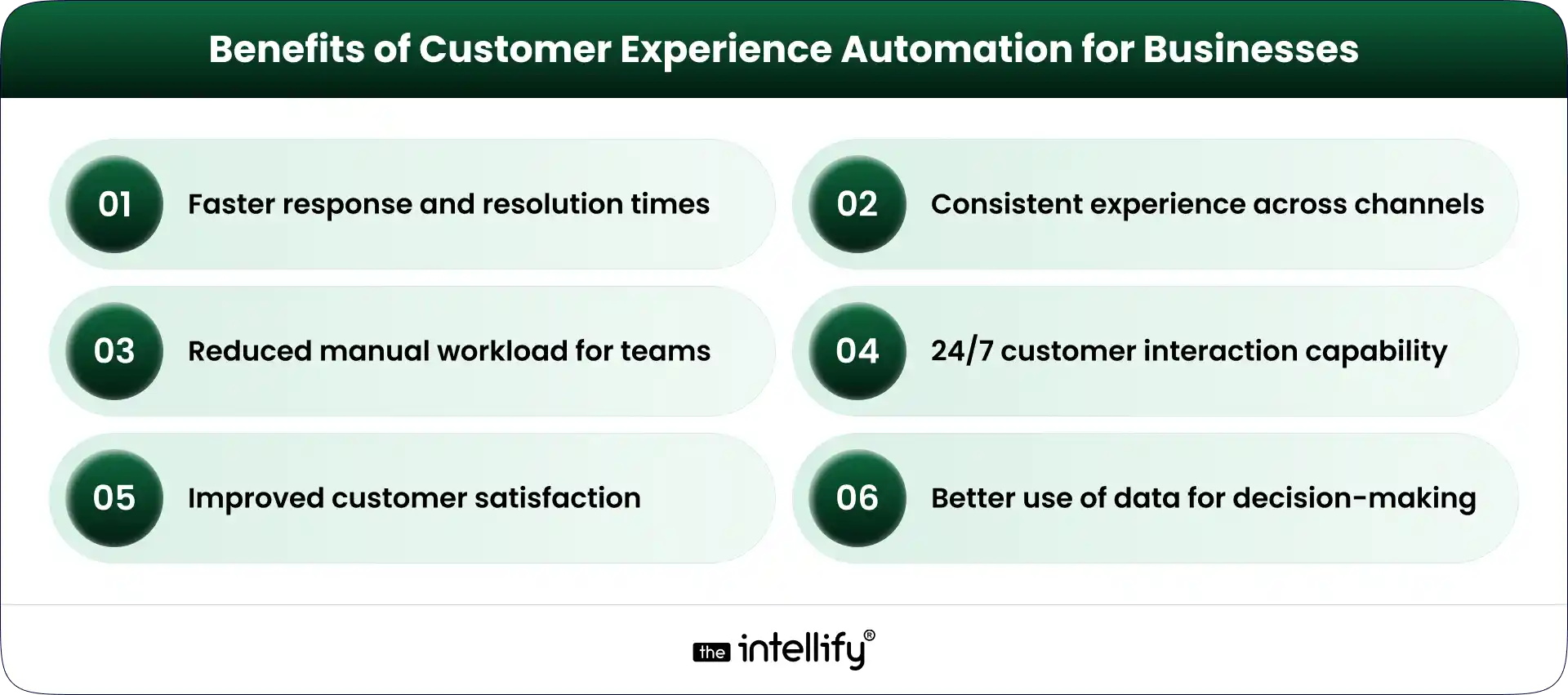
Key Benefits of Customer Experience Automation for Businesses

Benefits of Customer Experience Automation

The impact becomes visible in everyday operations.

Faster response and resolution times

Customers receive immediate assistance without waiting in queues.

Consistent experience across channels

The quality of interaction remains the same, regardless of the platform.

Reduced manual workload for teams

Teams can focus on complex tasks instead of repetitive queries.

24/7 customer interaction capability

Support remains available at all times.

Improved customer satisfaction and retention

Faster and smoother interactions lead to better customer experiences.

Better use of data for decision-making

Every interaction generates insights that help improve processes.

These are practical improvements businesses notice quickly.


Industry Applications of Customer Experience Automation in Action

Customer experience automation is applied differently across industries.

1. E-commerce & Retail: Supports order tracking, returns, and high query volumes during peak periods.
2. Banking & Financial Services: Handles account queries, transaction updates, and secure communication.
3. Healthcare Providers: Manages appointment scheduling, patient communication, and reduces administrative workload.
You can also explore case study – AI Carebot: Healthcare Chatbot that personalizes patient interactions and enhances care delivery.
4. Insurance: Helps with claims tracking and policy-related queries while managing large volumes.
5. Travel & Hospitality: Supports bookings, cancellations, and real-time travel updates.
6. Telecom & Subscription Services: Handles billing queries, service requests, and plan management.
7. SaaS & Digital Platforms: Improves onboarding, product guidance, and subscription lifecycle communication.

Each industry uses it differently, but the goal stays the same efficiency with consistency.


AI workflow Automation solutions


Operational Challenges That Indicate the Need for Automation

Some challenges clearly signal the need for automation.

1. Slow response times and inconsistent service: Customers experience delays and uneven support quality.

2. Overloaded support teams: Teams spend most of their time handling repetitive queries.

3. Fragmented customer data: Information is scattered across systems, making it harder to respond accurately.

4. Difficulty scaling during high-demand periods: Operations struggle to handle spikes in demand.

5. Limited personalization capabilities: Without unified data, personalization becomes difficult.

These issues tend to grow if not addressed early.


How to Choose the Right Customer Experience Automation Platform

Choosing the right platform requires focusing on fit, not just features.

  • Ease of integration with existing systems: The platform should work smoothly with your current tools.
  • Flexibility in designing workflows: It should allow changes as your processes evolve.
  • Accuracy of AI in understanding queries: The system must correctly interpret customer intent.
  • Support for multiple communication channels: Ensures consistency across platforms.
  • Real-time visibility into performance: Helps track and improve system efficiency.
  • Data security and compliance readiness: Critical for protecting sensitive customer information.

The right platform should support your operations, not complicate them.


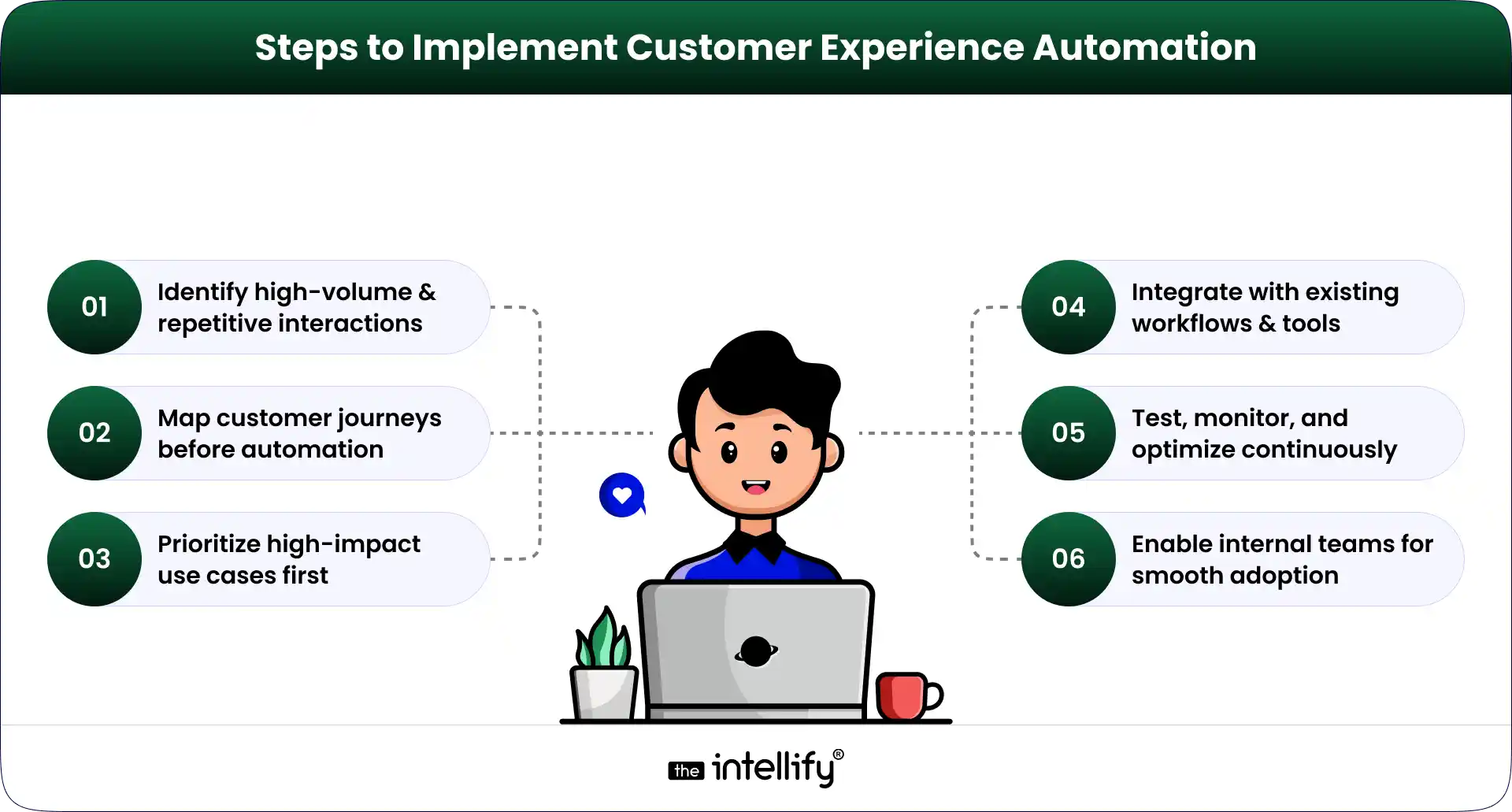
Steps to Successfully Implement Customer Experience Automation

Customer Experience Automation Implementation Steps

Implementation requires a structured approach.

  • Identify high-volume and repetitive interactions: Start with areas that have the most impact.
  • Map actual customer journeys before automation: Avoid assumptions focus on real behavior.
  • Prioritize high-impact use cases first: Start small and scale gradually.
  • Integrate with existing workflows and tools: Ensure smooth adoption without disruption.
  • Test, monitor, and optimize continuously: Automation improves over time with consistent refinement.
  • Enable internal teams for smooth adoption: Teams should understand how to work alongside automation.

Skipping structure here usually creates more problems later.


Ensuring the Right Balance Between Automation and Human Support

Automation works best when balanced with human involvement.

  • Defining boundaries for automation: Not every interaction should be automated.
  • Handling complex or sensitive interactions manually: Human judgment is still essential in certain cases.
  • Creating seamless transitions between systems and agents: Customers shouldn’t have to repeat their issues.
  • Maintaining personalization and empathy: Even automated responses should feel relevant and thoughtful.

Customers can easily sense when experiences feel too robotic.


Emerging Trends in CX Automation

Customer experience automation continues to evolve.

  • Predictive and proactive support systems: Systems identify and resolve issues before customers ask.
  • AI-driven personalization at scale: Experiences are tailored based on customer data.
  • Growth of conversational interfaces: Chat and Voice AI are becoming primary interaction channels.
  • Automation beyond support: Expanding into the full customer lifecycle.
  • Deeper integration with business operations: CX systems are becoming part of core business processes.

The shift is clearly moving toward proactive engagement.


How Businesses Are Structuring Scalable Customer Experience Systems

Businesses are moving toward more connected systems.

  • From standalone tools to connected systems: Tools are no longer used in isolation.
  • Combining AI with workflow automation: Both are used together to create efficient processes.
  • Aligning customer experience with backend operations: Ensures consistency across the entire system.
  • Building scalable and adaptable frameworks: Flexibility is becoming a priority.
  • Focusing on long-term efficiency: Businesses are moving away from quick fixes.

It’s less about tools and more about building systems that last.


Customer experience automation solutions


Final Thought

Customer experience automation is no longer optional it’s becoming essential. The key is not just adopting it, but implementing it properly.

Start with clear use cases, scale gradually, and focus on real customer journeys. At the same time, maintain the balance between automation and human interaction.

In the end, customers don’t think about the technology behind the scenes. They just expect things to work quickly, smoothly, and without friction.


Frequently Asked Questions (FAQs)

1. What is Customer Experience Automation, and how does it work?

Customer Experience Automation uses AI and automation to handle customer interactions automatically. It captures queries, understands intent, and responds or triggers actions in real time, helping businesses resolve requests faster and more efficiently.

2. What is a Customer Experience Automation Platform?

A Customer Experience Automation Platform combines AI, workflows, and communication channels into one system. It helps businesses manage customer interactions end-to-end across support, engagement, and service processes.

3. How is customer service automation different from customer experience automation?

Customer service automation focuses only on support tasks like answering queries. Customer experience automation covers the full journey, including onboarding, engagement, and follow-ups, creating a more connected experience.

4. What are the key benefits of Customer Experience Automation?

It improves response times, ensures consistent communication, reduces manual workload, and enables 24/7 support. It also helps businesses scale operations while maintaining customer satisfaction.

5. Where can Customer Experience Automation be used in a business?

It can be used for onboarding, handling support queries, order updates, scheduling, feedback collection, and complaint management across different customer touchpoints.

6. How do you choose the right Customer Experience Automation Platform?

Choose a platform that integrates easily with your systems, offers flexible workflows, supports multiple channels, and provides accurate AI understanding along with strong data security.
How to Build an AI agent for Insurance: Use Cases, Benefits & ROI

Summary:
AI agents are helping insurance companies work faster, reduce manual effort, and improve customer service. They can handle tasks like claims processing, policy updates, fraud checks, and customer support with better speed and accuracy. This blog covers real use cases, key benefits, and how to measure returns from AI adoption. It also shares simple steps to build an AI agent, along with common challenges and best practices for successful implementation.

The insurance industry is changing quickly, fueled by the demand for smarter workflows and enhanced customer experiences. AI agents for insurance are at the forefront of this transformation. These intelligent systems not only streamline operations but also elevate service delivery. In this blog, we’ll explore how to build an AI agent for insurance, its practical applications, the benefits it brings, and the expected return on investment.


Why Insurance Teams Need Smarter Workflows

Insurance operations are becoming increasingly complex and heavily reliant on data. Teams often find themselves spending a lot of time on repetitive tasks. Today’s customers expect faster claims processing, better service, and precise information. Traditional automation methods just can’t keep pace with these changing demands, making a smarter solution necessary.

With intelligent systems like AI agents, the insurance industry can embrace a more efficient and responsive operational model. These systems not only save time but also boost accuracy and service quality.


What Is an AI Agent for Insurance?

An AI agent in Insurance operations is a software solution that leverages artificial intelligence to manage various tasks throughout the insurance lifecycle. Unlike simple chatbots or straightforward automation, AI agents are designed to:

  • Understand Inputs: They interpret natural language and data requests.
  • Make Decisions: They analyze data to assist in multi-system decision-making.
  • Take Actions: They execute tasks like claims processing and policy updates.

In essence, an AI agent functions as an intelligent assistant that enhances operational workflows in the insurance sector.


Why Insurance Processes Are Well-Suited for AI Automation

The insurance industry is ripe for AI automation for several reasons:

  • High volume of Repetitive tasks: Many tasks involve repetitive decision-making actions that are perfect for automation.
  • Mix of Structured and Unstructured Data: Insurance processes often utilize various data formats, making them ideal for AI analysis.
  • Multiple Systems and Handoffs: AI agents can smooth transitions between different software systems, ensuring efficient workflows.
  • Frequent Validation and Follow-ups: AI can effectively track and manage validation processes.

These elements create an ideal environment for AI automation in insurance.


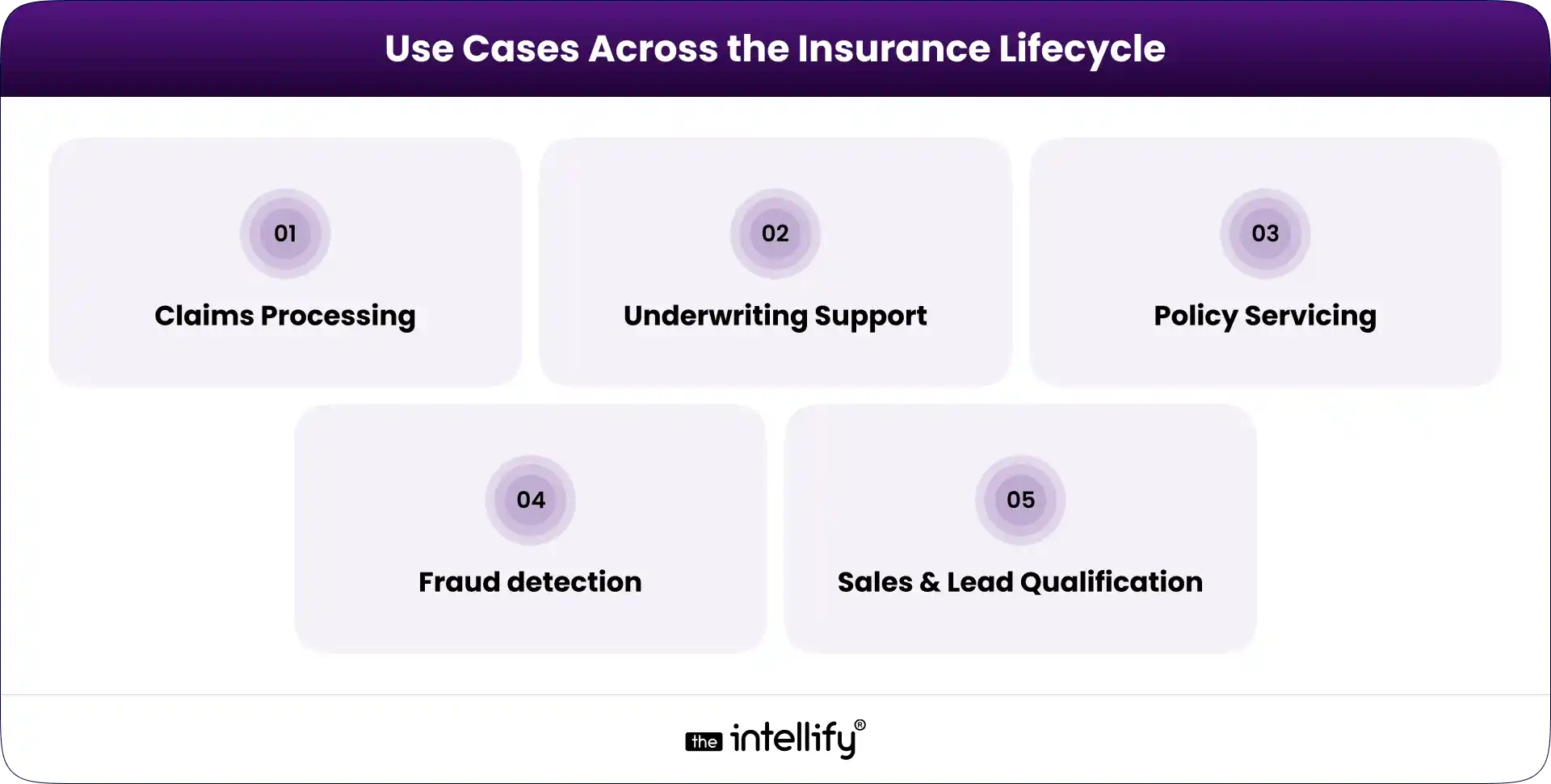
Practical Use Cases Across the Insurance Lifecycle

Use Cases Across the Insurance Lifecycle

AI agents can play a significant role at various stages of the insurance lifecycle. Here are a few practical use cases:

1. Claims Processing

  • Capturing the First Notice of Loss (FNOL)
  • Validating documents and routing them
  • Providing automatic updates to customers

2. Underwriting Support

  • Aggregating data
  • Conducting risk assessments and providing insights

3. Policy Servicing

  • Automating customer requests
  • Managing renewals and updates

4. Fraud detection

  • Identifying patterns and anomalies in data

5. Sales & Lead Qualification

  • Engaging leads and recommending the best products

Each of these applications can significantly boost efficiency and enhance customer satisfaction.


AI agent for Insurance workflow


Business Impact: Where AI Agents Deliver Real Value

Implementing AI solutions for insurance can yield substantial business benefits:

  • Faster Turnaround Times: Claims can be processed quicker and more efficiently.
  • Reduced operational costs: Automation cuts down on the need for redundant manual work.
  • Improved accuracy: Reducing human error enhances overall service quality.
  • Better customer experience: Customers receive timely updates and tailored interactions.
  • Scalable operations: AI agents can manage increased workloads with ease.


How an AI Agent for Insurance Works in Practice

Here’s a look at how an AI agent operates:

1. Input: Collect data from documents, customer requests, and existing system info.
2. Understanding: Use Natural Language Processing (NLP) to interpret user inputs and pull out relevant information.
3. Decision: Leverage AI models and business logic to make informed decisions.
4. Execution: Carry out workflow actions across various systems.

Example flow:

Claim Submission → Validation → Routing → Automated Update

This streamlined process helps eliminate bottlenecks and significantly improves operational efficiency.


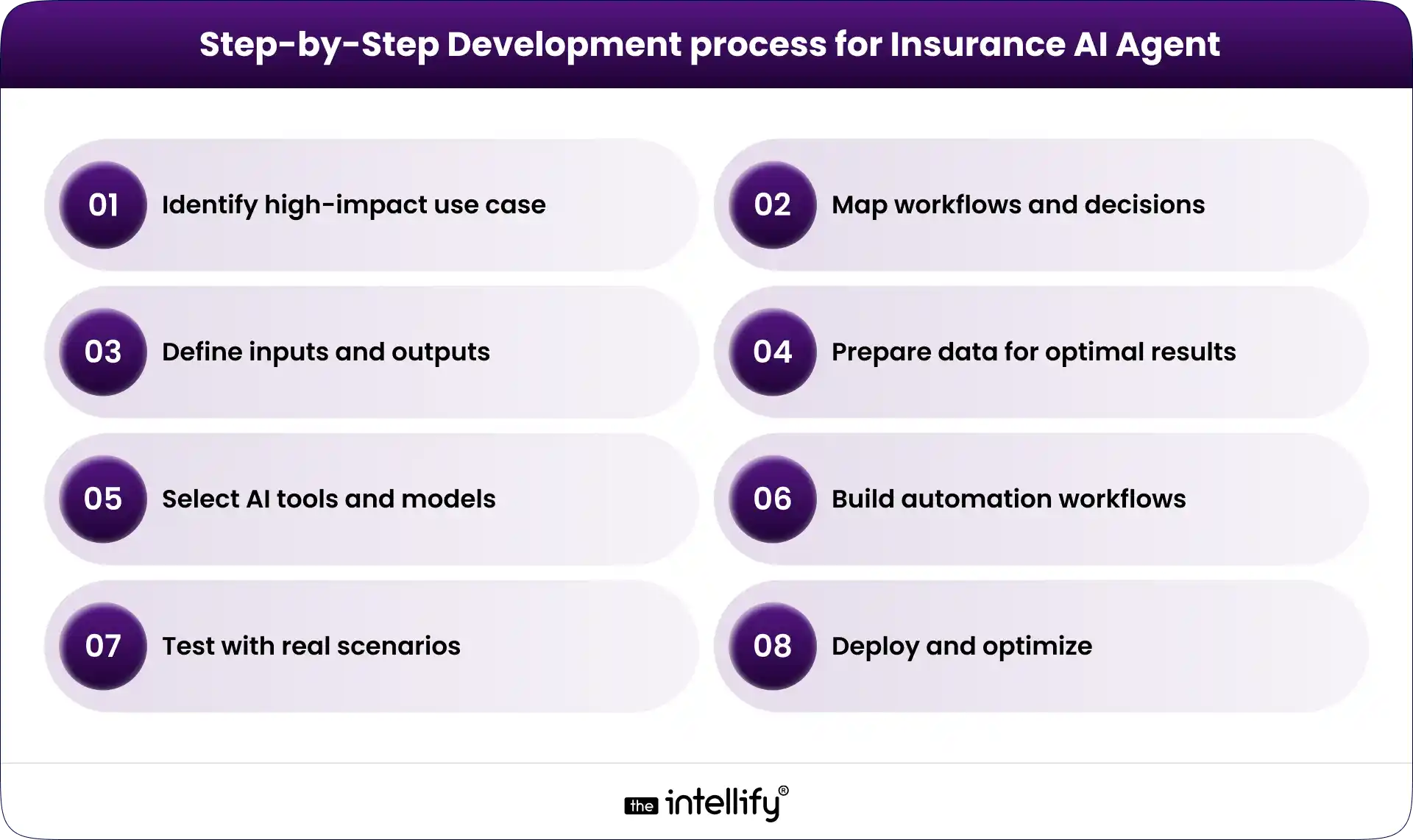
AI Agent Development Process for Insurance: Step-by-Step

Insurance AI Agent Development process

Building an AI agent development solution for insurance requires a methodical approach

1. Identify high-impact use case: Start with a process that stands to gain the most from automation.
2. Map workflows and decisions: Get a thorough understanding of existing processes.
3. Define inputs and outputs: Know what data is needed and what the expected outcomes are.
4. Prepare data: Clean and structure your data for optimal results.
5. Select AI tools and models: Choose the right technology stack for your needs.
6. Build automation workflows: Create efficient workflows that the AI can manage.
7. Test with real scenarios: Validate the system using actual data and situations.
8. Deploy and optimize: Launch the AI agent and continue to improve its functionality.


Systems and Integrations Required for AI-Driven Workflows

To successfully implement AI agents in insurance, you’ll need to integrate with a variety of systems:

  • Policy administration systems: For managing policies.
  • Claims platforms: To handle claims processing.
  • CRM tools: For customer relationship management.
  • External data sources: For Know Your Customer (KYC) and verification processes.
  • APIs and middleware: To ensure proper connectivity between systems.
  • Legacy system integration: To make sure older systems can work seamlessly with modern technology.


Measuring ROI of AI Agents in Insurance

Knowing your return on investment is key. Here’s how to measure it:

  • Processing time reduction: Assess how much time AI saves across tasks.
  • Cost savings: Compare operational costs before and after implementation.
  • Error reduction: Monitor the drop in mistakes with AI support.
  • Customer response improvement: Gauge shifts in customer satisfaction levels.
  • KPI tracking and benchmarking: Keep an eye on key performance indicators regularly.


Common Implementation Challenges You Should Expect

While the benefits are far-reaching, some challenges might come up:

  • Data quality issues: Inaccurate data can hinder AI performance.
  • Legacy system integration: Merging old systems with new tech can be complex.
  • Compliance requirements: Adhering to regulations is crucial.
  • Internal adoption challenges: Teams may resist changes or the introduction of new technologies.
  • Trust in AI decisions: Building confidence in AI-generated decisions is essential.

Addressing these challenges early on will help smooth the way for successful implementation.


Best Practices for Scaling Across Insurance Operations

To effectively scale AI agents in your insurance operations:

1. Start with one use case: Focus on a specific, impactful area first.
2. Scale based on results: Analyze outcomes before expanding.
3. Maintain human oversight: Ensure staff can monitor AI decisions.
4. Build flexible workflows: Adapt systems as your business needs evolve.
5. Continuously optimize: Regularly update AI functionalities based on user feedback.


Choosing the Right Approach to AI Agent Development in Insurance

When developing AI agents, keep these points in mind:

  • Evaluate workflow complexity: Understand the intricacies of your operations.
  • Data readiness: Make sure you have clean, actionable data ready for AI analysis.
  • Custom vs Structured AI Solutions: Determine what fits best for your specific needs.

Find development services that are well-versed in the insurance domain, offer scalable AI solutions, and can integrate seamlessly with your existing systems.


How AI Agents Are Shaping the Future of Insurance

AI agents are leading the charge toward the future of insurance through:

1. Autonomous workflows: Diminishing the need for manual oversight.
2. Real-time decision-making: Delivering immediate answers and recommendations.
3. Personalized experiences: Crafting services tailored to individual preferences.
4. Integration with conversational AI: Elevating customer interactions through smooth dialogues.

AI isn’t just a tool; it’s becoming a key player in insurance operations.


AI Agent for insurance services


Conclusion

Transitioning from manual tasks to intelligent execution is crucial for the insurance landscape. Embracing AI agents can dramatically enhance efficiency, accuracy, and scalability.

By implementing the right strategy and seeking expert assistance, your insurance business can open the door to a future brimming with opportunity and innovation.


Frequently Asked Questions (FAQs)

1. How is an AI agent different from traditional automation in insurance?

Traditional automation follows fixed rules, so it struggles with exceptions. An AI agent can understand context, make decisions, and handle variations in real-time, which makes it much more flexible for insurance workflows.

2. What kind of insurance processes can be fully handled by AI agents?

AI agents can manage tasks like claim intake, document validation, customer queries, and basic underwriting support. Most companies start with partial automation and then expand to more end-to-end workflows over time.

3. How long does it take to build an AI agent for insurance use cases?

It depends on the complexity. A focused use case like claims intake can take a few weeks, while more advanced workflows involving multiple systems may take a few months to fully implement and optimize.

4. What data is required to build an AI agent for insurance?

You typically need access to policy data, claims data, customer interactions, and documents. The more structured and clean the data is, the better the AI agent performs.

5. Can AI agents work with legacy insurance systems?

Yes, but it requires proper integration using APIs or middleware. Many insurance companies don’t replace legacy systems they connect AI agents on top of them to improve workflows.

6. How do AI agents help reduce claim processing time?

They automate steps like document checks, data extraction, and routing. Instead of manual back-and-forth, the process moves faster with fewer delays and fewer errors.

7. How can The Intellify assist in developing an AI agent for insurance?

The Intellify offers tailored AI solutions for insurance companies, ensuring seamless integration, effective workflows, and ongoing support for peak performance.

Mobile Banking App Development: Features, Security, Compliance & Cost

Summary:
Mobile banking app development is becoming essential as more users prefer to manage their finances on mobile. This blog gives a clear view of what it takes to build a banking app, from planning the right approach to understanding how everything comes together. It walks through the overall process, important decisions, and what businesses should consider before getting started. The aim is to help you move forward with clarity and build a practical, reliable, and ready-for-real-users solution.

Digital banking has changed the way people interact with financial services. What once required visiting a branch can now be done instantly through a mobile app, whether it’s transferring money, checking balances, or paying bills. This shift has made banking more accessible, faster, and convenient for users across different age groups.

As user expectations continue to grow, mobile-first banking has become essential for businesses. People expect seamless experiences, quick transactions, and strong security in just a few taps. In this guide, you’ll understand how mobile banking apps are developed, what features they need, how security and compliance work, and what it costs to build one.


What is a Mobile Banking Application?

Mobile banking applications allow users to access and manage their financial services through smartphones. These apps are designed to make everyday banking simple, fast, and available anytime without needing physical interaction.

In real-world usage, users can check balances, transfer funds, pay bills, and manage accounts directly from their phones. This type of application is widely used by banks, fintech startups, and enterprises that want to offer digital financial services to their customers.

As digital adoption continues to grow, these apps are becoming a core part of how modern banking services are delivered.


Types of Mobile Banking Apps

Retail Banking Apps (for everyday users)

Retail banking apps are designed for individual users who want to handle daily financial activities like checking balances, transferring money, and paying bills. These apps focus on simplicity and convenience to make everyday banking tasks easy.

Corporate Banking Apps (for businesses)

Corporate banking apps are built for businesses that need to manage bulk transactions, payroll, and financial operations. They offer more control, advanced features, and better management tools for handling business finances.

Neo-banking / Digital-Only Apps

Neo-banking apps operate completely online without physical branches and focus on digital-first experiences. They offer faster services, modern interfaces, and innovative features tailored for tech-savvy users.

How each type serves different user needs

Each type of banking app is designed based on specific user requirements, whether it’s individuals, businesses, or digital-first customers. This helps deliver more relevant and efficient financial solutions.


Why Businesses Are Investing in Mobile Banking Solutions

Rising demand for digital financial services

The demand for digital banking has increased as users prefer managing finances through mobile apps. Businesses are adopting these solutions to meet changing customer expectations and stay competitive.

Better customer experience

Mobile apps provide quick and easy access to financial services, improving overall user satisfaction. A smooth experience helps build trust and long-term customer relationships.

Reduced operational costs

Digital solutions reduce the need for physical infrastructure and manual processes. This helps businesses save costs while improving efficiency.

Faster service delivery

Mobile banking enables instant transactions and real-time updates, making services quicker and more efficient. This improves the overall user experience.

Competitive advantage in fintech market

Businesses that invest in mobile banking solutions stay ahead in the competitive fintech space. It helps them attract and retain users more effectively.


Essential Features of a Mobile Banking App

Features of a Mobile Banking App

Secure user registration & login (OTP, biometrics)

Secure login methods ensure that only authorized users can access the app. Features like OTP and biometrics make the process both safe and convenient.

Account dashboard & transaction history

A clear dashboard allows users to view account balances and transaction history in one place. This helps users stay informed about their financial activities.

Fund transfers (UPI, NEFT, RTGS)

Users can transfer money quickly using multiple payment options. These features provide flexibility and convenience for different types of transactions.

Bill payments & recharges

Users can pay bills and recharge services directly through the app. This saves time and reduces dependency on multiple platforms.

Card and account management

Users can manage their cards, set limits, or block them when needed. This gives users more control over their accounts.

Real-time notifications & alerts

Instant alerts keep users updated about transactions and account activities. This improves transparency and helps detect any unusual activity quickly.

Customer support (chat, help center)

In-app support allows users to resolve issues quickly without visiting a branch. It improves user satisfaction and convenience.

Personal finance tracking tools

These tools help users track spending and manage budgets effectively. It provides better financial insights and planning.

Multi-language & accessibility features

Supporting multiple languages makes the app accessible to a wider audience. It ensures inclusivity and better user experience.

Simple navigation and clean interface

A simple design helps users complete tasks easily without confusion. Clean layouts improve usability and engagement.

Fast and smooth app performance

Fast loading speed and smooth performance are essential for user retention. Users prefer apps that work quickly without delays.


Security Measures Every Banking App Must Have

1. End-to-end encryption:- Encryption ensures that user data remains secure during transactions. It protects sensitive information from unauthorized access.

2. Multi-factor authentication (MFA):- MFA adds an extra layer of security by requiring multiple verification steps. This reduces the risk of account breaches.

3. Secure APIs and data storage:- Secure APIs ensure safe communication between systems, while protected storage keeps user data secure. This is critical for maintaining data integrity.
4. Fraud detection and monitoring:- Monitoring systems help detect suspicious activities in real time. This allows quick action to prevent fraud.

5. Session management and device binding:- These features ensure that sessions are secure and linked to specific devices. This prevents unauthorized access from unknown devices.

6. Building user trust through security:- Strong security measures help build user confidence in the app. Trust plays a major role in user retention and engagement.


Compliance and Regulatory Requirements

Importance of regulatory compliance in banking

Compliance ensures that financial operations are carried out securely and within legal boundaries. It helps build user trust while protecting businesses from legal risks and penalties.

KYC (Know Your Customer)

KYC processes verify user identity during onboarding to prevent fraud and unauthorized access. It is a key step in ensuring that only genuine users can access financial services.

AML (Anti-Money Laundering)

AML regulations help monitor and prevent suspicious financial activities such as money laundering. These checks ensure transparency and maintain the integrity of financial systems.

Data protection and privacy standards

Data protection laws ensure that user information is securely stored and handled responsibly. Following these standards is essential to maintain user trust and avoid compliance issues.

Risks of non-compliance

Failing to meet regulatory requirements can lead to heavy penalties and reputational damage. It can also result in loss of customer trust, which is difficult to rebuild.


Mobile Banking App Development Process (Step-by-Step)

1. Planning and requirement analysis: This stage defines the goals, features, and target users of the app. Proper planning ensures a smooth development process.

2. UI/UX design focused on simplicity: Design focuses on making the app easy to use and visually clear. A good design improves user engagement.

3. Development (frontend + backend):- Both frontend and backend systems are developed to ensure functionality and performance. This is the core stage of mobile app development.

4. Testing (security, usability, performance):- Testing ensures the app works smoothly and securely. It helps identify and fix issues before launch.

5. Deployment and launch:- The app is released on platforms like Android and iOS. This makes it available for users to download and use.

6.Ongoing maintenance and updates:- Regular updates improve performance and add new features. Maintenance ensures long-term stability.
 

banking app development services


Integration & Architecture of Mobile Banking Apps

  • Connecting with core banking systems: Integration with core banking systems ensures real-time access to financial data. This keeps transactions accurate and updated.
  • Role of APIs and third-party integrations: APIs connect different services like payments and notifications. Third-party integrations enhance app functionality.
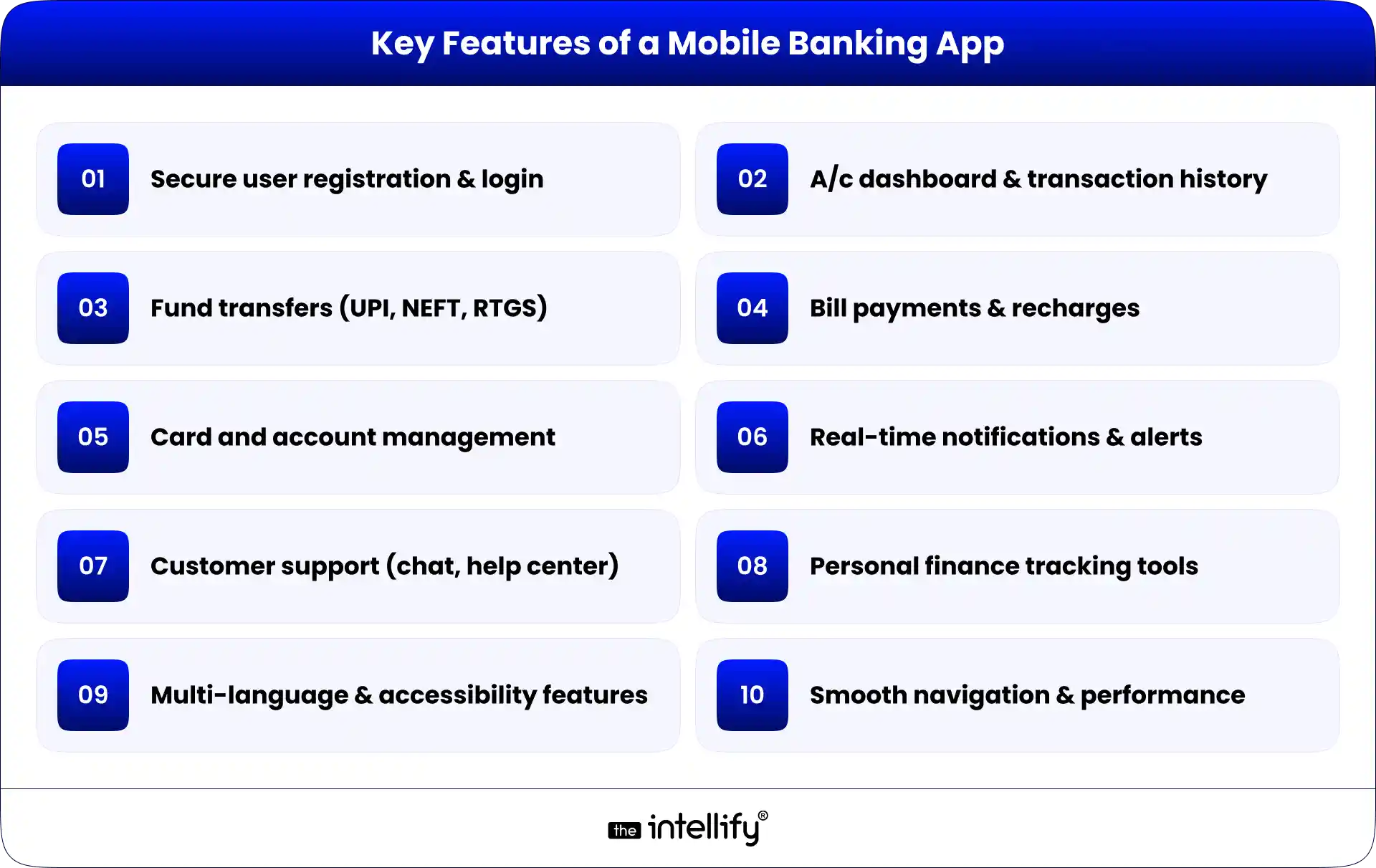
  • Payment gateway and financial service integrations: Payment gateways enable secure transactions within the app. They support multiple payment methods for user convenience.
  • Cloud infrastructure and scalability: Cloud systems help handle growing user demand efficiently. They ensure the app performs well at scale.
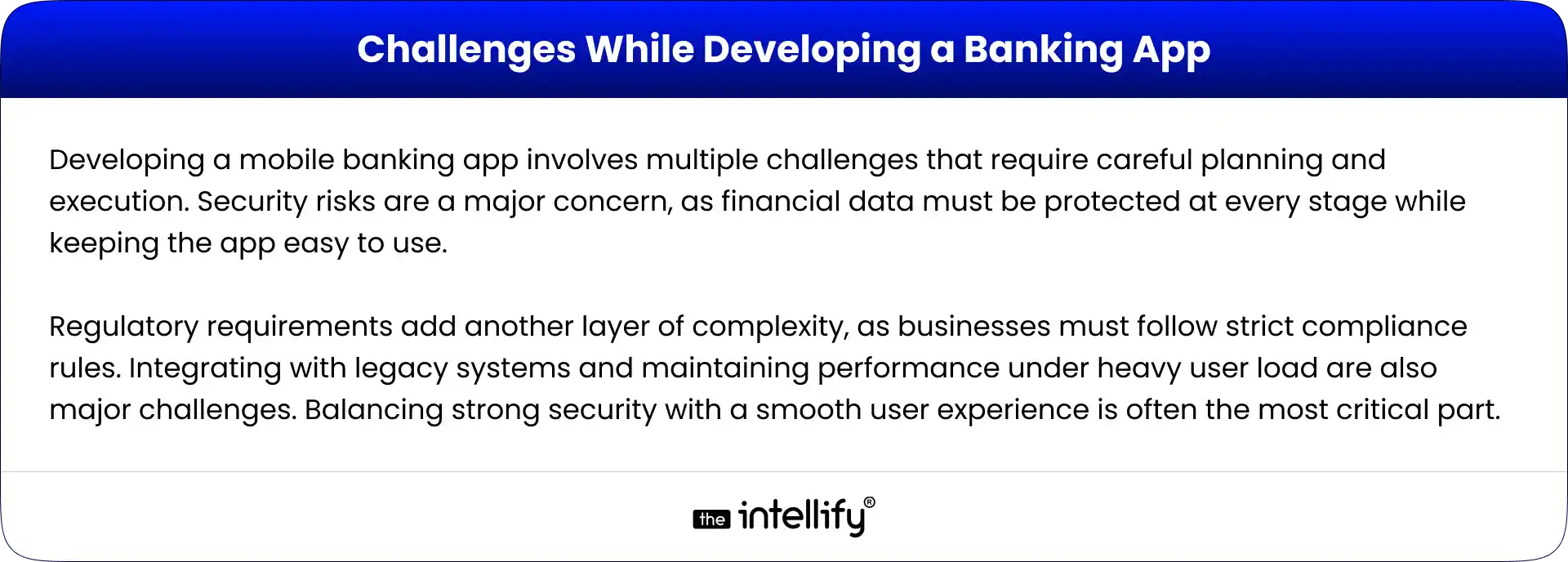
  • Ensuring smooth and secure data flow: Proper architecture ensures data flows securely between systems. This is important for performance and reliability.
  • Payment systems (UPI, cards): Integration with payment systems allows users to make quick transactions. It adds flexibility to financial operations.
  • Third-party services (analytics, notifications): These services improve user experience and provide insights. They help businesses track performance and engagement.


Technology Stack Used in Banking Application Development

Frontend (iOS, Android, cross-platform)

Frontend technologies define how users interact with the app across devices. Choosing the right approach ensures smooth performance and a consistent user experience.

Backend frameworks and databases

Backend systems manage data processing, storage, and core functionalities of the app. A strong backend ensures security, reliability, and seamless performance.

Cloud services and hosting

Cloud infrastructure allows the app to scale easily as the number of users grows. It also improves reliability and ensures the app performs well under high demand.

Analytics and monitoring tools

These tools help track user behavior, app performance, and system health. They provide insights that help improve features and user experience over time.

Role of AI in modern banking apps

AI in banking is used to provide personalized insights, automate tasks, and detect unusual activities. It helps make banking apps smarter, faster, and more user-friendly.


Cost of Mobile Banking App Development

  • Features and complexity: More features increase the complexity and cost of development. Advanced functionality requires higher investment.
  • Security and compliance requirements: Strong security and compliance add to development costs. These are essential for building a reliable app.
  • Design and user experience:  A well-designed app improves usability but may increase costs. Good design enhances user engagement.
  • Integration needs: Integration with systems and services affects overall cost. More integrations require additional effort.
  • Estimated cost range (basic vs advanced apps): Basic apps are less expensive, while advanced apps cost more due to added features. The cost depends on project scope.
  • Ongoing maintenance and upgrade costs: Maintenance ensures the app stays updated and secure. It is an important part of long-term investment.


_Banking App Development Challenges


Future Trends in Mobile Banking Applications

Mobile banking is continuously evolving with new technologies that improve user experience and efficiency. AI-driven features are helping users get personalized insights, while chatbots and voice banking are making interactions more convenient.

Open banking and API ecosystems are creating more flexible financial services, allowing better integration across platforms. At the same time, blockchain and hyper-personalization are shaping the future by making banking more secure, transparent, and tailored to individual needs.


How to Choose the Right Mobile Banking App Development Partner

Choosing the right banking app development partner is essential for building a secure and scalable banking app. A reliable partner should have experience in financial technology and a strong understanding of security and compliance requirements.

It is important to review their past work, technical expertise, and support capabilities. Asking the right questions before starting the project helps ensure smooth execution and better results in the long run.


mobile banking app development


Conclusion

Mobile banking app development has become a key part of modern financial services. Businesses need to focus on creating secure, easy-to-use apps that meet evolving user expectations.

By balancing features, security, and cost, companies can build solutions that provide long-term value. With the right strategy and development approach, mobile banking apps can help businesses grow and stay competitive in the digital landscape.


Frequently Asked Questions (FAQs)

1. How much does mobile banking app development cost?

The cost mainly depends on the features, level of security, integrations, and overall design. A basic app will cost less, but a fully secure, scalable banking app with advanced features requires a higher investment.

2. How long does it take to build a mobile banking app?

The timeline varies based on complexity. A simple version can take around 3–6 months, while a more advanced app with full features, integrations, and security layers may take 6–12 months or longer.

3. What features do users expect in a mobile banking app today?

Users expect a smooth and simple experience with features like secure login, quick money transfers, real-time updates, bill payments, and an easy-to-use dashboard. Convenience and speed matter the most.

4. How do mobile banking apps ensure user data security?

Security is handled through encryption, multi-factor authentication, and continuous monitoring of user activity. These measures work together to protect sensitive data and prevent unauthorized access.

5. Can a mobile banking app integrate with existing banking systems?

Yes, mobile banking apps are designed to connect with existing core banking systems using APIs. This allows real-time transactions, accurate data updates, and smooth communication between systems.

6. What are the ongoing costs after launching a banking app?

After launch, you’ll need to invest in maintenance, security updates, hosting, compliance checks, and adding new features. These ongoing efforts keep the app secure and up to date.

7. How important is user experience in a mobile banking app?

User experience plays a big role in retention. If the app is slow, confusing, or difficult to use, users are likely to switch, even if the app has strong features.

Virtual Reality in Education: Applications, Benefits & Future of Learning

Summary:
Virtual reality in education is changing how students learn by making lessons more interactive and practical. Instead of only reading or listening, learners can explore concepts through immersive experiences. This blog explains how VR is used across subjects, its key benefits, real-world applications, challenges, and future trends. It also covers how institutions can adopt VR effectively with the right strategy, tools, and support, including the role of VR development services in building meaningful learning experiences.


Why Immersive Technology Is Transforming Education

Education isn’t what it used to be. And honestly, it couldn’t stay the same. Students today are used to screens, interaction, and fast feedback. Sitting through long lectures with just slides? It works sometimes, but not always. Attention drops. You can almost feel it in a classroom.

That’s where virtual reality in education starts to make sense. Instead of just reading about something, students can actually experience it. Walk through a historical site. Look inside the human body. Try things, mess up, try again. It shifts learning from passive to active. And that small shift changes everything.

In this blog, we’ll go through how VR in education works, where it’s actually useful (not just hype), what challenges exist, and where things are heading next.


Understanding Virtual Reality in Education

Virtual Reality (VR) in Education

Virtual reality in education refers to computer-generated environments that learners can interact with as if they were physically present. By wearing a VR headset, students are immersed in a digital world where they can look around, move, and engage with objects naturally.

There are different levels of immersion. Fully immersive VR completely replaces the real world, while semi-immersive experiences combine digital environments with some awareness of surroundings. These systems typically use headsets, motion controllers, sensors, and specialized software designed for educational purposes.

Unlike augmented reality, which overlays digital elements onto the real world, VR creates an entirely simulated environment. This makes it especially useful for situations that are difficult, dangerous, expensive, or impossible to recreate in a traditional classroom. From exploring distant planets to practicing complex procedures, VR opens up learning opportunities that were previously out of reach.


The Role of Virtual Reality in Education Today

What once seemed futuristic is now becoming part of everyday learning. Schools, universities, and training institutions across the world are gradually integrating VR into their teaching strategies.

In many cases, VR supplements traditional instruction rather than replacing it. Teachers use it to demonstrate complex ideas, provide virtual field experiences, or allow students to practice skills in realistic scenarios. It is also proving valuable in remote and hybrid learning environments, where immersive interaction can reduce the sense of distance.

Professional education and workforce training are seeing particularly rapid adoption. Fields that require hands-on experience, such as healthcare, engineering, and technical trades, benefit greatly from safe, repeatable simulations. Institutions are increasingly recognizing that immersive tools can improve engagement while better preparing students for real-world challenges.


Key Applications Across Subjects and Training Areas

  • Science and virtual laboratories: Students can run experiments without worrying about safety or cost. No broken equipment. No chemical risks. Just repeat and learn.
  • Medical and healthcare training: Future doctors can practice procedures again and again. No pressure of real patients. It builds confidence slowly but surely.
  • Engineering and technical education: Machines, systems, structures they make more sense when you interact with them. VR lets students take things apart and rebuild them.
  • Humanities and cultural studies: History feels different when you can walk through it. Ancient cities, landmarks, it’s more than just reading dates.
  • Language learning: Instead of memorizing phrases, students actually use them. Conversations feel real. That’s where fluency starts.
  • Vocational and skills training: Construction, manufacturing, equipment handling—these need repetition. VR allows that without risk.
  • Special education support: Some students need calmer, controlled environments. VR can be adjusted to reduce distractions and support different learning needs.


Benefits for Students, Teachers, and Institutions

Benefits of VR in education

Greater engagement and motivation

Immersive experiences capture attention naturally. Students tend to stay focused longer because they feel involved rather than passive.

Deeper understanding through experience

Seeing and doing often leads to clearer comprehension than reading alone. Complex ideas become easier to grasp when learners interact with them directly.

Improved memory retention

Experiences tend to stay in memory longer than abstract information, helping students recall what they learned.

Safe environment for practice

Tasks that would be risky or costly in real life can be rehearsed without consequences, allowing students to learn from mistakes.

Personalized learning opportunities

Some VR systems adapt to individual progress, enabling students to move at a pace that suits them.

Collaboration beyond physical boundaries

Students can work together in shared virtual spaces, even if they are located in different places.

Support for diverse learning styles

Visual, auditory, and hands-on learners all benefit from immersive environments that combine multiple forms of interaction.


VR solutions for education


Real-World Examples of VR in Education

Virtual field trips:

Students explore oceans, space, or historical places without leaving the classroom. No logistics, no travel costs.

University simulations and labs:

Some universities now rely on VR labs for complex subjects. Less theory, more interaction.

Medical and technical programs:

Simulations help students practice before entering real environments. Fewer mistakes later.

Corporate learning initiatives:

Companies use VR to train employees in:

  • Customer service
  • Safety procedures
  • Operations

Measurable engagement gains:

Many institutions report better participation. Students ask more questions. They’re more curious. That’s usually a good sign.


How Augmented Reality (AR) Complements VR in Learning

1. Different approaches to immersion:- VR creates a fully digital environment, while AR enhances the real world with digital overlays. Each serves different learning needs.

2. When AR is more practical:- Activities that require awareness of the physical environment, such as lab work or field studies, often benefit more from AR.

3. Classroom applications:- AR can bring textbooks to life with interactive 3D models, animations, or contextual information displayed on devices.

4. Blended learning possibilities:- Using both technologies together allows students to explore concepts deeply in VR and then apply them in real-world settings using AR.

5. Future of mixed reality:- Emerging technologies aim to merge physical and digital spaces seamlessly, offering even more flexible learning experiences.

One example is the RainbowMe AR storytelling app, where kids scan storybook pages and watch characters come to life around them. This turns reading into an interactive experience, making stories easier to follow and more enjoyable to learn from. You can learn more about this real-world example here:- https://theintellify.com/work/rainbowme-ar-application-for-storytelling/


Challenges and Limitations of Implementing VR Solutions

Bringing virtual reality in education into classrooms sounds exciting, but the reality is a bit more layered.

Cost:

The biggest challenge is still cost. Good VR headsets, compatible devices, and quality content require investment. For schools managing tight budgets, scaling this across classrooms isn’t always practical. Some institutions try to manage this by working with VR development services that offer modular or subscription-based solutions, which can reduce upfront costs but it’s still not a small decision.

Content alignment:

Not every VR experience fits educational goals. If the content doesn’t match the curriculum, it may engage students briefly but won’t deliver real learning value. That’s why many institutions prefer customized solutions built specifically for their needs.

Teacher readiness:

Is another factor. Educators need time to learn, adapt, and integrate VR into lessons. Without proper training, even useful tools can go unused.

Physical limitations

Like motion sickness or eye strain, which limit usage time. Add infrastructure needs space, connectivity, and support and it becomes clear that adoption requires planning.

So yes, the potential is there, but implementation needs to be thoughtful, not rushed.


Opportunities and Future Trends in VR-Driven Learning

More affordable and accessible devices

VR hardware is slowly becoming more practical. Headsets are getting lighter, wireless, and less expensive. That makes it easier for schools to adopt without needing huge budgets. It’s not “cheap” yet, but it’s definitely moving in that direction. Over time, this could shift VR from special labs into regular classrooms.

AI-powered personalized learning

This is where things get interesting. Future VR systems may adjust lessons based on how each student learns. If someone struggles, the system slows down. If they’re doing well, it pushes them forward. It’s not perfect yet, but the idea of learning at your own pace inside an immersive environment feels like a big step.

Virtual campuses and shared digital spaces

Some institutions are already experimenting with virtual campuses. Students attend lectures, interact with peers, and collaborate in shared spaces without being physically present. It still feels a bit early, but you can see where it’s heading.

Global remote classrooms

VR removes location barriers in a very real way. Students from different countries can join the same class, interact, and learn together. It’s not just about access it’s also about exposure to different perspectives, which traditional classrooms don’t always offer.

Workforce training and lifelong learning

Learning doesn’t stop after school anymore. Industries keep evolving, and people need to keep up. VR makes it easier to train for new roles, tools, or processes without disrupting real operations. It’s practical, repeatable, and safer in many cases.

Transformation of education systems

Over time, education may shift away from just delivering information. The focus could move more toward applying knowledge solving problems, building skills, and learning by doing. VR supports that kind of learning naturally, which is why it’s gaining attention.


How Institutions Can Successfully Adopt VR for Learning

How to Successfully Adopt VR for Learning

Start with pilot programs

Jumping straight into full-scale adoption usually doesn’t work. It’s better to test things first. A small pilot maybe one subject or a limited group helps institutions understand how VR for education actually performs in real conditions. You get honest feedback, spot issues early, and avoid wasting resources.

Choose solutions aligned with learning goals

Not every VR tool fits every subject. Some look great but don’t add real value. Institutions should focus on solutions that directly support what students need to learn. This is where working with experienced VR development services can help custom or tailored solutions tend to align better with actual curriculum needs.

Train and support educators

Teachers are at the center of this. If they’re not comfortable, adoption slows down simple as that. Training should be practical, not overwhelming. Ongoing support also matters, especially in the early stages when things don’t always go as planned.

Integrate with curriculum design

VR shouldn’t feel like an extra activity. It should fit naturally into the lesson. When it supports existing topics rather than replacing them it becomes more useful and easier to manage.

Measure effectiveness and impact

It’s important to track what’s actually happening. Are students more engaged? Are they understanding concepts better? Data, feedback, even small observations all of it helps in figuring out if VR is worth continuing or expanding.

Scale gradually and sustainably

Once things start working, growth should be steady. Expanding step by step reduces risk and keeps things manageable. Many institutions also work with a VR development partner to ensure their solutions can scale without needing constant rework.

Adoption isn’t about rushing. It’s about getting it right, one step at a time.


VR Development Services


Final Thought

Virtual reality is redefining how knowledge can be experienced, not just delivered. By making learning interactive, practical, and engaging, it offers new possibilities across academic, professional, and lifelong education.

Its success, however, depends on thoughtful implementation. Technology works best when it supports strong teaching practices rather than trying to replace them. As tools become more accessible and content continues to evolve, immersive learning is likely to become a natural part of education systems worldwide.

The future of learning may not be limited by physical classrooms at all. Instead, it may be shaped by the experiences we can create and virtual reality is opening the door to those possibilities.


Frequently Asked Questions (FAQS)

1. How is virtual reality used in classrooms today?

VR is mainly used to support lessons with interactive experiences. Students can explore virtual labs, historical places, or complex concepts in 3D instead of just reading about them. It helps make learning more engaging and easier to understand.

2. Does VR actually improve learning or just make classes more fun?

It does both. VR makes lessons interesting, but it also helps students remember concepts better because they experience them directly. Learning by doing often leads to deeper understanding than memorizing information.

3. Which subjects benefit the most from VR-based learning?

Subjects that involve practical skills or complex visuals benefit the most. Science, medicine, engineering, and geography are common examples. However, VR can also enhance history, language learning, and vocational training.

4. How is VR different from augmented reality in education?

VR creates a completely digital environment that students can explore, while AR adds digital elements to the real world. VR is more immersive, whereas AR is useful for enhancing classroom activities without isolating learners.

5. What are the main challenges of using VR in schools?

The biggest challenges are cost, equipment needs, and teacher training. Schools also need reliable technology infrastructure and suitable content. Without proper planning, adoption can be difficult.

6. Can VR support online or remote learning?

Yes, VR can create shared virtual spaces where students interact with content and sometimes with each other. This makes remote learning feel more engaging than standard video-based classes. However, it usually works best as a complement, not a complete replacement.

7. What should schools consider before adopting VR?

Schools should first identify clear learning goals and start with small pilot programs. Training teachers and choosing the right content are just as important as buying equipment. A gradual approach helps ensure long-term success.

Healthcare Membership Management System: Key Features & Architecture

Summary:
A healthcare membership management system helps providers handle patient subscriptions, billing, and communication in one place. This blog covers how these systems work, their key features, and why they are important for clinics, hospitals, and wellness providers. It also highlights how they improve efficiency, reduce manual work, and help deliver better patient care while ensuring consistent and predictable revenue.

The healthcare landscape is evolving, shifting towards membership-based models that foster patient engagement and streamline service delivery. At the heart of this transformation is the Healthcare Membership Management system, providing the essential tools clinics and hospitals need to thrive in this new environment. In this blog, we’ll dive into what a healthcare membership management system is, its core features, how it operates, and why it’s so crucial for both providers and patients today.


The Shift Toward Membership-Based Healthcare

In recent years, subscription and membership models have gained popularity in the healthcare sector. These approaches, such as direct primary care (DPC), concierge medicine, and wellness plans, bring many benefits over traditional healthcare methods.
Why subscription and membership models are growing in healthcare.

Patient Centric Care:- These models prioritise patient engagement, allowing for tailored services and support.

Financial Predictability:- Providers enjoy predictable revenue streams as patients pay monthly or annual fees.

Less Administrative Overhead:- Automating member management cuts down on paperwork and boosts efficiency.

Challenges of managing members manually

Yet, many healthcare providers still struggle with manual member management, which often results in errors, inconsistencies, and ultimately, decreased patient satisfaction. As these models expand, there’s a growing need for specialized software instead of clinging to outdated systems.


What Is a Healthcare Membership Management System?

A healthcare membership management system simplifies the process of managing patient memberships, enabling healthcare providers to deliver personalized care more effectively.

How it differs from a general healthcare management system

While general systems track appointments and patient history, membership management systems concentrate on managing memberships, billing, and customized healthcare plans.

Who uses it?

  • Clinics
  • Hospitals
  • Speciality Providers
  • Wellness Brands

Types of membership models it supports

These systems can accommodate a variety of membership models, including single-tier plans, multi-tier plans, and bundled services.


Why Healthcare Providers Need a Membership System Today

The rising demand for a healthcare membership management system stems from several key factors:

Administrative overload without automation

Managing memberships manually takes time and often leads to errors. Staff end up handling billing, renewals, and patient communication separately. A membership system brings all of this into one place, reducing repetitive work and helping teams focus more on patient care instead of paperwork.

Revenue predictability and recurring billing needs

Traditional healthcare income can vary from month to month. Membership models bring stability through recurring payments. A proper system ensures billing runs on time, reducing missed payments and helping providers plan their finances with more confidence.

Improving patient experience and retention

Patients expect simple and smooth services. When booking, billing, and communication are easy, they are more likely to stay. A membership system helps create a consistent experience, which builds trust and improves long-term relationships.

Managing growth without increasing staff

As the number of members grows, manual processes become difficult to handle. A system allows providers to scale operations without needing to hire more staff, keeping costs under control while maintaining service quality.


How a Healthcare Membership Management System Works

Healthcare Membership Management System Processes

A healthcare membership management system streamlines various processes, making life easier for both providers and patients.

Member enrollment and onboarding flow

Patients can sign up online by filling in basic details and selecting a plan. The process is simple and does not require staff involvement at every step, which saves time and reduces delays.

Plan selection and subscription setup

Patients choose plans based on their needs. The system clearly shows available options, pricing, and services, making it easier for them to decide and subscribe without confusion.

Payment processing and renewals

Payments are handled automatically. The system processes transactions, sends reminders, and manages renewals. This ensures that billing runs smoothly without manual tracking.

Communication and service access

Patients receive updates through email or SMS. They can access services, get reminders, and stay informed without needing to call or visit the clinic every time.

Reporting and management dashboard

Providers can view all data in one place. Dashboards show member activity, revenue, and trends, helping in better decision-making without going through multiple reports.


Core Features That Power an Effective Healthcare Membership Platform

  • Member Enrollment & Profile Management:- Streamlining member registration while keeping detailed profiles ensures quick access to patient histories and preferences.
  • Subscription & Billing Automation:- Automated billing minimizes administrative burdens while ensuring timely payments, which in turn improves cash flow.
  • Plan Creation and Tier Management:- Providers can effortlessly create and manage various membership plans, tweaking them as needed to fit patient requirements.
  • Appointment and Service Tracking:- An integrated calendar helps track appointments and services, sending reminders to reduce no-shows.
  • Communication Tools (email, SMS, reminders):- Effective communication tools keep members in the know and engaged, enhancing their overall experience.
  • Analytics and Reporting:- Detailed analytics provide insights into trends, patient behaviors, and financial metrics, aiding strategic planning.


Mid-CTA


System Architecture: What Happens Behind the Scenes

healthcare membership platform development operates through several components:

1. Frontend (patient and admin interfaces):- User-friendly interfaces make it easy for both patients and administrative staff to navigate the system.

2. Backend logic and workflows:- Robust backend processes handle data management, billing, and member communication seamlessly.

3. Database for member records:- A secure database keeps sensitive patient information safe while allowing easy access for authorized personnel.

4. Payment gateway integration:- Secure payment processing is critical, ensuring that financial transactions are managed safely.

5. Security and compliance layers:- Special measures help ensure compliance with healthcare regulations while protecting sensitive patient data.

6. Scalability considerations:- A well-designed system can grow with your practice, facilitating additional features or accommodating increased user loads as necessary.

A U.S.-based Direct Primary Care platform improved patient access and care coordination by implementing a secure digital solution across its services. The system streamlined operations for providers while keeping sensitive health data protected under strict privacy standards. This shows how modern AI-enabled technology can enhance healthcare delivery without compromising compliance. View the complete case study for more details: https://theintellify.com/work/healthcare2u/


Integration with Existing Healthcare Systems

Integrating a membership management system with other vital healthcare software ensures smooth operations:

Electronic Health Records (EHR)

Integration with EHR systems ensures patient data stays connected. Providers can access medical history along with membership details without switching systems.

Practice management software

Linking with practice management tools helps manage appointments, staff schedules, and operations in a more organized way.

Payment systems

Connecting with payment gateways ensures secure and smooth transactions. It also supports different payment methods for patient convenience.

Telehealth platforms

Integration with telehealth allows providers to offer remote consultations as part of membership plans, improving access to care.

CRM or patient engagement tools

CRM systems help track communication and patient interactions, making it easier to maintain relationships and improve engagement.


Benefits for Providers and Healthcare Businesses

Benefits of Healthcare Membership System

  • Operational efficiency:- Automation reduces manual tasks and speeds up daily operations. Staff can handle more work in less time without feeling overloaded.
  • Predictable recurring revenue:- Membership payments bring steady income. This helps providers plan expenses and investments without uncertainty.
  • Reduced administrative workload:- Billing, renewals, and communication are handled automatically. This reduces the need for manual follow-ups and paperwork.
  • Better patient engagement and retention:- Consistent communication and smooth service improve patient satisfaction. Happy patients are more likely to stay and continue their memberships.
  • Data-driven decision making:- Access to reports and analytics helps providers understand trends and make better decisions based on real data.


Benefits for Patients and Members

  • Simpler access to care:-Patients can easily sign up, book services, and stay connected with their providers without complicated steps.
  • Transparent pricing:- Membership plans clearly show costs, so patients know what they are paying for. This builds trust and avoids unexpected charges.
  • Convenient communication:- Patients receive reminders and updates without needing to follow up. This makes the overall experience smoother.
  • Personalized services:- Plans can be designed based on individual needs, allowing patients to receive care that suits them better.
  • Long-term relationship with providers:- Membership models encourage regular interaction, helping build a stronger and more consistent relationship with healthcare providers.


Key Considerations When Choosing a Healthcare Membership Solution

When picking a healthcare membership solutions, keep these factors in mind:

Ease of use for staff and patients:- The system should be simple to use. Both staff and patients should be able to navigate it without confusion or long training.

Customization of plans:- Providers should be able to create and adjust plans based on their services and patient needs.

Compliance and data security:- The system must follow healthcare regulations and protect patient data through secure access and storage.

Integration capability:- It should connect easily with existing tools like EHR, billing systems, and telehealth platforms.

Scalability for future growth:- The system should handle growth without needing major changes as the number of patients increases.

Support and implementation:- Reliable support is important for setup and ongoing use. Providers should have access to help when needed.


Common Use Cases Across Healthcare Segments

  • Direct Primary Care practices:- DPC providers use membership systems to manage subscriptions and offer ongoing care without complex billing.
  • Specialty clinics:- Clinics can manage different services and patient needs through flexible membership plans.
  • Preventive care and wellness programs:- Memberships support regular check-ups and wellness services, encouraging better health management.
  • Corporate health memberships:- Companies can offer healthcare plans to employees, making it easier to manage group memberships.
  • Telehealth subscription services:- Telehealth providers can offer remote care through subscription models, ensuring continuous patient support.


Steps to Build or Implement a Healthcare Membership Management System

1. Define your membership model and pricing:- Start by deciding the type of plans you want to offer and how you will price them.

2. Choose between custom build or SaaS solution:- Decide whether you need a ready-made solution or a custom system based on your requirements and budget.

3. Design workflows and user experience:- Plan how patients and staff will use the system to ensure it is simple and efficient.

4. Integrate with existing systems:- Connect the system with current tools to avoid disruptions and ensure smooth operations.

5. Test, launch, and optimize continuously:- Test the system before launch and keep improving it based on feedback and changing needs.


What Affects the Cost of a Healthcare Membership System?

  • Features and customization level:- More features and customization usually increase the cost, especially if the system is built from scratch.
  • Integration complexity:- Connecting with multiple systems can add to the overall cost depending on how complex the setup is.
  • Compliance and security requirements:- Meeting healthcare standards and ensuring data protection can also impact the cost of development and maintenance.


Future Trends in Membership-Based Healthcare Technology

Growth of subscription healthcare models

More providers are adopting membership models as they offer stable revenue and better patient relationships.

AI-driven personalization

AI is helping tailor services based on patient data, making care more relevant and effective.

Remote care and digital health integration

Telehealth and digital tools are becoming a key part of membership plans, improving access to care.

Outcome-based memberships

There is a shift toward focusing on results rather than just services, improving overall care quality.

Expansion beyond primary care

Membership models are expanding into specialized and advanced healthcare services.


Healthcare membership platform development


Final Thought

A healthcare membership management system helps providers manage memberships, billing, and patient relationships in a simple and structured way. It reduces manual work, improves patient experience, and creates stable revenue. As more healthcare providers move toward membership-based care, having the right system in place becomes important for smooth operations and long-term growth.


Frequently Asked Questions

1. What makes a healthcare membership management system different from regular healthcare software?

A regular healthcare system mainly handles patient records and operations. A healthcare membership management system focuses on managing subscriptions, recurring billing, and member relationships. It’s built for practices that offer ongoing care through plans, not one-time visits.

2. How does a healthcare membership system handle recurring billing without errors?

It automates the entire billing cycle, plan selection, payment processing, renewals, and reminders. This reduces manual mistakes and ensures payments are collected on time without staff needing to track everything manually.

3. Can small clinics or DPC practices benefit from a membership management system?

Yes, especially small clinics. It helps them manage members efficiently, create predictable monthly revenue, and offer better patient experience without needing a large admin team.

4. What kind of integrations are important in a healthcare membership system?

Common integrations include EHR systems, payment gateways, telehealth platforms, and CRM tools. These connections help create a smooth workflow without switching between multiple tools.

5. Is a healthcare membership management system secure for handling patient data?

Yes, most systems are designed with strong security measures and follow healthcare compliance standards. Data is encrypted, and access is controlled to protect sensitive patient information.

6. How long does it take to implement a healthcare membership management system?

It depends on whether you choose a ready-made solution or a custom build. SaaS platforms can be set up quickly, while custom systems may take longer based on complexity and integrations.

View
Case Study