Virtual Reality in Education: Applications, Benefits & Future of Learning

Summary:
Virtual reality in education is changing how students learn by making lessons more interactive and practical. Instead of only reading or listening, learners can explore concepts through immersive experiences. This blog explains how VR is used across subjects, its key benefits, real-world applications, challenges, and future trends. It also covers how institutions can adopt VR effectively with the right strategy, tools, and support, including the role of VR development services in building meaningful learning experiences.


Why Immersive Technology Is Transforming Education

Education isn’t what it used to be. And honestly, it couldn’t stay the same. Students today are used to screens, interaction, and fast feedback. Sitting through long lectures with just slides? It works sometimes, but not always. Attention drops. You can almost feel it in a classroom.

That’s where virtual reality in education starts to make sense. Instead of just reading about something, students can actually experience it. Walk through a historical site. Look inside the human body. Try things, mess up, try again. It shifts learning from passive to active. And that small shift changes everything.

In this blog, we’ll go through how VR in education works, where it’s actually useful (not just hype), what challenges exist, and where things are heading next.


Understanding Virtual Reality in Education
Virtual Reality (VR) in Education

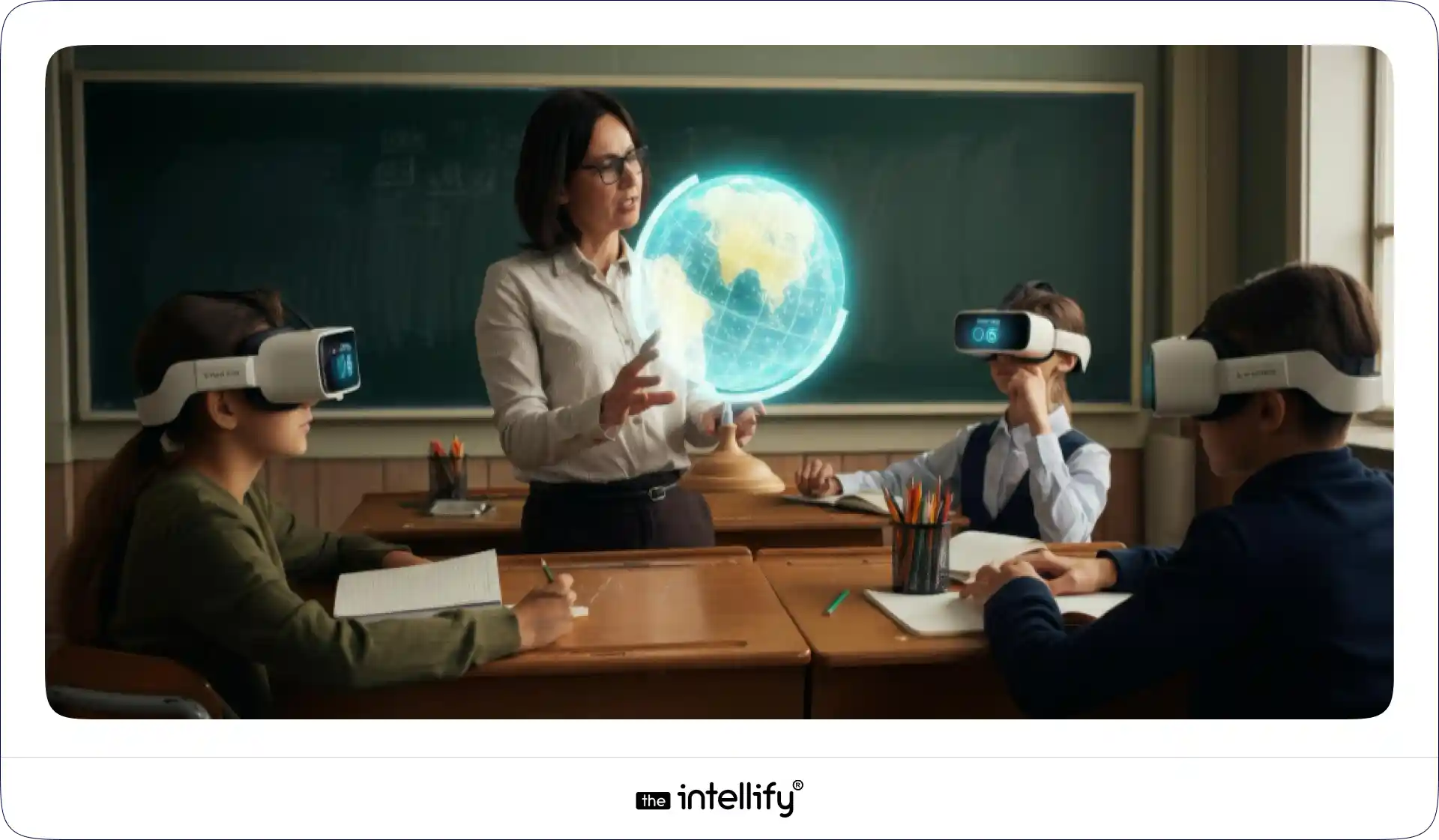
Virtual reality in education refers to computer-generated environments that learners can interact with as if they were physically present. By wearing a VR headset, students are immersed in a digital world where they can look around, move, and engage with objects naturally.

There are different levels of immersion. Fully immersive VR completely replaces the real world, while semi-immersive experiences combine digital environments with some awareness of surroundings. These systems typically use headsets, motion controllers, sensors, and specialized software designed for educational purposes.

Unlike augmented reality, which overlays digital elements onto the real world, VR creates an entirely simulated environment. This makes it especially useful for situations that are difficult, dangerous, expensive, or impossible to recreate in a traditional classroom. From exploring distant planets to practicing complex procedures, VR opens up learning opportunities that were previously out of reach.


The Role of Virtual Reality in Education Today

What once seemed futuristic is now becoming part of everyday learning. Schools, universities, and training institutions across the world are gradually integrating VR into their teaching strategies.

In many cases, VR supplements traditional instruction rather than replacing it. Teachers use it to demonstrate complex ideas, provide virtual field experiences, or allow students to practice skills in realistic scenarios. It is also proving valuable in remote and hybrid learning environments, where immersive interaction can reduce the sense of distance.

Professional education and workforce training are seeing particularly rapid adoption. Fields that require hands-on experience, such as healthcare, engineering, and technical trades, benefit greatly from safe, repeatable simulations. Institutions are increasingly recognizing that immersive tools can improve engagement while better preparing students for real-world challenges.


Key Applications Across Subjects and Training Areas

  • Science and virtual laboratories: Students can run experiments without worrying about safety or cost. No broken equipment. No chemical risks. Just repeat and learn.
  • Medical and healthcare training: Future doctors can practice procedures again and again. No pressure of real patients. It builds confidence slowly but surely.
  • Engineering and technical education: Machines, systems, structures they make more sense when you interact with them. VR lets students take things apart and rebuild them.
  • Humanities and cultural studies: History feels different when you can walk through it. Ancient cities, landmarks, it’s more than just reading dates.
  • Language learning: Instead of memorizing phrases, students actually use them. Conversations feel real. That’s where fluency starts.
  • Vocational and skills training: Construction, manufacturing, equipment handling—these need repetition. VR allows that without risk.
  • Special education support: Some students need calmer, controlled environments. VR can be adjusted to reduce distractions and support different learning needs.


Benefits for Students, Teachers, and Institutions
Benefits of VR in education

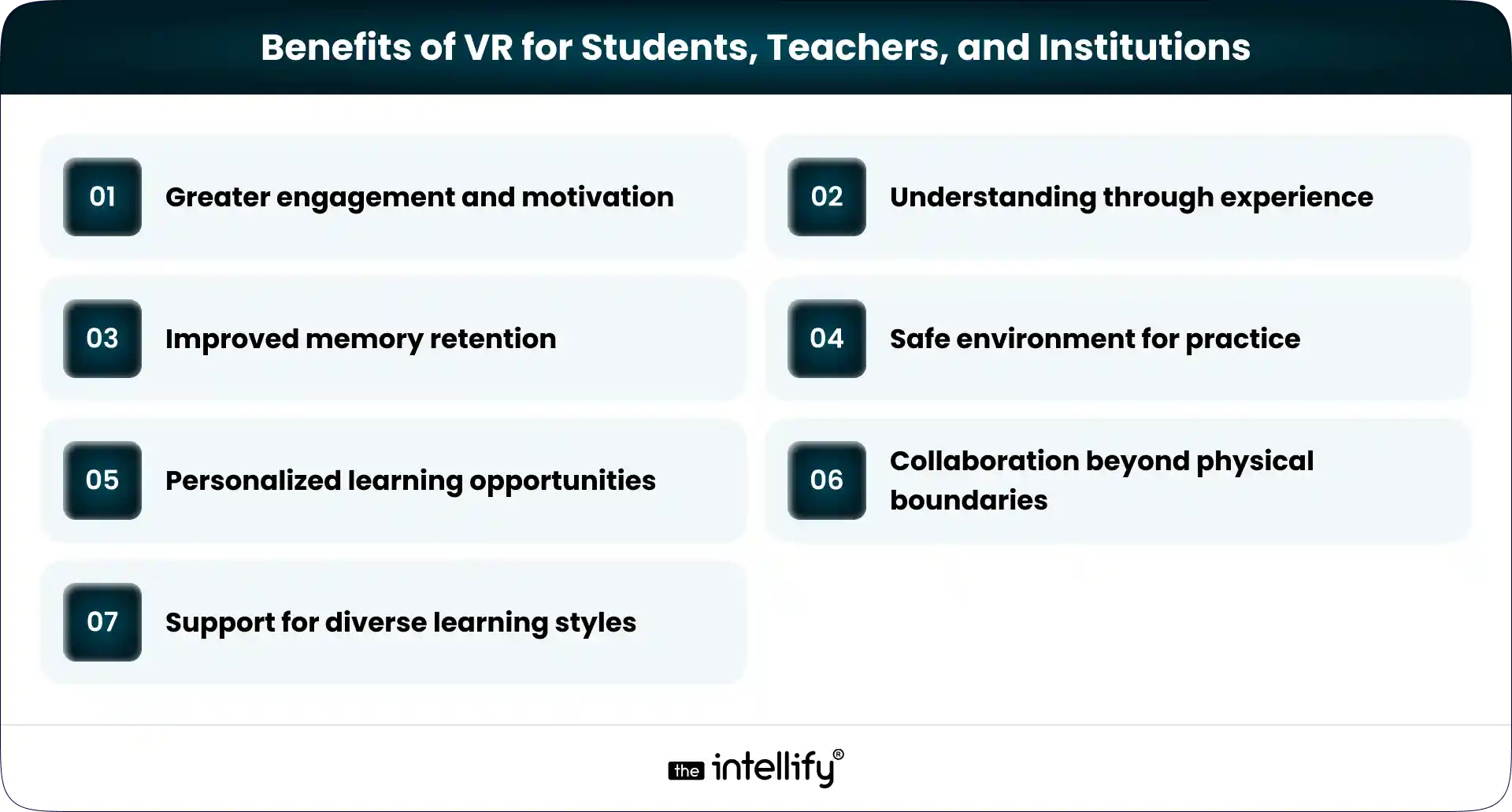
Greater engagement and motivation

Immersive experiences capture attention naturally. Students tend to stay focused longer because they feel involved rather than passive.

Deeper understanding through experience

Seeing and doing often leads to clearer comprehension than reading alone. Complex ideas become easier to grasp when learners interact with them directly.

Improved memory retention

Experiences tend to stay in memory longer than abstract information, helping students recall what they learned.

Safe environment for practice

Tasks that would be risky or costly in real life can be rehearsed without consequences, allowing students to learn from mistakes.

Personalized learning opportunities

Some VR systems adapt to individual progress, enabling students to move at a pace that suits them.

Collaboration beyond physical boundaries

Students can work together in shared virtual spaces, even if they are located in different places.

Support for diverse learning styles

Visual, auditory, and hands-on learners all benefit from immersive environments that combine multiple forms of interaction.

 

VR solutions for education


Real-World Examples of VR in Education

Virtual field trips:

Students explore oceans, space, or historical places without leaving the classroom. No logistics, no travel costs.

University simulations and labs:

Some universities now rely on VR labs for complex subjects. Less theory, more interaction.

Medical and technical programs:

Simulations help students practice before entering real environments. Fewer mistakes later.

Corporate learning initiatives:

Companies use VR to train employees in:

  • Customer service
  • Safety procedures
  • Operations

Measurable engagement gains:

Many institutions report better participation. Students ask more questions. They’re more curious. That’s usually a good sign.


How Augmented Reality (AR) Complements VR in Learning

1. Different approaches to immersion:- VR creates a fully digital environment, while AR enhances the real world with digital overlays. Each serves different learning needs.

2. When AR is more practical:- Activities that require awareness of the physical environment, such as lab work or field studies, often benefit more from AR.

3. Classroom applications:- AR can bring textbooks to life with interactive 3D models, animations, or contextual information displayed on devices.

4. Blended learning possibilities:- Using both technologies together allows students to explore concepts deeply in VR and then apply them in real-world settings using AR.

5. Future of mixed reality:- Emerging technologies aim to merge physical and digital spaces seamlessly, offering even more flexible learning experiences.

One example is the RainbowMe AR storytelling app, where kids scan storybook pages and watch characters come to life around them. This turns reading into an interactive experience, making stories easier to follow and more enjoyable to learn from. You can learn more about this real-world example here:- https://theintellify.com/work/rainbowme-ar-application-for-storytelling/


Challenges and Limitations of Implementing VR Solutions

Bringing virtual reality in education into classrooms sounds exciting, but the reality is a bit more layered.

Cost:

The biggest challenge is still cost. Good VR headsets, compatible devices, and quality content require investment. For schools managing tight budgets, scaling this across classrooms isn’t always practical. Some institutions try to manage this by working with VR development services that offer modular or subscription-based solutions, which can reduce upfront costs but it’s still not a small decision.

Content alignment:

Not every VR experience fits educational goals. If the content doesn’t match the curriculum, it may engage students briefly but won’t deliver real learning value. That’s why many institutions prefer customized solutions built specifically for their needs.

Teacher readiness:

Is another factor. Educators need time to learn, adapt, and integrate VR into lessons. Without proper training, even useful tools can go unused.

Physical limitations

Like motion sickness or eye strain, which limit usage time. Add infrastructure needs space, connectivity, and support and it becomes clear that adoption requires planning.

So yes, the potential is there, but implementation needs to be thoughtful, not rushed.


Opportunities and Future Trends in VR-Driven Learning

More affordable and accessible devices

VR hardware is slowly becoming more practical. Headsets are getting lighter, wireless, and less expensive. That makes it easier for schools to adopt without needing huge budgets. It’s not “cheap” yet, but it’s definitely moving in that direction. Over time, this could shift VR from special labs into regular classrooms.

AI-powered personalized learning

This is where things get interesting. Future VR systems may adjust lessons based on how each student learns. If someone struggles, the system slows down. If they’re doing well, it pushes them forward. It’s not perfect yet, but the idea of learning at your own pace inside an immersive environment feels like a big step.

Virtual campuses and shared digital spaces

Some institutions are already experimenting with virtual campuses. Students attend lectures, interact with peers, and collaborate in shared spaces without being physically present. It still feels a bit early, but you can see where it’s heading.

Global remote classrooms

VR removes location barriers in a very real way. Students from different countries can join the same class, interact, and learn together. It’s not just about access it’s also about exposure to different perspectives, which traditional classrooms don’t always offer.

Workforce training and lifelong learning

Learning doesn’t stop after school anymore. Industries keep evolving, and people need to keep up. VR makes it easier to train for new roles, tools, or processes without disrupting real operations. It’s practical, repeatable, and safer in many cases.

Transformation of education systems

Over time, education may shift away from just delivering information. The focus could move more toward applying knowledge solving problems, building skills, and learning by doing. VR supports that kind of learning naturally, which is why it’s gaining attention.


How Institutions Can Successfully Adopt VR for Learning
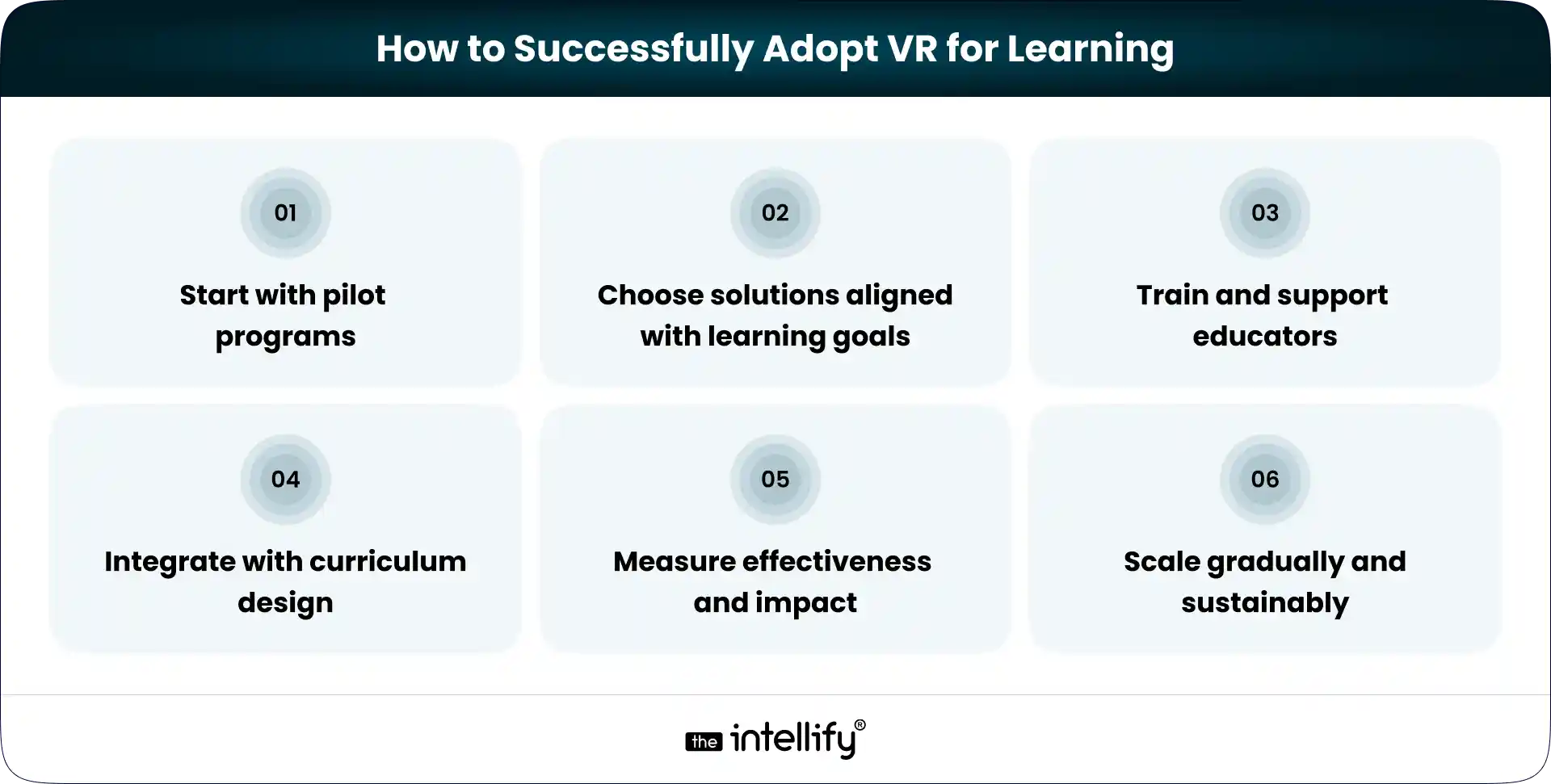
How to Successfully Adopt VR for Learning

Start with pilot programs

Jumping straight into full-scale adoption usually doesn’t work. It’s better to test things first. A small pilot maybe one subject or a limited group helps institutions understand how VR for education actually performs in real conditions. You get honest feedback, spot issues early, and avoid wasting resources.

Choose solutions aligned with learning goals

Not every VR tool fits every subject. Some look great but don’t add real value. Institutions should focus on solutions that directly support what students need to learn. This is where working with experienced VR development services can help custom or tailored solutions tend to align better with actual curriculum needs.

Train and support educators

Teachers are at the center of this. If they’re not comfortable, adoption slows down simple as that. Training should be practical, not overwhelming. Ongoing support also matters, especially in the early stages when things don’t always go as planned.

Integrate with curriculum design

VR shouldn’t feel like an extra activity. It should fit naturally into the lesson. When it supports existing topics rather than replacing them it becomes more useful and easier to manage.

Measure effectiveness and impact

It’s important to track what’s actually happening. Are students more engaged? Are they understanding concepts better? Data, feedback, even small observations all of it helps in figuring out if VR is worth continuing or expanding.

Scale gradually and sustainably

Once things start working, growth should be steady. Expanding step by step reduces risk and keeps things manageable. Many institutions also work with a VR development partner to ensure their solutions can scale without needing constant rework.

Adoption isn’t about rushing. It’s about getting it right, one step at a time.

 

VR Development Services


Final Thought

Virtual reality is redefining how knowledge can be experienced, not just delivered. By making learning interactive, practical, and engaging, it offers new possibilities across academic, professional, and lifelong education.

Its success, however, depends on thoughtful implementation. Technology works best when it supports strong teaching practices rather than trying to replace them. As tools become more accessible and content continues to evolve, immersive learning is likely to become a natural part of education systems worldwide.

The future of learning may not be limited by physical classrooms at all. Instead, it may be shaped by the experiences we can create and virtual reality is opening the door to those possibilities.


Frequently Asked Questions (FAQS)

1. How is virtual reality used in classrooms today?

VR is mainly used to support lessons with interactive experiences. Students can explore virtual labs, historical places, or complex concepts in 3D instead of just reading about them. It helps make learning more engaging and easier to understand.

2. Does VR actually improve learning or just make classes more fun?

It does both. VR makes lessons interesting, but it also helps students remember concepts better because they experience them directly. Learning by doing often leads to deeper understanding than memorizing information.

3. Which subjects benefit the most from VR-based learning?

Subjects that involve practical skills or complex visuals benefit the most. Science, medicine, engineering, and geography are common examples. However, VR can also enhance history, language learning, and vocational training.

4. How is VR different from augmented reality in education?

VR creates a completely digital environment that students can explore, while AR adds digital elements to the real world. VR is more immersive, whereas AR is useful for enhancing classroom activities without isolating learners.

5. What are the main challenges of using VR in schools?

The biggest challenges are cost, equipment needs, and teacher training. Schools also need reliable technology infrastructure and suitable content. Without proper planning, adoption can be difficult.

6. Can VR support online or remote learning?

Yes, VR can create shared virtual spaces where students interact with content and sometimes with each other. This makes remote learning feel more engaging than standard video-based classes. However, it usually works best as a complement, not a complete replacement.

7. What should schools consider before adopting VR?

Schools should first identify clear learning goals and start with small pilot programs. Training teachers and choosing the right content are just as important as buying equipment. A gradual approach helps ensure long-term success.

How Augmented Reality in Education is Transforming Learning Apps for Kids

Summary:
Augmented Reality in education is transforming how children learn by making lessons more interactive, visual, and engaging. Instead of relying only on text or videos, AR allows kids to explore 3D models, animations, and real-world simulations, improving understanding and retention. This blog covers how AR learning apps work, their key features, real-world applications, benefits, challenges, and how they are shaping the future of digital learning experiences for children.


The Shift Toward Interactive Digital Learning for Kids

Kids today are growing up in a world where technology naturally helps them learn. Digital tools are helping kids learn about new things in fun and interesting ways, both in the classroom and at home. Mobile learning apps have been a useful part of this change because they let kids practice math, language, and science outside of the classroom.

But a lot of educational apps still mostly use videos, reading, or quizzes. These tools can give kids useful information, but they don’t always keep them interested. Young learners often learn better when they can do things with what they learn instead of just reading about them.

This is where Augmented Reality (AR) is starting to change the way we learn. AR lets kids explore visual models, animations, and interactive objects in the real world by mixing digital and real-world elements. This makes learning more interesting and keeps kids interested in what they’re learning.


Understanding Augmented Reality in Education

Augmented Reality (AR) in Education

Using a smartphone or tablet camera, augmented reality (AR) adds digital things like 3D models, animations, or visual objects to the real world. The app can put interactive digital content on the screen when kids scan a surface or an image. This makes learning more visual and fun.

AR lets students learn about ideas in educational apps by letting them interact with them instead of just reading about them. Instead of looking at pictures that don’t move, kids can see and touch things like planets, animals, or scientific models. This hands-on method helps kids learn better and makes learning more fun.

Businesses and educational platforms looking to implement this technology can explore dedicated AR for education solutions to create interactive and scalable learning experiences.


Why AR Learning Apps Are Growing in Children’s Education

People are using AR learning apps more and more because they make digital learning more fun. Children can learn by looking at and touching things instead of just watching lessons or reading explanations.

Parents and teachers also like tools that keep kids interested while they learn important things. AR learning apps help with this by encouraging kids to be curious, explore, and take part, which keeps them interested and involved in the learning process.


Core Features That Make AR Educational Apps Effective

AR educational apps include several features that help turn simple lessons into engaging learning experiences.

Interactive 3D models allow children to explore objects such as planets, animals, or historical landmarks from different angles. This helps them understand structure and movement more clearly.

Real-world object recognition is another useful capability. Some apps can recognize images or objects through the device camera and display additional information or animations related to the topic.

Other helpful features include:

  • Interactive storytelling, where storybooks come alive with animated scenes
  • Gamified learning activities that motivate children through small challenges
  • Visual simulations that simplify complex subjects like science or geography

These features help create learning experiences that feel both educational and engaging.


How AR Learning Apps Help Kids Understand Complex Concepts

Some educational topics can be hard for kids to understand when they are only shown in text or diagrams. AR makes these ideas easier to understand by letting students see and interact with them.

For example, A kid who is learning about space can look at a 3D model of the solar system and see how the planets move around the sun. They don’t have to guess how the system works; they can see it in action and touch the model.

AR learning apps also make people want to learn more. Kids become more interested in a subject when they touch and play with things. Learning is more fun and memorable when you do things like look at 3D models of the human body or find real-world objects to learn new words.


AR Education App Development Services


Real-World Applications of AR in Children’s Learning Apps

Augmented Reality is already being used in many educational apps designed for children. These applications demonstrate how AR can make learning more interactive across different subjects.

Some common examples include:

  • AR storybooks that bring characters and scenes to life while children read
  • Science and STEM learning apps that display interactive models of animals, planets, or experiments
  • Language learning apps that connect words with real-world objects
  • Geography and history tools that visualize maps, landmarks, and historical environments
  • Creative exploration apps where children can see their drawings appear in the real environment

These experiences allow children to explore concepts in a more active and engaging way.

One example is the RainbowMe AR storytelling app, where kids scan storybook pages and watch characters come to life around them. This turns reading into an interactive experience, making stories easier to follow and more enjoyable to learn from. You can learn more about this real-world example here:- https://theintellify.com/work/rainbowme-ar-application-for-storytelling/


Key Considerations When Building AR Educational Apps for Kids

It takes a lot of thought and planning to make AR educational apps for kids. The goal is not just to use cutting-edge technology, but also to make learning experiences that are easy to understand and useful.

One important thing to consider is creating age-appropriate interfaces that are right for kids. Kids should be able to use the app without any trouble thanks to clear visual cues and easy-to-follow instructions.

Another important thing is to find a balance between learning and entertainment. Engaging visuals can help grab people’s attention, but the main goal should always be to help them learn.

Developers also need to make sure that the app works well on a variety of devices. Experiences that kids and parents can trust are those that have good performance, easy-to-use controls, and a safe place to learn.

If you’re planning to build a scalable and child-friendly AR solution, working with experts in AR app development can help you avoid common challenges and accelerate your product launch.


Challenges in Developing AR Learning Apps for Children

Although AR offers exciting opportunities for education, developing these apps can also present challenges. Integrating AR technology requires specialized development tools and careful testing to ensure that digital objects appear correctly in the real environment.

Device compatibility is another challenge because not all smartphones or tablets support advanced AR features. This can limit accessibility for some users.

Another important challenge is creating meaningful educational content. AR visuals alone cannot guarantee effective learning. Developers must carefully design lessons and interactions so children truly understand the concepts being presented.


The Future of AR-Powered Learning Apps for Kids

As technology keeps getting better, the future of AR in kids’ education looks bright. As mobile devices get better, AR learning experiences should become more realistic and seamless.

In the future, educational apps may offer personalized learning experiences by changing lessons based on how kids interact with the material. Combining with AI-powered learning platforms could also help make educational tools that are more flexible and responsive.

Augmented reality (AR) may also become more common in classrooms, where teachers use interactive visual models to help students understand difficult topics. Over time, this mix of digital and real-world learning could change the way kids learn about things.


Conclusion

Augmented Reality is gradually transforming how children interact with educational apps. By blending digital content with the real world, AR creates learning experiences that are interactive, visual, and engaging.

Instead of simply reading information, children can explore concepts through interactive models and animations. This approach often helps them understand ideas more clearly while making the learning process more enjoyable.

As educational technology continues to evolve, AR-powered learning apps are likely to play an important role in the future of digital education. By encouraging curiosity, exploration, and visual learning, AR has the potential to make learning more meaningful for young learners.


AR learning app solutions


Frequently Asked Questions (FAQs)

1. How do AR learning apps make digital learning more interactive for kids?

AR learning apps make digital learning more interactive by using 3D models and real-world overlays. Kids can explore, move, and interact with objects instead of just reading or watching. This hands-on experience improves understanding, boosts curiosity, and makes learning more engaging and fun.

2. What makes AR learning apps different from regular learning apps?

AR learning apps differ from regular apps by offering immersive, interactive experiences. Instead of static text or videos, they allow kids to interact with virtual objects in real environments. This helps learners better visualize concepts and improves retention compared to traditional digital learning methods.

3. What subjects benefit the most from AR educational apps?

Subjects that rely on visualization benefit the most from AR educational apps. These include science, geography, astronomy, and language learning. AR helps students understand complex topics by turning abstract ideas into interactive 3D experiences that are easier to grasp and remember.

4. Why do AR-based learning apps keep kids more engaged?

AR-based learning apps keep kids engaged by turning lessons into interactive experiences. Children can touch, explore, and experiment with digital objects, making learning feel like play. This active involvement increases attention span and helps kids retain information more effectively.

5. Can AR learning apps be used outside the classroom?

Yes, AR learning apps can be used anywhere with a smartphone or tablet. They allow students to learn at home, while traveling, or during free time. This flexibility encourages continuous learning and helps kids stay engaged even outside traditional classroom settings.

6. How will AR shape the future of children’s learning apps?

AR will shape the future of learning apps by making education more immersive and personalized. As technology advances, apps will adapt to individual learning styles and provide real-time interactive experiences. This will make learning more effective, engaging, and tailored to each child’s needs.

How Augmented Reality Is Redefining the Furniture Industry

Summary
Augmented Reality is changing how people explore and buy furniture by allowing them to visualize products in their own spaces before making a purchase. This technology helps reduce uncertainty, improves buying confidence, and creates a more interactive shopping experience. In this blog, we explore how AR is being used across the furniture industry, its benefits for businesses and customers, and what the future of AR in furniture retail may look like.

Augmented Reality(AR) puts digital elements into the real world, using a smartphone or tablet. Rather than wonder how a piece of furniture might appear in your house, AR shows you immediately.

Imagining what it will look like in one’s home has always been part of buying furniture. We imagine how a sofa will sit in the living room or if a table will coordinate with the wall colour. Even online shopping sounds doubtful, and that’s with all of its ease.

Customers demand greater certainty before making a purchase, particularly when buying high-value products. They want confidence, not guesswork. AR is becoming so crucial, which is the reason. It’s not just enhancing the shopping experience it’s transforming how furniture is experienced, marketed and sold.


The Furniture Industry Before AR

Furniture retail relied on physical showrooms before AR.” Customers needed to visit stores to try products, touch materials and understand size.

Shopping moved online, and convenience improved, but so did uncertainty. Photos and measurements were helpful, but a lot of shoppers still found it difficult to picture how a product would look in their own homes.

This often led to hesitation. It takes a lot of confidence to buy big purchases such as beds, wardrobes, or sofas. Without it, buyers postpone decisions or skip purchases entirely.

Return rates, too, became a problem. Products returned when expectations and reality failed to align. Resource taxes increased the burden on brands, creating additional costs and operational pressure.


 What Augmented Reality Means for the Furniture Industry

From a broader business perspective, AR in furniture is more than a feature. It connects digital browsing with the real-world environment. Instead of relying only on static images, customers can interact with products. They can place furniture inside their own rooms and see how it fits before buying.

This shifts the buying journey from imagination-based to experience-based. Customers move from guessing to seeing.

AR also supports a connected retail journey. A shopper may explore online, visualize at home, and visit a store for final confirmation. Since AR works directly on smartphones, it is far more practical for furniture retail than more complex technologies.


How Augmented Reality Is Transforming the Customer Experience

Real-Time Room Visualization

One of the biggest advantages of AR is true-to-scale placement. Customers can position furniture in their room and view it from different angles.

They can check spacing, alignment, and overall fit. This makes measurements easier to understand because the product appears in context.

Personalization & Customization

AR enables customers to test different colors, finishes, and materials. A wooden table will always look darker or lighter.

Customers can experiment with layout options and compare styles without needing to move tangible goods. It turns the process of writing to engage with readers.

Confident Buying Decisions

Customer skepticism naturally diminishes when they can visualize how a product will fit in their own home. They are more confident in their decision. The clearer the visualization, the clearer the decision.


Business Benefits of AR for Furniture Brands

1. Increased Conversion Rates

If customers are confident, they will make the purchase. AR eliminates ambiguity that can lead to indecision.

2. Reduced Product Returns

More visualization leads to fewer surprises later in delivery. This means decreasing return rates when customers know what to expect.

3. Higher Customer Engagement

Interactive experiences increase dwell time on websites and apps. In fact, customers are more engaged when they proactively explore products.

4. Stronger Brand Positioning

Offering AR makes brands look innovative and customer-focused. This creates an image that is modern and aspirational.

5. Improved Customer Retention

Positive buying experiences create trust. Happy customers are returning customers and potential brand advocates.


AR for furniture solutions


Examples of Augmented Reality in the Furniture Industry

IKEA

After all, IKEA was among the first furniture brands to come up with AR by introducing the IKEA Place app. An app that lets you see life-sized models of furniture sitting in your living room using your smartphone camera.

This allows shoppers to visualize how a sofa, chair or table would look and fit in their space before buying it. This new feature employed early is what helped IKEA make online furniture shopping more feasible and assured.

Wayfair

Wayfair embeds augmented reality directly in its mobile app, allowing shoppers to see how furniture would look in their homes. Users can put items in their room and see them from various angles to measure size and placement.

Because Wayfair sells furniture primarily online, this feature assists customers in sorting through their options more easily and feeling more confident about selecting large items.

Overstock

Similarly, Overstock implemented augmented reality to enhance the online shopping for furniture. The mobile app allows customers to visualize furniture items in their own rooms before they place an order.

That makes it easier to conceptualize scale and layout, which in turn reduces uncertainty when ordering furniture online.

Amazon

AR View a feature that enables customers to see what furniture and home products would look like in their homes with a smartphone.

Shoppers can move virtual items around and see how they compare with other furniture. This functionality enhances the online browsing of products and aids customers in faster purchase decision-making with confidence.

KisTag

KisTag has explored augmented reality to help customers visualize kitchen furniture and storage solutions within their space. This allows users to understand layout, size, and placement before selecting a product.

Kis Tag also collaborated with The Intellify to implement an AR experience for kitchen furniture visualization. To explore the complete project implementation and results, readers can view the detailed case study.:-  https://theintellify.com/work/kistag-ar-and-vr-solution/.


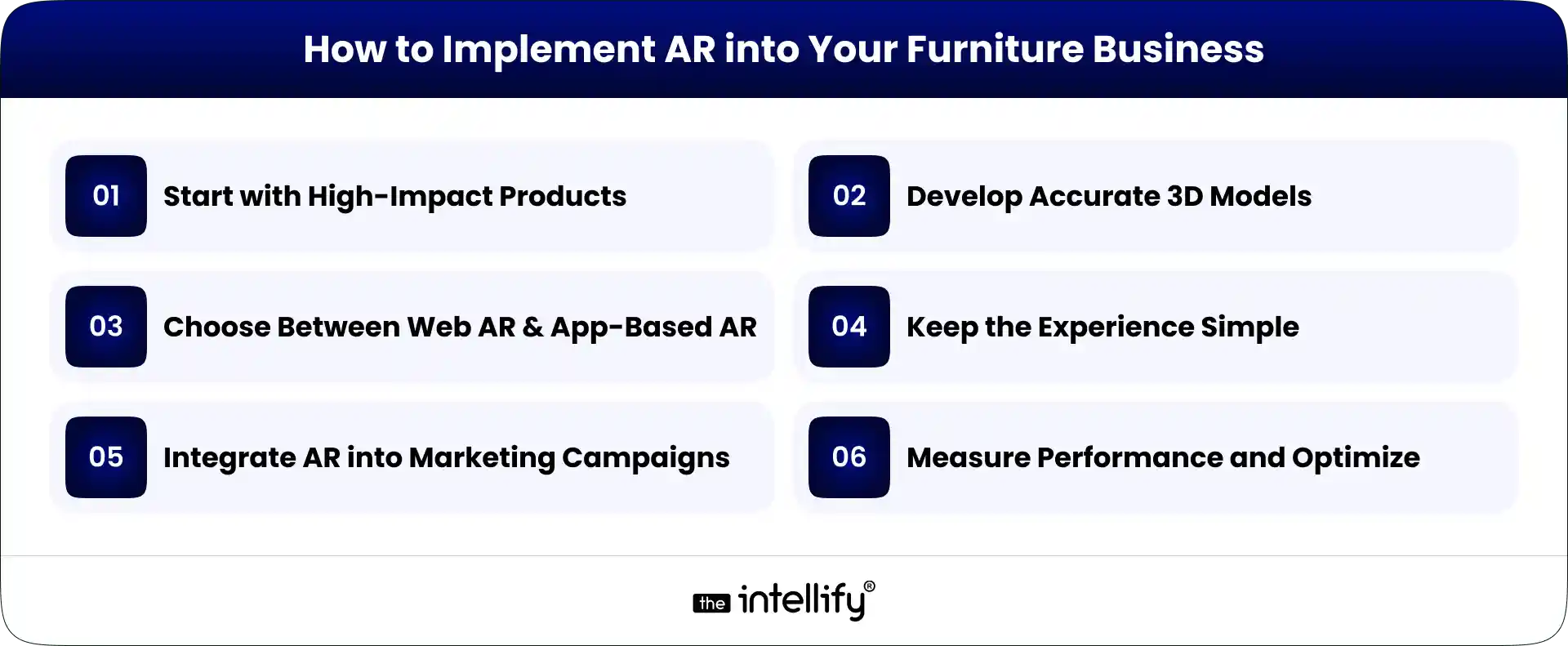
How to Incorporate AR into Your Furniture Business

Implement AR into Furniture Business

Start with High-Impact Products

First, focus on products in which size and fit are of the greatest importance, like sofas, beds and dining tables. These matters are best aided through visualization. Launching AR with selected products allows you to test impact before expanding further.

Develop Accurate 3D Models

Accuracy builds trust. Models have to closely mirror real-world item dimensions, materials and colors. When customers see realistic visuals, confidence increases. Poor rendering can create confusion instead.

Choose Between Web AR and App-Based AR

Web AR enables customers to use the feature straight from a browser. That way you don’t have to download it. App-based AR can have more additional features, so the right option is highly dependent on your customer behavior and goals.

Keep the Experience Simple

It should be a simple and straightforward process. If customers find this feature hard to activate, they might just not use it. How easy it is to figure things out, whether the program loads up quickly.

Integrate AR into Marketing Campaigns

Clearly advertise AR on product pages, ads and social channels. Customers must know that it exists. Showcasing the advantage of viewing items within their own environment boosts interaction.

Measure Performance and Optimize

Analyze metrics like engagement time, conversions, and return rates post-AR implementation. Utilize these insights to progressively enhance models, broaden features and user experience.


AR in Physical Stores and Hybrid Retail

AR also enhances in-store experiences. Interactive displays allow customers to browse more choices without adding physical inventory.
Endless aisle concepts enable shoppers to digitally browse even more products as they’re in the store. It is also a boon for hybrid shopping, linking online and offline elements into one seamless journey.

A customer may research a product online, see how it looks in their own home through AR, and visit the store to complete the purchase.


Challenges of Implementing AR in Furniture

This effort also involves investment in 3D modeling and technology integration. But furniture brands have to plan the implementation well in advance so that it works seamlessly within their digital platforms.

There are also potential compatibility issues for devices. Some customers may require some help to use the feature comfortably. It is therefore also important to maintain the outlook, having accurate sizing, textures, and details of the product helps in building trust and improving the experience.


 Opportunities and Emerging Trends

Adoption of AR use cases requires 3D modeling and technology integration investment. Long-term, this will add value to their e-commerce platforms, but it needs to be implemented carefully so that the infrastructure can accommodate and deliver it successfully.

There could also be some compatibility challenges on different devices. Certainly, some customers will require help using the feature. It is also crucial to stay true to the visuals, as accurate sizing, textures and product details build trust and enhance the overall experience.


The Future Outlook for AR in Furniture

AR is gradually becoming part of core retail strategy rather than an optional feature. As customers expect more clarity and interaction before buying, visualization tools will likely become standard across online furniture platforms.

In the future, AR may also support design planning and help brands understand customer preferences based on how people interact with products in their own spaces.

Companies that invest thoughtfully in AR today are likely to build stronger competitive positioning tomorrow, as furniture shopping continues to shift from guessing about products to experiencing them before purchase.


AR Furniture App solutions


Conclusion

Augmented Reality is redefining the furniture industry by reducing uncertainty and improving clarity. It helps customers make confident decisions while also supporting brands through better engagement and overall performance.

AR-powered visualization tools enhance the buying experience and reduce hesitation during the purchase process. As customer expectations continue to evolve, AR will become increasingly common across furniture retail. Businesses that adopt it strategically and focus on delivering real value will be better positioned to meet changing customer expectations and remain competitive in the market.


Frequently Asked Questions (FAQs)

1. How is augmented reality used in the furniture industry?

Augmented reality is used to let customers place virtual furniture inside their real rooms using a smartphone or tablet. It helps them see how a sofa, table, or bed will look and fit before buying. Brands use AR to improve shopping confidence, reduce returns, and make the buying experience more interactive.

2. How does AR help customers choose the right furniture?

AR allows customers to visualize furniture in their own space at true scale. They can check size, layout, and style instantly. This removes guesswork and makes decision-making easier, especially for large or expensive items.

3. How accurate is augmented reality for furniture placement?

Most AR tools are quite accurate when placing furniture in a room. They use your phone’s camera and sensors to measure space and adjust the size correctly. While lighting and room setup can slightly affect precision, the preview is usually reliable enough to help customers make confident decisions.

4. How does augmented reality improve online furniture conversion rates?

AR improves conversion rates by reducing hesitation during the buying process. When customers can visualize products in their own space, they feel more confident and are more likely to complete their purchase rather than abandon their cart.

5. Is AR expensive for furniture companies to implement?

There is an initial investment in creating 3D models and integrating the technology. However, many brands see long-term value through higher sales and lower return costs. Over time, AR often becomes a smart strategic investment rather than just a tech upgrade.

6. Can customers customize furniture using augmented reality?

Yes, many AR tools allow customers to change colors, materials, and finishes in real time. This makes the experience more personal and helps buyers choose styles that match their home decor.

How Augmented Reality is Transforming Online Shopping in E-commerce

Summary:
Online shopping often means customers cannot often physically experience products, which creates uncertainty for customers. This blog explains how Augmented Reality (AR) helps solve that by allowing shoppers to visualise products in real-world settings before buying. It covers how AR improves product understanding, boosts confidence, and reduces returns, along with real use cases, benefits, challenges, and what the future of interactive shopping could look like in e-commerce.


The Changing Landscape of Online Shopping

Online shopping has quietly become part of everyday life. Most people don’t even think twice anymore before ordering something from their phone, whether it’s a pair of shoes, a phone charger, or even a sofa.

But there’s still one small frustration that never really went away. You can’t touch the product. You can’t try it. And sometimes… you just don’t know if it’ll look good once it arrives. Almost everyone has had that moment, opening a package and thinking, “This looked better online.” That uncertainty is still there, even today.

This is where technologies like Augmented Reality (AR) are starting to make a difference. Instead of guessing, people can now actually see how a product might look in real life. It doesn’t completely replace physical shopping, but it gets surprisingly close. And slowly, this is changing how people shop online.


Understanding Augmented Reality in E-commerce

Augmented Reality, or AR, sounds complicated at first, but it’s actually pretty simple. It just means adding digital elements into the real world using your phone’s camera.

For example, you point your camera at your living room, and suddenly, there’s a virtual chair sitting in the corner. It’s not really there, but it looks real enough to help you decide.

In e-commerce, this solves a very basic problem: imagination. Instead of trying to picture how something might look, customers can actually see it. That small shift makes a big difference.

It’s also worth clearing up one common confusion. AR is not the same as Virtual Reality (VR). VR takes you into a completely digital world. AR, on the other hand, keeps you in the real world and just adds things to it. And the best part? You don’t need any fancy headset. Just a smartphone… which most people already have in their hands anyway.


Market Demand for Interactive Shopping in E-commerce

Customer expectations have changed. A lot. Earlier, a few product images and a short description were enough. Now, that feels… incomplete. People want to know:

  • How big is it really?
  • Will it match my space?
  • Will it suit me?

Because of this, many e-commerce businesses are slowly moving toward more interactive experiences. Not because it’s trendy, but because customers expect it. Big brands started experimenting with this first, but now even mid-sized retailers are catching up. The competition is getting tighter, and just listing products isn’t enough anymore.

If a customer can experience a product before buying, even in a small way, they’re more likely to trust what they’re seeing. And trust, in online shopping, matters a lot.


How Augmented Reality Enhances the Online Shopping Experience

One of the biggest improvements in online shopping is the ability to explore products more realistically. Instead of relying only on static images, customers can now view items in 3D and examine them from different angles.

Many retailers also offer virtual try-on features for products like glasses, accessories, and cosmetics. This allows shoppers to see how an item may look on them before making a purchase.

Another useful feature is real-world product placement. For example, someone buying furniture can place a digital sofa or table in their living room using their phone camera to see how it fits within the space.

By allowing shoppers to interact with products before buying, AR brings a level of clarity that traditional product images often cannot provide. This helps customers feel more confident when making purchase decisions.


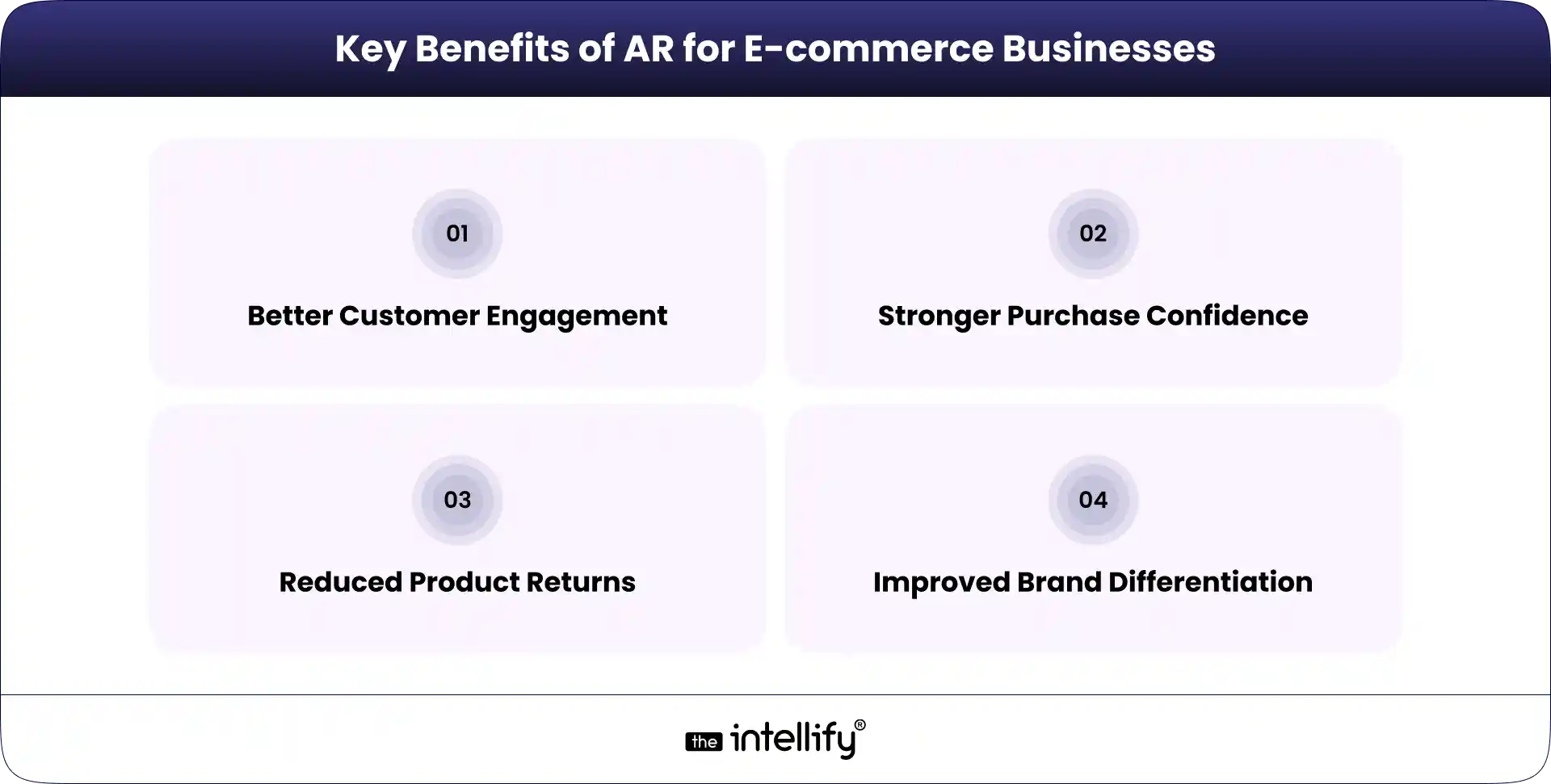
Key Benefits of AR for E-commerce Businesses

Benefits of AR for E-commerce Businesses

Introducing interactive experiences isn’t just about looking modern. It actually solves real problems for businesses.

  • Better Customer Engagement: When people can interact with products, they naturally spend more time exploring. It’s not forced it just happens.
  • Stronger Purchase Confidence: Seeing a product in context helps customers feel more sure about their decision. Less guessing, fewer second thoughts.
  • Reduced Product Returns: This one’s big. When customers know what to expect, they’re less likely to return items later.
  • Improved Brand Differentiation: Let’s be honest, most online stores still look the same. Adding interactive features makes a brand stand out without shouting for attention.

These benefits show why many online retailers are exploring such technologies as part of their long-term digital commerce strategy.


Industries Successfully Using AR for Online Shopping

Several industries have already started using AR for online shopping to improve product experiences.

Fashion and apparel industry: virtual fitting tools help customers see how clothes or accessories might look. It’s not exact, but it’s helpful.

Beauty and cosmetics sector: allows users to test different makeup shades digitally using their phone camera, helping them choose products more confidently.

Furniture and home décor industry, customers can see how items such as sofas, tables, or lamps will appear inside their living spaces before placing an order.

Eyewear industry also uses virtual try-on tools that allow shoppers to see how different frames suit their face.

Even industries like electronics and automotive are experimenting with similar ideas showing features more interactively instead of just listing them.

As these tools become easier to implement, more industries are expected to adopt them to improve how customers explore products online.


AR Solutions for E-commerce


Challenges and Limitations of AR in E-commerce

Of course, it’s not all smooth. Creating these experiences takes effort. Building accurate 3D models isn’t quick, and it’s definitely not cheap.

Device compatibility is another issue. Not all smartphones support advanced AR features, especially older ones. Then there’s the user side of things. Some people still find these tools confusing or simply ignore them.

There’s also the matter of privacy. When apps ask for camera access, users can feel a bit unsure and that hesitation is understandable. So yes, there are challenges. But despite that, many businesses are still exploring AR because the potential upside is hard to ignore.


The Future of AR in E-commerce Industry

The future of interactive shopping experiences looks promising as technology continues to improve.

Since most online purchases already happen through smartphones, mobile devices will likely remain the primary platform for these features. This makes it easier for shoppers to access them without needing additional hardware.

We may also see deeper integration with technologies like artificial intelligence to create more personalized product recommendations. Virtual showrooms and digital product demonstrations could become more common, helping customers explore items in more engaging ways.

As digital commerce continues to evolve, AR is likely to become a common feature that helps shoppers make more informed decisions online.


Conclusion

Online shopping isn’t standing still. It keeps changing, sometimes slowly, sometimes all at once.  AR in E-commerce are helping close the gap between digital and physical shopping. They don’t solve everything, but they make product understanding clearer and that matters.

When people can see how something might look or fit before buying, they feel more comfortable making a decision. For businesses, this means fewer returns, better engagement, and stronger trust over time. It’s not about adding flashy features. It’s about making the experience a little more real. And honestly, that’s what most shoppers were missing all along.


AR for E-commerce Solutions


Frequently asked questions (FAQs)

1. Why are e-commerce brands investing in Augmented Reality features?

Because basic product images don’t always answer real questions. Brands are using AR to make product browsing feel a bit more real. When people can actually see how something might look or fit, they spend more time exploring and usually feel more confident before buying. It’s not magic, but it definitely helps.

2. Which products benefit the most from Augmented Reality in online stores?

Anything where looks or fit matter. Furniture is a big one you want to know if it fits your space. Same with clothes, glasses, or even makeup. Home décor items too. Basically, if you’ve ever thought “Will this actually look good?”… that’s where AR helps the most.

3. Can Augmented Reality help reduce product returns in e-commerce?

Yes, and this is one of the main reasons businesses care about it. When people know what they’re getting, there are fewer surprises later. And fewer surprises usually mean fewer returns. It doesn’t eliminate returns completely, but it definitely reduces them.

4. Do customers need special devices to use Augmented Reality while shopping online?

No, not really. Most AR features work directly on a smartphone or tablet. You just open the camera, and that’s it. No headset, no extra setup. Which is probably why more people are actually starting to use it.

5. Does Augmented Reality influence customer buying decisions?

Yes… more than you might expect. A lot of online shopping hesitation comes from uncertainty. When you remove some of that—by showing how a product might look in real life people feel more sure. And when they feel sure, they’re more likely to buy.

6. What challenges do businesses face when introducing Augmented Reality in e-commerce?

It’s not as easy as it looks.

Creating accurate 3D models takes time. Making sure everything works smoothly across different devices can also be tricky. And yes, it needs investment.

But even with these challenges, many businesses are still moving forward with it because the long-term benefits are hard to ignore.

Augmented Reality Storytelling: Turning Brand Stories into Immersive Experiences

Summary:
This blog explores how Augmented Reality Storytelling helps brands create deeper engagement through immersive, interactive experiences. It explains what AR storytelling is, how it works, real-world brand examples, key benefits, and common use cases across industries. The article also covers essential features of an AR storytelling app, how to choose the right AR app development company, and what the future holds for AR-enhanced storytelling in brand communication.

Storytelling used to be simple. A picture. A headline. Maybe a video if the budget allowed. People watched, nodded, and scrolled on. These days, though, attention is hard to earn and even harder to keep. Most users decide in seconds whether something is worth their time.
That’s where Augmented Reality Storytelling quietly steps in. Not loud. Not flashy. Just… more real. It doesn’t shout at people. It invites them in. And when done right, it feels less like marketing and more like an experience someone remembers later while waiting for coffee, or telling a friend, or thinking, “That was actually kind of cool.”


What Is Augmented Reality Storytelling?

At its core, Augmented Reality Storytelling is simple. It blends a story with digital elements like 3D visuals, animations, and sounds layered onto the real world through a phone, tablet, or wearable device. The story doesn’t live on a flat screen anymore. It exists around the user.

Unlike traditional storytelling, AR Storytelling lets people interact. They don’t just watch. They move, tap, and explore. Sometimes they even shape how the story unfolds.

Think of it as reading a book where the characters step off the page and stand right in front of you. Slightly surreal. Very engaging.


Why Brands Are Investing in AR Storytelling

Most brands aren’t struggling with ideas. They’re struggling with attention. People skip ads. They ignore banners. They mute videos. And honestly, you can’t blame them. We’ve all done it.

Augmented Reality Storytelling works because it changes the dynamic. Instead of asking for attention, it earns it. Here’s why brands are leaning in:

  • People spend more time with interactive content
  • Experiences are remembered longer than messages
  • Users feel involved, not sold to

There’s also emotion involved. Curiosity. A small spark of surprise. Sometimes even joy. Those feelings matter more than click-through rates ever will.


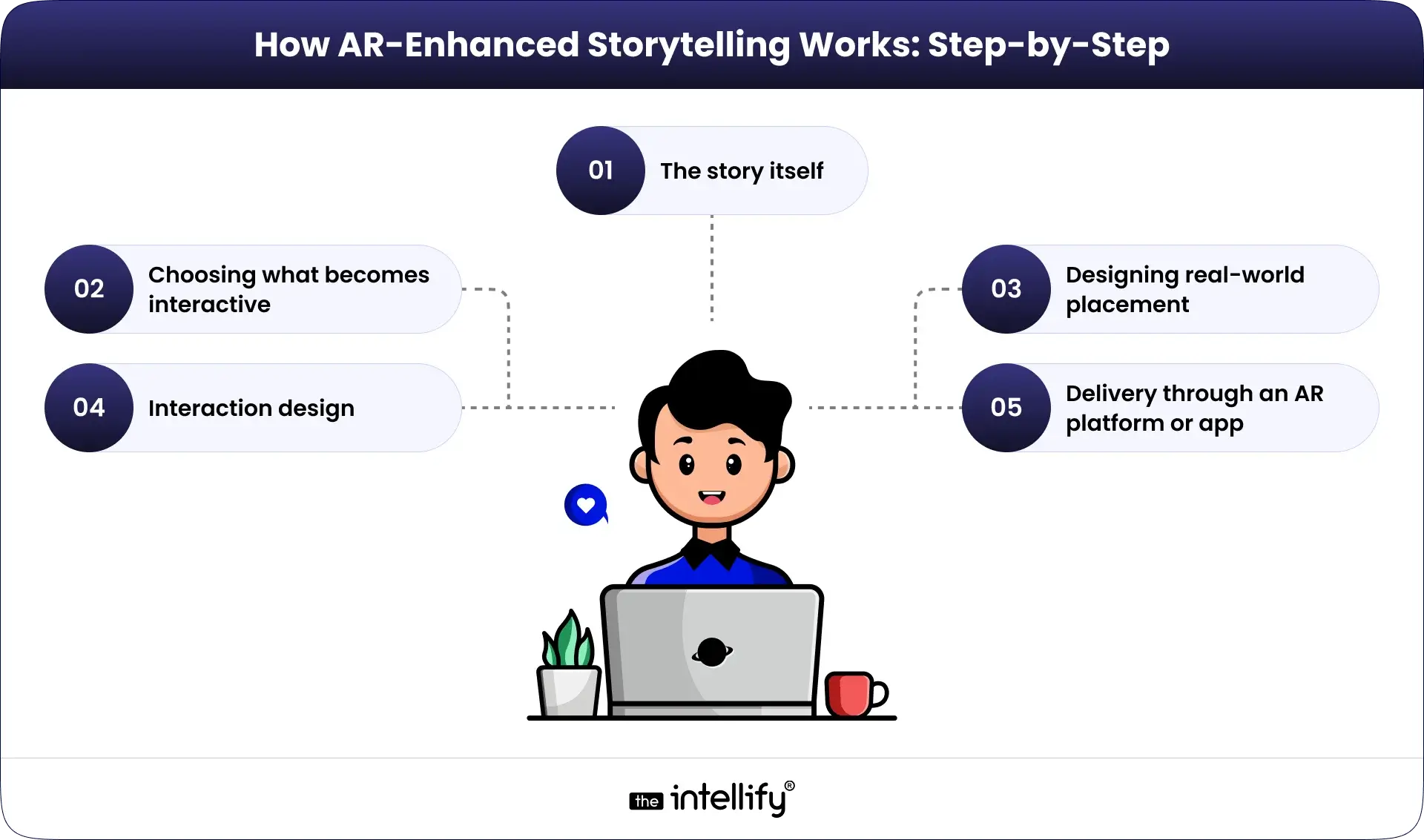
How AR-Enhanced Storytelling Works (Step-by-Step)

How AR-Enhanced Storytelling Works

AR-enhanced storytelling doesn’t begin with code or 3D models. It starts much earlier, often with a simple question: what do we want people to feel?

Step 1: The story itself.

This is the part many brands rush. A good AR experience doesn’t exist just to look impressive. It needs a clear narrative, something with a beginning, a middle, and a reason to care. It could be a product journey, a brand origin, or even a small moment that reflects a value.

Step 2: Choosing what becomes interactive.

Not everything needs to move. Some elements stay subtle. A floating object here. A character appears there. The best AR storytelling feels intentional, not crowded.

Step 3: Designing real-world placement.

This is where AR becomes different from video. Objects must feel like they belong in the user’s space. A table. A wall. A street corner. If placement feels off, users notice instantly.

Step 4: Interaction design.

Taps, swipes, movement, distance. These actions guide the story forward. Nothing should feel confusing. If users hesitate, the story breaks.

Step 5: Delivery through an AR platform or app.

Often this happens through a dedicated AR Storytelling App, built to handle performance, visuals, and analytics without friction.

When all steps align, the tech disappears, and the story stays.


Real-World Examples of AR Storytelling by Brands

AR storytelling shows up in everyday places now, even if people don’t label it as such.

  • Retail: Customers scan packaging and unlock stories about how a product was made, who designed it, or how it fits into real life. It feels personal. Almost quiet.
  • Entertainment: AR lets fans step inside scenes, explore characters, or unlock short narratives tied to shows or films. Not trailers, extensions of the story.
  • Education and museums: AR overlays bring history back into physical spaces. Old photographs turn into moving scenes. Voices return. People linger longer than planned.
  • Tourism: Cities use AR to recreate lost buildings or events right where they once stood. Standing there, phone raised, people pause. You can almost see it in their faces.

These experiences work because they don’t feel like campaigns. They feel discovered.


AR Storytelling Case Study: RainbowMe by The Intellify
To see how AR storytelling works in real life, take a look at RainbowMe, an AR storytelling application developed by The Intellify.
The app brings stories to life by letting users see and interact with characters in their own space. Instead of passively reading or watching, users explore the story through simple AR interactions. The focus stayed on smooth performance, child-friendly design, and clear storytelling. This project shows how AR storytelling apps can create meaningful engagement when the story comes first.

👉 View the full case study here:

RainbowME


Benefits of Augmented Reality Storytelling for Brands

This isn’t about trends. It’s about results that feel human. Some clear benefits brands notice:

  • Longer attention spans: When people interact, they slow down. AR experiences naturally extend time spent with a brand.
  • Stronger emotional memory: Stories layered into real space trigger emotion differently. Users remember the feeling, not just the message.
  • Higher brand trust: Interactive storytelling feels transparent. Brands aren’t talking at people, they’re inviting them in.
  • Organic sharing: People share AR experiences because they’re unexpected. Not because they’re told to.
  • Better insight: Behind the scenes, brands learn how users move, pause, interact, or drop off valuable data without intrusive tactics.
    It’s not perfect every time. Some experiences flop. But when it works, it works quietly and deeply.


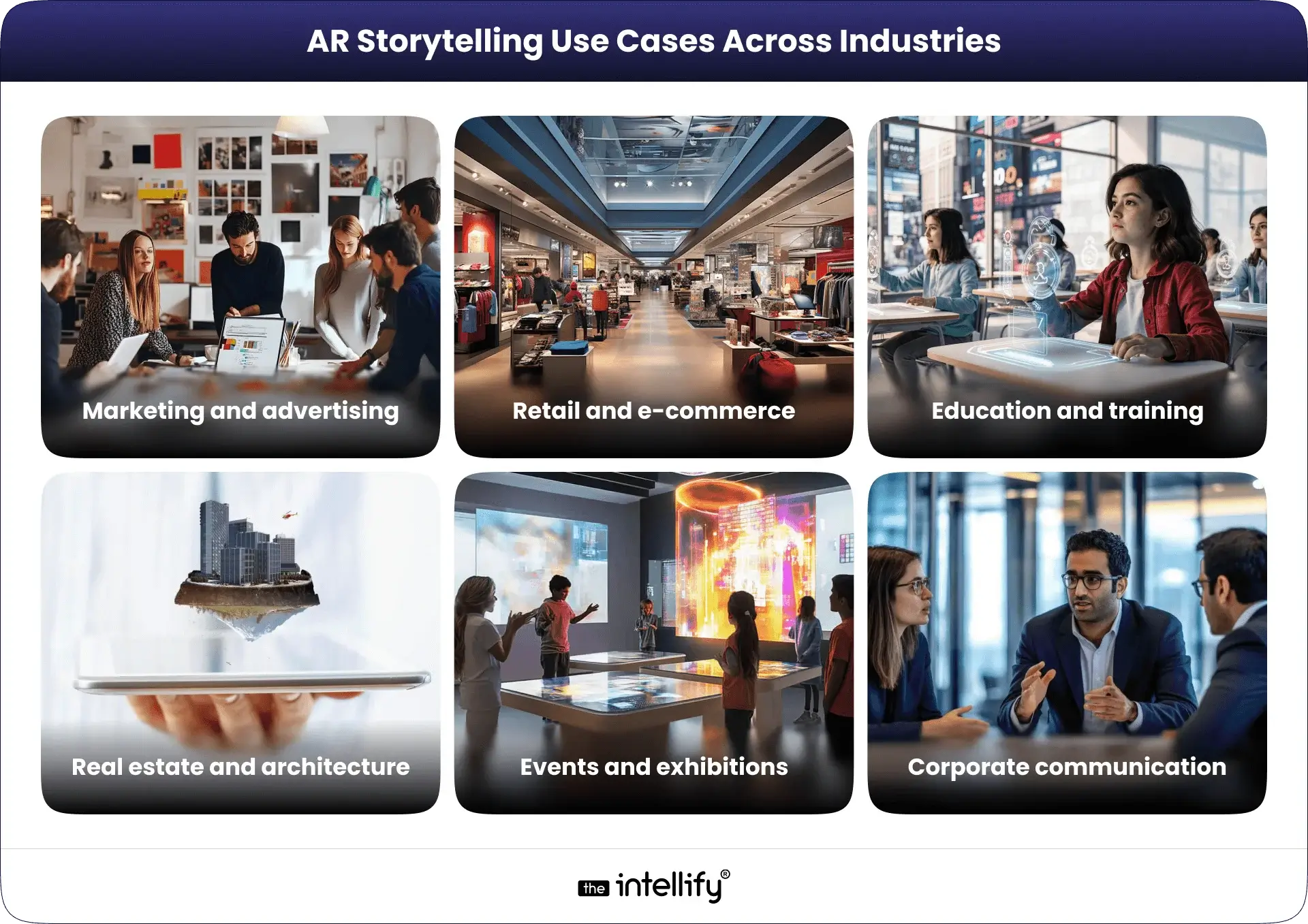
Use Cases of AR Storytelling Across Industries

Use Cases of AR Storytelling

1) Marketing and advertising: Campaigns become experiences people choose to engage with, not skip.

2) Retail and eCommerce: Products come with context. Stories replace static descriptions.

3) Education and training: Lessons feel lived-in. Learning sticks longer when people explore instead of memorize.

4) Real estate and architecture: Spaces tell their own stories before they exist physically.

5) Events and exhibitions: Booths stop being booths. They become narrative environments.

6) Corporate communication: Onboarding, values, and culture feel human instead of procedural.

Different industries. Same outcome: deeper connection.


Key Features of a Successful AR Storytelling App

A good AR Storytelling App doesn’t feel complicated. If it does, something went wrong. Strong apps usually include:

1) Ease of use: If someone needs instructions, the experience has already lost momentum.

2) Smooth performance: Lag breaks immersion instantly. Stability matters more than effects.

3) Thoughtful interaction design: Every tap or movement should feel purposeful, not gimmicky.

4) Cross-device compatibility: Users shouldn’t worry about what phone they’re holding.

5) Scalable architecture: Stories evolve. The app should grow with them.

6) Analytics without intrusion: Understanding engagement without disrupting the experience is key.

People notice when an app stutters or feels clunky. And they leave fast. Performance matters more than fancy tricks.


Challenges Brands Face with AR Storytelling


How to Choose the Right AR Storytelling App Development Partner

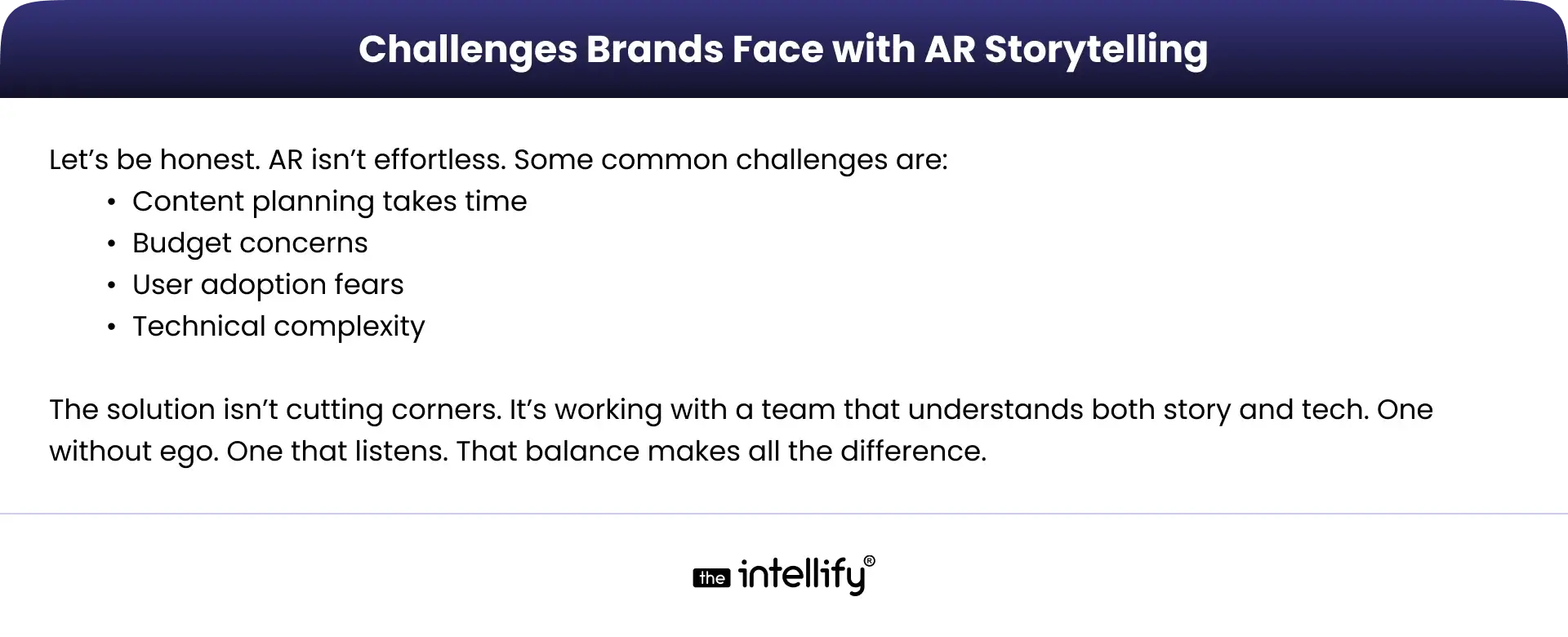
This decision shapes everything. Choosing an AR development partner isn’t just a technical decision. It’s a creative one. And honestly, this is where many AR storytelling projects either come together or quietly fall apart.

A good partner won’t start by talking about tools or frameworks. They’ll start by asking why you want to tell this story in the first place. A reliable partner should:

  • Understand storytelling, not just code
  • Have real AR project experience
  • Build custom solutions, not templates
  • Offer post-launch support
  • Think about scale from day one

If they jump straight into features without asking about your story, pause. That’s usually a red flag.


Future of Augmented Reality Storytelling

The future of AR storytelling isn’t about louder visuals or bigger effects. It’s moving in the opposite direction toward subtle, everyday experiences that blend naturally into real life.

We’re seeing:

  • AI-driven story personalization
  • Growth of WebAR experiences
  • AR Blending with AI and Spatial Computing
  • From Campaigns to Long-Term Experiences
  • Faster adoption in everyday marketing

It won’t replace traditional storytelling. It will sit beside it. Like another tool. A powerful one.


Build an AR Storytelling


Conclusion: Why AR Storytelling Is the Future of Brand Engagement

People don’t remember slogans. They remember how something made them feel. Augmented Reality Storytelling works because it turns stories into moments users can explore, not just watch. When a story exists in the real world, even briefly, it feels more personal and easier to remember.

This isn’t about using AR for the sake of it. It’s about giving people space to engage on their own terms. Brands that focus on meaning, not spectacle, tend to get it right. As immersive tech becomes more common, thoughtful storytelling will matter more than novelty. The brands that start building those experiences now will be the ones people remember later.


Frequently Asked Questions (FAQs)

1. What is Augmented Reality Storytelling, and how is it different from normal ads?

Augmented Reality Storytelling places a brand’s story into the real world using interactive digital elements. Unlike normal ads, users don’t just watch, they explore, move, and engage at their own pace. This makes the experience feel less promotional and more personal, which helps people remember the message longer.

2. What practical benefits can brands expect from AR storytelling?

Brands usually see longer engagement time, better brand recall, and stronger emotional connection. Because users interact with the story instead of scrolling past it, AR storytelling often leads to higher trust and more meaningful interest compared to traditional digital content.

3. Do I need a native app to run AR storytelling, or can I use WebAR?

Both options work. WebAR is faster to launch and doesn’t require downloads, making it ideal for quick campaigns. A native AR storytelling app offers deeper interaction, better performance, and long-term use. The right choice depends on your goals, audience, and how often you plan to use AR.

4. How long and how much does it take to build an AR storytelling app?

Timelines depend on complexity. A basic AR experience can take a few weeks, while a full AR storytelling app may take several months. Cost varies based on design depth, 3D content, and features. Clear planning early on helps control both time and budget.

5. Which industries benefit most from AR storytelling?

Retail, e-commerce, education, entertainment, real estate, tourism, and events benefit the most. Any industry where seeing, exploring, or understanding something in a real-world context improves decision-making can gain value from AR storytelling.

6. How do I pick the right AR storytelling app development partner?

Look for a partner who understands storytelling, not just AR technology. They should have real project experience, a clear development process, and post-launch support. Teams like The Intellify focus on story-first AR development, helping brands build scalable, meaningful AR storytelling experiences from concept to launch.

7. What does The Intellify specifically help with on AR storytelling projects?

The Intellify helps brands design the story, build AR experiences (WebAR or app-based), create optimized 3D content, and track engagement after launch. Their approach combines practical AR development with clear storytelling, ensuring the experience feels natural and delivers real business value.

View
Case Study