Top 10 AI Business Ideas to Start in 2025: Ultimate Guide

Introduction
Artificial intelligence (AI) is no longer only a buzzword. It has emerged as one of the most powerful technologies fueling innovation in virtually every business. AI is altering the way businesses and individuals live in fields ranging from health and education to finance and e-commerce. If you’re planning to start a business in 2025, exploring AI could be a wise and profitable choice.

What is the good news? You don’t need to be a tech whiz to start an AI-powered firm. Many tools and platforms are now user-friendly and accessible, even if you are new to artificial intelligence. This article will discuss 10 intriguing AI business concepts for 2025. We’ll also discuss some important tools, issues to be aware of, and how to get started quickly.


Why AI Is a Smart Business Move for 2025

Artificial intelligence enables organisations to make better decisions and save time and expenses. Small businesses may do outstanding things because of automation and creative solutions. Here are some ways AI may help:

AI is a Smart Business Move for the future

As AI advances, the possibilities for creating helpful, lucrative enterprises expand exponentially. According to recent research, organizations that integrate AI early earn a huge efficiency and customer satisfaction advantage. Whether you’re a lone entrepreneur or run a giant firm, adopting AI technologies may help you stand out in a crowded industry.


Top 10 AI Business Ideas to Start

Top AI Business Ideas

1. AI Education Platform

Teachers can also gain valuable information about students’ progress. Platforms such as Squirrel AI and Century Tech are already having an impact in this field. These platforms may also include features such as real-time feedback, speech recognition for language learning, and customized learning routes based on student success. The objective is to make education more accessible, engaging, and efficient.

2. AI Education Tools for Teachers and Students

These technologies save time and make learning more interesting. AI-based flashcard producers, plagiarism checks, and tools for converting text into interactive quizzes are among the most prominent use cases. AI can also help kids with learning difficulties by utilising speech-to-text, predictive text, and visual assistance.

3. AI Automation Tools for Small Businesses

Chatbots, smart calendars, and automatic email answers are examples of AI systems that can perform these duties, saving up time for company owners. Automation might involve billing, bookkeeping, social media posting, and responding to consumer reviews. Integrating AI with CRM systems such as HubSpot or Salesforce provides small organizations with a strong, low-maintenance solution for efficient growth.

4. AI-Powered Fraud Detection for Online Stores

Creating a fraud detection tool for small e-commerce businesses could significantly transform the industry. Companies like Kount and Signifyd inspire. Your solution can make use of machine learning models to scan real-time payment trends, login patterns, and location data. You might also use warnings or automatic steps to prevent suspicious transactions, notify administrators, or enforce two-factor authentication.

5. AI-Powered Health Monitoring Services

AI-powered applications can monitor your heart rate, sleep, food, and mental wellness. Using AI, you may construct best health-tracking software that provides daily health advice or alarms. There is also an increasing need for remote patient monitoring systems that utilise artificial intelligence to detect indicators of deterioration or sickness early. With the proliferation of wearable devices such as smartwatches, incorporating AI for real-time diagnostics has never been easier or more popular.

6. AI-Powered Financial Planning Assistants

You don’t need a large budget to create one; inexpensive AI APIs are accessible. A top AI financial solutions may assist users with planning their taxes, understanding investments, and even simulating various savings objectives. These assistants, which combine predictive analytics with simple dashboards, provide consumers with more intelligent management over their finances.

7. AI Content Generation for Blogs and Social Media

You may launch a firm that develops and sells AI-written content to busy entrepreneurs or influencers. These technologies may also create SEO-friendly material, recommend keywords, and reuse content across several platforms. You may provide weekly blog packages, AI-generated newsletters, and bulk material for e-commerce product listings.

8. AI-powered Virtual Customer Assistants

Tidio and Drift allow you to create and deliver unique chatbot services to small businesses. Virtual assistants may also be educated to deliver individualised customer support by analysing consumer behaviour and comments. They cut support expenses, shorten response times, and are accessible around the clock.

9. AI for Personalized E-Commerce Recommendations

Including this function on tiny e-commerce websites can increase revenue and customer happiness. This form of AI may also improve email marketing, personalise landing sites, and recommend packages based on user data. Small online shops that use AI for customisation are more likely to retain consumers and improve average order value.

10. AI is for Predictive Maintenance in Manufacturing.

If you’re interested in industrial technology, this is a promising field to pursue. AI algorithms can predict equipment faults and plan maintenance based on sensor data. This process reduces downtime and increases equipment life. Businesses in the industrial, logistics, and facilities management sectors can gain significantly.


How to Select the Right AI Tools

You don’t have to begin at the beginning. Many AI technologies and platforms are ready for usage. Here are a few beginner-friendly options:

  • ChatGPT/OpenAI: Ideal for content development and chatbots.
  • Zapier combines AI and automation for simple tasks.
  • Google AI Tools provides machine learning and speech recognition APIs.
  • Teachable Machine by Google: This allows you to design bespoke AI models without coding.
  • MonkeyLearn: For Text Analysis and Classification
  • Petition: Building deep learning models without requiring a PhD.

Begin with free or low-cost tools and expand as your business grows. Always try out multiple tools to evaluate which one best suits your needs, budget, and ability level.


Key Elements of a Successful AI Business

  1. Solve an actual problem: Make sure your concept benefits individuals or companies.
  2. Keep things simple: Easy-to-use items attract more customers.
  3. Use the proper tools: Don’t recreate the wheel; instead, make use of what already exists.
  4. Test and improve: Gather input to improve your product.
  5. Stay informed: AI is continuously evolving, so keep learning.
  6. Provide excellent support: Make it easy for users to get assistance.
  7. Use SEO, social media, and partnerships to develop your business.


Challenges to Know Before Starting
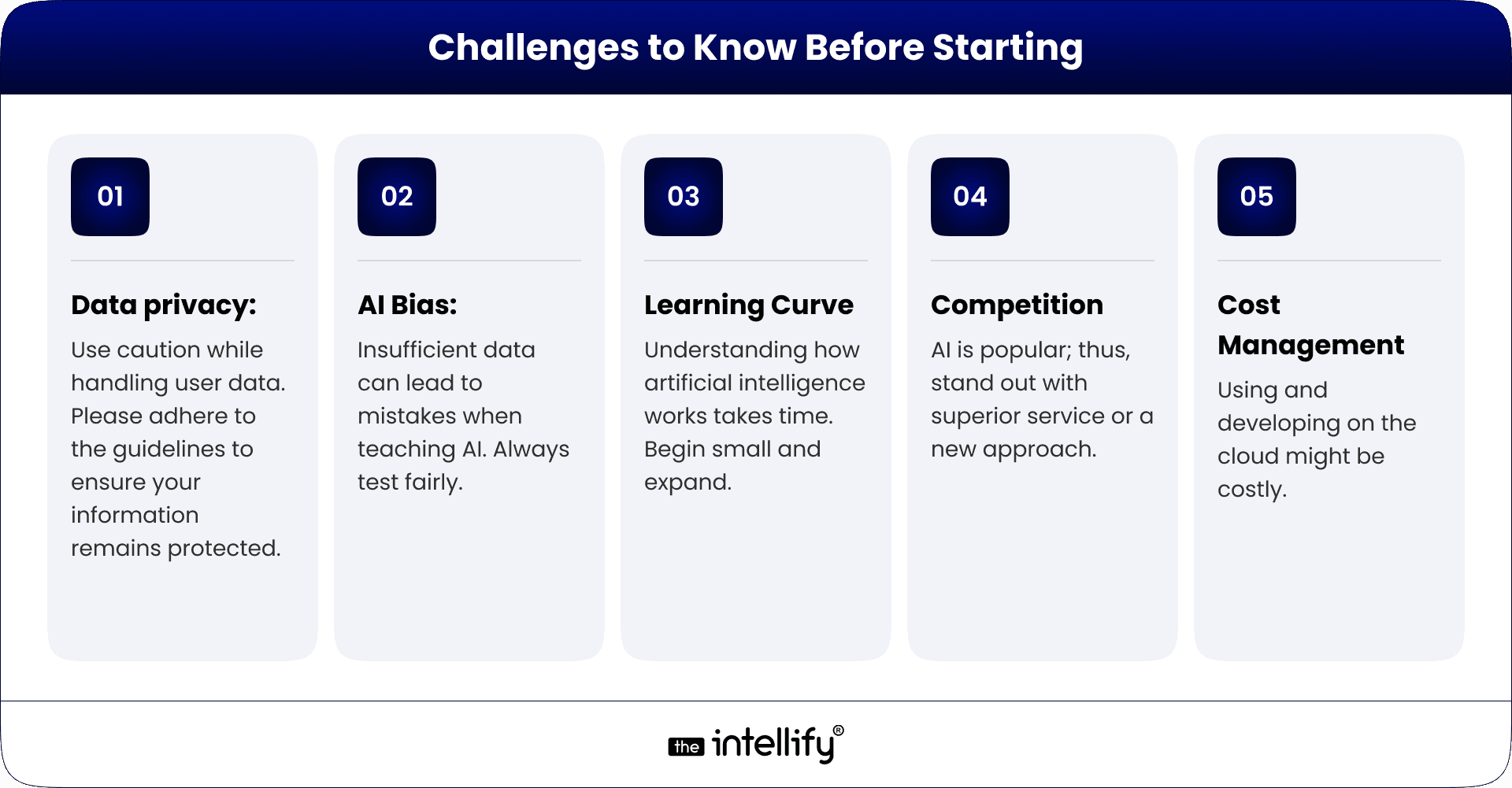
Challenges to Know Before Starting a Business

These challenges are not insurmountable. With the correct mentality, resources, and support, you can overcome obstacles and create something worthwhile.


Future of AI in Business

AI will only become better. Soon, we’ll have more capable virtual assistants, better health applications, and more precise financial tools. Starting now gives you a competitive advantage. As more customers search for AI-powered services, your company will be prepared to satisfy their demands.

We predict that technologies like generative AI, edge AI, and explainable AI will dominate in the coming years. Entrepreneurs that remain interested and adaptive will find infinite opportunity to innovate.


About The Intellify

The Intellify helps businesses bring their AI concepts to life. Whether you’re creating an AI teaching platform, health-tracking software, or an intelligent chatbot, our team will help you from idea to launch. We provide experienced AI development services, tailored solutions, and ongoing support.

We specialize in making AI useful and accessible to organizations of all sizes. From idea validation to full-scale implementation, The Intellify enables you to confidently take the next important step.

Start Building Your AI Business Today with Proven Experts

If you’re ready to make your AI company concept a reality, The Intellify is your reliable partner in innovation.


Final Thoughts

Starting an AI business in 2025 does not need to be difficult. Anyone can participate in the AI revolution with the proper concept, basic tools, and a clear goal. Choose a concept that matches your passion, tackle real-world issues, and don’t be afraid to start small.
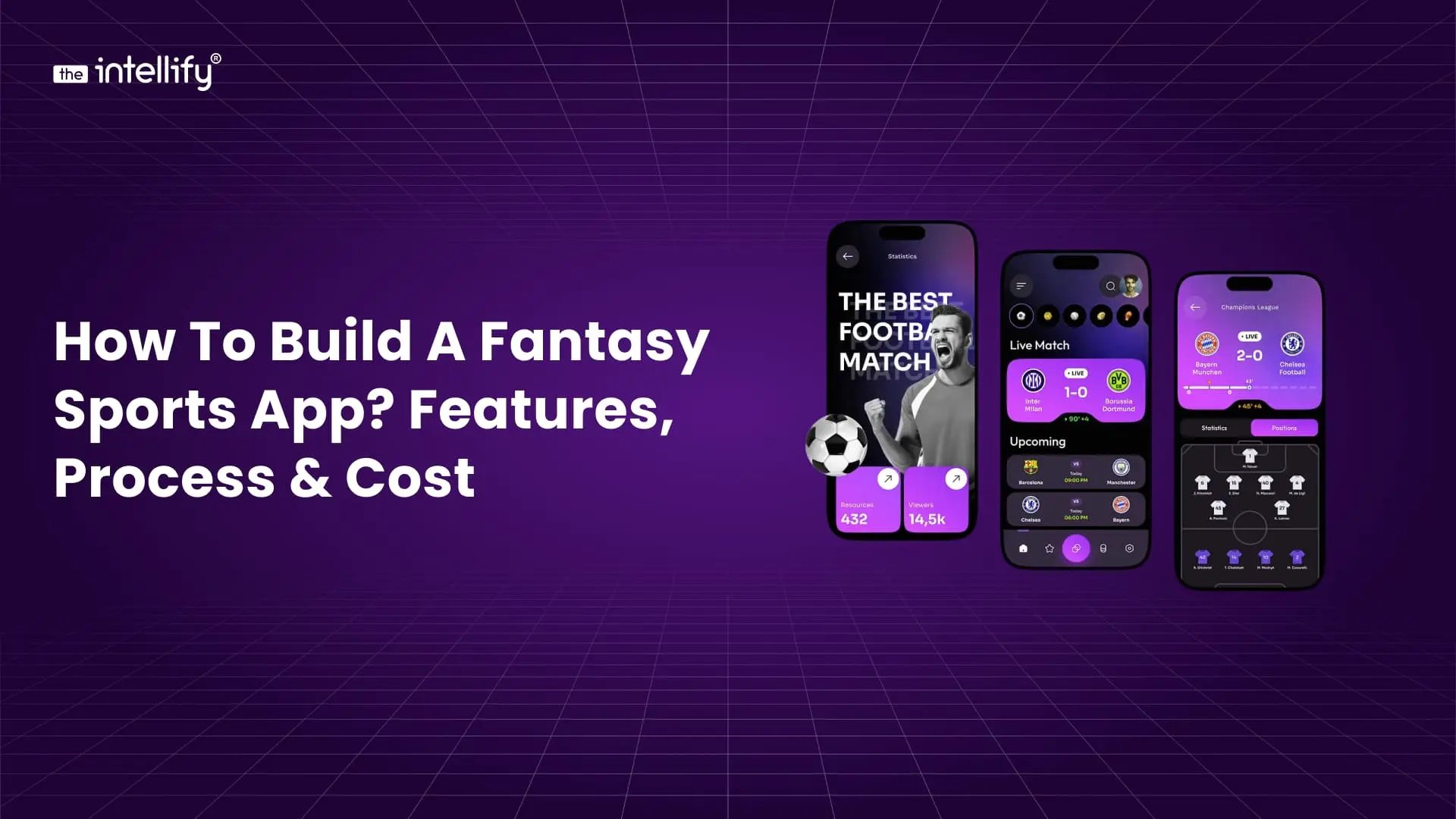
How to Build a Fantasy Sports App? Features, Process & Cost

Introduction
In recent years, fantasy sports apps have grown from niche games into billion-dollar platforms. Managing virtual teams, going head-to-head with friends, and winning actual prizes is something every sports fan has grown to love. If you’re thinking of building a fantasy sports app, now is an ideal time. But how and where do you start?
In this blog, we’ll walk you through the main features that all fantasy sports apps, the step-by-step development process, modern trends like blockchain in fantasy sports apps, and the cost to build a fantasy sports app. Let’s dive in!


Why Build a Fantasy Sports App?

The fantasy sports market is booming. Millions of users are signing up to play football, cricket, basketball, and other fantasy leagues online. The fantasy sports app revenue is expected to increase as online gaming grows and new technologies come into play.

  • Here’s why building a fantasy sports app makes sense:
  • Massive audience: Sports fans are everywhere.
  • High engagement: Users stay active throughout the sports season.
  • Revenue potential: Multiple monetization options like ads, entry fees, and premium features.
  • Trending tech: Blockchain, AI, and live data integrations are making apps better.


Key Features of a Fantasy Sports App

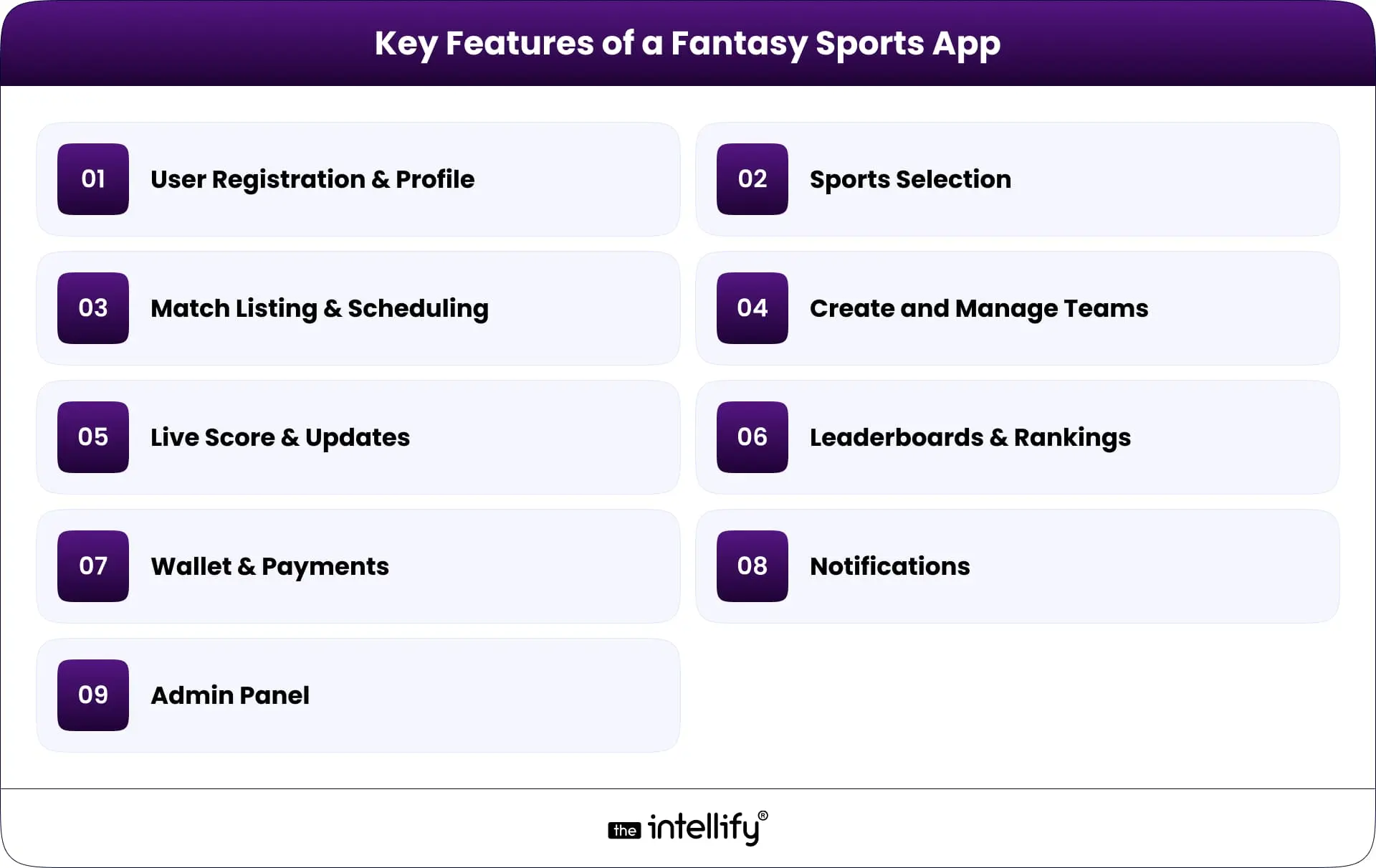
The fate of your app relies heavily on its features. Here’s the list of must-have elements that you need to include:

Key Features of a Fantasy Sports App

1. User Registration & Profile

Allow users to sign up using either an email address, phone number, or through a social account. A simple and secure onboarding process will increase retention.

Add features of two-factor authentication and user verification to improve trust and safety. Allow users to personalize their profiles by having avatars, biographies, and favorite teams.

2. Sports Selection

Let your users select any sport of their choice – football, cricket, basketball, baseball, or whatever they want. The more options you provide, the wider your audience will be.

Consider adding filters for regional leagues or international tournaments.

3. Match Listing & Scheduling

Show live and upcoming matches with detailed information like team stats, match timings, venue, weather updates, and more. Let users filter and sort matches based on their interests.

4. Create and Manage Teams

Users should be able to:

  • Select players based on points and stats
  • Manage team combinations within a set budget
  • Choose captains/vice-captains for bonus points
  • Save drafts or auto-pick teams based on AI suggestions

Make it easy to switch players before the match starts and view player performance history.

5. Live Score & Updates

Real-time score updates, player performance, and rankings should be displayed within the app. Use data APIs to keep everything accurate and fast. Also add audio commentary, highlight match activity, and dynamic animation to increase user engagement.

6. Leaderboards & Rankings

Gamify the experience. Show points earned by users and highlight top performers. Leaderboards can be global or specific to contests or regions.

Add badges, levels, and achievement milestones to reward user participation.

7. Wallet & Payments

Allow recharge wallet easily via UPI, credit cards, PayPal, crypto, etc. Also, ensure withdrawals are fast and secure. Users can see all of their transaction history and current balance clearly.

8. Notifications

Send timely push notifications for match updates, offers, results, player injuries, and more. Let users customize which notifications they want to receive or need.

9. Admin Panel

An admin dashboard helps you manage:

  • User activity and verification
  • Managing matches, contests, and results
  • Managing reports, payments, and transaction issues
  • Suspicious behavior and fair play monitoring
  • Add analytics tools to track app performance, user behavior, and revenue.


Advanced Features to Consider

To stand out from the crowd, add some of these trending features:

fantasy sports advanced features

1. Blockchain in Fantasy Sports App

Blockchain technology ensures transparency, especially in prize distribution and gameplay records. It builds user trust.

Use cases:

  • Smart contracts for prize payouts
  • Tamper-proof player statistics and scoring
  • Token-based reward and digital asset allocation (NFTs)
  • Transparent leaderboard algorithms

2. AI-Powered Recommendations

AI can help users build better teams by suggesting players based on:

  • Historical performance
  • Weather conditions
  • Head-to-head stats
  • User preferences and previous team patterns 

AI can also personalize news feeds and notify users about optimal changes.

3. Social Sharing & Community Building

Let users:

  • Share their teams or scores on social media
  • Invite friends through referral programs
  • Join public or private leagues
  • Participate in discussion forums or live chats

4. Chat & Community Features

Add forums, comment sections, and live chat options to create a community feel. Users love discussing strategy, match results, and player choices.

Allow emoji usage and media sharing for a fun yet moderated experience.

5. Fantasy Sports App Revenue Dashboard

Add dashboards for the admin and investors to track:

  • Daily active users (DAU)
  • Revenue sources and splits
  • Transaction volumes
  • ROI and marketing funnel stats

Use data visualization for better decision-making.


Fantasy Sports App Development Process

Now let’s look at the actual steps involved in creating your app.

Fantasy Sports App Development Process

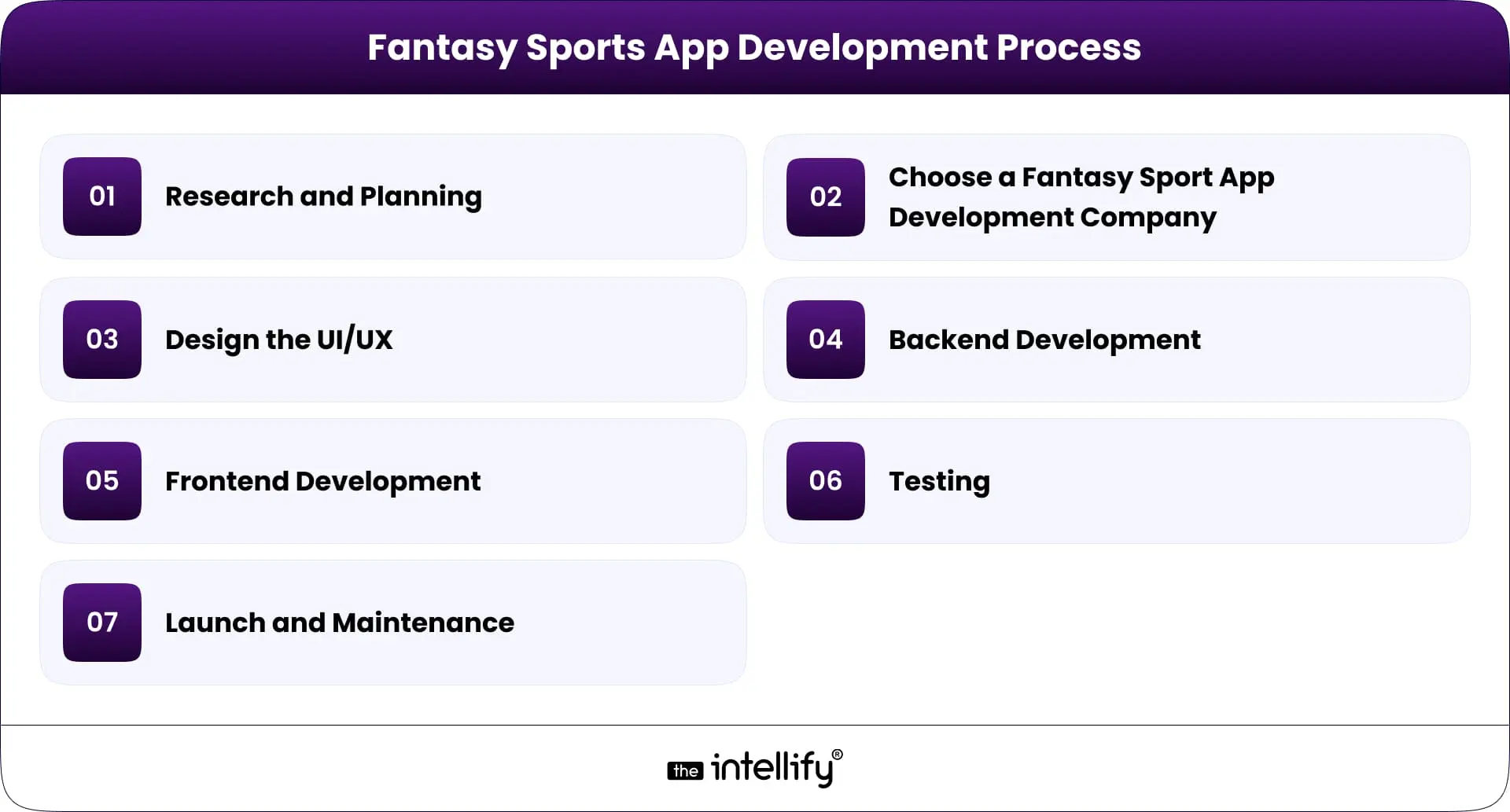
Step 1: Research and Planning

Before development, understand your target audience. Which sports are they interested in? What region are you targeting? What are your monetization goals?

Create user personas and analyze competitor apps. Identify what features users love and what they complain about.

Step 2: Choose a Fantasy Sport App Development Company

Working with a skilled fantasy sports app development company ensures you get a quality product that meets legal and tech standards.

Look for:

  • Experience in fantasy app projects
  • Strong design and backend skills
  • Transparent communication and cost estimation
  • Knowledge of sports APIs and legal compliance

Step 3: Design the UI/UX

A clean, intuitive design improves user experience. This includes:

  • Easy navigation and layout
  • Responsive designs for all device sizes
  • Custom branding for different themes
  • Engaging visuals like player cards, icons, animations

Step 4: Backend Development

The backend should handle:

  • Real-time data feeds and score calculation
  • Scalable infrastructure for high traffic
  • Secure payments and wallet systems
  • Contest management and game logic
  • Blockchain and smart contract integration (optional)

Use robust frameworks like Node.js, Django, or Laravel.

Step 5: Frontend Development

The frontend is what users see. Make sure it’s:

  • Fast and responsive
  • Smooth with transitions and animations
  • Compatible with iOS, Android, and web (React Native or Flutter)

Test different UI elements with real users to ensure usability.

Step 6: Testing

Thorough testing is crucial to fix bugs, ensure fair gameplay, and test load capacity. Test types include:

  • Functional testing
  • UI/UX testing
  • Performance testing under heavy loads
  • Payment and transaction testing
  • Security testing (for fraud prevention)

Step 7: Launch and Maintenance

Launch your app on Android and iOS. Promote it through ads, influencer marketing, and partnerships. After launch, continuously monitor performance, handle bug reports, release updates, and add new features based on user feedback.


Cost to Build a Fantasy Sports App

One of the most common questions is: How much does it cost to develop a fantasy sports app?

fantasy sports app development cost

Basic App Cost:

A simple version for one sport with core features can cost around $20,000 to $30,000.

Advanced App Cost:

An app with multi-sport support, live score APIs, AI, blockchain, and a custom UI can cost anywhere from $50,000 to $100,000+.

Enterprise App Cost:

For a full-scale app with premium features, custom leagues, in-house analytics, and dedicated servers, the cost can go over $150,000.

Factors Affecting the Cost:

  • Number of features and screens
  • Platform (Android, iOS, or both)
  • Use of third-party APIs and services
  • Design complexity and animations
  • Developer location and hourly rates
  • Compliance and licensing fees
  • Post-launch maintenance and marketing budget

When estimating the cost to develop fantasy sports app, include hidden costs like hosting, security, legal support, and server scaling.


Monetization Strategies

How do fantasy sports apps make money? Here are some popular ways:

  1. Entry Fees: Users pay to enter contests, and winners earn a prize.
  2. Advertisements: In-app ads, especially during matches, bring good revenue.
  3. In-App Purchases: Sell premium teams, expert tips, stat packs, or team boosters.
  4. Sponsorships: Partner with sports brands, clubs, or broadcasters.
  5. Affiliate Marketing: Promote related sports content or merchandise.
  6. Season Passes or Subscriptions: Offer advanced features and early access to contests.


Fantasy Sports App Development Trends in 2025

If you’re building an app now, stay ahead of the curve by keeping up with trends like:

  • Blockchain in fantasy sports app for fair and secure games
  • Voice command features for easier navigation
  • AR/VR to create immersive team-building experiences
  • Hyper-personalization using machine learning and user behavior
  • Fantasy Stock Market concept, where players are traded like stocks
  • Cross-platform compatibility for web and mobile

 
contact for fantasy sports app development
Building a new fantasy sports application is not an easy task. If you’re serious about building a fantasy sports app, the most important thing is to partner with the right development team. That’s where The Intellify comes in.

Here’s why The Intellify is a great choice:

  • Deep experience in sports app development
  • Skilled in integrating real-time APIs and blockchain
  • Proven record of delivering high-performance mobile apps
  • Focus on simple, clean, and user-friendly designs
  • Transparent pricing and clear timelines
  • Ability to support post-launch growth and scaling

Whether you’re launching a new app or upgrading an existing one, The Intellify can help you bring your idea to life. From concept to final product, their team ensures every detail is aligned with your business goals.


Final Thoughts

In the rapidly growing fantasy sports industry, an application with the right set of features, smart design, and modern technologies like blockchain can attract thousands (or millions) of sports lovers. From planning to launch, focus on what your users want and how you can set yourself apart or different.

If you’re looking to build a fantasy sports app that combines innovation, performance, and profitability, The Intellify is ready to guide you through every step of the way.

GITEX Europe Conference – GITEX Europe Berlin 2025 | The Intellify

The Intellify Announces Participation in GITEX Europe 2025 | Showcasing Advanced Technology Solutions

Plano, USA – March 17, 2025, The Intellify, a global leader in AI, AR/VR, and enterprise technology solutions, will make a powerful impact at GITEX Europe 2025, held from May 21 to 23 at Messe Berlin, Germany.

As one of the world’s premier technology exhibitions, GITEX Europe gathers top industry leaders, innovators, and decision-makers.  Intellify will present AI-driven automation, Industry 4.0, IoT, Augmented and Virtual Reality, and Cloud and DevOps solutions, showcasing how businesses can accelerate digital transformation through cutting-edge technology.

Industry-Specific Solutions at GITEX Europe 2025

At GITEX Berlin 2025, The Intellify will showcase its expertise in industry-specific solutions designed to drive efficiency, automation, and innovation across multiple sectors:

  • Alris.ai – HR & Operations Automation (Official Launch at GITEX!) – AI-driven chatbots and agentic agents to automate recruitment, onboarding, and interview scheduling, transforming HR operations with efficiency and intelligence.
  • InsureTech & Healthcare – Leveraging AI and cloud-native solutions to enhance user experiences, automate insurance claims and healthcare processes, and ensure security and scalability.
  • Metaverse Sports Engagement Platform – AI-powered 360° Metaverse experiences that enhance fan engagement, virtual sports events, and interactive brand activations.
  • Training & Simulation in Manufacturing – Industry 4.0-powered virtual training solutions that provide immersive learning experiences for industrial and technical workforce training.
  • AR Navigation – Augmented Reality-powered navigation solutions for indoor and outdoor environments, enhancing real-time wayfinding, logistics, and accessibility.


Next-Gen Technology That Drives Innovation

Beyond industry-specific solutions, The Intellify is pioneering digital transformation in Berlin through:

  • Artificial Intelligence (AI) & Machine Learning (ML) – AI-driven systems enhancing decision-making, automation, and operational efficiency.
  • Industry 4.0 & IoT Solutions – Smart manufacturing and real-time data exchange for intelligent, automated, and connected industrial operations.
  • Augmented Reality (AR) & Virtual Reality (VR) – Immersive experiences transforming business, consumer engagement, and training simulations.
  • Cloud & DevOps Solutions – Scalable cloud integration and agile DevOps methodologies for optimized software performance and seamless deployments.
  • Web & Mobile App Development – Expert-driven custom software, web solutions, and mobile applications (native & hybrid), leveraging AI/ML and emerging technologies to deliver high-impact digital experiences.
  • Legacy Modernization & Digital Transformation – Upgrading legacy systems with advanced technologies, automation, and cloud migration to enhance scalability, security, and efficiency.
  • Product Development for Startups – End-to-end product development, from idea validation to market-ready solutions.


Meet The Intellify at GITEX Europe 2025

“We’re excited to bring our AI-driven innovations to GITEX Europe 2025,” said Shravan Rajpurohit, CEO of The Intellify. “This is the perfect platform to connect with global tech pioneers, showcase our expertise, and explore game-changing collaborations.”

📍 Visit The Intellify at Booth H2.2-C15, Hall 2.2 to experience live demos, expert insights, and the latest in AI, AR/VR, and cloud transformation.


About The Intellify

Since 2018, The Intellify has been at the forefront of AR/VR and Mobile App Development, delivering innovative, business-driven solutions. With a global presence across North America, Europe, Asia, Middle East, and Africa, the company has successfully delivered 250+ projects across 15+ industries for 100+ clients.

By leveraging rapid prototyping, AI-driven automation, and agile methodologies, The Intellify empowers businesses to accelerate digital transformation and redefine user experiences.

For more details, don’t hesitate to get in touch with us.

Media Contact

Shravan Rajpurohit
CEO, The Intellify
📞 +1 302 803 4983
[email protected]

For more information about GITEX Europe 2025, visit GITEX Global Berlin.


Digital Transformation in Berlin: Fueling Innovation for Startups and Enterprises

Summary
Berlin stands at the forefront of digital transformation in Europe. In the city where creativity meets technology, innovative startups and well‑established enterprises join forces to redefine industries, streamline operations, and create new business models. Often leveraging the power of Generative AI Development to drive breakthrough innovations.
This blog explores how Berlin’s dynamic ecosystem drives digital transformation across sectors, the key strategies companies implement to stay competitive, and the challenges they overcome on their journey toward a digitally enabled future.

Introduction: Berlin – A Hub for Digital Transformation

Berlin has long been celebrated for its creative culture, vibrant arts scene, and rich history. Over the past decade, however, the city has also emerged as a powerhouse for digital innovation. Digital transformation in Berlin is not just a trend but a fundamental shift that touches every aspect of the economy.

Today, startups and large enterprises use technology to improve operations, create innovative products, and redefine customer experiences.

Berlin attracts entrepreneurs with its lower cost of living, diverse talent pool, and thriving startup ecosystem. At the same time, established regional enterprises increasingly invest in digital technologies to remain competitive. This blog explores how Berlin’s unique landscape fosters digital transformation and what this means for various industries.

Statistics on Digital Transformation in Industries and Technology Adoption

Berlin’s digital transformation is reshaping entire industries and driving widespread technology adoption. Digital companies employ over 88,000 people in the capital and generate annual sales exceeding EUR 10 billion, making the city a leader in Germany’s digital economy.

Since 2008, the sector has experienced an average annual employment growth of nearly 9%, with one in every seven new jobs created in Berlin belonging to the digital economy.

In the core areas, software development and data services, employment in Berlin is growing at an average annual rate of 10.8%, more than twice the national rate.

Additionally, industry reports forecast that Germany’s digital transformation market will reach USD 46 billion by 2025 and is projected to grow at a compound annual growth rate (CAGR) of 15.21% to hit USD 94 billion by 2030.

However, challenges remain. A Vodafone study indicates that by 2030, only about 45% of German companies will fully digitalize, below the expected 55% global benchmark. These statistics underscore both the immense potential of digital transformation and the significant work still required for businesses in Berlin to harness its full benefits.

The Berlin Digital Ecosystem: Startups Meet Enterprises

Berlin’s digital ecosystem is a vibrant mix of young, agile startups and seasoned enterprises. The city is an innovation hub where creativity and technology intersect, fostering dynamic collaborations that drive progress.

A Collaborative Environment

Berlin hosts numerous co‑working spaces, incubators, accelerators, and tech hubs, such as Factory Berlin and the hub. Berlin to CODE_n and Tech Open Air, these spaces provide startups with an environment to network, learn, and collaborate with peers.

Meanwhile, established enterprises partner with startups, invest in digital projects, and even create in‑house innovation labs to leverage fresh ideas.

Startups: The Digital Pioneers

Berlin startups break new ground by experimenting with disruptive technologies and innovative business models. With agile methodologies, rapid prototyping, and lean development practices, these companies quickly pivot in response to market demands.

Many develop breakthrough solutions in fintech, e‑commerce, healthcare, logistics, and AI.

Enterprises: The Digital Adopters

Large companies in Berlin are also actively engaging in digital transformation. They invest in cloud computing, big data analytics, and IoT to optimize processes and enhance decision‑making.

By partnering with startups, these enterprises integrate cutting‑edge digital tools into their operations, ensuring competitiveness in an ever‑changing market.

Networking and Ecosystem Events

Berlin’s vibrant networking events, meetups, conferences, and hackathons encourage the exchange of ideas between startups and enterprises. Events like Tech Open Air enable entrepreneurs to pitch innovative ideas, connect with investors, and learn from industry experts, fostering synergy across the ecosystem.

Key Drivers of Digital Transformation in Berlin

Several key factors drive the rapid pace of digital transformation in Berlin:

1. Entrepreneurial Spirit and Innovation Culture

Berlin’s entrepreneurial mindset encourages risk‑taking and experimentation. The city’s cultural diversity and openness to new ideas create a fertile ground for innovation, enabling entrepreneurs to develop unconventional solutions.

2. Access to Talent and Skills

Berlin attracts top talent from Europe and beyond, forming a highly skilled workforce proficient in digital technologies. Local universities, coding boot camps, and training programs build a robust talent pool that fuels digital transformation.

3. Lower Operational Costs

Compared to global tech hubs like Silicon Valley, Berlin offers a lower cost of living and affordable office space, allowing startups to launch with minimal overhead and enterprises to allocate more resources to R&D.

4. Government Support and Public Initiatives

The Berlin and German governments actively promote digital transformation through funding programs, grants, and advisory services. These initiatives streamline digital adoption and encourage innovation.

5. International Connectivity and Market Access

Berlin’s central location in Europe provides companies with access to a vast market. This connectivity allows startups and enterprises to expand rapidly without the heavy initial investment required for international expansion.

Digital Transformation Trends and Technologies

The digital landscape in Berlin is evolving rapidly, with several trends and technologies serving as catalysts for change:

Digital Transformation and Trends 2025

  1. Cloud Computing and Big Data

    Many companies in Berlin leverage cloud computing for scalable data storage and application hosting, integrating big data analytics to drive more intelligent decision‑making.

  2. Internet of Things (IoT)

    IoT technologies enable real‑time data exchange and automation, transforming industries from manufacturing to urban living by connecting devices and optimizing processes.

  3. Artificial Intelligence and Machine Learning

    AI and ML drive innovation across sectors in Berlin, powering customer service improvements, personalized marketing, and process automation to give companies a competitive edge.

  4. Cybersecurity Solutions

    As digital transformation deepens, robust cybersecurity solutions & measures become critical. Berlin’s tech ecosystem invests heavily in solutions to safeguard data and ensure regulatory compliance.

  5. Digital Platforms and Ecosystem Integration

    Successful digital transformation hinges on integrating diverse systems. Berlin companies create digital ecosystems where various platforms work together seamlessly, enhancing operational efficiency and customer experience.

  6. Automation and Robotics

    Automation technologies and robotics streamline repetitive manufacturing, logistics, and service tasks, improving efficiency and reducing operational costs.

  7. Sustainable Digital Solutions

    Sustainability is key. Berlin companies prioritize green technologies and digital solutions that reduce waste and promote energy efficiency, aligning with broader environmental goals.

Success Stories: How Berlin Startups and Enterprises Innovate

Berlin’s success in digital transformation is best illustrated through its innovative startups and enterprises:

Case Study 1: A Startup Revolutionizing Fintech

A Berlin fintech startup developed an AI‑powered platform that streamlines payment processes for SMEs. By leveraging advanced analytics, the platform optimizes cash flow and reduces errors. Collaborations with established banks helped the startup rapidly scale its operations across Europe.

Case Study 2: An Enterprise Embracing Industry 4.0

A leading manufacturing enterprise in Berlin transformed its operations with an Industry 4.0 digital transformation. By integrating IoT sensors, cloud computing, and AI‑driven analytics, the company improved efficiency, reduced downtime, and cut energy consumption, while enabling predictive maintenance.

Case Study 3: Digital Healthcare Innovations

A Berlin‑based healthcare startup created a telemedicine platform that connects patients with doctors via video consultations, digital diagnostics, and remote monitoring. AI‑driven tools provide personalized treatment recommendations, significantly enhancing patient care.

Case Study 4: Urban Mobility Transformation

An innovative mobility startup in Berlin introduced a smart ride‑sharing app that uses real‑time data and AI to optimize routes, reduce wait times, and lower carbon emissions, revolutionizing urban transportation.

Case Study 5: Evolving Retail with Digital Platforms

A traditional retail enterprise reinvented itself by launching an omnichannel digital platform that integrated online and offline sales channels. AI‑driven personalization and big data analytics boosted revenue and customer loyalty, showcasing how digital transformation can revitalize even long‑established sectors.

Challenges in Digital Transformation

Despite Berlin’s thriving ecosystem, companies face several challenges in digital transformation:

  • Cultural Resistance to Change

    Traditional organizational cultures can resist new technologies and processes. Overcoming this requires strong leadership, continuous training, and a clear vision for change.

  • Skills Gap and Talent Shortage

    Despite a robust talent pool, many companies struggle to find professionals skilled in emerging technologies like AI, IoT, and cybersecurity. Partnerships with educational institutions and specialized training programs are essential.

  • Cybersecurity Risks

    As companies digitize operations, they become more vulnerable to cyberattacks. Robust cybersecurity measures, regular audits, and proactive threat mitigation are vital.

  • Integration of Legacy Systems

    Many enterprises still rely on outdated legacy systems. Gradual integration and migration to modern platforms ensure continuity while unlocking digital potential.

  • Regulatory and Compliance Issues

    Navigating complex regulatory landscapes, such as GDPR, adds complexity to digital transformation efforts. Companies must invest in compliance and legal expertise.

  • Funding and Investment Challenges

    Access to venture capital and government grants is crucial, yet risk‑averse attitudes and high costs can limit funding opportunities for startups and SMEs.

Strategies for Startups: Scaling with Digital Tools

Berlin startups embrace digital transformation by adopting agile and innovative strategies:

Strategies for Startups: Scaling with Digital Tools

Strategies for Enterprises: Embracing Digital Change

For established enterprises, digital transformation is a holistic process that involves culture, processes, and business models:

  • Develop a Clear Digital Strategy

    Define a digital roadmap that aligns with business goals and appoint dedicated digital transformation teams or Chief Digital Officers (CDOs).

  • Invest in Employee Training

    Upskill your workforce through continuous training programs and partnerships with educational institutions to bridge the digital skills gap.

  • Modernize Legacy Systems Gradually

    Adopt a phased approach to integrate new technologies with existing systems, ensuring minimal disruption during the transition.

  • Foster a Culture of Innovation

    Encourage cross‑departmental collaboration, incentivize creative ideas, and create internal innovation labs to drive transformation.

  • Collaborate with Startups

    Partner with agile startups to access fresh ideas, cutting‑edge technologies, and flexible solutions that can accelerate digital transformation.

  • Leverage Data as a Strategic Asset

    Invest in data analytics platforms and employ data scientists to harness the full potential of your data for improved decision‑making.

  • Automate and Streamline Operations

    Invest in automation technologies, including robotic process automation (RPA), to reduce costs and improve operational efficiency.

Government Initiatives and Support Networks

Government support plays a crucial role in fostering digital transformation in Berlin:

  • Funding Programs and Grants

    The German government and Berlin Senate provide numerous funding programs and grants to support innovation and digital transformation projects.

  • Digital Innovation Hubs and Incubators

    Innovation hubs such as Factory Berlin, hub.berlin, and CODE_n offer essential resources, mentorship, and networking opportunities to bridge the gap between startups and established enterprises.

  • Regulatory Reforms and Advisory Services

    Streamlined bureaucratic processes, simplified data protection laws, and improved digital infrastructure help companies adopt new technologies more efficiently.

  • Collaboration with Academic Institutions

    Berlin’s universities and research institutes collaborate with industry players, resulting in joint research projects, technology transfer programs, and specialized training that equips the workforce with cutting‑edge digital skills.

  • Public‑Private Partnerships

    PPPs unite government, private enterprises, startups, and investors to create scalable solutions that drive innovation and support economic growth.

Spotlight: The Intellify – Your AI‑Enabled Software Development Partner

The Intellify is an innovative AI‑enabled software development company dedicated to driving digital transformation for businesses. It is a trusted software development partner in Berlin.

The Intellify leverages cutting‑edge technologies to help companies streamline processes, enhance customer experiences, and accelerate growth.

Why Choose The Intellify?

  • AI‑Enabled Solutions: Our expert team uses advanced artificial intelligence and machine learning to create robust software solutions that power digital transformation.
  • Cloud Consulting: We offer tailored and top-notch cloud consulting services to help your business migrate, integrate, and optimize cloud infrastructures.
  • Industry 4.0 Expertise: We enable digital transformation in production processes from smart manufacturing to predictive maintenance.
  • AR/VR Solutions: Our immersive augmented and virtual reality solutions enhance training, marketing, and customer engagement.
  • Legacy Application Modernization: We modernize your legacy systems to integrate with modern digital solutions, ensuring continuity and improved performance.

Step into the future with The Intellify at GITEX Berlin. Transform challenges into scalable, intelligent solutions.

Future Outlook: Berlin’s Role in Shaping the Digital Economy

Future Outlook: Berlin’s Role in Shaping the Digital Economy

  • Increasing Global Competitiveness

    Berlin’s startups and enterprises are becoming increasingly competitive globally. As more companies embrace digital transformation, Berlin’s tech scene will attract further international investment and talent, setting new benchmarks for innovation.

  • Emerging Technologies and Disruptive Innovation

    Emerging technologies like 5G, blockchain, augmented reality (AR), and virtual reality (VR) will further shape Berlin’s digital landscape. Berlin companies are well‑positioned to integrate these advancements into their business models, unlocking new opportunities and operational efficiencies.

  • Sustainable and Inclusive Digital Transformation

    Sustainability and social inclusion are critical drivers. Berlin’s companies integrate green technologies and digital solutions to reduce waste and promote energy efficiency, ensuring that innovation benefits society.

  • Enhancing Cross‑Sector Collaboration

    Greater collaboration between startups, enterprises, academia, and government will define the future of digital transformation in Berlin. This synergy will foster comprehensive solutions that drive innovation across healthcare, manufacturing, urban mobility, and energy sectors.

  • Preparing for a Rapidly Changing World

    Berlin’s ecosystem is built on resilience, creativity, and a willingness to experiment. As technological change accelerates, companies must invest more in research, development, and innovation to stay ahead.

    This proactive mindset will be crucial for navigating future disruptions and maintaining Berlin’s digital leadership.

Conclusion: Embracing the Digital Future

Berlin is a beacon of digital transformation, where startups and enterprises work together to forge innovative solutions and reshape industries. The city’s supportive ecosystem, bolstered by government initiatives, international connectivity, and a vibrant culture of innovation, creates an ideal environment for digital success.

Whether you’re a startup looking to scale quickly or an established enterprise aiming to reinvent your business model, Berlin offers the resources, talent, and network necessary to thrive.

By embracing digital transformation, Berlin’s businesses can enhance operational efficiency, improve customer experiences, and drive sustainable growth.

The Intellify is proud to be at the forefront of this revolution. As your trusted partner, we empower startups and enterprises with AI‑enabled solutions, cloud consulting, Industry 4.0 expertise, top AR/VR solutions, digital transformation strategies, and legacy application modernization.

Our mission is to help you unlock the full potential of digital technologies and secure a competitive edge in today’s rapidly evolving market.

Take Action Today:

Elevate your enterprise by embracing digital innovation in Berlin.Now is the time to embrace change, invest in digital transformation, partner with innovators like The Intellify, and build a future that is not only profitable but also innovative, sustainable, and inclusive.

Thank you for reading! For more insights into digital transformation, startups, and innovative enterprise strategies in Germany, please visit our latest blog, Top Mobile App Development Companies in Germany.

AI Enabled Retail Chatbots: Use Cases, Types & How to Build

Summary
AI Chatbots for the Retail Industry have revolutionized customer interactions in retail. Retail digital assistants help businesses run more efficiently. They improve customer relationships and the shopping experience. Retail bots use NLP and ML to chat like humans. They provide helpful, personalized support. AI chatbot development is essential in creating these advanced systems that cater to retail needs. This article explores retail chatbots in detail. It analyses their types, benefits, and applications. It also shows how to build retail AI chatbots.

Importance of AI in Retail

The tough retail market demands a top-notch customer experience. It’s the key to business success. Today’s consumers want quick, personalized service and easy support. These factors determine their loyalty to a brand. AI Chatbots in Retail are the solution the industry needs.

These retail chatbot software meet consumer demands. They provide 24/7, personalized service at scale. These tools boost customer satisfaction. They also help businesses grow and be more efficient. All retailers of any size must use chatbots to stay competitive.

How AI Chatbots Are Transforming the Retail Industry?

Top Retail chatbots are AI agents. They help customers with shopping. In 2023 the worldwide chatbot market exceeded $5.4 billion in value. Virtual assistants will generate $142 billion worth of retail sales by 2025, and consumers will maintain a neutral to positive evaluation of their chatbot encounters at 87.2%. Industrial efficiency improvements through chatbot implementation will save business operations $8 billion annually. These systems enhance operational efficiency to achieve their business outcomes. The combined impact results in 30% lower customer support expenditures and 80% faster response times.

What Are AI Chatbots in Retail?

AI Chatbots in Retail.

AI-Powered Customer Assistance

Retail AI chatbots are tools that assist customers through conversation. They answer questions and suggest products. AI, NLP, and ML interpret customer inquiries to respond to chatbots. Retail chatbots provide instant, consistent support. They need no human help, unlike traditional systems.

Mimicking Human Interaction

These retail chatbots mimic human conversation. They interpret user feedback and goals to provide contextually relevant responses. The chatbot can check product availability in real-time. So it can quickly answer customer queries. Retailers benefit from this connection. It smooths the shopping process.

Superior to Traditional Support

Retail chatbots are better than call centres and email for support. It scales better, delivers more personalized service, and is cheaper. The chatbot platform helps businesses build personalized chatbots. These chatbots meet their needs and improve customer experiences.

Beyond Text-Based Interactions

Retail chatbots do more than text. They connect with voice commerce services. This lets customers use voice commands to search for products and make payments. AI chatbots help modern consumers by serving their diverse preferences. Thus, they are essential for today’s retail market.

What are the Advantages of AI Chatbots in Retail?

Advantages of AI Chatbots in Retail

AI Chatbots in Retail improve operations and save money. This creates a better retail experience. Sales agents first benefit from chatbots through automation. These systems handle common queries, except for returns. This lets employees focus on complex issues. The automation process creates both time savings and error reduction.

AI chatbots provide customized service quality that operates across multiple client interactions. AI chatbots review customer data to give targeted recommendations. These include cross-selling products based on past purchases. Through tailored customer interactions, customers become more satisfied, which drives higher sales results.

AI Chatbots in Retail are highly scalable. This is crucial for peak times, like Black Friday and holiday sales. These systems process multiple queries at once so customers never go unanswered. Chatbots help businesses cut costs. They replace large customer service teams but keep high-quality interactions.

These chatbots collect valuable customer feedback. It helps businesses find ways to improve. The Intellify helps retailers add feedback loops to their chatbots. This way, they can keep improving them continuously.

Retail chatbots help brands build customer loyalty. Their reliable service wins customers. These chatbots solve customer frustration. They cut long wait times and unresponsive support. They also provide better feedback. Chatbots help customers buy by assisting them throughout their journey.

Read Also: What are AI Chatbots?

Challenges of AI Implementation in Retail

Challenges of AI in Retail

Retail AI chatbots benefit businesses. However, organizations must fix some issues. Chatbot systems must run well to satisfy customers and meet business goals. This requires fixing several performance-limiting issues.

1. Understanding complex queries

AI Chatbots in Retail struggle with complex customer queries. They cannot understand difficult questions. NLP has come a long way, but chatbots still struggle. They often misinterpret complex language and sarcasm, mainly because of cultural differences. This leads to unproductive responses.

2. Ensure robust data encryption

Retail chatbots need sensitive consumer data for personalization, which raises privacy and security concerns. I worry that the private information customers provide might not be safe. Businesses must protect customer data and meet GDPR standards, and they need reliable security systems for this.

3. Legacy Systems

Many retailers have outdated IT systems. They block easy integration with modern chatbot platforms. Incompatible systems block chatbots from key features. These include inventory data, order info, and customer purchase records.

Companies building advanced AI Chatbots in Retail face high development and ongoing training costs. This lack of compatibility can hinder chatbots. It limits their access to real-time inventory, order details, and customer history.

4. High Development and Maintenance Costs

Building an advanced AI chatbot is costly. It requires a big investment in development, training, and maintenance. Small to medium-sized businesses struggle to fund these initiatives. It’s hard to predict their return on investment. Chatbots can handle basic inquiries efficiently.

Customers get frustrated when chatbots can’t solve complex problems. They also dislike long waits to reach a human. Chatbots have issues. They cannot access real-time inventory, order details, and customer history.

5. Customer Frustration with Limited Capabilities

Chatbots excel at simple queries. They frustrate customers. They fail to connect them to humans or resolve complex issues quickly. Customer satisfaction relies on how well we switch from automated to human support.

6. Language and Cultural Barriers

Chatbots must provide multilingual support for global retailers. This is a technical challenge. Building chatbots for various languages and cultures is costly. It requires much training and localization work.

7. Regular maintenance is required

AI Chatbots in Retail need ongoing maintenance. They must adapt to changing consumer demands, new products, and market trends. Lack of chatbot optimization leads to outdated responses. Users find this unsatisfactory.

8. Ethical Concerns and Bias in AI

Retail chatbots may have biased replies. They come from their training data. This can lead to unfair interactions with users. To resolve ethical issues, we must improve algorithms. We must ensure they are fair and inclusive. Retail chatbots have many applications that improve customer interactions during the purchasing process.

However, they may not easily integrate with modern chatbot platforms. This lack of compatibility can disrupt how chatbots work. It limits their access to real-time inventory, order details, and customer history.

Use Cases of Retail Chatbots

Use Cases of Retail Chatbots

The use cases of retail chatbots are vast, addressing aspects of the customer journey. A major retail use for these systems is 24/7 customer support. Retail chatbots provide real-time answers to customers. They cover business hours, product availability, and store policies.

Personalized product recommendations function as one of the main applications. Chatbots analyse history and preferences to suggest products. This boosts the chances of a purchase. When customers search for sneakers, the chatbot suggests accessories. These include socks and fitness trackers.

The retail industry relies on chatbots to reduce abandoned shopping carts. Chatbots notify consumers about abandoned cart items. They also offer discounts to encourage customers to complete their purchases. After buying, customers can track and return orders. This improves their experience.

Chatbots can collect customer feedback. They help businesses find and fix weaknesses in their products and services. Chatbots manage promotions and cross-selling.

They track sales offers for customers and suggest complementary products. The retail industry has seen retail chatbots succeed at H&M, Sephora, and other top brands.

Retail chatbots show their value when merging with loyalty programs. Retail chatbots let members check their reward points. They also present exclusive offers and help redeem points at checkout. Chatbots improve customer loyalty by streamlining program operations. They keep customers invested in rewards programs.

Through social commerce, retail chatbots play a vital role. Retail chatbots create shopping opportunities via Facebook Messenger and Instagram. They do this through platform integration. Integrating shopping and social functions makes online shopping very convenient.

Learn More: Insurance Chatbot Development

Types of Retail Chatbots

Types of Retail Chatbots

Rule-Based Chatbots

Retail chatbots exist in various formats that fulfil specific business requirements. Between them, rule-based chatbots follow programmed decision scripts and tree-based logic structures. These programs meet basic questions well, yet their uncompromising nature creates performance restrictions.

AI-Powered Chatbots

AI chatbots use algorithms to understand the context and provide tailored answers. They effectively deliver tailored user interactions. Their intelligent adaptation skills handle complex customer interactions well. Voice-activated chatbots that connect to voice commerce platforms are in high demand. They allow users to operate them hands-free and easily.

Hybrid Chatbots

Hybrid chatbots combine rule-based and AI-powered features. This gives businesses the best of both technologies. These bots use AI to answer simple queries with structured replies. They address more complex customer needs. This includes those that suit unique retail needs.

Voice-Activated Chatbots

Voice commerce is growing fast, and voice-activated chatbots play a big role in this trend. Customers can now shop by voice commands. They can use smart devices like Amazon Alexa and Google Assistant. Tech-savvy, busy consumers find the hands-free capabilities of this system especially desirable.

Predictive AI Chatbots

A new type of chatbot exists. It uses AI for predictive customer service. It predicts their needs and suggests products based on their past online behaviour. This new capability gives customers a better way to interact. It boosts loyalty and sales.

How to Build a Retail AI Chatbot

Creating AI Chatbots in Retail follows a defined series of steps. The process starts with clearly setting your desired outcomes. First, set the main goals for your chatbot. It should improve support or sales or cut costs.

Selecting the right platform for your chatbot should be the second step in this process. It comes among the top retail chatbot platforms that let you create and use chatbots that fit your business needs.

First, pick your platform. Then, create workflows that meet your goals. Your chatbot needs AI, especially NLP and ML, to manage customer inquiries.

The development process reaches its essential stage during testing. Your chatbot requires testing together with real-world conditions to show effective performance.

After testing, deploy your chatbot. Then, track its performance. To maintain success your chatbot demands frequent maintenance and enhancement procedures.

Successful design requires user experience to remain a top priority. Your chatbot needs a user-friendly interface. It should look nice and allow smooth interactions. Analysed user interactions let you improve the chatbot’s responses. This boosts its performance over time.

To provide a full service, connect your chatbot to your CRM and other tools. This chatbot tech will greatly benefit your retail business. It can use customer purchase records to make tailored suggestions.

Future Trends in AI Retail Chatbots

Future Trends in AI Retail Chatbots

Retail chatbots present many exciting opportunities in the upcoming years. AI Development technology now allows for emotionally intelligent chatbots. They can understand customers’ emotions. Chatbots will enable virtual store guidance. This will allow for virtual shopping using augmented and virtual reality.

Predictive analytics will help retail chatbots understand customer demand. They can then offer solutions based on anticipated needs. Organizations must develop multilingual capabilities because their business expansion extends across international markets. Retailers who use The Intellify’s advanced solutions will lead the industry. They will also stay at the forefront of innovation.

Blockchain-based chatbots can improve how businesses store and share data. Real-time information sharing via blockchain would boost security and transparency.

This, in turn, would increase trust in sharing customer data. Chatbots will help sustainability efforts. They will guide customers to eco-friendly products and sustainable practices.

Conclusion

Retail AI chatbots are very promising. Customers want seamless, personalized experiences. Chatbot solutions can boost customer satisfaction and grow businesses. They automate support and enable personalized shopping.

Contact us for retail ai chatbots

Selecting the correct chatbot solution requires serious consideration. Retail businesses need a flexible, easy-to-use solution that integrates well.

So, retailers should team up with a trusted self-service provider like The Intellify. Contact us for a free consultation, instant quotes, and best practices for eCommerce chatbots.

AI Face-off: DeepSeek vs. ChatGPT – What Works Best for Your Needs?

Summary
In the rapidly evolving landscape of artificial intelligence (AI), The Intellify stands at the forefront, leveraging cutting-edge technologies to enhance its service offerings. A key focus is on conversational AI, with the company integrating advanced chatbots like DeepSeek and ChatGPT into its solutions. This article delves into the capabilities of DeepSeek, compares it with ChatGPT, and explores how The Intellify utilizes these tools to deliver superior AI consulting services.

Introduction

Artificial intelligence has become a cornerstone in modern business operations, driving efficiency and innovation. Conversational AI has gained significant traction among the various AI applications, enabling seamless interactions between humans and machines. 

The Intellify, a leading AI consulting services provider, recognizes the potential of conversational AI and has incorporated advanced chatbots like DeepSeek and ChatGPT into its offerings. This integration enhances customer engagement and streamlines processes across various industries.

Technical Insights into DeepSeek

DeepSeek, a Chinese AI startup founded in 2023, has developed innovative open-source large language models (LLMs) that have garnered significant attention in the AI community. 

Its flagship model, DeepSeek-R1, was developed at a fraction of the cost of comparable models, approximately $6 million compared to over $100 million for models like OpenAI’s GPT-4. This efficiency is attributed to novel training methods and a focus on optimizing computational resources.

DeepSeek-R1 employs a reasoning model capable of self-correcting without human supervision, utilizing reinforcement learning techniques to minimize human intervention. 

This approach allows the model to generate accurate answers by taking more time to “think” about responses, achieving performance comparable to leading models like OpenAI’s GPT-4.

Furthermore, DeepSeek has developed smaller models capable of running on devices like smartphones, retaining strong reasoning capabilities while being resource-efficient. 

This innovation opens avenues for deploying advanced AI applications on a wider range of devices, enhancing accessibility and usability.

Technical Insights into ChatGPT

ChatGPT, developed by OpenAI, is a well-established conversational AI model built upon the GPT architecture. It has been instrumental in various applications, from customer support to content creation. 

ChatGPT’s extensive training on diverse datasets enables it to generate human-like responses, making it a popular choice for businesses seeking to enhance customer engagement strategies.

The model is designed to facilitate human-like interactions, understanding and responding to natural language inputs. 

However, it is sensitive to tweaks in input phrasing and may sometimes produce plausible-sounding but incorrect or nonsensical answers. Addressing these challenges is an ongoing area of research in AI development.

Comparative Analysis: DeepSeek vs. ChatGPT

Comparative Analysis DeepSeek vs ChatGPT

Performance and Accuracy

While both DeepSeek and ChatGPT are designed to facilitate human-like interactions, their performance metrics differ. According to a NewsGuard audit, DeepSeek’s chatbot achieved a 17% accuracy rate, trailing behind Western counterparts like ChatGPT. 

The audit revealed that DeepSeek’s chatbot repeated false information 30% of the time and provided vague or unhelpful responses 53% of the time, resulting in an overall failure rate of 83%. In contrast, ChatGPT demonstrated higher accuracy and reliability in its responses.

Cost and Accessibility

One of DeepSeek’s notable advantages is its cost-effectiveness. The development of DeepSeek-R1 was significantly less expensive than that of ChatGPT, making it an attractive option for businesses with budget constraints. 

Additionally, DeepSeek’s open-source nature allows for greater customization and flexibility, enabling companies like The Intellify to tailor the chatbot to specific needs. 

ChatGPT, while robust and versatile, involves higher development and operational costs, which may be a consideration for some organizations.

Integration and Application

The Intellify, as a chatbot development company, leverages both DeepSeek and ChatGPT to deliver customized solutions to clients. 

DeepSeek’s open-source framework allows for seamless integration into existing systems, providing a foundation for developing specialized conversational AI applications. 

ChatGPT’s advanced language capabilities enhance these applications, ensuring coherent and contextually relevant interactions. 

By combining the strengths of both models, The Intellify offers comprehensive AI consulting services that cater to diverse business requirements.

Future Trends and Developments in Conversational AI

Future Trends and Developments of Conversational AI

Advanced Reasoning: AI models like DeepSeek and ChatGPT will improve contextual understanding and self-correction for more accurate responses.

Multimodal Capabilities: Future models will integrate text, image, and voice inputs for more interactive experiences.

Customization & Personalization: Businesses will get AI solutions tailored to specific industries for better efficiency.

Cost Efficiency: AI training will become more affordable, making high-quality models accessible to startups.

AI Ethics & Compliance: Stronger measures will be implemented to reduce bias, misinformation, and ethical concerns.

Autonomous AI Agents: AI-powered chatbots will execute tasks beyond conversation, automating workflows.

Real-Time Learning: Models will continuously improve through user interactions, enhancing adaptability.

The Intellify’s Approach to Conversational AI

The Intellify's Approach to Conversational AI

At The Intellify, the focus is on harnessing the power of conversational AI to drive business transformation. 

By integrating advanced chatbots like DeepSeek and ChatGPT, the company enhances customer engagement, automates routine tasks, and provides insightful analytics. This approach not only improves operational efficiency but also delivers personalized experiences to end-users. 

Clients seeking to implement conversational AI solutions can contact us to explore customized AI strategies that align with their objectives.

Conclusion

In the dynamic field of conversational AI, both DeepSeek and ChatGPT offer unique advantages. DeepSeek’s cost-effectiveness and open-source flexibility make it a compelling choice for businesses aiming for customized solutions. 

Conversely, ChatGPT’s proven performance and versatility provide a solid foundation for a wide range of applications. The Intellify’s expertise in deploying these technologies ensures that clients receive solutions that are both innovative and effective.

FAQs

What is conversational AI?
Conversational AI refers to technologies that enable machines to engage in human-like interactions, understanding and responding to natural language inputs.

How does The Intellify utilize DeepSeek and ChatGPT?
The Intellify integrates DeepSeek and ChatGPT into its AI solutions to enhance customer engagement, automate tasks, and provide data-driven insights.

What are the benefits of using DeepSeek in AI applications?
DeepSeek offers cost-effective development and open-source flexibility, allowing for tailored conversational AI solutions.

Why choose The Intellify for AI consulting services?
The Intellify combines expertise in advanced AI technologies with a client-centric approach, delivering customized solutions that drive business success.

How can I get started with implementing conversational AI in my business?
To explore how conversational AI can benefit your business, contact us for a consultation and tailored strategy development.

Insurance Chatbot Development: Key Benefits, Use Cases & Cost Insights

Summary
The insurance industry is going digital, due to factors like AI and chatbots. Chatbots are improving customer satisfaction and productivity in insurance. They help insurers meet the demand for faster, more personalized service. It offers custom AI chatbot development. They boost efficiency, cut costs, and improve client satisfaction. This blog covers everything about AI chatbots in insurance. Insurers must adopt them to stay relevant in a digitalizing market.

Impact of Chatbots on Insurance

Insurance is a complex industry that requires human interaction. However, it is adapting to a changing audience. Chatbots for insurance agencies are not just productivity tools. They are disruptive technologies that are changing the insurance customer interface. Self-learning chatbots help insurance companies serve many customers at once.

As competition stiffens in this industry, we must adopt these advanced solutions. This blog will explore how AI chatbots can help insurance firms. It covers their use, examples, and costs.

Insurance AI Chatbot’s Market Insights

Recent research says that AI-driven insurance chatbots could hit $2.6 billion by 2030, up from $251.4 million in 2023. This is in conjunction with the projected 24% CAGR for the market in the forecast period. Our research shows that 74% prefer chatbots over humans for quick customer service.

Analysts expect the insurance chatbot market to hit $0.97 billion in 2025. It will grow at a CAGR of 26.2% from 2024 to 2025. Also, new AI chatbots could cut insurance fees by 40% by 2030. More than 3 out of 4 customers go to insurer websites to study policy offerings and premiums.

What Are the Advantages of AI Chatbots for Insurance Agencies?

Advantages of AI Chatbots for Insurance Agencies

AI chatbots are not only functional tools in the insurance industry but also much more. They are revolutionizing how insurance firms operate, from customer relations to claims management. Let’s look at the main advantages they provide.

Enhanced Customer Experience

As insurance becomes more intermediated and competitive, customer experience is key. It builds confidence and a lasting edge over rivals. AI chatbots are improving many company’s customer service. They provide quick, tailored help and answers, 24/7.

This interaction is a big improvement over the old method. These include calls and emails, where customers must wait a long time. Chatbots let customers ask questions anytime. They won’t have to wait for a response.

Think of a customer wanting to know more about their insurance claim or choosing a policy. Another form of communication is an AI Chatbot for insurance agencies. They can provide needed info in a chatty way. It can support complex queries.

It might provide the consumer with the policies he or she is interested in. They can enter their risk level, location, and budget into the chatbot. It will then recommend the right policies to buy.

Also, AI talk-to-type has feeling algorithms. They make customer relations more human. This is important in health and life insurance. Emotions and trust are vital there. It’s good to let customers express their concerns.

It’s important when discussing some topics, like medical insurance claims. The Intellify’s solutions ensure that insurance chatbots are both fast and emotionally smart. This builds trust and loyalty among policyholders.

Streamlined Operations

Insurance firms face many challenges. They are both cumbersome and mechanical. They include: Claim processing; Policy maintenance; Customer relations; and Documentation authentication. AI chatbots can help by acting as assistants. This will free human agents to handle more important work.

For example, in claims processing, the AI-driven insurance chatbot may guide the user from filing a claim to its approval. The chatbot checks the uploaded documents for errors. It aims to reduce mistakes and long wait times. These are time-consuming tasks. If automated, insurers could process claims faster. This would improve turnaround time for clients.

The Intellify offers advanced chatbots in insurance. They are built to work with current insurance systems. They streamline back-end processes while following regulations. By delegating simple tasks to chatbots, teams can focus on higher-level work.

Also, integrating the insurance chatbots into the org system can improve internal communication. Employees can easily access the policies, client histories, and legal requirements. This saves time in searching for information. It also ensures employees have the latest info. This will let insurers work faster and more efficiently. It will improve service delivery to clients.

Cost Efficiency

Another factor that makes AI chatbots in the insurance industry appealing is that they cut costs. Automated models can now perform tasks once done by humans. This will save time and money. Chatbots can handle up to 80% of customer inquiries.

These are inquiries that would usually be addressed by human agents. This reduces the need for many agents. It may only be cost-effective for companies with fixed demand. But, it will help companies with high demand, like during the festive season or after a major claim.

Also, chatbots for insurance agencies can help avoid needing to hire new staff during peak workloads. Chatbots are very efficient at assessing many questions. For example, during disasters, policy renewals, and open enrolments. They maintain service quality while controlling costs.

This scalability lets the insurance firm provide great customer service. It can do this with a reasonable use of resources and without spending a lot of money. Insurance software development can further optimize this process, ensuring smooth integration of AI-driven tools into existing systems.

What Are the Applications of AI Chatbots in Insurance?

Applications of AI Chatbots in Insurance

AI chatbots for insurance agencies can be useful in many ways. Now, let’s look at the key areas where chatbots can benefit your business.

Policy Recommendations and Purchases

Chatbots can help your company by simplifying policy recommendations and purchases for consumers. Using Insurance chatbots, we could study customers’ needs, preferences, and risk profiles. Then, we could recommend policies that best suit them.

For instance, a customer wanting to buy home insurance can use a chatbot. It will ask about the area, the house’s location, and the desired coverage. The customer’s answers determine the chatbot’s policy options. This makes it easy for the customer to decide quickly.

This engagement boosts the customer experience. It also makes them more likely to do business with the organization. Chatbots can persuade customers to buy by giving quick, helpful answers.  They do this by applying relevant policy recommendations that match the customer.

Claims Management

Claims management is a complex and time-consuming process for insurers. AI chatbots can simplify and speed it up. The chatbots can check if clients submitted and verified all claims papers. They will do this through interactions with customers as the process is ongoing. This cuts the number of praise-filled interactions. They slow the claims process and hurt customer satisfaction.

Also, chatbots can update customers on their claims. There will be no need for follow-up calls or emails. Automating this process speeds up claim approvals. This is vital when a customer needs the service. The Intellify’s chatbots simplify this. They help process claims with few errors.

Customer Support

Routine customer inquiries are a tough nut to crack for insurance sales firms. The Chatbot for insurance agencies can quickly address and answer such queries. They are for the customers of the insurance policy on premium and coverage. It can also answer advanced questions by passing them to human agents if needed. This approach gives clients an instant response. It uses humans to handle complex questions.

AI chatbots in your customer service will help consumers faster. This will make them more loyal.

Fraud Detection

Due to the high risk of fraud, insurance firms have to be on the lookout for it; with the help of AI chatbots. Chatbots can find fraud patterns in customer contact and claims data. If the chatbot finds multiple claims for the same accident or inconsistent data, it can tell the insurers to investigate.

It uses AI to detect fraud, offset insurance losses, and secure the claims process. AI chatbots in insurance also have a fraud detection alarm. It uses advanced algorithms to predict and prevent fraud before it becomes a big issue.

Challenges of Implementing AI Chatbots in Insurance

Challenges of Implementing AI Chatbots in Insurance

This smart tech in insurance systems has its rewards. However, there are challenges worth noting. Below, we look at some of the challenges insurers encounter and ways of dealing with them.

Primary Research Issues: Data Privacy and Compliance

Customers trust insurance companies with their information. So, the data must be protected. So, it is vital to ensure that every AI chatbot can follow data privacy laws like the GDPR and HIPAA. The Intellify also ensures its AI chatbots comply with data protection laws. It does this by using encryption and other security measures to safeguard data.

Organizations cannot meet customer expectations and demands

Customers expect customized and prompt service in all sectors and domains. Expectations for AI chatbots must be high. They should match the experiences of sectors like retail and banking. It demands that insurers use better tech, like NLP, to improve these experiences.

Often predefined interfaces have to be used for integration with existing systems.

Some insurance companies still use old systems. They can be ineffective with AI chatbots. To implement these chatbots on such archaic systems, one has to spend a lot of time and resources. But, it’s better to integrate AI into the business in the long run than in the short term.

What Are the Future Trends in AI Chatbots for Insurance Agencies?

Future Trends in AI Chatbots for Insurance Agencies

There are great prospects for AI chatbots in insurance. New tech is always being introduced. Some of the ai trends to watch out for include:

Voice-Activated Chatbots

In the future, as voice recognition improves, insurers will use a voice-activated chatbot. These chatbots will let customers talk to their insurers without using their devices. They can report losses, make inquiries, and buy policies while doing other tasks.

AI-Driven Predictive Analytics

Using AI’s data prediction, insurance chatbots will suggest solutions before customers ask. It means that chatbots will act on their own. They will analyze customer activity and market trends. They will offer solutions in real time.

Blockchain Integration

Blockchain could change how people view insurance claims. It can reduce risks and improve the claims process and transactions. The integration of chatbots and blockchain may enable some benefits. Blockchain can enhance chatbots. This can speed up claim processing, improve fraud detection, and boost data security.

AI Chatbot Development Cost Analysis

The cost of building an AI Chatbot for insurance agencies depends on the solution and its functions. A basic chatbot — or one designed to respond to a limited number of questions can cost as little as $10,000 to $30,000. However, features like NLP and machine learning will be costly. Integrating an advanced chatbot with other systems will add $50,000 to $150,000 or more.

The process works like this: requirements, design, testing, and deployment. I guarantee that its chatbot solutions will meet your business’s exact requirements. They are flexible and can be integrated into your current systems. The high initial cost is worth it. The long-term savings and happier customers make it a great business deal.

Maintenance and improvements are also a concern. Most prefer them to be ongoing, not at fixed intervals. AI chatbots in insurance must often be reprogrammed due to constant changes in rules. Many improvements to features, training, and data processing would raise costs. But they are needed for the chatbot to be effective in the fast-changing insurance market.

Conclusion

Insurance Chatbots could be a real breakthrough in the insurance industry. However, for any chatbot to succeed, the right technology must be at the centre of its action. That’s where The Intellify comes in. We offer a cloud-based flexible implementable chatbot system suited for your needs depending on the operations of your business.

contact us for insurance chatbot development

It is one of high efficiency, great customer experiences, and flexible operations. Insurance chatbots can learn and adapt. It is now more accessible, friendly, and efficient. The chatbot system will improve the insurance experience. It will create a more connected, customer-focused future.

Start building your insurance AI chatbot with us today. Contact us to our team to learn more.

AI in Travel and Tourism 2025

Summary
AI is transforming travel and tourism. It personalizes services and improves efficiency. This benefits both businesses and travellers. The travel industry uses AI to create innovative tools. These include predictive analytics and AI-powered travel apps that meet modern tourism needs. AI technology has changed travel and hospitality operations. It also enhances customer experiences through advanced platforms.

Effortless Trip Planning with AI

AI technology in the travel industry now simplifies the trip planning process, making it stress-free. AI tools, including advanced AI app solutions, give travellers custom itineraries. They also provide instant travel ideas and auto-booking support. AI transforms business operations. It optimizes processes, predicts trends, and provides insights. The convergence of AI with travel and hospitality creates smart, sustainable solutions. They support both visitors and service organisations. 

Travel AI Market

Studies show that AI in travel and tourism will grow fast from 2024 to 2030. Analysts expect a CAGR of 28.7%. The market value will rise from USD 2.95 billion to USD 13.38 billion. The AI in travel market will grow at a 35% CAGR from 2022 to 2027. Its value will rise from USD 81.3 billion to USD 423.7 billion. The travel industry’s Generative AI market earned USD 632.18 million in 2022. Analysts predict it will reach USD 3.58 billion by 2032. A McKinsey study shows AI’s strong economic impact. It says travel businesses can create $2 to $4 trillion in value.

How AI is Revolutionizing Travel and Tourism?

How AI is Revolutionizing Travel and Tourism

AI-Powered Personalization: A Tailored Approach to Travel

Modern travel now bases its core principles on personalization. AI drives this evolution. Today’s travellers want more than basic tips. They seek unique experiences that match their tastes. Artificial intelligence in travel systems analyzes vast data, like booking histories and user demographics. They use this to find browsing patterns. Then, they deliver personalized recommendations.

When you often search for beach vacations, your AI learns this pattern. Then, it suggests beach spots that fit your likes. This includes places in the Caribbean and the Maldives. The food lover will find famous restaurants and food tours in their chosen travel spot.

AI-powered travel applications create tailored experiences for travellers. This leads to lasting, happy travel memories. AI platforms can adjust in real-time. They refine recommendations based on changing user preferences. This creates a better journey experience.

Smart Booking Systems: Efficiency Redefined

Travellers today can skip the hassle of comparing options. Advanced search systems make this process easy. AI booking technology by The Intellify lets travellers access real-time options for flights, accommodations, and activities. It covers the entire booking process.

These systems use advanced algorithms to analyze millions of data points. They present travellers with options that best match their preferences. Predictive analytics uses historical data and market ai trends. It recommends the best booking times for flights and hotels at their lowest prices.

These automated tools simplify booking. They save users time by handling ticket changes. So, users enjoy hassle-free travel.

AI-Driven Language Translation for International Travelers

Travelling abroad gets harder for tourists due to language barriers. AI translation software removes language barriers and enhances travel.

Google Translate uses advanced AI. It lets users convert text and speech between languages instantly and without limits.

The tools by AI tech companies like The Intellify help users understand local transport and culture. They also enable conversations with locals. AI in travel and tourism removes language barriers. It keeps travellers confident and connected, no matter the destination.

AI-Enhanced Health and Safety Monitoring

The pandemic has taught travellers to prioritize health and safety before travelling. AI risk management practices give travellers vital risk info. They can use it to make confident choices.

AI systems analyze official advisories, local medical reports, and ecological data. They then assess the safety of specific travel locations. These systems show areas with low COVID-19 cases and alert users to natural disasters.

Wearable, AI-powered Travel Applications track traveller health. They alert users to dehydration, fatigue, and high-altitude illness. These steps help travellers keep their health a priority when exploring new places.

Virtual Travel Assistants: Your Smart Companion

Virtual travel assistants are now essential to modern travellers. They provide trip management tools that improve planning and execution. AI-powered digital assistants provide continuous updates. They handle bookings and answer questions. They are a reliable wayfinding for the whole trip.

Virtual assistants use natural language processing. It helps them understand and answer customers’ questions conversationally. Users can get precise, immediate info from the assistant. They can ask for tourist tips, route help, or weather forecasts at their travel location.

Virtual travel assistants help users with international travel. They convert currency, translate languages, and provide cultural insights. Virtual travel assistance improves the whole travel experience. It combines useful features with ease of use. It lets travellers focus on their activities.

AI Chatbots: Revolutionizing Customer Service

AI chatbots now let the travel industry provide real-time, efficient customer service. Traditional support systems with long wait times are replaced by 24/7 chatbots.

Transportation bots can answer basic questions. They can also process complex requests, like itinerary changes and refunds. When flights are delayed, the chatbot will find new travel options. It will then update your itinerary and notify those affected.

Automated tasks and chatbots by companies like The Intellify boost customer satisfaction. As a leading chatbot development company, they enable support staff handle complex issues. This optimizes customer service efficiency.

Predictive Analytics: Anticipating Traveler Needs

Travel organizations use predictive analytics to anticipate customer needs. It is an AI tool. They want to create proactive solutions. Practical decision-making strategies come from looking at past data and current market trends. We also consider customer actions using predictive models.

Airlines use predictive analytics to set ticket prices. They monitor consumer demand, seasonal trends, and competitors’ prices. Hotels use comparable insights to set optimal room prices and availability. This maximizes their occupancy during busy times.

Travelers benefit from predictive analytics. It simplifies decision support. The system gives them recommendations. They are tailored to their preferences and budgets. Predictive analytics can help companies create better travel services. These services improve planning and enhance user enjoyment.

How Is AI Shaping Emerging Travel Technologies?

How Is AI Shaping Emerging Travel Technologies

Augmented Reality (AR) and Virtual Reality (VR): The Future of Exploration

AI-powered augmented and virtual reality can enhance travel. It offers on-site improvements and virtual exploration.

Virtual reality solution tours let people explore destinations and hotels before booking. They can do this via virtual walkthroughs. This realistic virtual experience lets users better predict their destination. It helps them make confident travel choices.

Augmented reality solution adds digital layers to real-world settings. It improves the experience of actual destinations. AR apps can give you the history, architecture, and culture of landmarks as you pass them.

By merging AI with AR and VR, these technologies help today’s travellers. They provide relevant info.

Smart Destinations and IoT Integration

Smart destination initiatives are rapidly growing. This is due to the synergy of AI and IoT.

Singapore and Amsterdam use AI sensors to track tourist movement. They provide real-time data on crowd levels, transport schedules, and local events. Data-driven solutions boost visitor mobility. They reduce congestion and create a seamless travel experience.

Visitors get alerts about crowded attractions. They then get suggestions for alternative entry times and nearby sites. By managing tourist flow, operators can boost visitor satisfaction. They can also protect cultural and natural sites.

AI and Sustainable Tourism: Toward a Greener Future

AI-powered travel applications have boosted ecology. So, sustainability is now critical in travel. AI can reduce travel’s environmental impact. It can optimize logistics, cut waste, and promote sustainable tourism.

AI platforms show visitors green accommodations. They also present low-carbon transport options and eco-friendly activities.

AI technology lets systems monitor and control tourism’s environmental effects. Data on carbon emissions and waste disposal patterns help stakeholders. They can then create and implement sustainable policies.

What’s AI’s Role in Business Travel?

AI Role in Business Travel

Streamlined Corporate Travel Solutions

Organizations simplify corporate travel using AI. It automates reservations, maintains compliance, and reports expenses. AI systems analyze company policies and employee travel preferences. They then suggest options that save money and please employees.

AI tools analyze travel costs to find cheap routes. They recommend approved hotels. Then, they auto-generate expense reports. This benefits both business users and admins.

AI will be key for optimizing business travel. It will automate compliance checks with custom solutions. This will boost productivity and traveller convenience.

Travel security and safety receive improvement through intelligent systems capabilities.

Artificial Intelligence in the Travel, Tourism and Hospitality industry prioritizes traveller safety. Artificial Intelligence systems offer key solutions that enhance security across the sector. The system uses predictive algorithms to detect travel risks. This helps consumers make better trip choices.

AI and facial recognition tech at airports improve security checks. They boost both speed and accuracy. The new technology creates a security system. It ensures safe, dependable travel for all types of travellers.

AI-Powered Travel Expense Management

AI simplifies corporate travel expense management, making it smoother and more automated. AI-powered travel applications can classify expenses automatically. They can find policy violations and create expense reports with little human input. They are detailed.

The system uses AI to check employees’ submitted documents for accuracy. It also ensures compliance with the rules. Advanced systems can integrate with company accounts. They deliver real-time tracking of travel budgets and spending. These financial systems are automated. They reduce labour time, errors, and fraud in financial reconciliations.

AI-Driven Meeting and Event Planning

Corporate travel mainly involves business meetings, conferences, and events. But, these require much planning and time. AI has become key to streamlining event planning. It has evolved intelligent event planning solutions.

AI systems like The Intellify suggest the best conference options. They do this by evaluating attendee choices, space, and budget. Such systems forecast participant numbers. They also handle scheduling, transport, and dining services. Businesses that use these insights will create high-impact, cost-effective events. This will enhance participants’ experiences.

Business travel now uses AI technology. The industry values efficiency, convenience, and innovation. Together, these elements create smoother and more productive corporate trips.

What Is the Future of AI in Travel and Tourism?

Future of AI in Travel and Tourism

Hyper-Personalization at Scale

AI will push personalization in travel. It will create highly customized experiences that match each traveller’s preferences. Future technology will enable real-time itinerary changes. It will adjust based on weather, local events, and travellers’ moods. This will create unique, personalized travel experiences.

AI Technology In The Travel Industry

New tech, like blockchain and advanced machine learning, will merge with AI. This will create more immersive travel experiences. Virtual reality tours may expand to imitate entire journeys. They would allow travellers to “preview” their trips in great detail. This would include navigating city streets and attending cultural events.

Sustainability-Driven Innovations

As the travel industry focuses on sustainability, AI will help promote eco-friendly practices. AI will help the industry meet its sustainability goals. It will do this by optimizing supply chains and promoting responsible tourism. At the same time, it will deliver great traveller experiences.

Conclusion

The travel and tourism industry benefits from AI-driven changes. AI-powered travel applications change and create personalised services and better customer experiences. They also improve operations, leading to better business results and happy customers.

Today, technology is key for sustainable business success in fast-changing travel markets. AI chatbots, flexible pricing, and predictive analytics can help travel agencies grow. They can expand their services using these tools.

Your goal of achieving travel capability requires solutions you can find now. Contact us right now.

Contact us for AI travel and tourism

Our dedicated development team can help you access our AI app development services. Our travel app developers will unlock your AI potential. They will revolutionize your business with their expert help.

What are AI Chatbots? A Comprehensive Guide [2025]

Summary
AI Chatbots transform customer engagement by delivering quick responses, enhancing experiences, and streamlining lead generation. This blog explores AI Chatbot development, including its definition, benefits, implementation, and AI Chatbot use in customer service.

Understanding AI Chatbots

AI Chatbots are intelligent systems designed to interact and communicate with users effectively. You can find them in today’s marketing models. They let businesses engage customers on real-time issues and advise on purchases. They can also answer inquiries at any time.

Chatbot AI development is improving. It’s boosting business growth by speeding up work. At The Intellify, we specialize in developing custom chatbots that meet your business needs.

Artificial Intelligence Chatbots can be deployed in all industries. They efficiently manage CSOs and lower costs. For example, global e-commerce and banking firms use AI robots. They react instantly and deliver standard services. The pattern change is due to the rise of automation and AI. They are needed to satisfy customers in the green digital age.

AI Chatbot Statistics: Key Trends and Market Growth

AI Chatbot software is important for the success of businesses, especially e-commerce stores. Chatbots can handle 69% of customer issues from start to finish. Using them can cut customer service costs by up to 30%. It emerges that about 60% of B2B companies will rise by 34% in the next three years and about 50% of customers like talking to an AI chatbot.

In 2022, the market reached $4.7 billion and is projected to grow to $15.5 billion by 2028. By 2030, our forecasted market size is $27.3 billion. This is due to the rising demand for AI in customer service.   

What Are AI Chatbots?

What are AI chatbots?

AI Chatbots are conversational interfaces that use AI. They can mimic human conversations. AI-based chatbots are unlike rule-based ones. They use NLP, algorithms, and data analytics to make smart user replies. Most can be implemented on a website, messaging app, or voice assistant. This lets businesses keep customer communications seamless and effective. 

These chatbots are not restricted to any script that has been prepared earlier. They can learn from user interactions, improve their responses, and learn from new queries. Their flexibility makes them useful in many businesses.

They can answer questions and handle processes. At The Intellify we have adopted such advancements and developed AI Chatbot services for various industries.

For example, AI uses shoppers’ comments and preferences in retail to suggest products. It makes the shopping experience even better and helps create brand-loyal customers.

How Do AI Chatbots Work?

AI Chatbots work in harmony when using NLP and machine learning. If a user types a query, the chatbot will analyze it. It will find the intent and look for related information. It uses pre-trained models and large databases for that.

It then gives a user-friendly answer. Sophisticated AI Chatbots now use business systems to fetch data. They work with it in real time to produce accurate, relevant solutions.

The Process Involves Several Key Components

  1. Natural Language Understanding (NLU) is important for the bot. It parses the user’s query and converts it to intents and entities.
  2. Dialogue Management: The bot decides how to respond based on the query and context.
  3. Natural Language Generation (NLG): The bot writes a human message. It must be clear and relevant.
  4. Machine Learning: A chatbot can adjust to past interactions. This improves its efficiency and accuracy.

In some fields, like healthcare, AI Chatbots use NLU. They evaluate a patient’s symptoms and offer an initial consultation. This can save time for both the patient and the healthcare worker. Their components are integrated to create a natural, fluid flow.

What Are the Benefits of AI Chatbots?

benefits of AI chatbots

AI Chatbots are not only convenient but also have many advantages. Companies using these solutions also gain benefits. They reduce costs, improve efficiency, and boost customer satisfaction. Here are some key advantages:

  1. AI Chatbots are always available. It serves customers without delays from humans.
  2. It enhances the customer experience. Chatbots can focus on individuals’ needs. This makes for more fulfilling conversations.
  3. Cost Efficiency: It reduces dull work. This lets people tackle tougher problems.
  4. Scalability: AI Chatbots can handle multiple chats at once. So, it is good for growing businesses.
  5. Data Insights: These bots gather user data to help businesses.

Also, AI Chatbots are very flexible; they can work in various organizational capacities. Their value is unmatched. They help customers with purchases, tech complaints, and employee queries.

In banking, AI Chatbots prevent fraud. They spot patterns in transactions and alert users to suspicious activity. This approach reduces risks for clients and banks. It also builds trust.

AI Chatbots For Customer Service

Another important field in which AI chatbots work best is customer service. Conventional customer support models often have two flaws. They have long wait times and unclear answers. AI Chatbots overcome these challenges since the answers are accurate, fast, and uniform.

For example, The Intellify’s chatbots work perfectly with custom CRM systems. They can handle tricky questions while providing a human touch.

These bots can hand off issues to human agents when needed. So, customers get both value and satisfaction. AI Chatbots have changed how businesses deliver services. They boost response rates and customer satisfaction. Enhanced multilingual properties take them even further. So, international corporations find these tools essential.

What are the Popular Application Areas of AI Chatbots?

Application are of AI chatbots

  1. E-commerce: The chatbots help clients find products and check their orders. They also recommend products to buy. They also help recover abandoned carts by messaging customers promptly.
  2. Healthcare: Many do everything from scheduling appointments to providing medical care and therapy. Using AI, these medical chatbots can filter patient complaints. They can then refer them to the right personnel or services.
  3. Banking and Finance: Chatbots check balances, detect fraud, and give advice. They make the exchanges safe and effective. They show customer concern and protect data.
  4. Education: Virtual tutors and admins are improving learning at schools. Students can get a study plan tailored to their needs. They can also get answers to general questions about the course and the remote projects.
  5. Travel and Hospitality: AI Chatbots will help travellers. They will assist with bookings, answer travel questions, and provide flight updates.

How To Create AI Chatbots from Scratch?

how to create AI chatbots from scratch

Building an AI Chatbot needs a proper strategy and of course, the tools. Here are the steps companies like The Intellify follow to make efficient bots:

  1. Define the Purpose: Know what you want the chatbot to do. It could be for customer service, lead generation, support, etc.
  2. Choose the Platform: Decide where the bot will run: on websites, chat apps, or social media.
  3. Sketch the Conversation Flow: Plan the user’s interactions for a great chat experience. Visual tools can make those flows intuitive. They can anticipate user intent in several styles.
  4. Incorporate AI: Use AI frameworks such as chatGPT integration services or Dialog Slow to build intelligence for the bot. At this step, the bot is trained on relevant datasets. This helps it understand and respond more accurately.
  5. Test and Deploy: Testing is done at its best. Once deployed, the chatbot must perform as required. We can address these by analyzing user feedback after the app’s deployment. We can then make any needed changes.
  6. Monitor and Update: Fix flaws to align the chatbot with users’ demands and Schn in the tech.

How to Select the Right AI Chatbot Software Solutions?

How to select right AI chatbot software

This is especially true due to the many choices in AI Chatbot software solution. But, the right AI software solution varies. It depends on business goals, cost, and tech. Here’s a deeper dive into factors you should consider:

  1. Integration Capabilities: The chatbot must adapt to the org’s CRM, e-commerce, and analytics. The integration gives the chatbot real-time info. This helps it make better responses to customers.
  2. Customization Options: Each enterprise is unique. Configuring the chatbot’s behaviour, design, and script is vital. Flexibility lets a business design a bot that aligns with its values and goals. For example, we provide a chatbot service for organizations. They can customize it to meet their industry’s needs.
  3. User-Friendly Interface: The interfaces used should be easy to use. They must let organizations create, customize, and maintain their chatbots. This is despite the complexity of the processes involved. They prefer such platforms for their ease of use. They like the drag-and-drop builders and the visual editors.
  4. AI and NLP Features: NLU and sentiment analysis boost the bot’s performance. These features let the chatbot understand keywords and feelings. It can also grasp the context of the given questions and answers.
  5. Scalability: As the business grows, the chatbot’s customer engagement must improve. Productivity must not decline. That’s why scalability is vital for companies expecting growth or holiday rushes.
  6. Analytics and Reporting: The reports let users track the chatbot’s success. They can analyze their audience and find areas to improve. Metrics like response time and user engagement would help optimize the bot.
  7. Security and Compliance: It is vital to protect data. It is a critical resource for companies handling this information. If the software handled user data, verify its identity. It must meet industry standards and laws, like GDPR and HIPAA.

The popular, AI-powered ones are Dialogflow, IBM Watson Assistant, and Microsoft Bot Framework. But, some companies, like The Intellify, take it to the next level. They create custom solutions for specific business types. This helps those businesses get the most from their chatbot investment.

Before selecting AI-powered chatbot software, consider exploring AI consulting services or partnering with an AI Chatbot development company.This will help you pick the right service. The right chatbot can greatly improve customer interactions, productivity, and efficiency. So, choosing one is vital for the business’s sustainability.

What’s the Future of AI Chatbot Development?

The future of AI Chatbot development holds great growth potential. This is due to advances in NLP, voice recognition, and machine learning. The main trend is that bots will become more human-like. They will recognize emotions and context faster. Tools like sentiment analysis and adaptive learning will boost their usefulness. This will make them handy in various fields.

Artificial intelligence chatbots can improve customer communication. For instance, customers can chat with a virtual assistant in a 3D space. It can be viewed from different angles.

New tech, like augmented and virtual reality solutions, will work with AI chatbots. This will create immersive customer experiences. Users might communicate with a virtual assistant in 3D.

They would engage with it in real-time and from multiple angles. This breakthrough could transform customer communication. It would allow for unmatched customization and engagement.

At The Intellify will set new standards in client involvement. Collaboration with such enterprises can help corporations use cutting-edge chatbot technologies. Ongoing talks about ethics and compliance will shape AI chatbots. They must be trustworthy, inclusive, and align with societal ideals. The rise of tech and ethics bodes well for AI chatbots.

The Intellify – AI Chatbot development company will lead this change. Companies that work with them will do the same. They can set high standards for customer engagement. Also, talks on ethics and compliance will improve AI Chatbots’ future.

Conclusion

With smartphones now a daily necessity, people use them to chat with a bot when dealing with a business. They will let you create, or ‘fake,’ an AI chat assistant for your business. This will improve customer interactions and boost user satisfaction.

AI chatbot software is a convincing tool. You can use them to boost customer engagement. If done right, chatbot features can help service teams. They can enhance the customer experience with quick, efficient responses and help.

The Intellify’s dedicated development teams stay updated on technology and customer demand. Continuously enhance your AI-powered chatbot based on our new technologies and customer requirements. It’s time to transform your customer service with our custom AI chatbot services.

Contact us for AI chatbot development

For more information or to build a custom AI Chatbot for your business needs, feel free to contact us and take the first step toward transforming your customer service.

Artificial Intelligence In Healthcare

Summary
AI-powered healthcare apps, or medical chatbots, are revolutionising healthcare. Administrative jobs are now automated. On-demand medical advice is key to our digital healthcare. As 2025 approaches, medical chatbots are being created faster than ever. New technologies, like generative AI solutions and Retrieval-Augmented Generation, are behind this. They use HIPAA to protect patients’ info. This blog will cover all the approaches to creating a medical chatbot. We will discuss its elements and the changes these tools will bring to healthcare.

Build a Secure Medical Chatbot

Healthcare chatbots have rapidly emerged in the past few years. They have changed how patients and doctors interact. The rise of generative AI consulting and HIPAA rules makes medical chatbots harder to build. But they are now much more beneficial. This blog will provide a step-by-step guide to help you create a medical-grade chatbot. It must comply with current healthcare standards. It should deliver the best to patients while protecting their data.

Key Statistics: AI in Healthcare

The AI in healthcare market was worth $22.4 billion in 2023, up from $6.7 billion in 2020. That’s a 233% increase over three years. Experts project that it will reach about $164.16 billion by 2030. It will grow from $14.92 billion in 2024, a CAGR of 49.1%. AI and machine learning could cut healthcare costs by $13 billion by 2025. The Asia-Pacific region is expected to grow the most, with a 42.5% CAGR from 2023 to 2030.

How AI Chatbots Are Transforming Healthcare?

How AI Chatbots Are Transforming Healthcare

One of the biggest AI trends in the healthcare sector is medical chatbots. Artificial intelligence in healthcare is helping patients with its growing technology. They provide prompt aid, automate tasks, and give personalized health advice. The rise of medical chatbots has eased the burden of patient care. They have also improved health LEXs by providing quick access to patient data.

Medical chatbot development services fall into different categories. Some are simple. It depends on various types of AI in Healthcare. They can schedule appointments, answer medical questions, and provide mental health support. The chatbot can engage with patients at any time. Conventional healthcare systems failed to offer this. This can be especially good for patients in rural areas. They often have less access to healthcare facilities.

Medical chatbots, however, are not just an interface but much more. All these systems use machine learning algorithms. They can learn and adapt. Chatbots are evolving. They can now better decode complex medical issues and provide patient-specific guidelines. Their constant improvement makes them very useful to healthcare providers. They want to create a personalized and efficient healthcare solution.

In 2025, potential improvements to medical chatbots include:

  1. Enhancing their abilities
  2. Adding generative AI

This would make interactions more like those with real people. You must know the specific techniques used in these chatbots. Whether your organization is in healthcare, tech, or another field doesn’t matter. They will be key to fully exploiting them in the next few years.

How to Build AI Healthcare Chatbot?

How to Build AI Healthcare Chatbot

Creating a medical chatbot is complex. It requires preparation. It also needs reliable technology and compliance with healthcare laws. Let us take a closer look at the main components with which the medical chatbot is developed.

1. Understanding the Imperative as well as Applications

The first step in designing a medical chatbot is to define its function and uses. Will your chatbot call to make appointments? Or Help with therapy? The chatbot can cater to patients, doctors, or admin staff based on who to reach.

For example, patient-facing chatbots will do several things. They will triage, book appointments, and remind users to take their meds. Healthcare professional-facing chatbots will support treatment decisions and help manage patient records. Defining the use case up front will guide the development. It will ensure the final product meets these goals.

2. Application of AI and Machine Learning Languages

In the centre of any medical chatbot, there is artificial intelligence in healthcare or AI for short. AI lets the chatbot capture natural language inputs and give friendly replies. Unlike other AIs, machine learning lets the chatbot know medical terms.

There are two big concerns with developing a medical chatbot. They are its ability to interpret medical info and to communicate. The chatbot developed will be for patients with diabetes. It must understand terms like “insulin level” and “hypoglycaemia.” It should then provide useful suggestions based on the patient’s input. Generative AI can enhance healthcare by creating tailored responses to patients’ questions.

3. Ensuring HIPAA Compliance

Ensuring HIPAA compliance is key in designing any healthcare tech, including medical chatbots. It is used by the top AI development companies. These chatbots will handle patients’ personal health information. So, they must meet the country’s privacy and security standards.

HIPAA-compliant software development has strict security requirements. These include data encryption, cloud storage, and multi-factor authentication. Following these rules can help create a compliant app. Also, the developers must ensure the chatbot’s structure is secure. It must save the patient info from every conversation. For instance, healthcare providers must restrict access to patient data. They must also check the security systems patented by the chatbot.

Another new feature of healthcare chatbots is HIPAA compliance in Gen-AI medical chatbots. As deep learning models gain popularity in health, they must follow privacy laws. This will be key to keeping patient trust and avoiding legal problems.

4. Benefits from the Retrieval-Augmented Generation (RAG)

A promising new direction for conversational AI is RAG as a service. It combines generative models with the ability to retrieve information in real time. RAG allows the Medical Chatbots to provide relevant, timely information. It uses credible medical data from standard sources.

AI-powered healthcare apps, a.k.a. The medical chatbot needs to answer some important, and specific medical questions. A RAG-trained chatbot might use the latest research to better answer a patient’s questions. It could also use a pharmaceutical database. This approach boosts the final result’s precision. It also increases patients’ confidence. They trust the chatbot’s information to be both timely and scientific.

5. They Must Incorporate an Interface for Easy Users

This brings the interface component as being key in realising the success of the chatbot. The goal of friendly design in this medical chatbot is to help patients of all ages and IT skills engage with it. In AI-powered healthcare apps, accessibility is crucial. Users may be upset by an ailment. They may also struggle to navigate a complex website.

Your chatbot must have a clean, well-designed conversation flow. The layout should be user-friendly and motivate users throughout the chat. Also, the chatbot should easily combine with other healthcare systems. This includes EHRs and patient management systems. It will ensure continuity of care for patients and clinicians.

Top AI development companies are also developing targeted AI models. User interaction is a key focus. One such company is The Intellify, which creates tailored AI products. You can use their experience. You’ll get a chatbot that works well and is easy to use.

How Healthcare Chatbots are Transforming Patient Care?

How Healthcare Chatbots are Transforming Patient Care

Healthcare chatbots are not just tools for routine tasks. They can help rethink patient management. They can also provide support and recommendations at the click of a button. The impact of healthcare chatbots can be seen in several key areas:

1. Overcoming an Administrative Burden

A key benefit of medical chatbots is less admin work for healthcare workers. It saves time for doctors and nurses. They can now spend more time with patients. They no longer need to book appointments or remind patients about follow-ups.

Chatbots also work well for passing info between patients and caregivers. A patient chats, asking about symptoms or medications. He/she gets the right info from his/her history or is given instructions, without asking the doctor.

2. Enhancing the Reception of Patients to the Health-Related Services

First, chatbots are available 24/7. They enable patients to get healthcare advice or book doctor appointments. This matters most to users, especially those in rural areas. They may struggle to access some health care. Also, it means we can answer patients’ questions immediately. It’s more convenient for them.

An example is in mental yoga where the chatbots may act as the initial contact for distressed patients. Live counselling through an AI system, saves lives when they are needed most.

3. Fortifying Chronic Disease Treatment

Chronic diseases are well navigated by medical chatbots, and their use has been on the rise as of late. Some diseases, like diabetes, asthma, and hypertension, allow patients to use chatbots. They can track their condition, take doses on time, and check long-term results. This system improves patient compliance and finds issues early.

The Intellify has helped to establish chatbots for the health sector. This is especially true for diseases that require self-care. Healthcare organizations also benefit from AI-based solutions. They create care plans that change, based on the patient’s condition.

How Is AI Transforming Medical Chatbots?

How Is AI Transforming Medical Chatbots

Generative AI has revolutionized healthcare. It has advanced apps for creating medical chatbots. Chatbots can use generative AI to appear and sound human. They should also provide relevant, emotional answers to natural language questions.

1. PCM helps providers deliver healthcare that meets each patient’s needs

In Artificial intelligence in healthcare apps, the algorithm lets the system answer using the patient’s history, symptoms, and likes. For example, if a diabetic patient wants a diet plan, a generative AI chatbot will provide one. It will consider their diabetes type, glucose levels, and medications.

This level of personalization boosts patient satisfaction. They feel understood and that their needs are met. It also improves efficiency for health care professionals. They get to know their patients better.

2. AI-Powered Decision Support

Chatbots can automate self-care. They can also help healthcare practitioners make decisions. Generative AI chatbots can connect to EHRs and clinical databases. They can give doctors a real-time view of their patients. This helps doctors make better patient care decisions.

A chatbot could, for example, get a patient’s symptoms. It could then use past experiences to suggest possible disease causes or treatments. It can help in extreme conditions. Vital information can mean the difference between winning and losing.

3. Analytics of Disease Forecasting

One of the most promising uses of generative AI in healthcare is data analysis. It can find patterns in large datasets that doctors often miss. Generative AI chatbots can warn of potential health problems in patients. This allows for efforts to minimize their impact.

How Much Does It Cost To Develop A Medical Chatbot?

How Much Does It Cost To Develop A Medical Chatbot

Creating a medical chatbot may be a huge project. It could take a lot of time and money. But, it could be a great investment. It might improve patient outcomes, reduce costs, and increase access to care. The cost of developing a medical chatbot depends on several factors: 

1. Technology Stack

The cost showed that the right tech stack is key to low medical chatbot development costs. If you are using complex models like generative AI or RAG, then the cost will be high since they are complex.

2. Compliance and Security

Of course, a HIPAA-compliant medical chatbot would cost more. You’d need to spend on safety measures, data encoding, and audits to protect clients’ data. This raises the cost a little. However, it avoids legal issues and maintains patients’ trust.

3. Customization and Features

More customization of a chatbot will raise its development cost. A simple HL chatbot with no complex features will be much cheaper than a complicated one. That would have advanced AI, multiple interfaces, and real-time data modelling.

Conclusion

The healthcare of the future is completely synonymous with artificial intelligence. New tech will create amazing solutions for the apps. AI apps in diagnosis, therapy, and healthcare are the future of the industry. Most businesses seek remote, dedicated developers.

They want to build AI-powered programs, like virtual nurses, scanners, and robotic limbs. The Intellify specializes in leveraging cutting-edge technologies to create exceptional healthcare software solutions. We can seamlessly integrate advanced tech into healthcare apps.

contact us

Looking for secure, efficient, and seamless AI-powered healthcare apps? Then The Intellify is your trusted partner for top-tier healthcare software development. Our premium healthcare apps aim to maximize efficiency, secure data, and boost profits.

For top-tier healthcare ai software development solutions that prioritize security and efficiency, contact us today and let us help you transform your healthcare services with AI-powered innovations.

View
Case Study