Virtual Reality in Education: Applications, Benefits & Future of Learning

Summary:
Virtual reality in education is changing how students learn by making lessons more interactive and practical. Instead of only reading or listening, learners can explore concepts through immersive experiences. This blog explains how VR is used across subjects, its key benefits, real-world applications, challenges, and future trends. It also covers how institutions can adopt VR effectively with the right strategy, tools, and support, including the role of VR development services in building meaningful learning experiences.


Why Immersive Technology Is Transforming Education

Education isn’t what it used to be. And honestly, it couldn’t stay the same. Students today are used to screens, interaction, and fast feedback. Sitting through long lectures with just slides? It works sometimes, but not always. Attention drops. You can almost feel it in a classroom.

That’s where virtual reality in education starts to make sense. Instead of just reading about something, students can actually experience it. Walk through a historical site. Look inside the human body. Try things, mess up, try again. It shifts learning from passive to active. And that small shift changes everything.

In this blog, we’ll go through how VR in education works, where it’s actually useful (not just hype), what challenges exist, and where things are heading next.


Understanding Virtual Reality in Education
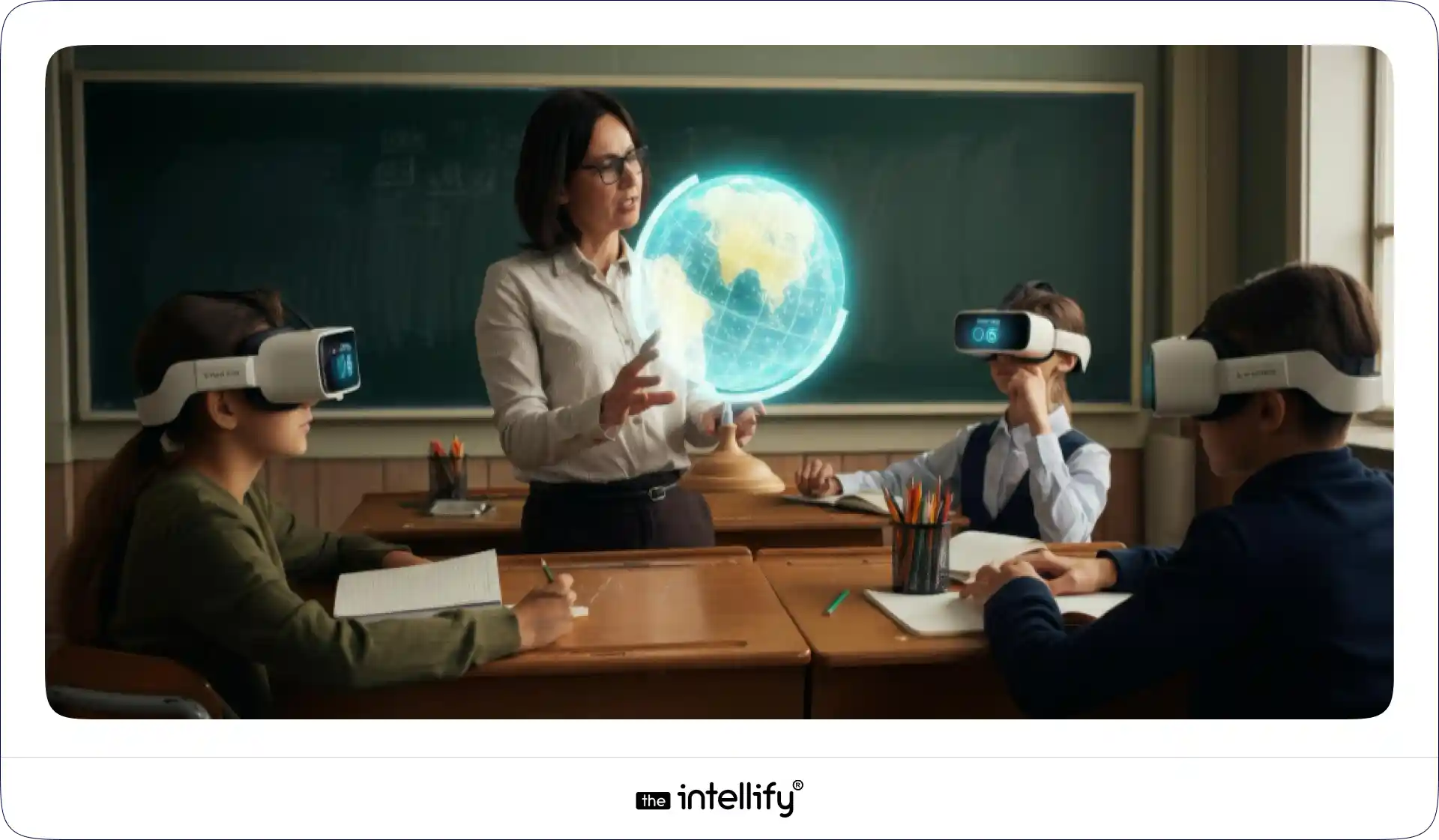
Virtual Reality (VR) in Education

Virtual reality in education refers to computer-generated environments that learners can interact with as if they were physically present. By wearing a VR headset, students are immersed in a digital world where they can look around, move, and engage with objects naturally.

There are different levels of immersion. Fully immersive VR completely replaces the real world, while semi-immersive experiences combine digital environments with some awareness of surroundings. These systems typically use headsets, motion controllers, sensors, and specialized software designed for educational purposes.

Unlike augmented reality, which overlays digital elements onto the real world, VR creates an entirely simulated environment. This makes it especially useful for situations that are difficult, dangerous, expensive, or impossible to recreate in a traditional classroom. From exploring distant planets to practicing complex procedures, VR opens up learning opportunities that were previously out of reach.


The Role of Virtual Reality in Education Today

What once seemed futuristic is now becoming part of everyday learning. Schools, universities, and training institutions across the world are gradually integrating VR into their teaching strategies.

In many cases, VR supplements traditional instruction rather than replacing it. Teachers use it to demonstrate complex ideas, provide virtual field experiences, or allow students to practice skills in realistic scenarios. It is also proving valuable in remote and hybrid learning environments, where immersive interaction can reduce the sense of distance.

Professional education and workforce training are seeing particularly rapid adoption. Fields that require hands-on experience, such as healthcare, engineering, and technical trades, benefit greatly from safe, repeatable simulations. Institutions are increasingly recognizing that immersive tools can improve engagement while better preparing students for real-world challenges.


Key Applications Across Subjects and Training Areas

  • Science and virtual laboratories: Students can run experiments without worrying about safety or cost. No broken equipment. No chemical risks. Just repeat and learn.
  • Medical and healthcare training: Future doctors can practice procedures again and again. No pressure of real patients. It builds confidence slowly but surely.
  • Engineering and technical education: Machines, systems, structures they make more sense when you interact with them. VR lets students take things apart and rebuild them.
  • Humanities and cultural studies: History feels different when you can walk through it. Ancient cities, landmarks, it’s more than just reading dates.
  • Language learning: Instead of memorizing phrases, students actually use them. Conversations feel real. That’s where fluency starts.
  • Vocational and skills training: Construction, manufacturing, equipment handling—these need repetition. VR allows that without risk.
  • Special education support: Some students need calmer, controlled environments. VR can be adjusted to reduce distractions and support different learning needs.


Benefits for Students, Teachers, and Institutions
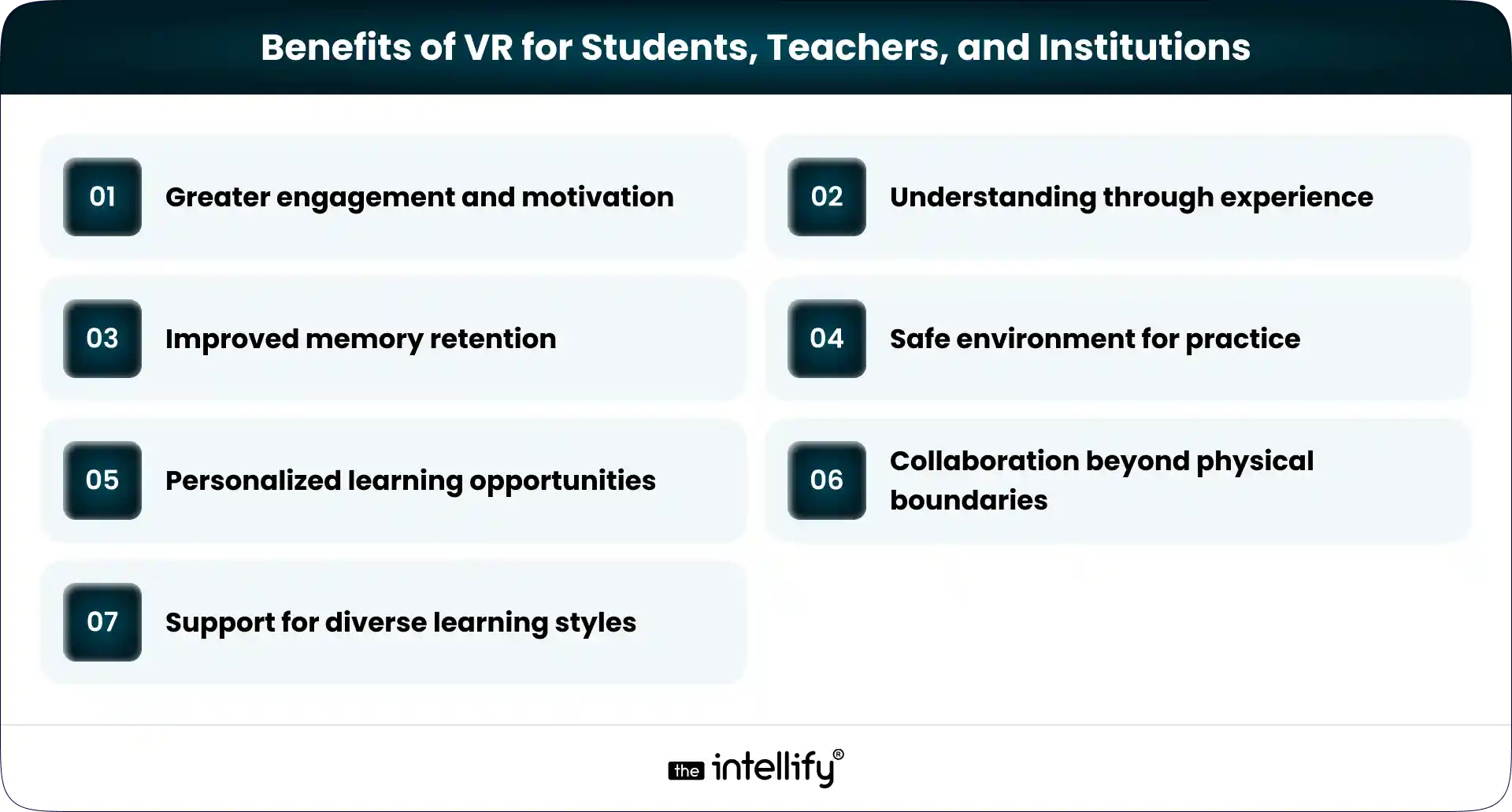
Benefits of VR in education

Greater engagement and motivation

Immersive experiences capture attention naturally. Students tend to stay focused longer because they feel involved rather than passive.

Deeper understanding through experience

Seeing and doing often leads to clearer comprehension than reading alone. Complex ideas become easier to grasp when learners interact with them directly.

Improved memory retention

Experiences tend to stay in memory longer than abstract information, helping students recall what they learned.

Safe environment for practice

Tasks that would be risky or costly in real life can be rehearsed without consequences, allowing students to learn from mistakes.

Personalized learning opportunities

Some VR systems adapt to individual progress, enabling students to move at a pace that suits them.

Collaboration beyond physical boundaries

Students can work together in shared virtual spaces, even if they are located in different places.

Support for diverse learning styles

Visual, auditory, and hands-on learners all benefit from immersive environments that combine multiple forms of interaction.

 

VR solutions for education


Real-World Examples of VR in Education

Virtual field trips:

Students explore oceans, space, or historical places without leaving the classroom. No logistics, no travel costs.

University simulations and labs:

Some universities now rely on VR labs for complex subjects. Less theory, more interaction.

Medical and technical programs:

Simulations help students practice before entering real environments. Fewer mistakes later.

Corporate learning initiatives:

Companies use VR to train employees in:

  • Customer service
  • Safety procedures
  • Operations

Measurable engagement gains:

Many institutions report better participation. Students ask more questions. They’re more curious. That’s usually a good sign.


How Augmented Reality (AR) Complements VR in Learning

1. Different approaches to immersion:- VR creates a fully digital environment, while AR enhances the real world with digital overlays. Each serves different learning needs.

2. When AR is more practical:- Activities that require awareness of the physical environment, such as lab work or field studies, often benefit more from AR.

3. Classroom applications:- AR can bring textbooks to life with interactive 3D models, animations, or contextual information displayed on devices.

4. Blended learning possibilities:- Using both technologies together allows students to explore concepts deeply in VR and then apply them in real-world settings using AR.

5. Future of mixed reality:- Emerging technologies aim to merge physical and digital spaces seamlessly, offering even more flexible learning experiences.

One example is the RainbowMe AR storytelling app, where kids scan storybook pages and watch characters come to life around them. This turns reading into an interactive experience, making stories easier to follow and more enjoyable to learn from. You can learn more about this real-world example here:- https://theintellify.com/work/rainbowme-ar-application-for-storytelling/


Challenges and Limitations of Implementing VR Solutions

Bringing virtual reality in education into classrooms sounds exciting, but the reality is a bit more layered.

Cost:

The biggest challenge is still cost. Good VR headsets, compatible devices, and quality content require investment. For schools managing tight budgets, scaling this across classrooms isn’t always practical. Some institutions try to manage this by working with VR development services that offer modular or subscription-based solutions, which can reduce upfront costs but it’s still not a small decision.

Content alignment:

Not every VR experience fits educational goals. If the content doesn’t match the curriculum, it may engage students briefly but won’t deliver real learning value. That’s why many institutions prefer customized solutions built specifically for their needs.

Teacher readiness:

Is another factor. Educators need time to learn, adapt, and integrate VR into lessons. Without proper training, even useful tools can go unused.

Physical limitations

Like motion sickness or eye strain, which limit usage time. Add infrastructure needs space, connectivity, and support and it becomes clear that adoption requires planning.

So yes, the potential is there, but implementation needs to be thoughtful, not rushed.


Opportunities and Future Trends in VR-Driven Learning

More affordable and accessible devices

VR hardware is slowly becoming more practical. Headsets are getting lighter, wireless, and less expensive. That makes it easier for schools to adopt without needing huge budgets. It’s not “cheap” yet, but it’s definitely moving in that direction. Over time, this could shift VR from special labs into regular classrooms.

AI-powered personalized learning

This is where things get interesting. Future VR systems may adjust lessons based on how each student learns. If someone struggles, the system slows down. If they’re doing well, it pushes them forward. It’s not perfect yet, but the idea of learning at your own pace inside an immersive environment feels like a big step.

Virtual campuses and shared digital spaces

Some institutions are already experimenting with virtual campuses. Students attend lectures, interact with peers, and collaborate in shared spaces without being physically present. It still feels a bit early, but you can see where it’s heading.

Global remote classrooms

VR removes location barriers in a very real way. Students from different countries can join the same class, interact, and learn together. It’s not just about access it’s also about exposure to different perspectives, which traditional classrooms don’t always offer.

Workforce training and lifelong learning

Learning doesn’t stop after school anymore. Industries keep evolving, and people need to keep up. VR makes it easier to train for new roles, tools, or processes without disrupting real operations. It’s practical, repeatable, and safer in many cases.

Transformation of education systems

Over time, education may shift away from just delivering information. The focus could move more toward applying knowledge solving problems, building skills, and learning by doing. VR supports that kind of learning naturally, which is why it’s gaining attention.


How Institutions Can Successfully Adopt VR for Learning
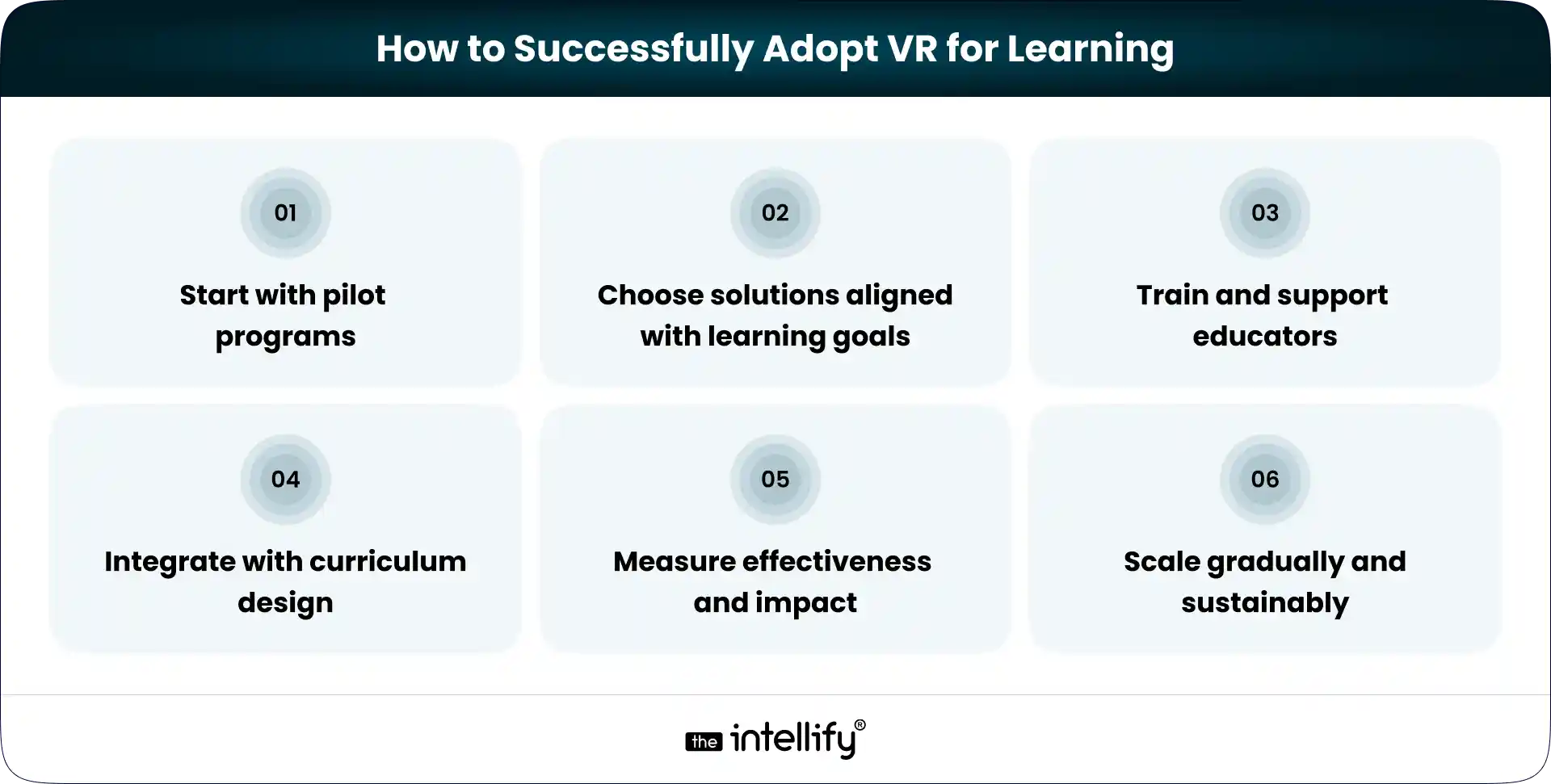
How to Successfully Adopt VR for Learning

Start with pilot programs

Jumping straight into full-scale adoption usually doesn’t work. It’s better to test things first. A small pilot maybe one subject or a limited group helps institutions understand how VR for education actually performs in real conditions. You get honest feedback, spot issues early, and avoid wasting resources.

Choose solutions aligned with learning goals

Not every VR tool fits every subject. Some look great but don’t add real value. Institutions should focus on solutions that directly support what students need to learn. This is where working with experienced VR development services can help custom or tailored solutions tend to align better with actual curriculum needs.

Train and support educators

Teachers are at the center of this. If they’re not comfortable, adoption slows down simple as that. Training should be practical, not overwhelming. Ongoing support also matters, especially in the early stages when things don’t always go as planned.

Integrate with curriculum design

VR shouldn’t feel like an extra activity. It should fit naturally into the lesson. When it supports existing topics rather than replacing them it becomes more useful and easier to manage.

Measure effectiveness and impact

It’s important to track what’s actually happening. Are students more engaged? Are they understanding concepts better? Data, feedback, even small observations all of it helps in figuring out if VR is worth continuing or expanding.

Scale gradually and sustainably

Once things start working, growth should be steady. Expanding step by step reduces risk and keeps things manageable. Many institutions also work with a VR development partner to ensure their solutions can scale without needing constant rework.

Adoption isn’t about rushing. It’s about getting it right, one step at a time.

 

VR Development Services


Final Thought

Virtual reality is redefining how knowledge can be experienced, not just delivered. By making learning interactive, practical, and engaging, it offers new possibilities across academic, professional, and lifelong education.

Its success, however, depends on thoughtful implementation. Technology works best when it supports strong teaching practices rather than trying to replace them. As tools become more accessible and content continues to evolve, immersive learning is likely to become a natural part of education systems worldwide.

The future of learning may not be limited by physical classrooms at all. Instead, it may be shaped by the experiences we can create and virtual reality is opening the door to those possibilities.


Frequently Asked Questions (FAQS)

1. How is virtual reality used in classrooms today?

VR is mainly used to support lessons with interactive experiences. Students can explore virtual labs, historical places, or complex concepts in 3D instead of just reading about them. It helps make learning more engaging and easier to understand.

2. Does VR actually improve learning or just make classes more fun?

It does both. VR makes lessons interesting, but it also helps students remember concepts better because they experience them directly. Learning by doing often leads to deeper understanding than memorizing information.

3. Which subjects benefit the most from VR-based learning?

Subjects that involve practical skills or complex visuals benefit the most. Science, medicine, engineering, and geography are common examples. However, VR can also enhance history, language learning, and vocational training.

4. How is VR different from augmented reality in education?

VR creates a completely digital environment that students can explore, while AR adds digital elements to the real world. VR is more immersive, whereas AR is useful for enhancing classroom activities without isolating learners.

5. What are the main challenges of using VR in schools?

The biggest challenges are cost, equipment needs, and teacher training. Schools also need reliable technology infrastructure and suitable content. Without proper planning, adoption can be difficult.

6. Can VR support online or remote learning?

Yes, VR can create shared virtual spaces where students interact with content and sometimes with each other. This makes remote learning feel more engaging than standard video-based classes. However, it usually works best as a complement, not a complete replacement.

7. What should schools consider before adopting VR?

Schools should first identify clear learning goals and start with small pilot programs. Training teachers and choosing the right content are just as important as buying equipment. A gradual approach helps ensure long-term success.
Healthcare Membership Management System: Key Features & Architecture

Summary:
A healthcare membership management system helps providers handle patient subscriptions, billing, and communication in one place. This blog covers how these systems work, their key features, and why they are important for clinics, hospitals, and wellness providers. It also highlights how they improve efficiency, reduce manual work, and help deliver better patient care while ensuring consistent and predictable revenue.

The healthcare landscape is evolving, shifting towards membership-based models that foster patient engagement and streamline service delivery. At the heart of this transformation is the Healthcare Membership Management system, providing the essential tools clinics and hospitals need to thrive in this new environment. In this blog, we’ll dive into what a healthcare membership management system is, its core features, how it operates, and why it’s so crucial for both providers and patients today.


The Shift Toward Membership-Based Healthcare

In recent years, subscription and membership models have gained popularity in the healthcare sector. These approaches, such as direct primary care (DPC), concierge medicine, and wellness plans, bring many benefits over traditional healthcare methods.
Why subscription and membership models are growing in healthcare.

Patient Centric Care:- These models prioritise patient engagement, allowing for tailored services and support.

Financial Predictability:- Providers enjoy predictable revenue streams as patients pay monthly or annual fees.

Less Administrative Overhead:- Automating member management cuts down on paperwork and boosts efficiency.

Challenges of managing members manually

Yet, many healthcare providers still struggle with manual member management, which often results in errors, inconsistencies, and ultimately, decreased patient satisfaction. As these models expand, there’s a growing need for specialized software instead of clinging to outdated systems.


What Is a Healthcare Membership Management System?

A healthcare membership management system simplifies the process of managing patient memberships, enabling healthcare providers to deliver personalized care more effectively.

How it differs from a general healthcare management system

While general systems track appointments and patient history, membership management systems concentrate on managing memberships, billing, and customized healthcare plans.

Who uses it?

  • Clinics
  • Hospitals
  • Speciality Providers
  • Wellness Brands

Types of membership models it supports

These systems can accommodate a variety of membership models, including single-tier plans, multi-tier plans, and bundled services.


Why Healthcare Providers Need a Membership System Today

The rising demand for a healthcare membership management system stems from several key factors:

Administrative overload without automation

Managing memberships manually takes time and often leads to errors. Staff end up handling billing, renewals, and patient communication separately. A membership system brings all of this into one place, reducing repetitive work and helping teams focus more on patient care instead of paperwork.

Revenue predictability and recurring billing needs

Traditional healthcare income can vary from month to month. Membership models bring stability through recurring payments. A proper system ensures billing runs on time, reducing missed payments and helping providers plan their finances with more confidence.

Improving patient experience and retention

Patients expect simple and smooth services. When booking, billing, and communication are easy, they are more likely to stay. A membership system helps create a consistent experience, which builds trust and improves long-term relationships.

Managing growth without increasing staff

As the number of members grows, manual processes become difficult to handle. A system allows providers to scale operations without needing to hire more staff, keeping costs under control while maintaining service quality.


How a Healthcare Membership Management System Works

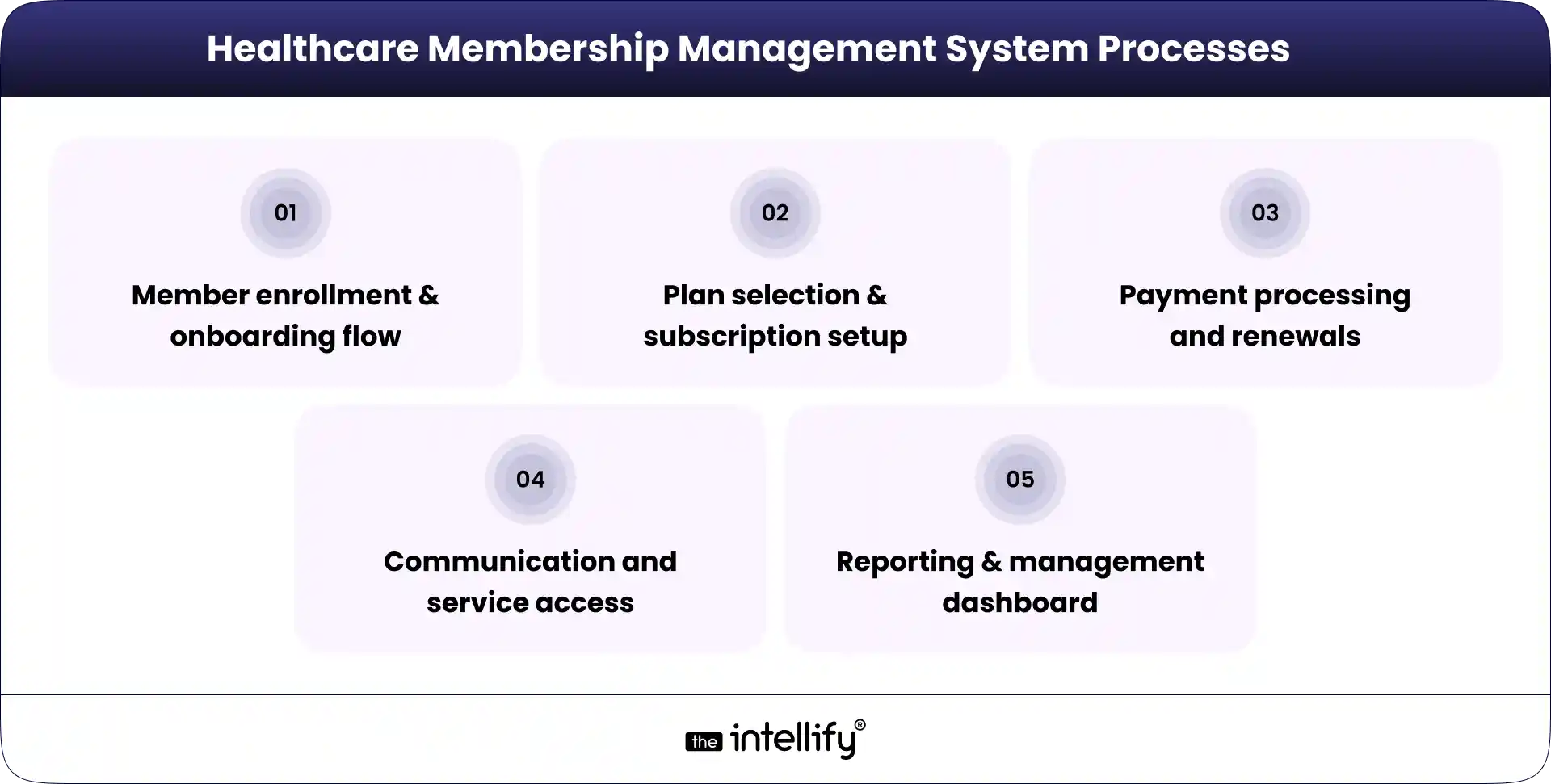
Healthcare Membership Management System Processes

A healthcare membership management system streamlines various processes, making life easier for both providers and patients.

Member enrollment and onboarding flow

Patients can sign up online by filling in basic details and selecting a plan. The process is simple and does not require staff involvement at every step, which saves time and reduces delays.

Plan selection and subscription setup

Patients choose plans based on their needs. The system clearly shows available options, pricing, and services, making it easier for them to decide and subscribe without confusion.

Payment processing and renewals

Payments are handled automatically. The system processes transactions, sends reminders, and manages renewals. This ensures that billing runs smoothly without manual tracking.

Communication and service access

Patients receive updates through email or SMS. They can access services, get reminders, and stay informed without needing to call or visit the clinic every time.

Reporting and management dashboard

Providers can view all data in one place. Dashboards show member activity, revenue, and trends, helping in better decision-making without going through multiple reports.


Core Features That Power an Effective Healthcare Membership Platform

  • Member Enrollment & Profile Management:- Streamlining member registration while keeping detailed profiles ensures quick access to patient histories and preferences.
  • Subscription & Billing Automation:- Automated billing minimizes administrative burdens while ensuring timely payments, which in turn improves cash flow.
  • Plan Creation and Tier Management:- Providers can effortlessly create and manage various membership plans, tweaking them as needed to fit patient requirements.
  • Appointment and Service Tracking:- An integrated calendar helps track appointments and services, sending reminders to reduce no-shows.
  • Communication Tools (email, SMS, reminders):- Effective communication tools keep members in the know and engaged, enhancing their overall experience.
  • Analytics and Reporting:- Detailed analytics provide insights into trends, patient behaviors, and financial metrics, aiding strategic planning.


Mid-CTA


System Architecture: What Happens Behind the Scenes

healthcare membership platform development operates through several components:

1. Frontend (patient and admin interfaces):- User-friendly interfaces make it easy for both patients and administrative staff to navigate the system.

2. Backend logic and workflows:- Robust backend processes handle data management, billing, and member communication seamlessly.

3. Database for member records:- A secure database keeps sensitive patient information safe while allowing easy access for authorized personnel.

4. Payment gateway integration:- Secure payment processing is critical, ensuring that financial transactions are managed safely.

5. Security and compliance layers:- Special measures help ensure compliance with healthcare regulations while protecting sensitive patient data.

6. Scalability considerations:- A well-designed system can grow with your practice, facilitating additional features or accommodating increased user loads as necessary.

A U.S.-based Direct Primary Care platform improved patient access and care coordination by implementing a secure digital solution across its services. The system streamlined operations for providers while keeping sensitive health data protected under strict privacy standards. This shows how modern AI-enabled technology can enhance healthcare delivery without compromising compliance. View the complete case study for more details: https://theintellify.com/work/healthcare2u/


Integration with Existing Healthcare Systems

Integrating a membership management system with other vital healthcare software ensures smooth operations:

Electronic Health Records (EHR)

Integration with EHR systems ensures patient data stays connected. Providers can access medical history along with membership details without switching systems.

Practice management software

Linking with practice management tools helps manage appointments, staff schedules, and operations in a more organized way.

Payment systems

Connecting with payment gateways ensures secure and smooth transactions. It also supports different payment methods for patient convenience.

Telehealth platforms

Integration with telehealth allows providers to offer remote consultations as part of membership plans, improving access to care.

CRM or patient engagement tools

CRM systems help track communication and patient interactions, making it easier to maintain relationships and improve engagement.


Benefits for Providers and Healthcare Businesses

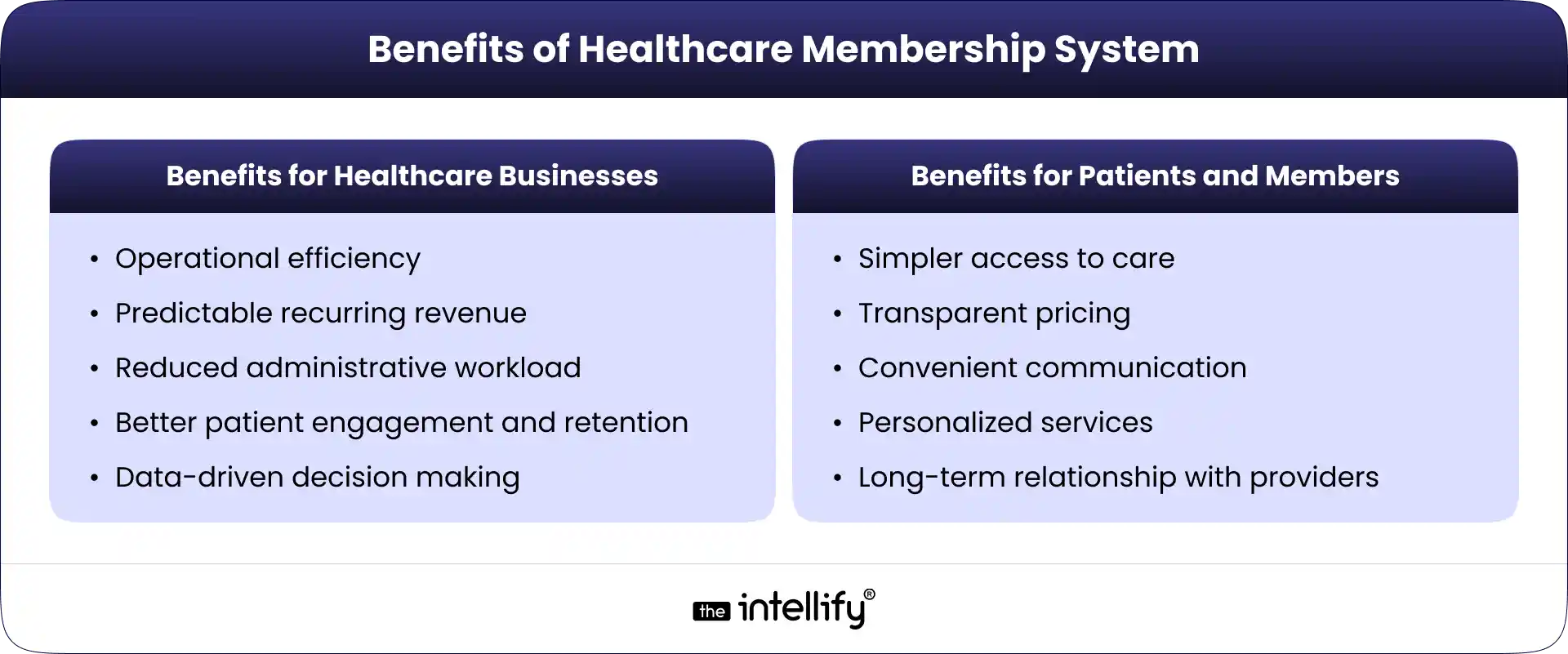
Benefits of Healthcare Membership System

  • Operational efficiency:- Automation reduces manual tasks and speeds up daily operations. Staff can handle more work in less time without feeling overloaded.
  • Predictable recurring revenue:- Membership payments bring steady income. This helps providers plan expenses and investments without uncertainty.
  • Reduced administrative workload:- Billing, renewals, and communication are handled automatically. This reduces the need for manual follow-ups and paperwork.
  • Better patient engagement and retention:- Consistent communication and smooth service improve patient satisfaction. Happy patients are more likely to stay and continue their memberships.
  • Data-driven decision making:- Access to reports and analytics helps providers understand trends and make better decisions based on real data.


Benefits for Patients and Members

  • Simpler access to care:-Patients can easily sign up, book services, and stay connected with their providers without complicated steps.
  • Transparent pricing:- Membership plans clearly show costs, so patients know what they are paying for. This builds trust and avoids unexpected charges.
  • Convenient communication:- Patients receive reminders and updates without needing to follow up. This makes the overall experience smoother.
  • Personalized services:- Plans can be designed based on individual needs, allowing patients to receive care that suits them better.
  • Long-term relationship with providers:- Membership models encourage regular interaction, helping build a stronger and more consistent relationship with healthcare providers.


Key Considerations When Choosing a Healthcare Membership Solution

When picking a healthcare membership solutions, keep these factors in mind:

Ease of use for staff and patients:- The system should be simple to use. Both staff and patients should be able to navigate it without confusion or long training.

Customization of plans:- Providers should be able to create and adjust plans based on their services and patient needs.

Compliance and data security:- The system must follow healthcare regulations and protect patient data through secure access and storage.

Integration capability:- It should connect easily with existing tools like EHR, billing systems, and telehealth platforms.

Scalability for future growth:- The system should handle growth without needing major changes as the number of patients increases.

Support and implementation:- Reliable support is important for setup and ongoing use. Providers should have access to help when needed.


Common Use Cases Across Healthcare Segments

  • Direct Primary Care practices:- DPC providers use membership systems to manage subscriptions and offer ongoing care without complex billing.
  • Specialty clinics:- Clinics can manage different services and patient needs through flexible membership plans.
  • Preventive care and wellness programs:- Memberships support regular check-ups and wellness services, encouraging better health management.
  • Corporate health memberships:- Companies can offer healthcare plans to employees, making it easier to manage group memberships.
  • Telehealth subscription services:- Telehealth providers can offer remote care through subscription models, ensuring continuous patient support.


Steps to Build or Implement a Healthcare Membership Management System

1. Define your membership model and pricing:- Start by deciding the type of plans you want to offer and how you will price them.

2. Choose between custom build or SaaS solution:- Decide whether you need a ready-made solution or a custom system based on your requirements and budget.

3. Design workflows and user experience:- Plan how patients and staff will use the system to ensure it is simple and efficient.

4. Integrate with existing systems:- Connect the system with current tools to avoid disruptions and ensure smooth operations.

5. Test, launch, and optimize continuously:- Test the system before launch and keep improving it based on feedback and changing needs.


What Affects the Cost of a Healthcare Membership System?

  • Features and customization level:- More features and customization usually increase the cost, especially if the system is built from scratch.
  • Integration complexity:- Connecting with multiple systems can add to the overall cost depending on how complex the setup is.
  • Compliance and security requirements:- Meeting healthcare standards and ensuring data protection can also impact the cost of development and maintenance.


Future Trends in Membership-Based Healthcare Technology

Growth of subscription healthcare models

More providers are adopting membership models as they offer stable revenue and better patient relationships.

AI-driven personalization

AI is helping tailor services based on patient data, making care more relevant and effective.

Remote care and digital health integration

Telehealth and digital tools are becoming a key part of membership plans, improving access to care.

Outcome-based memberships

There is a shift toward focusing on results rather than just services, improving overall care quality.

Expansion beyond primary care

Membership models are expanding into specialized and advanced healthcare services.


Healthcare membership platform development


Final Thought

A healthcare membership management system helps providers manage memberships, billing, and patient relationships in a simple and structured way. It reduces manual work, improves patient experience, and creates stable revenue. As more healthcare providers move toward membership-based care, having the right system in place becomes important for smooth operations and long-term growth.


Frequently Asked Questions

1. What makes a healthcare membership management system different from regular healthcare software?

A regular healthcare system mainly handles patient records and operations. A healthcare membership management system focuses on managing subscriptions, recurring billing, and member relationships. It’s built for practices that offer ongoing care through plans, not one-time visits.

2. How does a healthcare membership system handle recurring billing without errors?

It automates the entire billing cycle, plan selection, payment processing, renewals, and reminders. This reduces manual mistakes and ensures payments are collected on time without staff needing to track everything manually.

3. Can small clinics or DPC practices benefit from a membership management system?

Yes, especially small clinics. It helps them manage members efficiently, create predictable monthly revenue, and offer better patient experience without needing a large admin team.

4. What kind of integrations are important in a healthcare membership system?

Common integrations include EHR systems, payment gateways, telehealth platforms, and CRM tools. These connections help create a smooth workflow without switching between multiple tools.

5. Is a healthcare membership management system secure for handling patient data?

Yes, most systems are designed with strong security measures and follow healthcare compliance standards. Data is encrypted, and access is controlled to protect sensitive patient information.

6. How long does it take to implement a healthcare membership management system?

It depends on whether you choose a ready-made solution or a custom build. SaaS platforms can be set up quickly, while custom systems may take longer based on complexity and integrations.

View
Case Study