AI Automation in Healthcare: Transforming Care and Operations

Summary:
Healthcare systems today are under pressure to deliver faster, more efficient care while managing growing workloads and fragmented processes. AI automation in healthcare is helping streamline workflows like patient onboarding, documentation, billing, and communication, improving both operations and care delivery. This blog explores how automation fits into healthcare, its real-world applications, key benefits, challenges, and how organizations can adopt it effectively to build more connected and patient-centered systems.


The Growing Pressure on Modern Healthcare Systems

Patients expect faster responses, smoother experiences, and fewer delays. Waiting weeks for reports or chasing updates? That doesn’t sit well anymore. People compare healthcare experiences to other industries now, like banking and e-commerce, where things just work. That expectation shift is real.

At the same time, hospitals are seeing more patients than ever. Ageing populations, chronic conditions, and increased awareness all contribute to higher demand. The system isn’t just busy, it’s constantly operating near its limits.

Then comes the administrative burden. Doctors and nurses spend a surprising amount of time on non-clinical work like documentation, scheduling, and coordination. It eats into time meant for patient care. Over time, that leads to frustration and burnout. You can feel it in conversations with healthcare professionals, they’re tired, not of helping patients, but of everything around it.

Another issue? Disconnected systems. A patient’s data might live in multiple platforms, EHRs, lab systems, and billing tools, and they don’t always sync properly. That leads to delays, repeated tests, or incomplete information during decision-making.

Traditional workflows weren’t designed for this level of complexity. They worked when volumes were lower and systems simpler. Today, they’re struggling to keep up.


Defining AI Automation in Healthcare Today

AI Automation in Healthcare isn’t just about speeding things up, it’s about making smarter decisions without constant manual effort.
Earlier, automation meant basic rules. If X happens, do Y. Simple, predictable, and a bit rigid. Now, with healthcare AI automation, systems can actually learn, adapt, and assist in decision-making.

Instead of manually reviewing patient records, AI can highlight patterns. Instead of scheduling everything by hand, systems can optimize appointments based on urgency, availability, and history. This shift from manual work to intelligent systems is changing how healthcare operates quietly but steadily.

In daily operations, AI automation shows up quietly:

  • Suggesting next steps in patient care
  • Flagging anomalies in reports
  • Automating routine communication
  • Prioritizing tasks based on real-time data

It’s not replacing healthcare professionals. It’s more like reducing the noise so they can focus on what matters. Across the care journey from patient onboarding to diagnosis to post-treatment follow-ups, this technology is already being used. Not everywhere, not perfectly, but enough to create visible improvements.


Gaps in Today’s Healthcare Workflow

Challenges in Healthcare Workflow

If you step back and observe, the inefficiencies are hard to ignore.

Repetitive administrative tasks take a lot of time. Data entry, form filling, and insurance verification are necessary work, but not the best use of highly trained professionals.

Patient Communication delays are another pain point. Patients wait for confirmations. Staff wait for approvals. Small gaps, but they stack up.

Data fragmentation is another issue. Information is spread across systems and departments. Bringing it together takes effort, and sometimes important details slip through the cracks.

All of this impacts care quality in subtle but important ways:

  • Slower decision-making
  • Increased chances of human error
  • Gaps in patient experience
  • Added pressure on staff

Operational efficiency also suffers. Processes move, but not smoothly. There’s friction at multiple points and over time, that friction adds up.


How AI-Driven Automation Fits into Healthcare Workflows

AI-driven automation works by turning scattered data into meaningful action.

It starts with data capture, like patient records, lab results, clinical notes, and device data. This data is then processed using machine learning and natural language processing. These technologies help systems understand both structured and unstructured information.

For instance, clinical notes written in plain language can be analyzed automatically. Important insights can be extracted without manual review.

Integration plays a big role here. When connected with EHRs and hospital systems, automation becomes part of the workflow rather than an add-on.

There are two main approaches:

  • Real-time automation: Immediate actions based on live data (like alerts or recommendations)
  • Trigger-based workflows: Actions initiated when specific conditions are met (like sending reminders after discharge)

Both approaches serve different needs, and most healthcare systems use a mix of both.

The real shift? Faster, data-driven decisions. Instead of relying on delayed inputs or manual checks, teams can act on real-time insights.


Key Areas Where Healthcare Workflow Automation Creates Impact

AI in Healthcare workflow automation doesn’t focus on just one area, it improves multiple parts of the system at once.

  • Patient onboarding becomes smoother. Forms are pre-filled, data is validated instantly, and appointments get scheduled without back-and-forth.
  • Clinical documentation improves too. Notes can be captured and structured automatically, reducing manual effort.
  • Billing and insurance processing see major benefits. Claims can be verified, errors flagged, and approvals processed faster. This alone can save a lot of time and reduce financial friction.
  • Internal coordination improves as well. When systems are connected, departments don’t operate in isolation. Information flows more freely.
  • Remote monitoring is another growing area. Devices continuously send patient data, and systems trigger alerts when something unusual is detected.

These changes may seem small individually, but together they create a smoother, more efficient workflow.
 

Healthcare AI Automation Solutions


Real-World Applications of Workflow Automation in Healthcare

In practice, workflow automation is already shaping how healthcare operates.

  • Hospitals use it to streamline daily tasks, from admissions to discharge. What used to take hours can now be done in minutes.
  • Clinics and diagnostic centers rely on automation for managing patient flow, test scheduling, and report generation. It reduces chaos during peak hours. Telehealth platforms depend heavily on automation. Without it, managing virtual consultations, reminders, and follow-ups would be overwhelming.
  • Patient communication has improved significantly. Automated reminders for appointments, medication schedules, and follow-ups keep patients informed without adding to staff workload.
  • One noticeable benefit is workload reduction, not by cutting staff, but by reducing unnecessary tasks. Teams can focus more on patient care instead of administrative work.
  • Billing, insurance verification, and claims processing have become faster and more accurate. Appointment scheduling is more organized. Follow-ups happen on time.
  • Coordination between departments improves, too. Information doesn’t get stuck; it moves where it’s needed.
  • For patients, the experience feels more connected. Fewer delays, clearer communication, and a more predictable journey across touchpoints.


Implementing Healthcare Automation Services the Right Way

Implementing healthcare automation services works best when you keep it simple and focused.

1. Start by identifying high-impact workflows tasks that are repetitive and time-consuming, like scheduling, onboarding, or billing. These areas usually deliver quick wins.

2. Make sure automation aligns with your existing systems. If it doesn’t integrate well, it can create more problems than it solves.

3. Staff adoption is just as important. Teams need to understand how it helps them, not just the process. A gradual rollout and basic training can make a big difference.

4. Avoid adding too much complexity early on. Start small, test what works, and expand slowly.

5. If your processes feel slow, repetitive, or hard to scale, that’s a clear sign you’re ready for automation.


Measurable Benefits for Care Delivery and Operations
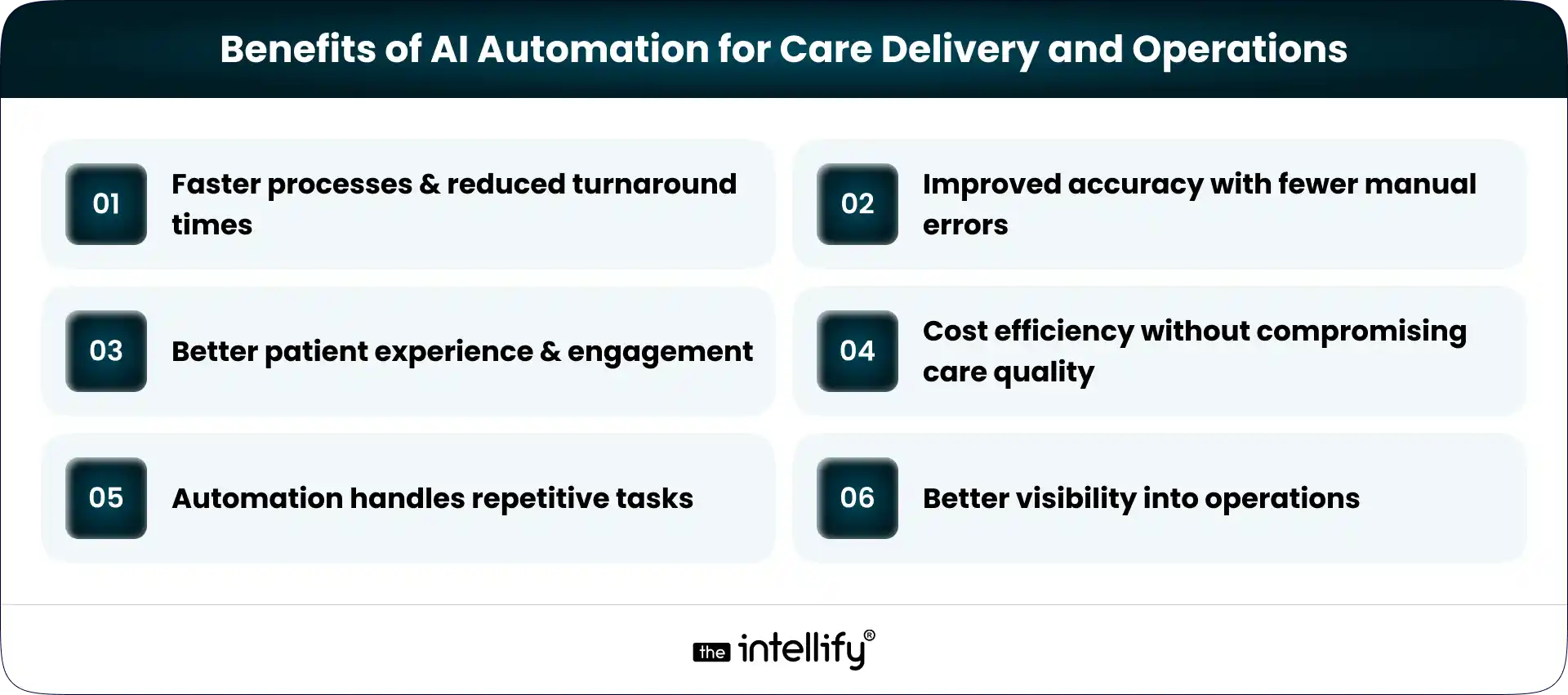
Benefits of AI Automation in healthcare

The impact of automation shows up in both numbers and day-to-day experience.

1. Processes become faster. Turnaround times for reports, approvals, and communication decrease.

2. Accuracy improves. Automated systems reduce manual errors, especially in data entry and documentation.

3. Patients experience smoother interactions. Shorter wait times, timely updates, and better overall communication.

4. Cost efficiency improves gradually. Not through drastic cuts, but by optimizing existing resources.

5. Healthcare teams benefit too. Automation handles repetitive tasks, allowing professionals to focus on more meaningful work.

There’s also better visibility into operations. Leaders can track performance, identify bottlenecks, and make informed decisions based on real data.


Common Challenges in Healthcare AI Automation

Despite its benefits, healthcare AI automation comes with challenges.

  • Resistance to change within healthcare teams: Healthcare professionals are careful, and they should be. New systems need to prove reliability before gaining trust.
  • Data privacy, compliance, and security concerns: Patient data must be handled securely, with strict adherence to regulations.
  • Integration with legacy systems: It can make integration difficult. Many healthcare organizations still rely on older infrastructure that isn’t built for modern automation.
  • Maintaining balance is another challenge. Automation should support decision-making, not replace human judgment, especially in clinical scenarios.

These challenges require planning, but they’re manageable with the right approach.


How Automation is Reshaping Hospitals and Healthcare Systems

Automation is gradually changing how hospitals operate, less fragmented, more connected.

There’s a clear shift toward data-driven environments. Information flows more easily across systems, so teams aren’t working in silos anymore. Decisions are based on real-time data, not delayed reports.

AI is also playing a bigger role, both in clinical and operational decisions. It helps surface insights, flag risks, and support faster actions without replacing human judgment.

Automation is no longer limited to one department. What starts in areas like billing or scheduling often expands across the organization once results become visible.

All of this leads to more coordinated care delivery. Departments stay aligned, communication improves, and the overall patient experience feels more consistent.


How Healthcare Automation Is Evolving

Rise of predictive and preventive care models

Healthcare is moving from reacting to problems → predicting them early. Systems can flag risks before they become serious issues.

More personalized patient journeys

Care plans are becoming more tailored, based on patient history, behavior, and real-time data not just standard protocols.

Real-time insights guiding decisions

Decisions are no longer delayed. Doctors and staff can act on live data, improving the speed and accuracy of care.

Expansion into remote and home-based care

Automation is enabling continuous monitoring outside hospitals, making care more accessible and less dependent on physical visits.

 

Healthcare automation services


Conclusion

AI automation in healthcare is steadily improving how care is delivered and how operations are managed, helping reduce delays, minimize manual effort, and support better decision-making across the system. From streamlining workflows to enhancing patient experiences, the impact is visible, even if it’s happening gradually.

The key, though, is not rushing into it. A thoughtful, phased approach works better starting with the right use cases, aligning with existing systems, and ensuring teams are comfortable with the change. In the long run, it’s less about automation itself and more about building a healthcare system that is efficient, responsive, and truly centered around patient needs.


Frequently Asked Questions (FAQs)

1. Where does AI automation create the most impact in healthcare today?

It usually starts with operational areas like scheduling, billing, and patient communication. These are repetitive and time-consuming, so automation quickly improves efficiency and reduces delays.

2. How does AI automation improve the patient experience in practical terms?

Patients notice faster responses, fewer delays, and smoother coordination. Things like timely updates and easy communication make the overall care journey feel more organized.

3. What’s the difference between basic automation and AI-driven automation in healthcare?

Basic automation follows fixed rules, while AI-driven systems can learn from data and adapt over time. This helps improve accuracy and supports better decision-making.

4. How does automation change the day-to-day work of healthcare teams?

It reduces repetitive tasks like data entry and follow-ups, allowing staff to focus more on patient care and important decisions rather than routine work.

5. Can AI automation work with existing hospital systems, or does everything need to change?

Most solutions are designed to integrate with existing systems like EHRs, so organizations can improve workflows without replacing everything.

6. What are the early signs that a healthcare organization is ready for automation?

Frequent delays, high manual workload, and coordination issues are clear indicators. If teams are spending too much time on repetitive tasks, automation can help.

7. What’s the best place to start with AI automation in healthcare?

Start with workflows that are repetitive and time-consuming, like scheduling, billing, or patient communication. These areas usually deliver quick and measurable improvements.
Telehealth App Development: A Complete Guide for Healthcare Providers

Summary:
Telehealth apps are reshaping how healthcare is delivered by making consultations, monitoring, and follow-ups more accessible and efficient. This guide covers essential features, benefits for providers and patients, and how AI reduces manual work. It also highlights the role of a reliable Telehealth App Development Company, along with the development process, cost factors, challenges, and future trends shaping modern, scalable, and patient-focused healthcare systems.

Healthcare is changing quickly, but not in a flashy way. It’s more of a steady shift that people working in the system can clearly notice.

Patients don’t want to wait weeks just to see a doctor. At the same time, healthcare providers are dealing with too much paperwork and packed schedules. It’s becoming harder for both sides to keep up. Because of this, there’s a growing need to make healthcare simpler and easier to access.

That’s where Telehealth App Development comes in. It’s not just a trend, it’s a practical way to help doctors and patients connect more easily and manage care better. Let’s get into it properly.


Why Telehealth Is Becoming a Core Part of Modern Healthcare

A few years back, telehealth felt like a backup plan. Now it’s becoming a default option in many cases.

Rising demand for remote care and convenience

People are used to doing everything from their phones banking, shopping, even therapy sessions. So, expecting them to travel for every consultation feels a bit outdated. Telehealth removes that friction.

Shift in patient expectations toward digital-first experiences

Patients today don’t just compare healthcare providers they compare experiences. If one clinic offers smooth online booking and instant consultations while another requires calls and waiting the choice is obvious.

Pressure on providers to improve access and efficiency

Hospitals and clinics are dealing with higher patient volumes than ever. Telehealth helps manage that load by handling non-critical consultations remotely, freeing up physical space for urgent care.

Role of AI automation in reducing manual workload

This part’s honestly a game changer. AI tools can manage scheduling, collect patient data, and even assist in documentation. It doesn’t replace human judgment, it just removes repetitive work that slows everything down.

How telehealth fits into long-term healthcare delivery models

We’re moving toward hybrid care. Some visits happen in person, others online. It’s not about replacing traditional care, it’s about making it more flexible and accessible.


Telehealth App Development: Understanding the Bigger Picture

When most people hear telehealth, they picture a video consultation. That’s just the surface. Healthcare App Development today is about building complete digital ecosystems that support the entire care journey.

What telehealth apps actually include beyond video calls

Think scheduling systems, patient records, billing, messaging, analytics, everything connected in one place.

Key stakeholders: patients, doctors, admins, care teams

It’s not just doctor and patient anymore. Nurses, coordinators, and admin staff all interact with the system. So the app has to work for everyone, not just one group.

Difference between basic telemedicine and advanced digital care platforms

Basic telemedicine = consultation.
Advanced platforms = continuous care, monitoring, data insights, follow-ups the whole journey.

Where AI automation enhances decision-making and workflows

AI can flag high-risk patients, suggest next steps, and even prioritize cases. It’s not replacing doctors, it’s helping them move faster and smarter.


Core Features Every Telehealth Platform Should Include

Features of Telehealth Platform

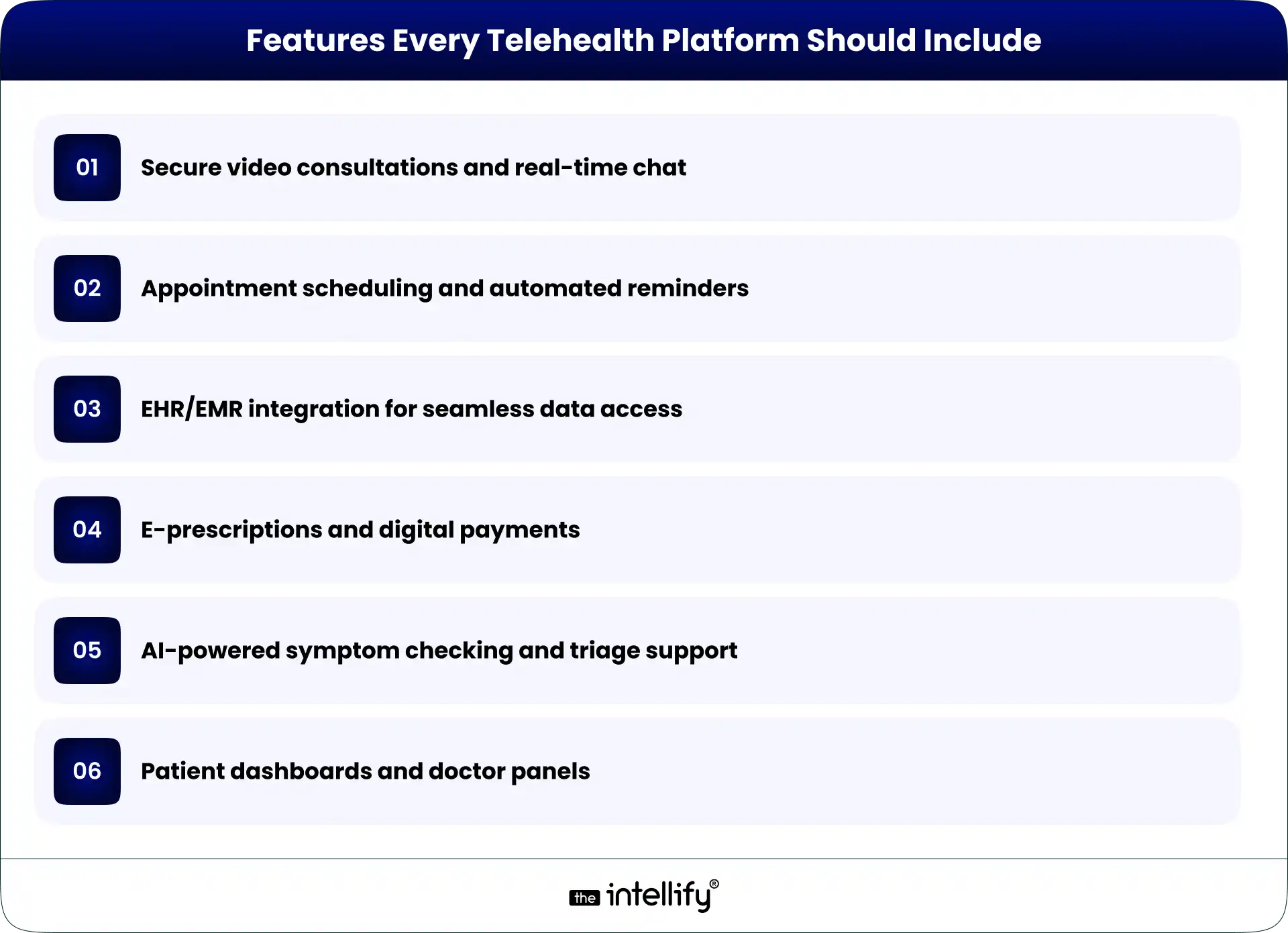
If you’re building a telehealth platform, these features aren’t optional, they’re foundational.

  • Secure video consultations and real-time chat: This is the core experience. Video calls should be stable, clear, and secure. Even small lags or glitches can frustrate users.
  • Appointment scheduling and automated reminders: Manual scheduling is messy. Automated systems reduce missed appointments and help providers manage time better.
  • EHR/EMR integration for seamless data access: Doctors need context. Without access to patient history, even simple consultations become inefficient.
  • E-prescriptions and digital payments: Patients shouldn’t have to switch between systems. Everything from consultation to payment should happen in one smooth flow.
  • AI-powered symptom checking and triage support: Before even meeting a doctor, patients can input symptoms. This helps prioritize cases and saves time during consultations.
  • Patient dashboards and doctor panels: Dashboards keep everything organized: appointments, reports, prescriptions. Doctors and patients both need clear visibility.


Benefits for Providers and Patients

Telehealth isn’t just about convenience, it improves how healthcare works on both sides.

  • Improved access to care: Patients in remote areas or with mobility issues can get medical help without traveling long distances.
  • Reduced operational burden: Less paperwork, fewer physical visits, and better scheduling systems make operations smoother.
  • Better patient engagement: When care is easier to access, patients are more likely to follow up, attend appointments, and stay involved.
  • Cost efficiency: Providers save on infrastructure costs, while patients save on travel and time.
  • Faster decision-making with AI support: AI tools help doctors process information quickly, leading to faster and often more accurate decisions.


Telehealth App Development Company


How AI Automation Is Transforming Telehealth App Solutions

AI isn’t just an add-on anymore, it’s becoming a core part of Telehealth app solutions.

Smart appointment scheduling and no-show reduction

AI can analyze patterns and suggest optimal appointment slots. It can even predict when patients might miss appointments.

AI chatbots for patient support and intake

Basic queries don’t need human intervention. AI Chatbots can handle FAQs, onboarding, and initial data collection instantly.

Clinical decision support systems

AI can assist doctors by analyzing patient data and suggesting possible diagnoses or treatments. It’s not perfect, but it’s useful.

Automated documentation and voice-to-text notes

Doctors spend less time typing and more time interacting with patients. Conversations can be converted into structured medical notes.

Predictive analytics for patient monitoring

AI can detect early warning signs by analyzing trends in patient data. This helps in proactive care.

Personalized care recommendations

Treatment plans can be tailored based on patient behavior, history, and real-time data.


Ensuring Compliance, Security, and Data Privacy

Healthcare data is sensitive. There’s no room for mistakes here.

Importance of regulatory compliance (HIPAA, GDPR, etc.): Healthcare apps must follow strict regulations depending on the region.

Non-compliance can lead to serious consequences: Secure data storage and encryption practices: Patient data must be encrypted at all stages of storage, transmission, and access. No exceptions.

User authentication and access control: Different users need different levels of access. Role-based permissions help protect sensitive data.

Risks of non-compliance and how to avoid them: Legal issues, fines, and loss of trust all of it can happen if compliance is ignored.

Building trust with patients through transparent data handling: Patients are more likely to use digital healthcare if they trust how their data is handled.


Telehealth App Development Process: From Idea to Launch

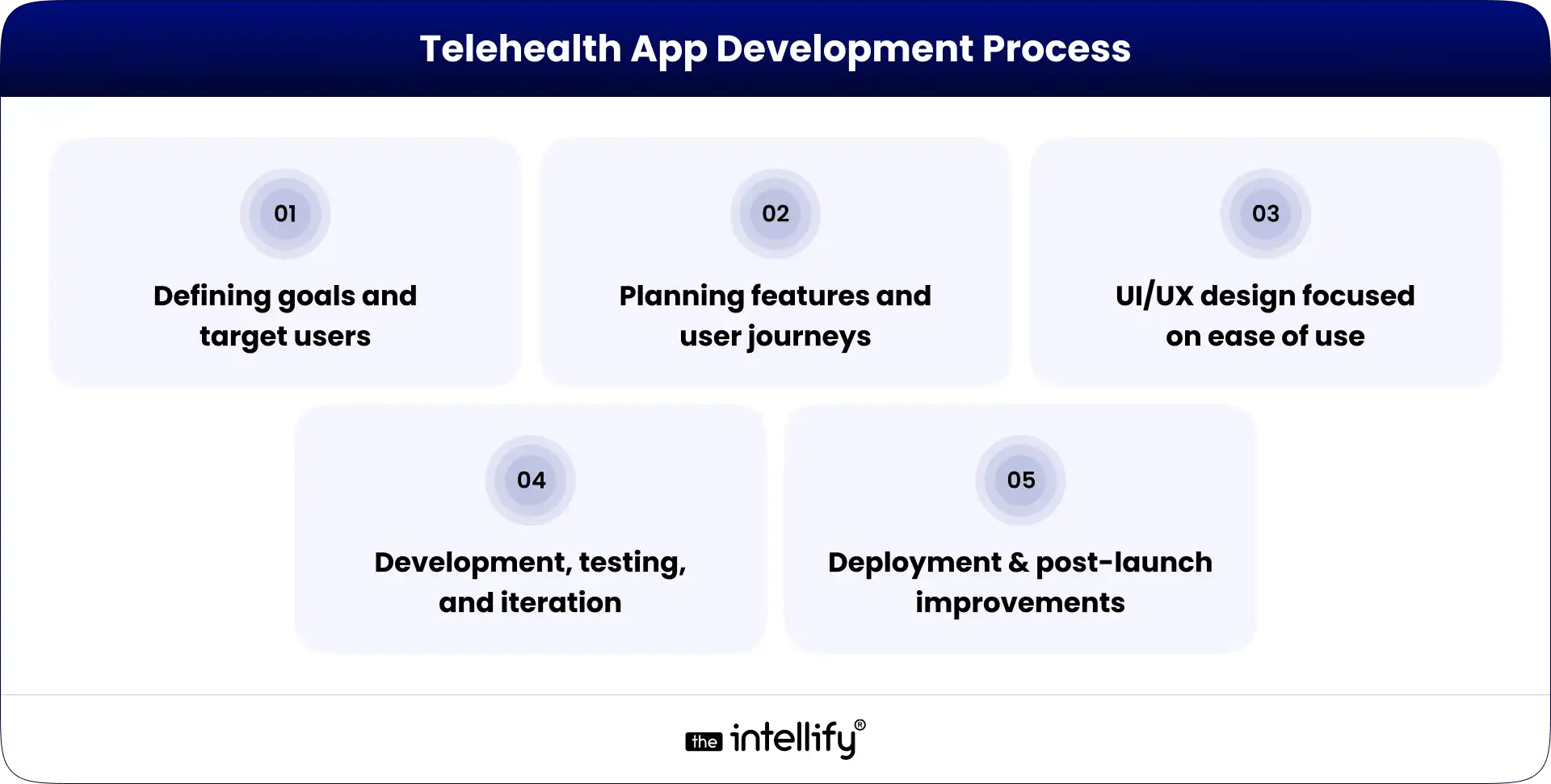
Telehealth App Development Process

Building a telehealth app isn’t just about writing code, it’s about solving real problems step by step, with a clear plan from the start.

Defining goals and target users

Everything begins with clarity. You need to understand who the app is for patients, doctors, or both and what exact problem you’re trying to solve. Without this, it’s easy to build something that looks good but doesn’t really help anyone.

Planning features and user journeys

Once the goals are clear, the next step is mapping how users will move through the app. From booking an appointment to completing a consultation, every step should feel simple and natural. If the journey feels confusing, users will drop off.

UI/UX design focused on ease of use

Design matters more than people think. Healthcare apps are used by all age groups, so the interface needs to be clean, clear, and easy to navigate. If users have to “figure things out,” it usually means the design needs improvement.

Development, testing, and iteration

This is where the actual build happens, but it’s not a one-time process. The app is developed in phases, tested regularly, and improved based on feedback. Issues will come up that’s normal. The key is fixing them early.

Deployment and post-launch improvements

Launching the app isn’t the end, it’s just the beginning. Real users will interact with it in unexpected ways, and their feedback helps shape future updates. Continuous improvements are what keep the app relevant and useful over time.


Cost Factors That Influence Telehealth App

Costs can vary a lot. And yeah, it depends on what you’re building.

  • Feature complexity and customization level: More advanced features increase development time and cost.
  • Integration requirements (EHR, payment systems, etc.): Connecting with existing systems adds layers of complexity.
  • AI capabilities and data infrastructure: AI requires data, processing power, and continuous tuning.
  • Development team structure and location: Costs differ based on whether you’re working with in-house teams or external partners.
  • Ongoing maintenance and updates: Apps need regular updates, security patches, and improvements.


Common Challenges in Building Telehealth Platforms

It’s not all smooth. Some challenges are kinda unavoidable.

  • Integration with legacy healthcare systems: Older systems aren’t built for modern integrations. APIs and middleware help bridge the gap.
  • Managing data security at scale: As your user base grows, so do security risks. Planning early helps avoid bigger issues later.
  • Ensuring a smooth user experience for all age groups: Not everyone is comfortable with technology. Simplicity matters more than design trends.
  • Handling real-time communication without lag: Video and chat systems need a strong infrastructure. Even slight delays can affect user experience.
  • Balancing innovation with compliance requirements: You can’t move fast and break things in healthcare. Everything needs to be controlled and compliant.


Real-World Use Cases Across Healthcare Segments

Telehealth is already being used across different areas, and it’s only expanding as providers find more practical ways to apply it.

Virtual consultations for general practice

Patients can handle routine check-ups, minor illnesses, and follow-ups without visiting a clinic. It saves time for both patients and doctors, especially for non-urgent cases.

Remote patient monitoring for chronic conditions

For conditions like diabetes or hypertension, continuous monitoring helps doctors track progress without frequent in-person visits. It also allows early intervention if something seems off.

Mental health and therapy platforms

Online therapy has made mental health support easier to access. Patients often feel more comfortable attending sessions from home, which improves consistency.

Post-surgery follow-ups and rehabilitation

Recovery doesn’t always require hospital visits. Patients can share updates, attend follow-ups, and receive guidance remotely while recovering at home.

Rural and underserved area healthcare access

Telehealth helps bridge the gap where medical facilities are limited. Patients in remote areas can connect with specialists without long travel, improving overall access to care.


What to Look for in a Telehealth App Development Company

Choosing the right Telehealth App Development Company can make or break your project. It’s not just about technical skills, it’s about understanding healthcare, users, and long-term goals.

Experience in healthcare and compliance standards

Healthcare is complex, with strict regulations and workflows. You need a team that already understands compliance requirements like HIPAA or GDPR, not one that’s learning on the go.

Ability to integrate AI automation effectively

AI should simplify processes like scheduling, patient intake, and documentation. A good team knows where AI adds value, and where it might just create confusion.

Strong portfolio and proven case studies

Past work gives you a clear picture of what the company can deliver. Look for real projects, not just concepts, especially in healthcare or similar regulated industries.

Focus on scalability and long-term support

Your app shouldn’t feel limited after launch. It should be built to scale as your user base grows, with ongoing support for updates, security, and new features.

Clear communication and transparent processes

If communication feels unclear or slow in the early stages, that’s usually a sign of bigger issues later. You want a team that keeps things simple, honest, and easy to follow. Healthcare-focused companies like The Intellify  are often involved in projects where ongoing collaboration and clarity matter throughout development.


Future Trends in Telehealth and AI-Driven Healthcare

This space is evolving quickly, and honestly, it’s not slowing down anytime soon. What we’re seeing right now is just the early version of what telehealth can actually become. A lot of things that felt “advanced” a few years ago are now becoming standard.

Expansion of AI-powered diagnostics

AI will support doctors by analyzing data faster and spotting patterns early. It won’t replace clinical decisions but will help improve accuracy and speed.

Integration with wearable devices and IoT

Health data from devices like smartwatches will connect directly with telehealth apps, giving doctors a more continuous view of patient health.

Real-time health analytics and alerts

Systems will track patient data in real time and send alerts when something seems off, helping providers act earlier.

Hyper-personalized patient experiences

Care plans will become more tailored based on individual health data, making treatment more relevant.

Growth of decentralized and home-based care models

More care will shift from hospitals to homes, supported by telehealth platforms and connected devices.


Telehealth app development solutions


Final Thoughts

Building a telehealth app isn’t about adding more features; it’s about solving real problems. If patients struggle to book appointments or join consultations, the tech doesn’t really matter.

The key is balancing innovation with usability and trust. Healthcare apps need to feel simple and reliable, not complicated. AI automation will keep playing a role by reducing manual work and helping providers make faster decisions, but it has to be used carefully.

In the end, a well-built telehealth platform improves access, reduces effort for providers, and makes care more efficient. That’s what actually matters.


Frequently Asked Questions (FAQs)

1. How long does it usually take to build a telehealth app?

It depends on the features and complexity. A basic version can take 3-4 months, while a fully integrated platform with AI, EHR, and advanced features may take 6-9 months or more.

2. What makes a telehealth app actually successful in real use, not just in launch?

Ease of use, reliable video quality, strong data security, and smooth doctor-patient workflows matter more than just features. If users find it simple and trustworthy, they stick with it.

3. How do telehealth apps handle sensitive patient data securely?

They use encryption, secure cloud storage, and strict access controls. Following regulations like HIPAA or GDPR ensures patient data is handled safely and responsibly.

4. Can a telehealth app integrate with existing hospital systems?

Yes, most modern solutions are built to integrate with EHR/EMR systems, payment gateways, and other healthcare tools through APIs. This helps avoid data silos.

5. What are the biggest mistakes to avoid when building a telehealth solution?

Overloading with features, ignoring user experience, and not planning for compliance early on are common mistakes. Simplicity and clarity always win.

6. How much does it cost to develop a telehealth platform?

Costs vary widely based on features, integrations, and technology. A basic app may start lower, while a scalable, AI-enabled solution can require a larger investment.

7. Who should consider investing in telehealth app development today?

Hospitals, clinics, startups, and even individual practitioners looking to expand reach, improve patient care, or streamline operations can benefit from it.

Healthcare Membership Management System: Key Features & Architecture

Summary:
A healthcare membership management system helps providers handle patient subscriptions, billing, and communication in one place. This blog covers how these systems work, their key features, and why they are important for clinics, hospitals, and wellness providers. It also highlights how they improve efficiency, reduce manual work, and help deliver better patient care while ensuring consistent and predictable revenue.

The healthcare landscape is evolving, shifting towards membership-based models that foster patient engagement and streamline service delivery. At the heart of this transformation is the Healthcare Membership Management system, providing the essential tools clinics and hospitals need to thrive in this new environment. In this blog, we’ll dive into what a healthcare membership management system is, its core features, how it operates, and why it’s so crucial for both providers and patients today.


The Shift Toward Membership-Based Healthcare

In recent years, subscription and membership models have gained popularity in the healthcare sector. These approaches, such as direct primary care (DPC), concierge medicine, and wellness plans, bring many benefits over traditional healthcare methods.
Why subscription and membership models are growing in healthcare.

Patient Centric Care:- These models prioritise patient engagement, allowing for tailored services and support.

Financial Predictability:- Providers enjoy predictable revenue streams as patients pay monthly or annual fees.

Less Administrative Overhead:- Automating member management cuts down on paperwork and boosts efficiency.

Challenges of managing members manually

Yet, many healthcare providers still struggle with manual member management, which often results in errors, inconsistencies, and ultimately, decreased patient satisfaction. As these models expand, there’s a growing need for specialized software instead of clinging to outdated systems.


What Is a Healthcare Membership Management System?

A healthcare membership management system simplifies the process of managing patient memberships, enabling healthcare providers to deliver personalized care more effectively.

How it differs from a general healthcare management system

While general systems track appointments and patient history, membership management systems concentrate on managing memberships, billing, and customized healthcare plans.

Who uses it?

  • Clinics
  • Hospitals
  • Speciality Providers
  • Wellness Brands

Types of membership models it supports

These systems can accommodate a variety of membership models, including single-tier plans, multi-tier plans, and bundled services.


Why Healthcare Providers Need a Membership System Today

The rising demand for a healthcare membership management system stems from several key factors:

Administrative overload without automation

Managing memberships manually takes time and often leads to errors. Staff end up handling billing, renewals, and patient communication separately. A membership system brings all of this into one place, reducing repetitive work and helping teams focus more on patient care instead of paperwork.

Revenue predictability and recurring billing needs

Traditional healthcare income can vary from month to month. Membership models bring stability through recurring payments. A proper system ensures billing runs on time, reducing missed payments and helping providers plan their finances with more confidence.

Improving patient experience and retention

Patients expect simple and smooth services. When booking, billing, and communication are easy, they are more likely to stay. A membership system helps create a consistent experience, which builds trust and improves long-term relationships.

Managing growth without increasing staff

As the number of members grows, manual processes become difficult to handle. A system allows providers to scale operations without needing to hire more staff, keeping costs under control while maintaining service quality.


How a Healthcare Membership Management System Works

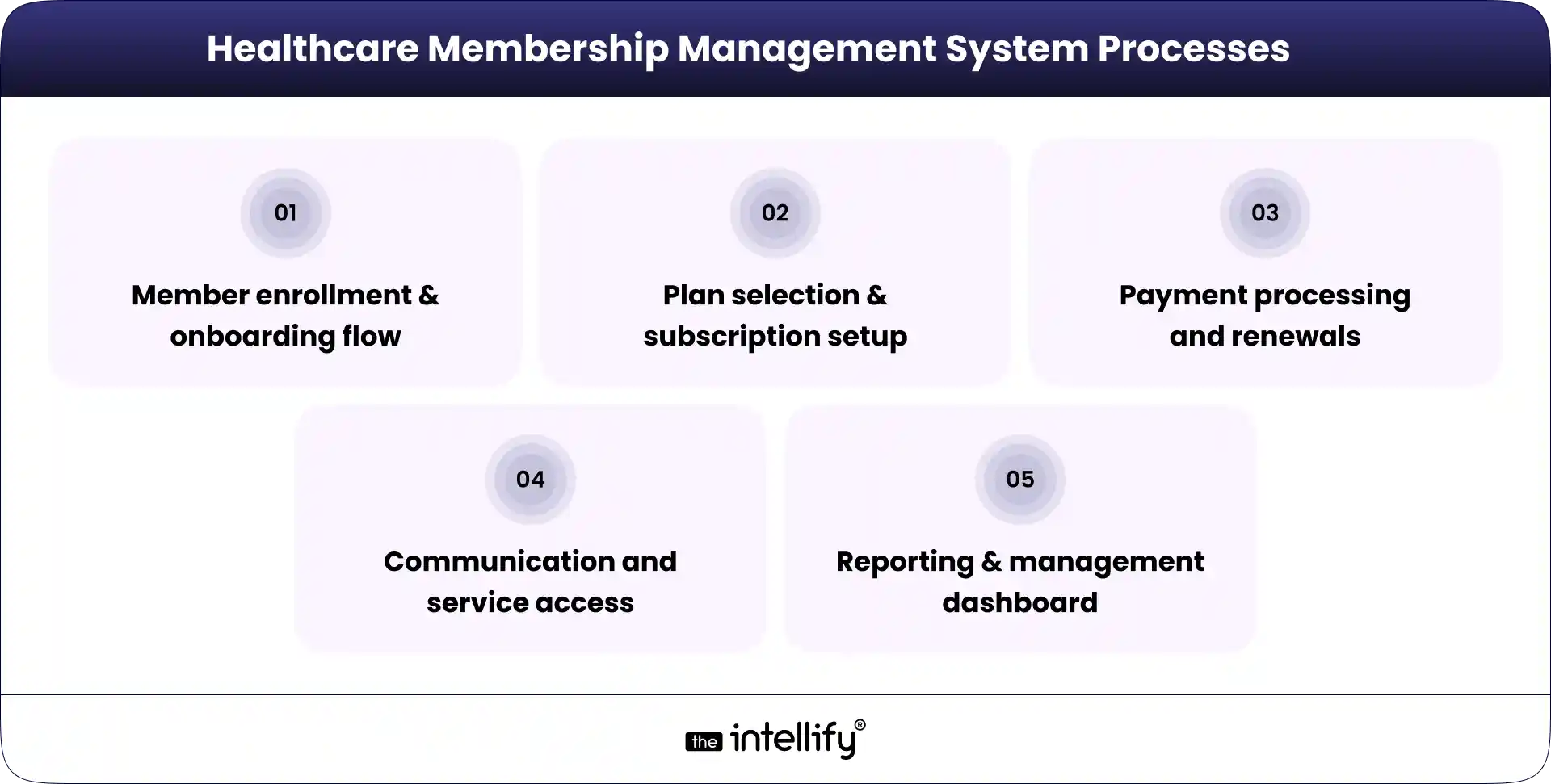
Healthcare Membership Management System Processes

A healthcare membership management system streamlines various processes, making life easier for both providers and patients.

Member enrollment and onboarding flow

Patients can sign up online by filling in basic details and selecting a plan. The process is simple and does not require staff involvement at every step, which saves time and reduces delays.

Plan selection and subscription setup

Patients choose plans based on their needs. The system clearly shows available options, pricing, and services, making it easier for them to decide and subscribe without confusion.

Payment processing and renewals

Payments are handled automatically. The system processes transactions, sends reminders, and manages renewals. This ensures that billing runs smoothly without manual tracking.

Communication and service access

Patients receive updates through email or SMS. They can access services, get reminders, and stay informed without needing to call or visit the clinic every time.

Reporting and management dashboard

Providers can view all data in one place. Dashboards show member activity, revenue, and trends, helping in better decision-making without going through multiple reports.


Core Features That Power an Effective Healthcare Membership Platform

  • Member Enrollment & Profile Management:- Streamlining member registration while keeping detailed profiles ensures quick access to patient histories and preferences.
  • Subscription & Billing Automation:- Automated billing minimizes administrative burdens while ensuring timely payments, which in turn improves cash flow.
  • Plan Creation and Tier Management:- Providers can effortlessly create and manage various membership plans, tweaking them as needed to fit patient requirements.
  • Appointment and Service Tracking:- An integrated calendar helps track appointments and services, sending reminders to reduce no-shows.
  • Communication Tools (email, SMS, reminders):- Effective communication tools keep members in the know and engaged, enhancing their overall experience.
  • Analytics and Reporting:- Detailed analytics provide insights into trends, patient behaviors, and financial metrics, aiding strategic planning.


Mid-CTA


System Architecture: What Happens Behind the Scenes

healthcare membership platform development operates through several components:

1. Frontend (patient and admin interfaces):- User-friendly interfaces make it easy for both patients and administrative staff to navigate the system.

2. Backend logic and workflows:- Robust backend processes handle data management, billing, and member communication seamlessly.

3. Database for member records:- A secure database keeps sensitive patient information safe while allowing easy access for authorized personnel.

4. Payment gateway integration:- Secure payment processing is critical, ensuring that financial transactions are managed safely.

5. Security and compliance layers:- Special measures help ensure compliance with healthcare regulations while protecting sensitive patient data.

6. Scalability considerations:- A well-designed system can grow with your practice, facilitating additional features or accommodating increased user loads as necessary.

A U.S.-based Direct Primary Care platform improved patient access and care coordination by implementing a secure digital solution across its services. The system streamlined operations for providers while keeping sensitive health data protected under strict privacy standards. This shows how modern AI-enabled technology can enhance healthcare delivery without compromising compliance. View the complete case study for more details: https://theintellify.com/work/healthcare2u/


Integration with Existing Healthcare Systems

Integrating a membership management system with other vital healthcare software ensures smooth operations:

Electronic Health Records (EHR)

Integration with EHR systems ensures patient data stays connected. Providers can access medical history along with membership details without switching systems.

Practice management software

Linking with practice management tools helps manage appointments, staff schedules, and operations in a more organized way.

Payment systems

Connecting with payment gateways ensures secure and smooth transactions. It also supports different payment methods for patient convenience.

Telehealth platforms

Integration with telehealth allows providers to offer remote consultations as part of membership plans, improving access to care.

CRM or patient engagement tools

CRM systems help track communication and patient interactions, making it easier to maintain relationships and improve engagement.


Benefits for Providers and Healthcare Businesses

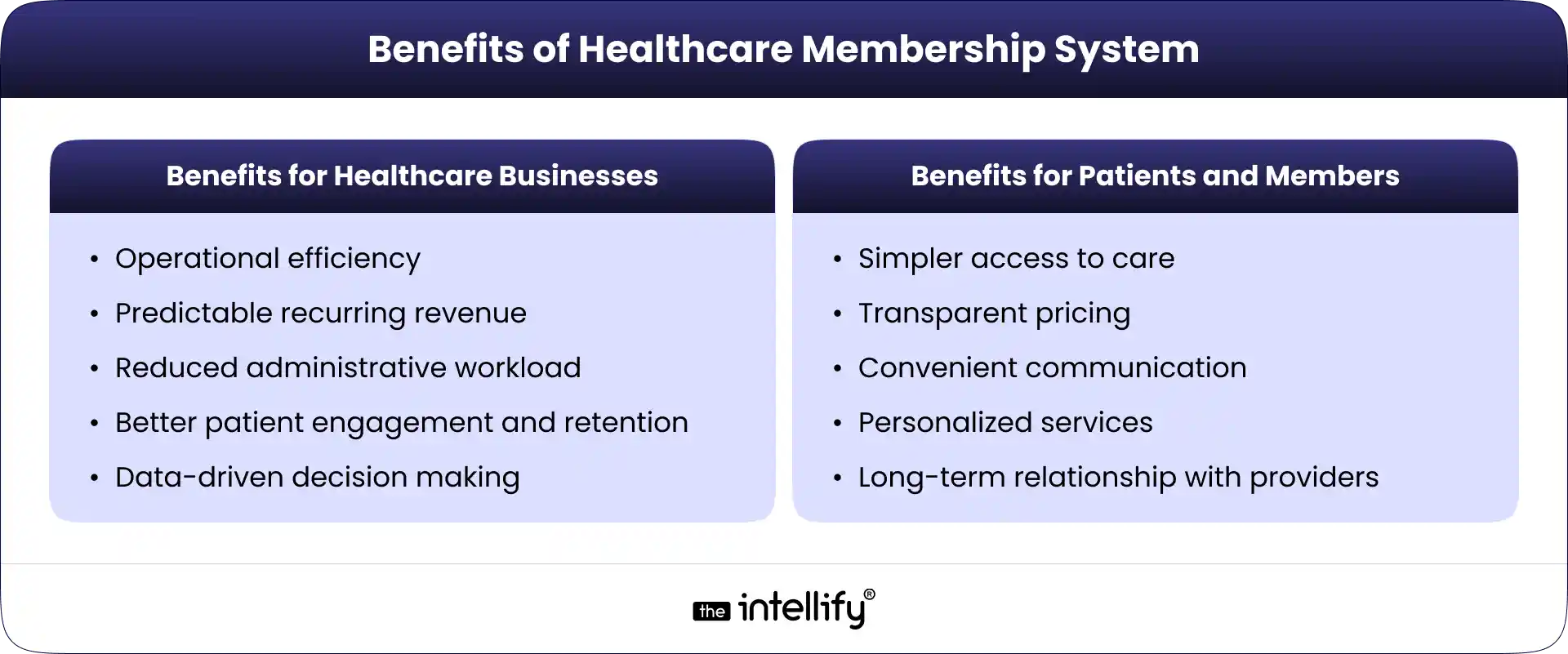
Benefits of Healthcare Membership System

  • Operational efficiency:- Automation reduces manual tasks and speeds up daily operations. Staff can handle more work in less time without feeling overloaded.
  • Predictable recurring revenue:- Membership payments bring steady income. This helps providers plan expenses and investments without uncertainty.
  • Reduced administrative workload:- Billing, renewals, and communication are handled automatically. This reduces the need for manual follow-ups and paperwork.
  • Better patient engagement and retention:- Consistent communication and smooth service improve patient satisfaction. Happy patients are more likely to stay and continue their memberships.
  • Data-driven decision making:- Access to reports and analytics helps providers understand trends and make better decisions based on real data.


Benefits for Patients and Members

  • Simpler access to care:-Patients can easily sign up, book services, and stay connected with their providers without complicated steps.
  • Transparent pricing:- Membership plans clearly show costs, so patients know what they are paying for. This builds trust and avoids unexpected charges.
  • Convenient communication:- Patients receive reminders and updates without needing to follow up. This makes the overall experience smoother.
  • Personalized services:- Plans can be designed based on individual needs, allowing patients to receive care that suits them better.
  • Long-term relationship with providers:- Membership models encourage regular interaction, helping build a stronger and more consistent relationship with healthcare providers.


Key Considerations When Choosing a Healthcare Membership Solution

When picking a healthcare membership solutions, keep these factors in mind:

Ease of use for staff and patients:- The system should be simple to use. Both staff and patients should be able to navigate it without confusion or long training.

Customization of plans:- Providers should be able to create and adjust plans based on their services and patient needs.

Compliance and data security:- The system must follow healthcare regulations and protect patient data through secure access and storage.

Integration capability:- It should connect easily with existing tools like EHR, billing systems, and telehealth platforms.

Scalability for future growth:- The system should handle growth without needing major changes as the number of patients increases.

Support and implementation:- Reliable support is important for setup and ongoing use. Providers should have access to help when needed.


Common Use Cases Across Healthcare Segments

  • Direct Primary Care practices:- DPC providers use membership systems to manage subscriptions and offer ongoing care without complex billing.
  • Specialty clinics:- Clinics can manage different services and patient needs through flexible membership plans.
  • Preventive care and wellness programs:- Memberships support regular check-ups and wellness services, encouraging better health management.
  • Corporate health memberships:- Companies can offer healthcare plans to employees, making it easier to manage group memberships.
  • Telehealth subscription services:- Telehealth providers can offer remote care through subscription models, ensuring continuous patient support.


Steps to Build or Implement a Healthcare Membership Management System

1. Define your membership model and pricing:- Start by deciding the type of plans you want to offer and how you will price them.

2. Choose between custom build or SaaS solution:- Decide whether you need a ready-made solution or a custom system based on your requirements and budget.

3. Design workflows and user experience:- Plan how patients and staff will use the system to ensure it is simple and efficient.

4. Integrate with existing systems:- Connect the system with current tools to avoid disruptions and ensure smooth operations.

5. Test, launch, and optimize continuously:- Test the system before launch and keep improving it based on feedback and changing needs.


What Affects the Cost of a Healthcare Membership System?

  • Features and customization level:- More features and customization usually increase the cost, especially if the system is built from scratch.
  • Integration complexity:- Connecting with multiple systems can add to the overall cost depending on how complex the setup is.
  • Compliance and security requirements:- Meeting healthcare standards and ensuring data protection can also impact the cost of development and maintenance.


Future Trends in Membership-Based Healthcare Technology

Growth of subscription healthcare models

More providers are adopting membership models as they offer stable revenue and better patient relationships.

AI-driven personalization

AI is helping tailor services based on patient data, making care more relevant and effective.

Remote care and digital health integration

Telehealth and digital tools are becoming a key part of membership plans, improving access to care.

Outcome-based memberships

There is a shift toward focusing on results rather than just services, improving overall care quality.

Expansion beyond primary care

Membership models are expanding into specialized and advanced healthcare services.


Healthcare membership platform development


Final Thought

A healthcare membership management system helps providers manage memberships, billing, and patient relationships in a simple and structured way. It reduces manual work, improves patient experience, and creates stable revenue. As more healthcare providers move toward membership-based care, having the right system in place becomes important for smooth operations and long-term growth.


Frequently Asked Questions

1. What makes a healthcare membership management system different from regular healthcare software?

A regular healthcare system mainly handles patient records and operations. A healthcare membership management system focuses on managing subscriptions, recurring billing, and member relationships. It’s built for practices that offer ongoing care through plans, not one-time visits.

2. How does a healthcare membership system handle recurring billing without errors?

It automates the entire billing cycle, plan selection, payment processing, renewals, and reminders. This reduces manual mistakes and ensures payments are collected on time without staff needing to track everything manually.

3. Can small clinics or DPC practices benefit from a membership management system?

Yes, especially small clinics. It helps them manage members efficiently, create predictable monthly revenue, and offer better patient experience without needing a large admin team.

4. What kind of integrations are important in a healthcare membership system?

Common integrations include EHR systems, payment gateways, telehealth platforms, and CRM tools. These connections help create a smooth workflow without switching between multiple tools.

5. Is a healthcare membership management system secure for handling patient data?

Yes, most systems are designed with strong security measures and follow healthcare compliance standards. Data is encrypted, and access is controlled to protect sensitive patient information.

6. How long does it take to implement a healthcare membership management system?

It depends on whether you choose a ready-made solution or a custom build. SaaS platforms can be set up quickly, while custom systems may take longer based on complexity and integrations.

View
Case Study