AI Workflow Automation in Hospitals: Smarter Systems for Better Care

Summary:
AI workflow automation is transforming hospital operations by streamlining both administrative and clinical tasks. This blog covers how AI for workflow automation connects systems like EHR, billing, lab, and scheduling platforms to reduce manual coordination, improve accuracy, and accelerate patient flow. It also highlights practical use cases, key benefits, implementation challenges, and best practices for adopting AI in hospital environments to build more efficient and responsive healthcare systems.


Why Hospital Workflows Need Smarter Systems

Walk into any hospital at 9:15 a.m. on a Monday, and you’ll see it. Phones ringing. Nurses juggling files. Someone chasing a signature. Someone else is waiting for a lab update that should’ve arrived 20 minutes ago.

Hospitals handle thousands of daily tasks, both clinical and administrative. Admissions, billing, discharge summaries, lab coordination, referrals, approvals… the list doesn’t end. And when these tasks depend on manual coordination, care slows down.

Staff spend hours on repetitive processes. Copying data from one system to another. Sending reminder emails. Following up on missing documents. It’s not exactly why they chose healthcare. This is where AI workflow automation steps in. It connects systems, moves tasks automatically, and reduces the need for constant follow-ups. In short, it helps hospitals breathe a little.

In this blog, we’ll break down what AI workflow automation means in hospitals, where it fits, how it works step-by-step, real use cases, benefits, challenges, and what the future looks like.


What AI Workflow Automation Means for Hospitals

At its core, AI workflow automation means using intelligent systems to move tasks, data, and decisions across hospital operations without manual intervention.

Traditional automation follows fixed rules. “If X happens, do Y.”

But hospitals are messy. Priorities change. Emergencies happen. Data isn’t always clean. That’s where intelligent automation differs. AI in hospital workflows can:

  • Recognize patterns in patient flow
  • Prioritize urgent cases automatically
  • Flag missing information before it causes delays
  • Suggest actions based on historical data

Instead of just executing rules, AI supports decision-making and coordination. It doesn’t just automate tasks. It understands context. Inside hospital operations, this fits across:

  • Admissions and registration
  • Clinical documentation
  • Lab coordination
  • Scheduling
  • Billing and claims
  • Internal communication

Basically, anywhere there’s repetitive movement of information, AI for workflow automation can step in.


Core Areas of Hospital Workflow Automation

Now let’s talk about how this actually works on the ground.

Automating Administrative Processes

Administrative work is where time quietly disappears.

  • Registration and admissions: AI systems can auto-fill patient data, verify insurance, and route admission requests instantly.
  • Form processing: Instead of staff manually reviewing every form, AI can validate entries, flag missing fields, and push them to the next department.
  • Internal approvals: Whether it’s bed allocation or procedure approval, intelligent routing ensures requests reach the right authority without delay.
  • Automated document routing: Discharge summaries, reports, and billing documents, all can move automatically based on predefined workflows.

No more “Did you send that file?” emails.

Automating Clinical Support Tasks

Clinical teams deal with pressure. Removing small friction points matters.

  • Updating patient records:- AI syncs updates across systems in real time, reducing duplicate data entry.
  • Lab report coordination:- Results can be automatically shared with the concerned physician and flagged if critical.
  • Discharge summaries:- Drafts can be generated using structured data, reducing typing time.
  • Referral management:- Referrals can be routed, tracked, and scheduled automatically.

It’s not flashy. But it saves hours each week.

Automating Communication and Alerts

Communication gaps cause delays. And sometimes worse.

  • Appointment reminders:- Automated SMS or email reminders reduce no-shows.
  • Staff notifications:- When a lab result is ready or a patient is admitted, relevant staff get notified instantly.
  • Emergency alerts:- Critical cases can trigger priority routing.
  • Task assignments:- Tasks can be assigned based on availability and workload.

This is where AI in healthcare settings quietly improves coordination.


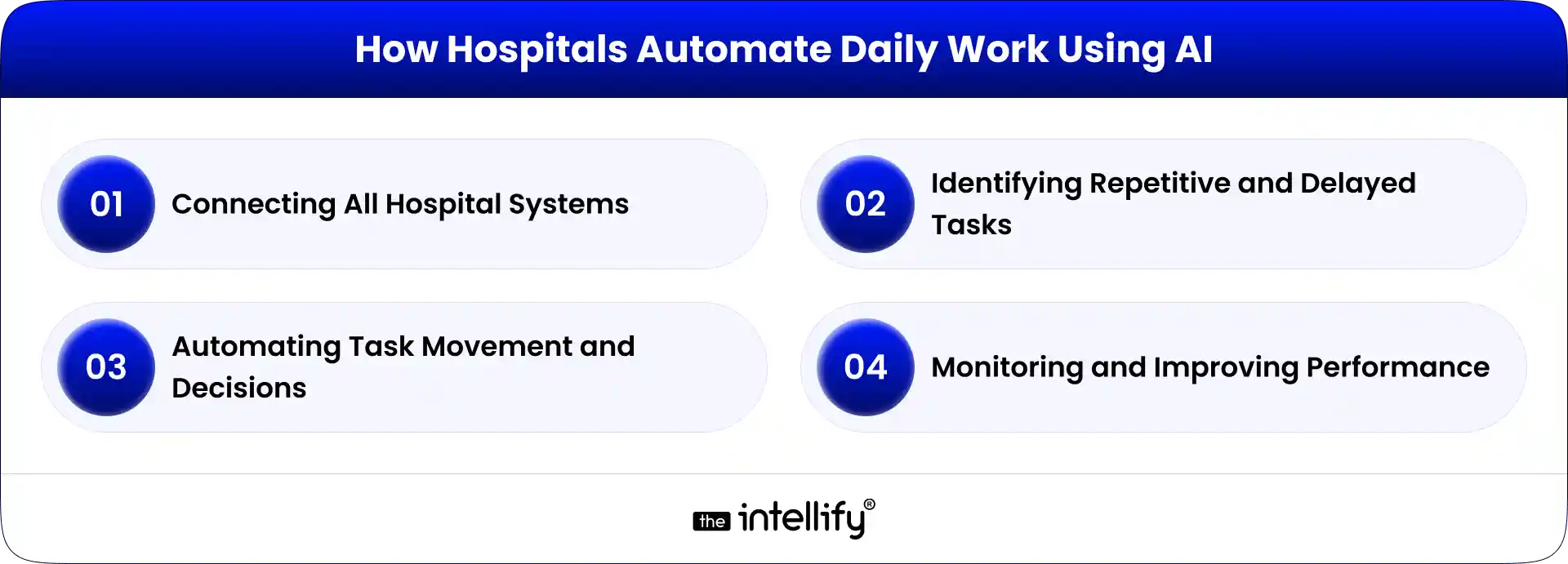
How Hospitals Automate Daily Work Using AI
AI automation for Daily Hospital Work

Let’s break this down into simple, practical steps.

Step 1: Connecting All Hospital Systems

Most hospitals use multiple platforms:

  • EHR
  • Billing software
  • Lab systems
  • Pharmacy systems
  • Scheduling tools

When these systems don’t talk to each other, staff switch screens constantly. It’s exhausting. AI workflow automation begins by integrating these systems. Data flows into one connected environment. No more scattered silos.

The goal? A unified operational view. This is the foundation. Without it, automation won’t work smoothly.

Step 2: Identifying Repetitive and Delayed Tasks

You can’t automate what you don’t understand. Hospitals analyze:

  • Manual data entry points
  • Approval bottlenecks
  • Delays in admissions or discharge
  • Patterns in daily workflow

For example, if discharge approvals are consistently delayed by two hours, that’s a signal.

AI systems help detect these patterns using real data. This step often reveals surprising inefficiencies.

Step 3: Automating Task Movement and Decisions

Now the real shift begins.

  • Patient files are routed automatically
  • Appointments are scheduled based on availability
  • Alerts and reminders are sent without manual input
  • Records update in real time
  • Billing triggers after treatment completion

Instead of someone manually coordinating every step, the system moves tasks forward. Manual follow-ups drop. Turnaround time improves. Staff feel it almost immediately.

Step 4: Monitoring and Improving Performance

Automation isn’t a one-time setup. Hospitals track:

  • Turnaround time
  • Workflow efficiency
  • Admission-to-discharge duration
  • Error rates

AI systems learn from historical data. Over time, they refine processes. If something slows down, the system highlights it. Continuous improvement becomes part of daily operations.

 

AI for Workflow Automation Services


AI Workflow Automation Use Cases in Hospitals

Let’s look at practical examples.

1. Patient Admission and Discharge Management

AI reduces paperwork. It verifies details instantly and speeds up bed allocation. Discharge summaries move faster. Billing starts automatically. Patients leave without waiting in corridors for hours.

2. Intelligent Scheduling Systems

Balancing doctor availability and patient demand is tricky. AI-driven scheduling considers:

  • Doctor availability
  • Appointment urgency
  • Past no-show patterns

It adjusts schedules dynamically. Fewer gaps. Fewer conflicts.

3. Billing and Claims Coordination

Billing errors are common in manual systems. AI verifies insurance details, checks documentation completeness, and routes claims correctly. This reduces rejections and speeds up reimbursements.

4. Clinical Documentation Assistance

Doctors often spend late evenings finishing documentation. (You’ve probably seen it.) AI can auto-populate structured fields and assist in drafting reports. Manual typing decreases.

5. Emergency Workflow Optimization

In emergency departments, seconds matter. AI prioritizes urgent cases based on symptoms and historical data. It routes them accordingly. Smarter triage with faster action.


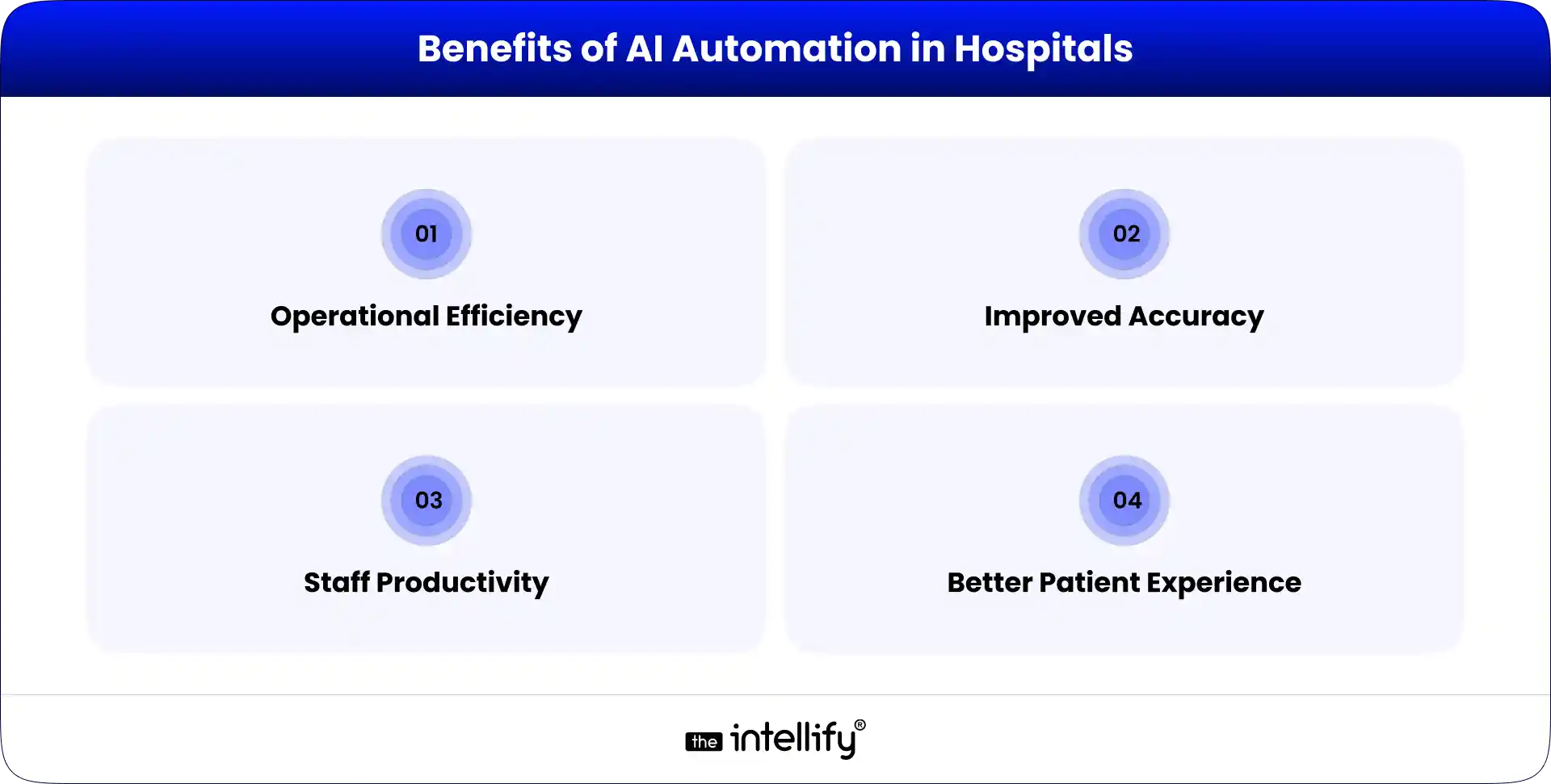
Benefits of AI Automation in Hospitals
Benefits of AI Automation in Hospitals

AI workflow automation brings practical improvements to daily hospital operations. The impact is visible not in theory, but in how smoothly work moves from one department to another.

Operational Efficiency

Processes move faster because tasks no longer wait for manual follow-ups. Admissions, documentation, lab coordination, and billing flow automatically. Bottlenecks are reduced, and departments stay aligned. This creates a more stable and predictable operational rhythm.

Improved Accuracy

Manual data entry often leads to small but costly errors. AI in hospital workflows helps validate information, flag inconsistencies, and reduce documentation mistakes. Fewer errors mean fewer claim rejections and fewer compliance risks.

Staff Productivity

When repetitive coordination is automated, staff spend less time switching systems and more time focusing on patients. Even saving a few minutes per task makes a difference across an entire shift.

Better Patient Experience

Faster admissions, timely updates, smoother discharge processes, and fewer billing issues improve the overall care journey. Patients may not see the automation, but they feel the efficiency.


Challenges to Consider Before Implementation

While AI for workflow automation offers clear advantages, hospitals must plan carefully before implementation.

  • System Integration Complexity:-Many hospitals operate on multiple legacy platforms. Connecting EHR, billing, lab, and pharmacy systems can require technical effort. Without proper integration, automation cannot function smoothly.
  • Data Privacy Compliance:-Healthcare data is sensitive. AI systems must comply with strict privacy regulations. Security and compliance should be built into the system from the beginning.
  • Staff Adaptation:- New workflows can create hesitation among staff. Clear communication and proper training are essential to ensure teams feel supported rather than disrupted.
  • Cost Considerations:- Initial setup costs can be significant. However, long-term efficiency gains often balance the investment when planned correctly.


Best Practice for Implementing AI Automation in Healthcare

A structured approach increases the success rate of AI workflow automation in hospitals.

1. Start with High-Impact Workflows

Focus on repetitive tasks that slow down patient flow. Automating admissions, discharge coordination, or billing verification often delivers quick results. Avoid automating everything at once.

2. Involve Both IT and Healthcare Teams

Doctors, nurses, administrative staff, and IT teams should collaborate early. Their combined insight ensures automation aligns with real hospital needs.

3. Monitor Workflow Performance

Track time savings, error reduction, and improvements in patient wait times. Measuring performance ensures the system delivers practical value.

4. Scale Gradually

Begin with one department and expand after achieving stable results. Gradual scaling reduces risk and allows adjustments based on feedback.


The Future of Hospital Operations with Intelligent Automation

Hospital operations will continue evolving with intelligent automation. AI in hospital environments will support predictive task management, helping teams anticipate workload changes.

Real-time workflow visibility will allow administrators to monitor operations across departments. Smarter coordination will reduce communication gaps and improve response time.

Automation will become a core operational layer rather than an added feature.

 

AI workflow automation solutions


Conclusion:

AI workflow automation supports hospital teams by reducing administrative strain. It improves coordination, speeds up processes, and minimizes errors. The goal is not to replace healthcare professionals. It is to help them focus on patient care instead of repetitive system tasks. When workflows become organized and intelligent, healthcare delivery becomes more responsive, accurate, and patient-centered.

As healthcare systems continue evolving, thoughtful adoption of automation will play a key role in shaping more organized and responsive hospitals. For those looking to explore this shift further, The Intellify offers deeper perspectives on how AI workflow automation is being applied in real hospital environments.


Frequently Asked Questions

1. What is AI workflow automation in healthcare?

AI workflow automation in healthcare means using intelligent systems to handle repetitive hospital tasks automatically. It helps manage scheduling, billing, documentation, and approvals without constant manual follow-up. By connecting departments and moving tasks digitally, AI in hospital environments reduces delays and improves operational flow.

2. How does AI workflow automation improve healthcare operations?

AI for workflow automation improves healthcare operations by reducing paperwork, speeding up internal processes, and improving coordination between teams. Tasks move automatically instead of waiting for manual action. This helps hospitals operate more efficiently and allows staff to focus more on patient care.

3. Which hospital processes can be automated using AI?

Common hospital processes that can be automated include patient admissions, discharge coordination, appointment scheduling, billing and claims processing, clinical documentation updates, and lab report routing. AI workflow automation works best in repetitive and time-sensitive workflows.

4. How long does it take to implement automation in a hospital?

Implementation timelines vary based on hospital size and system complexity. Many hospitals begin with one high-impact workflow and expand gradually. A phased approach helps minimize disruption and ensures smoother adoption of AI workflow automation.

6. How does AI integrate with existing hospital systems?

AI integrates with existing hospital systems such as EHR, billing platforms, lab software, and scheduling tools through secure connections. Instead of replacing current systems, AI for workflow automation connects them to create a unified and streamlined operational flow.

7. What are the biggest challenges in automating hospital workflows?

Major challenges include integrating legacy systems, ensuring data accuracy, training staff, and managing change. Hospitals that start small and scale gradually typically see better results when implementing AI in hospital workflows.
How to Make a Smart Factory with AI Automation in Deutschland

Introduction
The term Smart Factory refers to an advanced, cyber-physical production environment where machines, people, and systems are tightly integrated through digital technologies and their digital transformations. In a smart factory, sensors and IoT devices collect real-time data from the shop floor, and artificial intelligence (AI) and machine learning (ML) analyze that data to drive automated decisions. 

As SAP explains, “a smart factory is a cyber-physical system that uses advanced technologies to analyze data, drive automated processes, and learn as it goes.” 

In practice, this means machinery equipped with sensors and AI models can self-adapt, adjusting their behavior on the fly, for example, switching to smaller batch production automatically when demand changes to improve efficiency and quality. 

Fraunhofer IKS notes that such automated production enables a smart factory to maintain operations even amid equipment failures or changing conditions, since systems can predict and compensate for issues in real time. In short, a smart factory is a digitalized, flexible manufacturing plant where IoT, data platforms, and AI work together to optimize performance and enable rapid innovation.


The Smart Factory Evolution: From Industrie 4.0 to 5.0

The smart factory concept emerged from Germany’s Industrie 4.0 initiative, the fourth industrial revolution, focused on the digitalization of manufacturing. Initially, this meant connecting production machines and collecting data for analysis. 

Today, the vision has matured: Industry 4.0 aims “to reach a smart factory state” by using digital twins and AI models that “connect the virtual and real worlds,” thereby improving efficiency and revenue. For example, creating a virtual model of a production line (a digital twin) allows engineers to simulate changes before applying them to the real line.

Looking ahead, the European Union’s concept of Industry 5.0 builds on this by placing sustainability and people at the centre. In the emerging Industry 5.0 paradigm, smart factories not only optimise cost and speed but also minimise environmental impact and empower workers. EU thought leaders emphasize that in an Industry 5.0 factory, “people are seen as an integral part of the system and the production chain”

The idea is that by relieving humans of repetitive tasks (through AI-automated solutions), workers can focus on creative problem-solving and quality control, adding more value to production. In this way, modern smart factories evolve from pure automation (Industrie 4.0) into resilient, human-centric systems that balance efficiency, sustainability, and workforce wellbeing.


Deutschland’s Smart Manufacturing Advantage

Germany – Deutschland – has been at the forefront of the smart factory movement. National initiatives like Plattform Industrie 4.0 provide a coordinated strategy for digital transformation. As Germany Trade & Invest (GTAI) reports, “Plattform Industrie 4.0 is the central network to advance digital transformation in production in the country,” engaging industry and research partners to maintain Germany’s leading role. 

This public–private collaboration means German factories benefit from shared standards, pilot projects, and best practices developed by acatech, VDMA, Bitkom, ZVEI and other associations.

The results are evident in industry figures. According to GTAI, 62% of German companies already utilise Industrie 4.0-related technologies and solutions. Major sectors like automotive and machinery have invested heavily: the German machinery industry alone spent over €10 billion on smart manufacturing technologies between 2015-2020. 

Moreover, Germany’s digital infrastructure supports this adoption: over 86% of the country had 5G coverage as of 2021, and 80% of manufacturers plan to digitalize their value chain by 2024. This robust ecosystem of funding (Horizon Europe, national programs) and support centres (e.g. Mittelstand 4.0 competence centres for SMEs) helps even smaller manufacturers get connected.

Recent research confirms that AI is already entering German production. A December 2024 Fraunhofer ISI study found that roughly “16 percent of industrial firms integrate intelligent systems directly into their production processes” in Germany. Large enterprises are especially active: about 30% of factories with 500+ employees now use AI in manufacturing. 

These figures show that the German industry recognizes the business value of smart factory solutions and is investing accordingly. In summary, Germany’s combination of a strong industrial base, government initiatives, cutting-edge R&D (Fraunhofer institutes and universities), and high technology adoption has made it a world leader in smart manufacturing.


Core Technologies: IoT, Connectivity, and Data

Core Technologies: IoT, Connectivity, and Data

Smart factories are built on a foundation of sensors, networks, and data platforms. IoT sensors on machines, tools and products feed continuous data about temperature, vibration, quality, energy use, and more. This data is transported via reliable connectivity, increasingly 5G wireless networks and industrial Ethernet to on-site edge computers or cloud servers. 

As GTAI notes, “the Internet of Things (‘IoT’) is one of the most promising innovation accelerators for digital enterprises… enabling a new level of automation.”. In practical terms, IoT allows factories to monitor everything in real time: equipment status, production progress, even worker location and safety.

Once collected, this “big data” must be processed. Germany’s strong IT infrastructure (massive 5G rollout, cloud platforms) means factories can run powerful analytics and AI models. For example, manufacturers create digital twins, real-time digital models of machines or entire production lines that mirror the current physical state. 

These twins let AI algorithms predict future behaviour: if a simulation shows a part likely to wear out, the factory can pre-emptively change it. As Fraunhofer observes, innovative smart factories use “digital twin space… smart sensors and predictive maintenance” to digitalize processes and maintain operations even when conditions change.

This data-driven backbone also empowers flexible automation. Modular robots and AI-guided machines can reconfigure themselves. Because of smart connectivity, production lines can respond instantly to new orders or supply changes. 

In fact, GTAI reports that by 2021, over 80% of German manufacturers aimed to digitalize their entire value chain by 2024. With IoT, AI and data platforms fully integrated, the factory gains unprecedented visibility and control over every process. The result is a networked, responsive production system,  the essence of a smart factory.


AI Automation in Smart Factories

Artificial intelligence is at the heart of smart factory solutions. In practice, AI is applied wherever pattern recognition, prediction, or decision-making can boost efficiency. Predictive maintenance is a classic example: machine sensors stream vibration and temperature data, and ML models learn to flag equipment that shows the same precursors of failure seen in the past. 

In other words, the factory can predict machine failures and schedule maintenance before a breakdown occurs. Indeed, one solution overview describes a smart factory platform “powered by AI and IoT” that uses highly trained machine learning algorithms to predict machine failures and bring higher operational intelligence beyond what legacy systems could do.

Similarly, quality inspection is being transformed by AI. High-resolution cameras and AI vision systems scan parts or welds, instantly spotting defects that a human might miss. The Fraunhofer IKS notes that AI-based vision allows “visual quality inspection more efficiently and accurately,” which is critical when production volumes are high and skilled inspectors are scarce. 

Beyond vision, AI can analyse sensory data to detect anomalies, for example, unusual noise or vibration that indicates a problem. As IKS describes, AI-driven monitoring can “detect anomalies and prevent potential hazards, thus ensuring precision and reliability” in human–machine collaboration.

AI also drives workflow automation within the factory. Advanced scheduling algorithms (sometimes provided by specialized AI automation agencies or consultants) can automatically adjust production schedules, allocate resources, or route tasks based on real-time conditions. 

For example, if an upstream bottleneck arises, an AI workflow system might reroute jobs or call for overtime in another shift to keep output steady. Generative AI is even being explored to automate documentation and planning tasks. 

In short, AI in industrial automation means that decision loops (from ordering parts to scheduling maintenance) become faster and more autonomous. Processes become AI-automated, with smart algorithms initiating actions once they identify the optimal response.

For industrial decision-makers, the promise of AI is clear: higher uptime, better quality, and more efficient operations. As SAP observed at Hannover Messe 2024, AI can create levels of resiliency that wouldn’t be possible without it, by giving management detailed insight into every process step. 

In practical terms, smart factories use AI to continuously learn from data, so the system “learns as it goes”, improving itself over time. Whether it’s “AI for automation” or “AI workflow automation,” the end goal is the same: a factory that tunes itself to changing demands and uses resources optimally, day after day.


Smart Factory Solutions and Use Cases

Industry leaders have identified numerous smart factory solutions that deliver value. Common use cases include:

Smart Manufacturing Solutions

These smart factory solutions share a few key features: they integrate real-time data from multiple sources, apply AI/machine learning for insight, and create feedback loops so humans and machines can act on those insights. For instance, if an anomaly is detected on the line, a notification might go to operators’ tablets, or a robot could pause production to avoid damage. 

As Fraunhofer IKS emphasizes, such solutions enable factories to “increase efficiency and ensure sustainable, resource-conserving production.”. In practice, a well-designed smart factory will deliver continuous improvement: smaller batch sizes at lower cost, higher throughput, and greater agility to meet customer needs.


Building the Smart Factory: Implementation Strategy

Establishing a smart factory is a journey, not a flip of a switch. Decision-makers should follow a structured approach:

Smart Factory: A How-To Guide

  1. Assess and Plan: Begin by identifying pain points (e.g. unplanned downtime, long changeovers) and defining clear goals. Evaluate existing assets: Which machines have sensors or connectivity? This data strategy is the foundation.
  2. Connect Assets: Retrofit or install IoT sensors on critical equipment (motors, pumps, CNC machines, conveyor belts, etc.) and ensure reliable networking (wired or wireless). Many manufacturers deploy industrial Ethernet or private 5G for robust connectivity.
  3. Develop Data Platforms: Implement a data infrastructure (edge computers and/or cloud) to collect and store the sensor data. Build a digital twin for key production cells so you can visualize and simulate processes. Fraunhofer research recommends using modular, self-organising architectures and digital twins to improve monitoring and flexibility.
  4. Deploy AI Use Cases: Choose an initial use case with high ROI (commonly predictive maintenance or quality inspection) and develop the AI/ML models for it. Leverage in-house data scientists or partner with an AI automation agency, a specialist consultant or a startup to build and fine-tune these models. Pilot the solution on a small scale, refine the algorithms, then expand.
  5. Integrate and Iterate: Connect the AI-driven application to your control systems (PLC/SCADA/ERP) so insights become actions (e.g. automatic work orders for maintenance, alerts for operators). Train staff on new tools (such as AR interfaces or mobile dashboards) and establish processes for human-machine collaboration. Continuously collect feedback and performance metrics.
  6. Scale Up: Once pilots demonstrate value, roll out solutions across more lines or sites. Update your digital twin with new data and use AI feedback loops (self-learning algorithms) to refine system behaviour. Collaborate with research institutes or industry partners to stay at the cutting edge.

Throughout this process, best practices include maintaining modularity (so one change doesn’t break everything), ensuring strong cybersecurity, and adhering to open standards (e.g. OPC UA for machine data). As Fraunhofer points out, flexilient manufacturing requires combining strategies at different levels: modular hardware, digital twins for real-time state, and AI to “automatically modify the system’s behavior” when needed. 

In other words, the smart factory is built in layers, with connectivity and data platforms as the base, then AI/automation on top. Engaging expert partners (such as specialised system integrators or AI consultancies) can accelerate this transformation by bringing in know-how and proven frameworks.


Human-Centric Smart Factory: People and Robots Working Together

Contrary to fears of machines replacing humans, Europe’s smart factory vision emphasizes human–machine partnership. In a Smart Factory, technology is meant to augment human workers, not make them obsolete. Fraunhofer IKS underscores that the new paradigm (Industry 5.0) places people at the centre of automation. By automating repetitive or hazardous tasks, skilled workers are freed to apply their expertise on complex problems.

For example, collaborative robots (cobots) can handle heavy lifting or precise assembly under human supervision. Augmented reality (AR) interfaces can guide technicians through diagnostics or repairs. Personalized HMI (human machine interface) software can adjust controls based on the operator’s style and speed. 

The goal is seamless interaction: the factory senses the human, and the human sees actionable insights. As IKS notes, flexible person-detection and safety systems are being developed so that robots and humans can share a workspace safely, maximizing efficiency without extra delays.

This human-centric approach also means training the workforce. Successful adopters invest in upskilling: teaching workers to use digital tools, interpret dashboards, and collaborate with AI systems. Consultants or internal change agents can run workshops and simulations (sometimes using VR) to build trust in the new processes. In the end, the most effective smart factories harness both the precision of machines and the ingenuity of people.

Struggling to predict equipment failures before they happen_

Challenges and Best Practices

Building a smart factory comes with hurdles. Key challenges include:

  • Legacy Equipment: Many plants still run older machines that lack sensors or connectivity. The workaround is using IoT gateways or retrofit sensors to bridge the gap. Always follow open protocols (like OPC UA) so new systems can communicate with the old.
  • Data Silos and Integration: Factories often have fragmented systems (separate databases, old PLCs). Best practice is to create a unified data platform or MES (Manufacturing Execution System) that aggregates information. Phased integration helps: start by linking a few machines, then gradually expand.
  • Cybersecurity: Connecting everything raises the attack surface. Smart factories must implement strong security (firewalls, network segmentation, encrypted data) and comply with regulations. Germany’s focus on safety in AI and automation (including standards from VDMA and ZVEI) guides on building of trustworthy systems.
  • Skill Gaps: Data scientists and AI engineers are still scarce in manufacturing. To mitigate this, German SMEs can leverage support networks: Mittelstand 4.0 centres and industrial clusters provide training and advice on digital tools. Outsourcing to AI consultancies or collaborating with universities can also help access expertise.
  • Return on Investment: Smart factory projects can be costly. It’s essential to calculate the business case: estimate the gains from reduced downtime, higher yield, or faster changeovers. Start with high-impact, low-risk pilots to build confidence. Keep stakeholders aligned by demonstrating quick wins and clear KPIs.

To overcome these challenges, German industry often relies on standards and collaboration. Germany Trade & Invest notes that industry bodies and research institutes work closely together on Industrie 4.0 standards and testbeds. 

For example, Fraunhofer provides test labs where companies can experiment with Industry 4.0 applications. In practice, successful manufacturers adopt a mindset of continuous improvement: regular reviews, KPI tracking, and incremental upgrades, rather than waiting for a “big bang” transformation.


Future Outlook: Industry 5.0 and Sustainable Production

Looking ahead, smart factories are evolving to meet new economic and societal priorities. Sustainability is a central theme: future factories must use resources more efficiently and generate less waste. AI can play a crucial role here, for instance, optimizing energy usage or routing production to minimize carbon footprints. 

Fraunhofer researchers highlight that AI is expected to “increase efficiency and ensure sustainable, resource-conserving production.” In practice, this could mean a factory where AI algorithms continuously tweak processes (like temperature control or waste recycling) to meet environmental targets.

Another trend is even tighter digital ecosystems. Smart factories will increasingly link with suppliers and customers in real time, forming self-organizing supply chains. Concepts like Blockchain for traceability and digital product passports may become common. 

CTA - The Intellify

Meanwhile, the human-centric vision continues: as Industry 5.0 ideas spread, factories will place more emphasis on worker safety, ergonomics and creativity. In the long term, manufacturing in Deutschland and across Europe is shifting toward smart, green, and human-friendly production.

In conclusion, the smart factory represents the cutting edge of industrial innovation. It combines IoT and AI to create highly adaptive, efficient production systems. As the data shows, Germany’s firms and institutions are leading the way, from powerful national initiatives to advanced R&D, setting a global example of how to implement these solutions at scale. 

For decision-makers and investors in the European manufacturing sector, the message is clear: embracing smart factory technologies is not only a matter of competitiveness, it’s a pathway to resilience and sustainability in the digital age.


View
Case Study