Enterprise AI Strategy & Adoption: Step-by-Step Implementation Guide

Summary:
In today’s fast-paced business environment, enterprise AI is no longer just a buzzword; it’s become essential. Its potential to reshape operations, enhance decision-making, and drive efficiency is making AI a crucial part of organizational strategies around the globe. In this guide, we’ll explore how businesses can methodically adopt AI, from crafting a solid strategy to understanding potential obstacles and recognizing the benefits.


How Artificial Intelligence is Reshaping Large Enterprises

Shift from experimental AI projects to structured enterprise AI adoption

For many organizations, the journey into AI began with small, experimental projects. But as companies see the real benefits of AI, the focus is shifting toward more scalable and structured adoption. Businesses are now keen on integrating AI into their core functions rather than treating it like just another tech upgrade.

Rising pressure for operational efficiency and smarter decision-making

In the current economic landscape, there’s mounting pressure to streamline operations while still making insightful decisions. AI tools allow organizations to sift through vast amounts of data and extract meaningful insights, enabling quicker, smarter choices that drive real value.

Why leadership alignment is critical from the beginning

Nothing ensures successful AI adoption like alignment among leadership. Leaders must champion AI initiatives, making sure all departments are synced on goals, expectations, and resource allocation.


What an Effective Enterprise AI Strategy Looks Like

Aligning AI with business goals

Before diving into AI implementation, organizations need to define clear business objectives that align with their overall strategy. This approach ensures that AI initiatives are focused on creating genuine value.

Connecting strategy with measurable outcomes

Establishing KPIs to assess AI performance from the very beginning is essential. By linking AI strategy to measurable outcomes, organizations can make iterative adjustments and maximize impact.

Leadership and cross-functional ownership

Leadership needs to do more than just give a thumbs-up; they should actively engage in this journey. Empowering cross-functional teams with AI knowledge fosters a sense of ownership that leads to more effective implementations.


How Enterprise AI Adoption Delivers Business Impact
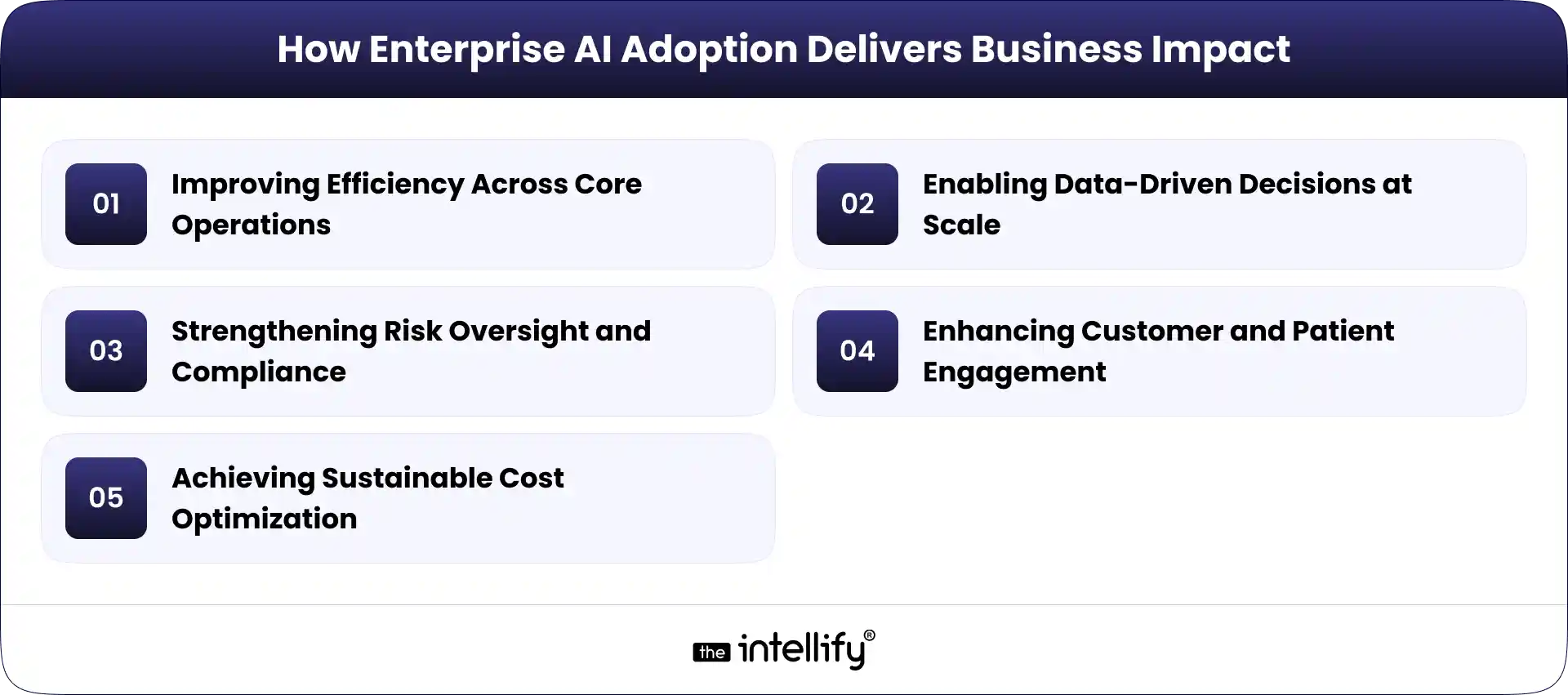
Enterprise AI Adoption Business Impact

Improving Efficiency Across Core Operations

AI has the power to significantly boost efficiency by automating routine tasks, optimizing workflows, and speeding up processing times, all of which lead to cost savings and higher productivity.

Enabling Data-Driven Decisions at Scale

With strong data analysis capabilities, AI helps organizations make informed decisions based on real-time insights. This agility supports responsive strategies that can quickly adapt to market changes.

Strengthening Risk Oversight and Compliance

AI enhances risk management by spotting potential issues before they become serious problems. Through data pattern analysis, organizations can meet compliance requirements while bolstering their security posture.

Enhancing Customer and Patient Engagement

AI tools like chatbots and personalized recommendation systems allow brands to engage effectively with customers, boosting satisfaction and fostering loyalty.

Achieving Sustainable Cost Optimization

AI paves the way for smarter resource allocation and optimization, ensuring sustainable cost management. Organizations can pinpoint wasteful practices that can either be improved or removed.


Common Barriers to Enterprise AI Adoption

Legacy Infrastructure and Disconnected Data

Many enterprises grapple with outdated technology and siloed data, which complicates the implementation of effective AI solutions.

Regulatory Complexity and Data Privacy Risks

Navigating regulatory hurdles can feel overwhelming. Companies need to prioritize data privacy and compliance to steer clear of potential pitfalls.

Lack of Clear Governance and Ownership

Without a governance framework, AI initiatives may become misaligned and misused, hampering overall success.

Internal Skill and Capability Gaps

Organizations lacking the right talent and training may struggle to unlock AI’s full potential, resulting in stagnant or underperforming projects.

Organizational Readiness and Change Resistance

Resistance to change can hinder AI projects. It’s vital to cultivate a culture of acceptance and understanding regarding AI for smooth integration.

 

AI implementation guide


Enterprise AI Implementation Roadmap

Step 1 – Define Clear Objectives

Start by identifying specific business goals and how AI can help achieve them. This clarity will serve as the bedrock for all subsequent efforts.

Step 2 – Assess Data and Infrastructure

Evaluate existing data systems and infrastructure to confirm they can effectively support new AI solutions.

Step 3 – Identify High-Impact Use Cases

Focus on high-impact use cases that promise significant returns. Allocate resources to areas likely to generate the most value.

Step 4 – Establish Governance and Risk Controls

Implement a strong governance framework to oversee AI initiatives, ensuring that all ethical and compliance standards are met.

Step 5 – Run Pilot Projects

Before scaling, run pilot projects to test assumptions and methodologies. Gather insights from these tests to fine-tune your approaches.

Step 6 – Scale Across the Organization

Once pilot projects validate your strategies, it’s time to scale AI solutions throughout the organization, making sure every department benefits.

Step 7 – Monitor, Measure, and Improve

Regularly assess the performance of AI initiatives, adapt your strategies based on results, and keep seeking improvement.


Key Areas of Enterprise AI Use Cases

1. Operational Optimization in Healthcare

AI can analyze patient data to boost operational efficiencies, reduce wait times, and enhance overall patient care.

2. Risk Modeling and Claims Efficiency in Insurance

Insurance companies use AI for predictive risk modeling, faster claims processing, and reduced fraud. Many are adopting advanced Enterprise AI solutions for Insurance to improve underwriting accuracy, automate claims workflows, and strengthen compliance.

3. Fraud Prevention and Compliance Monitoring

AI algorithms can keep a watchful eye on transactions in real-time, helping organizations swiftly identify and tackle fraudulent activities.

4. Intelligent Workflow Automation Across Functions

By automating repetitive tasks across departments, AI liberates human capital for more strategic work, thereby boosting productivity.
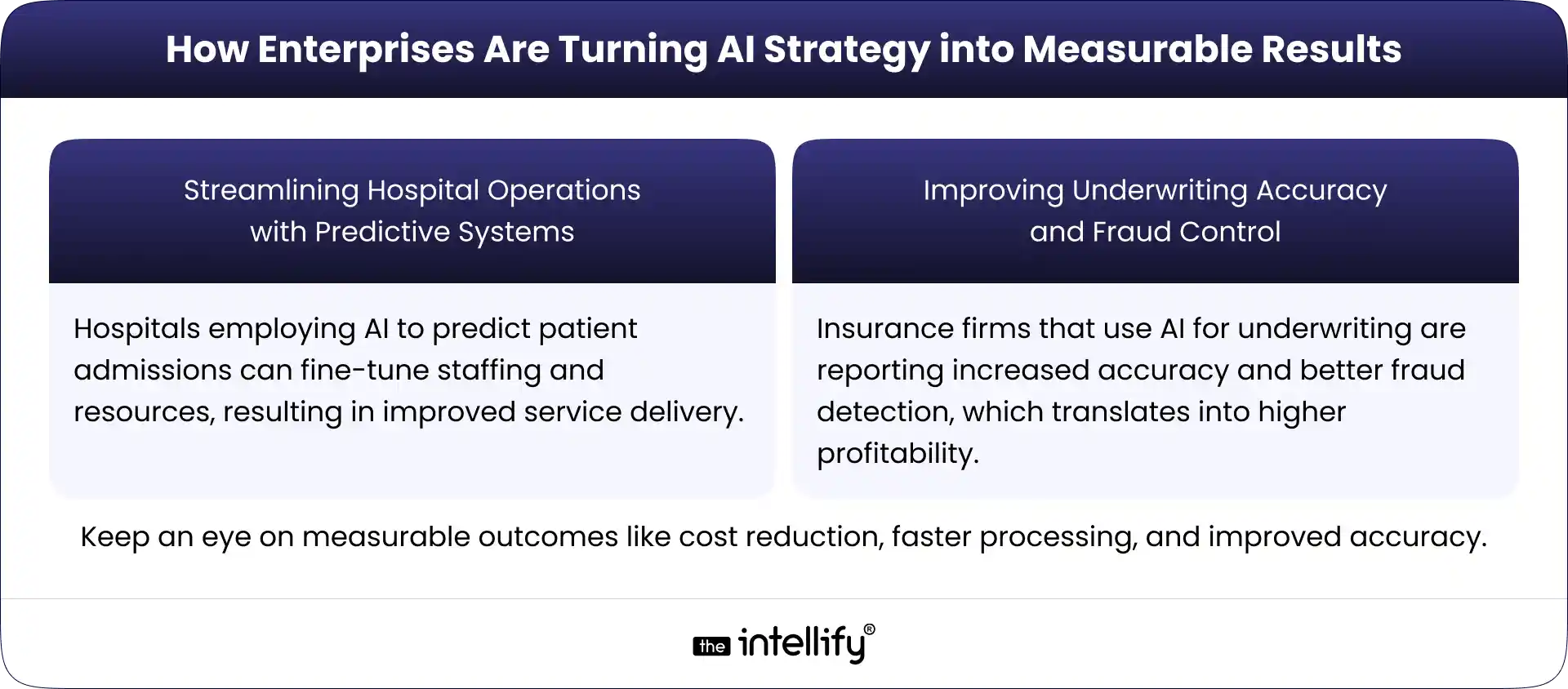
 

AI Strategy into Measurable Results


Governance and Responsible AI Practices

Data Governance Standards

Strong data governance standards should be implemented to assure data integrity and accountability.

Ethical and Transparent AI Use

Place a priority on ethical considerations in AI deployment to build trust among stakeholders and customers.

Regulatory Alignment

Stay up to date with evolving regulations to avoid legal consequences and improve your reputation.

Ongoing Risk Management

Keep an eye on potential risks and incorporate feedback mechanisms to navigate challenges effectively.


Measuring ROI and Business Impact

1. Financial performance metrics:- Look at cost reductions and revenue boosts post AI implementation.

2. Operational improvements:- Assess productivity gains and process efficiencies that can be attributed to AI.

3. Adoption and usage indicators:- Monitor engagement with the new technologies and systems.

4. Long-term strategic value:- Evaluate how AI fits into long-term business strategies.


Future Trends in Enterprise AI Strategy

1. Generative AI integration:- Look for AI algorithms to start producing creative outputs, spurring innovation across sectors.

2. Intelligent decision support:- AI will enable even more advanced predictive insights for better decision-making.

3. Enterprise-wide automation:- Expect broader adoption of AI automation across various business functions.

4. Human-AI collaboration:- The future will enhance cooperation between human capabilities and AI solutions, driving overall efficiency.

 

Enterprise AI Solutions


Conclusion:-

Charting the path to effective enterprise AI adoption can definitely feel daunting, but the rewards are significant. By taking a structured approach, companies can harness AI to optimize processes, improve engagement, and achieve sustainable growth. The future isn’t going to wait, so adopting enterprise AI isn’t just advantageous, it’s essential.

In practice, turning strategy into execution requires both technical clarity and strong business alignment. Many enterprises collaborate with experienced teams that understand this balance. Organizations like The Intellify, for example, work alongside enterprises to translate AI strategy into practical roadmaps that support scalable and responsible adoption.


Frequently asked questions

1. What is enterprise AI, and why is it important for businesses?

Enterprise AI helps organizations automate processes, improve decision-making, and use data more effectively. It supports long-term growth and competitiveness.

2. How do you start an enterprise AI strategy?

Start by defining business goals, assessing data readiness, and selecting high-impact use cases. A clear roadmap helps reduce risks and improve success.

3. What are the common challenges in adopting AI at the enterprise level?

Common challenges include outdated systems, data silos, compliance risks, skill gaps, and resistance to change.

4. How can enterprises measure the success of their AI initiatives?

Success is measured through cost savings, productivity gains, accuracy, system adoption, and overall business impact.

5. Which industries benefit most from enterprise AI adoption?

Healthcare, finance, retail, manufacturing, and insurance benefit the most from automation, analytics, and predictive insights.

6. How do leadership and governance impact AI adoption?

Strong leadership and clear governance ensure AI aligns with business goals, remains compliant, and scales effectively.

7. What practical steps should be in an AI adoption roadmap?

An effective roadmap includes goal setting, data assessment, pilot testing, scaling, governance, and continuous improvement.
AI in Healthcare Claims Processing: A Practical Implementation & ROI Guide

Summary:
Healthcare claims processing is often slow, manual, and prone to costly errors. This blog breaks down how AI in healthcare helps reduce denials, speed up reimbursements, and improve revenue cycle performance. You’ll see how AI supports each step of the claims process, what benefits providers and insurers can expect, and what it takes to implement it properly. It also covers ROI, costs, compliance, and common challenges in simple, practical terms.


The Growing Impact of AI in Healthcare Operations

Walk into any hospital billing office, and you’ll feel it. The quiet tension. The stacks of files. The “we’re still waiting on that claim” conversations. Healthcare runs on care. But it survives on reimbursement. And that’s where things often get messy.

AI in healthcare is starting to change how operations work behind the scenes. Not in a flashy, sci-fi way. More in a practical, roll-up-your-sleeves kind of way. It helps teams catch errors early, process claims faster, and avoid those painful denials that stall revenue.


How AI in healthcare is changing operational efficiency

Operational efficiency used to mean hiring more staff to handle more claims. More volume? Add more people. But that model doesn’t scale well. It’s expensive. It’s exhausting. And honestly, it’s error-prone.

AI changes that dynamic. It reviews documentation in seconds. It flags mismatches between diagnosis and procedure codes. It learns from past denials and spots patterns humans might miss on a long Tuesday afternoon. Instead of reacting to problems, teams can prevent them. That shift alone changes everything.


Challenges in Traditional Claims Processing

Let’s be honest. Traditional claims processing is fragile. It depends heavily on manual work, fragmented systems, and a lot of patience.

Manual coding and documentation errors

Coding errors happen. A digit off. A missing modifier. A mismatched diagnosis. Most of the time, it’s not negligence. It’s an overload. Coders review hundreds of records daily. Fatigue creeps in. And small mistakes turn into denied claims.

High denial and rejection rates

Denials don’t just hurt revenue. They drain morale. When denial rates rise, teams spend hours reworking submissions instead of focusing on new claims. It becomes a cycle. Fix, resubmit, wait. Repeat.

Delayed reimbursements and cash flow gaps

A delayed claim means delayed payment. That delay can stretch from weeks to months. For healthcare providers, this affects payroll, equipment purchases, and expansion plans. Cash flow gaps aren’t abstract. They’re real.

Compliance and audit risks

Healthcare is tightly regulated. Every claim must follow strict rules. Manual processes increase the risk of missing documentation, incomplete records, or coding mismatches. Audits become stressful events instead of routine checks.

Rising administrative costs

More denials mean more rework. More rework means more staff time. Administrative overhead keeps rising. And it often feels like there’s no clear way to stop the climb.


How AI in Healthcare Improves Claims Management

AI doesn’t just automate steps. It changes how decisions are made.

Moving beyond rule-based automation

Basic automation follows fixed rules. If X happens, do Y. AI goes further. It analyzes patterns. It learns from outcomes. It adapts. Instead of simply checking if a field is filled, it evaluates whether the documentation actually supports the claim.

Supporting faster and more accurate decisions

AI systems can review thousands of data points in seconds. That includes patient history, prior claims, payer policies, and coding guidelines. This reduces guesswork. Decisions become data-backed instead of instinct-driven.

Strengthening revenue cycle performance

When errors are caught before submission, denial rates drop. When claims move faster, reimbursement improves.

When patterns are identified early, process improvements follow. Revenue cycle performance becomes more predictable. And predictability is gold in healthcare finance.

Automated data extraction from medical records

AI for healthcare tools can automatically extract structured data from clinical notes, discharge summaries, and lab reports. This reduces manual entry, minimizes errors, and ensures critical details aren’t missed.

Intelligent coding validation

Before a claim goes out, AI checks whether diagnosis codes match procedures and whether documentation supports the billing. It acts like a second pair of eyes. A very fast one.

Predictive denial detection

AI can flag claims that are likely to be denied based on historical payer behavior. Instead of waiting for rejection, teams fix the issue before submission. That’s a big shift.

Fraud detection and risk analysis

AI can identify unusual billing patterns or inconsistencies across large datasets. This helps reduce fraud risk and supports internal compliance efforts.


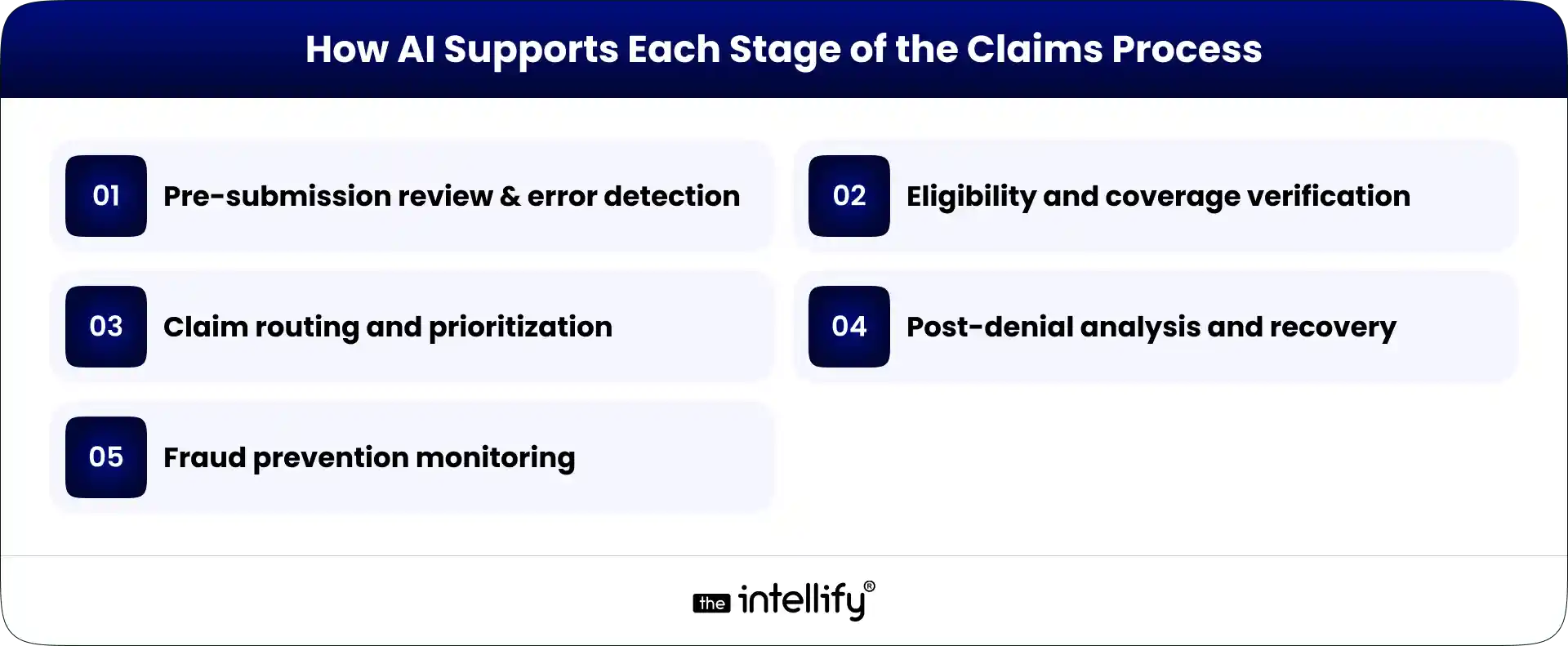
How AI Supports Each Stage of the Claims Process

How AI Supports Each Stage of the Claims Process

Let’s break it down in simple terms.

Pre-submission review and error detection

Before sending a claim, AI checks for missing fields, mismatches, and incomplete documentation. It’s like proofreading an email before hitting send. Basic, but powerful.

Eligibility and coverage verification

AI verifies patient coverage in real time. It checks whether services are covered under specific plans. Fewer surprises later.

Claim routing and prioritization

Some claims need faster attention. AI can prioritize high-value or high-risk claims automatically. This keeps critical cases moving.

Post-denial analysis and recovery

When a denial does happen, AI analyzes the reason and suggests corrective action. Instead of manually digging through records, teams get guided insights.

Fraud prevention monitoring

AI continuously monitors claim patterns. If something unusual appears, it flags it. Not dramatic. Just steady oversight.


Key Benefits for Healthcare Providers and Insurance Teams

Here’s what this actually means on the ground.

Faster claims processing cycles

  • Claims move from submission to reimbursement more quickly.
  • Less waiting. Less uncertainty.

Lower denial and appeal rates

  • When errors are caught early, denial rates drop.
  • Appeals become the exception, not the norm.

Reduced administrative workload

  • Teams spend less time correcting mistakes.
  • That time can go toward patient communication or financial planning instead.

Improved cash flow stability

  • Faster reimbursements create steadier revenue streams.
  • And steadier revenue reduces financial stress.

Stronger compliance readiness

  • With consistent validation and monitoring, audit risks decrease.
  • Documentation is more complete. Records are easier to retrieve.


AI for Healthcare Claim


Implementing AI in Healthcare: A Step-by-Step Approach

This isn’t a switch you flip overnight.

Assessing existing revenue cycle workflows

Start by mapping your current process. Where do errors happen most? Where are delays common? Be honest. Even if it’s uncomfortable.

Identifying high-impact automation areas

Focus first on steps with high denial rates or heavy manual effort. Small wins build confidence.

Selecting the right solution partner

Look for a partner who understands healthcare regulations and billing realities. Not just someone selling software.

Integration with EHR and billing systems

AI in Healthcare must integrate seamlessly with existing EHR and billing systems. Poor integration can disrupt workflows instead of improving efficiency.

Pilot deployment and staff training

Start small. Run a pilot. Train teams clearly. Change feels scary at first. That’s normal.

Monitoring performance and scaling

Track metrics. Compare denial rates before and after. If results are strong, expand gradually.


Understanding ROI in AI-Driven Claims Processing

ROI isn’t just about cost savings. It’s about control.

Reduction in denial rates

Even a small percentage drop in denials can translate into significant revenue protection.

Faster reimbursement timelines

Shorter payment cycles improve working capital.

Administrative cost savings

Less rework means fewer overtime hours and lower staffing pressure.

Revenue recovery improvements

AI can identify underpayments and missed billing opportunities.

Money that might have slipped through the cracks comes back.


Key performance indicators to track

  • Denial rate percentage
  • Days in accounts receivable
  • Cost per claim processed
  • First-pass claim acceptance rate
  • Appeal success rate

These numbers tell the real story.


Cost and Investment Considerations

AI requires investment. There’s no sugarcoating that.

Technology and licensing costs

Software subscriptions or platform licenses form the base cost.

Integration and infrastructure needs

Some upgrades to infrastructure or system connectors may be needed.

Training and change management

Teams need training. And time to adjust.

Ongoing maintenance and compliance

Systems require updates. Regulations change. Monitoring is continuous.


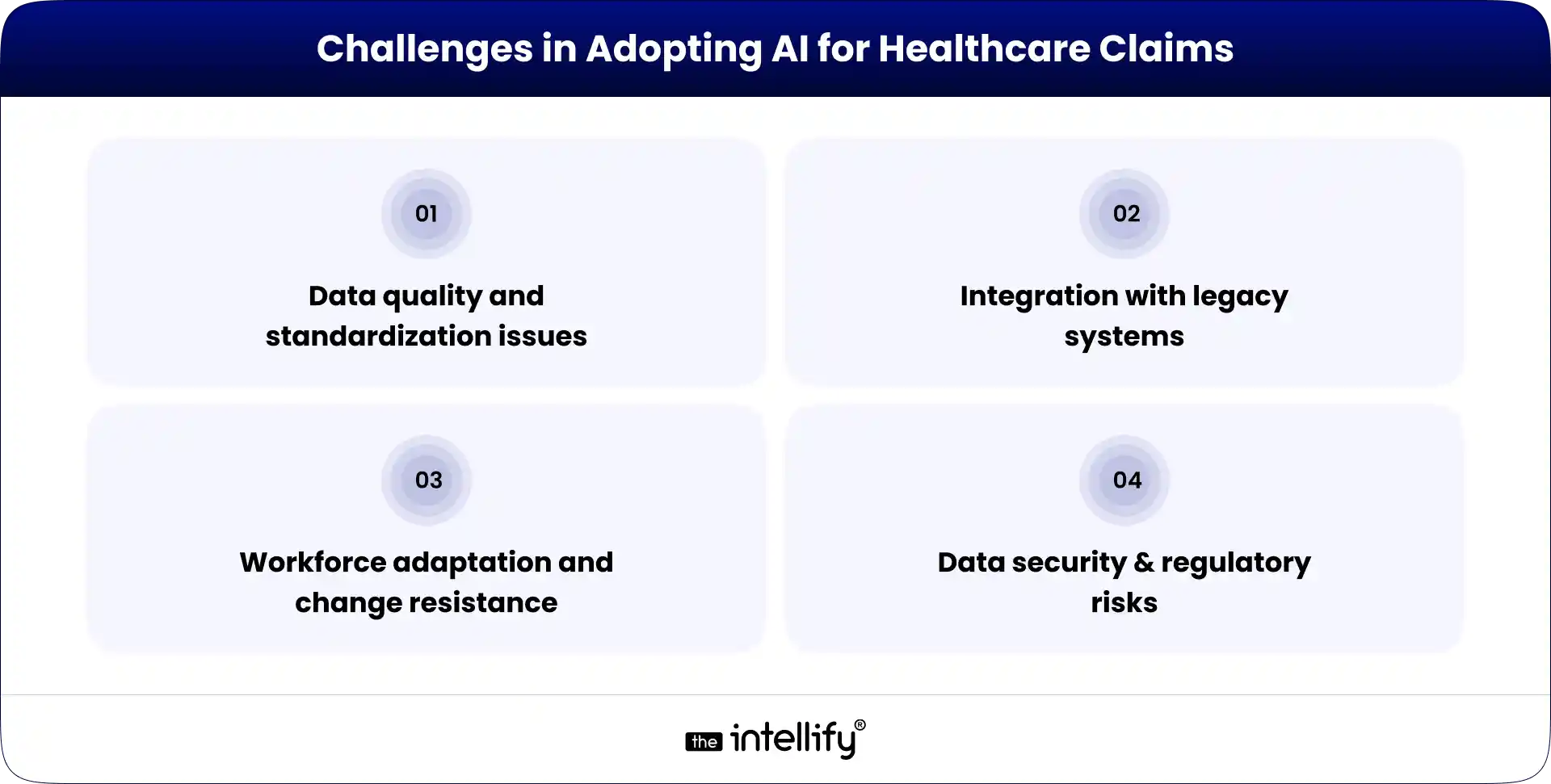
Challenges in Adopting AI for Healthcare Claims

Challenges in AI Healthcare Claims

It’s not all smooth sailing.

Data quality and standardization issues

If data is inconsistent or incomplete, AI struggles. Clean data matters more than fancy algorithms.

Integration with legacy systems

Older systems may resist integration. Sometimes the tech feels like it’s from 2009. And it probably is.

Workforce adaptation and change resistance

Some staff may worry about job security. Clear communication is essential. AI supports teams; it doesn’t replace them.

Data security and regulatory risks

Healthcare data is sensitive. Strong encryption, access controls, and compliance practices are non-negotiable.


Governance, Compliance, and Responsible Use

AI must be used carefully.

Data privacy requirements

Patient data must remain protected under regulatory standards. No shortcuts here.

Transparency in automated decisions

If a claim is flagged or rejected, there should be a clear explanation. Black-box decisions create trust issues.

Audit trails and accountability

Systems should log actions and changes. This supports audits and internal reviews.

Risk management practices

Regular system evaluations and compliance checks help reduce long-term risk.


The Future of AI in Healthcare Claims Management

The direction is clear:

Real-time claims adjudication

AI could enable near-instant claim review and approval. Imagine submitting and receiving confirmation within minutes. Not weeks.

Predictive revenue forecasting

Using historical data, AI can project revenue trends and identify risk periods ahead of time.

End-to-end revenue automation

From patient registration to final reimbursement, automation may streamline the full revenue cycle.

Expanding AI across healthcare operations

Claims are just one piece. Scheduling, patient communication, supply chain management AI is expanding across operations.


AI for Healthcare Claim Solutions


Conclusion

AI in healthcare is not about replacing people. It’s about reducing friction. It helps teams avoid preventable errors. It stabilizes cash flow. It reduces administrative pressure. But success depends on structured implementation. Clear goals. Clean data. Strong governance.
When done thoughtfully, AI transforms claims processing from a reactive process into a controlled, measurable system. And honestly? In a world where healthcare margins are tight and expectations are high, that kind of stability feels like a breath of fresh air.


Frequently Asked Questions (FAQs)

1. What does AI in healthcare claims management mean?

It means using intelligent software to review, validate, and process healthcare claims automatically. AI reads medical records, checks codes, and flags errors before submission. At The Intellify, we use AI to simplify claims workflows and reduce manual effort without disrupting existing systems.

2. How does AI help reduce claim denials?

AI reviews claims before they’re sent to payers. It detects missing details, coding mismatches, or policy conflicts early. By fixing issues upfront, providers avoid preventable denials and repeated rework.

3. Will AI replace human staff in claims processing?

No. AI handles repetitive checks and data validation. Human teams still manage decisions, exceptions, and compliance oversight. The goal is support not replacement.

4. Can AI detect fraudulent claims?

Yes. AI identifies unusual billing patterns and inconsistencies across large datasets. This helps flag potential fraud early and reduces financial risk.

5. What are the common challenges when adopting AI for claims?

Common issues include poor data quality, legacy system integration, and staff resistance to change. A structured rollout plan helps reduce these risks.

6. How does AI improve reimbursement speed?

By reducing errors and automating validation, AI increases first-pass acceptance rates. Fewer rejections mean faster approvals and quicker payments

The Top 8 AI Implementation Challenges (And How to Overcome Them)

Summary
AI adoption is accelerating, but enterprises face a new generation of complex challenges that threaten success. This comprehensive guide, informed by U.S. market trends and expert analysis, dives deep into the most critical AI implementation challenges of today. From managing the astronomical cost of implementing AI to navigating the complexities of generative AI implementation and ensuring regulatory compliance, we provide actionable, human-centric strategies to overcome these demanding hurdles. Our goal is to empower you with the knowledge to build a robust AI implementation strategy and achieve a tangible return on your investment.

The Top AI Implementation ChallengesIntroduction

In today’s fast-paced digital world, Artificial Intelligence (AI) has moved from a futuristic concept to a practical business necessity. From powering personalised customer experiences to automating complex operations, the benefits of implementing AI are significant. But for many organisations, the journey to a successful AI deployment is far from straightforward. The path is littered with obstacles, and it’s no wonder that a significant number of AI initiatives fail to deliver on their promise.

This guide examines the most common AI implementation challenges businesses encounter and, more importantly, offers practical strategies to address them. We’ll delve into everything from technical hurdles to cultural resistance, giving you a clear best AI implementation roadmap to follow.


8 Critical Challenges of AI Implementation (and Their Solutions)

A series of complex challenges mark the journey to successful AI implementation. This section provides a deep dive into the eight most critical challenges and their corresponding strategic solutions, as a guide to building a resilient and effective AI implementation strategy.

8 Critical Challenges of AI Implementation (and Their Solutions)


ChallengeCore ProblemStrategic Solution
The Data DilemmaInsufficient, poor-quality, and biased dataBuild a robust data governance strategy
The Production PredicamentModel drift and the “set it and forget it” fallacyAdopt an MLOps mindset for continuous care
The “Black Box” ProblemLack of transparency and explainability (XAI)Prioritise explainability and document everything
The Cybersecurity ConundrumAdversarial attacks and model poisoningImplement AI-specific security protocols
Cost & Resource ManagementAstronomical costs and inefficient resource useStrategic cost optimisation and model efficiency
Proving the ValueLack of a clear strategy and measurable ROIDefine business value and align from day one
Regulatory GovernanceEvolving regulations and legal liabilityBuild a proactive AI governance framework
Technical ComplicationsLegacy systems and the complexity of new AIA phased, expert-led integration approach


1. The Data Dilemma: More Than Just “Big Data”

At the heart of every successful AI system is data. However, for many, this is where the journey encounters its first major obstacle. It’s not enough to simply have a lot of data; it has to be the right kind of data.

The Problem: Insufficient, Poor-Quality, and Biased Data

You’ve heard the phrase “garbage in, garbage out.” It’s never been truer than with AI. Many organisations struggle with data that is:

  • Too sparse or vast: You either don’t have enough data to train a model, or you have so much of it that it becomes unmanageable.
  • Incompatible and siloed: Data is often scattered across different departments in incompatible formats, making it nearly impossible to consolidate and use.
  • Full of errors and inconsistencies: Poor data quality can lead to flawed outputs and misguided decisions.
  • Inherently biased: The biggest issue of all. If your historical data reflects societal biases (e.g., in hiring, lending, or healthcare), your AI model will learn and amplify those biases, leading to unfair, unethical, and legally risky outcomes.

How to Overcome It: Build a Robust Data Governance Strategy

Mastering your data isn’t an IT project; it’s a foundational business imperative.

  • Establish a Data Strategy First: Before you even think about an AI model, define a clear data strategy. What data do you need? Where does it live? How will you collect, store, and manage it? This is the foundation of any successful AI implementation strategy.
  • Implement Strong Governance: Establish a comprehensive data governance framework to ensure that data is clean, secure, and accessible. Invest in data management tools that can help with data cleansing, integration, and a master data management program.
  • Proactive Bias Audits: Don’t wait for a problem to appear. Use tools and techniques to audit your datasets for bias before they are used to train a model. This is an ongoing process crucial for an ethical and responsible AI implementation in business.


2. The Production Predicament: Moving from PoC to Performance

Many organisations find that their AI project works perfectly in a controlled proof-of-concept (PoC) environment, only to fail spectacularly in production. The leap from a lab to the real world is one of the most demanding AI implementation challenges.

The Problem: Model Drift and the “Set It and Forget It” Fallacy

Unlike traditional software that performs the same function every time, AI models degrade over time. This is known as “model drift,” and it happens for several reasons:

  • Data Drift: The real-world data your model sees in production starts to differ significantly from the data it was trained on. Think of a fraud detection model trained on historical data suddenly having to deal with a new type of scam.
  • Concept Drift: The fundamental relationship between the input data and the target output changes. An e-commerce recommendation engine that worked perfectly during the holidays might become less effective in the off-season.
  • Environmental Changes: The business environment itself changes, making the model’s original purpose less relevant.

How to Overcome It: Adopt an MLOps Mindset

Treat your AI model not as a static product, but as a dynamic organism that requires continuous care and maintenance.

  • Continuous Monitoring: Implement automated monitoring for both data and performance drift. Your system should be able to send alerts when an AI model’s accuracy drops below a certain threshold.
  • Automated Retraining Pipelines: Create automated pipelines to periodically retrain your models with new data. This ensures your AI is always learning and adapting to the latest trends.
  • A/B Testing in Production: When you have a new model version, don’t deploy it all at once. Use A/B testing to compare its performance against the old model in a live environment before fully rolling it out. This is especially important for things like implementing agentic AI, where behaviour is complex and hard to predict.


3. The “Black Box” Problem: Trust and Explainability

In high-stakes industries like finance, healthcare, and criminal justice, you can’t just accept a decision without knowing why it was made.

The Problem: Lack of Transparency and Explainable AI (XAI)

Many powerful, complex AI models (like deep learning networks) are inherently opaque. They are “black boxes” that take an input and give an output, but their internal workings are too complex for humans to understand. This opacity creates several critical problems:

  • Erodes Trust: People won’t trust a system they can’t understand. A loan applicant who is rejected wants to know the reasons, not just be told the AI said “no.”
  • Hindered Debugging: If a model makes a mistake, debugging becomes a nightmare. You don’t know if the problem is in the data, the model architecture, or an external factor.
  • Regulatory Non-Compliance: Regulations like the GDPR in Europe give individuals a “right to an explanation” for automated decisions, which is impossible to provide with a black box model.

How to Overcome It: Prioritise Explainability (XAI)

This is about choosing the right tools for the job and demanding transparency.

  • Embrace Post-Hoc Explainability: For complex models, use techniques like SHAP (Shapley Additive Explanations) or LIME (Local Interpretable Model-Agnostic Explanations) that can analyse a model’s output and provide a human-readable explanation of why it made a particular decision.
  • Choose the Right Model: Not every problem needs a deep neural network. Sometimes, a simpler, inherently interpretable model like a decision tree or linear regression is a better, more trustworthy choice.
  • Document Everything: Maintain thorough documentation of your model’s design, training data, and decision-making logic. This is essential for both internal debugging and external audits.


4. The Cybersecurity Conundrum: A New Frontier of Threats

AI doesn’t just automate tasks; it creates a new attack surface for malicious actors to exploit. The security risks are distinct from traditional IT vulnerabilities.

The Problem: Adversarial Attacks and Model Poisoning

Hackers are getting smarter. They know how to attack AI models directly:

  • Adversarial Attacks: Attackers can make subtle, imperceptible changes to input data that trick an AI model into making a wrong decision. A few pixels changed on an image of a stop sign, and a self-driving car might mistake it for a yield sign.
  • Data Poisoning: Malicious actors can inject bad data into your training datasets, corrupting your model from the beginning. A poisoned training set could cause a facial recognition system to fail on a specific person or a spam filter to classify malicious emails as safe.
  • Model Inversion: Hackers can try to reverse-engineer your AI model to extract sensitive information about the private data it was trained on.

How to Overcome It: Implement AI-Specific Security Protocols

Traditional firewalls aren’t enough. You need to build security into the AI lifecycle from the ground up.

  • Adversarial Training: Train your models to recognise and resist adversarial attacks by intentionally exposing them to “tricked” data during the training phase.
  • Robust Data Governance: This is a recurring theme. Strong data governance and a secure supply chain for your training data are your first line of defence against data poisoning.
  • Continuous Monitoring: Monitor your model’s outputs for sudden, unexplained changes in behaviour that could signal an attack. Look for unusual activity and have an incident response plan ready to go.


5. Cost & Resource Management: The Hidden Price Tag of AI

The hype around AI often overshadows its practical financial realities. For many organisations, the true cost of implementing AI is a major surprise, often leading to stalled projects and budget overruns.

The Problem: Astronomical Costs and Inefficient Resource Use

  • GPU Dependency: Modern AI, especially generative AI implementation, relies heavily on specialised hardware like GPUs. The cost of running these on a large scale for both training and inference can be prohibitive.
  • Idle Infrastructure: You’re not just paying for what you use; you’re often paying for what you don’t. Cloud resources, particularly GPUs, can sit idle between tasks, wasting significant budget without delivering any value.
  • Egress Fees: Moving the massive datasets required for AI training between different clouds or storage systems can result in unexpected and costly network fees.

How to Overcome It: Strategic Cost Optimisation

  • Resource Optimisation: Use tools and platforms that can dynamically provision and de-provision resources. For example, a platform that can automatically spin up GPUs for a training run and then shut them down immediately after completion can save a fortune.
  • Model Efficiency: Don’t always go for the biggest, most complex model. Explore techniques like model distillation or quantisation to create smaller, more efficient models that require less computational power and are ideal for edge AI implementations.
  • Cloud Agnostic Strategy: A multi-cloud or hybrid-cloud approach can help you negotiate better rates and avoid vendor lock-in. It gives you the flexibility to choose the most cost-effective provider for each specific task.


6. ROI and Business Alignment: Proving the Value

With all the talk of technology, it’s easy to lose sight of the ultimate goal: delivering real business value. An AI project that doesn’t contribute to the bottom line is simply a costly experiment.

The Problem: Lack of a Clear Strategy and Measurable ROI

  • Solution: Searching for a Problem: Many organisations get caught up in the hype and begin an AI project without a clear business objective. They are looking for a problem to solve with AI, rather than using AI to solve a genuine, high-impact business problem.
  • Inadequate KPIs: Measuring the ROI of AI is not always straightforward. Traditional metrics don’t always capture the full value, and projects often fail because their success was never clearly defined in the first place.
  • Stakeholder Misalignment: Without a clear vision, there can be a significant gap between what the technical team is building and what the business leaders need or expect. This is a common AI adoption challenge that leads to project failure.

How to Overcome It: Define Value and Align from Day One

  • Start with a Business Problem: Don’t start with the technology; start with a business pain point. Identify a specific, high-impact problem, like reducing customer churn, optimising a supply chain, or personalising customer service, that AI can solve.
  • Define and Track KPIs: Establish clear, measurable KPIs (Key Performance Indicators) for both financial and qualitative benefits. This can include cost savings, revenue growth, customer satisfaction scores, and employee productivity gains.
  • Appoint an Executive Champion: Secure executive sponsorship and a dedicated champion who can ensure the project remains aligned with broader business goals and has the support it needs to succeed.

CTA

7. Regulatory Governance: The New Frontier of Compliance

As AI becomes more integral to our lives, governments and regulatory bodies are taking notice. A lack of a formal governance framework is a significant risk that many organisations are unprepared for.

The Problem: Evolving Regulations and Compliance Headaches

  • The Regulatory Wild West: The legal landscape for AI is evolving rapidly, with new laws like the EU’s AI Act emerging. Without a formal governance structure, it’s nearly impossible to keep up with these changes and ensure compliance.
  • Legal Liability: In the event of a faulty AI decision (e.g., in a self-driving car or a medical diagnostic tool), who is responsible? The company? The developer? The data scientist? This question of accountability is a major legal risk.
  • Trust and Brand Reputation: Failure to use AI responsibly and transparently can lead to a loss of public trust, which is incredibly difficult to regain. How can customers reduce risks when implementing AI? By partnering with companies that prioritise and demonstrate a commitment to ethical AI.

How to Overcome It: Build a Proactive AI Governance Framework

  • Establish a Governance Committee: Create a cross-functional committee with members from legal, ethics, technology, and business departments. This committee should be responsible for setting and enforcing your AI policies.
  • Formalise an AI Policy: Develop a formal, written policy that outlines your organisation’s principles for the ethical and responsible use of AI. This policy should cover data privacy, bias mitigation, transparency, and accountability.
  • Conduct Regular Audits: Regularly audit your AI models and systems to ensure they comply with both your internal policies and external regulations.


8. Technical Hurdles: Integrating with Emerging AI Types

The proliferation of new AI technologies, from generative AI to complex agentic AI, presents a fresh wave of technical integration challenges.

The Problem: Legacy Systems and the Complexity of New AI

  • Integration Nightmare: Your existing legacy systems were built for a different era. Integrating new, sophisticated AI models with these older, often-closed systems can be a complex, costly, and time-consuming process.
  • Agentic AI Implementation: Implementing agentic AI, where AI systems can act independently and even interact with other agents, introduces unprecedented complexity. Ensuring they operate safely, securely, and in a controlled manner requires a new level of architectural planning and oversight.
  • Specialised Expertise: These new forms of AI often require specialised skills that are different from traditional machine learning. Finding the right talent to manage and integrate these complex systems is a major barrier.

How to Overcome It: A Phased, Expert-Led Approach

  • Phased Integration: Start with a small pilot project to test the integration points between a new AI model and your existing systems. This iterative approach allows you to work out the kinks before a full-scale deployment.
  • Use APIs and Microservices: Build a microservices-based architecture with robust APIs that act as a bridge between your legacy systems and new AI solutions.
  • Collaborate with Experts: Work with an AI implementation consultant or a partner firm that specialises in the integration of cutting-edge technologies like generative AI and implementing agentic AI. This can significantly reduce risk and accelerate your time to value.


Your Partner in Navigating These Challenges: The Intellify

Overcoming these demanding challenges requires more than just a brilliant idea; it requires a strategic partner with deep expertise and a proven track record.

At The Intellify, we understand that every one of these problems can derail your project. That’s why we specialise in turning these obstacles into opportunities. As a leading AI solutions provider, we offer end-to-end services that solve the exact pain points detailed in this guide:

Your Partner in Navigating These Challenges: The Intellify

  • Generative AI Development: We help you harness the power of generative AI and LLMs by building custom solutions that align with your business goals, ensuring a tangible ROI.
  • Seamless Integration: Our experts handle the complex task of integrating new AI solutions, including agentic AI, into your existing infrastructure, bridging the gap between legacy systems and cutting-edge technology.
  • AI Implementation Services: We provide the expertise you need to develop a clear AI implementation strategy, from the initial discovery phase and consulting to deployment, monitoring, and fine-tuning.
  • AI Chatbot Implementation Case Studies: Our deep experience in conversational AI and AI chatbot implementation case studies demonstrates our ability to deliver fast, effective solutions that enhance customer service and drive efficiency.

Ready to move beyond the challenges and start seeing real results? Partner with The Intellify and turn your AI vision into a reality, with fast, reliable, and expertly crafted solutions.


Conclusion: The Future of AI Implementation

The journey of AI implementation is a strategic business transformation, not a simple technological upgrade. To navigate the complexities of data dilemmas, security risks, and cultural resistance, organisations must adopt a holistic, human-centric approach. Success is found in a clear roadmap that aligns AI with tangible business objectives, prioritises continuous monitoring, and fosters a culture ready for change. Ultimately, this deliberate process is the only way to move beyond the hype and unlock a genuine, long-term return on your AI investment.

CTA

AI Implementation FAQs

1. What is AI implementation?

A: AI implementation is the process of integrating artificial intelligence into business operations to solve specific problems and drive measurable outcomes.

2. What are the biggest challenges in implementing AI?

A: The biggest challenges include dealing with poor-quality data, model drift after deployment, high costs, and a lack of transparency in AI’s decision-making.

3. How can I solve data quality and bias issues for my AI?

A: To solve these issues, you must first define a clear data strategy and build a robust data governance framework that includes proactive bias audits on datasets.

4. What is an MLOps mindset?

A: An MLOps (Machine Learning Operations) mindset treats an AI model as a dynamic system that requires continuous care, including automated monitoring and retraining, to prevent performance degradation over time.

5. What is the “black box” problem in AI?

A: The “black box” problem refers to complex AI models whose internal decision-making processes are too opaque for humans to understand, which can erode trust and lead to regulatory issues.


View
Case Study