Top AI Development Company for Custom AI Solutions & Services

Summary:
Businesses are increasingly adopting AI to improve efficiency, automate workflows, enhance customer experiences, and make smarter decisions. This blog explains how an AI development company helps organizations build custom AI solutions, intelligent applications, and AI automation systems tailored to their needs. It also explores industry use cases, implementation best practices, emerging AI trends, and the key factors to consider when selecting the right AI development partner for long-term success.


Artificial Intelligence is no longer something businesses talk about as a future possibility. It’s already reshaping how companies operate, serve customers, and make decisions every day. A few years ago, businesses relied heavily on traditional software to manage operations. While those systems still play an important role, they often struggle when dealing with large volumes of data, changing customer expectations, or complex decision-making processes. That’s where AI comes in.

Organizations across healthcare, retail, finance, manufacturing, logistics, and many other industries are investing in intelligent systems that can learn from data, automate repetitive work, and deliver insights in real time. Instead of spending hours on manual tasks, teams can focus on strategic work that drives growth. From predicting customer behavior and automating workflows to creating personalized experiences and improving operational efficiency, AI is helping businesses solve challenges that traditional software simply wasn’t designed to handle.

However, building successful AI solutions requires much more than writing code. It demands expertise in machine learning, data engineering, automation, cloud infrastructure, and business strategy. This is why many organizations choose to work with an experienced AI development company that can design, build, and scale AI-powered systems aligned with their business goals.


What Is an AI Development Company and Why Does It Matter?

An AI development company specializes in creating software solutions powered by artificial intelligence technologies such as machine learning, natural language processing, computer vision, predictive analytics, and generative AI.
Unlike traditional software development, where applications follow predefined rules and instructions, AI systems are designed to learn from data, identify patterns, and continuously improve their performance over time.
For example, a traditional customer support platform may follow scripted workflows. An AI-powered platform, on the other hand, can understand customer intent, answer questions intelligently, and improve responses based on previous interactions.
Developing such systems requires specialized expertise in areas including:

  • Machine learning engineering
  • Data science
  • AI model training
  • Data architecture
  • Cloud computing
  • Automation technologies
  • AI governance and compliance

Many businesses initially assume that any software development team can build AI solutions. In reality, successful AI projects require unique skills, tools, and methodologies that differ significantly from conventional software development.
Partnering with a specialized AI development company provides access to experienced professionals who understand how to turn business challenges into scalable AI-driven solutions.


How Custom AI Solutions Help Businesses Solve Real Challenges
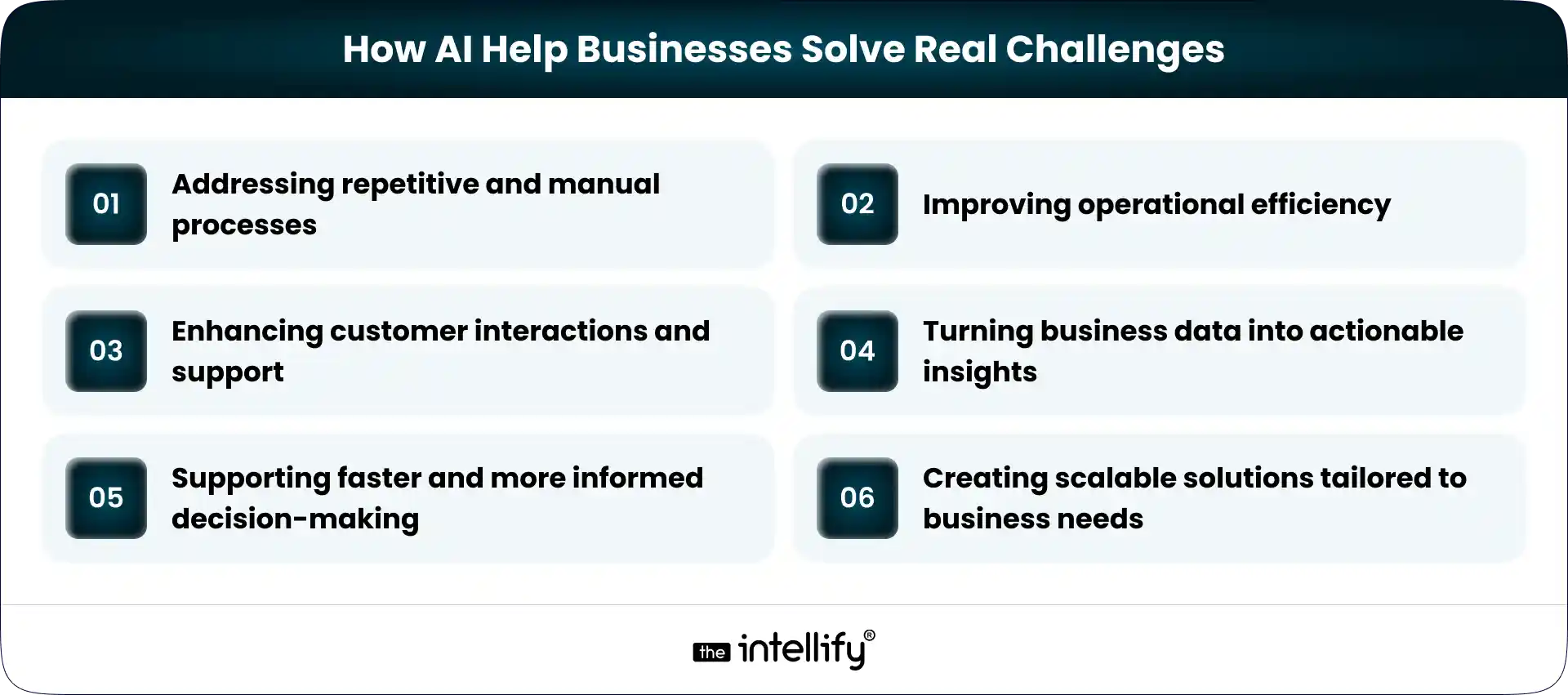
How AI Help Businesses Solve Real Challenges

Every business has unique processes, workflows, and operational challenges. Off-the-shelf software often forces organizations to adapt their operations around the software itself.
Custom AI solutions work differently. They are designed around specific business objectives, allowing companies to solve problems more effectively while maintaining flexibility as they grow.

Addressing Repetitive and Manual Processes

Many organizations still rely on employees to perform routine tasks such as data entry, document verification, scheduling, and report generation. AI can automate these activities, reducing workload and minimizing human error.

Improving Operational Efficiency

Intelligent systems help businesses complete tasks faster, streamline workflows, and eliminate bottlenecks across departments.

Enhancing Customer Interactions and Support

AI-powered chatbots, virtual assistants, and recommendation engines can provide instant responses, personalized experiences, and 24/7 customer support.

Turning Business Data Into Actionable Insights

Most companies collect massive amounts of data but struggle to use it effectively. AI solutions analyze data in real time and identify trends, risks, and opportunities that might otherwise go unnoticed.

Supporting Faster and More Informed Decision-Making

Executives and managers can use AI-generated insights to make smarter decisions based on facts rather than assumptions.

Creating Scalable Solutions Tailored to Business Needs

As organizations grow, AI systems can scale alongside operations, handling larger datasets and more complex workflows without significant increases in manual effort.


Core AI Development Services Businesses Should Look For

Choosing the right AI development partner starts with understanding the services they offer.

AI Consulting and Strategy Development

Before implementation begins, businesses need a clear AI roadmap. AI Consulting services help identify opportunities, define objectives, assess feasibility, and create implementation strategies.

Machine Learning Model Development

Machine learning models enable systems to recognize patterns, make predictions, and continuously improve through data analysis.

Natural Language Processing Solutions

Natural Language Processing (NLP) helps machines understand, interpret, and generate human language.

Common applications include:

  • Chatbots
  • Virtual assistants
  • Sentiment analysis
  • Document processing
  • Language translation

Computer Vision Applications

Computer vision enables systems to analyze images and videos for tasks such as:

  • Quality inspection
  • Facial recognition
  • Medical imaging analysis
  • Security monitoring

Generative AI Development

Generative AI solutions can create text, images, code, reports, and business content, helping organizations improve productivity and innovation.

Predictive Analytics Solutions

Predictive models help businesses forecast future outcomes, customer behavior, demand patterns, and operational risks.

AI Integration With Existing Business Systems

Successful AI projects must work seamlessly with CRM, ERP, HRM, and other enterprise systems.

AI Maintenance, Monitoring, and Optimization

AI systems require continuous monitoring, retraining, and optimization to maintain performance and accuracy over time.


AI App Development Services for Intelligent Digital Experiences

Modern users expect digital experiences that are personalized, responsive, and intelligent. This demand has fueled rapid growth in AI app development services across industries.

AI-Powered Mobile Application Development

Mobile apps can leverage AI to provide recommendations, automate tasks, and improve user engagement.

AI-Enabled Web Platforms

AI-powered web applications can personalize content, optimize user journeys, and deliver intelligent interactions.

Smart Business Applications

Organizations are increasingly building internal AI-powered tools that support operations, analytics, and decision-making.

Personalized User Experiences Through AI

AI can analyze user behavior and tailor experiences based on preferences, interests, and previous interactions.

Recommendation and Prediction Engines

Popular examples include:

  • Product recommendations
  • Content suggestions
  • Personalized marketing campaigns
  • Demand forecasting

Conversational AI and Virtual Assistants

Conversational AI solutions help businesses engage users through natural and intuitive interactions.

Benefits of Integrating AI Into Modern Applications

Key benefits include:

  • Higher customer engagement
  • Better user retention
  • Faster service delivery
  • Personalized experiences
  • Improved business intelligence
  • Increased operational efficiency


AI Automation Services That Drive Productivity and Growth

Automation has always been a business priority. AI takes automation several steps further by enabling systems to learn, adapt, and make decisions.

Business Process Automation

AI automates repetitive workflows that traditionally require manual intervention.

Intelligent Workflow Management

AI helps coordinate tasks, prioritize activities, and optimize process execution.

Document Processing and Data Extraction

Organizations can automate invoice processing, contract reviews, claims handling, and document classification.

Customer Service Automation

AI-powered assistants can resolve inquiries instantly while escalating complex issues when necessary.

Automated Reporting and Analytics

Instead of manually compiling reports, AI can generate insights automatically from multiple data sources.

Internal Operations Optimization

Departments such as HR, finance, procurement, and operations can benefit significantly from intelligent automation.

Key Business Benefits

  • Reduced Manual Effort: Employees spend less time on repetitive work and more time on strategic initiatives.
  • Faster Execution of Tasks: Processes that once took hours can often be completed within minutes.
  • Improved Accuracy: Automation reduces errors caused by manual processing.
  • Lower Operational Costs: Organizations can achieve significant cost savings through improved efficiency.
  • Better Resource Utilization: Teams can focus on higher-value activities while AI handles routine operations.
 

AI Development Services Solutions


Where AI Workflow Automation Creates the Most Impact

AI workflow automation is delivering measurable results across nearly every department.

Sales and Lead Management

  • Lead scoring
  • Opportunity prioritization
  • Sales forecasting
  • Automated follow-ups

Marketing and Campaign Optimization

  • Audience segmentation
  • Campaign personalization
  • Content recommendations
  • Performance analysis

Customer Support Operations

  • AI chatbots
  • Ticket routing
  • Customer sentiment analysis
  • Automated responses

Human Resources Processes

  • Resume screening
  • Candidate matching
  • Employee onboarding
  • Workforce analytics

Finance and Accounting Workflows

  • Invoice processing
  • Expense management
  • Financial forecasting
  • Compliance monitoring

Supply Chain and Logistics Management

  • Inventory optimization
  • Route planning
  • Demand forecasting
  • Vendor management

Project and Operations Management

  • Resource allocation
  • Project monitoring
  • Risk identification
  • Performance tracking


Industry Applications of AI Solutions

Healthcare

Healthcare organizations are using AI to improve patient care and operational efficiency.

  • Patient Engagement: AI assistants help patients schedule appointments and receive support.
  • Medical Data Analysis: AI can identify patterns across large medical datasets.
  • Diagnostic Support: Advanced algorithms assist clinicians in detecting conditions earlier and more accurately.

Retail and eCommerce

  • Product Recommendations: AI delivers personalized shopping experiences.
  • Demand Forecasting: Retailers can predict inventory requirements more accurately.
  • Customer Personalization: Businesses tailor promotions and experiences based on customer behavior.

Banking and Financial Services

  • Fraud Detection: AI identifies suspicious transactions in real time.
  • Risk Assessment: Financial institutions improve lending and investment decisions.
  • Customer Support Automation: Virtual assistants provide faster service and lower support costs.

Manufacturing

  • Predictive Maintenance: AI predicts equipment failures before they occur.
  • Quality Control: Computer vision systems identify defects during production.
  • Production Optimization: Manufacturers improve efficiency and reduce waste.

Insurance

  • Claims Processing: AI accelerates claim reviews and approvals.
  • Risk Analysis: Insurers can assess policy risk more accurately.
  • Customer Service Automation: Virtual agents provide policyholder support around the clock.
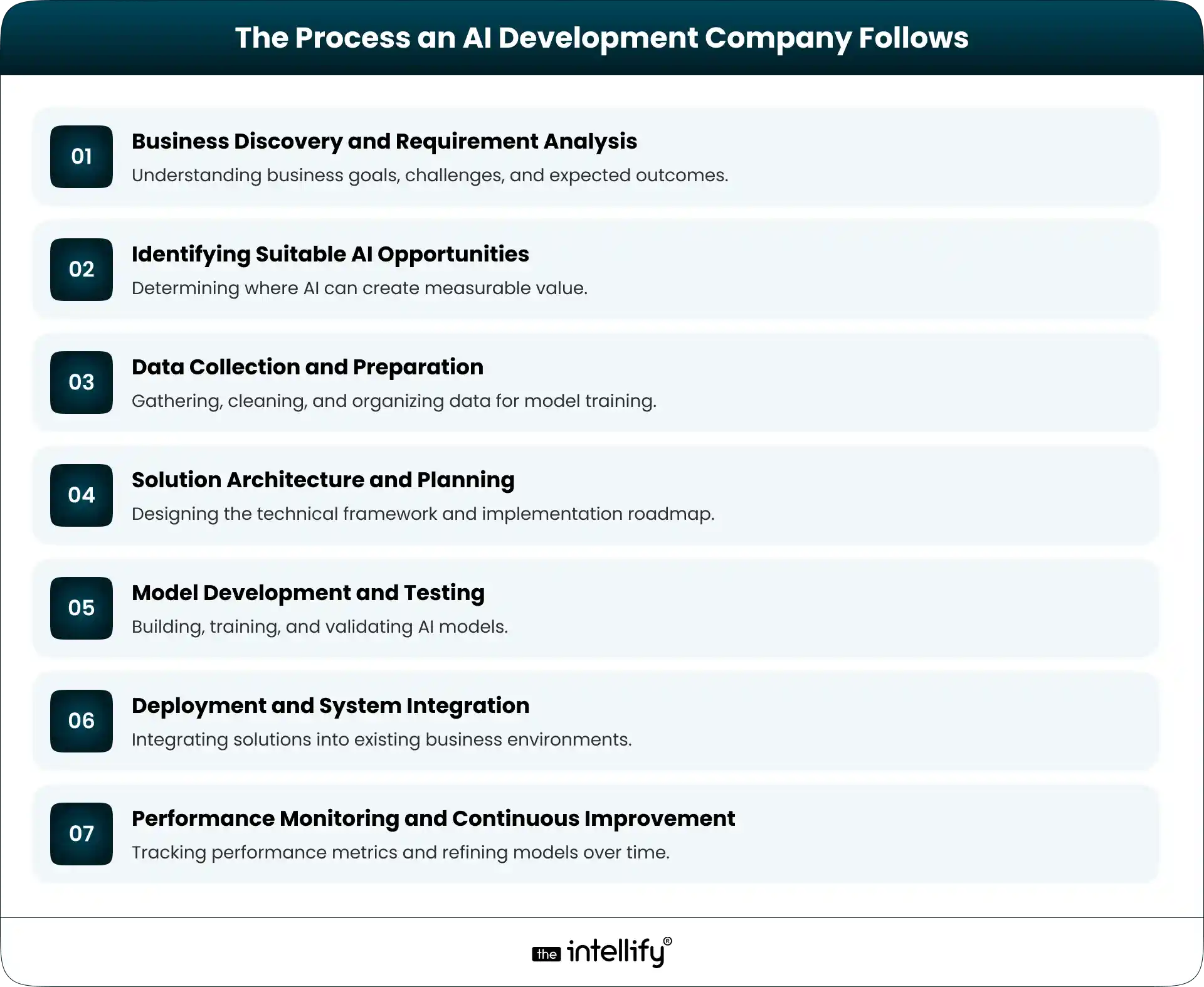
 

Process of AI Development Company


Key Factors That Determine the Success of AI Development Solutions

Several factors influence whether an AI initiative succeeds or struggles.

  1. Clearly Defined Business Objectives: AI should solve real business problems, not exist simply because it’s trendy.
  2. Availability of Quality Data: Even the best algorithms cannot compensate for poor-quality data.
  3. Scalability Considerations: Solutions should support future growth and evolving business needs.
  4. Integration With Existing Systems: Seamless connectivity improves adoption and usability.
  5. User Adoption and Change Management: Employees must understand and trust AI-driven processes.
  6. Ongoing Optimization and Support: AI requires continuous improvements to remain effective.
  7. Security, Compliance, and Governance Requirements: Strong governance ensures data privacy, compliance, and responsible AI usage.


How to Choose the Right AI Development Company

Selecting the right partner can significantly influence project outcomes.

Technical Expertise and AI Capabilities: Evaluate experience across machine learning, NLP, computer vision, and automation technologies.
Industry-Specific Experience: Industry knowledge often leads to faster implementation and better results.
Portfolio and Case Studies: Review previous projects and measurable outcomes.
Development Methodology and Transparency: Look for structured processes and open communication.
Security and Compliance Standards: Ensure the company follows recognized security frameworks and compliance requirements.
Scalability and Future Support: Choose a partner capable of supporting long-term growth.
Communication and Collaboration Approach: Strong collaboration often determines project success more than technology alone.

Questions to Ask Before Selecting a Partner

  • What industries have they worked with?
  • How do they measure project success?
  • What support is provided after deployment?
  • How do they ensure data security and compliance?


Emerging Trends Shaping the Future of AI Development

The AI landscape continues to evolve rapidly.

  • Generative AI Adoption Across Industries: Organizations are increasingly integrating generative AI into daily operations.
  • AI Agents and Autonomous Workflows: AI agents are beginning to manage tasks with minimal human intervention.
  • Hyperautomation Strategies: Businesses are combining AI, automation, and analytics to streamline operations end-to-end.
  • Industry-Specific AI Platforms: Purpose-built AI solutions are becoming more common across sectors.
  • Responsible and Ethical AI Practices: Organizations are prioritizing transparency, fairness, and accountability.
  • AI-Powered Decision Intelligence: AI is moving beyond predictions and supporting strategic decision-making.
  • The Growing Role of Human-AI Collaboration: The future isn’t humans versus AI. It’s humans working alongside AI to achieve better outcomes.


Why Businesses Are Partnering With AI Development Companies for Long-Term Innovation

Businesses aren’t adopting AI simply to follow a trend. They’re investing because it delivers measurable advantages.

  • Accelerating Digital Transformation Initiatives: AI helps organizations modernize processes faster.
  • Building Competitive Advantages Through AI: Companies that effectively use AI often outperform slower-moving competitors.
  • Scaling Operations More Efficiently: Growth becomes easier when repetitive work is automated.
  • Improving Customer Experiences: Personalized and intelligent interactions increase satisfaction and loyalty.
  • Unlocking New Revenue Opportunities: AI can create entirely new products, services, and business models.
  • Future-Proofing Business Growth: Organizations that embrace AI today are better positioned for tomorrow’s challenges.

 

Custom AI Solutions


Conclusion

Artificial intelligence is quickly becoming a core part of modern business strategy. From improving operational efficiency and automating repetitive tasks to enhancing customer experiences and supporting smarter decision-making, AI is transforming how organizations compete and grow.

Custom AI solutions, intelligent applications, and AI automation services enable businesses to address unique challenges while creating scalable systems that evolve alongside their needs. Whether it’s predictive analytics, workflow automation, generative AI, or conversational experiences, the opportunities continue to expand across every major industry.

The success of any AI initiative, however, depends heavily on choosing the right AI development company. An experienced partner like The Intellify can help identify opportunities, build tailored solutions, integrate AI into existing systems, and ensure long-term optimization. As AI adoption accelerates worldwide, businesses that invest strategically today will be better equipped to innovate, adapt, and achieve sustainable growth in the years ahead.


Frequently Asked Questions

Q1. How do I know if my business is ready for AI development?

If your business relies on repetitive processes, manual decision-making, or large amounts of data, AI can help improve efficiency, automate workflows, and generate valuable insights. An AI development company can assess your operations and identify the most impactful opportunities for AI adoption.

Q2. What are the benefits of choosing custom AI solutions over ready-made tools?

Custom AI solutions are designed specifically for your business goals, workflows, and data. Unlike off-the-shelf software, they offer greater flexibility, scalability, and long-term value while addressing unique operational challenges.

Q3. Can an AI development company integrate AI into existing business systems?

Yes. Most AI solutions can be integrated with existing platforms such as CRM, ERP, HR, and customer support systems. This allows businesses to enhance current processes without replacing their existing technology infrastructure.

Q4. What should I look for when selecting an AI development company?

Look for technical expertise, industry experience, successful project delivery, security standards, transparent communication, and ongoing support capabilities. Reviewing case studies and client success stories can also help evaluate a company’s capabilities.

Q5. How can businesses measure the return on investment from AI solutions?

Businesses can measure AI ROI through improvements in operational efficiency, productivity, customer satisfaction, cost savings, revenue growth, and process automation. Establishing clear KPIs before implementation helps track success more effectively.
AI Solutions for Enterprises: Implementation Guide with ROI Insights

Summary:
AI is changing how enterprises work, helping them improve efficiency and make better decisions. It’s no longer just about new technology, but about using it in the right way to solve real business problems. From getting started to scaling across teams, each step matters in making AI work effectively. This guide gives a clear view of how enterprises can use AI in a practical and meaningful way.

Businesses today are evolving faster than ever, and AI is becoming a key part of that change. It’s no longer just something new to explore; companies are now using AI to improve how they work, make better decisions, and handle everyday tasks more efficiently. This shift is opening up new possibilities across different teams and industries.

In this guide, we’ll look at how AI is being used in enterprises, where it creates the most value, and how businesses can get started practically. We’ll also cover simple implementation steps and how to measure impact over time.


Why AI Is Becoming a Core Business Priority for Enterprises

Businesses today are moving beyond digital tools and increasingly relying on AI to make everyday decisions. With so much data coming in from different sources, it’s becoming harder to manage things manually. AI helps simplify this by turning data into useful insights that teams can actually act on.

At the same time, AI is no longer just about trying something new; it’s becoming a key part of staying competitive. Many companies are shifting from small experiments to more serious, long-term use. While some are still exploring, others are already starting to scale AI across their operations.


How AI Is Being Applied Across Enterprise Functions

AI solutions aren’t confined to one department they can reshape various aspects of an organization. AI is being used across different parts of the business, from customer support and operations to finance and HR. It helps automate routine work, improve accuracy, and support better decision-making without adding extra effort to teams.

Instead of using separate tools, many enterprises are now connecting AI across systems to make processes smoother. Different industries are using it in their own way, but the idea is the same. AI works best when it becomes part of the overall business, not just one function.


Understanding the Scope of AI for Enterprises

What does “AI for enterprises” really entail?

  • Core Components: It consists of systems, models, and decision-making layers that work together harmoniously.
  • Types of Technology: Machine learning (ML), natural language processing (NLP), generative AI, and computer vision are all key players.
  • Distinguishing AI: It’s crucial to differentiate between straightforward automation, analytics, and true AI-driven intelligence.
  • Enterprise requirements: To build a successful AI strategy, scalability, security, and interoperability are essential.
  • Structured Adoption: Implementing AI systematically is far more effective than ad-hoc solutions, which can lead to disappointing results.


Key Use Cases That Drive Value for Enterprise

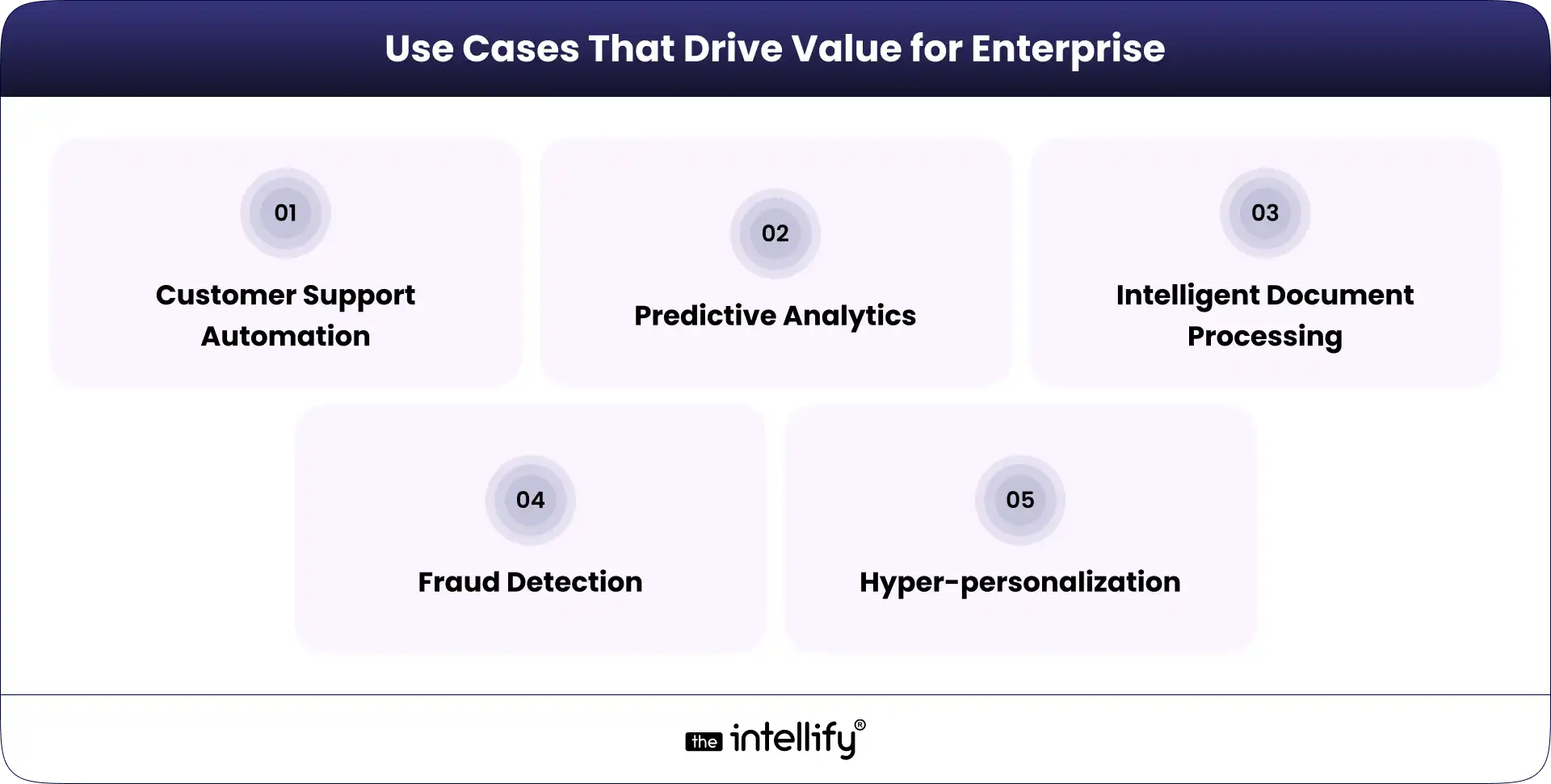
Use Cases That Drive Value for Enterprise

Identifying use cases that deliver the most value is key to successful AI deployment. Here are a few impactful applications:

1. Customer Support Automation: Chatbots and voice AI help handle customer queries instantly and reduce response time. They also support teams by managing routine questions, allowing staff to focus on more complex issues.

2. Predictive Analytics: Using data to forecast trends helps businesses plan better and make informed decisions. It improves demand forecasting, resource allocation, and reduces the chances of unexpected issues.

3. Intelligent Document Processing: AI can quickly process and organize large volumes of documents, reducing manual work. This helps improve accuracy and speeds up workflows across departments.

4. Fraud Detection: Real-time monitoring helps identify unusual activities and prevent potential threats. This makes systems more secure and reduces financial and operational risks.

5. Hyper-personalization: Recommendation systems analyze user behavior to offer more relevant products or services. This improves customer experience and helps increase engagement and conversions.

When choosing use cases, weigh the potential business impact against complexity to ensure a successful rollout.


Key Barriers That Slow Down Enterprise AI Adoption

Even with all its promise, several challenges can impede successful AI adoption:

  • Data silos: When data is scattered across systems or not consistent, it becomes difficult to get accurate insights. This limits how effectively AI models can perform.
  • Legacy infrastructure: Older systems are often not designed to support modern AI tools, making integration more complex and time-consuming.
  • Budget constraints: Many organizations struggle to balance the cost of AI implementation with uncertain ROI, especially in the early stages.
  • Skill gaps: Lack of in-house expertise can slow down progress, and heavy reliance on external partners may delay execution and scaling.

Overcoming these barriers requires commitment and strategic planning.


How to Identify the Right Starting Point for AI in Your Enterprise

Getting Started with AI: Readiness and First Steps

  • Signs your business is ready for AI: Spot areas where AI can genuinely make a difference, like customer support or supply chain operations.
  • Evaluating Readiness: Analyze your data maturity, current infrastructure, and team capabilities.
  • Identifying quick-win opportunities: Focus on use cases that promise both feasibility and high ROI potential.
  • When AI May Not Be Right: Be mindful of situations where diving into AI might not be the smartest choice, such as unclear data or organizational goals.


AI solutions for enterprises


AI for Enterprises: From Strategy to Execution

Laying the groundwork for successful AI solutions involves several key steps:

Defining Objectives

Start by clearly identifying what you want to achieve with AI, such as improving efficiency or reducing costs. Setting clear goals and success metrics helps keep the implementation focused.

Mapping Use Cases

Identify and prioritize use cases that can deliver the most value. Focus on areas where AI can solve real problems or improve existing processes.

Preparing Data Pipelines

Ensure your data is clean, organized, and accessible. Strong data pipelines and governance are essential for AI systems to work effectively.

Choosing the Right Tools

Select tools, platforms, or partners that fit your business needs and existing systems. The right choice makes implementation smoother and more scalable.

Building Pilots

Start with a small pilot or proof of concept to test how the solution works. This helps validate results before scaling it across the organization.

Testing and Scaling

Testing is vital to ensure your AI solutions yield the expected results. Once validated, successful projects can be expanded throughout the organization.


Building an Enterprise AI Strategy That Aligns with Business Goals

Enterprise AI Strategy for Business Goals

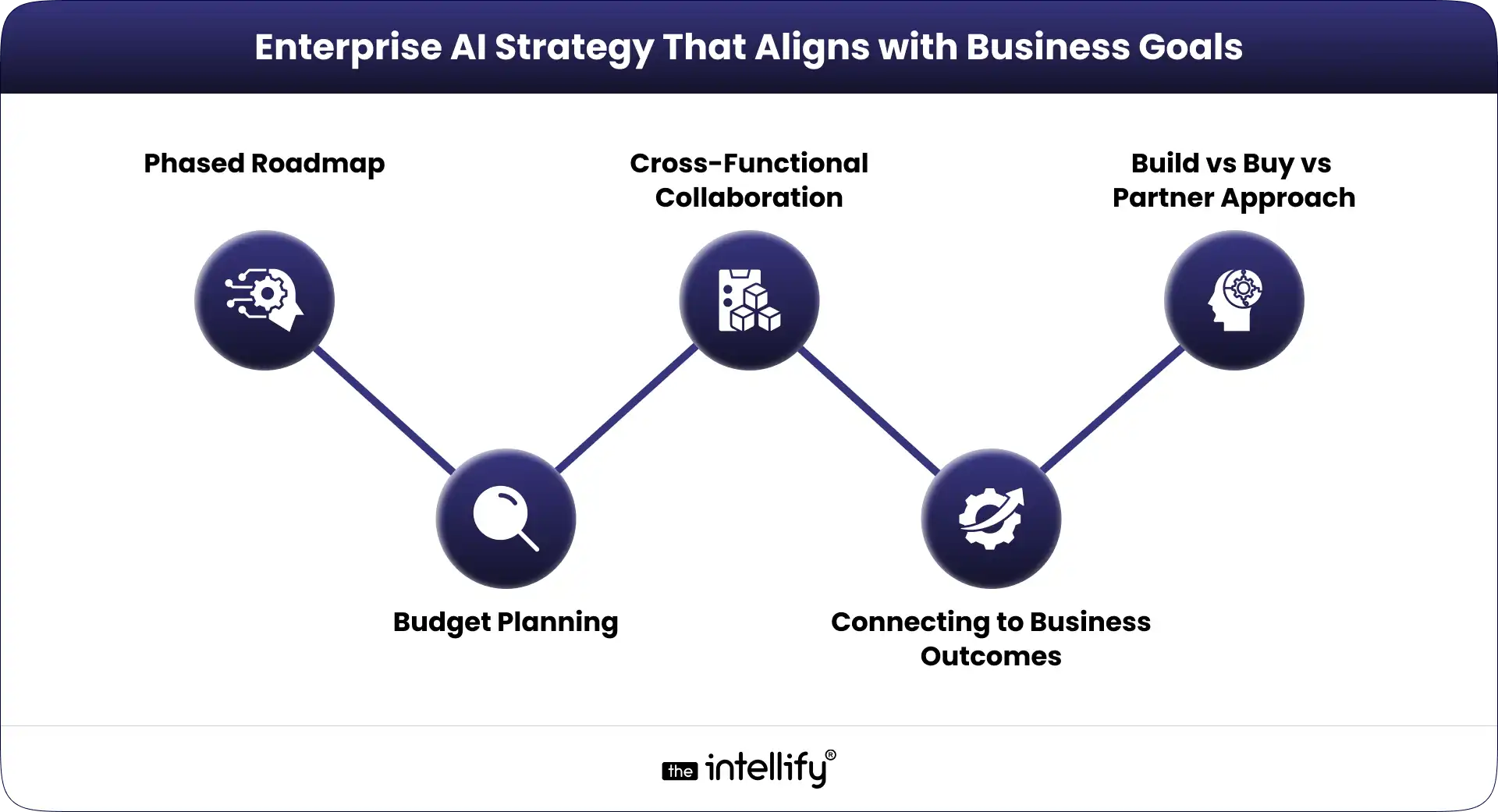
A successful AI strategy should align seamlessly with your broader business objectives:

  • Phased Roadmap: Plan a clear timeline with a mix of quick wins and long-term initiatives. This helps show early results while building toward bigger goals.
  • Budget Planning: Allocate your budget carefully by focusing on initiatives that deliver the most value. It’s important to balance costs with expected outcomes.
  • Cross-Functional Collaboration: Ensure teams across departments work together. This improves coordination and helps AI initiatives run more smoothly.
  • Connecting to Business Outcomes: Link every AI effort to clear business goals, such as improving efficiency, increasing revenue, or enhancing customer experience.
  • Build vs Buy vs Partner Approach: Decide whether to build in-house, use existing tools, or work with partners based on your resources and long-term plans.


Measuring ROI of AI in Enterprises

To grasp the true value of your AI investments, keep the following in mind:

  • Key Performance Indicators (KPIs): Establish measurable metrics covering efficiency, cost savings, and revenue growth.
  • Understanding Time-to-Value: Differentiate between immediate and long-term ROI.
  • Real-World Examples: Use benchmarks from organizations that have effectively measured their AI success.
  • Linking AI to Business Performance: Connect AI outcomes directly to business results, such as improved productivity, better decision-making, or increased customer satisfaction.
  • Avoiding Common Mistakes: Don’t rely only on short-term results or unclear metrics focus on consistent tracking and realistic expectations to measure true success


Governance, Security, and Responsible AI in Enterprise Environments

Effective governance is key to ensuring responsible AI use:

  • Data Privacy: Ensure compliance with regulations while handling sensitive data carefully and securely.
  • Bias Management: Put checks in place to reduce bias and maintain fairness in AI-driven decisions.
  • Transparency: Keep AI processes clear and explainable so decisions can be understood and trusted.
  • Governance Frameworks: Set clear internal rules for how AI is used across the business. This helps maintain consistency and alignment with company policies.
  • Risk Management and Monitoring: Regularly monitor AI systems to identify issues early. This keeps systems reliable and reduces potential risks over time.


Scaling AI Across the Enterprise

Moving from pilot projects to full-scale implementations is a crucial phase:

  • Standardizing Processes: Create a common framework for AI initiatives so teams can follow a consistent approach across the organization.
  • Upskilling Teams: Invest in training so employees can understand and work effectively with AI tools in their daily tasks.
  • Continuous Optimization: Regularly review performance and make improvements to keep AI systems efficient and relevant over time.
  • Transitioning from PoC to Deployment: Turn successful pilot projects into practical solutions used across teams. This requires proper planning and smooth integration with existing systems.
  • Change Management and Leadership Support: Strong leadership helps guide teams through change. Clear communication and training make adoption easier and reduce resistance.


The Future of AI in Enterprises

AI in enterprises is growing fast, with trends like generative AI helping automate content and tasks. Hyper-automation is also making processes more efficient by combining AI with automation. Many businesses are now using AI to support better and faster decision-making.

Industry-specific solutions are also becoming more common, making AI more practical. To stay ahead, enterprises need to stay flexible and keep adapting as technology evolves.


Build Enterprise AI Solutions


Conclusion

AI isn’t just a one-off project; it’s a long-term journey. Organizations should begin with targeted use cases and scale strategically, balancing technology, human resources, and processes. With a solid roadmap and the right mindset, enterprises can turn AI into a sustainable advantage.

The key is to focus on real business value rather than just adopting new technology. Start small, learn from early results, and build step by step. Over time, this approach helps create a strong foundation where AI becomes a natural part of everyday operations.


Frequently asked questions (FAQs)

1. How can a business start using AI without making it too complex?

Start with one clear problem where AI can help, like saving time or improving support. Test a small solution first, then scale once it shows results.

2. How long does it take to implement AI in an enterprise?

Small AI projects can take a few weeks to a couple of months. Larger implementations take longer depending on data and system complexity.

3. How can we measure if AI is actually working?

Track simple results like time saved, cost reduced, or faster processes. If these improve, your AI solution is delivering real value.

4. Can small or growing businesses also benefit from AI?

Yes, AI is useful for businesses of all sizes, not just large enterprises. Smaller companies can start small and scale as they grow.

5. What are the common challenges when starting with AI?

Unclear goals, poor data quality, and trying too much at once are common issues. Starting with a focused approach helps avoid these problems.

6. Will AI work with our existing systems, like CRM or ERP?

Yes, most AI solutions can integrate with tools like CRM and ERP systems. The key is having clean and accessible data for better results.

7. Is AI implementation very expensive to start with?

It depends on the use case, but you don’t need a huge budget to begin. Many businesses start small and invest more after seeing results.

Enterprise AI Strategy & Adoption: Step-by-Step Implementation Guide

Summary:
In today’s fast-paced business environment, enterprise AI is no longer just a buzzword; it’s become essential. Its potential to reshape operations, enhance decision-making, and drive efficiency is making AI a crucial part of organizational strategies around the globe. In this guide, we’ll explore how businesses can methodically adopt AI, from crafting a solid strategy to understanding potential obstacles and recognizing the benefits.


How Artificial Intelligence is Reshaping Large Enterprises

Shift from experimental AI projects to structured enterprise AI adoption

For many organizations, the journey into AI began with small, experimental projects. But as companies see the real benefits of AI, the focus is shifting toward more scalable and structured adoption. Businesses are now keen on integrating AI into their core functions rather than treating it like just another tech upgrade.

Rising pressure for operational efficiency and smarter decision-making

In the current economic landscape, there’s mounting pressure to streamline operations while still making insightful decisions. AI tools allow organizations to sift through vast amounts of data and extract meaningful insights, enabling quicker, smarter choices that drive real value.

Why leadership alignment is critical from the beginning

Nothing ensures successful AI adoption like alignment among leadership. Leaders must champion AI initiatives, making sure all departments are synced on goals, expectations, and resource allocation.


What an Effective Enterprise AI Strategy Looks Like

Aligning AI with business goals

Before diving into AI implementation, organizations need to define clear business objectives that align with their overall strategy. This approach ensures that AI initiatives are focused on creating genuine value.

Connecting strategy with measurable outcomes

Establishing KPIs to assess AI performance from the very beginning is essential. By linking AI strategy to measurable outcomes, organizations can make iterative adjustments and maximize impact.

Leadership and cross-functional ownership

Leadership needs to do more than just give a thumbs-up; they should actively engage in this journey. Empowering cross-functional teams with AI knowledge fosters a sense of ownership that leads to more effective implementations.


How Enterprise AI Adoption Delivers Business Impact

Enterprise AI Adoption Business Impact

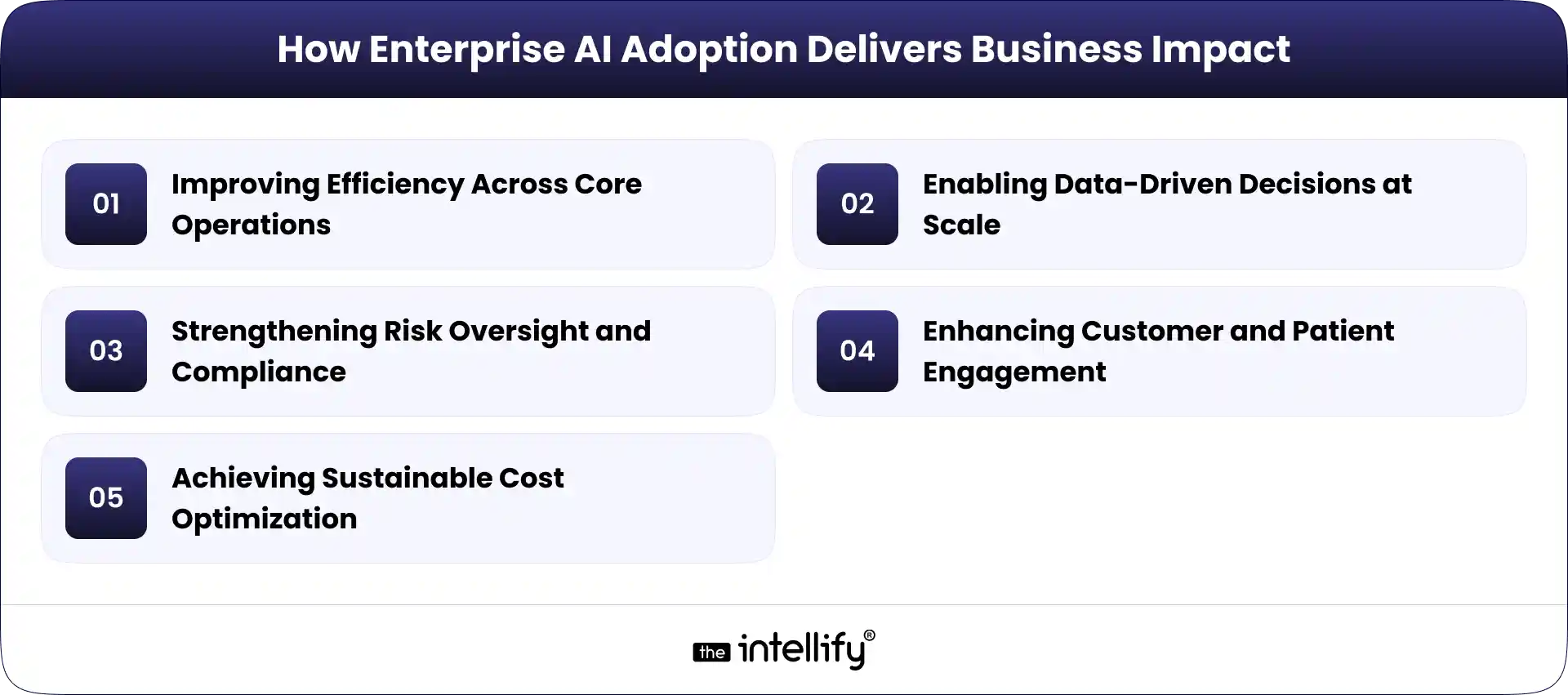
Improving Efficiency Across Core Operations

AI has the power to significantly boost efficiency by automating routine tasks, optimizing workflows, and speeding up processing times, all of which lead to cost savings and higher productivity.

Enabling Data-Driven Decisions at Scale

With strong data analysis capabilities, AI helps organizations make informed decisions based on real-time insights. This agility supports responsive strategies that can quickly adapt to market changes.

Strengthening Risk Oversight and Compliance

AI enhances risk management by spotting potential issues before they become serious problems. Through data pattern analysis, organizations can meet compliance requirements while bolstering their security posture.

Enhancing Customer and Patient Engagement

AI tools like chatbots and personalized recommendation systems allow brands to engage effectively with customers, boosting satisfaction and fostering loyalty.

Achieving Sustainable Cost Optimization

AI paves the way for smarter resource allocation and optimization, ensuring sustainable cost management. Organizations can pinpoint wasteful practices that can either be improved or removed.


Common Barriers to Enterprise AI Adoption

Legacy Infrastructure and Disconnected Data

Many enterprises grapple with outdated technology and siloed data, which complicates the implementation of effective AI solutions.

Regulatory Complexity and Data Privacy Risks

Navigating regulatory hurdles can feel overwhelming. Companies need to prioritize data privacy and compliance to steer clear of potential pitfalls.

Lack of Clear Governance and Ownership

Without a governance framework, AI initiatives may become misaligned and misused, hampering overall success.

Internal Skill and Capability Gaps

Organizations lacking the right talent and training may struggle to unlock AI’s full potential, resulting in stagnant or underperforming projects.

Organizational Readiness and Change Resistance

Resistance to change can hinder AI projects. It’s vital to cultivate a culture of acceptance and understanding regarding AI for smooth integration.


AI implementation guide


Enterprise AI Implementation Roadmap

Step 1 – Define Clear Objectives

Start by identifying specific business goals and how AI can help achieve them. This clarity will serve as the bedrock for all subsequent efforts.

Step 2 – Assess Data and Infrastructure

Evaluate existing data systems and infrastructure to confirm they can effectively support new AI solutions.

Step 3 – Identify High-Impact Use Cases

Focus on high-impact use cases that promise significant returns. Allocate resources to areas likely to generate the most value.

Step 4 – Establish Governance and Risk Controls

Implement a strong governance framework to oversee AI initiatives, ensuring that all ethical and compliance standards are met.

Step 5 – Run Pilot Projects

Before scaling, run pilot projects to test assumptions and methodologies. Gather insights from these tests to fine-tune your approaches.

Step 6 – Scale Across the Organization

Once pilot projects validate your strategies, it’s time to scale AI solutions throughout the organization, making sure every department benefits.

Step 7 – Monitor, Measure, and Improve

Regularly assess the performance of AI initiatives, adapt your strategies based on results, and keep seeking improvement.


Key Areas of Enterprise AI Use Cases

1. Operational Optimization in Healthcare

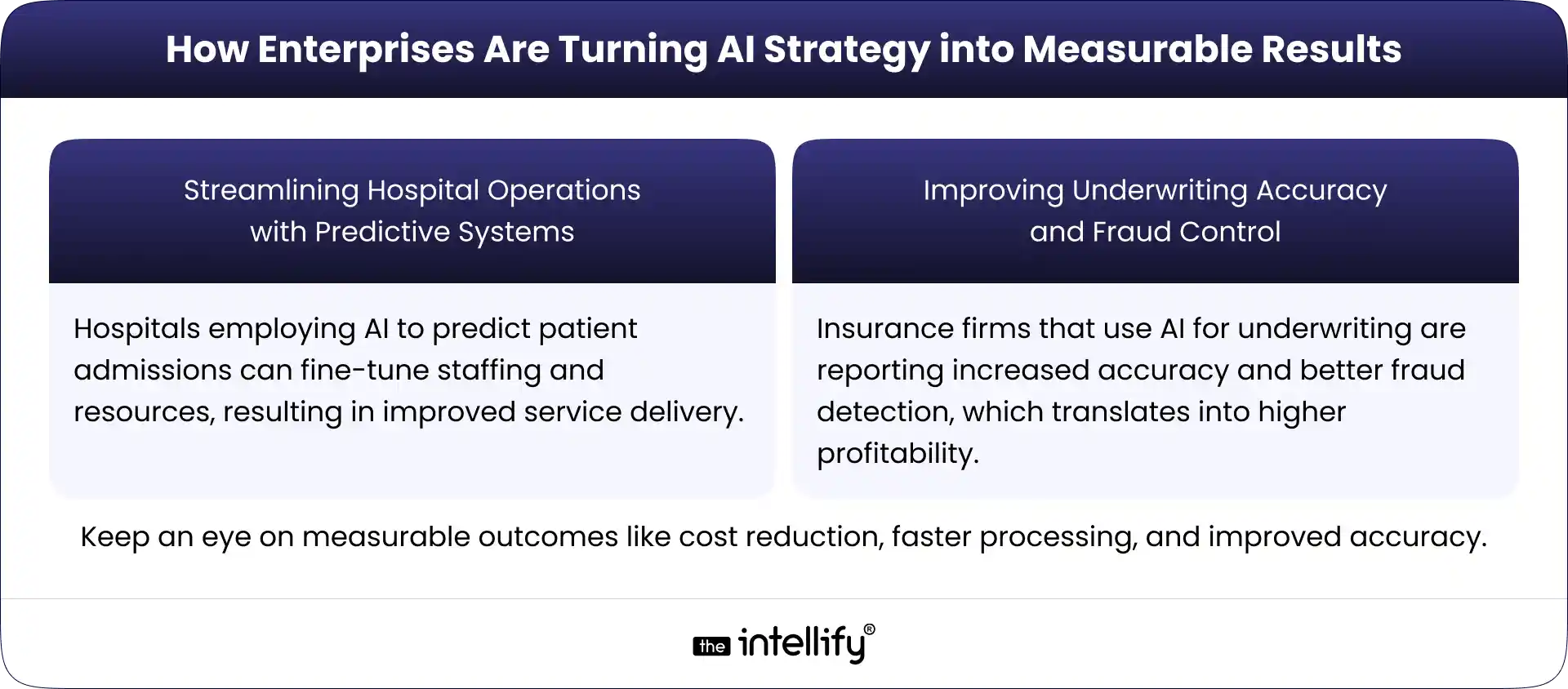
AI can analyze patient data to boost operational efficiencies, reduce wait times, and enhance overall patient care.

2. Risk Modeling and Claims Efficiency in Insurance

Insurance companies use AI for predictive risk modeling, faster claims processing, and reduced fraud. Many are adopting advanced Enterprise AI solutions for Insurance to improve underwriting accuracy, automate claims workflows, and strengthen compliance.

3. Fraud Prevention and Compliance Monitoring

AI algorithms can keep a watchful eye on transactions in real-time, helping organizations swiftly identify and tackle fraudulent activities.

4. Intelligent Workflow Automation Across Functions

By automating repetitive tasks across departments, AI liberates human capital for more strategic work, thereby boosting productivity.


AI Strategy into Measurable Results


Governance and Responsible AI Practices

Data Governance Standards

Strong data governance standards should be implemented to assure data integrity and accountability.

Ethical and Transparent AI Use

Place a priority on ethical considerations in AI deployment to build trust among stakeholders and customers.

Regulatory Alignment

Stay up to date with evolving regulations to avoid legal consequences and improve your reputation.

Ongoing Risk Management

Keep an eye on potential risks and incorporate feedback mechanisms to navigate challenges effectively.


Measuring ROI and Business Impact

1. Financial performance metrics:- Look at cost reductions and revenue boosts post AI implementation.

2. Operational improvements:- Assess productivity gains and process efficiencies that can be attributed to AI.

3. Adoption and usage indicators:- Monitor engagement with the new technologies and systems.

4. Long-term strategic value:- Evaluate how AI fits into long-term business strategies.


Future Trends in Enterprise AI Strategy

1. Generative AI integration:- Look for AI algorithms to start producing creative outputs, spurring innovation across sectors.

2. Intelligent decision support:- AI will enable even more advanced predictive insights for better decision-making.

3. Enterprise-wide automation:- Expect broader adoption of AI automation across various business functions.

4. Human-AI collaboration:- The future will enhance cooperation between human capabilities and AI solutions, driving overall efficiency.


Enterprise AI Solutions


Conclusion:-

Charting the path to effective enterprise AI adoption can definitely feel daunting, but the rewards are significant. By taking a structured approach, companies can harness AI to optimize processes, improve engagement, and achieve sustainable growth. The future isn’t going to wait, so adopting enterprise AI isn’t just advantageous, it’s essential.

In practice, turning strategy into execution requires both technical clarity and strong business alignment. Many enterprises collaborate with experienced teams that understand this balance. Organizations like The Intellify, for example, work alongside enterprises to translate AI strategy into practical roadmaps that support scalable and responsible adoption.


Frequently asked questions

1. What is enterprise AI, and why is it important for businesses?

Enterprise AI helps organizations automate processes, improve decision-making, and use data more effectively. It supports long-term growth and competitiveness.

2. How do you start an enterprise AI strategy?

Start by defining business goals, assessing data readiness, and selecting high-impact use cases. A clear roadmap helps reduce risks and improve success.

3. What are the common challenges in adopting AI at the enterprise level?

Common challenges include outdated systems, data silos, compliance risks, skill gaps, and resistance to change.

4. How can enterprises measure the success of their AI initiatives?

Success is measured through cost savings, productivity gains, accuracy, system adoption, and overall business impact.

5. Which industries benefit most from enterprise AI adoption?

Healthcare, finance, retail, manufacturing, and insurance benefit the most from automation, analytics, and predictive insights.

6. How do leadership and governance impact AI adoption?

Strong leadership and clear governance ensure AI aligns with business goals, remains compliant, and scales effectively.

7. What practical steps should be in an AI adoption roadmap?

An effective roadmap includes goal setting, data assessment, pilot testing, scaling, governance, and continuous improvement.

How AI Automation Is Transforming Internal Operations in HR, Finance & IT

Summary:
This blog explains why AI automation is becoming essential for modern business operations. It covers how AI automation differs from traditional automation, where it fits across HR, finance, and IT, and the real operational costs of relying on manual processes. The article also explores industry use cases, measurable benefits, implementation steps, and future trends, helping businesses understand how AI automation improves efficiency, accuracy, scalability, and employee productivity across internal teams.


Why AI Automation Is Becoming a Business Imperative

Most internal teams today are stretched thin. HR is juggling hiring and onboarding. Finance is chasing invoices and approvals. IT is buried under tickets that all feel “urgent.” None of this is new, but the pressure has quietly crossed a line.

The problem isn’t effort, it’s volume. As businesses grow, internal operations don’t just get bigger; they get messier. Manual handoffs increase. Dependencies multiply. One missed approval email can stall an entire process. We’ve all seen it happen. You wait. You follow up. You wait again.

Traditional automation helped for a while. Rule-based workflows, scripts, and macros are useful, but rigid. They work only when everything behaves exactly as expected. And let’s be honest, real operations never do. That’s why AI automation is no longer a “nice to have.” It’s becoming a strategic requirement.

This guide breaks down what AI automation really means, how it fits into HR, finance, and IT operations, what happens when businesses delay adopting it, and how organizations can implement it without chaos or burnout.


What Is AI Automation and How Is It Different?

AI automation goes beyond predefined rules. Instead of just following instructions, it learns from data, adapts to patterns, and supports decisions, not just tasks. This difference matters more than it sounds.

Aspect Basic Automation AI Automation
System Logic Works on fixed rules. If X happens, it does Y. Learns from past data and improves decisions over time.
Workflow Behavior Follows static workflows that break when conditions change. Adapts automatically when inputs, priorities, or situations shift.
Response to Change Needs manual updates for every new scenario. Adjusts on its own based on patterns and context.
Task Handling Focuses only on completing predefined tasks. Supports smarter decisions along with task execution.
Error Management Often misses unusual cases or exceptions. Detects anomalies and flags risks early.
Scalability Becomes harder to manage as processes grow. Scales easily with increasing data and complexity.
Business Impact Improves speed but offers limited intelligence. Improves speed, accuracy, and strategic insight.


Where AI Automation Fits in Internal Operations

AI automation isn’t limited to one department. It sits quietly across daily operations, smoothing edges where friction usually shows up.

1. It supports daily process management, keeping routine workflows moving without constant supervision.

2. It powers data-driven workflows, where decisions are based on real-time signals instead of outdated reports.

3. It improves cross-functional coordination, so HR, finance, and IT stop working in isolation.

Think fewer “Who owns this?” emails and more things simply moving forward.


The Cost of Operating Without AI Automation

Cost of Operating Without AI Automation

Avoiding AI automation doesn’t keep things stable. It slowly makes operations heavier, slower, and harder to scale.

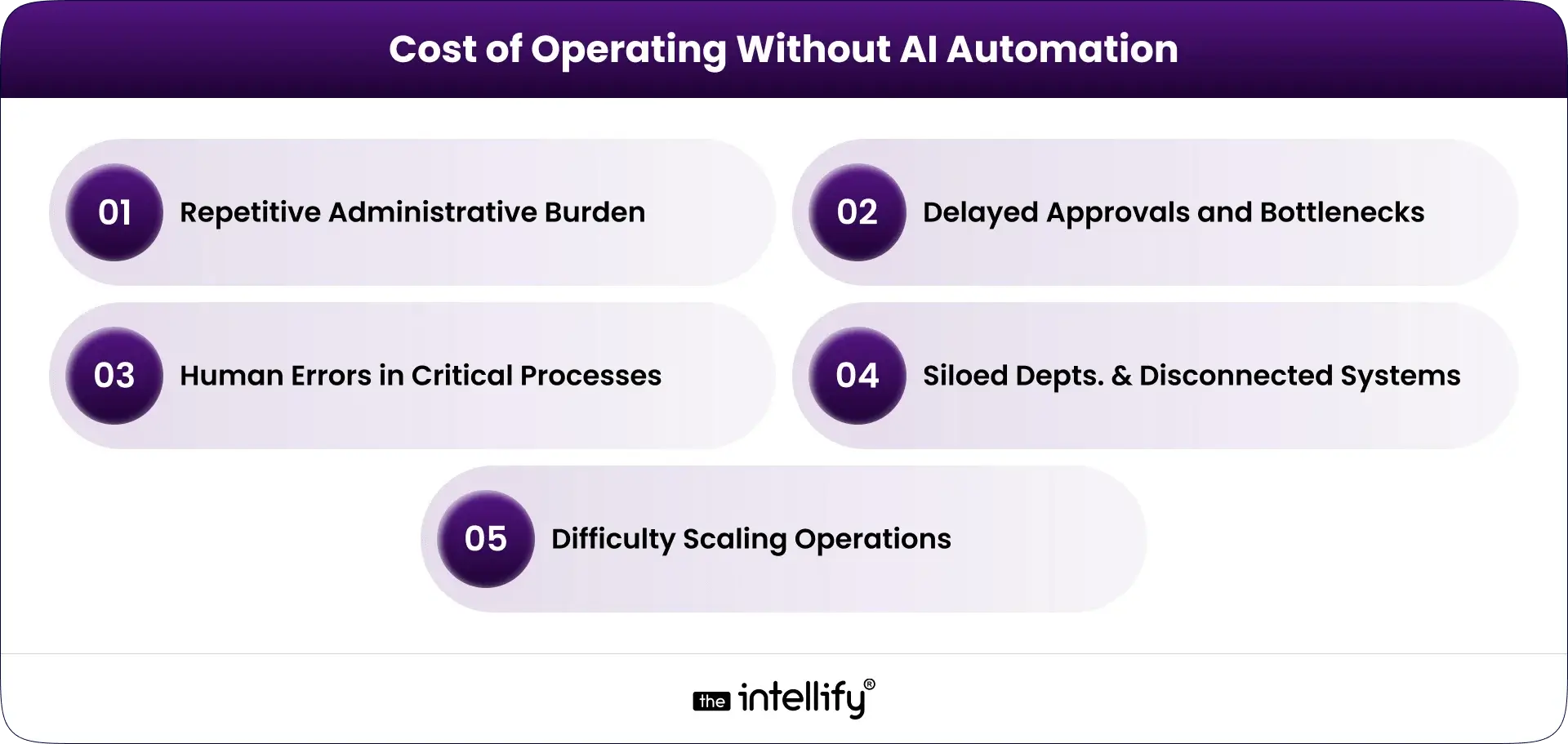
Repetitive Administrative Burden

Teams spend hours on data entry, document checks, and manual updates. It’s exhausting work, and nobody was hired for it.

Delayed Approvals and Bottlenecks

One unavailable manager. One missed notification. Suddenly payroll, procurement, or onboarding stalls. These delays compound quickly.

Human Errors in Critical Processes

Manual systems invite mistakes. A wrong number in payroll. A duplicate invoice. A missed compliance deadline. Fixing errors costs more than preventing them.

Siloed Departments and Disconnected Systems

When systems don’t talk to each other, people fill the gap with emails, spreadsheets, and workarounds that don’t scale.

Difficulty Scaling Operations

Growth without automation means hiring more people just to keep up. That’s expensive and unsustainable.


Market Trends and Adoption of AI Automation

AI automation adoption is accelerating, especially in mid-sized and large enterprises.

Organizations are investing heavily in intelligent workflows that reduce dependency on manual coordination. There’s a clear shift toward operational intelligence, where systems don’t just execute, they observe and suggest improvements. And businesses are prioritizing automation now because labor costs, compliance pressure, and customer expectations are all rising at once. Waiting feels safer, but it’s usually costlier.


AI Automation in HR – Smarter Workforce Management

HR teams deal with sensitive data, tight timelines, and constant context switching. AI automation helps by quietly removing friction.

Intelligent Hiring and Resume Screening

AI systems scan resumes, rank candidates, and highlight relevant experience without bias creeping in through fatigue or rushed decisions.

Automated Onboarding and Documentation

Offer letters, policy acknowledgments, and account setup are handled automatically, so new hires don’t start their first day confused or blocked.

Payroll, Attendance, and Compliance Support

AI automation flags inconsistencies before payroll runs and ensures compliance checks don’t rely on memory or spreadsheets.

Employee Performance and Engagement Insights

Patterns in feedback, attendance, and output help HR act early before disengagement turns into attrition.


AI Automation in Finance – Faster, Smarter Financial Operations

Finance teams need accuracy, speed, and clarity. AI automation supports all three without adding risk.

Invoice and Expense Automation

Invoices are matched, validated, and approved faster, with anomalies flagged instead of overlooked.

Budget Planning and Financial Forecasting

AI models analyze trends and adjust forecasts dynamically no waiting for month-end closures.

Fraud Detection and Risk Monitoring

Unusual transactions stand out immediately, not weeks later during audits.

Regulatory Compliance and Reporting

Compliance checks become continuous, not reactive. Reporting becomes simpler, cleaner, and more reliable.


AI Automation in IT Support – Smarter, Faster Service Delivery

IT teams are expected to keep everything running, often with limited resources.

Smart Helpdesk and Ticket Management

AI categorizes tickets, assigns priority, and routes issues automatically. No more manual triage.

Automated Issue Detection and System Monitoring

Problems are detected before users complain. Sometimes, before anyone notices at all.

AI Chatbots for Internal Support

Employees get instant answers to common IT questions without waiting in queues.

Workflow Automation for IT Teams

Patch management, access provisioning, and routine tasks happen on schedule without reminders.


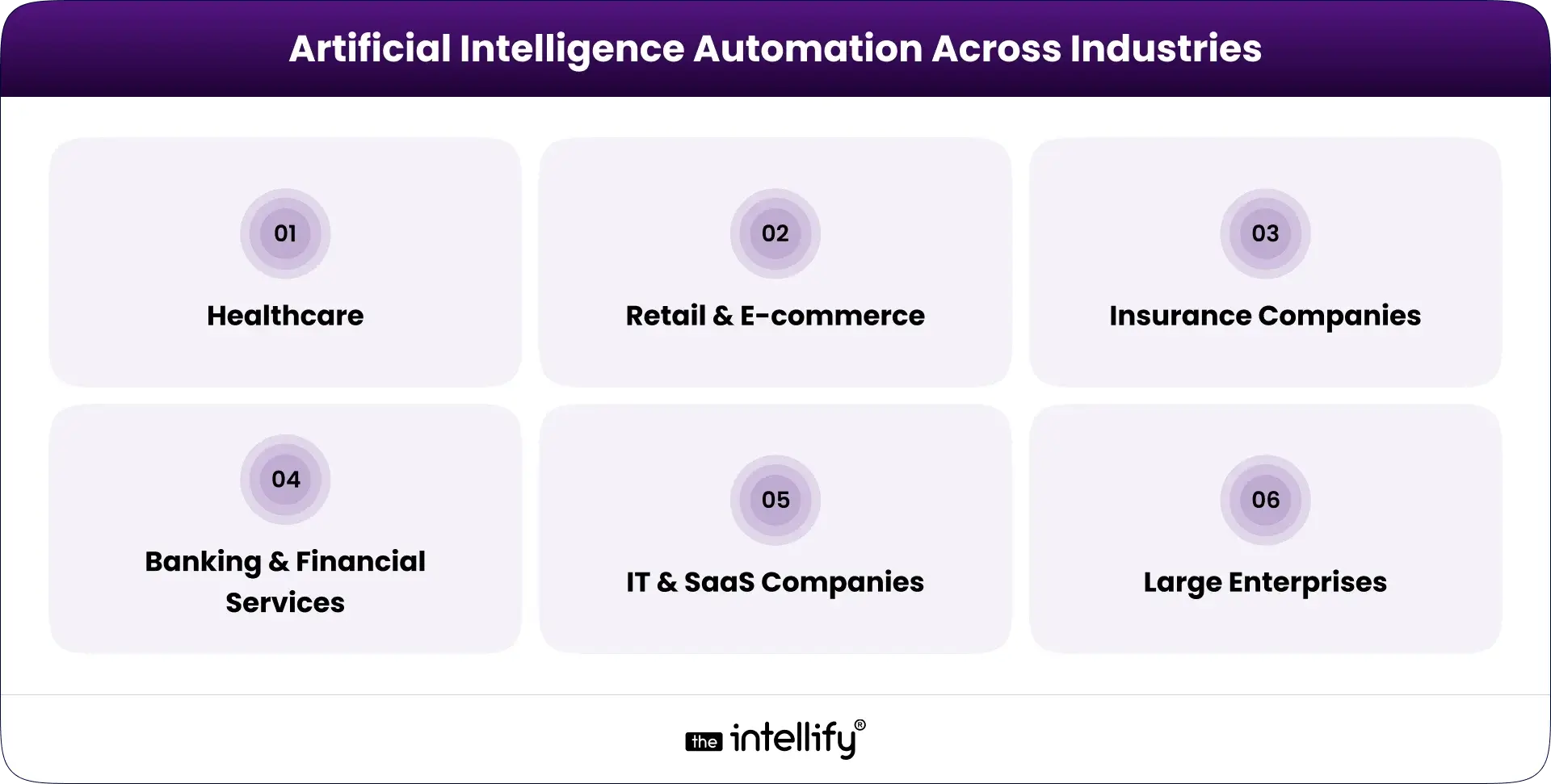
AI Automation Across Industries: Real-World Applications

AI automation across industries

Healthcare

  • Patient billing workflows run faster and cleaner.
  • Staff scheduling adapts automatically to demand and availability.

Retail & E-commerce

  • Inventory and finance systems stay in sync.
  • Workforce scaling during peak demand becomes predictable, not chaotic.

Insurance Companies

  • Claims processing accelerates.
  • Risk assessment becomes more consistent.

Banking & Financial Services

  • Loan processing automation reduces turnaround time.
  • Risk monitoring systems catch issues early.

IT & SaaS Companies

  • Internal support systems scale with growth.
  • Subscription revenue forecasting improves accuracy.

Large Enterprises

  • Multi-location operations stay coordinated.
  • Global compliance becomes manageable instead of overwhelming.


AI automation solutions


Key Benefits of AI Automation Across Internal Teams

AI automation brings steady, practical improvements to how teams work every day. It focuses on removing friction, not adding complexity.

1. Reduced operational costs

By cutting manual work and reducing errors, AI automation helps lower processing and rework costs without affecting quality.

2. Increased productivity

Teams spend less time on routine tasks and more time on meaningful work, improving overall output and focus.

3. Improved accuracy and compliance

Built-in checks and monitoring reduce mistakes in payroll, invoicing, and reporting, while keeping compliance on track.

4. Faster, data-backed decisions

Real-time insights replace delayed reports, helping managers act quickly and with confidence.

5. Better employee experience

Less repetitive work means lower stress and better engagement across departments.

6. Scalable growth without increasing headcount

Operations can grow without constantly adding staff, making expansion more manageable.


AI Automation as an Operational Partner, Not a Replacement

AI automation supports people. It doesn’t replace them.

1. Supporting HR Professionals:- HR spends less time on admin and more time on people.

2.Enabling Finance Teams to Focus on Strategy:- Finance shifts from reconciliation to planning and insight.

3.Empowering IT Teams with Predictive Tools:- IT becomes proactive instead of reactive.


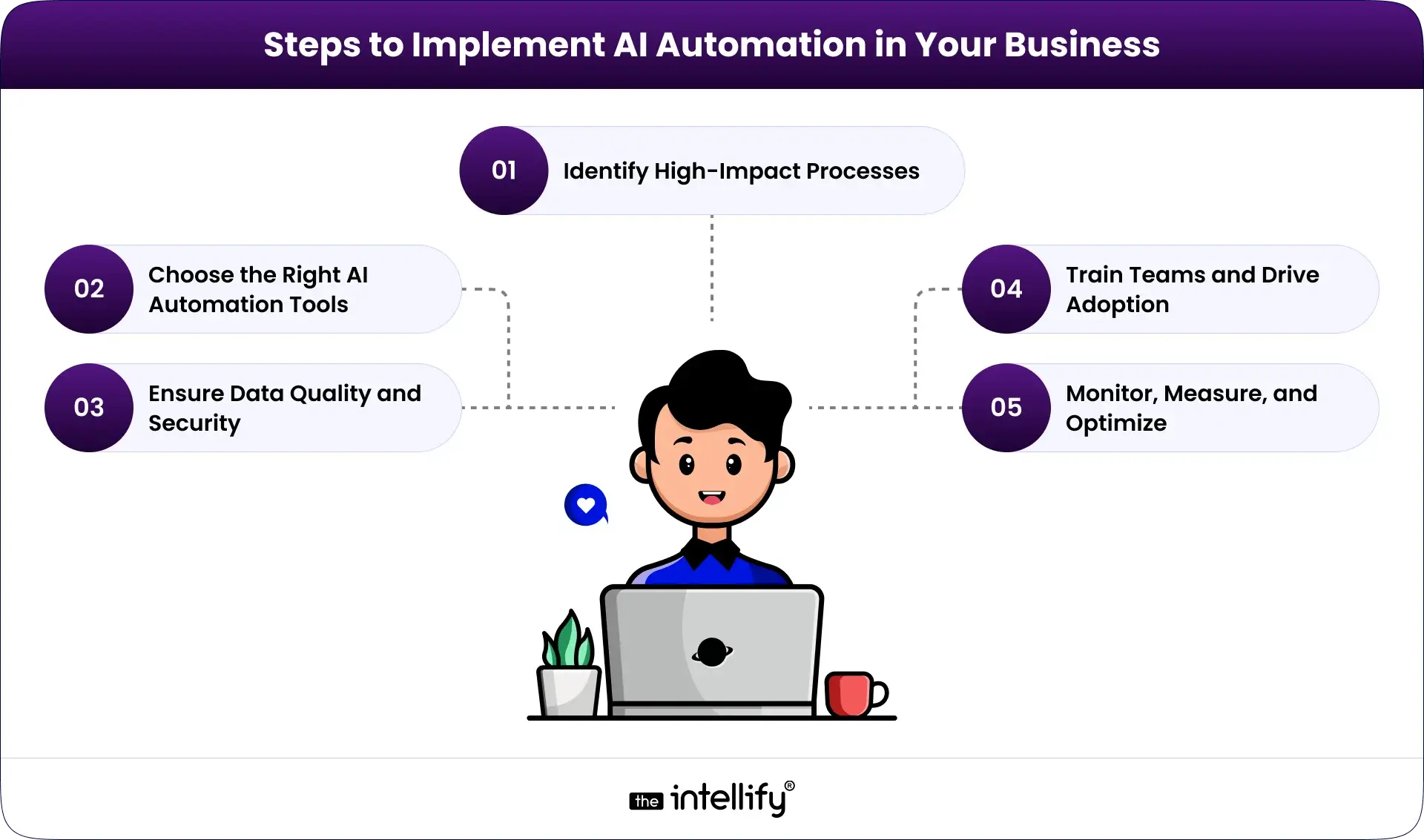
Steps to Implement AI Automation in Your Organization

Steps for AI Automation in Your Business

1. Identify High-Impact Processes

Start with repetitive, error-prone workflows.

2. Choose the Right AI Automation Tools

Flexibility, integration, and security matter more than features.

3. Ensure Data Quality and Security

AI is only as good as the data it learns from.

4. Train Teams and Drive Adoption

Automation works when people trust it.

5. Monitor, Measure, and Optimize

Treat automation as a system that evolves, not a one-time setup.


Key Challenges Businesses Face Without AI Automation

Businesses that rely mainly on manual systems often face growing operational pressure. Over time, these issues affect efficiency, costs, and employee motivation.

  • Heavy Dependence on Manual Processes:-  Many teams depend on spreadsheets, emails, and manual entry. This leads to repetitive work, slow approvals, and administrative overload, leaving little time for important tasks.
  • Slow and Fragmented Workflows:- When HR, finance, and IT use disconnected tools, workflows slow down. Updates are delayed, visibility is limited, and teams waste time coordinating basic information.
  • Increased Risk of Errors:- Manual handling increases the chance of payroll mistakes, invoice mismatches, and missed compliance checks. These errors often require extra time and effort to fix.
  • Limited Data Insights for Decision-Making:- Without automation, reports are often outdated. Financial insights arrive late, and leaders lack clear, predictive information for planning.
  • Difficulty Scaling Operations:- As workloads increase, efficiency does not always improve. Companies hire more staff just to keep up, creating higher costs and operational strain.
  • Employee Frustration and Low Productivity:- Too much routine work reduces focus and motivation. Employees have less time for strategic work, leading to slower responses and lower engagement.


The Future of AI Automation in Business Operations

AI automation is moving beyond simple task support. The next phase focuses on smarter, connected systems that guide operations in real time.

Agentic AI assistants will manage workflows from start to finish, reducing manual coordination between teams. Instead of reacting to problems, businesses will rely on predictive operational intelligence to identify delays and risks early.

Enterprise platforms will become more connected, allowing HR, finance, and IT to share data seamlessly. At the same time, processes will continuously improve in the background through ongoing monitoring and learning.


Conclusion

Modern enterprises aren’t defined by size. They’re defined by how smoothly things run when nobody’s watching. AI automation isn’t about replacing teams. It’s about giving them breathing room. Fewer blockers. Fewer errors. Fewer “Can you follow up on this?” messages.

Organizations that adopt AI automation early build operations that scale calmly. Those who wait often spend years untangling avoidable complexity.

If you’re exploring AI automation for HR, finance, or IT and want a practical, business-first approach, the right implementation partner makes all the difference. That’s where The Intellify helps organizations design AI automation that fits real operations, not just diagrams.


AI Automation for Operations


Frequently Asked Questions (FAQs)

1. What exactly is AI automation in business operations?

AI automation uses intelligent systems to manage repetitive and data-heavy business tasks. Unlike basic automation, it can learn from past activity and adjust to new situations. It helps HR, finance, and IT teams work faster, reduce errors, and make better decisions. Companies like The Intellify design AI automation systems that fit real workflows, not just technical models.

2. How does AI automation differ from traditional automation?

Traditional automation follows fixed rules and breaks when conditions change. AI automation learns from data and adapts over time. It can handle documents, emails, and changing processes without constant reprogramming. This makes it more reliable for growing businesses with complex operations.

3. Can AI automation replace human workers?

No. AI automation supports employees rather than replacing them. It handles routine tasks so teams can focus on planning, problem-solving, and strategy. When implemented properly, it reduces burnout and improves job satisfaction instead of eliminating roles.

4. What are common use cases of AI automation across departments?

Common use cases include resume screening in HR, invoice processing in finance, and ticket management in IT. It is also used for reporting, compliance checks, and internal support. These applications help departments work together more smoothly and reduce manual coordination.

5. Is AI automation only for large companies?

AI automation is useful for businesses of all sizes. Small and mid-sized companies often start with one or two workflows and expand gradually. With the right implementation partner, organizations can adopt automation without heavy upfront investment.

6. What are the costs and challenges of implementing AI automation?

Costs depend on system complexity, data readiness, and integration needs. Common challenges include poor data quality, resistance to change, and security concerns. These issues can be managed through proper planning, training, and phased implementation.

7. How can AI automation improve decision-making?

AI automation analyzes real-time data, identifies patterns, and highlights risks early. This helps managers make informed decisions instead of relying on delayed reports. Over time, it builds a clearer view of operations and supports long-term planning.

View
Case Study