How Digital Transformation in Healthcare Is Shaping the Industry’s Future

Summary:
Digital transformation in healthcare is changing how systems, data, and processes work together. It is helping improve coordination, reduce delays, and make operations more efficient. Healthcare organizations are using connected technologies and data to manage services better and respond faster. While there are challenges, many are moving forward step by step to improve their systems. Overall, it is shaping a more connected and efficient future for the healthcare industry.

Digital transformation in healthcare is changing how systems, data, and processes work together. It is helping improve coordination, reduce delays, and make operations more efficient. Healthcare organizations are using connected technologies and data to manage services better and respond faster. While there are challenges, many are moving forward step by step to improve their systems. Overall, it is shaping a more connected and efficient future for the healthcare industry.

It is not just improving how healthcare works today, but also shaping how systems will function in the coming years. As the industry evolves, digital transformation is becoming a key part of long-term healthcare growth.


How Healthcare Systems Are Becoming More Connected

In the past, healthcare often relied on outdated manual processes and isolated systems. Departments worked in silos, resulting in gaps in coordination and efficiency. As a consequence, managing the ever-growing sea of patient and operational data could feel like an uphill battle, leading to frustration for both providers and patients alike.

Nowadays, the demand for interconnected systems is surging. Healthcare providers are starting to understand that the secret to enhancing service delivery lies in building systems that foster communication and collaboration.

This level of connectivity reduces repeated work and improves the overall flow of services. It also helps different parts of the system work together more smoothly.


Digital Transformation in Healthcare as the New Foundation

Healthcare Digital Transformation

Digital transformation in healthcare isn’t just about switching to digital formats; it represents a fundamental change in how healthcare systems operate. This transformation aims to connect people, processes, and data into a smooth, cohesive flow.

  • Reducing operational gaps: Automation of workflows and system integration helps minimize delays and miscommunications, enabling better care delivery.
  • Modern foundation: This transformation forms the solid groundwork on which today’s healthcare systems are built, enhancing patient experiences and operational efficiencies.


What makes Digital Transformation Essential in Healthcare

The rapid pace of change in healthcare brings several challenges:

  • Managing Data: The amount of patient and operational data continues to grow. Digital transformation enables healthcare organizations to manage and harness this data for improved decision-making.
  • Faster Coordination: As healthcare teams expand, quick coordination across various systems becomes crucial. Digital tools offer real-time data sharing, ensuring everyone stays aligned.
  • Meeting Expectations: Today’s patients expect smooth, accessible services. Digital transformation equips healthcare providers to meet these rising expectations.

It also helps bring more consistency in how services are delivered across different systems. As operations grow, managing complexity without digital support becomes difficult.


Where Digital Healthcare Transformation Is Creating Real Impact

Digital healthcare transformation is delivering tangible benefits across the industry:

  • Improved coordination: Departments and teams can now communicate effectively, fostering trust and collaboration.
  • Faster Communication: Instant messaging systems and data-sharing platforms cut down on waiting times and speed up decision-making.
  • Efficient Workflows: Routine processes are now more structured, giving healthcare professionals more time to focus on what matters patient care.

It also improves visibility across systems, helping teams make quicker and more informed decisions.


Technologies Behind Digital Transformation in Healthcare Solutions

Several cutting-edge technologies drive the digital transformation in healthcare solutions:

  • AI: This technology speeds up analysis and supports quicker decision-making.
  • Cloud Systems: These enable secure access to and sharing of data.
  • Connected Devices: They allow for continuous monitoring of patient health.
  • Data Platforms: These help organize and simplify vast amounts of information.
  • Integration Tools: They link multiple systems, facilitating smooth operations.

Together, these technologies form the backbone of a transformed healthcare landscape, paving the way for smarter, more efficient practices.


Digital transformation Solutions


How healthcare Operations Are Being Reshaped Internally

Internally, healthcare operations are prioritizing efficiency:

  • Reduction in manual work: Automation takes over routine tasks, freeing staff to focus on vital issues.
  • Faster process Handling: Fewer bottlenecks in workflows enable healthcare facilities to quickly respond to patient needs.
  • Better Use of Resources: By optimizing staff time and hospital resources, organizations can provide improved care.
  • Improved Accuracy: Less manual intervention means fewer mistakes, boosting overall service quality.

This allows healthcare organizations to respond faster to changing needs and improve overall service delivery.


The Expanding Role of Data in Healthcare

Gone are the days when data was merely stored away. Now, it plays a vital role in everyday operations:

  • Real Time Access: Quick access to data enhances decision-making and planning processes.
  • Better Resource Management: Data analytics empower organizations to allocate staff and materials more effectively.
  • Connected Systems: A solid data strategy fosters informed systems that can dynamically respond to patient needs.

Over time, this is helping healthcare systems move toward more planned and proactive decision-making.


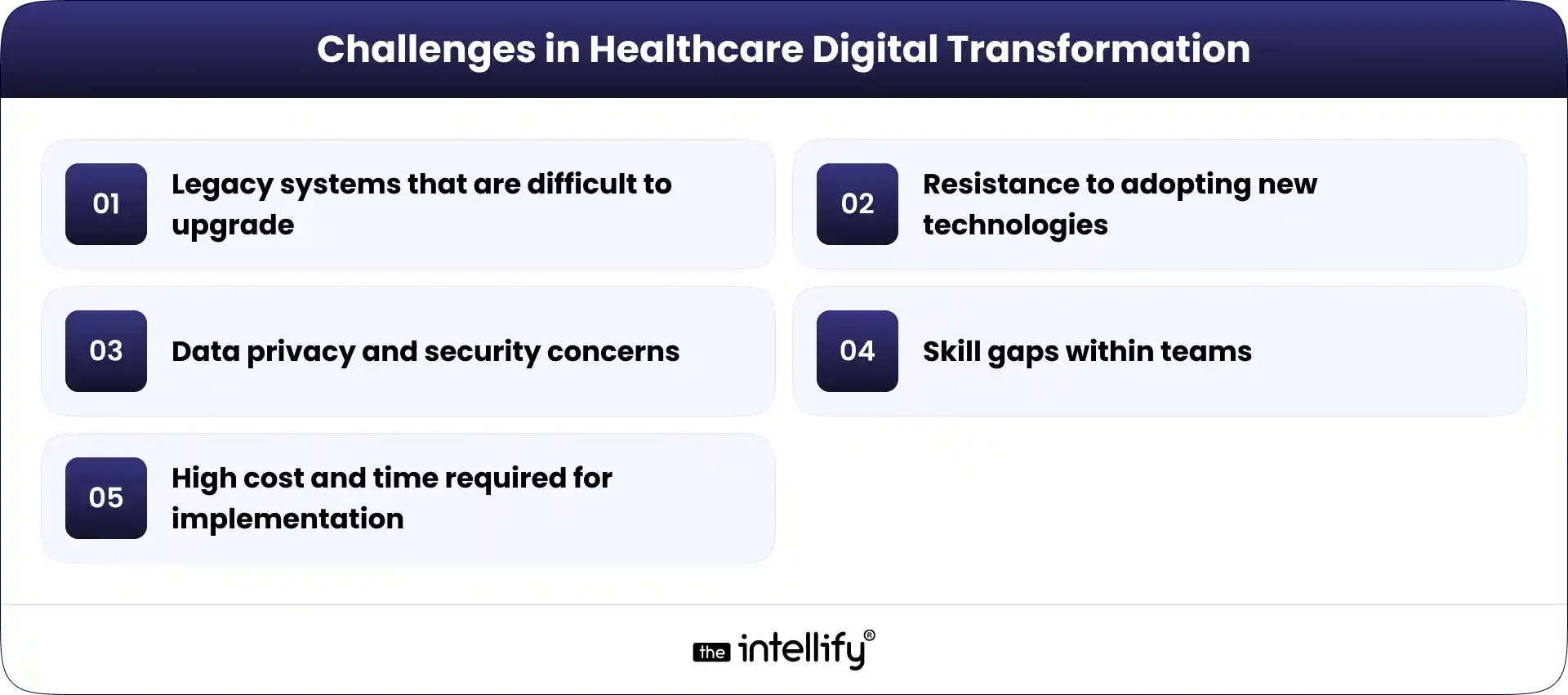
Challenges in Adopting Digital Transformation in Healthcare

Challenges in Healthcare Digital Transformation

Yet, the path to adopting digital transformation isn’t without its hurdles:

  • Legacy Systems: Many organizations struggle with outdated systems that aren’t easy to upgrade.
  • Privacy and Security Concerns: Safeguarding sensitive patient data is crucial and can slow technology adoption.
  • Resistance to Change: Some staff may be hesitant to embrace new technologies, which can stall progress.
  • Skill Gaps: Existing teams might lack the necessary skills for implementation, requiring additional training.
  • Implementation Costs: Upgrading systems can be costly and time-consuming, making many organizations hesitant to proceed.

These challenges can slow progress, but with the right approach, they can be managed over time.


How Healthcare Organizations Are Improving Their Systems

Healthcare organizations are cautiously progressing with strategies to enhance their frameworks:

  • Gradual adoption: Instead of a complete overhaul, many are choosing incremental improvements that minimize disruption.
  • Training Initiatives: Investing in staff training ensures teams are ready to tackle new systems effectively.
  • Scalable Solutions: Organizations focus on flexible technology that can adapt as their needs grow.
  • Partnerships with Tech Providers: Teaming up with experienced technology providers can lead to better outcomes.
  • Long Term Focus: Emphasizing ongoing improvements and results is crucial for sustainable transformation.

The focus is on making systems more stable, reliable, and easier to manage in the long run.


Real-World Applications in Healthcare Services

Digital transformation in healthcare services is already showing its worth in various areas:

  • Online Consultations: Telehealth is enhancing patient access to healthcare services.
  • Digital Health Records: Streamlined management of information reduces paperwork and makes care more efficient.
  • Remote Monitoring: Wearable tech supports continuous patient care, boosting health outcomes.
  • Automation: Routine tasks, from scheduling to billing, are increasingly automated to cut delays.
  • Better Coordination: Enhanced communication tools ensure smooth service across all touchpoints.

These applications are already changing how healthcare services are delivered and experienced.


How Healthcare Systems Are Changing for the Future

The future of healthcare is on a transformative path:

Connected Systems: Improved integration offers a more holistic view of patient care.

Faster Service Delivery: Automation and streamlined processes ensure prompt care.

Increased Automation: Smart tools and technologies are set to reshape daily operations further.

Improved Coordination: A more connected infrastructure will facilitate stronger relationships among providers.

Healthcare systems are expected to become more proactive rather than reactive in handling needs.


What Healthcare Organizations Need to Focus on Next

Looking ahead, healthcare organizations should concentrate on:

Scalability: Designing systems that can adapt to future challenges.

Digital Strategy: Making digital transformation a cornerstone of long-term planning.

Continuous Improvement: Prioritizing process refinement over merely implementing new tools.

Alignment of Teams: Ensuring that people, processes, and technology work in harmony.

Staying Adaptable: Keeping an open mind toward new technologies and changing patient expectations.

The goal is to build systems that can support continuous change and future growth.


Healthcare digital transformation solutions


Conclusion:

Digital transformation is no longer a choice; it’s central to how the healthcare industry operates. As organizations embrace these changes, they’re paving the way for more connected, efficient systems that ultimately benefit everyone from healthcare providers to patients.

The journey is just beginning, and healthcare organizations need to remain flexible and proactive to stay relevant in an ever-evolving landscape. By effectively implementing these changes, the future of healthcare looks bright, buoyed by innovation and progress.


Frequently Asked Questions

1. Why do traditional healthcare systems face limitations?

They depend on manual work and disconnected systems, which slows down processes. This makes it harder to manage data, coordinate teams, and deliver services efficiently.

2. How do connected systems improve healthcare services?

They allow information to move smoothly between departments and teams. This improves coordination, reduces errors, and helps deliver services faster.

3.. What changes do healthcare teams notice after going digital?

Teams experience faster workflows and less dependency on paperwork. They also see better accuracy and smoother coordination across different departments.

4. What are the common challenges in digital transformation for healthcare?

Many organizations struggle with outdated systems and data security concerns. They also need time and training to help teams adapt to new ways of working.

5. What should healthcare organizations focus on moving forward?

They should focus on building flexible systems that can adapt over time. Continuous improvement in processes and team readiness is also important for long-term success.

HIPAA-Compliant AI for Healthcare Platforms: Architecture, Security & Practices

Summary:
Healthcare organizations are increasingly using AI to improve diagnostics, operations, and patient engagement. However, handling sensitive medical data requires strict privacy and regulatory safeguards. This guide explains how to design HIPAA compliant AI systems for healthcare platforms. It covers key AI architecture components, security measures, compliance practices, and common challenges organizations face when using patient data. The article also explores how healthcare providers can safely adopt AI in healthcare while maintaining patient privacy and regulatory compliance.


Why AI in Healthcare Must Be Built Around Compliance

AI is quietly becoming part of everyday healthcare. Hospitals use it to analyze scans, clinics rely on it to manage appointments, and digital health platforms use it to guide patients through symptoms or treatment plans. Just a few years ago, many of these things sounded futuristic. Now they’re slowly becoming normal.

But healthcare data isn’t like other types of data. A person’s medical history, prescriptions, mental health records, and diagnostic reports are deeply personal. Patients share this information because they trust providers to protect it. Break that trust, and the consequences go far beyond a technical failure.

That’s why privacy and compliance sit at the center of modern healthcare technology. Regulations around HIPAA compliance in healthcare have grown stricter over time, and for good reason. Data breaches in the healthcare sector remain one of the most damaging types of cyber incidents. A single leak can expose thousands or sometimes millions of patient records.

AI introduces even more complexity. Machine learning systems need data to learn patterns, improve predictions, and generate insights. But if that data includes protected health information (PHI), the way it is collected, stored, processed, and shared must follow strict security rules.
In other words, compliance isn’t something you “add later.” It has to be built into the foundation.

This guide explains how healthcare organizations and technology providers can design AI systems that respect privacy, meet regulatory expectations, and still deliver meaningful innovation. We’ll walk through architecture decisions, security practices, and real-world considerations involved in building HIPAA compliant AI platforms.


The Role of AI in Modern Healthcare Platforms

Role of AI in Modern Healthcare Platforms

Healthcare has always generated enormous amounts of data lab results, imaging scans, patient records, treatment outcomes, and more. For years, much of that information sat in systems that were difficult to analyze or connect. AI is changing that

Today, AI in Healthcare is helping providers turn raw data into useful insights.

For example, diagnostic AI systems can analyze medical images and highlight patterns that might indicate disease. Virtual assistants can help patients schedule appointments or get medication reminders. Hospitals use AI to optimize staffing and predict patient admissions. Even administrative tasks like insurance processing and documentation are becoming more automated.

These tools are pushing healthcare toward more data-driven decision making. Instead of relying only on manual reviews or intuition, clinicians can use AI-powered insights to support diagnoses, treatment planning, and patient monitoring.

But there’s another shift happening too.

Healthcare technology is moving away from isolated tools toward integrated platforms. A hospital might use one platform to manage electronic health records (EHR), another for telemedicine, and another for analytics. AI needs to work across these systems—not just within one small application.

That’s where architecture becomes important. AI models must connect with patient records, clinical workflows, and operational systems without breaking compliance rules. Designing that infrastructure properly is what allows healthcare platforms to scale safely.


What HIPAA Compliance Means for AI Systems

To understand compliance in healthcare AI, it helps to start with the basics.

The Health Insurance Portability and Accountability Act (HIPAA) is a U.S. regulation designed to protect patient health information. Its primary goal is to ensure that sensitive medical data is handled securely and only accessed by authorized individuals. The law specifically focuses on protecting Protected Health Information (PHI). This includes:

  • Patient names
  • Addresses
  • Medical records
  • Test results
  • Insurance details
  • Treatment histories

If a piece of information can identify a patient and is related to their healthcare, it usually falls under PHI protection.

For traditional healthcare systems, compliance mainly involves secure storage and controlled access. AI systems introduce new concerns.
Machine learning models often require large datasets for training. If those datasets contain PHI, developers must carefully control how the data is used, processed, and stored. There’s also the risk that AI models could unintentionally expose sensitive information through logs, outputs, or data pipelines.

Another important distinction is responsibility.

Healthcare providers, insurance companies, and hospitals are considered “covered entities” under HIPAA. Technology vendors that process or manage healthcare data on their behalf are considered “business associates.” Both groups share responsibility for protecting patient information.

Non-compliance can have serious consequences. Organizations may face financial penalties, legal investigations, and reputational damage. In healthcare, losing trust is often harder to recover from than paying a fine.


Key Challenges of Using AI with Sensitive Health Data

Using AI in healthcare sounds promising, and in many ways it is, but it also brings several challenges that technology teams must navigate carefully.

Data access limitations and fragmentation.

Healthcare data is often fragmented across multiple systems. Hospitals may store records in different databases, labs use separate systems, and imaging tools operate on their own infrastructure. Bringing all that data together for AI training can be complicated, both technically and legally.

Risk of data leakage during model training

Machine learning models learn patterns from datasets. If those datasets contain identifiable patient information, there’s a risk that the model could memorize sensitive data. That creates potential exposure if the model outputs or logs reveal details from training data.

Bias and ethical concerns challenge

Healthcare datasets sometimes reflect historical inequalities in treatment or access to care. If AI models are trained on biased data, they may produce unfair or inaccurate recommendations for certain patient groups.

Integration with legacy systems

Integration with legacy healthcare systems also creates friction. Many hospitals still rely on older software that wasn’t designed for modern AI workflows. Connecting these systems securely requires careful planning and sometimes significant upgrades.

Balancing innovation with strict compliance rules

Finally, organizations must balance innovation with compliance. Healthcare teams often want to experiment with new technologies, but regulatory requirements limit how data can be used. Navigating that balance takes both technical expertise and strong governance.


Foundations of HIPAA-Compliant AI in Healthcare Platforms

Building HIPAA-compliant AI starts with a simple mindset:

Privacy-first design approach

Instead of designing AI systems and then trying to make them compliant later, organizations should begin with privacy and security principles from the start. This approach is often called “privacy-first design.”

Minimum necessary data usage

AI systems should only access the data required for a specific task. If a model only needs anonymized medical records for pattern analysis, there’s no reason to include patient names or addresses.

Data de-identification and anonymization practices

De-identification removes personal identifiers from datasets so individuals cannot easily be recognized. In many cases, AI models can be trained on anonymized data without compromising accuracy.

Secure data handling across the AI lifecycle

Security must also be maintained across the entire AI lifecycle:

  • Data collection
  • Data storage
  • Model training
  • Model deployment
  • Continuous monitoring

Each stage introduces potential risks that need to be controlled.

Importance of governance and accountability

Governance is another critical piece. Organizations need clear policies defining who can access data, how models are trained, and how compliance is monitored. Without accountability structures, even well-designed systems can drift into risky territory over time.


Designing Secure AI Architecture for Healthcare

A well-designed AI architecture acts as the backbone of a healthcare platform. It ensures that data moves safely through each stage of processing while maintaining compliance and performance.

Most healthcare AI architectures include several key layers.

1. Data ingestion:- This layer collects information from sources such as EHR systems, medical devices, imaging platforms, and patient apps. Because these sources may contain PHI, secure transfer protocols are essential.

2. Data storage:-  Healthcare data often lives in encrypted databases or data lakes that enforce strict access controls. Storage systems must support compliance requirements while still allowing data scientists to work with datasets efficiently.

3. Processing layer:- Handles data preparation, cleaning, and transformation. AI models rely on structured, well-organized data, so this stage is critical for both performance and compliance.

4. Model layers are where machine learning models are trained and deployed. Secure environments should isolate training pipelines from external access and log all activity.

Healthcare platforms also need to decide between cloud-based and on-premise infrastructure.

  • Cloud environments offer scalability and modern security tools, but organizations must ensure their cloud providers support healthcare compliance standards.
  • On-premise systems provide more direct control but can be harder to scale.

Finally, interoperability is essential. AI systems must integrate with EHR platforms, clinical decision tools, and hospital management systems without exposing sensitive data.


HIPPA compliant AI for Healthcare


Security Measures Required for Compliance

Even the best architecture needs strong security controls to protect patient data.

Encryption for data at rest and in transit

Healthcare platforms should encrypt data both at rest (when stored) and in transit (when being transferred between systems). Encryption ensures that even if data is intercepted, it cannot be read without the proper keys.

Access controls and identity management

Systems should use identity management tools that restrict access based on roles. A data scientist may need anonymized datasets for model training, while a clinician may need full patient records for treatment decisions. Each user should only access the data necessary for their role.

Audit logs and monitoring

Audit logs also play a critical role. These logs track who accessed data, when it was accessed, and what actions were performed. If suspicious activity occurs, logs help investigators identify the source quickly.

Secure APIs and integrations

Healthcare platforms also rely heavily on APIs to connect systems. These APIs must be secured using authentication protocols and rate limiting to prevent unauthorized access.

Incident response readiness

Organizations need clear incident response plans. If a breach or vulnerability is detected, teams should know exactly how to contain the issue, notify stakeholders, and restore secure operations.


Best Practices for Building & Deploying HIPAA-Compliant AI

Building HIPAA-compliant AI systems requires discipline throughout the development process.

Privacy-by-design during development

Development teams should integrate compliance checks directly into their workflows. Security reviews, data protection checks, and documentation should be part of the development cycle, not an afterthought.

Testing models without exposing real patient data

Developers often use real datasets for testing models, but exposing real patient data during experimentation can create unnecessary risk. Many organizations use synthetic or anonymized datasets for model validation instead.

Vendor risk assessment and compliance checks

Healthcare platforms often rely on external vendors for AI tools, cloud services, or analytics platforms. Each vendor must meet the same compliance standards as the healthcare organization itself. This typically involves formal security reviews and signed compliance agreements.

Documentation and compliance workflows

Documentation is equally important. Organizations should maintain records showing how data is handled, how models are trained, and how compliance requirements are met. Regulators and auditors often request this documentation during investigations.

Ongoing monitoring after deployment

Even after deployment, monitoring must continue. AI systems evolve over time as data changes and models update. Regular reviews ensure that compliance standards remain intact.


Practical Use Cases of AI in Healthcare

Use Cases of AI in Healthcare

AI applications in healthcare are expanding quickly, but many of the most useful solutions focus on improving efficiency and decision-making rather than replacing clinicians.

Clinical decision support systems: These tools analyze patient data and medical research to help doctors evaluate possible diagnoses or treatment options.

Patient engagement platforms are another growing area. AI chatbots and virtual assistants can answer basic health questions, schedule appointments, and remind patients to take medications.

Remote monitoring solutions use AI to analyze data from wearable devices and connected health tools. Doctors can detect changes in patient health earlier, which helps prevent complications.

Medical imaging, AI models can analyze scans such as X-rays or MRIs and highlight potential abnormalities. Radiologists still review results, but AI can help prioritize urgent cases.

Operational efficiency tools for hospitals: Predictive models can estimate patient admissions, manage staffing schedules, and optimize supply chains.

These practical uses show how AI can support healthcare professionals without interfering with patient safety or privacy.

A U.S.-based Direct Primary Care platform improved patient access and care coordination by implementing a secure digital solution across its services. The system streamlined operations for providers while keeping sensitive health data protected under strict privacy standards. This shows how modern AI-enabled technology can enhance healthcare delivery without compromising compliance. View the complete case study for more details: https://theintellify.com/work/healthcare2u/


How AI Is Helping Healthcare Go Digital

Healthcare organizations around the world are going through digital transformation. Paper records are disappearing, telemedicine is expanding, and patient services are moving online.

AI plays an important role in this shift.

1. When designed responsibly, AI enables innovation without compromising trust. Healthcare providers can analyze large datasets, automate routine processes, and deliver more personalized care.

2. Patients benefit as well. Digital health platforms can provide faster responses, easier access to care, and more consistent monitoring for chronic conditions.

3. AI also supports scalability. Healthcare systems are under constant pressure from rising patient volumes and limited resources. Intelligent automation helps organizations manage workloads more efficiently.

4. Perhaps most importantly, strong compliance frameworks create long-term credibility. When patients know their data is handled responsibly, they are more likely to adopt digital health services.

5. For healthcare providers and technology companies alike, secure AI systems can become a meaningful competitive advantage.


Common Mistakes Organizations Should Avoid

Even organizations with strong intentions sometimes make mistakes when implementing AI in healthcare.

Treating compliance as a one-time task

One common issue is treating compliance as a one-time project. Regulations evolve, technology changes, and new risks emerge over time. Compliance requires continuous monitoring and updates.

Using generic AI tools not designed for healthcare

Another mistake is using generic AI tools that were not designed for healthcare environments. These tools may lack the security features required for handling PHI.

Poor data governance practices

Poor data governance can also create problems. Without clear rules for data access, retention, and sharing, organizations may unintentionally expose sensitive information.

Lack of cross-functional collaboration

Lack of collaboration is another challenge. Building compliant healthcare AI systems requires input from multiple teams of technical experts, legal advisors, compliance officers, and clinicians. When these groups work in isolation, gaps often appear.

Underestimating ongoing maintenance needs

Finally, some organizations underestimate the effort required to maintain AI systems. Models require updates, security checks, and performance monitoring over time. Ignoring these responsibilities can create long-term risks.


Conclusion

AI has enormous potential to improve healthcare systems. It can support clinicians, streamline operations, and help organizations deliver better care. But healthcare technology operates in an environment where trust is essential. Patients expect their data to remain private and secure. Any AI system that processes medical information must respect that responsibility.

Building compliant systems requires thoughtful architecture, strong security practices, and clear governance. Organizations that prioritize privacy from the beginning are better positioned to innovate safely. A principle followed by responsible technology teams across the industry, including companies like The Intellify that work closely with data-sensitive solutions. For decision-makers and product teams, the key takeaway is simple: innovation and compliance are not opposing goals. When implemented correctly, they reinforce each other.

The future of healthcare AI will belong to platforms that combine intelligent technology with responsible data protection. And the organizations that understand this balance today will shape the healthcare systems of tomorrow.


AI solutions for Healthcare


Frequently Asked Questions (FAQs)

1. Can AI use patient data without breaking HIPAA laws?

Yes, but only with safeguards. Data is usually anonymized or de-identified so individuals cannot be identified. In some cases, patient consent or legal agreements are also required.

2. Which healthcare platforms typically use HIPAA-compliant AI?

Telehealth apps, patient portals, remote monitoring tools, clinical decision systems, and hospital management platforms commonly use it. Any system handling patient data can benefit from secure AI.

3. Is cloud-based AI safe for healthcare use?

It can be safe if the cloud provider meets healthcare security standards. Proper configuration, encryption, and access controls are essential. Organizations still remain responsible for protecting the data.

4. What happens if healthcare AI is not HIPAA compliant?

Organizations risk data breaches, legal penalties, and loss of patient trust. It can also damage reputation and disrupt services. Compliance helps prevent these risks.

5. Do startups also need HIPAA-compliant AI systems?

Yes. If a startup handles patient health information, it must follow HIPAA rules regardless of size. Building compliance early is easier than fixing problems later.

AI for Healthcare Operations: Transforming Hospital Process in 2026

Summary:
Healthcare is facing growing operational pressure due to rising patient demand, staffing limitations, and complex compliance requirements. This blog explores how AI for healthcare operations helps address these challenges by improving scheduling, billing, diagnostics, and documentation workflows. It highlights key business benefits, practical implementation steps, and strategic priorities for long-term success, offering hospital leaders clear insights into building efficient, secure, and future-ready healthcare systems

The healthcare landscape is changing rapidly, and AI for healthcare is leading the way. As we look towards 2026, hospitals are confronted with a host of operational challenges from growing patient demands to strict compliance mandates. In this blog, we’ll explore how AI is reshaping healthcare operations, its key advantages, the hurdles hospitals must navigate, and why this is the ideal moment to adopt these cutting-edge technologies.


The Growing Complexity of Hospital Operations in 2026

As we head into 2026, the operational hurdles that hospitals face are becoming increasingly complex:

  • Rising patient demand and limited staff:- An influx of patients is putting a strain on resources, making efficient care delivery more critical than ever.
  • Administrative overload slowing down care: The burden of paperwork and numerous administrative tasks often eats into the time that could be spent on patient care.
  •  Financial pressure and reimbursement delays-: Shifts in reimbursement models can lead to financial constraints, which in turn affect service quality.
  •  Increasing compliance requirements: Regulatory demands can add to the workload, creating inevitable bottlenecks in hospital operations.

Given these challenges, traditional systems simply can’t keep up anymore. For hospitals to succeed, they’ll need to go beyond basic automation and integrate AI for healthcare operations it’s a practical pivot that transcends mere trends.


What AI for Healthcare Means in Operational Terms

AI isn’t just a tool for automating repetitive tasks; it’s about enhancing both clinical and administrative workflows. Here’s how it works:

Moving Beyond Basic Automation

AI in healthcare operations goes beyond simple task automation. It doesn’t just complete repetitive work it analyzes data, identifies patterns, and helps hospitals make smarter decisions in real time.
 Supporting Clinical and Administrative Workflows

AI helps clinical teams and administrative staff work in better coordination. It connects systems like scheduling, billing, and patient records so departments don’t operate in isolation.

Connecting Fragmented Hospital Systems

Many hospitals use multiple disconnected systems. AI helps bring these together, allowing information to flow smoothly across departments and reducing delays or duplicate work.

Shifting from Manual Coordination to Intelligent Support

Instead of relying only on manual tracking and follow-ups, AI provides smart insights and alerts. This helps staff focus more on patient care while the system supports operational decisions.

How AI for Healthcare Operations Strengthens Internal Systems

AI strengthens internal systems by improving accuracy, reducing bottlenecks, and making processes more predictable. It builds a more responsive foundation that supports both efficiency and quality care.

In short, AI for healthcare reinforces internal systems, creating a healthier environment for staff and patients alike.


How Intelligent Systems Improve Daily Hospital Functions

AI technology has tremendous potential to enhance daily hospital functions, which are vital for operational success:

  • Collecting and organizing operational data: AI systems aggregate information from various sources, making critical data easily accessible.
  • Identifying inefficiencies in scheduling and billing: By analyzing patterns, AI can spotlight areas needing improvement, enabling more effective resource allocation.
  • Detecting compliance gaps early: AI continuously monitors operations, helping unearth regulatory risks before they become problematic.
  • Supporting faster clinical decision-making: With real-time insights, AI empowers healthcare professionals to make informed decisions on the spot.
  • Automating repetitive administrative tasks: Routine tasks such as appointment bookings and data entry can be automated, allowing staff to engage more meaningfully with patients.
  • Providing real-time performance visibility: AI equips hospitals with dashboards and reports that shed light on operational efficiency, enabling prompt adjustments.


AI for hospitals operations


Core Areas Transformed by AI in Healthcare Operations

Patient Scheduling and Resource Planning

  • Reducing wait times: Smart scheduling algorithms optimize appointment slots, helping to cut down on patient wait times.
  • Better staff allocation: AI analyzes demand trends, ensuring that staff levels are aligned with patient volume, thus boosting service quality.
  • Managing appointment flow: Automated systems streamline appointment flow, enhancing overall patient satisfaction.

Revenue Cycle and Claims Processing

  • Reducing coding errors: AI algorithms accurately code services, minimizing potential errors.
  • Predicting claim denials: By digging into historical data, AI can spot patterns that lead to claim denials, enabling proactive measures.
  •  Speeding up reimbursements: AI quickens the claims process, ensuring that providers receive payments more promptly.
    Diagnostic Support and Case Prioritization
  • Assisting imaging review: AI tools can analyze medical images, helping radiologists identify urgent cases more efficiently.
  •  Flagging urgent cases: AI prioritizes cases needing immediate attention, ensuring timely interventions.
  • Supporting physician decisions: With data-driven insights, physicians can make more informed choices regarding patient care.

Compliance and Documentation Oversight

  • Monitoring regulatory changes: AI stays current on regulations, helping compliance teams respond effectively.
  • Identifying documentation gaps: Automated checks highlight areas where documentation may be lacking, reducing the risk of audits.
  • Reducing audit risks: Continuous monitoring helps ensure that compliance requirements are consistently met.


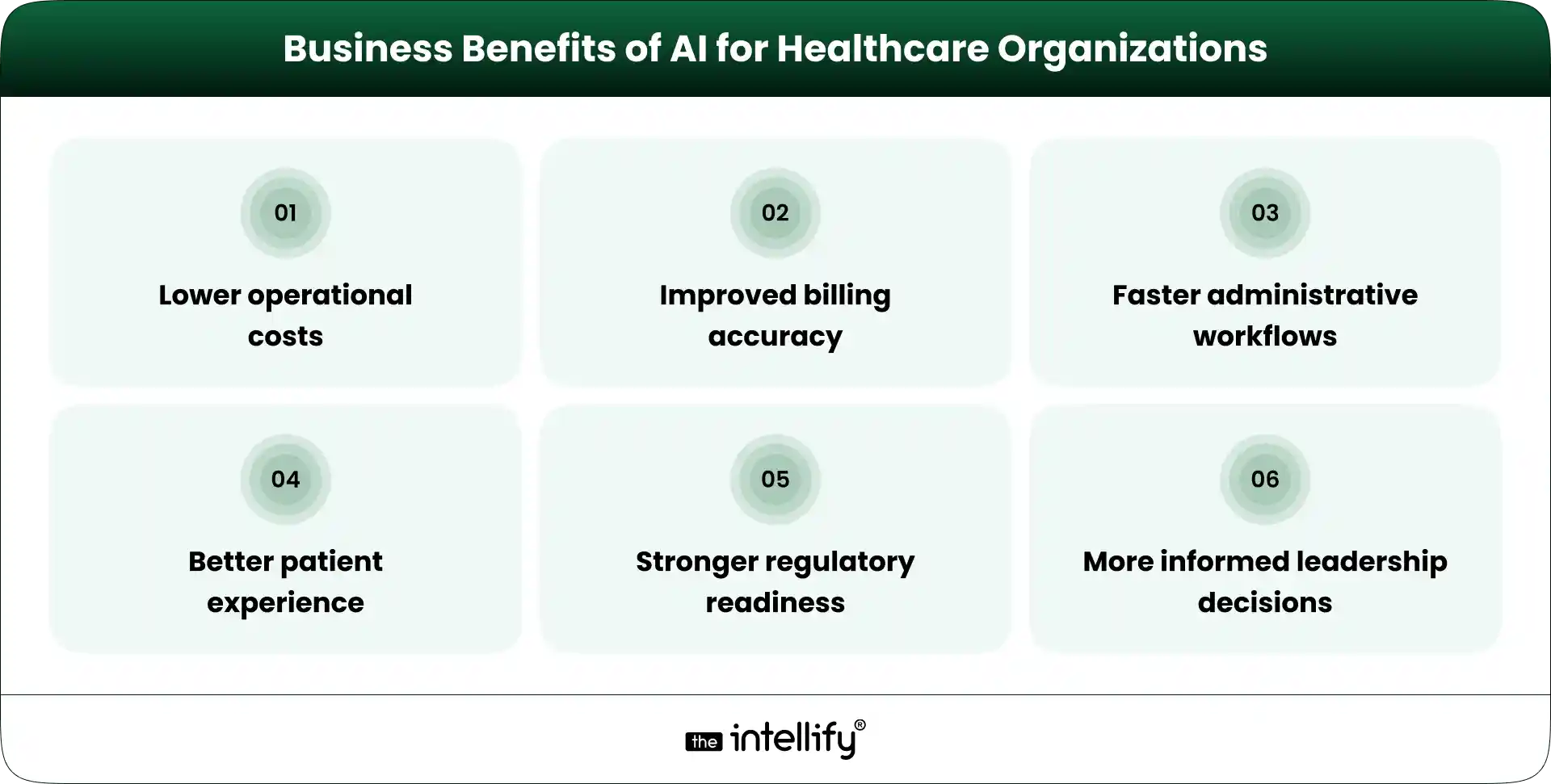
Business Benefits of AI for Healthcare Organizations

Benefits of AI for Healthcare Organizations_

Incorporating AI for healthcare operations comes with a host of benefits:

1. Lower operational costs:- Automation decreases reliance on manual processes, leading to cost savings.

2. Improved billing accuracy:- AI enhances accuracy in billing, reducing discrepancies.

3. Faster administrative workflows:- Streamlined procedures mean that administrative tasks are handled swiftly, boosting productivity.

4. Better patient experience:- Efficient operations enhance overall patient satisfaction, helping to build loyalty.

5. Stronger regulatory readiness:- Proactive compliance systems ensure hospitals are always audit-ready.

6. More informed leadership decisions:- With comprehensive insights, hospital leaders can make strategic decisions that drive growth and efficiency.


Step-by-Step Process to Implement AI in Healthcare Management

Assess Operational Gaps

  • Identify workflow bottlenecks: Pinpoint areas where delays typically occur.
  •  Analyze denial rates: Review past claims data to uncover ongoing issues.
  • Evaluate scheduling inefficiencies: Scrutinize current scheduling practices to enhance efficiency.

Define Clear Goals

  •  Improve turnaround time: Set benchmarks for how quickly patients are processed.
  • Reduce compliance risks: Establish compliance targets to ensure adherence.
  • Increase financial accuracy: Aim for error-free billing and claims processing.

Start with Focused Deployment

  • Pilot in one department: Begin AI implementation in a single department to minimize disruption.
  • Measure impact: Assess pilot results to gauge benefits before a broader rollout.
  • Expand gradually: Scale up implementation based on successful outcomes.

Align Teams and Governance

  • Train staff: Make sure staff are adequately trained to work with new AI systems.
  • Maintain human oversight: While AI provides support, human oversight remains crucial for quality care.
  • Establish performance benchmarks: Regularly review performance metrics to evaluate success.


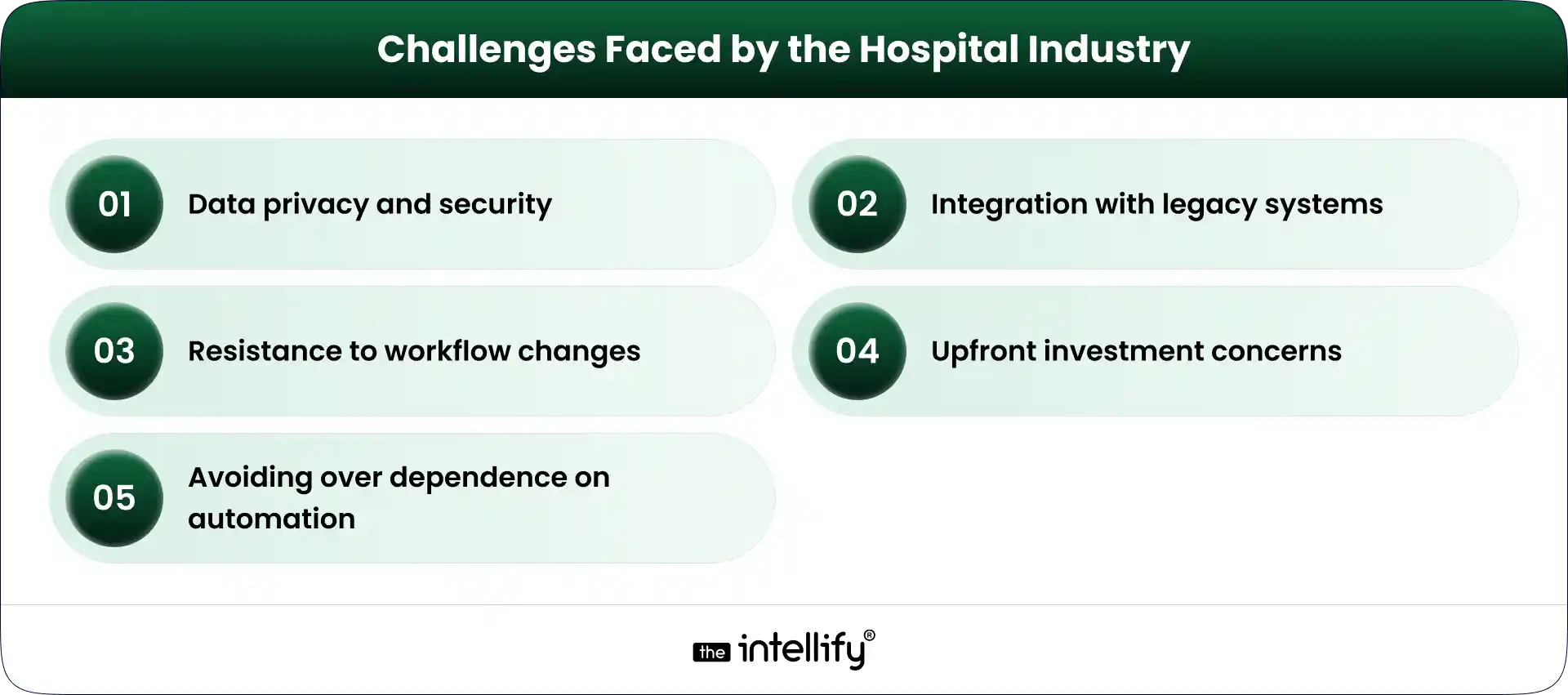
Challenges being faced by Hospital Industry

Challenges Faced by the Hospital Industry

While AI presents incredible opportunities, hospitals also face a variety of challenges:

  • Data privacy and security: Protecting patient data must remain a top priority.
  •  Integration with legacy systems: Merging AI tools with existing infrastructure can prove complex.
  •  Resistance to workflow changes: Staff may be hesitant to embrace new technologies.
  • Upfront investment concerns: Initial costs can make hospitals wary of adopting AI solutions.

Avoiding overdependence on automation: It’s essential to strike a balance between human input and machine support.


Why 2026 Is a Defining Year for AI Healthcare Operations

The year 2026 is shaping up to be a game-changer for AI in healthcare, as hospitals increasingly recognize AI’s potential:

  • Maturity of AI tools: These technologies are becoming more advanced, offering robust solutions ready for deployment.
  • Clearer regulatory frameworks: Evolving regulations will ease the path for AI integration.
  •  Proven operational ROI: Hospitals are seeing measurable benefits from AI investments.
  •  Increasing competitive pressure: As more facilities adopt AI, hospitals need to keep pace or risk falling behind.
  • Industry-wide shift from pilots to enterprise-scale deployment: Organizations are transitioning from pilot projects to full-scale implementations.


What Hospital Systems Should Address Next

To stay competitive, hospital leaders should center their attention on several key areas:

  • Building long-term digital infrastructure: Invest in systems that can accommodate future technological advancements.
  • Integrating AI into core systems: Make sure AI tools are a foundational part of operations.
  • Tracking measurable performance improvements: Regularly evaluate the impact of AI implementations.
  • Ensuring transparency and accountability: Cultivate a culture that values clear decision-making.
  • Preparing for continuous system optimization: Adopt a mindset geared towards ongoing improvements and adjustments.


AI Solutions for Healthcare


Conclusion

Embracing AI for healthcare operations transforms hospitals into more efficient, patient-centered organizations. The benefits ranging from enhanced patient experiences to improved operational efficiency are compelling. As we approach 2026, adopting AI isn’t merely about technology; it’s about paving the way to a healthier future.

Beyond automation, this shift is about building smarter hospital systems that can adapt, respond, and grow with changing demands. With the right strategy and trusted partners like The Intellify supporting innovation, hospitals can move from fragmented processes to connected, future-ready operations that truly support both staff and patients.


Frequently Asked Questions

1. How is AI improving scheduling and patient flow in hospitals?

AI analyzes appointment patterns, staff availability, and patient demand to reduce wait times and avoid overbooking. It helps hospitals manage patient flow more smoothly without adding extra administrative pressure.

2. Can AI speed up billing and claims processing?

Yes, AI can automatically check coding errors, verify claims, and flag missing information before submission. This reduces claim denials and helps hospitals receive payments faster and more accurately.

3. What are the main benefits of AI in hospital operations?

It improves efficiency, reduces paperwork errors, lowers operational costs, and supports better decision-making. Hospitals also benefit from smoother workflows and improved compliance tracking.

4. How does AI support better diagnostic accuracy?

AI tools can analyze imaging scans and patient data to highlight patterns that might need attention. It doesn’t replace doctors but provides decision support that helps prioritize critical cases more quickly.

5. How safe is AI in healthcare when handling patient data?

AI systems are designed to follow strict data security and privacy regulations. When implemented correctly, they include encryption, access controls, and monitoring tools to protect sensitive patient information.

6.  How will AI change hospital operations by 2026?

By 2026, AI is expected to move from pilot projects to broader system-wide adoption. Hospitals will rely more on predictive insights, automation, and real-time monitoring to improve performance and patient care.

7.  Will AI replace staff in hospital operations or work alongside them?

AI will not replace hospital staff but work alongside them. It handles repetitive and data-heavy tasks, allowing healthcare professionals to focus more on patient care and critical decisions.

AI in Healthcare Claims Processing: A Practical Implementation & ROI Guide

Summary:
Healthcare claims processing is often slow, manual, and prone to costly errors. This blog breaks down how AI in healthcare helps reduce denials, speed up reimbursements, and improve revenue cycle performance. You’ll see how AI supports each step of the claims process, what benefits providers and insurers can expect, and what it takes to implement it properly. It also covers ROI, costs, compliance, and common challenges in simple, practical terms.


The Growing Impact of AI in Healthcare Operations

Walk into any hospital billing office, and you’ll feel it. The quiet tension. The stacks of files. The “we’re still waiting on that claim” conversations. Healthcare runs on care. But it survives on reimbursement. And that’s where things often get messy.

AI in healthcare is starting to change how operations work behind the scenes. Not in a flashy, sci-fi way. More in a practical, roll-up-your-sleeves kind of way. It helps teams catch errors early, process claims faster, and avoid those painful denials that stall revenue.


How AI in healthcare is changing operational efficiency

Operational efficiency used to mean hiring more staff to handle more claims. More volume? Add more people. But that model doesn’t scale well. It’s expensive. It’s exhausting. And honestly, it’s error-prone.

AI changes that dynamic. It reviews documentation in seconds. It flags mismatches between diagnosis and procedure codes. It learns from past denials and spots patterns humans might miss on a long Tuesday afternoon. Instead of reacting to problems, teams can prevent them. That shift alone changes everything.


Challenges in Traditional Claims Processing

Let’s be honest. Traditional claims processing is fragile. It depends heavily on manual work, fragmented systems, and a lot of patience.

Manual coding and documentation errors

Coding errors happen. A digit off. A missing modifier. A mismatched diagnosis. Most of the time, it’s not negligence. It’s an overload. Coders review hundreds of records daily. Fatigue creeps in. And small mistakes turn into denied claims.

High denial and rejection rates

Denials don’t just hurt revenue. They drain morale. When denial rates rise, teams spend hours reworking submissions instead of focusing on new claims. It becomes a cycle. Fix, resubmit, wait. Repeat.

Delayed reimbursements and cash flow gaps

A delayed claim means delayed payment. That delay can stretch from weeks to months. For healthcare providers, this affects payroll, equipment purchases, and expansion plans. Cash flow gaps aren’t abstract. They’re real.

Compliance and audit risks

Healthcare is tightly regulated. Every claim must follow strict rules. Manual processes increase the risk of missing documentation, incomplete records, or coding mismatches. Audits become stressful events instead of routine checks.

Rising administrative costs

More denials mean more rework. More rework means more staff time. Administrative overhead keeps rising. And it often feels like there’s no clear way to stop the climb.


How AI in Healthcare Improves Claims Management

AI doesn’t just automate steps. It changes how decisions are made.

Moving beyond rule-based automation

Basic automation follows fixed rules. If X happens, do Y. AI goes further. It analyzes patterns. It learns from outcomes. It adapts. Instead of simply checking if a field is filled, it evaluates whether the documentation actually supports the claim.

Supporting faster and more accurate decisions

AI systems can review thousands of data points in seconds. That includes patient history, prior claims, payer policies, and coding guidelines. This reduces guesswork. Decisions become data-backed instead of instinct-driven.

Strengthening revenue cycle performance

When errors are caught before submission, denial rates drop. When claims move faster, reimbursement improves.

When patterns are identified early, process improvements follow. Revenue cycle performance becomes more predictable. And predictability is gold in healthcare finance.

Automated data extraction from medical records

AI for healthcare tools can automatically extract structured data from clinical notes, discharge summaries, and lab reports. This reduces manual entry, minimizes errors, and ensures critical details aren’t missed.

Intelligent coding validation

Before a claim goes out, AI checks whether diagnosis codes match procedures and whether documentation supports the billing. It acts like a second pair of eyes. A very fast one.

Predictive denial detection

AI can flag claims that are likely to be denied based on historical payer behavior. Instead of waiting for rejection, teams fix the issue before submission. That’s a big shift.

Fraud detection and risk analysis

AI can identify unusual billing patterns or inconsistencies across large datasets. This helps reduce fraud risk and supports internal compliance efforts.


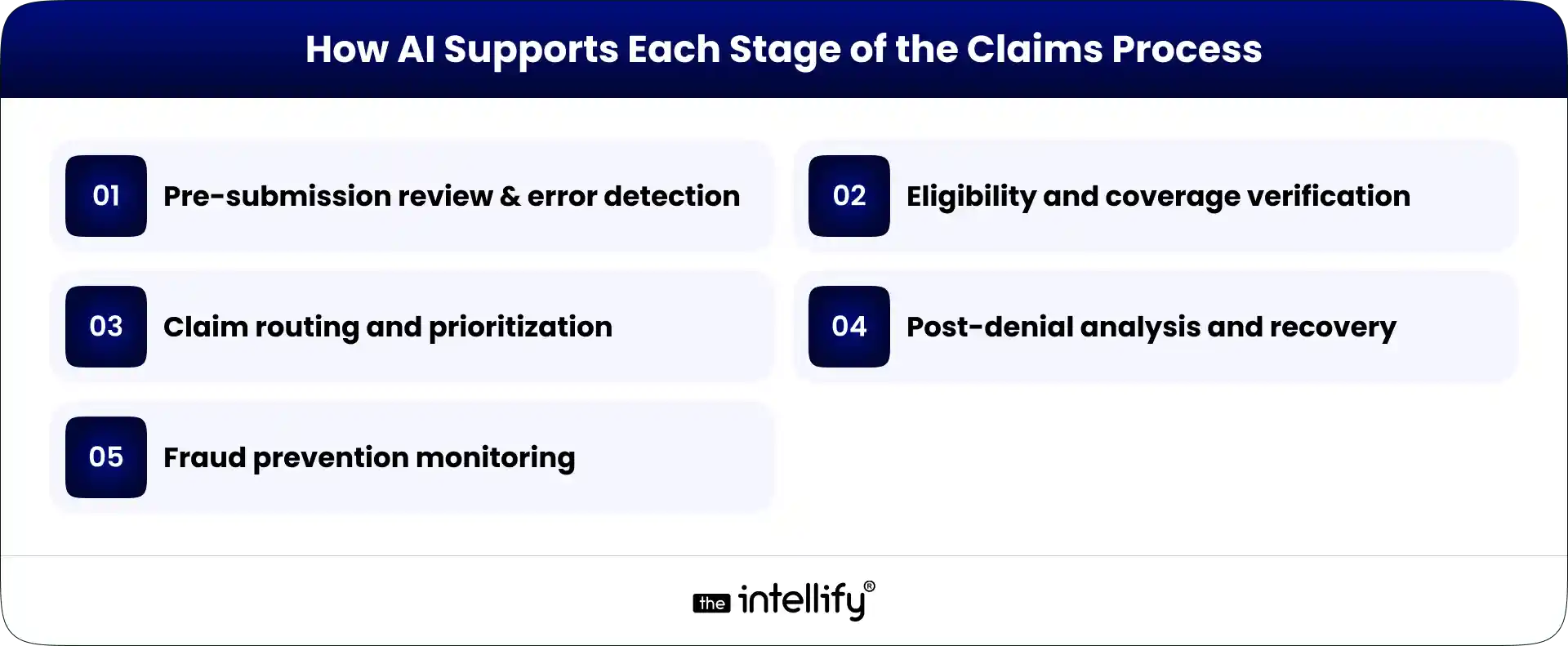
How AI Supports Each Stage of the Claims Process

How AI Supports Each Stage of the Claims Process

Let’s break it down in simple terms.

Pre-submission review and error detection

Before sending a claim, AI checks for missing fields, mismatches, and incomplete documentation. It’s like proofreading an email before hitting send. Basic, but powerful.

Eligibility and coverage verification

AI verifies patient coverage in real time. It checks whether services are covered under specific plans. Fewer surprises later.

Claim routing and prioritization

Some claims need faster attention. AI can prioritize high-value or high-risk claims automatically. This keeps critical cases moving.

Post-denial analysis and recovery

When a denial does happen, AI analyzes the reason and suggests corrective action. Instead of manually digging through records, teams get guided insights.

Fraud prevention monitoring

AI continuously monitors claim patterns. If something unusual appears, it flags it. Not dramatic. Just steady oversight.


Key Benefits for Healthcare Providers and Insurance Teams

Here’s what this actually means on the ground.

Faster claims processing cycles

  • Claims move from submission to reimbursement more quickly.
  • Less waiting. Less uncertainty.

Lower denial and appeal rates

  • When errors are caught early, denial rates drop.
  • Appeals become the exception, not the norm.

Reduced administrative workload

  • Teams spend less time correcting mistakes.
  • That time can go toward patient communication or financial planning instead.

Improved cash flow stability

  • Faster reimbursements create steadier revenue streams.
  • And steadier revenue reduces financial stress.

Stronger compliance readiness

  • With consistent validation and monitoring, audit risks decrease.
  • Documentation is more complete. Records are easier to retrieve.


AI for Healthcare Claim


Implementing AI in Healthcare: A Step-by-Step Approach

This isn’t a switch you flip overnight.

Assessing existing revenue cycle workflows

Start by mapping your current process. Where do errors happen most? Where are delays common? Be honest. Even if it’s uncomfortable.

Identifying high-impact automation areas

Focus first on steps with high denial rates or heavy manual effort. Small wins build confidence.

Selecting the right solution partner

Look for a partner who understands healthcare regulations and billing realities. Not just someone selling software.

Integration with EHR and billing systems

AI in Healthcare must integrate seamlessly with existing EHR and billing systems. Poor integration can disrupt workflows instead of improving efficiency.

Pilot deployment and staff training

Start small. Run a pilot. Train teams clearly. Change feels scary at first. That’s normal.

Monitoring performance and scaling

Track metrics. Compare denial rates before and after. If results are strong, expand gradually.


Understanding ROI in AI-Driven Claims Processing

ROI isn’t just about cost savings. It’s about control.

Reduction in denial rates

Even a small percentage drop in denials can translate into significant revenue protection.

Faster reimbursement timelines

Shorter payment cycles improve working capital.

Administrative cost savings

Less rework means fewer overtime hours and lower staffing pressure.

Revenue recovery improvements

AI can identify underpayments and missed billing opportunities.

Money that might have slipped through the cracks comes back.


Key performance indicators to track

  • Denial rate percentage
  • Days in accounts receivable
  • Cost per claim processed
  • First-pass claim acceptance rate
  • Appeal success rate

These numbers tell the real story.


Cost and Investment Considerations

AI requires investment. There’s no sugarcoating that.

Technology and licensing costs

Software subscriptions or platform licenses form the base cost.

Integration and infrastructure needs

Some upgrades to infrastructure or system connectors may be needed.

Training and change management

Teams need training. And time to adjust.

Ongoing maintenance and compliance

Systems require updates. Regulations change. Monitoring is continuous.


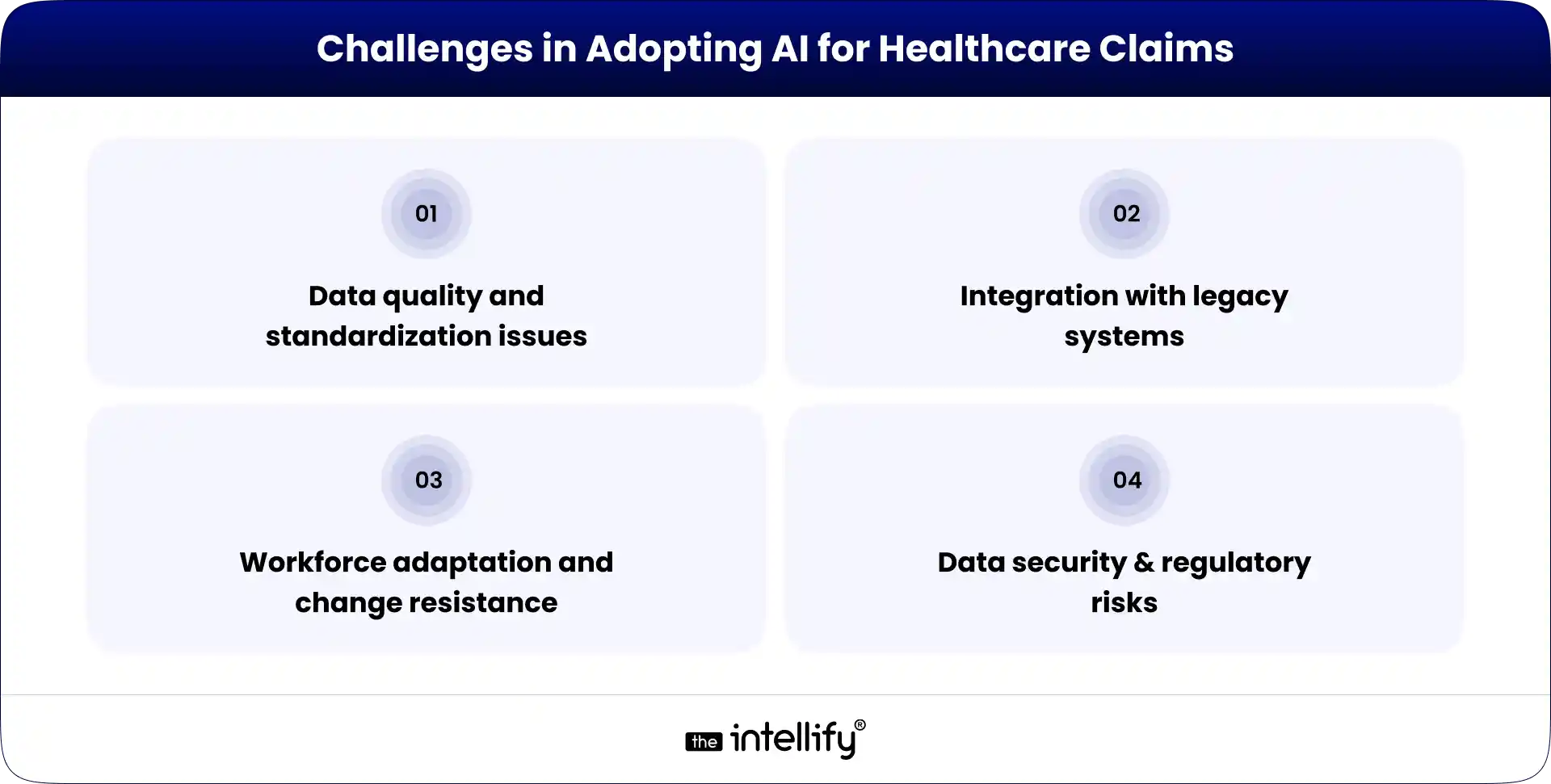
Challenges in Adopting AI for Healthcare Claims

Challenges in AI Healthcare Claims

It’s not all smooth sailing.

Data quality and standardization issues

If data is inconsistent or incomplete, AI struggles. Clean data matters more than fancy algorithms.

Integration with legacy systems

Older systems may resist integration. Sometimes the tech feels like it’s from 2009. And it probably is.

Workforce adaptation and change resistance

Some staff may worry about job security. Clear communication is essential. AI supports teams; it doesn’t replace them.

Data security and regulatory risks

Healthcare data is sensitive. Strong encryption, access controls, and compliance practices are non-negotiable.


Governance, Compliance, and Responsible Use

AI must be used carefully.

Data privacy requirements

Patient data must remain protected under regulatory standards. No shortcuts here.

Transparency in automated decisions

If a claim is flagged or rejected, there should be a clear explanation. Black-box decisions create trust issues.

Audit trails and accountability

Systems should log actions and changes. This supports audits and internal reviews.

Risk management practices

Regular system evaluations and compliance checks help reduce long-term risk.


The Future of AI in Healthcare Claims Management

The direction is clear:

Real-time claims adjudication

AI could enable near-instant claim review and approval. Imagine submitting and receiving confirmation within minutes. Not weeks.

Predictive revenue forecasting

Using historical data, AI can project revenue trends and identify risk periods ahead of time.

End-to-end revenue automation

From patient registration to final reimbursement, automation may streamline the full revenue cycle.

Expanding AI across healthcare operations

Claims are just one piece. Scheduling, patient communication, supply chain management AI is expanding across operations.


AI for Healthcare Claim Solutions


Conclusion

AI in healthcare is not about replacing people. It’s about reducing friction. It helps teams avoid preventable errors. It stabilizes cash flow. It reduces administrative pressure. But success depends on structured implementation. Clear goals. Clean data. Strong governance.
When done thoughtfully, AI transforms claims processing from a reactive process into a controlled, measurable system. And honestly? In a world where healthcare margins are tight and expectations are high, that kind of stability feels like a breath of fresh air.


Frequently Asked Questions (FAQs)

1. What does AI in healthcare claims management mean?

It means using intelligent software to review, validate, and process healthcare claims automatically. AI reads medical records, checks codes, and flags errors before submission. At The Intellify, we use AI to simplify claims workflows and reduce manual effort without disrupting existing systems.

2. How does AI help reduce claim denials?

AI reviews claims before they’re sent to payers. It detects missing details, coding mismatches, or policy conflicts early. By fixing issues upfront, providers avoid preventable denials and repeated rework.

3. Will AI replace human staff in claims processing?

No. AI handles repetitive checks and data validation. Human teams still manage decisions, exceptions, and compliance oversight. The goal is support not replacement.

4. Can AI detect fraudulent claims?

Yes. AI identifies unusual billing patterns and inconsistencies across large datasets. This helps flag potential fraud early and reduces financial risk.

5. What are the common challenges when adopting AI for claims?

Common issues include poor data quality, legacy system integration, and staff resistance to change. A structured rollout plan helps reduce these risks.

6. How does AI improve reimbursement speed?

By reducing errors and automating validation, AI increases first-pass acceptance rates. Fewer rejections mean faster approvals and quicker payments

Top 25+ AI Use Cases & Applications Across Industries in 2025

In 2025, artificial intelligence (AI) is no longer a futuristic concept; it’s an indispensable part of how industries operate and innovate. From diagnosing diseases to optimizing supply chains, AI is transforming every sector by improving decision-making, efficiency, and customer experience.
In this blog, we’ll explore more than 25 industry-proven AI use cases and real-world AI applications across major industries, based on current market insights, enterprise adoption trends, and practical results. Whether you’re looking into enterprise AI use cases, AI in the metaverse, or generative AI use cases in retail industry, this guide is built to show how transformative the technology is for healthcare, finance, government, manufacturing, education, insurance, and beyond.


Why AI Is Everywhere in 2025

AI is everywhere

The global AI market is expected to reach $407 billion by 2027, with nearly every enterprise exploring its potential. But what’s driving this adoption?

  • The rise of generative AI and autonomous agents is enabling faster automation and personalized interactions.
  • Advancements in natural language processing (NLP) and computer vision are unlocking new capabilities in customer support, fraud detection, quality control, and education.
  • Cloud-native, scalable AI platforms and APIs have made AI accessible even to small and mid-sized businesses.
  • Organizations of all sizes, whether B2B or B2C, are using AI to unlock value from their data and transform operations.

Let’s now explore how AI is creating real value across the world’s major industries.


AI use cases across industries


AI in Healthcare: Diagnosis, Personalization & Drug Discovery

Transforming Diagnosis and Care Delivery AI is reshaping the healthcare landscape with impactful applications of AI in healthcare such as early disease detection, personalized treatment plans, and continuous patient monitoring. Real-world AI use cases in healthcare include AI-powered radiology tools, robotic surgeries, AI-enabled drug discovery, and virtual health agents that improve patient engagement while reducing the burden on human professionals.

Example:
IBM Watson and Google’s DeepMind are helping hospitals detect conditions like diabetic retinopathy and breast cancer early.

Impact:

  • Reduced diagnostic errors by 30%
  • Shorter treatment cycles
  • Improved patient satisfaction


AI in Retail & Ecommerce:

AI in Retail & Ecommerce

Hyper-Personalization and Smart Shopping AI use cases in ecommerce are enabling real-time personalization, smart inventory management, and automated support. In the retail space, generative AI use cases in the retail industry range from AI-written product descriptions to personalized outfit recommendations and visual search tools that improve the customer shopping experience.

Example:
Zara uses AI to analyze customer behavior and automate stock replenishment. Sephora’s AI tool suggests makeup based on facial recognition.

Impact:

  • 3X increase in customer engagement
  • 15–20% uplift in average order value (AOV)
  • Reduced returns and improved loyalty


AI in Banking & Financial Services: From Risk to Robo-Advisors

Safer, Smarter AI in finance industry covers credit risk modeling, fraud detection, and customer support automation. Banks are using AI in banking, like natural language chatbots, algorithmic trading platforms, and intelligent document processing to reduce risk, boost compliance, and improve client satisfaction.

Example:
JPMorgan’s COIN platform reviews legal documents using NLP, saving 360,000 hours annually.

Impact:

  • Enhanced compliance
  • Reduced operational cost
  • Improved customer trust


AI in Insurance: Smarter Claims & Risk Prediction

Risk Assessment to Claims Automation AI applications in the insurance sector are solving key challenges in underwriting, claims processing, and fraud prevention. Popular AI use cases in insurance include AI-powered chatbots for claims assistance, machine learning models for policy pricing, and automation tools that enhance customer service and reduce operational cost.

Example:
Lemonade’s AI bot “Jim” handles claims in under 3 minutes, using NLP and image recognition.

Impact:

  • Up to 75% reduction in claims processing time
  • Higher transparency and customer satisfaction


AI in Manufacturing: Predictive Maintenance & Digital Twins:

AI in Manufacturing

Smarter Operations and Product Quality AI use cases in manufacturing include predictive maintenance systems, real-time defect detection through computer vision, and AI-based production line optimization. Applications of AI in manufacturing are helping businesses reduce downtime, improve quality control, and enhance demand forecasting.

Example:
GE Digital uses AI to optimize equipment uptime and avoid failures in industrial plants.

Impact:

  • 30–50% reduction in downtime
  • Better energy efficiency and leaner operations


AI in Education: Smart Learning & Assessment Tools:

Intelligent Learning and Assessment AI use cases in education span adaptive learning systems, automated grading, and virtual classroom environments. The application of AI in education improves accessibility and personalization by tailoring learning pathways based on student performance, while AI-powered assistants help educators design effective curriculum strategies.

Example: Platforms like Coursera and Duolingo use AI to personalize courses, while tools like Gradescope apply AI for accurate grading and academic feedback.


AI in Procurement & Supply Chain:

Agile and Efficient Logistics AI use cases in procurement include intelligent contract analysis, spend categorization, and supplier risk prediction. Meanwhile, AI applications in the supply chain are enabling predictive demand forecasting, automated inventory management, and logistics optimization for resilient and cost-efficient operations.

Example:
Unilever uses AI to monitor over 60,000 supply chain variables and optimize distribution in 190 countries.

Impact:

  • 20–30% reduction in logistics cost
  • Reducing delays and waste
  • Better supplier performance and sourcing agility


AI in Business & IT Operations: Process Automation at Scale

Smarter Workflows Enterprise AI use cases are transforming business processes across departments. AI use cases in business include customer segmentation, sales forecasting, HR recruitment automation, and decision intelligence. AI use cases in IT operations (AIOps) involve anomaly detection, root cause analysis, and predictive alerting to reduce outages and streamline service management.

Example:
Companies like Salesforce embed AI in CRM for lead scoring and next-best-action recommendations, while ServiceNow uses AI to resolve IT tickets autonomously.

Impact:

  • 40% improvement in service delivery time
  • Reduced downtime and cost per ticket


AI in Government: Smart Cities & Public Service Delivery

AI in Government

Proactive and Predictive Public Services Governments are using AI to enhance citizen services and improve decision-making. Prominent AI use cases in government include smart traffic systems, AI-powered citizen service bots, and predictive analytics for urban planning, social welfare targeting, and fraud detection in public services.

Example:
Dubai and Singapore use AI to manage traffic congestion, permits, and utilities. while India’s AI-driven tax fraud analytics has reduced leakage by over 30%.


AI in Agriculture: Precision Farming & Yield Prediction

Smart and Sustainable Farming Farmers are adopting AI applications in agriculture such as crop monitoring via drones, weather-based irrigation optimization, and pest identification using machine vision. These AI use cases help maximize yields while ensuring more sustainable farming practices and resource utilization.

Example: Startups like CropIn and Taranis use AI and satellite imagery to forecast harvests, manage irrigation, and reduce crop loss through timely alerts.


AI in Construction & Real Estate:

AI in real estate and construction industry include project planning through predictive analytics, site safety monitoring using AI cameras, and automated equipment scheduling. These technologies enhance operational efficiency, reduce waste, and ensure project timelines are met.

Example:
Buildots applies AI to track construction progress using 360° cameras and dashboards.
Doxel uses AI to track construction progress and detect delays in real time.

Impact:

  • On-time project delivery
  • Lower cost overruns and enhanced safety


AI in Metaverse & Virtual Worlds:

AI in Metaverse & Virtual Worlds

Interactive Digital Realities AI in the metaverse enables hyper-realistic avatars, personalized environments, and natural conversation interfaces. AI applications in this domain power immersive experiences using voice recognition, real-time emotion detection, and behavioral analytics, helping brands engage users in virtual economies.

Example: Meta and NVIDIA are leading this space by combining AI with real-time 3D graphics, enabling lifelike simulations and digital twins within the metaverse.


AI in Marketing: Personalization & Campaign Optimization

Automated Creativity and Personalization Marketers are embracing AI applications in marketing to optimize campaigns and create content at scale. Generative AI use cases include email copy generation, product ad variations, and A/B testing automation. AI also helps with consumer sentiment analysis and predictive customer behavior modeling.

Example:
Tools like Jasper and Copy.ai use generative AI to speed up content production. Netflix uses AI for personalized thumbnails, trailers, and watchlist curation and Coca-Cola uses OpenAI’s tools for ad ideation and content creation.

Impact:

  • Faster time-to-market for campaigns
  • Higher engagement with personalized content


AI in Media & Entertainment

Creative and Real-Time Storytelling From personalized recommendations to automated content editing, AI use cases in media and entertainment are reshaping content creation. Applications include deepfake generation, auto-captioning, real-time language translation, and content personalization across streaming platforms.

Example: Spotify’s AI curates playlists by understanding moods and listening behavior, while Adobe’s AI tools simplify post-production workflows.


AI in Tourism & Hospitality: Smart Experiences

AI in Tourism & Hospitality

Next-Level guest experience AI in tourism industry focus on enhancing service quality and operational efficiency. Key use cases include travel planning assistants, personalized booking engines, emotion-aware customer support, and predictive pricing engines for hotels and airlines.

Example: Expedia uses conversational AI for trip planning, while Hilton’s connected rooms leverage AI to adapt settings based on guest preferences.


AI in Legal & Compliance

Smarter Document Intelligence AI is increasingly vital in legal and compliance functions. AI tools can scan, analyze, and interpret massive volumes of legal documents, contracts, and case law in seconds. Law firms use AI for case prediction, while enterprises apply it to maintain compliance and audit trails. Tools like Luminance and Kira Systems help streamline contract reviews with high accuracy.


Emerging AI Use Cases


Building an Enterprise AI Strategy

  • Identify the right use cases for your business model.
  • Invest in scalable, explainable AI models.
  • Ensure compliance with data and ethical AI guidelines.
  • Partner with AI specialists to reduce risk and time-to-market.

Recommended Tools & Platforms:

  • OpenAI, Google Vertex AI, AWS Bedrock
  • Custom AI models via LangChain, RAG frameworks

Pro Tip:
Start with small, ROI-driven pilots and scale gradually across the organization.


Conclusion: AI Use Cases Are Business Use Cases

Artificial Intelligence isn’t just “good to have” in 2025, it’s essential. Every industry now has concrete, proven AI use cases that can drive ROI, efficiency, and customer satisfaction. Whether it’s through smarter chatbots, predictive analytics, or generative content, AI is transforming the way businesses operate. The time to adopt is now.
To succeed with AI in 2025:

  • Start small with high-ROI use cases
  • Ensure data readiness and governance
  • Choose scalable, secure AI platforms
  • Partner with an expert AI Development Company for implementation.

Whether you’re starting small with AI pilots or ready to build enterprise-wide solutions, the opportunities are vast, and the time to act is now.


AI development company

About The Intellify

At The Intellify, we build custom AI solutions for businesses across sectors. From predictive modeling to generative AI agents, we help you accelerate innovation and scale intelligently.

The Future of AI in Healthcare Industry: Chatbots & AI Agents

The healthcare industry is on the edge of a major transformation, and artificial intelligence (AI) is spearheading the change. AI agents and chatbots are reshaping the industry by automating processes like appointment scheduling, billing, and even assisting physicians with critical examinations. These innovations are optimizing the operational efficiency of healthcare institutions and enhancing patient care experiences simultaneously.

In this blog, we’ll cover how AI is shaping the future of healthcare, the differences between AI chatbots and AI agents, their advantages, key features, real-world applications, and what lies ahead.


Understanding AI in Healthcare: Why It Matters

Healthcare AI refers to the application of technology in the form of machines or software capable of performing language comprehension, data interpretation, and leveraging past experiences to generate outcomes and operate intelligently tasks that require human cognition.

The industry is riddled with problems such as an overwhelming number of patients to attend to, understaffed departments, and excessive administrative work. All of these concerns are AI solvable. The most impactful assets in healthcare AI include:

  • AI Chatbot: The healthcare AI chatbot is an automated system that engages with patients in conversations to provide assistance, handle simple queries, and perform basic tasks.
  • AI Agents: More sophisticated chatbots that can process data, take actions, learn from conversations, and make informed suggestions.


What Are AI Chatbots and AI Agents?

Both AI chatbots and AI agents have different functions in the healthcare system, although they might appear to be the same.

1. AI chatbot in healthcare sector

These are referred to as computer programs that healthcare providers utilize to interact with users. Healthcare chatbots can:

  • Guide patients through symptom-checking processes
  • Assist in scheduling appointments
  • Provide responses to FAQ’s
  • Send reminders for medication refills

They operate based on predefined scripts or use natural language processing (NLP) to understand human speech.

Curious how a real-world healthcare AI chatbot works?
Check out how we built an intelligent AI CareBot that’s transforming patient engagement and virtual assistance in real healthcare environments.
👉 Read the AI Carebot Success Story.

2. AI agents in the healthcare sector

AI agents in healthcare perform a bit more advanced tasks. They are autonomous systems that can:

  • Conduct analysis on medical records
  • Recommend treatments
  • Continuously monitor patient vitals
  • Aid users in diagnostic processes

AI agents are proactive, adaptable, and capable of handling complex tasks with little to no human assistance.


The Future of AI in Healthcare Industry

Future of AI in Healthcare Industry

The use and implementation of AI technologies in medicine is highly regarded for the potential benefits it could offer. With improvements in the fields of machine learning, voice recognition, and big data AI technologies, healthcare systems are becoming smarter, more reliable, and efficient.

Here’s what we can expect in the next 5–10 years:

  • hyper-personalized care based on real-time data & AI analysis.
  • 24/7 Virtual assistance for both patients and medical practitioners..
  • AI-powered diagnostics that are faster and more accurate
  • Automation of repetitive tasks leads to a reduction in administrative burdens
  • Monitoring predictive analytics for early disease detection and intervention.

AI will not replace doctors, but it will support them in decision making, fast-tracking processes, and optimizing patient results.


Key Benefits of AI Chatbots and AI Agents in Healthcare

Benefits of Chatbots & AI Agents in Healthcare

On Patients:

  • Faster access to care: Unlimited access to services unbound by time restrictions.
  • Instant answers: AI interaction assists with symptoms, medication, and others.
  • Personalized communication: Recalls user’s information and preferences driven by previous interactions.

On Healthcare Providers:

  • Decreased staff burnout: Streamlining issues such as scheduling and documentation increases efficiency.
  • Improved efficiency: Improvement in data analytics and diagnostics leads to faster processing.
  • Increased precision: Recognition of patterns that are difficult for humans to detect.

On Healthcare Systems:

  • Reduction in operational costs: Staff hours are saved for monotonous tasks.
  • Better resource management: Predicts patient volumes and manages beds effectively.
  • Stronger data security: AI-powered systems are efficient in detecting fraud or breaches, thus improving data security.


Real-World Use Cases of AI Chatbots and AI Agents in Healthcare

AI Chatbots Scope and Functionality:

a. Symptomatic Analysis

Symptom chatbots help with preliminary diagnosis and are commonly used in hospital settings these days. These applications ask questions and offer solutions based on their AI analyses.

b. Appointment Scheduling

Filling out forms and waiting on hold is now an obsolete practice with the use of AI and is no longer necessary while booking appointments. Scheduling bots are capable of checking the calendars of the doctors and booking the patients seamlessly.

c. Telemonitoring

AI powered agents can track metrics, offer guidance, and notify healthcare professionals when there’s an abnormality for conditions like diabetes or hypertension, thus aiding in managing chronic diseases.

d. Mental Wellness Assistance

Through organized dialogue, artificial intelligence chatbots provide emotional assistance at any time of the day. While they do not act as a substitute for therapists, they do provide some level of comfort and assist individuals in seeking appropriate professional support.

e. Virtual Nursing Assistants

Some chatbots are specialized virtual nurses who follow up with patients, respond to postoperative queries, and monitor adherence to care protocols.


AI chatbot & AI agent development


Primary Features to Look for in an AI Healthcare Chatbot

In addition to the functionality highlighted above, the AI chatbot development should also have the following:

  • Natural Language Processing (NLP) – To accurately interpret human speech.
  • Data Privacy Compliance – Compliant with HIPAA and GDPR for handling sensitive healthcare information.
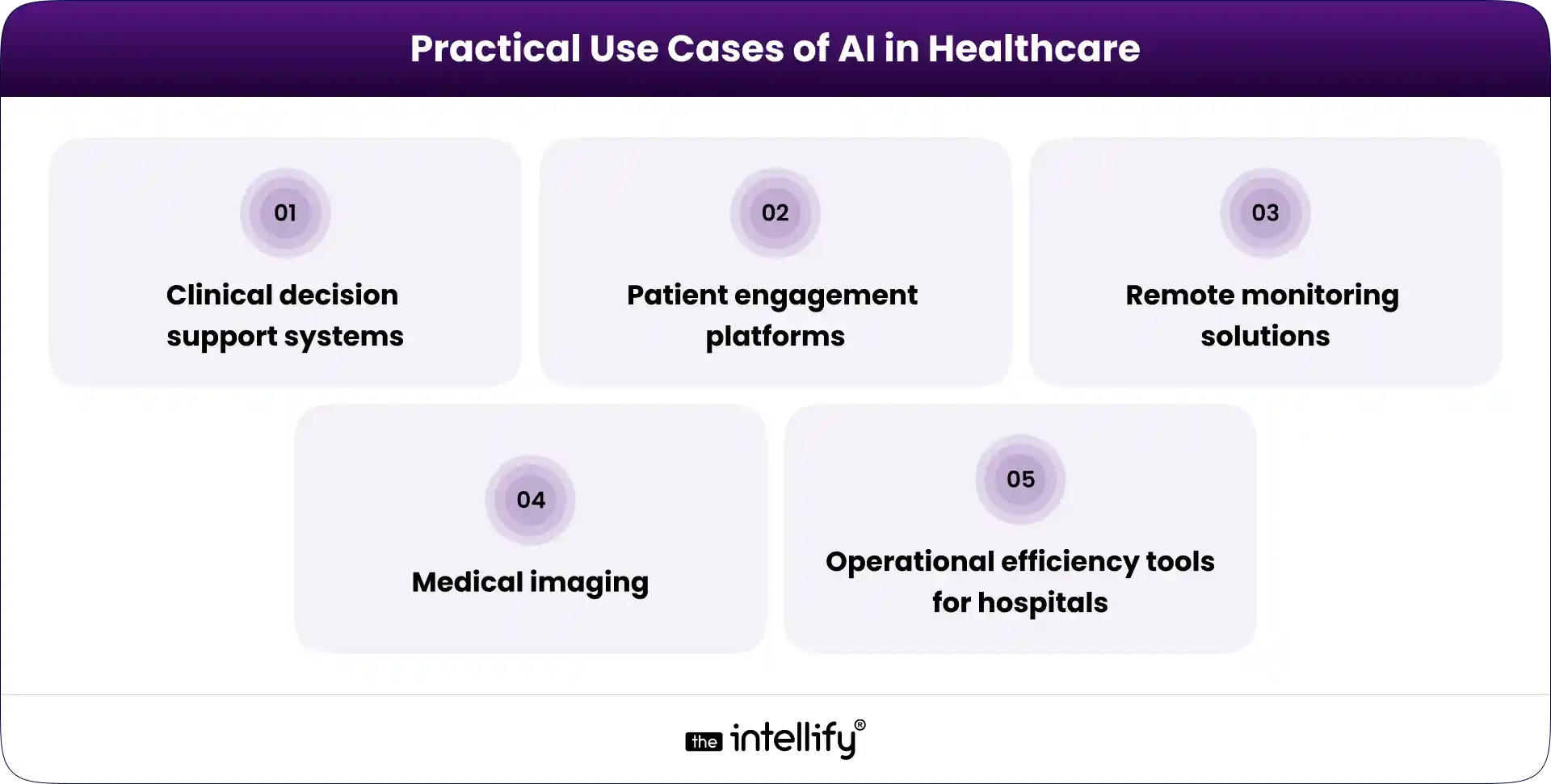
  • EHR Integration – Interfacing with electronic health records increases workflow efficiency.
  • Support in multiple languages – Very critical in heterogeneous patient populations.
  • 24/7 Assistance – Patients receive help at any time.
  • Learning Capability – Chatbots can use information from prior conversations to improve future interactions.


Challenges and Ethical Concerns

The areas above clearly show how helpful AI can be, but there are some issues that we cannot ignore.

AI Challenges in healthcare

To succeed, AI tools must be transparent, reliable, and used as supporting aids and not as replacements for human care.


How to Prepare for an AI-Driven Healthcare Future

Healthcare systems, including hospitals and clinics, as well as new healthcare ventures need to start considering the application of AI technologies.

Key Steps:

  • Start with small initiatives: Use AI for basic functions such as reminders and appointment scheduling.
  • Train your team: Ensure doctors and clinic staff possess the skills to utilize AI tools effectively.
  • Choose the appropriate partner: Collaborate with professionals specializing in AI who understand healthcare.
  • Focus on the patient: Strive to improve systems designed for patient outcomes and experiences.


Role of AI During Pandemics


Final Thoughts: AI is a Healthcare Game-Changer

The future of AI chatbots and AI agents in the healthcare industry is promising. As technology advances, its application will grow from virtual healthcare assistants to diagnostics and more. What’s most exciting is that AI can improve both productivity and human empathy in healthcare. Handling repetitive tasks allows greater attention to be given to people by physicians and nurses.


Why Choose The Intellify for AI Chatbot and AI Agent Development

Here at The Intellify, we design and develop intelligent AI chatbots and AI agents tailored for the healthcare industry.

Whether you are a hospital looking to streamline operational efficiency or a startup developing the next big healthcare software solution, we can help you:

  • Build HIPAA-compliant AI solutions
  • Conversational bots design with NLP techniques for your specific needs
  • Custom integrations of AI into your legacy systems (like EHR)
  • Trustworthy implementation of security and scalability, as well as user experience and satisfaction.
View
Case Study