Summary:
Healthcare membership platform development is transforming how providers deliver continuous, subscription-based care. This guide explains how membership models help organizations improve patient engagement, generate predictable revenue, and streamline operations. It covers essential features, development strategies, integration needs, and the role of automation and AI in modern healthcare systems. Whether you’re a startup or a DPC provider, this blog offers practical insights to build scalable, compliant, and patient-centric healthcare membership platforms.
In today’s healthcare landscape, organizations are increasingly looking into healthcare membership platform development. This change highlights the rising demand for ongoing and accessible care, as well as the need for steady revenue and enhanced patient engagement. As expectations soar for digital-first healthcare services, many providers are moving beyond traditional systems to offer innovative solutions. This guide will delve into the essentials of creating effective healthcare membership platforms and how they can improve long-term service delivery for both startups and Direct Primary Care (DPC) providers.
Why Organizations Are Developing Membership-Based Healthcare Apps
Growing demand for continuous and accessible care
Patients today aren’t just looking for one-off visits; they want ongoing access to their healthcare providers. Membership-based platforms make it easier to connect, ensuring that patients receive continuous care tailored to their needs.
Need for predictable revenue and stronger patient engagement
Membership models create a steady stream of income, helping organizations forecast finances more effectively. By nurturing ongoing relationships, these models foster patient loyalty and engagement, leading to better health outcomes.
Rising expectations for digital-first healthcare services
With the surge of digital solutions in other industries, patients expect the same convenience from healthcare. Membership platforms can meet these expectations with features like telemedicine and online appointment scheduling.
Why many providers are moving beyond traditional systems
Many healthcare providers find their existing systems inadequate, prompting a shift toward modern solutions that enhance both operational efficiency and patient satisfaction.
How a membership platform supports long-term service delivery
By offering flexible membership options, healthcare providers can establish sustainable business models that prioritize long-term patient health while streamlining operations.
What Your Membership Platform Needs to Support
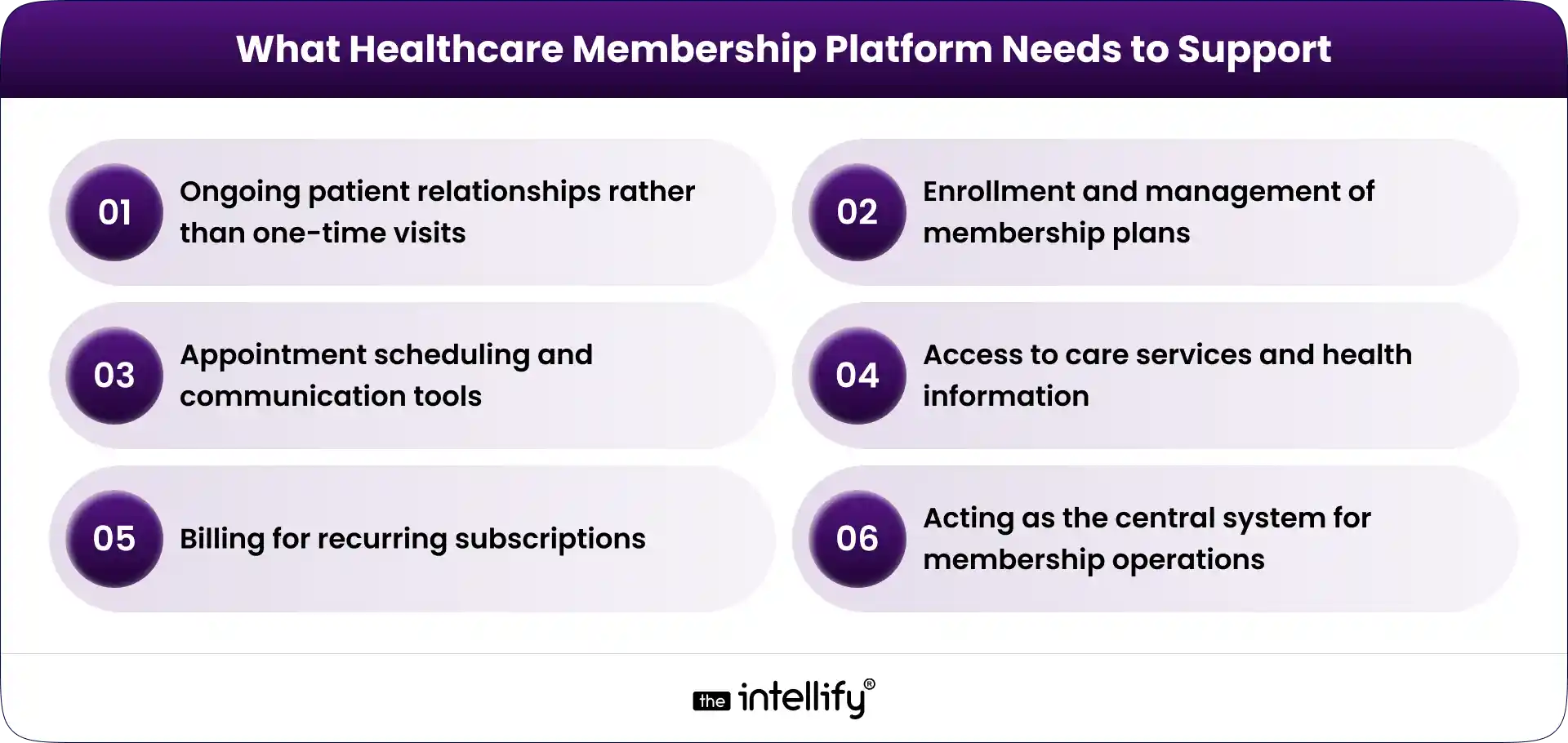
When planning your healthcare membership app development, keep these key functionalities in mind:
Ongoing patient relationships rather than one-time visits
Your platform should enable continuous engagement, allowing patients to easily reach out for advice or updates about their health.
Enrollment and management of membership plans
A smooth onboarding experience is key. Patients should find it easy to enroll in various membership plans, while providers should effortlessly manage these memberships.
Appointment scheduling and communication tools
Incorporate tools that let patients book appointments and communicate with their healthcare providers in real-time.
Access to care services and health information
Patients should have hassle-free access to their medical records and prescriptions, empowering them to take control of their health.
Billing for recurring subscriptions
Put in place a billing system that allows for automatic payments, reducing administrative tasks and enhancing the overall patient experience.
Acting as the central system for membership operations
Your platform should act as the hub for all membership-related activities, ensuring efficient management from enrollment to billing.
When and Why Companies Decide to Build One
The choice to invest in DPC platform development often varies between organizations and is frequently prompted by specific needs:
Launching new membership-based programs
If you’re looking to roll out new services, a dedicated membership platform can simplify that process.
Expanding telehealth or outpatient services
As telehealth gains traction, many providers recognize the need to broaden their digital offerings through membership applications.
Improving patient retention and accessibility
Membership models can help retain patients through enhanced engagement, making healthcare more accessible.
Creating scalable digital offerings
A well-crafted membership platform can easily adapt to growing needs, ensuring that your healthcare offerings expand alongside your business.
Responding to competitive pressure from modern providers
To maintain relevance, many organizations are updating their service models, and developing a membership platform is often a crucial step in that transformation.
A U.S.-based Direct Primary Care platform improved patient access and care coordination by implementing a secure digital solution across its services. The system streamlined operations for providers while keeping sensitive health data protected under strict privacy standards. This shows how modern AI-enabled technology can enhance healthcare delivery without compromising compliance. View the complete case study for more details: https://theintellify.com/work/healthcare2u/
Modernizing Legacy Systems for a Membership Model
Limitations of outdated healthcare software
Legacy modernization systems can become burdensome, hampering efficiency and negatively impacting the patient experience.
Fragmented tools and manual workflows
Fragmentation leads to inefficiencies and a higher likelihood of errors. Modernizing software can provide a unified solution.
Need for unified digital infrastructure
A centralized platform helps integrate various functionalities, streamlining operations across the board.
Options for modernization:
- Replacing legacy systems: Sometimes, a full overhaul is necessary for highly outdated systems.
- Integrating existing systems: Occasionally, it makes more sense to enhance and integrate what you already have.
- Phased transition strategies: Gradually shifting to a modern system can help ensure ongoing service continuity.
Ensuring continuity of ongoing services
Transitioning to a new system requires careful planning to avoid interruptions in patient care.
Core Features Required for a Healthcare Membership App
To truly benefit your patients and staff, your healthcare membership app should include some essential features:
Patient Experience
- Account creation and enrollment: A simple, frictionless sign-up process.
- Appointment booking and management: Easy scheduling.
- Secure messaging and communication: Direct lines to providers.
- Access to records and service details: Empowerment through information.
- Mobile-friendly interface: Accessibility on any device.
Provider & Staff Tools
- Patient management dashboard: Streamlined oversight of patient interactions.
- Care coordination features: Improved collaboration among healthcare providers.
- Workflow tracking: Real-time progress monitoring.
- Reporting and analytics: Insight into important operational metrics.
Membership & Billing Management
- Subscription plans and tiers: Flexible options for patients.
- Recurring payment processing: Automated billing features.
- Plan upgrades, renewals, and cancellations: Easy management for both patients and providers.
- Financial monitoring: Insight into membership performance.
Technology Architecture & Compliance Requirements
Cloud-based healthcare SaaS architecture:- A cloud-based solution boosts accessibility while ensuring data security.
Data security and privacy considerations:- Health information is sensitive, so your platform must guard against unauthorized access.
HIPAA-compliant system design:- Compliance with regulations is a must for navigating the healthcare landscape.
Role-based access and audit controls:- Set up access controls to protect data while still allowing your team the access they need.
Scalability and performance planning:- Your platform should be designed to grow alongside your organization’s needs.
How Automation Streamlines Operations
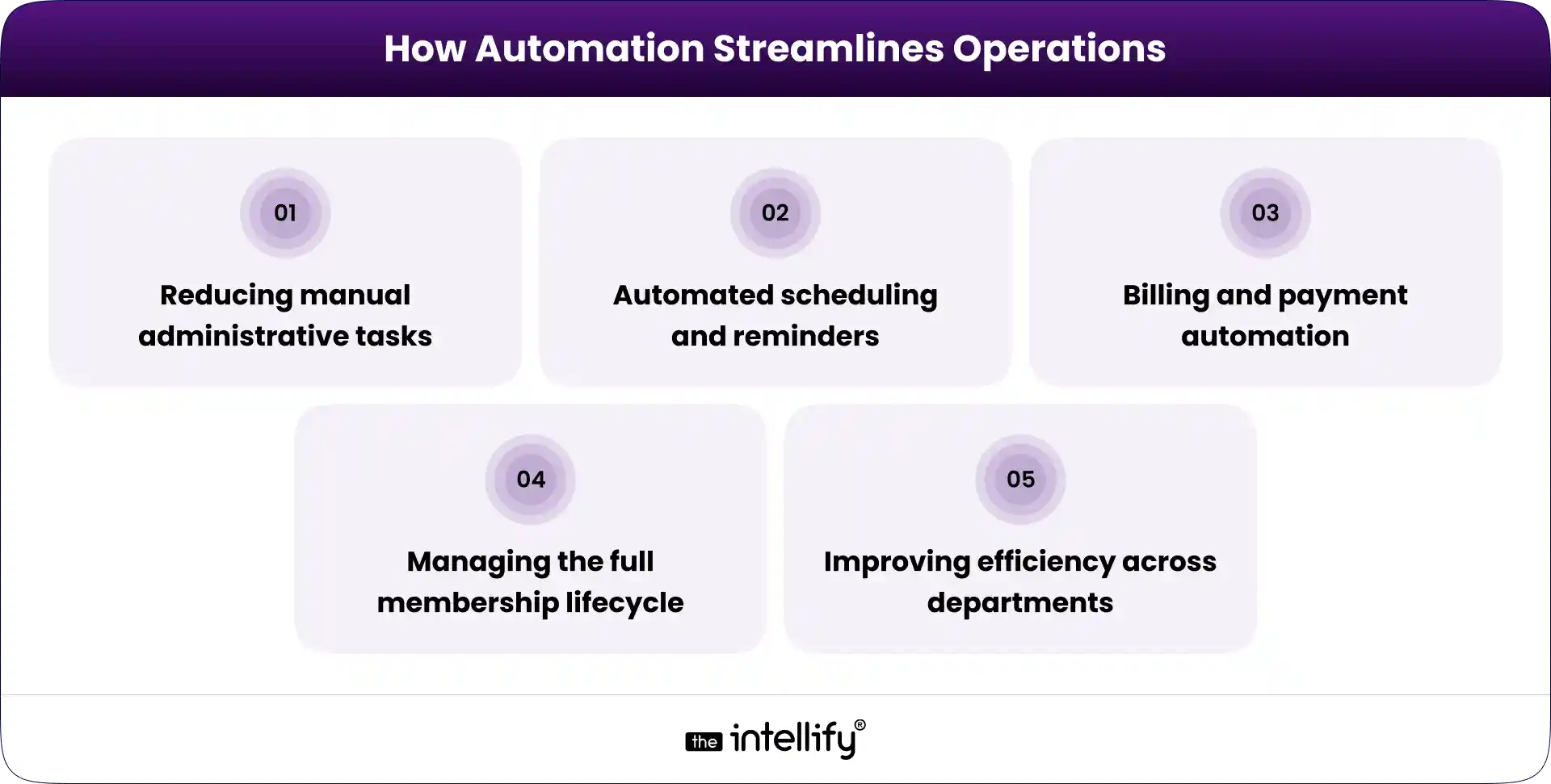
1. Reducing manual administrative tasks
Automating routine tasks can free up time for healthcare providers and support staff, ultimately leading to better patient care.
2. Automated scheduling and reminders
This can help reduce no-shows and keep patients informed about their upcoming appointments.
3. Billing and payment automation
An automated system simplifies financial processes, increasing both revenue and patient satisfaction.
4. Managing the full membership lifecycle
Efficient management of all membership stages from sign-up to renewal enriches the user experience.
5. Improving efficiency across departments
Streamlined workflows can enhance overall efficiency, benefiting both patients and providers.
The Role of AI in Advanced Membership Platforms
Intelligent scheduling and demand prediction:
AI can analyze patient data to optimize scheduling and predict demand for services.
Personalized patient engagement:
Harnessing AI allows for tailored content, significantly improving the patient experience.
Automated support and triage tools:
Chatbots can handle routine inquiries, letting clinical staff focus on complex cases.
Insights for operational planning:
AI can sift through operational metrics, guiding organizations in making informed decisions.
Enhancing decision-making while supporting clinicians:
AI tools can provide actionable insights to help healthcare providers improve care delivery.
Integration With Existing Healthcare Systems
- Connecting with electronic health records:- Seamless integration ensures that all patient data is synchronized across platforms.
- Integration with labs, pharmacies, and diagnostics:- Connecting with third-party services can streamline operations and elevate patient care.
- Payment gateways and communication tools:- Make sure your platform can effectively manage transactions and facilitate communication.
- Ensuring data consistency across platforms:- Data consistency helps prevent errors and enhances the user experience.
- Importance of interoperability for smooth operations:- An interconnected healthcare landscape is crucial for continuity of care.
Development Approach: How Organizations Build the Platform
1. Defining scope and requirements:- Before diving into development, clarify what your platform needs to accomplish.
2. Choosing custom development or adapting existing solutions:- Evaluate whether a tailored solution or adapting a pre-existing platform fits your needs better.
3. Selecting internal teams or external partners:- Decide whether to use in-house talent or hire external experts for development.
4. Designing for scalability and future expansion:- Ensure your system is robust enough to grow with your organization.
5. Testing and validation before launch:- Pilot testing is essential to ensure everything runs smoothly upon launch.
Implementation & Adoption Strategy
Preparing staff through training:- Thorough training is key to facilitating smooth transitions to new systems.
Updating workflows to align with the new system:- Make sure that all workflows are updated to maximize efficiency.
Educating patients about the membership model:- Open communication with patients regarding the new model is crucial for buy-in.
Phased rollout versus full launch:- Consider whether to roll out your platform gradually or all at once based on user feedback.
Monitoring early performance and feedback:- Collecting feedback post-launch can lead to necessary improvements.
Continuous improvements after deployment:- Keep assessing the platform to enhance its effectiveness over time.
Cost Considerations and Investment Factors
- Key drivers of development costs:- Initial costs will cover development and compliance, but don’t forget to budget for ongoing maintenance.
- Infrastructure and compliance expenses:- Investing now can lead to considerable long-term savings.
- Integration complexity:- Complex integrations may require additional resources, impacting your initial investment.
- Ongoing maintenance and support:- Ensure you set aside a budget for long-term support and maintenance needs.
- Factors affecting long-term ROI:- Evaluate how your platform will generate revenue over time for a clearer picture of ROI.
Key Challenges to Plan for Early
1. Resistance to organizational change:- Get staff on board with new systems to facilitate a smoother transition.
2. Migrating data from legacy systems:- This can be tricky, but it is essential for centralized information management.
3. Security and privacy considerations:- Continuous review of data protection measures is crucial.
4. Balancing customization with usability:- Find the right balance so the platform meets unique needs without overwhelming users.
5. Maintaining service continuity during transition:- Be proactive about ensuring service stays steady during the shift.
Conclusion
In summary, healthcare membership platform development is reshaping how organizations deliver care. By adopting this model, providers can boost patient engagement, streamline operations, and establish sustainable practices. Thoughtful planning and cross-team coordination are vital for long-term success. If you’re considering making the leap into membership-based healthcare services, now’s the perfect time to evaluate your readiness for this transformative journey!
Frequently Asked Questions (FAQs)
1) What is a healthcare membership platform, and how does it work?
A healthcare membership platform is a digital system that allows providers to offer ongoing care through subscription plans instead of one-time visits. Patients enroll, pay recurring fees, and access services like appointments, communication, and care coordination through a single app or portal.
2) Who should consider building a healthcare membership app?
Organizations that want predictable revenue, stronger patient relationships, and scalable digital services benefit most. This includes clinics, telehealth providers, startups, and healthcare groups expanding preventive or continuous care programs.
3) How is a membership platform different from a traditional patient portal?
A traditional portal mainly supports appointment booking and records access. A membership platform manages the entire lifecycle, including enrollment, subscriptions, communication, billing, and ongoing care delivery, making it the operational core of membership-based services.
4) What core features are essential for a successful membership healthcare app?
Key capabilities include membership enrollment, recurring billing, appointment management, secure communication, patient records access, and administrative tools for providers. Without these, managing ongoing care relationships becomes difficult.
5) How does automation improve day-to-day operations?
Automation reduces manual tasks such as scheduling, reminders, billing, and membership renewals. This allows staff to focus more on patient care while improving accuracy and operational efficiency across departments.
6) How long does it typically take to develop and launch a membership platform?
Timelines vary depending on complexity, integrations, and compliance requirements. Many organizations start with a focused version, test it with a pilot group, and expand gradually to reduce risk and ensure smooth adoption.
7) What are the biggest challenges organizations face during implementation?
Common challenges include staff resistance to change, migrating data from older systems, ensuring security and compliance, and redesigning workflows. Careful planning and phased rollout strategies help overcome these issues.