AI in AR & VR: Redefining Intelligent Immersive Experiences

Summary:
AI is making AR and VR smarter, turning static experiences into adaptive, personalized environments. From training and healthcare to retail and gaming, intelligent immersive systems are improving engagement, learning, and decision-making. This blog explores how AI is shaping the future of immersive technology across industries.


In a world where technology is changing faster than ever, AI in AR and VR is reimagining how we engage with digital environments. Augmented Reality (AR) and Virtual Reality (VR) started as platforms that focused purely on immersive visuals. However, today’s users are looking for interactions that are not just immersive but smarter and more intuitive as well. This evolving expectation has set the stage for artificial intelligence to become a fundamental component in shaping these immersive systems.

What this shift means is that digital experiences are no longer static displays; they’re transforming into intelligent ecosystems that can learn from us, adapt in real time, and provide personalized interactions. In this blog, we’ll delve into how AI is reshaping AR and VR, the key technologies driving this transformation, and the real-world applications that are making an impact across various industries.


How Artificial Intelligence Transforms AR and VR

How AI Transforms AR and VR

From Static Environments to Adaptive Systems

The days of AR and VR experiences being merely static presentations are behind us. With AI integration in AR and VR, these environments can now adjust based on real-time user interactions, creating a responsive landscape. This adaptability not only enhances user engagement but also makes the experience feel immersive and personalized.

Learning from User Behavior

AI allows AR and VR systems to learn from user behaviors and preferences. By analyzing how people interact, these systems can tailor experiences specifically to what users enjoy. This kind of responsiveness is crucial for keeping users engaged and satisfied.

Context-Aware Interaction

Thanks to advancements in AI, AR, and VR can now understand the context of interactions. This means users can expect systems to respond not only to their immediate actions but also to surrounding environmental cues. For instance, in a VR game, the difficulty level might automatically adjust based on a player’s skill, making for a more enjoyable experience.


Core Technologies Powering Intelligent Immersion

Generative AI for Dynamic Content

Generative AI is vital in creating content that can evolve. Instead of relying solely on pre-loaded graphics, immersive experiences can now generate environments, characters, and scenarios on the fly, dramatically enriching user engagement.

Computer Vision and Spatial Awareness

Computer vision enhances spatial awareness in immersive experiences. It equips AR systems to recognize real-world objects and overlay relevant info seamlessly, crafting a blended reality that heightens the user’s understanding of their surroundings.

Conversational Interfaces and Smart Avatars

Integrating conversational interfaces such as smart avatars facilitates natural conversations within AR and VR. Users can interact using their voices, adding layers of realism and making the experience feel more relatable and engaging.

Predictive and Behavioral Systems

These systems can anticipate user needs and preferences. By analyzing behavioral data, they can suggest actions or content, leading to a more intuitive experience that feels custom-made.


AI Personalization in Immersive AR/VR Experiences

Adaptive Learning and Training

In educational settings, AR and VR combined with AI can adapt to each learner’s pace. This means students receive personalized feedback and tailored educational journeys, which significantly improve learning outcomes.

Interactive Entertainment

The gaming and entertainment industries are undergoing a transformation. AI-driven avatars and dynamic narratives create unique experiences for each user, ensuring that no two gaming sessions feel the same.

Immersive Commerce

AR is reshaping the online shopping landscape by allowing users to virtually try on products before making a purchase. Imagine seeing how a new sofa fits into your living room through your smartphone while AI suggests additional furniture based on your personal style.

Enterprise and Workplace Applications

In corporate training and simulations, AR and VR are providing hands-on learning experiences by creating realistic, immersive environments. AI enhances these experiences, ensuring they are both relevant and impactful.


Mid-CTA


Real-World Applications of AI in AR/VR Across Industries

Healthcare

AI in AR and VR stands to revolutionize training for medical professionals. By simulating surgeries and complex procedures, practitioners can gain vital experience without any risk to patients. Plus, AR can support surgeons during operations by overlaying essential information onto their field of view.

Education and Workforce Development

In both schools and workplaces, immersive learning driven by AI is equipping students and employees for the future job market. Engaging environments not only enhance information retention but also skill development.

Manufacturing and Operations

AI-powered VR simulations can aid in training operators on complex machinery, minimizing risks and boosting efficiency. Workers can practice scenarios and gain insights into operations without physical trials.

Retail and Real Estate

In retail, brands are leveraging AR to give customers a feel for how products might fit in their lives. In real estate, AI-enhanced virtual tours allow potential buyers to explore properties more interactively, facilitating informed decision-making.


Business Value of Intelligent Immersive Systems

• Higher engagement and retention: Users are more likely to return when their experiences are tailored to their preferences.

• Improved learning outcomes: Personalized training leads to quicker skill acquisition and better knowledge retention.

• Operational efficiency: Companies can reduce costs by optimizing training and cutting down on errors through immersive learning solutions.

• Better customer insights: Collecting data on user interactions helps brands understand customer needs, leading to better product offerings.

• Scalable personalization: AI empowers businesses to efficiently scale personalized experiences as they grow.


Implementation and Key Challenges

Infrastructure and Performance

For organizations to effectively harness AI in AR and VR, robust infrastructure is crucial. It’s essential that systems can support high-performance demands.

Data Responsibility

With powerful tools come great responsibilities. It’s vital to handle user data ethically and transparently to build trust.

Clear Strategic Alignment

Aligning AI initiatives with broader business goals ensures that investments yield tangible benefits. Companies need a clear vision of how AI will influence their operations and customer interactions.


The Future of AI in AR/VR beyond 2026

Looking ahead, several trends are starting to emerge:

• More natural human-machine interaction: We can expect AI to streamline interactions, bridging the gap between users and technology.

• Emotion-aware virtual systems: AI could help design environments that adapt according to users’ emotional states, making interactions even more personalized.

• Persistent immersive environments: Users might soon have the ability to seamlessly leave and re-enter the same AR/VR spaces without losing any progress.

• Faster, seamless real-time experiences: As technology continues to evolve, the speed and fluidity of immersive experiences are set to improve significantly.
 

Bottom CTA


Conclusion

AI isn’t just enhancing AR and VR; it’s transforming how we engage with digital content. As businesses adopt these intelligent immersive systems, they uncover new opportunities for engagement, learning, and interaction. Embracing this revolution means staying ahead of the curve, offering futuristic experiences today, and laying the groundwork for tomorrow’s innovations. Curious about how AI can reshape your business? Get in touch with us at The Intellify today!


Frequently asked questions (FAQs)

1. What is AI in AR and VR?

AI in AR and VR uses advanced algorithms to create immersive experiences that adapt to user preferences and behaviors, resulting in greater engagement.

2. How does AI enhance the user experience in AR and VR?

AI personalizes interactions, learns from behaviors, and crafts context-aware environments, making experiences more immersive and enjoyable.

3. What industries benefit most from AI in AR and VR?

Industries like healthcare, education, retail, and manufacturing have seen significant strides in training, customer engagement, and operational efficiency through AI-driven AR and VR solutions.

4. What technologies power intelligent immersive experiences?

Core technologies include generative AI for content creation, computer vision for spatial awareness, and smart avatars for conversational interfaces.

5. What challenges come with implementing AI in AR and VR?

Key challenges include ensuring infrastructure meets performance needs, managing user data responsibly, and aligning AI efforts with strategic business objectives.

6. What does the future hold for AI in AR and VR?

Trends indicate advancements in emotional awareness, natural interactions, and persistent environments, paving the way for richer, more engaging experiences.

7. How can The Intellify assist in integrating AI into AR/VR Solutions?

The Intellify offers tailored solutions to optimize immersive systems, ensuring businesses leverage AI effectively for maximum engagement and efficiency.

How AI Automation Is Transforming Internal Operations in HR, Finance & IT

Summary:
This blog explains why AI automation is becoming essential for modern business operations. It covers how AI automation differs from traditional automation, where it fits across HR, finance, and IT, and the real operational costs of relying on manual processes. The article also explores industry use cases, measurable benefits, implementation steps, and future trends, helping businesses understand how AI automation improves efficiency, accuracy, scalability, and employee productivity across internal teams.
 

Why AI Automation Is Becoming a Business Imperative

Most internal teams today are stretched thin. HR is juggling hiring and onboarding. Finance is chasing invoices and approvals. IT is buried under tickets that all feel “urgent.” None of this is new, but the pressure has quietly crossed a line.

The problem isn’t effort, it’s volume. As businesses grow, internal operations don’t just get bigger; they get messier. Manual handoffs increase. Dependencies multiply. One missed approval email can stall an entire process. We’ve all seen it happen. You wait. You follow up. You wait again.

Traditional automation helped for a while. Rule-based workflows, scripts, and macros are useful, but rigid. They work only when everything behaves exactly as expected. And let’s be honest, real operations never do. That’s why AI automation is no longer a “nice to have.” It’s becoming a strategic requirement.

This guide breaks down what AI automation really means, how it fits into HR, finance, and IT operations, what happens when businesses delay adopting it, and how organizations can implement it without chaos or burnout.


What Is AI Automation and How Is It Different?

AI automation goes beyond predefined rules. Instead of just following instructions, it learns from data, adapts to patterns, and supports decisions, not just tasks. This difference matters more than it sounds.

Aspect Basic Automation AI Automation
System Logic Works on fixed rules. If X happens, it does Y. Learns from past data and improves decisions over time.
Workflow Behavior Follows static workflows that break when conditions change. Adapts automatically when inputs, priorities, or situations shift.
Response to Change Needs manual updates for every new scenario. Adjusts on its own based on patterns and context.
Task Handling Focuses only on completing predefined tasks. Supports smarter decisions along with task execution.
Error Management Often misses unusual cases or exceptions. Detects anomalies and flags risks early.
Scalability Becomes harder to manage as processes grow. Scales easily with increasing data and complexity.
Business Impact Improves speed but offers limited intelligence. Improves speed, accuracy, and strategic insight.


Where AI Automation Fits in Internal Operations

AI automation isn’t limited to one department. It sits quietly across daily operations, smoothing edges where friction usually shows up.

1. It supports daily process management, keeping routine workflows moving without constant supervision.

2. It powers data-driven workflows, where decisions are based on real-time signals instead of outdated reports.

3. It improves cross-functional coordination, so HR, finance, and IT stop working in isolation.

Think fewer “Who owns this?” emails and more things simply moving forward.


The Cost of Operating Without AI Automation

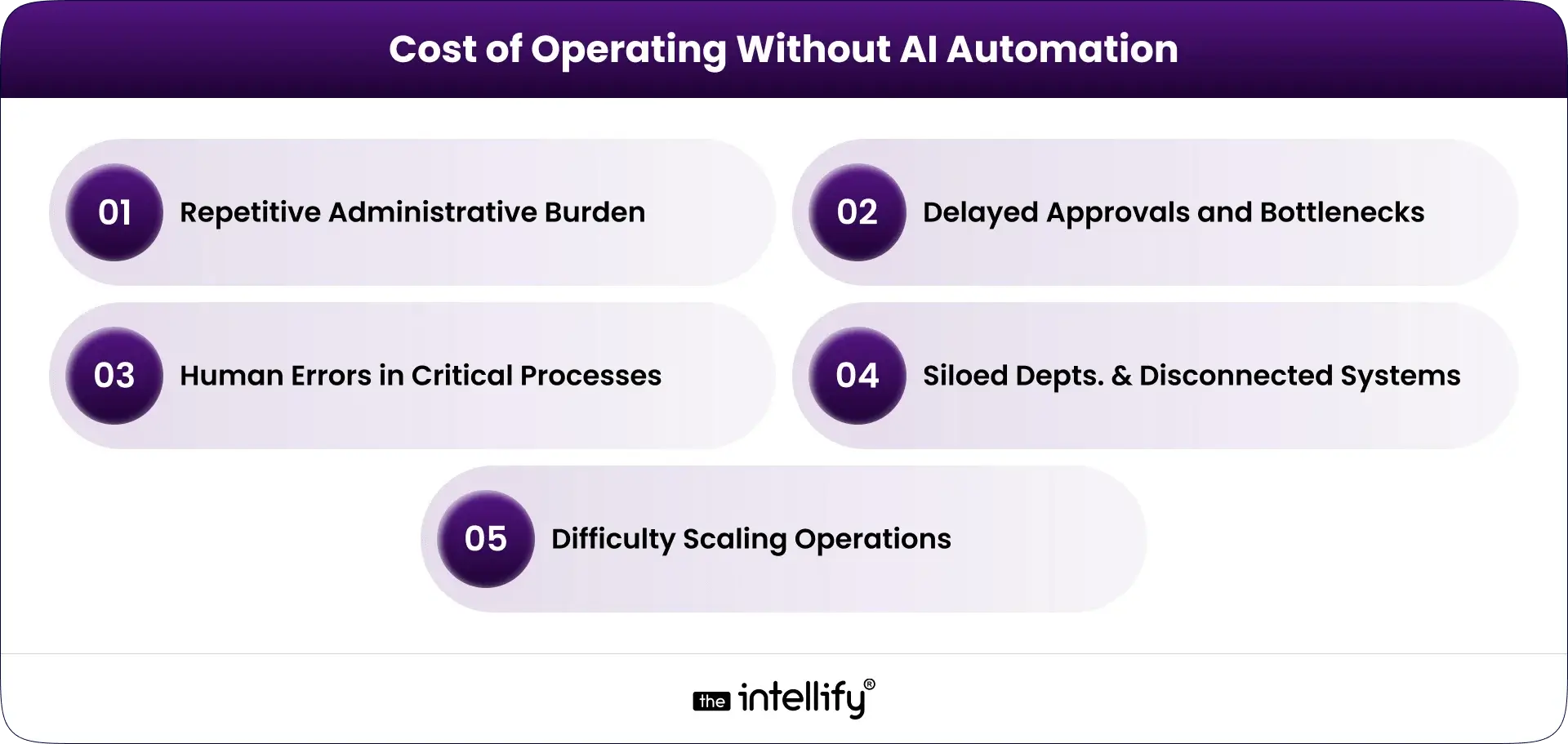
Cost of Operating Without AI Automation

Avoiding AI automation doesn’t keep things stable. It slowly makes operations heavier, slower, and harder to scale.

Repetitive Administrative Burden

Teams spend hours on data entry, document checks, and manual updates. It’s exhausting work, and nobody was hired for it.

Delayed Approvals and Bottlenecks

One unavailable manager. One missed notification. Suddenly payroll, procurement, or onboarding stalls. These delays compound quickly.

Human Errors in Critical Processes

Manual systems invite mistakes. A wrong number in payroll. A duplicate invoice. A missed compliance deadline. Fixing errors costs more than preventing them.

Siloed Departments and Disconnected Systems

When systems don’t talk to each other, people fill the gap with emails, spreadsheets, and workarounds that don’t scale.

Difficulty Scaling Operations

Growth without automation means hiring more people just to keep up. That’s expensive and unsustainable.


Market Trends and Adoption of AI Automation

AI automation adoption is accelerating, especially in mid-sized and large enterprises.

Organizations are investing heavily in intelligent workflows that reduce dependency on manual coordination. There’s a clear shift toward operational intelligence, where systems don’t just execute, they observe and suggest improvements. And businesses are prioritizing automation now because labor costs, compliance pressure, and customer expectations are all rising at once. Waiting feels safer, but it’s usually costlier.


AI Automation in HR – Smarter Workforce Management

HR teams deal with sensitive data, tight timelines, and constant context switching. AI automation helps by quietly removing friction.

Intelligent Hiring and Resume Screening

AI systems scan resumes, rank candidates, and highlight relevant experience without bias creeping in through fatigue or rushed decisions.

Automated Onboarding and Documentation

Offer letters, policy acknowledgments, and account setup are handled automatically, so new hires don’t start their first day confused or blocked.

Payroll, Attendance, and Compliance Support

AI automation flags inconsistencies before payroll runs and ensures compliance checks don’t rely on memory or spreadsheets.

Employee Performance and Engagement Insights

Patterns in feedback, attendance, and output help HR act early before disengagement turns into attrition.


AI Automation in Finance – Faster, Smarter Financial Operations

Finance teams need accuracy, speed, and clarity. AI automation supports all three without adding risk.

Invoice and Expense Automation

Invoices are matched, validated, and approved faster, with anomalies flagged instead of overlooked.

Budget Planning and Financial Forecasting

AI models analyze trends and adjust forecasts dynamically no waiting for month-end closures.

Fraud Detection and Risk Monitoring

Unusual transactions stand out immediately, not weeks later during audits.

Regulatory Compliance and Reporting

Compliance checks become continuous, not reactive. Reporting becomes simpler, cleaner, and more reliable.


AI Automation in IT Support – Smarter, Faster Service Delivery

IT teams are expected to keep everything running, often with limited resources.

Smart Helpdesk and Ticket Management

AI categorizes tickets, assigns priority, and routes issues automatically. No more manual triage.

Automated Issue Detection and System Monitoring

Problems are detected before users complain. Sometimes, before anyone notices at all.

AI Chatbots for Internal Support

Employees get instant answers to common IT questions without waiting in queues.

Workflow Automation for IT Teams

Patch management, access provisioning, and routine tasks happen on schedule without reminders.


AI Automation Across Industries: Real-World Applications

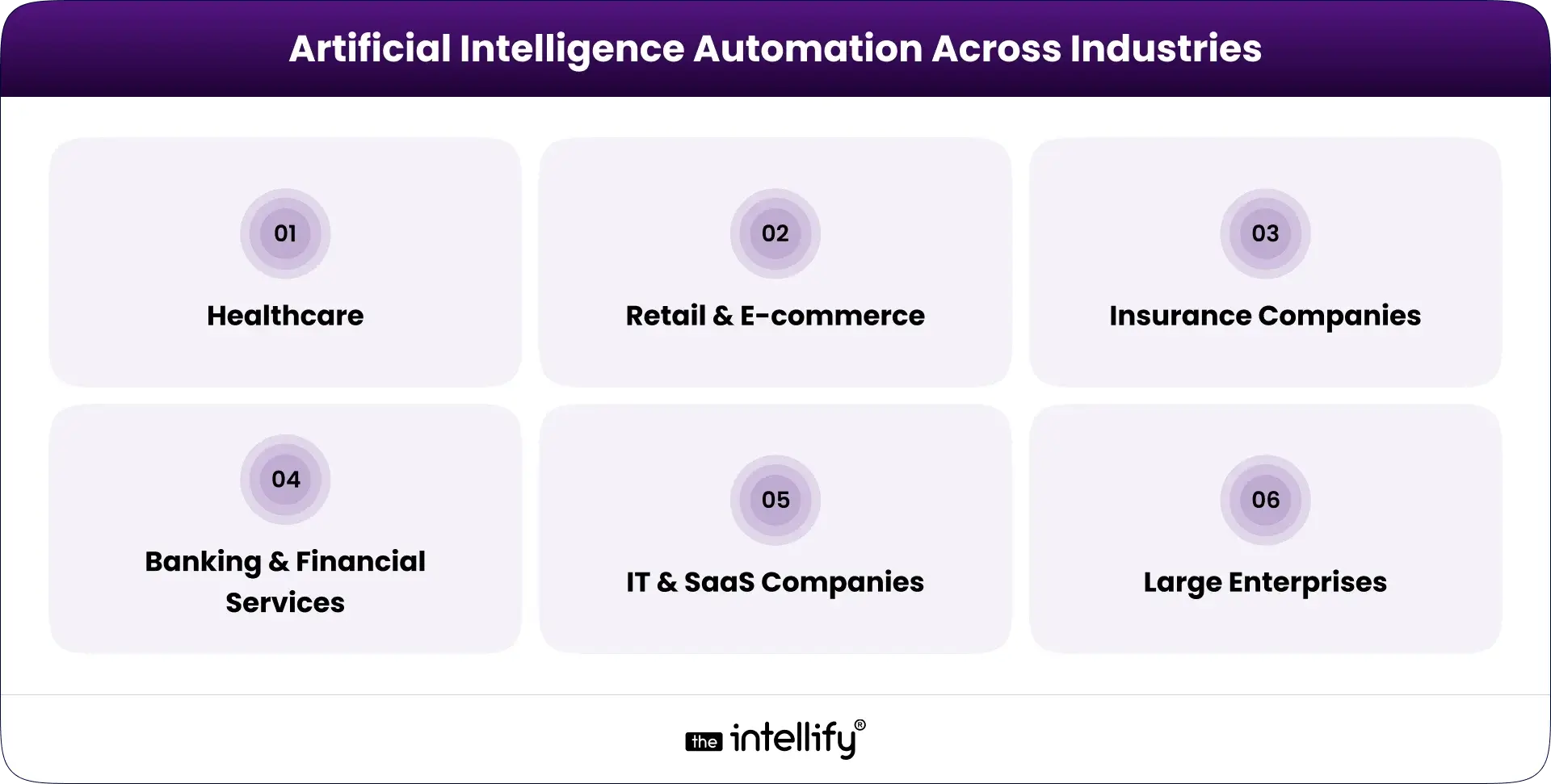
AI automation across industries

Healthcare

  • Patient billing workflows run faster and cleaner.
  • Staff scheduling adapts automatically to demand and availability.

Retail & E-commerce

  • Inventory and finance systems stay in sync.
  • Workforce scaling during peak demand becomes predictable, not chaotic.

Insurance Companies

  • Claims processing accelerates.
  • Risk assessment becomes more consistent.

Banking & Financial Services

  • Loan processing automation reduces turnaround time.
  • Risk monitoring systems catch issues early.

IT & SaaS Companies

  • Internal support systems scale with growth.
  • Subscription revenue forecasting improves accuracy.

Large Enterprises

  • Multi-location operations stay coordinated.
  • Global compliance becomes manageable instead of overwhelming.


AI automation solutions


Key Benefits of AI Automation Across Internal Teams

AI automation brings steady, practical improvements to how teams work every day. It focuses on removing friction, not adding complexity.

1. Reduced operational costs

By cutting manual work and reducing errors, AI automation helps lower processing and rework costs without affecting quality.

2. Increased productivity

Teams spend less time on routine tasks and more time on meaningful work, improving overall output and focus.

3. Improved accuracy and compliance

Built-in checks and monitoring reduce mistakes in payroll, invoicing, and reporting, while keeping compliance on track.

4. Faster, data-backed decisions

Real-time insights replace delayed reports, helping managers act quickly and with confidence.

5. Better employee experience

Less repetitive work means lower stress and better engagement across departments.

6. Scalable growth without increasing headcount

Operations can grow without constantly adding staff, making expansion more manageable.


AI Automation as an Operational Partner, Not a Replacement

AI automation supports people. It doesn’t replace them.

1. Supporting HR Professionals:- HR spends less time on admin and more time on people.

2.Enabling Finance Teams to Focus on Strategy:- Finance shifts from reconciliation to planning and insight.

3.Empowering IT Teams with Predictive Tools:- IT becomes proactive instead of reactive.


Steps to Implement AI Automation in Your Organization

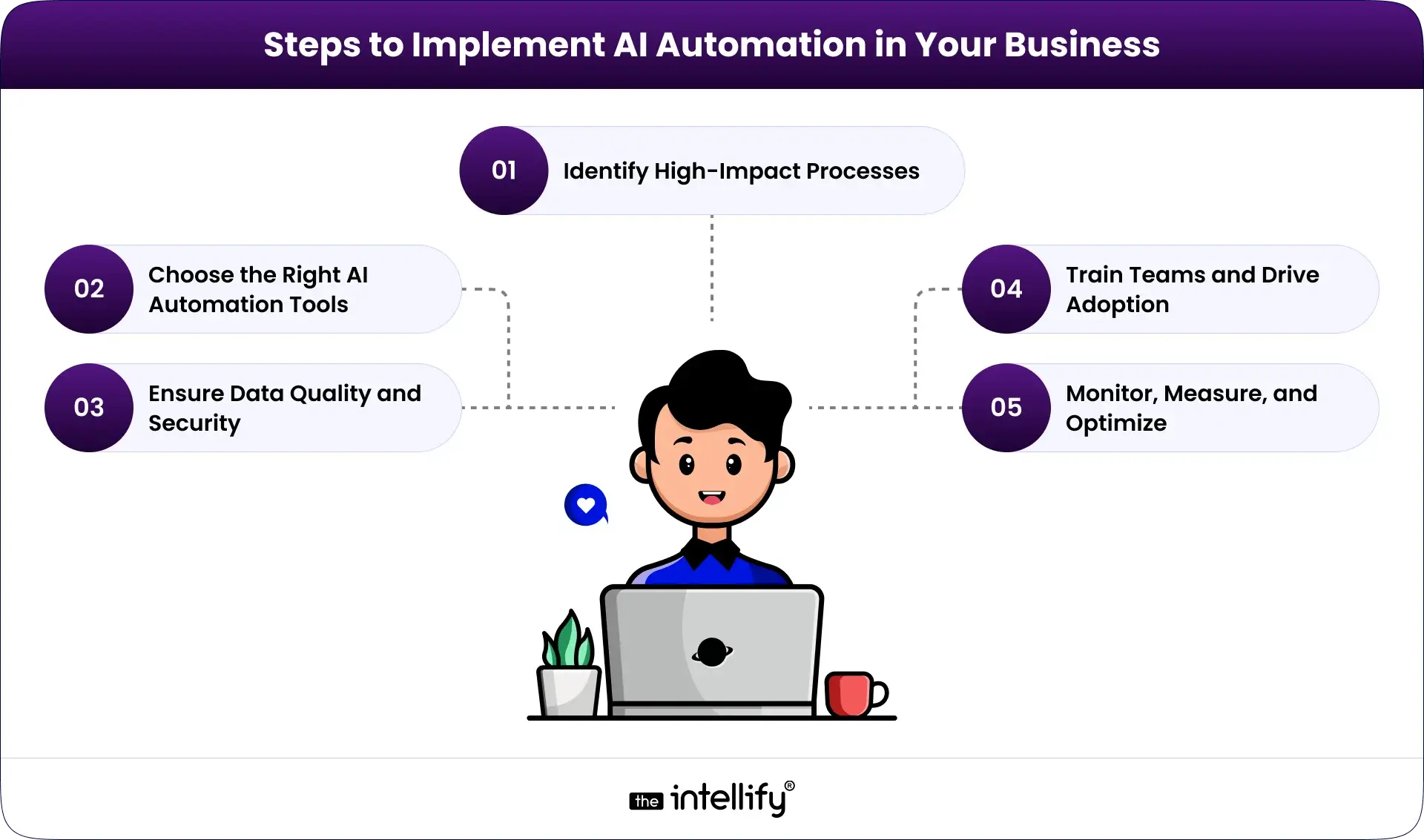
Steps for AI Automation in Your Business

1. Identify High-Impact Processes

Start with repetitive, error-prone workflows.

2. Choose the Right AI Automation Tools

Flexibility, integration, and security matter more than features.

3. Ensure Data Quality and Security

AI is only as good as the data it learns from.

4. Train Teams and Drive Adoption

Automation works when people trust it.

5. Monitor, Measure, and Optimize

Treat automation as a system that evolves, not a one-time setup.


Key Challenges Businesses Face Without AI Automation

Businesses that rely mainly on manual systems often face growing operational pressure. Over time, these issues affect efficiency, costs, and employee motivation.

  • Heavy Dependence on Manual Processes:-  Many teams depend on spreadsheets, emails, and manual entry. This leads to repetitive work, slow approvals, and administrative overload, leaving little time for important tasks.
  • Slow and Fragmented Workflows:- When HR, finance, and IT use disconnected tools, workflows slow down. Updates are delayed, visibility is limited, and teams waste time coordinating basic information.
  • Increased Risk of Errors:- Manual handling increases the chance of payroll mistakes, invoice mismatches, and missed compliance checks. These errors often require extra time and effort to fix.
  • Limited Data Insights for Decision-Making:- Without automation, reports are often outdated. Financial insights arrive late, and leaders lack clear, predictive information for planning.
  • Difficulty Scaling Operations:- As workloads increase, efficiency does not always improve. Companies hire more staff just to keep up, creating higher costs and operational strain.
  • Employee Frustration and Low Productivity:- Too much routine work reduces focus and motivation. Employees have less time for strategic work, leading to slower responses and lower engagement.


The Future of AI Automation in Business Operations

AI automation is moving beyond simple task support. The next phase focuses on smarter, connected systems that guide operations in real time.

Agentic AI assistants will manage workflows from start to finish, reducing manual coordination between teams. Instead of reacting to problems, businesses will rely on predictive operational intelligence to identify delays and risks early.

Enterprise platforms will become more connected, allowing HR, finance, and IT to share data seamlessly. At the same time, processes will continuously improve in the background through ongoing monitoring and learning.


Conclusion

Modern enterprises aren’t defined by size. They’re defined by how smoothly things run when nobody’s watching. AI automation isn’t about replacing teams. It’s about giving them breathing room. Fewer blockers. Fewer errors. Fewer “Can you follow up on this?” messages.

Organizations that adopt AI automation early build operations that scale calmly. Those who wait often spend years untangling avoidable complexity.

If you’re exploring AI automation for HR, finance, or IT and want a practical, business-first approach, the right implementation partner makes all the difference. That’s where The Intellify helps organizations design AI automation that fits real operations, not just diagrams.


AI Automation for Operations


Frequently Asked Questions (FAQs)

1. What exactly is AI automation in business operations?

AI automation uses intelligent systems to manage repetitive and data-heavy business tasks. Unlike basic automation, it can learn from past activity and adjust to new situations. It helps HR, finance, and IT teams work faster, reduce errors, and make better decisions. Companies like The Intellify design AI automation systems that fit real workflows, not just technical models.

2. How does AI automation differ from traditional automation?

Traditional automation follows fixed rules and breaks when conditions change. AI automation learns from data and adapts over time. It can handle documents, emails, and changing processes without constant reprogramming. This makes it more reliable for growing businesses with complex operations.

3. Can AI automation replace human workers?

No. AI automation supports employees rather than replacing them. It handles routine tasks so teams can focus on planning, problem-solving, and strategy. When implemented properly, it reduces burnout and improves job satisfaction instead of eliminating roles.

4. What are common use cases of AI automation across departments?

Common use cases include resume screening in HR, invoice processing in finance, and ticket management in IT. It is also used for reporting, compliance checks, and internal support. These applications help departments work together more smoothly and reduce manual coordination.

5. Is AI automation only for large companies?

AI automation is useful for businesses of all sizes. Small and mid-sized companies often start with one or two workflows and expand gradually. With the right implementation partner, organizations can adopt automation without heavy upfront investment.

6. What are the costs and challenges of implementing AI automation?

Costs depend on system complexity, data readiness, and integration needs. Common challenges include poor data quality, resistance to change, and security concerns. These issues can be managed through proper planning, training, and phased implementation.

7. How can AI automation improve decision-making?

AI automation analyzes real-time data, identifies patterns, and highlights risks early. This helps managers make informed decisions instead of relying on delayed reports. Over time, it builds a clearer view of operations and supports long-term planning.

Enterprise Digital Transformation Roadmap: From Strategy to Execution

Summary:
This blog explains how enterprises can plan and execute a successful digital transformation using a structured roadmap. It covers what digital transformation truly means, why initiatives fail without clear direction, and how to align strategy, technology, people, and governance. The blog walks through assessing current capabilities, defining goals, implementing transformation in phases, measuring ROI, and scaling innovation to build a resilient, future-ready enterprise.

Digital transformation gets talked about a lot. Sometimes too much. But for most enterprises today, it’s no longer optional. It’s how you stay relevant, avoid getting outpaced, and actually make your systems work for people instead of against them.

This blog walks through what an enterprise digital transformation roadmap really looks like from early strategy to real execution. Not theory. Not buzzwords. Just a clear, step-by-step way to move forward without burning budget or patience.


Why a Structured Roadmap Matters

A well-crafted roadmap serves as a clear guide for organizations, outlining specific steps and goals. Without it, businesses often feel adrift in a complex and overwhelming digital landscape. A structured roadmap:

• Keeps digital initiatives aligned with business goals.
• Helps manage the risks tied to adopting new technologies.
• Promotes measurable outcomes and encourages ongoing improvement.


What Digital Transformation Means for Modern Enterprises

Business Model Evolution

Digital transformation isn’t just about tech; it’s a fundamental shift in how businesses operate. Companies have to rethink their business models to effectively leverage new technologies. Take traditional retail, for example; today, many retailers incorporate e-commerce platforms to reach a broader audience and create seamless shopping experiences.

Operational Modernization

Modernizing operations means embracing automation and digital tools to boost efficiency. Businesses are leaving outdated manual processes behind, allowing them to streamline functions and cut costs.

Data as a Strategic Asset

In the digital age, data is hugely valuable. By adopting effective analytics tools, organizations can extract insights from their data and make informed, data-driven decisions, enhancing service delivery and fueling innovation.

Leadership and Cultural Alignment

For digital transformation to succeed, it’s vital to have leadership buy-in and a culture ready to embrace change. Leaders need to share the vision and engage every level of the workforce to create an environment conducive to digital adoption.


Why Enterprise Digital Transformation Fails Without a Clear Roadmap

Aligning Technology with Business Goals

When there’s no clear roadmap, businesses often implement technologies that miss the mark concerning their overarching goals, leading to wasted resources and disappointing results.

Managing Risk and Investment

Digital transformations come with both investments and risks. A structured approach can help mitigate the risks associated with adopting new technologies, making for a smoother transition.

Driving Measurable Outcomes

Clear metrics and well-defined objectives allow teams to gauge progress and results, fostering accountability and aiding performance tracking. Without these, it’s easy to lose sight of the transformation goals.


Defining Your Enterprise Transformation Vision

Setting Strategic Objectives

Begin by identifying the long-term goals your organization wants to achieve through digital transformation. What specific pain points do you aim to resolve? How will these goals fit into your overall business strategy?

Securing Executive Sponsorship

Leadership support is key to success. Make sure that executives not only understand but also champion the vision for transformation. Their backing can open doors for resource allocation and drive employee engagement.

Establishing Governance Early

Create a governance framework that defines roles, responsibilities, and decision-making processes. This clarity will keep your organization focused as you navigate the transformation journey.


Assessing Your Current Digital Landscape

Technology Infrastructure

Take stock of your current technology infrastructure. Can your systems support your digital initiatives? Pinpointing gaps in technology is crucial for planning ahead.

Data & Analytics Capabilities

Examine your existing data management processes. Are you able to derive meaningful insights? Understanding your data landscape will shape your transformation strategy moving forward.

Workforce Readiness

Gauge the skills and capabilities of your employees. Are they prepared to handle new technologies? Assessing workforce readiness can help you identify areas for strategic training and development.

Process Gaps

Spot any inefficiencies within your current processes. This analysis will shed light on opportunities for improvement and provide a foundation for designing future workflows.


Key Foundations of a Digital Transformation

Strategy & Governance

A successful enterprise digital transformation hinges on a strong strategy that aligns with your business objectives. Governance should ensure accountability and guide transformation efforts along the way.

Technology & Cloud

Invest in the right technologies and consider cloud solutions that offer scalability and flexibility. A solid tech foundation is essential for supporting growth down the line.

Data & Security

Safeguard data integrity and security with robust measures. Keeping sensitive information secure is vital for maintaining trust with customers and stakeholders.

Customer Experience

Enhance the customer experience through your digital initiatives. Use technology to personalize interactions and eliminate friction along the customer journey.

People & Change Management

Effective change management is crucial. Prepare your workforce for transformation by fostering a growth mindset and providing ongoing support throughout the transition.


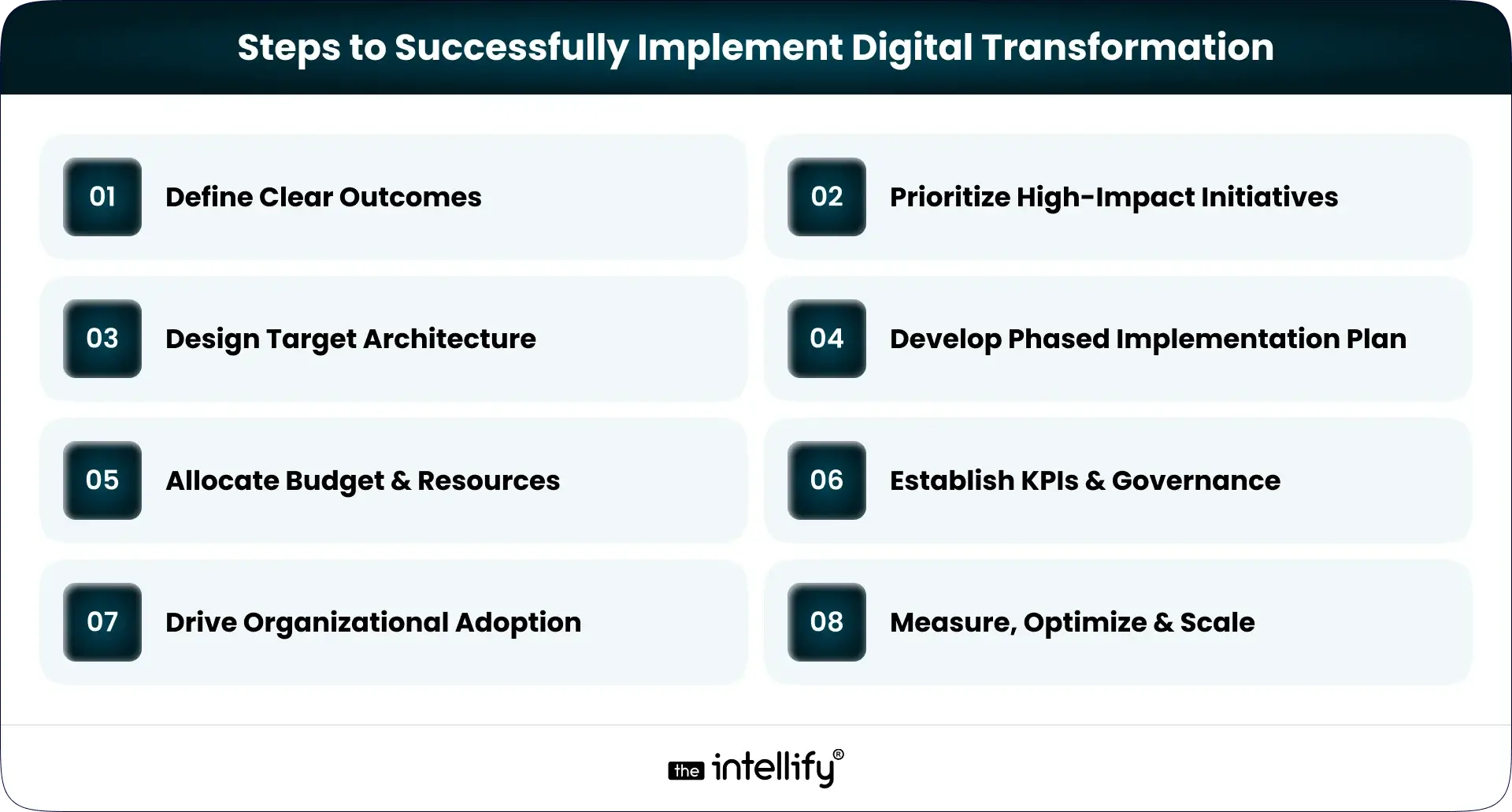
Steps to Successfully Implement Digital Transformation

Steps to Implement Digital Transformation

Define Clear Outcomes

Kick things off with specific, measurable goals. What do you want to achieve within set timeframes?

Prioritize High-Impact Initiatives

Focus on initiatives that promise the greatest potential impact on your business. These should align well with your strategic objectives.

Design Target Architecture

Develop a detailed architecture plan that outlines how different systems and technologies will connect. This clarity will ease implementation.

Develop Phased Implementation Plan

Roll out the transformation in phases rather than attempting it all at once. This approach allows for adjustments and promotes continuous improvement.

Allocate Budget & Resources

Identify the financial and human resources necessary for a successful transformation. Make sure budget allocations align with your priorities.

Establish KPIs & Governance

Set up key performance indicators (KPIs) that will help you track progress and success. Regularly review these metrics to ensure you’re on course.

Drive Organizational Adoption

Engage employees throughout the transformation process. Cultivating a culture that embraces change and encourages innovation is vital.

Measure, Optimize & Scale

Keep an eye on performance, and refine processes based on what you learn. Scale successful initiatives to extend their impact throughout the organization.


Digital transformation Strategy


Enterprise Trends Shaping Digital Transformation

AI and Intelligent Automation

Artificial intelligence (AI) and automation are at the forefront of transforming operations. From chatbots in customer service to advanced analytics, these technologies streamline processes and enhance how businesses interact with customers.

Hybrid & Multi-Cloud Strategies

More businesses are opting for hybrid and multi-cloud strategies to maximize flexibility and optimize costs. This way, organizations can take advantage of the best features from multiple platforms.

Zero-Trust Security

Security is crucial. The zero-trust model acknowledges that threats can come from both outside and within the network. Adopting this strategy significantly strengthens defenses.

Data-Driven Decision Making

Relying on data-driven insights is now integral to how businesses make decisions. Leveraging analytics is an essential step to remain competitive in the digital landscape.


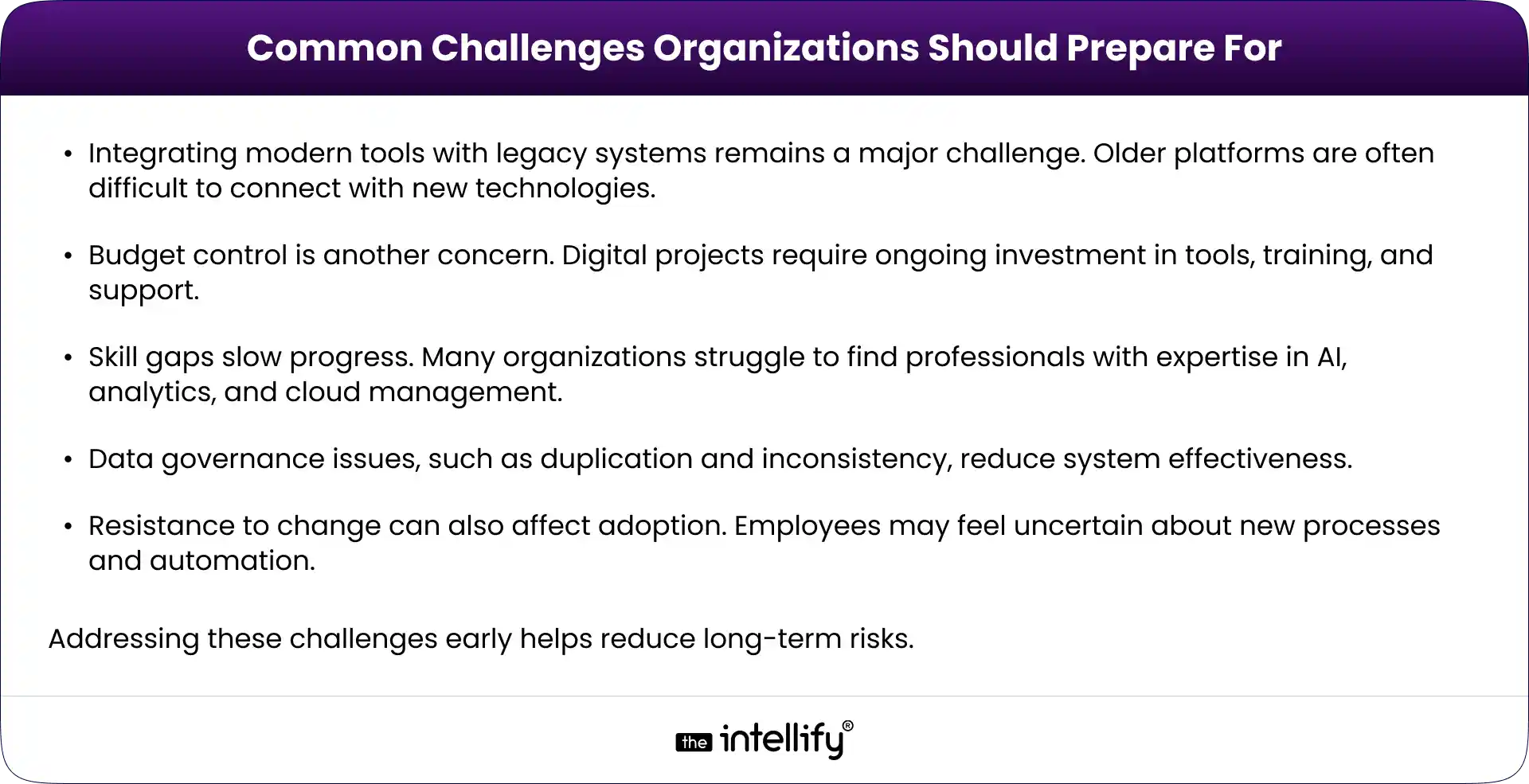
Challenges in Enterprise Digital Transformation

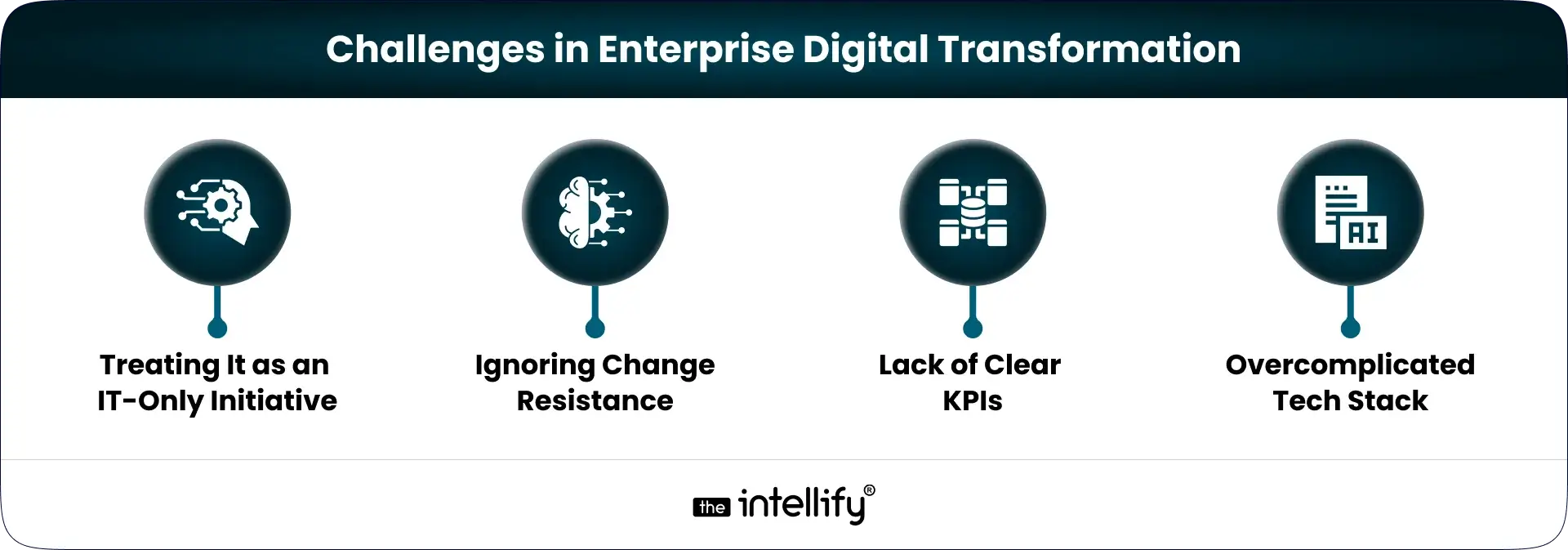
Challenges in Enterprise Digital Transformation

Treating It as an IT-Only Initiative

Digital transformation shouldn’t be limited to just IT. It requires the involvement of the entire organization; having all departments onboard is vital for success.

Ignoring Change Resistance

It’s important to anticipate some pushback against change. Engage employees early on and clearly communicate the benefits of digital transformation to counter skepticism.

Lack of Clear KPIs

Without measurable KPIs, it becomes challenging to assess progress. Establish these metrics early on to foster accountability and focus.

Overcomplicated Tech Stack

A complicated tech stack can slow you down. Simplifying your technology mix will make integration smoother and easier to use.


Measuring ROI and Long-Term Impact

Operational Efficiency

Monitor improvements in operational efficiency as a key measure of ROI. Are processes flowing faster and more smoothly?

Customer Experience Gains

Look at customer satisfaction metrics to grasp how transformation affects their overall experience.

Revenue & Growth Metrics

Track increases in revenue and market share as indicators of successful transformation.

Risk & Compliance Indicators

Evaluate how digital initiatives influence regulatory compliance. Strong compliance reflects a solid risk management strategy.


From Strategy to Execution: Making Transformation Sustainable

Cross-Functional Ownership

Faster ownership across different departments. Collaborative efforts often yield the best results and improve buy-in.

Continuous Optimization

Remember, digital transformation is an ongoing journey. Regularly review your strategies and fine-tune them based on emerging trends and organizational needs.

Scaling Innovation

Encourage a culture of innovation. Embrace creative solutions and be prepared to scale successful initiatives quickly.


Conclusion

Enterprise digital transformation goes beyond just technology; it’s about fundamentally reshaping your organization to excel in a digital-first world. By following this roadmap and focusing on collaboration, measurement, and ongoing optimization, your enterprise can become more resilient and better equipped to adapt to the ever-evolving landscape.

Enterprise digital transformation succeeds when strategy, technology, and people move in alignment toward clear business outcomes. A structured roadmap reduces risk, sharpens focus, and turns ambition into measurable progress. The real challenge isn’t planning change, it’s executing it with discipline and clarity. That’s where experienced execution partners like The Intellify help enterprises translate vision into a structured, scalable transformation that lasts.


Start Digital transformation journey


Frequently Asked Questions (FAQs)

1. What is enterprise digital transformation?

Enterprise digital transformation is about using technology to improve how a business operates, serves customers, and makes decisions. It goes beyond tools; it reshapes processes, workflows, and culture. At The Intellify, we help enterprises turn this shift into practical, measurable outcomes rather than isolated tech upgrades.

2. Why is a roadmap important for digital transformation?

A roadmap keeps transformation focused. It aligns technology with business goals, controls risk, and sets clear milestones. Without it, initiatives often stall or drift. We help enterprises build and execute structured roadmaps that move smoothly from strategy to real-world implementation.

3. What are some common challenges in digital transformation?

The biggest challenges include resistance to change, unclear KPIs, and treating transformation as an IT-only project. These issues slow adoption and reduce impact. A clear execution partner like The Intellify helps address both technical and organizational challenges early.

4. How can organizations measure the success of digital transformation?

Success is measured through operational efficiency, better customer experiences, revenue impact, and improved compliance. Tracking the right KPIs from day one is critical. The Intellify focuses on measurable outcomes, not just completed projects.

5. What role do leadership and culture play in digital transformation?

Leadership sets direction, and culture determines whether change sticks. When teams understand the “why,” adoption improves. We work closely with leadership teams to align vision, execution, and organizational buy-in.

6. How can companies ensure sustainable digital transformation?

Sustainability comes from continuous optimization, shared ownership across teams, and scaling what works. Digital transformation isn’t a one-time effort. We support long-term execution, so the transformation keeps delivering value over time.

7. What future trends should businesses watch in digital transformation?

Key trends include AI-driven automation, hybrid and multi-cloud strategies, zero-trust security, and data-led decision-making. Enterprises that prepare early rather than react later stay ahead. We help organizations adopt these trends at a practical, enterprise-ready pace

Why Digital Transformation in 2026 Is About Strategy, Not Tools

Summary:
Digital transformation is no longer about adopting the latest tools or technologies. It’s about building the right strategy first. This blog explains what digital transformation really means today, why tool-led approaches fail, and how strategy-driven transformation delivers real business value. It covers key pillars, trends, benefits, challenges, and how businesses can succeed by choosing the right digital transformation approach and partners.

Digital transformation sounds exciting on paper. In real life? It’s often messy. Loud. A little exhausting. New tools get rolled out. Teams nod in meetings. Nothing really changes.

By 2026, one thing is painfully clear: digital transformation doesn’t fail because companies choose the wrong tools. It fails because they never had a strategy to begin with.

I’ve watched organizations invest heavily in software while basic problems linger slow approvals, confused teams, customers quietly drifting away. The tech stack looks impressive. The results don’t.

So let’s talk honestly. No hype. No buzzwords. Just a grounded look at why digital transformation in 2026 is about strategy, not tools, and what that actually means if you’re trying to grow a business.


What Digital Transformation Really Means in 2026

If you’re still asking what digital transformation is, here’s the short answer:

It’s not about becoming “more digital.” It’s about changing how your business works, using technology as support, not as the star of the show.

Back in the early days, digital transformation meant websites, CRMs, and cloud storage. Later, it meant mobile apps, analytics, and automation. Now? In 2026? It means rethinking decisions, workflows, customer journeys, and ownership.

A quick clarity check:

  • Digitization = turning paper into files
  • Digitalization = improving processes with tech
  • Digital transformation = redesigning the business itself

That last step is where the real work is. And also where most companies hesitate. Because it forces uncomfortable conversations.


The Big Myth: Buying Tools Equals Digital Transformation

This myth refuses to die. Somewhere along the way, digital transformation became confused with shopping. New CRM. New ERP. New AI tool everyone’s talking about on LinkedIn. Done, right?

Not even close. Buying tools feels productive. Changing habits does not. One is quick. The other is slow and slightly annoying. I once walked into an office where a brand-new system was live, but teams were still tracking work in spreadsheets “just in case.” The smell of panic coffee was strong that morning.

Tools don’t fix confusion. They just give confusion a nicer interface.


Why Strategy Is the Real Driver of Digital Transformation

Here’s the quiet truth:

Technology amplifies whatever already exists. If your strategy is unclear, tech will spread that confusion faster. If your strategy is solid, technology becomes powerful.

A real digital transformation strategy answers simple questions:

  • What outcome are we chasing?
  • Which problems actually matter?
  • What should feel easier for customers?
  • What work should stop happening?

Without these answers, even the best digital transformation solutions fall flat. In 2026, companies that win start with intent. Tools come later. Sometimes much later.


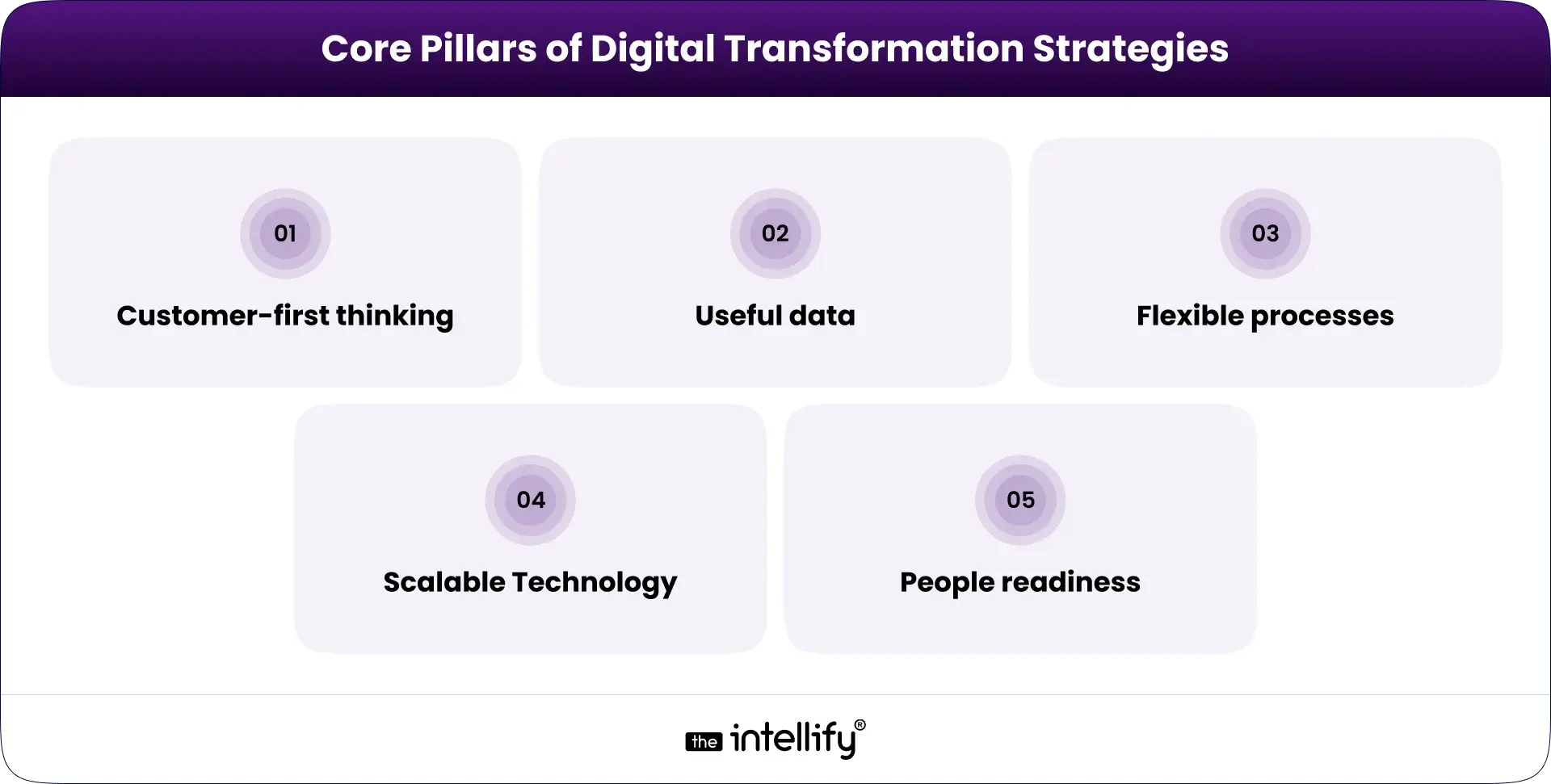
Core Pillars of Successful Digital Transformation Strategies

Core Pillars of Digital Transformation Strategies

Successful digital transformation strategies aren’t built in a sprint. They’re built through deliberate choices that hold up under pressure. Over time, patterns emerge. The companies that get this right usually focus on a few unglamorous but essential pillars.

Customer-first thinking

This sounds obvious, but it’s often misunderstood. Customer-first doesn’t mean adding more features or channels. It means understanding where customers feel friction, long wait times, confusing handoffs, repeated questions, and removing those points quietly.

The best strategies obsess over moments, not journeys. A failed payment. A delayed response. A confusing screen. Fixing these moments creates real impact.

Useful data

Many businesses are drowning in data and still guessing. Good digital transformation strategies focus on decision-ready data, not volume.

If a report doesn’t help someone decide faster or better, it’s noise. Strategy-first teams identify:

  • Who needs data
  • When they need it
  • What action it should trigger

Everything else is optional.

Flexible processes

Perfect workflows look great in diagrams and fall apart in reality. People work around them. Shortcuts appear. Shadow systems creep in.

Strong strategies accept this and design for flexibility. They leave room for exceptions. They adapt as the business grows. They don’t assume humans behave like flowcharts.

Scalable Technology

Scalability shouldn’t feel dramatic. When systems are right, growth feels… boring. No panic. No midnight fixes. No emergency calls.

That calm comes from strategic architecture decisions early on, choices made with tomorrow in mind, not just today’s urgency.

People readiness

This pillar gets ignored more than it should. Digital transformation asks people to change habits, give up control, and learn new ways of working.

If teams don’t trust the intent behind the change, resistance is inevitable. Clear communication, realistic training, and honest timelines matter more than most tools.


Benefits of Digital Transformation When Strategy Comes First

When strategy leads, the benefits of digital transformation feel less like promises and more like relief.

1. Decision-making improves first. Fewer meetings. Less back-and-forth. People know what to act on and when.

2. Teams stop wasting energy. Manual work drops. Duplicate efforts fade. People focus on work that actually matters.

3. Customer experience improves quietly, not through flashy changes, but through fewer mistakes and smoother interactions. Customers don’t always notice what changed; they just feel it.

4. Costs reduce naturally. Not through layoffs or cuts, but through efficiency. Less rework. Fewer delays. Better use of time.

5. Most importantly, growth feels controlled. Expansion doesn’t break systems. New markets don’t create chaos. Strategy absorbs pressure.


Why Digital Transformation Fails: Common Challenges

Digital transformation doesn’t usually fail loudly. It fades. Momentum slows. Enthusiasm drops. People stop caring. The most common digital transformation challenges are surprisingly consistent.

  • No shared vision
  • Siloed departments
  • Fear of change
  • Measuring the wrong outcomes
    Over-reliance on vendors to “figure it out.”

None of these can be solved with software alone. They need leadership, patience, and a clear plan.


Digital Transformation as a Service: Why Companies Are Choosing This Model

This is where digital transformation as a service makes sense for many businesses.

Transformation today is complex. It touches systems, people, culture, and leadership. Few organizations have all the skills in-house. Companies are choosing this model because it offers:

  • Strategic guidance, not just execution
  • Experience across industries
  • Faster learning curves
  • Lower risk of expensive missteps

A good digital transformation company doesn’t just deliver solutions. It challenges assumptions. It asks uncomfortable questions. It helps teams see blind spots. And importantly, it stays involved after launch, where most problems actually surface.


Digital Transformation Trends That Matter in 2026

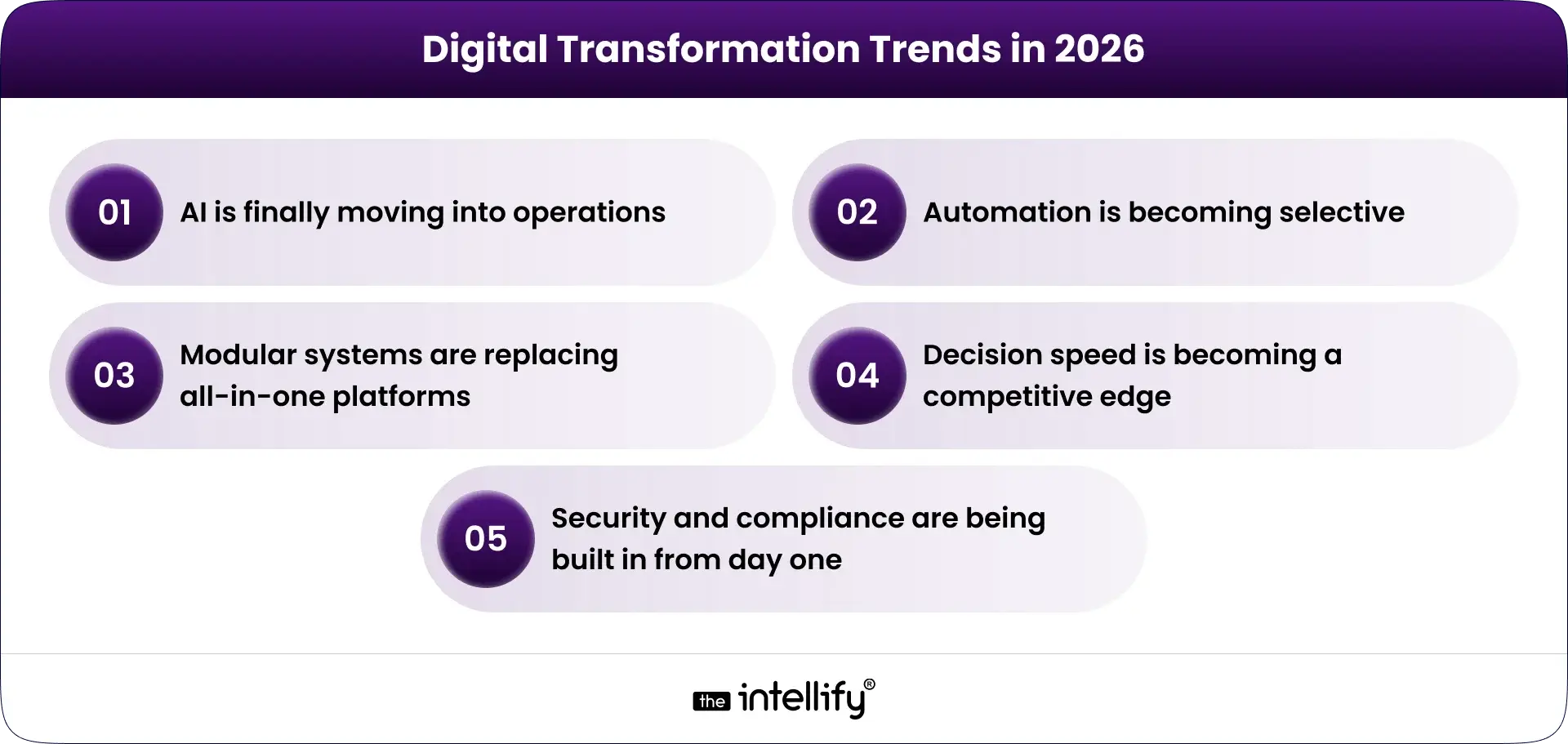
Digital Transformation Trends in 2026

There’s no shortage of trends floating around. Most fade fast. A few actually stick because they solve real problems. Here are the digital transformation trends that matter in 2026, not because they’re new, but because they’re practical.

1. AI is finally moving into operations. Not as a headline feature, but as quiet support. It helps route work, flag issues early, and reduce manual effort. When AI works well, people barely notice it.

2. Automation is becoming selective. Businesses are no longer trying to automate everything. They’re automating what slows people down: approvals, data handoffs, repetitive checks. Less noise. More focus.

3. Modular systems are replacing all-in-one platforms. Companies want flexibility. They want to swap parts without tearing everything down. Strategy-first organizations choose systems that evolve, not lock them in.

4. Decision speed is becoming a competitive edge. Faster insights. Clear signals. Less waiting. This isn’t about dashboards, it’s about confidence.

5. Security and compliance are being built in from day one. Not bolted on. Not postponed. Because the cost of ignoring them is now very real.


How to Choose the Right Digital Transformation Partner

Choosing a partner is less about credentials and more about behavior.

The right digital transformation services partner starts with questions, not demos. They listen more than they pitch. They talk openly about trade-offs. They explain what not to do. They don’t promise instant results.

Ask them how they handle:

  • Internal resistance
  • Scope changes
  • Long-term ownership
  • Post-launch reality

Red flags are easy to spot. Tool-first conversations. Overconfidence. Vague success stories.

A strong partner aligns with your strategy or helps you build one before touching technology.


The Future of Digital Transformation: What Comes After 2026

After 2026, digital transformation won’t feel like a program or initiative. It’ll feel routine. Businesses will expect systems to evolve continuously. Strategy reviews will be regular. Technology updates won’t cause panic.

The idea of “being done” with transformation will disappear. Instead, companies will adapt in smaller, steadier steps. Strategy will remain the anchor, technology will keep shifting, and people will stay at the center.

The organizations that thrive won’t chase trends. They’ll stay clear on direction and adjust calmly as the world changes.


Digital transformation Services - The Intellify


Conclusion: Strategy Is the Only Sustainable Advantage

In 2026, digital transformation isn’t about having the latest tools. Everyone has tools. That’s not special anymore. What matters is:

  • Clear intent
  • Thoughtful execution
  • A strategy that connects people, processes, and technology

When businesses get this right, digital transformation solutions stop feeling risky. They start feeling inevitable, and that’s where real growth happens quietly, steadily, and with far less stress. If you’re exploring digital transformation and wondering where to start, start with strategy, the rest will follow.


Frequently Asked Questions (FAQs)

1. What is digital transformation in 2026?

In 2026, digital transformation is about redesigning how a business operates, makes decisions, and serves customers. Technology supports this change, but strategy defines the direction. Companies now focus more on outcomes and adaptability than on adopting tools.

2. Why do most digital transformation initiatives fail?

Most initiatives fail due to unclear strategy, weak leadership alignment, and low employee adoption. Tools are often implemented without fixing processes or ownership, which leads to poor results despite heavy investment.

3. How is digital transformation different from digitalization?

Digitalization improves existing processes using technology, while digital transformation rethinks the entire business model. Transformation changes how work is done, not just how tools are used.

4. What are the biggest digital transformation challenges today?

The biggest challenges include lack of vision, internal resistance to change, siloed teams, and measuring the wrong success metrics. These issues are strategic and cultural, not technical.

5. What are the key benefits of digital transformation?

Key benefits include faster decision-making, better customer experience, improved efficiency, lower operational costs, and scalable growth when transformation is guided by a clear strategy.

6. What is digital transformation as a service?

Digital transformation as a service provides ongoing strategic and execution support instead of a one-time project. It helps businesses continuously adapt while reducing risk and internal strain.

7. How do I choose the right digital transformation company?

Choose a company that starts with business strategy, understands change management, and focuses on long-term outcomes. Firms like The Intellify emphasize alignment between people, processes, and technology rather than tool-first implementations.

AI Agents vs Traditional Automation: Business Use Cases, Costs & ROI

Summary:
Confused about whether AI agents or traditional automation are right for your business? You’re not alone. This blog breaks it down in plain terms, like what each approach does well, where it falls short, and how they compare on cost and ROI. It also highlights real-world use cases, common mistakes, and practical steps to choose the right automation approach for your business.

Automation used to be simple. You mapped a process, you wrote rules, you let software repeat the same steps again and again. It worked for a while, but businesses today don’t run on fixed rules anymore. Customers behave differently, markets shift fast, and data changes by the hour, and suddenly old-school automation begins to feel… narrow, useful, yes, but limited.

That’s where AI agents enter the picture. They aren’t here to replace automation. They appeared because businesses needed systems that could handle uncertainty without breaking.

This blog walks through AI agents vs traditional automation not as a trend comparison, but as a business decision. We’ll talk about real use cases, realistic costs, and the kind of ROI leaders actually care about when budgets are on the line.


What Is Traditional Automation?

Traditional automation is built on instructions. “If X happens, do Y.” That’s it. These systems don’t think. They don’t adapt. They don’t guess. They just execute steps you’ve already defined.

You’ll see traditional automation in things like:

  • Invoice processing
  • Payroll workflows
  • Employee onboarding checklists
  • Scheduled reports
  • Data moving from one system to another

It’s reliable. Predictable. And honestly, kind of comforting.

If your process is stable and rarely changes, traditional automation does its work quietly in the background. But the moment something unexpected happens, like missing data, a new customer behavior, or a process tweak, it freezes or fails or sends the task to a human. That’s the limit.


What Are AI Agents? How Are They Different?

AI agents don’t just follow rules. They make decisions. They behave less like scripts and more like junior team members. They look at data, understand context, and choose what to do next without being told every single step.

Think of an AI agent as a digital worker that:

  • Knows the goal
  • Understands the environment
  • Takes action
  • Learns from outcomes

Not perfectly, not magically. But enough to handle real-world messiness.

An AI agent can:

  • Decide which customer query needs escalation
  • Adjust responses based on past conversations
  • Route tasks dynamically
  • Handle incomplete or noisy data

This doesn’t mean it’s always right. Sometimes it hesitates. Sometimes it needs guardrails. Sometimes a human steps in. But unlike traditional automation, it improves over time. The more it works, the more patterns it learns. That learning curve is the difference.


AI Agents vs Traditional Automation: Core Differences

AI Agents vs Traditional Automation

Let’s keep this practical.

  • Decision-making: Traditional automation executes fixed steps. AI agents choose between options.
  • Learning: Traditional systems don’t learn. AI agents improve with data and feedback.
  • Flexibility: Rule-based automation breaks when inputs change. AI agents adapt.
  • Maintenance: Traditional automation needs constant rule updates. AI agents need monitoring and training, not endless rewrites.
  • Human involvement: Traditional automation depends on humans for exceptions. AI agents reduce exceptions over time.

One isn’t better by default. They solve different problems.


Business Use Cases: Where Each Approach Makes Sense

This is where theory meets the real world.

Traditional Automation Use Cases

Traditional automation still shines when processes are:

  • Rarely change
  • Have clear inputs and outputs
  • Are compliance-heavy

Common examples include:

  • Invoice and expense approvals
  • Employee onboarding tasks
  • Contract document routing
  • Regulatory reporting
  • Internal system syncing

These processes don’t need intelligence. They need consistency. Trying to add AI here often adds cost without adding value.

AI Agent Use Cases

AI agents work best when humans used to rely on judgment. They’re better suited for:

  • Customer support conversations that don’t follow scripts
  • Sales qualification across multiple channels
  • Demand forecasting when conditions shift weekly
  • Supply chain decisions with incomplete data
  • Internal IT or HR help desks

Anywhere humans used to “just figure it out,” AI agents can assist. Not replace. Assist.


Cost Comparison: AI Agents vs Traditional Automation

Let’s talk about money. Carefully.

Traditional Automation Costs

  • Lower initial setup
  • Faster deployment
  • Cheaper tools
  • Predictable maintenance

But there’s a catch. As processes grow, rule management becomes expensive. Every change needs rework. Every edge case adds complexity.

AI Agent Costs

  • Higher upfront investment
  • Data preparation costs
  • Model training and testing
  • Ongoing monitoring

But over time? Fewer manual interventions. Less rule maintenance. Better scalability.

Traditional automation is cheaper to start. AI agents are cheaper to grow with.


ROI Comparison: Which Delivers Better Business Value?

ROI Comparison table

ROI is often treated like a math problem. In reality, it’s more of a feeling backed by numbers.

Traditional automation delivers value fast. You automate a task, reduce manual effort, and see immediate savings. It’s satisfying. Especially when teams are stretched, and leadership wants results this quarter, not next year.

AI agents work differently. Their value builds over time. Early results may look modest, but as the system learns and adapts, the impact becomes broader and harder to ignore.

Here’s how ROI typically shows up:

Traditional Automation ROI

  • Immediate reduction in manual work
  • Lower error rates for repetitive tasks
  • Predictable cost savings
  • Quick deployment wins

AI Agent ROI

  • Better decision quality over time
  • Reduced need for human intervention
  • Improved customer experience
  • Long-term scalability without linear cost growth

Traditional automation saves hours. AI agents change outcomes.


When Traditional Automation Is Still the Right Choice

Despite the excitement around AI, traditional automation still deserves its place. It’s the right choice when processes are well-defined and unlikely to change. In these cases, adding intelligence doesn’t improve results; it just adds cost and complexity.

  • Steps are fixed and repeatable
  • Rules are clear and rarely updated
  • Compliance and audits matter
  • Errors must be minimized at all costs
  • Budgets are tightly controlled

Examples include finance operations, regulatory reporting, internal approvals, and backend system syncing. These processes don’t benefit from “thinking.” They benefit from consistency.

Sometimes, boring systems are the most valuable ones.


When AI Agents Become a Competitive Advantage

AI agents start to matter when businesses operate in uncertainty. They shine in environments where:

  • Customer behavior shifts frequently
  • Data arrives incomplete or late
  • Decisions affect revenue or retention
  • Human teams struggle to keep up

Instead of reacting to every exception, AI agents handle variation naturally. They prioritize, adapt, and escalate only when needed.

Over time, this creates advantages:

  • Faster responses without hiring more staff
  • Smarter decisions at scale
  • Reduced operational friction
  • Teams focused on strategy, not triage

This isn’t about replacing people. It’s about removing constant interruptions that drain momentum.


Common Mistakes Businesses Make While Choosing Automation

Most automation failures don’t come from bad tools. They come from bad assumptions. Some common mistakes include:

  • Automating broken or unclear processes
  • Expecting AI to fix poor data quality
  • Choosing software before defining goals
  • Underestimating change management
  • Ignoring security and compliance early

Another quiet mistake is expecting instant perfection. AI agents need time, feedback, and oversight. Treating them like plug-and-play software often leads to disappointment.

Automation amplifies design. If the design is flawed, the system will be too.


Future of Automation


How to Choose Between AI Agents and Traditional Automation

The decision doesn’t need to be complicated. Start with a few honest questions:

  • Does this process change often?
  • Does it require judgment or interpretation?
  • Are exceptions common?
  • Will scale increase complexity?

If most answers are “no,” traditional automation is usually enough.

If most answers are “yes,” AI agents are worth exploring.

The goal isn’t to adopt new technology. It’s to reduce friction without creating new problems.


How Businesses Can Get Started with AI Agents

Getting started with AI agents doesn’t begin with tools. It begins with clarity.

Most businesses don’t fail at AI because the technology doesn’t work. They fail because they start too big, too fast, or without a clear problem to solve. The smartest teams take a slower, more deliberate approach.

A practical starting point usually looks like this:

  • Identify one process that feels painful or inefficient
  • Focus on tasks that require judgment, not just repetition
  • Look for areas where teams are overwhelmed by volume or variation
  • Choose outcomes, not features, as success metrics

This is where an experienced AI agent development company makes a difference.

At The Intellify, the approach typically starts with understanding how your business actually runs, where decisions slow things down, where humans step in too often, and where intelligent agents could reduce friction without disrupting operations.


Build Intelligent Automation


Final Thoughts: Choosing the Right Automation Strategy

Choosing between AI agents and traditional automation is less about technology and more about fit. Some processes need structure and certainty. Others need flexibility and judgment. Forcing one approach everywhere usually creates more friction than value.

Traditional automation works best when rules are clear, and change is rare. AI agents add value when conditions shift, decisions matter, and scale makes manual work painful. Most businesses benefit from using both, each where it makes sense.

The goal isn’t to automate everything. It’s to automate the right things, in the right way, so teams can focus on work that actually moves the business forward. That’s what a good automation strategy looks like.


Frequently Asked Questions (FAQs)

1) What is the main difference between AI agents and traditional automation?

Traditional automation follows fixed rules and workflows. AI agents go a step further by understanding context, making decisions, and adapting when situations change. One repeats tasks; the other responds to situations.

2) Are AI agents better than traditional automation?

Not always. AI agents are better for processes that change often or require judgment. Traditional automation works best for stable, repeatable tasks. Most businesses use a mix of both rather than choosing just one.

3) Which is more cost-effective: AI agents or traditional automation?

Traditional automation is usually cheaper to set up. AI agents cost more upfront but often deliver better long-term value by reducing manual effort and scaling without constant rule updates.

4) Can AI agents replace RPA or workflow automation?

No. AI agents don’t replace RPA; they enhance it. RPA handles structured tasks, while AI agents manage decisions and exceptions. Together, they create more flexible and reliable systems.

5) When should a business switch from automation to AI agents?

If automation breaks frequently, needs constant rule changes, or depends heavily on human judgment, it may be time to introduce AI agents to handle complexity more smoothly.

6) Are AI agents safe for enterprise use?

Yes, when designed properly. Enterprise-grade AI agents include security controls, audit trails, and human oversight. This is why many organizations work with experienced teams like The Intellify to build them responsibly.

7) How do I decide what automation approach is right for my business?

Look at your process. If it’s predictable and rule-based, traditional automation fits. If it’s dynamic and decision-heavy, AI agents make more sense. A structured assessment helps avoid overengineering

Digital Transformation in Berlin: Fueling Innovation for Startups and Enterprises

Summary
Berlin stands at the forefront of digital transformation in Europe. In the city where creativity meets technology, innovative startups and well‑established enterprises join forces to redefine industries, streamline operations, and create new business models. Often leveraging the power of Generative AI Development to drive breakthrough innovations.
This blog explores how Berlin’s dynamic ecosystem drives digital transformation across sectors, the key strategies companies implement to stay competitive, and the challenges they overcome on their journey toward a digitally enabled future.

Introduction: Berlin – A Hub for Digital Transformation

Berlin has long been celebrated for its creative culture, vibrant arts scene, and rich history. Over the past decade, however, the city has also emerged as a powerhouse for digital innovation. Digital transformation in Berlin is not just a trend but a fundamental shift that touches every aspect of the economy.

Today, startups and large enterprises use technology to improve operations, create innovative products, and redefine customer experiences.

Berlin attracts entrepreneurs with its lower cost of living, diverse talent pool, and thriving startup ecosystem. At the same time, established regional enterprises increasingly invest in digital technologies to remain competitive. This blog explores how Berlin’s unique landscape fosters digital transformation and what this means for various industries.

Statistics on Digital Transformation in Industries and Technology Adoption

Berlin’s digital transformation is reshaping entire industries and driving widespread technology adoption. Digital companies employ over 88,000 people in the capital and generate annual sales exceeding EUR 10 billion, making the city a leader in Germany’s digital economy.

Since 2008, the sector has experienced an average annual employment growth of nearly 9%, with one in every seven new jobs created in Berlin belonging to the digital economy.

In the core areas, software development and data services, employment in Berlin is growing at an average annual rate of 10.8%, more than twice the national rate.

Additionally, industry reports forecast that Germany’s digital transformation market will reach USD 46 billion by 2025 and is projected to grow at a compound annual growth rate (CAGR) of 15.21% to hit USD 94 billion by 2030.

However, challenges remain. A Vodafone study indicates that by 2030, only about 45% of German companies will fully digitalize, below the expected 55% global benchmark. These statistics underscore both the immense potential of digital transformation and the significant work still required for businesses in Berlin to harness its full benefits.

The Berlin Digital Ecosystem: Startups Meet Enterprises

Berlin’s digital ecosystem is a vibrant mix of young, agile startups and seasoned enterprises. The city is an innovation hub where creativity and technology intersect, fostering dynamic collaborations that drive progress.

A Collaborative Environment

Berlin hosts numerous co‑working spaces, incubators, accelerators, and tech hubs, such as Factory Berlin and the hub. Berlin to CODE_n and Tech Open Air, these spaces provide startups with an environment to network, learn, and collaborate with peers.

Meanwhile, established enterprises partner with startups, invest in digital projects, and even create in‑house innovation labs to leverage fresh ideas.

Startups: The Digital Pioneers

Berlin startups break new ground by experimenting with disruptive technologies and innovative business models. With agile methodologies, rapid prototyping, and lean development practices, these companies quickly pivot in response to market demands.

Many develop breakthrough solutions in fintech, e‑commerce, healthcare, logistics, and AI.

Enterprises: The Digital Adopters

Large companies in Berlin are also actively engaging in digital transformation. They invest in cloud computing, big data analytics, and IoT to optimize processes and enhance decision‑making.

By partnering with startups, these enterprises integrate cutting‑edge digital tools into their operations, ensuring competitiveness in an ever‑changing market.

Networking and Ecosystem Events

Berlin’s vibrant networking events, meetups, conferences, and hackathons encourage the exchange of ideas between startups and enterprises. Events like Tech Open Air enable entrepreneurs to pitch innovative ideas, connect with investors, and learn from industry experts, fostering synergy across the ecosystem.

Key Drivers of Digital Transformation in Berlin

Several key factors drive the rapid pace of digital transformation in Berlin:

1. Entrepreneurial Spirit and Innovation Culture

Berlin’s entrepreneurial mindset encourages risk‑taking and experimentation. The city’s cultural diversity and openness to new ideas create a fertile ground for innovation, enabling entrepreneurs to develop unconventional solutions.

2. Access to Talent and Skills

Berlin attracts top talent from Europe and beyond, forming a highly skilled workforce proficient in digital technologies. Local universities, coding boot camps, and training programs build a robust talent pool that fuels digital transformation.

3. Lower Operational Costs

Compared to global tech hubs like Silicon Valley, Berlin offers a lower cost of living and affordable office space, allowing startups to launch with minimal overhead and enterprises to allocate more resources to R&D.

4. Government Support and Public Initiatives

The Berlin and German governments actively promote digital transformation through funding programs, grants, and advisory services. These initiatives streamline digital adoption and encourage innovation.

5. International Connectivity and Market Access

Berlin’s central location in Europe provides companies with access to a vast market. This connectivity allows startups and enterprises to expand rapidly without the heavy initial investment required for international expansion.

Digital Transformation Trends and Technologies

The digital landscape in Berlin is evolving rapidly, with several trends and technologies serving as catalysts for change:

Digital Transformation and Trends 2025

  1. Cloud Computing and Big Data

    Many companies in Berlin leverage cloud computing for scalable data storage and application hosting, integrating big data analytics to drive more intelligent decision‑making.

  2. Internet of Things (IoT)

    IoT technologies enable real‑time data exchange and automation, transforming industries from manufacturing to urban living by connecting devices and optimizing processes.

  3. Artificial Intelligence and Machine Learning

    AI and ML drive innovation across sectors in Berlin, powering customer service improvements, personalized marketing, and process automation to give companies a competitive edge.

  4. Cybersecurity Solutions

    As digital transformation deepens, robust cybersecurity solutions & measures become critical. Berlin’s tech ecosystem invests heavily in solutions to safeguard data and ensure regulatory compliance.

  5. Digital Platforms and Ecosystem Integration

    Successful digital transformation hinges on integrating diverse systems. Berlin companies create digital ecosystems where various platforms work together seamlessly, enhancing operational efficiency and customer experience.

  6. Automation and Robotics

    Automation technologies and robotics streamline repetitive manufacturing, logistics, and service tasks, improving efficiency and reducing operational costs.

  7. Sustainable Digital Solutions

    Sustainability is key. Berlin companies prioritize green technologies and digital solutions that reduce waste and promote energy efficiency, aligning with broader environmental goals.

Success Stories: How Berlin Startups and Enterprises Innovate

Berlin’s success in digital transformation is best illustrated through its innovative startups and enterprises:

Case Study 1: A Startup Revolutionizing Fintech

A Berlin fintech startup developed an AI‑powered platform that streamlines payment processes for SMEs. By leveraging advanced analytics, the platform optimizes cash flow and reduces errors. Collaborations with established banks helped the startup rapidly scale its operations across Europe.

Case Study 2: An Enterprise Embracing Industry 4.0

A leading manufacturing enterprise in Berlin transformed its operations with an Industry 4.0 digital transformation. By integrating IoT sensors, cloud computing, and AI‑driven analytics, the company improved efficiency, reduced downtime, and cut energy consumption, while enabling predictive maintenance.

Case Study 3: Digital Healthcare Innovations

A Berlin‑based healthcare startup created a telemedicine platform that connects patients with doctors via video consultations, digital diagnostics, and remote monitoring. AI‑driven tools provide personalized treatment recommendations, significantly enhancing patient care.

Case Study 4: Urban Mobility Transformation

An innovative mobility startup in Berlin introduced a smart ride‑sharing app that uses real‑time data and AI to optimize routes, reduce wait times, and lower carbon emissions, revolutionizing urban transportation.

Case Study 5: Evolving Retail with Digital Platforms

A traditional retail enterprise reinvented itself by launching an omnichannel digital platform that integrated online and offline sales channels. AI‑driven personalization and big data analytics boosted revenue and customer loyalty, showcasing how digital transformation can revitalize even long‑established sectors.

Challenges in Digital Transformation

Despite Berlin’s thriving ecosystem, companies face several challenges in digital transformation:

  • Cultural Resistance to Change

    Traditional organizational cultures can resist new technologies and processes. Overcoming this requires strong leadership, continuous training, and a clear vision for change.

  • Skills Gap and Talent Shortage

    Despite a robust talent pool, many companies struggle to find professionals skilled in emerging technologies like AI, IoT, and cybersecurity. Partnerships with educational institutions and specialized training programs are essential.

  • Cybersecurity Risks

    As companies digitize operations, they become more vulnerable to cyberattacks. Robust cybersecurity measures, regular audits, and proactive threat mitigation are vital.

  • Integration of Legacy Systems

    Many enterprises still rely on outdated legacy systems. Gradual integration and migration to modern platforms ensure continuity while unlocking digital potential.

  • Regulatory and Compliance Issues

    Navigating complex regulatory landscapes, such as GDPR, adds complexity to digital transformation efforts. Companies must invest in compliance and legal expertise.

  • Funding and Investment Challenges

    Access to venture capital and government grants is crucial, yet risk‑averse attitudes and high costs can limit funding opportunities for startups and SMEs.

Strategies for Startups: Scaling with Digital Tools

Berlin startups embrace digital transformation by adopting agile and innovative strategies:

Strategies for Startups: Scaling with Digital Tools

Strategies for Enterprises: Embracing Digital Change

For established enterprises, digital transformation is a holistic process that involves culture, processes, and business models:

  • Develop a Clear Digital Strategy

    Define a digital roadmap that aligns with business goals and appoint dedicated digital transformation teams or Chief Digital Officers (CDOs).

  • Invest in Employee Training

    Upskill your workforce through continuous training programs and partnerships with educational institutions to bridge the digital skills gap.

  • Modernize Legacy Systems Gradually

    Adopt a phased approach to integrate new technologies with existing systems, ensuring minimal disruption during the transition.

  • Foster a Culture of Innovation

    Encourage cross‑departmental collaboration, incentivize creative ideas, and create internal innovation labs to drive transformation.

  • Collaborate with Startups

    Partner with agile startups to access fresh ideas, cutting‑edge technologies, and flexible solutions that can accelerate digital transformation.

  • Leverage Data as a Strategic Asset

    Invest in data analytics platforms and employ data scientists to harness the full potential of your data for improved decision‑making.

  • Automate and Streamline Operations

    Invest in automation technologies, including robotic process automation (RPA), to reduce costs and improve operational efficiency.

Government Initiatives and Support Networks

Government support plays a crucial role in fostering digital transformation in Berlin:

  • Funding Programs and Grants

    The German government and Berlin Senate provide numerous funding programs and grants to support innovation and digital transformation projects.

  • Digital Innovation Hubs and Incubators

    Innovation hubs such as Factory Berlin, hub.berlin, and CODE_n offer essential resources, mentorship, and networking opportunities to bridge the gap between startups and established enterprises.

  • Regulatory Reforms and Advisory Services

    Streamlined bureaucratic processes, simplified data protection laws, and improved digital infrastructure help companies adopt new technologies more efficiently.

  • Collaboration with Academic Institutions

    Berlin’s universities and research institutes collaborate with industry players, resulting in joint research projects, technology transfer programs, and specialized training that equips the workforce with cutting‑edge digital skills.

  • Public‑Private Partnerships

    PPPs unite government, private enterprises, startups, and investors to create scalable solutions that drive innovation and support economic growth.

Spotlight: The Intellify – Your AI‑Enabled Software Development Partner

The Intellify is an innovative AI‑enabled software development company dedicated to driving digital transformation for businesses. It is a trusted software development partner in Berlin.

The Intellify leverages cutting‑edge technologies to help companies streamline processes, enhance customer experiences, and accelerate growth.

Why Choose The Intellify?

  • AI‑Enabled Solutions: Our expert team uses advanced artificial intelligence and machine learning to create robust software solutions that power digital transformation.
  • Cloud Consulting: We offer tailored and top-notch cloud consulting services to help your business migrate, integrate, and optimize cloud infrastructures.
  • Industry 4.0 Expertise: We enable digital transformation in production processes from smart manufacturing to predictive maintenance.
  • AR/VR Solutions: Our immersive augmented and virtual reality solutions enhance training, marketing, and customer engagement.
  • Legacy Application Modernization: We modernize your legacy systems to integrate with modern digital solutions, ensuring continuity and improved performance.

Step into the future with The Intellify at GITEX Berlin. Transform challenges into scalable, intelligent solutions.

Future Outlook: Berlin’s Role in Shaping the Digital Economy

Future Outlook: Berlin’s Role in Shaping the Digital Economy

  • Increasing Global Competitiveness

    Berlin’s startups and enterprises are becoming increasingly competitive globally. As more companies embrace digital transformation, Berlin’s tech scene will attract further international investment and talent, setting new benchmarks for innovation.

  • Emerging Technologies and Disruptive Innovation

    Emerging technologies like 5G, blockchain, augmented reality (AR), and virtual reality (VR) will further shape Berlin’s digital landscape. Berlin companies are well‑positioned to integrate these advancements into their business models, unlocking new opportunities and operational efficiencies.

  • Sustainable and Inclusive Digital Transformation

    Sustainability and social inclusion are critical drivers. Berlin’s companies integrate green technologies and digital solutions to reduce waste and promote energy efficiency, ensuring that innovation benefits society.

  • Enhancing Cross‑Sector Collaboration

    Greater collaboration between startups, enterprises, academia, and government will define the future of digital transformation in Berlin. This synergy will foster comprehensive solutions that drive innovation across healthcare, manufacturing, urban mobility, and energy sectors.

  • Preparing for a Rapidly Changing World

    Berlin’s ecosystem is built on resilience, creativity, and a willingness to experiment. As technological change accelerates, companies must invest more in research, development, and innovation to stay ahead.

    This proactive mindset will be crucial for navigating future disruptions and maintaining Berlin’s digital leadership.

Conclusion: Embracing the Digital Future

Berlin is a beacon of digital transformation, where startups and enterprises work together to forge innovative solutions and reshape industries. The city’s supportive ecosystem, bolstered by government initiatives, international connectivity, and a vibrant culture of innovation, creates an ideal environment for digital success.

Whether you’re a startup looking to scale quickly or an established enterprise aiming to reinvent your business model, Berlin offers the resources, talent, and network necessary to thrive.

By embracing digital transformation, Berlin’s businesses can enhance operational efficiency, improve customer experiences, and drive sustainable growth.

The Intellify is proud to be at the forefront of this revolution. As your trusted partner, we empower startups and enterprises with AI‑enabled solutions, cloud consulting, Industry 4.0 expertise, top AR/VR solutions, digital transformation strategies, and legacy application modernization.

Our mission is to help you unlock the full potential of digital technologies and secure a competitive edge in today’s rapidly evolving market.

Take Action Today:

Elevate your enterprise by embracing digital innovation in Berlin.Now is the time to embrace change, invest in digital transformation, partner with innovators like The Intellify, and build a future that is not only profitable but also innovative, sustainable, and inclusive.

Thank you for reading! For more insights into digital transformation, startups, and innovative enterprise strategies in Germany, please visit our latest blog, Top Mobile App Development Companies in Germany.

View
Case Study